Heterocyclic Compounds
Heterocyclic Chemistry
Shubhangi Chaudhary
Assistant Professor
1
Heterocyclic Compounds
• A heterocyclic compound or ring structure is
a cyclic compound that has atoms of at least two
different elements as members of its
ring(s). Heterocyclic chemistry is the branch
of organic chemistry dealing with the synthesis,
properties, and applications of these heterocycles.
2
3
PYRIDINE- Structure and Aromaticity
 Pyridine is a six membered heterocyclic compound with molecular
formula of C6H5N and it is obtained from coal tar.
 It may be formally derived from the structure of benzene through
the exchange of one ring carbon for a sp2 hybridized nitrogen.
 Pyridine is an aromatic compound, however, the nitrogen’s lone
pair of electrons is in an sp2 orbital orthogonal to the p orbitals of
the ring, therefore it is not involved in maintaining aromaticity but it
is available to react with protons thus pyridine is basic
Heterocyclic Chemistry 4
Heterocyclic Chemistry
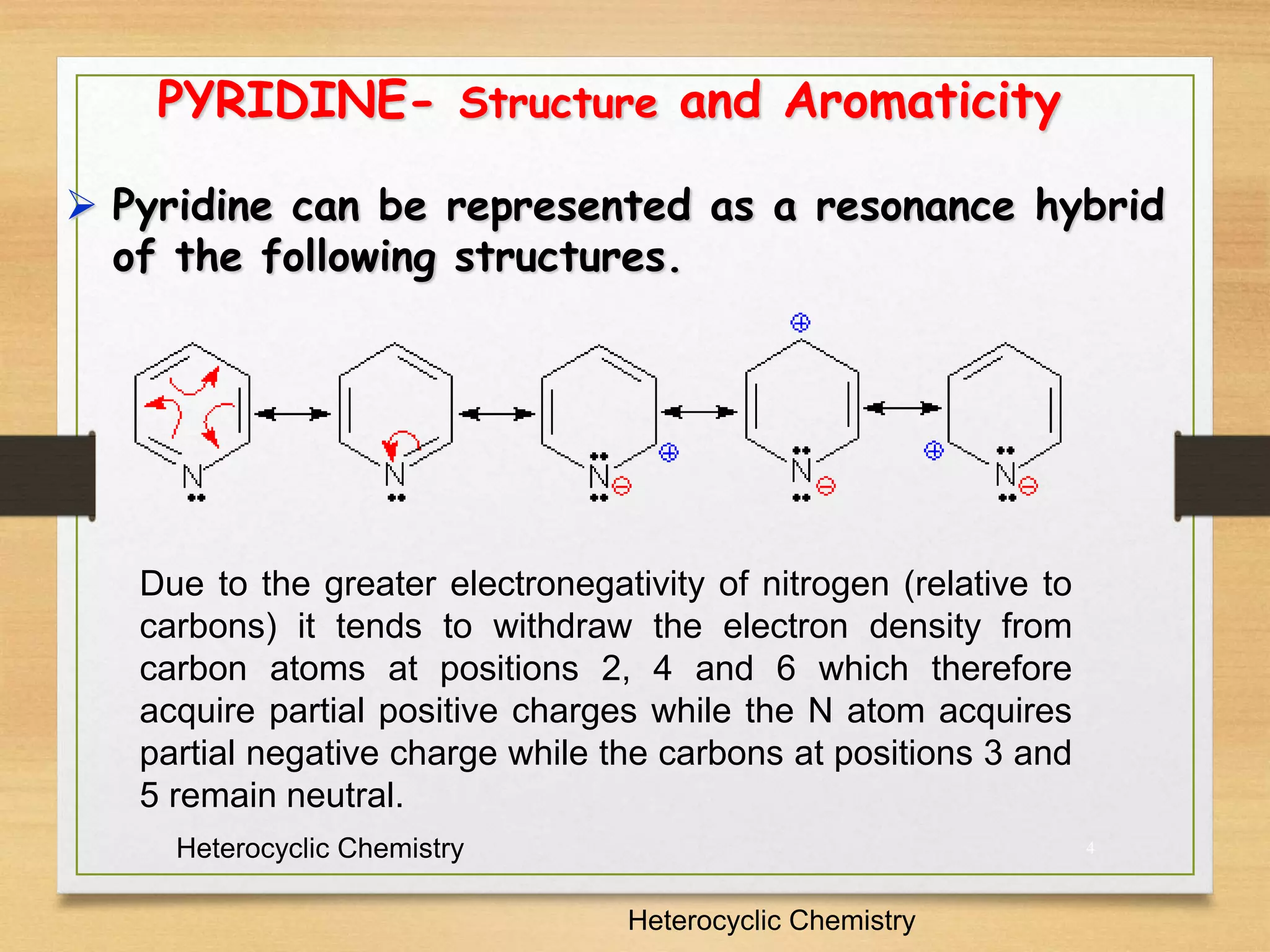
 Pyridine can be represented as a resonance hybrid
of the following structures.
PYRIDINE- Structure and Aromaticity
Due to the greater electronegativity of nitrogen (relative to
carbons) it tends to withdraw the electron density from
carbon atoms at positions 2, 4 and 6 which therefore
acquire partial positive charges while the N atom acquires
partial negative charge while the carbons at positions 3 and
5 remain neutral.
5
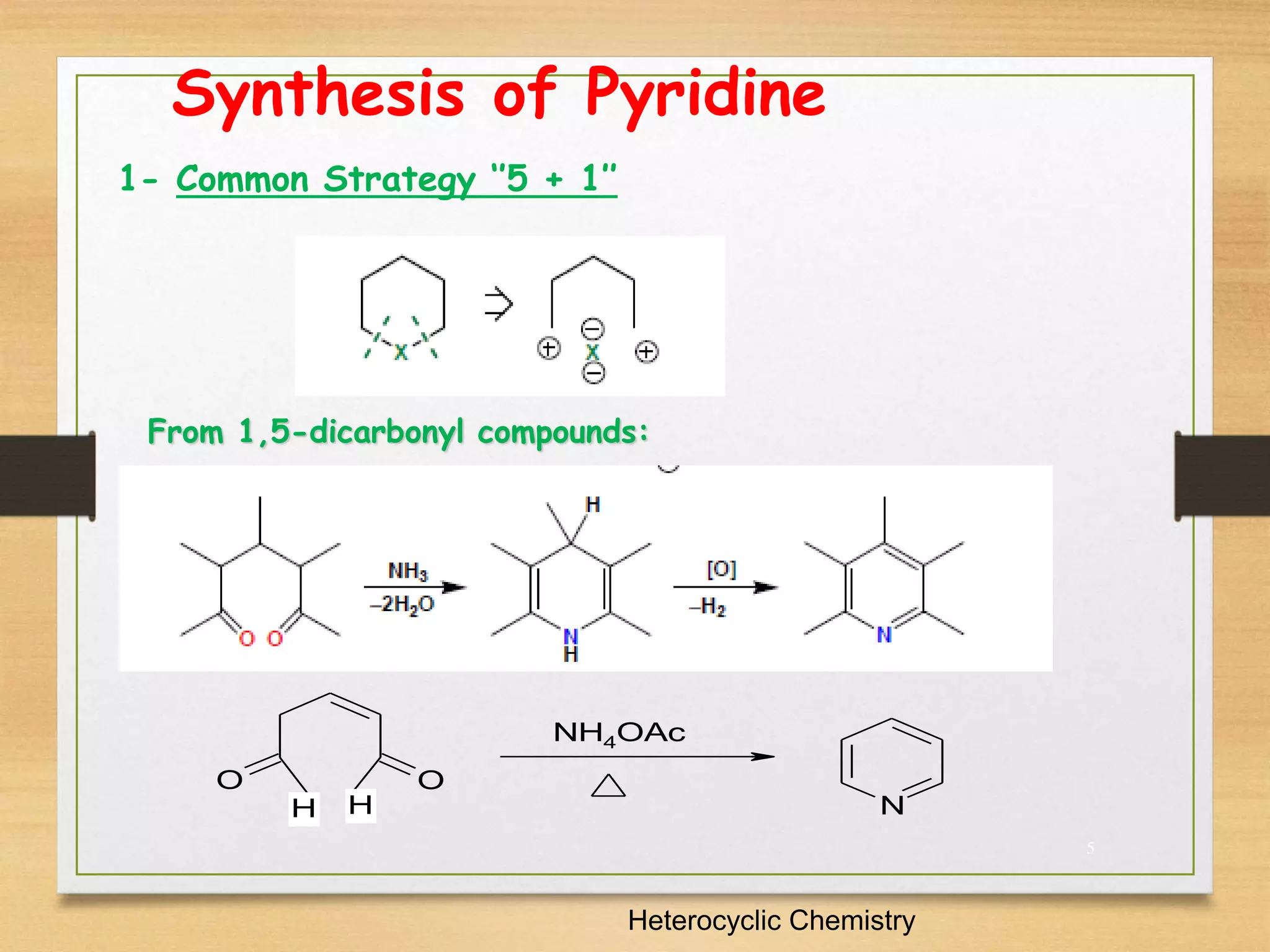
1- Common Strategy ‘’5 + 1’’
Heterocyclic Chemistry
Synthesis of Pyridine
From 1,5-dicarbonyl compounds:
O O
N
H H
NH4OAc
6
Heterocyclic Chemistry
2- Bönnemann cyclization:
Synthesis of Pyridine
3- Hantzsch Synthesis:
O
OEt
O O
H H
OEt
O
O
+
+
N
H
EtO
O
OEt
O
HNO3
[O]
NH3
Ethylacetoacetate
-dicarbonyl cpd
dihydropyridine drivative 1) KOH
2) CaO, 
N
O O
N
EtO
O
OEt
O

N
CH
CH
+ N
HC +
CH
CH
red hot tube
N
H
+ CHCl3
KOH
N
Cl
Pyrrole
C
N
+
N
CN CN - H2
N
CN
300 C
°
1,3-butadiene
7
Synthesis of Pyridine
4- From pyrrole:
5- By Diels Alder reaction
Basicity of pyridine
Pyridine is a weak base; since lone pair is in an
sp2 hybrid orbital. Is the conjugate acid
aromatic?
It undergoes many reactions typical of amines such
as reaction with Bronsted acids such as chromic
acid and hydrobromic acid.
N N
H
Br
Br2
N
H
Br3
+ HBr
8
Pyridinium salt
Basicity of pyridine
Heterocyclic Chemistry 9
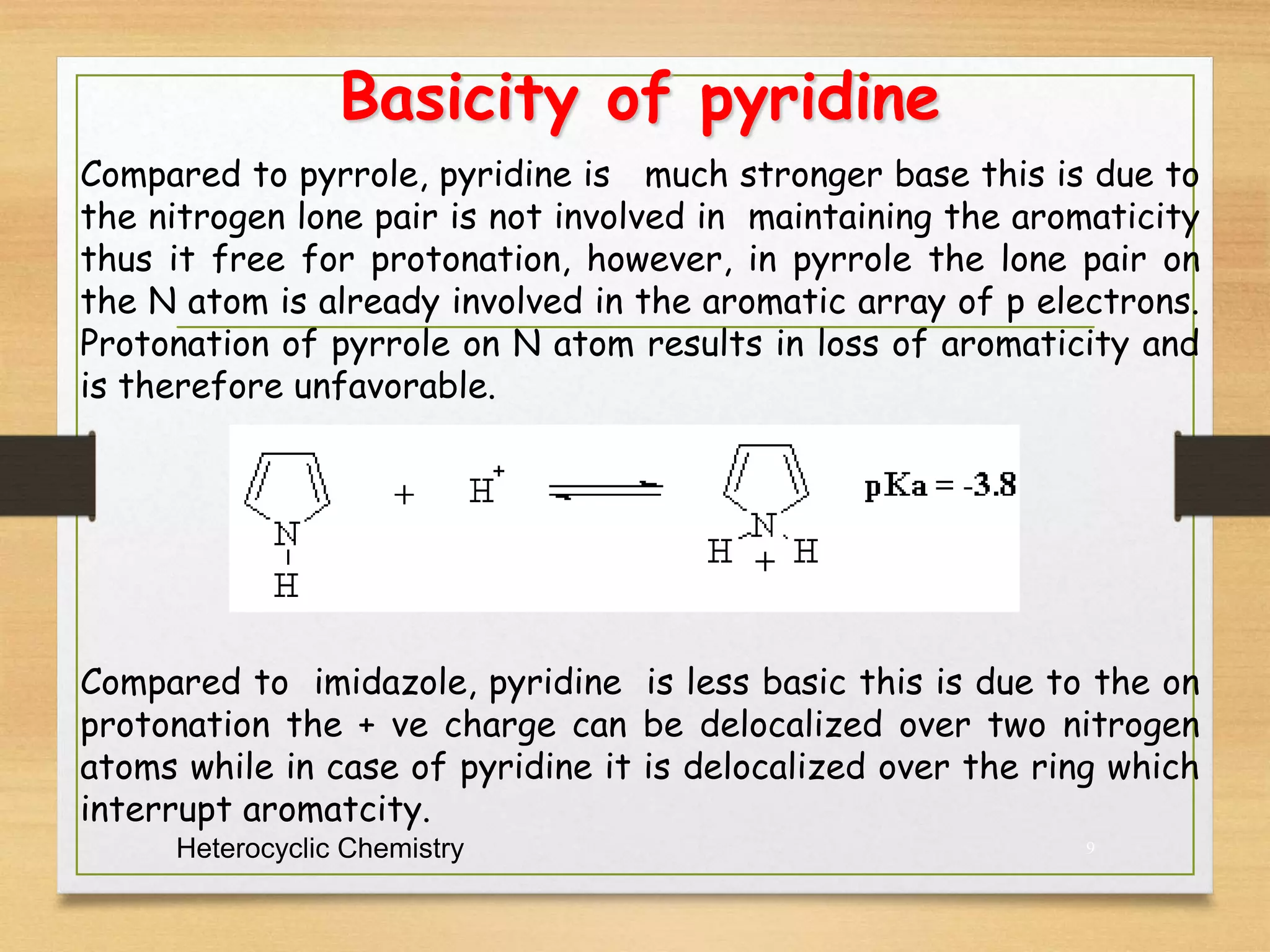
Compared to pyrrole, pyridine is much stronger base this is due to
the nitrogen lone pair is not involved in maintaining the aromaticity
thus it free for protonation, however, in pyrrole the lone pair on
the N atom is already involved in the aromatic array of p electrons.
Protonation of pyrrole on N atom results in loss of aromaticity and
is therefore unfavorable.
Compared to imidazole, pyridine is less basic this is due to the on
protonation the + ve charge can be delocalized over two nitrogen
atoms while in case of pyridine it is delocalized over the ring which
interrupt aromatcity.
Basicity of pyridine
N
N
H
N
H
N
H
N
> > >
Decreasing order of basicity
10
Compared to analogous aliphatic amines, pyridine is less basic this
is due to the nitrogen atom in pyridine is sp2 hybridized (more
electronegative) and the lone pair of electrons occupies an sp2
orbital thus it is held more tightly by the nucleus than the lone
pair of electron in aliphatic amines with sp3 hybrdized N atom and
the lone pair of electrons occupies an sp3 orbital (less
electronegative).
Chemical properties:
1-Electrophilic substitution
 the negative pole in pyridine ring is at N while the positive pole is
at carbon skeleton which is opposite to what happens in pyrrole.
 This is due to the greater electronegativity of nitrogen (relative
to carbons) it tends to withdraw the electron density from carbon
atoms at positions 2, 4 and 6 which therefore acquire partial
positive charges while the N atom acquires partial negative charge
and the carbons at positions 3 and 5 (β-position) remain neutral
therefore these positions are the most preferred for elctrophilic
attack.
N


11
Chemical properties:
1-Electrophilic substitution
 Also as a consequence of electron deficiency on pyridine ring ,
pyridine is less reactive towards electrophiles than pyrrole and
benzene (it resembles highly deactivated benzene derivatives),
where it does not undergo Friedel-Craft’s alkylation or acylation or
coupling with diazonium salts.
 Moreover, electrophilic substitution reactions of pyridine require
very harsh conditions (e.g. v. high temp.) to take place and are low
yielding .
12
2-Pyridine as a nucleophile (reactions on N
atom)
 As a tertiary amine pyridine has nucleophilic properties thus it
reacts with electrophiles:
N
HCl N
H Cl
+
-
Pyridinium chloride
CH3I
N
CH3 I
+
-
N-methyl pyridinium iodide
CH3COOOH
r.t.
N
O
Pyridine-N-oxide
13
3-Nucleophilic substitution on carbon
14
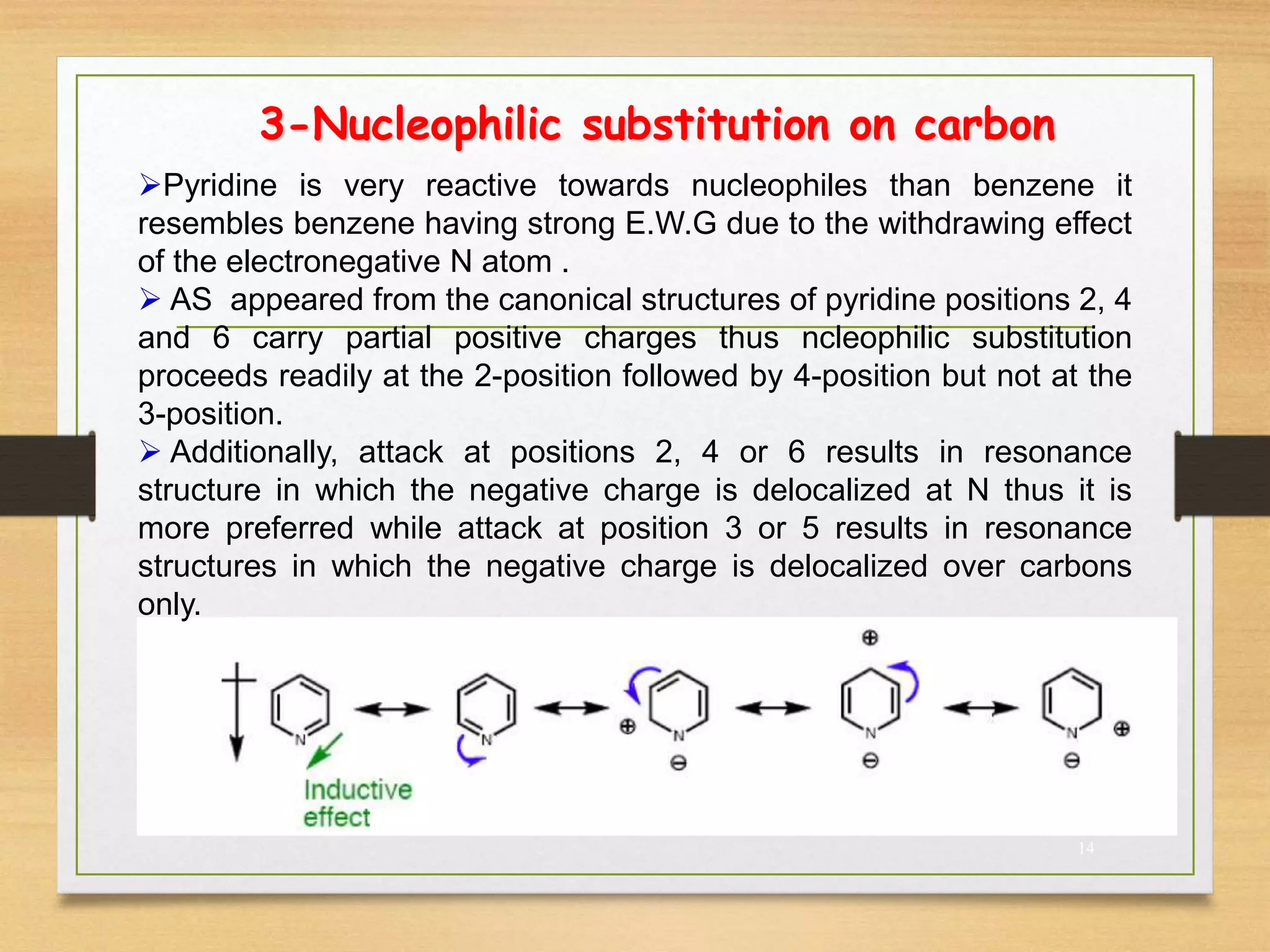
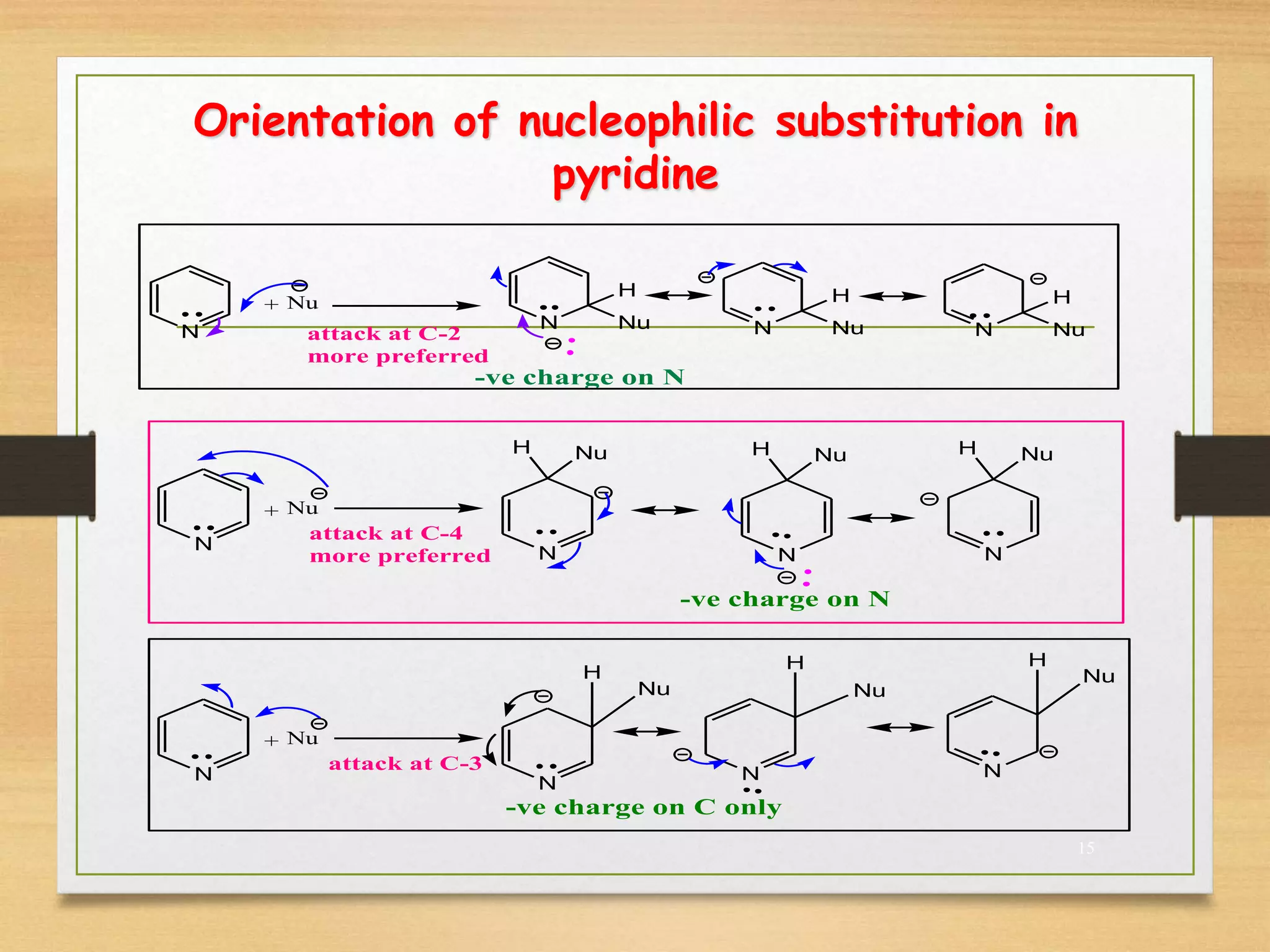
Pyridine is very reactive towards nucleophiles than benzene it
resembles benzene having strong E.W.G due to the withdrawing effect
of the electronegative N atom .
 AS appeared from the canonical structures of pyridine positions 2, 4
and 6 carry partial positive charges thus ncleophilic substitution
proceeds readily at the 2-position followed by 4-position but not at the
3-position.
 Additionally, attack at positions 2, 4 or 6 results in resonance
structure in which the negative charge is delocalized at N thus it is
more preferred while attack at position 3 or 5 results in resonance
structures in which the negative charge is delocalized over carbons
only.
Orientation of nucleophilic substitution in
pyridine
N
+ Nu
N Nu
H
N Nu
H
N Nu
H
attack at C-2
more preferred
-ve charge on N
N
N
Nu
H
N
Nu
H
N
Nu
H
attack at C-4
more preferred
+ Nu
-ve charge on N
N N
attack at C-3
+ Nu
Nu
H
N
Nu
H
N
Nu
H
-ve charge on C only
15
16
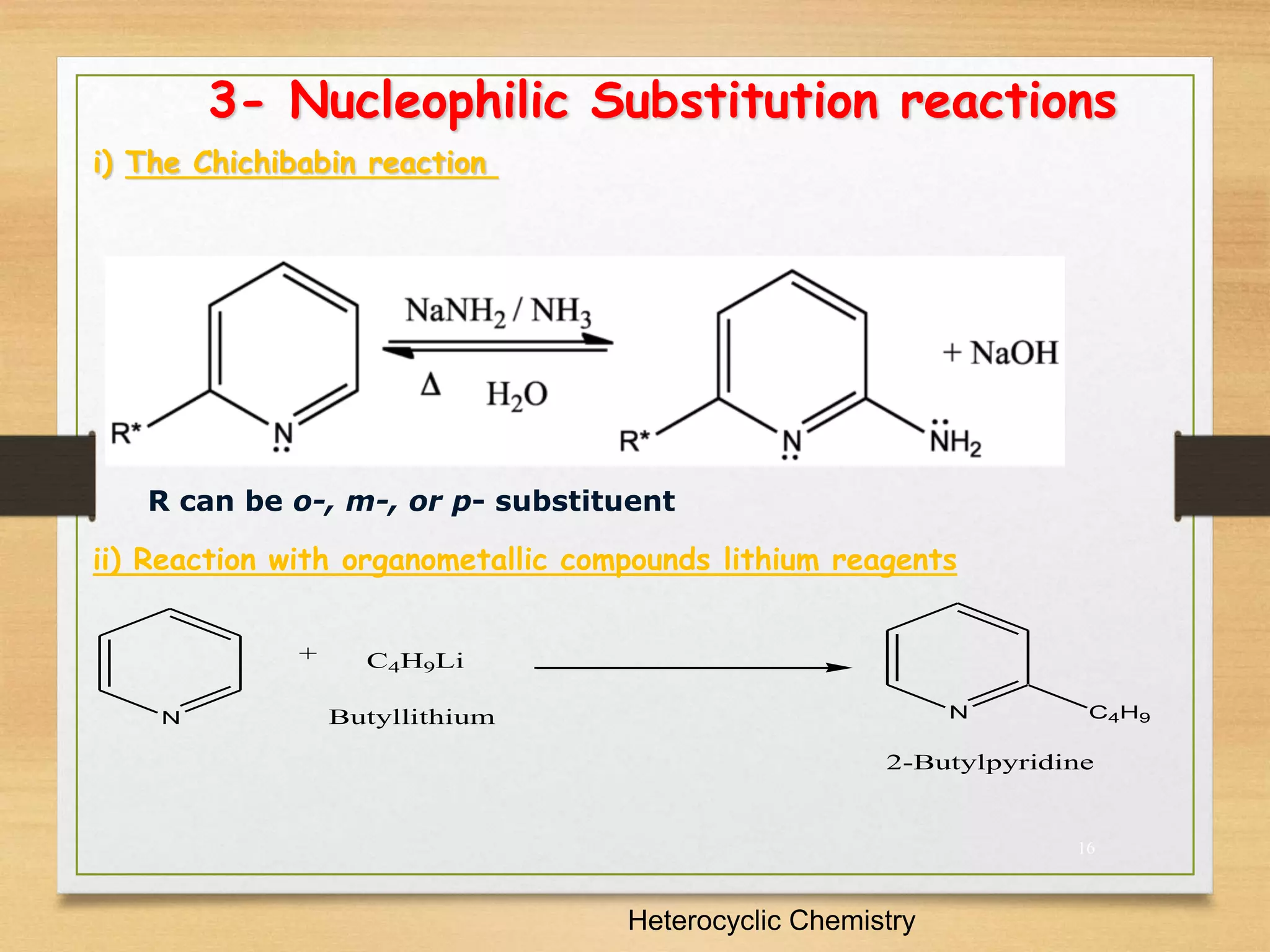
3- Nucleophilic Substitution reactions
i) The Chichibabin reaction
Heterocyclic Chemistry
R can be o-, m-, or p- substituent
ii) Reaction with organometallic compounds lithium reagents
N
C4H9Li
N C4H9
+
Butyllithium
2-Butylpyridine
3-Nucleophilic substitution Reactions
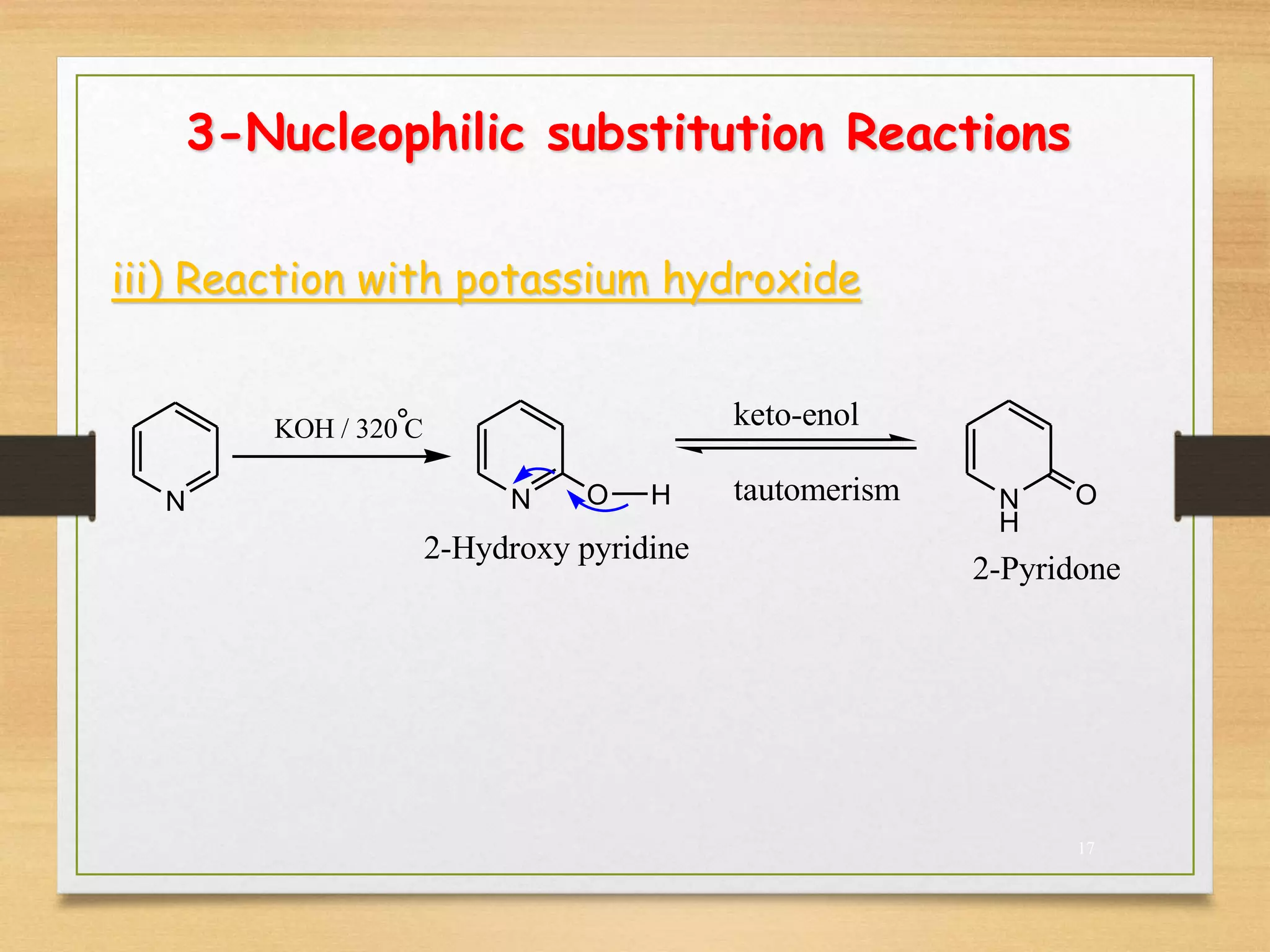
iii) Reaction with potassium hydroxide
N
KOH / 320 C
N O N
H
O
H
2-Pyridone
2-Hydroxy pyridine
° keto-enol
tautomerism
17
18
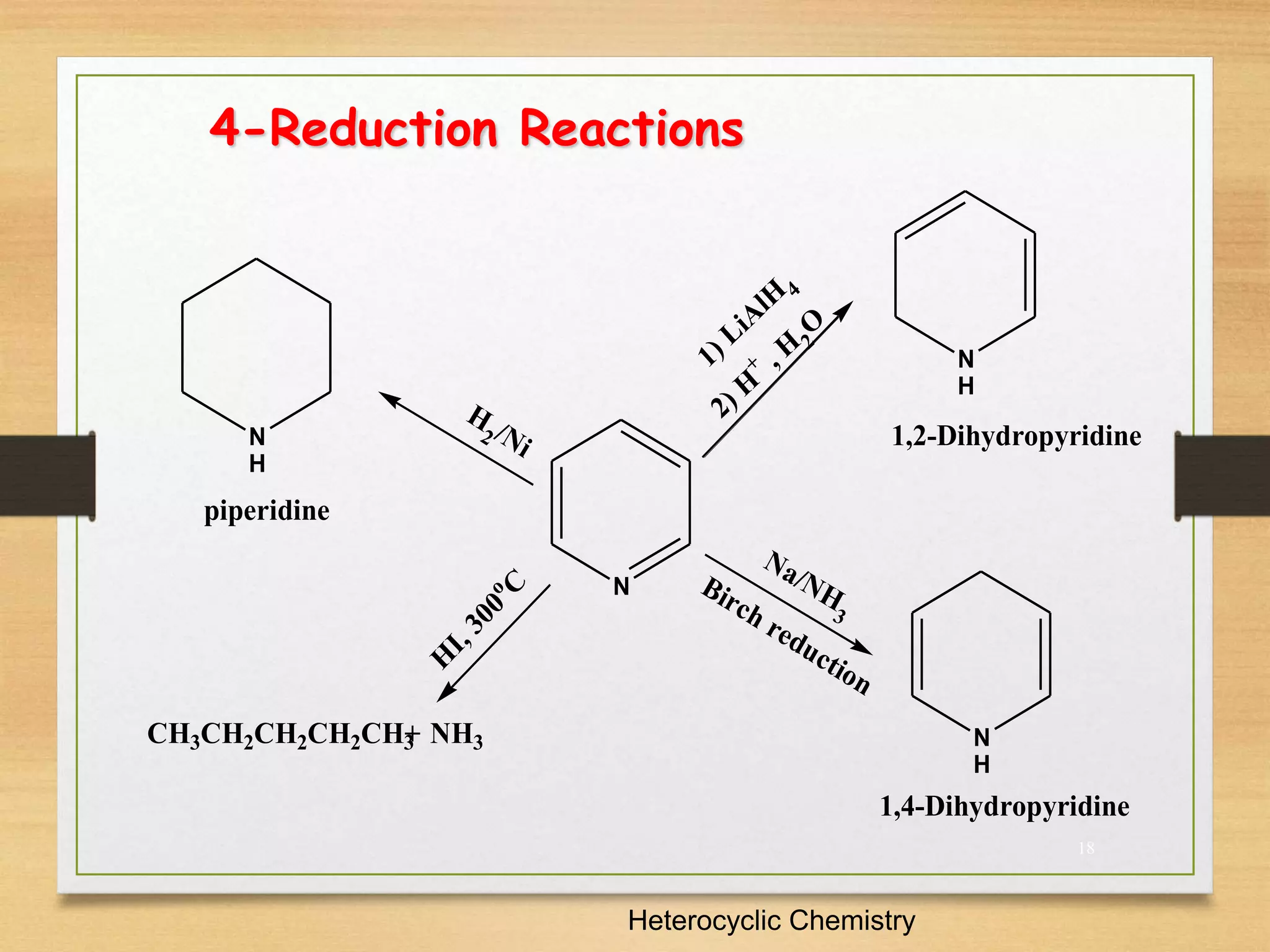
4-Reduction Reactions
Heterocyclic Chemistry
CH3CH2CH2CH2CH3 NH3
N
H
N
N
H
N
H
1) LiA
lH 4
2) H
+ , H 2
O
Na/NH
3
Birch reduction
H
2 /Ni
H
I
,
3
0
0
o
C
+
1,4-Dihydropyridine
1,2-Dihydropyridine
piperidine
Derivative of pyridine:
N-oxide pyridine
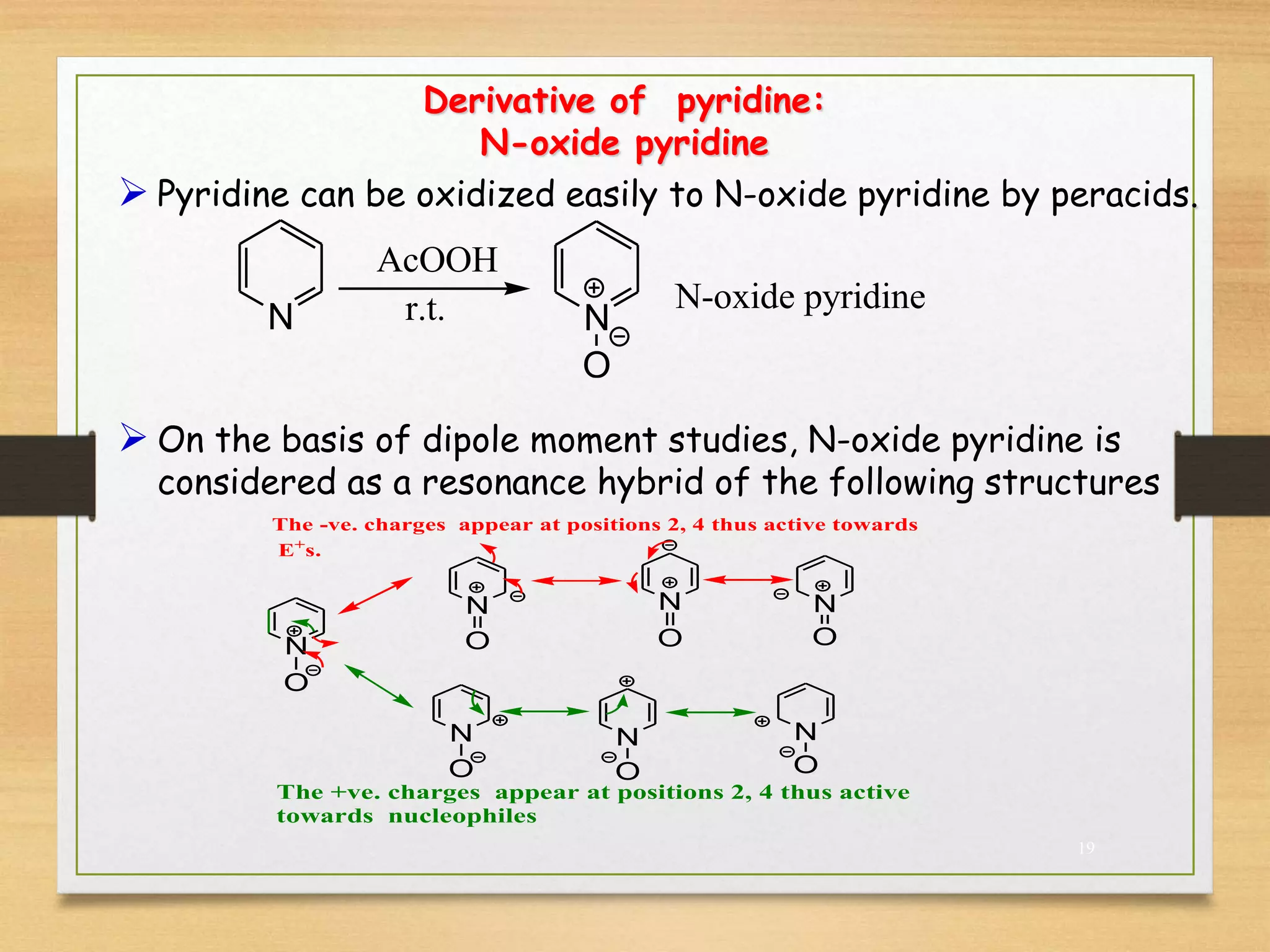
 Pyridine can be oxidized easily to N-oxide pyridine by peracids.
 On the basis of dipole moment studies, N-oxide pyridine is
considered as a resonance hybrid of the following structures
N N
O
AcOOH
r.t. N-oxide pyridine
N
O
N
O
N
O
N
O
N
O
N
O
The -ve. charges appear at positions 2, 4 thus active towards
E+
s.
The +ve. charges appear at positions 2, 4 thus active
towards nucleophiles
N
O
19
N-oxide pyridine
20
 As appears from the previous canonical forms , there are
positive and negative charges at positions 2 and 4 thus N-
oxide pyridine is more activated for electrophilic and
nucleophilic attack at these positions than pyridine itself.
 N-oxide pyridines are very important intermediates for
preparing pyridine derivatives that are difficult to prepare
due to the easiness of removal of oxygen atom by reduction.
 For instance, nitration of pyridine is very difficult and low
yielding reaction and it occurs at position 3, however using N-
oxide pyridine will direct the nitration to position 4 and then
the oxygen can be easily removed by reduction as shown in the
following scheme.
Reactions of N-oxide pyridine
N N
O
CH3CO OOH, r.t.
HNO3 / H2SO4
N
NO2
6 %
N
O
NO2
PCl3
N
NO2
H2 / Pd / H+
N
NH2
300 C°
HNO3
SOCl2
N
O
Cl
+
N
O
Cl
or H2O2
21
Heterocyclic Chemistry 22

heterocyclic compounds.ppt

  • 1.
  • 2.
    Heterocyclic Compounds • Aheterocyclic compound or ring structure is a cyclic compound that has atoms of at least two different elements as members of its ring(s). Heterocyclic chemistry is the branch of organic chemistry dealing with the synthesis, properties, and applications of these heterocycles. 2
  • 3.
    3 PYRIDINE- Structure andAromaticity  Pyridine is a six membered heterocyclic compound with molecular formula of C6H5N and it is obtained from coal tar.  It may be formally derived from the structure of benzene through the exchange of one ring carbon for a sp2 hybridized nitrogen.  Pyridine is an aromatic compound, however, the nitrogen’s lone pair of electrons is in an sp2 orbital orthogonal to the p orbitals of the ring, therefore it is not involved in maintaining aromaticity but it is available to react with protons thus pyridine is basic
  • 4.
    Heterocyclic Chemistry 4 HeterocyclicChemistry  Pyridine can be represented as a resonance hybrid of the following structures. PYRIDINE- Structure and Aromaticity Due to the greater electronegativity of nitrogen (relative to carbons) it tends to withdraw the electron density from carbon atoms at positions 2, 4 and 6 which therefore acquire partial positive charges while the N atom acquires partial negative charge while the carbons at positions 3 and 5 remain neutral.
  • 5.
    5 1- Common Strategy‘’5 + 1’’ Heterocyclic Chemistry Synthesis of Pyridine From 1,5-dicarbonyl compounds: O O N H H NH4OAc
  • 6.
    6 Heterocyclic Chemistry 2- Bönnemanncyclization: Synthesis of Pyridine 3- Hantzsch Synthesis: O OEt O O H H OEt O O + + N H EtO O OEt O HNO3 [O] NH3 Ethylacetoacetate -dicarbonyl cpd dihydropyridine drivative 1) KOH 2) CaO,  N O O N EtO O OEt O  N CH CH + N HC + CH CH red hot tube
  • 7.
    N H + CHCl3 KOH N Cl Pyrrole C N + N CN CN- H2 N CN 300 C ° 1,3-butadiene 7 Synthesis of Pyridine 4- From pyrrole: 5- By Diels Alder reaction
  • 8.
    Basicity of pyridine Pyridineis a weak base; since lone pair is in an sp2 hybrid orbital. Is the conjugate acid aromatic? It undergoes many reactions typical of amines such as reaction with Bronsted acids such as chromic acid and hydrobromic acid. N N H Br Br2 N H Br3 + HBr 8 Pyridinium salt
  • 9.
    Basicity of pyridine HeterocyclicChemistry 9 Compared to pyrrole, pyridine is much stronger base this is due to the nitrogen lone pair is not involved in maintaining the aromaticity thus it free for protonation, however, in pyrrole the lone pair on the N atom is already involved in the aromatic array of p electrons. Protonation of pyrrole on N atom results in loss of aromaticity and is therefore unfavorable. Compared to imidazole, pyridine is less basic this is due to the on protonation the + ve charge can be delocalized over two nitrogen atoms while in case of pyridine it is delocalized over the ring which interrupt aromatcity.
  • 10.
    Basicity of pyridine N N H N H N H N >> > Decreasing order of basicity 10 Compared to analogous aliphatic amines, pyridine is less basic this is due to the nitrogen atom in pyridine is sp2 hybridized (more electronegative) and the lone pair of electrons occupies an sp2 orbital thus it is held more tightly by the nucleus than the lone pair of electron in aliphatic amines with sp3 hybrdized N atom and the lone pair of electrons occupies an sp3 orbital (less electronegative).
  • 11.
    Chemical properties: 1-Electrophilic substitution the negative pole in pyridine ring is at N while the positive pole is at carbon skeleton which is opposite to what happens in pyrrole.  This is due to the greater electronegativity of nitrogen (relative to carbons) it tends to withdraw the electron density from carbon atoms at positions 2, 4 and 6 which therefore acquire partial positive charges while the N atom acquires partial negative charge and the carbons at positions 3 and 5 (β-position) remain neutral therefore these positions are the most preferred for elctrophilic attack. N   11
  • 12.
    Chemical properties: 1-Electrophilic substitution Also as a consequence of electron deficiency on pyridine ring , pyridine is less reactive towards electrophiles than pyrrole and benzene (it resembles highly deactivated benzene derivatives), where it does not undergo Friedel-Craft’s alkylation or acylation or coupling with diazonium salts.  Moreover, electrophilic substitution reactions of pyridine require very harsh conditions (e.g. v. high temp.) to take place and are low yielding . 12
  • 13.
    2-Pyridine as anucleophile (reactions on N atom)  As a tertiary amine pyridine has nucleophilic properties thus it reacts with electrophiles: N HCl N H Cl + - Pyridinium chloride CH3I N CH3 I + - N-methyl pyridinium iodide CH3COOOH r.t. N O Pyridine-N-oxide 13
  • 14.
    3-Nucleophilic substitution oncarbon 14 Pyridine is very reactive towards nucleophiles than benzene it resembles benzene having strong E.W.G due to the withdrawing effect of the electronegative N atom .  AS appeared from the canonical structures of pyridine positions 2, 4 and 6 carry partial positive charges thus ncleophilic substitution proceeds readily at the 2-position followed by 4-position but not at the 3-position.  Additionally, attack at positions 2, 4 or 6 results in resonance structure in which the negative charge is delocalized at N thus it is more preferred while attack at position 3 or 5 results in resonance structures in which the negative charge is delocalized over carbons only.
  • 15.
    Orientation of nucleophilicsubstitution in pyridine N + Nu N Nu H N Nu H N Nu H attack at C-2 more preferred -ve charge on N N N Nu H N Nu H N Nu H attack at C-4 more preferred + Nu -ve charge on N N N attack at C-3 + Nu Nu H N Nu H N Nu H -ve charge on C only 15
  • 16.
    16 3- Nucleophilic Substitutionreactions i) The Chichibabin reaction Heterocyclic Chemistry R can be o-, m-, or p- substituent ii) Reaction with organometallic compounds lithium reagents N C4H9Li N C4H9 + Butyllithium 2-Butylpyridine
  • 17.
    3-Nucleophilic substitution Reactions iii)Reaction with potassium hydroxide N KOH / 320 C N O N H O H 2-Pyridone 2-Hydroxy pyridine ° keto-enol tautomerism 17
  • 18.
    18 4-Reduction Reactions Heterocyclic Chemistry CH3CH2CH2CH2CH3NH3 N H N N H N H 1) LiA lH 4 2) H + , H 2 O Na/NH 3 Birch reduction H 2 /Ni H I , 3 0 0 o C + 1,4-Dihydropyridine 1,2-Dihydropyridine piperidine
  • 19.
    Derivative of pyridine: N-oxidepyridine  Pyridine can be oxidized easily to N-oxide pyridine by peracids.  On the basis of dipole moment studies, N-oxide pyridine is considered as a resonance hybrid of the following structures N N O AcOOH r.t. N-oxide pyridine N O N O N O N O N O N O The -ve. charges appear at positions 2, 4 thus active towards E+ s. The +ve. charges appear at positions 2, 4 thus active towards nucleophiles N O 19
  • 20.
    N-oxide pyridine 20  Asappears from the previous canonical forms , there are positive and negative charges at positions 2 and 4 thus N- oxide pyridine is more activated for electrophilic and nucleophilic attack at these positions than pyridine itself.  N-oxide pyridines are very important intermediates for preparing pyridine derivatives that are difficult to prepare due to the easiness of removal of oxygen atom by reduction.  For instance, nitration of pyridine is very difficult and low yielding reaction and it occurs at position 3, however using N- oxide pyridine will direct the nitration to position 4 and then the oxygen can be easily removed by reduction as shown in the following scheme.
  • 21.
    Reactions of N-oxidepyridine N N O CH3CO OOH, r.t. HNO3 / H2SO4 N NO2 6 % N O NO2 PCl3 N NO2 H2 / Pd / H+ N NH2 300 C° HNO3 SOCl2 N O Cl + N O Cl or H2O2 21
  • 22.