
PRODUCTION SCHEDULING Meenu S Babu
Production Scheduling Deals with multi-period planning. Linear programming could be used. Solution to this problem enables the managers to establish an  efficient low-cost production schedule  for one or more products  over  several time period . Production Scheduling Problem is recursive.
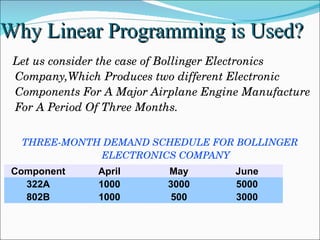
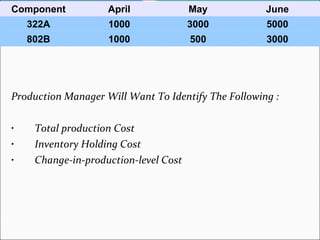
Why Linear Programming is Used? Let us consider the case of Bollinger Electronics Company,Which Produces two different Electronic Components For A Major Airplane Engine Manufacture For A Period Of Three Months. THREE-MONTH DEMAND SCHEDULE FOR BOLLINGER ELECTRONICS COMPANY Component April May June 322A 1000 3000 5000 802B 1000 500 3000
Production Manager Will Want To Identify The Following : Total production Cost Inventory Holding Cost Change-in-production-level Cost Component April May June 322A 1000 3000 5000 802B 1000 500 3000
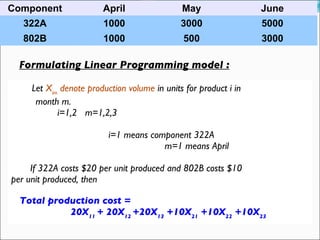
Formulating Linear Programming model : Let  X im  denote production volume  in units for product i in month m. i=1,2  m=1,2,3 i=1 means component 322A m=1 means April If 322A costs $20 per unit produced and 802B costs $10  per unit produced, then Total production cost =  20X 11  + 20X 12  +20X 13  +10X 21  +10X 22  +10X 23 Component April May June 322A 1000 3000 5000 802B 1000 500 3000
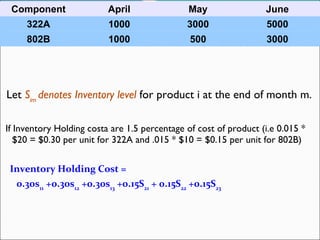
Let  S im  denotes Inventory level  for product i at the end of month m. If Inventory Holding costa are 1.5 percentage of cost of product (i.e 0.015 * $20 = $0.30 per unit for 322A and .015 * $10 = $0.15 per unit for 802B) Inventory Holding Cost = 0.30s 11  +0.30s 12  +0.30s 13  +0.15S 21  + 0.15S 22  +0.15S 23 Component April May June 322A 1000 3000 5000 802B 1000 500 3000
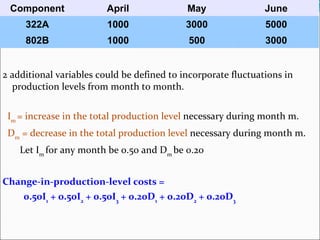
2 additional variables could be defined to incorporate fluctuations in production levels from month to month. I m  = increase in the total production level  necessary during month m. D m  = decrease in the total production level  necessary during month m. Let I m  for any month be 0.50 and D m  be 0.20  Change-in-production-level costs =  0.50I 1  + 0.50I 2  + 0.50I 3  + 0.20D 1  + 0.20D 2  + 0.20D 3 Component April May June 322A 1000 3000 5000 802B 1000 500 3000
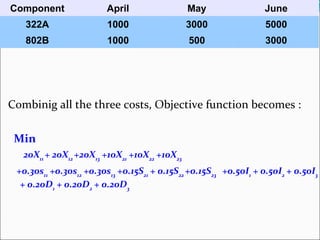
Combinig all the three costs, Objective function becomes : Min   20X 11  + 20X 12  +20X 13  +10X 21  +10X 22  +10X 23  +0.30s 11  +0.30s 12  +0.30s 13  +0.15S 21  + 0.15S 22  +0.15S 23  +0.50I 1  + 0.50I 2  + 0.50I 3  + 0.20D 1  + 0.20D 2  + 0.20D 3 Component April May June 322A 1000 3000 5000 802B 1000 500 3000
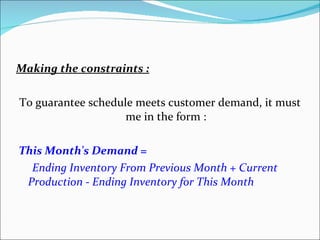
Making the constraints : To guarantee schedule meets customer demand, it must me in the form : This Month's Demand = Ending Inventory From Previous Month + Current Production - Ending Inventory for This Month
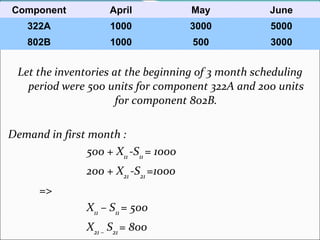
Let the inventories at the beginning of 3 month scheduling period were 500 units for component 322A and 200 units for component 802B. Demand in first month : 500 + X 11  -S 11  = 1000 200 + X 21  -S 21  =1000 =>  X 11  – S 11  = 500 X 21 –  S 21  = 800 Component April May June 322A 1000 3000 5000 802B 1000 500 3000
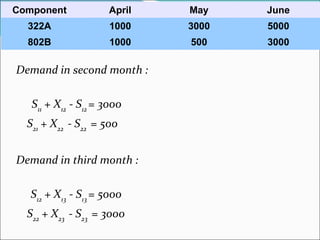
Demand in second month : S 11  + X 12  - S 12  = 3000 S 21  + X 22  - S 22  = 500 Demand in third month :   S 12  + X 13  - S 13  = 5000 S 22  + X 23  - S 23  = 3000 Component April May June 322A 1000 3000 5000 802B 1000 500 3000
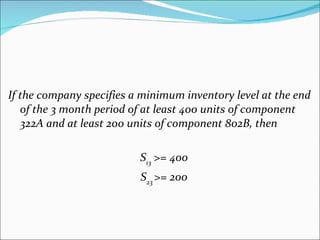
If the company specifies a minimum inventory level at the end of the 3 month period of at least 400 units of component 322A and at least 200 units of component 802B, then S 13  >= 400 S 23  >= 200
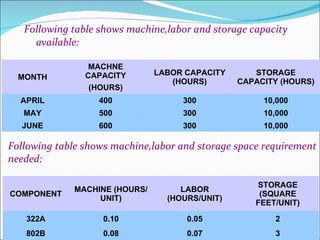
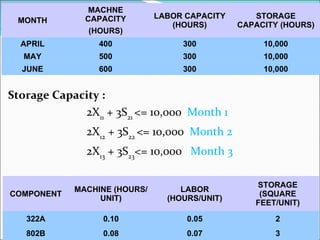
Following table shows machine,labor and storage capacity available: Following table shows machine,labor and storage space requirement needed: MONTH MACHNE CAPACITY (HOURS) LABOR CAPACITY (HOURS) STORAGE CAPACITY (HOURS) APRIL 400 300 10,000 MAY 500 300 10,000 JUNE 600 300 10,000 COMPONENT MACHINE (HOURS/UNIT) LABOR (HOURS/UNIT) STORAGE (SQUARE FEET/UNIT) 322A 0.10 0.05 2 802B 0.08 0.07 3
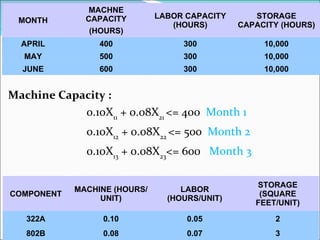
Machine Capacity : 0.10X 11  + 0.08X 21  <= 400  Month 1 0.10X 12  + 0.08X 22  <= 500  Month 2 0.10X 13  + 0.08X 23 <= 600  Month 3 MONTH MACHNE CAPACITY (HOURS) LABOR CAPACITY (HOURS) STORAGE CAPACITY (HOURS) APRIL 400 300 10,000 MAY 500 300 10,000 JUNE 600 300 10,000 COMPONENT MACHINE (HOURS/UNIT) LABOR (HOURS/UNIT) STORAGE (SQUARE FEET/UNIT) 322A 0.10 0.05 2 802B 0.08 0.07 3
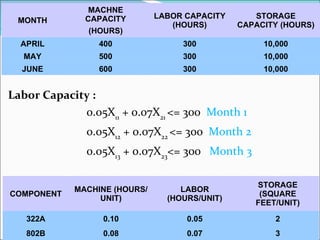
Labor Capacity : 0.05X 11  + 0.07X 21  <= 300  Month 1 0.05X 12  + 0.07X 22  <= 300  Month 2 0.05X 13  + 0.07X 23 <= 300  Month 3 MONTH MACHNE CAPACITY (HOURS) LABOR CAPACITY (HOURS) STORAGE CAPACITY (HOURS) APRIL 400 300 10,000 MAY 500 300 10,000 JUNE 600 300 10,000 COMPONENT MACHINE (HOURS/UNIT) LABOR (HOURS/UNIT) STORAGE (SQUARE FEET/UNIT) 322A 0.10 0.05 2 802B 0.08 0.07 3
Storage Capacity : 2X 11  + 3S 21  <= 10,000  Month 1 2X 12  + 3S 22  <= 10,000  Month 2 2X 13  + 3S 23 <= 10,000  Month 3 MONTH MACHNE CAPACITY (HOURS) LABOR CAPACITY (HOURS) STORAGE CAPACITY (HOURS) APRIL 400 300 10,000 MAY 500 300 10,000 JUNE 600 300 10,000 COMPONENT MACHINE (HOURS/UNIT) LABOR (HOURS/UNIT) STORAGE (SQUARE FEET/UNIT) 322A 0.10 0.05 2 802B 0.08 0.07 3
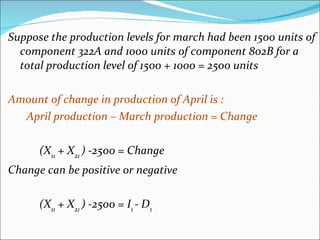
Suppose the production levels for march had been 1500 units of component 322A and 1000 units of component 802B for a total production level of 1500 + 1000 = 2500 units Amount of change in production of April is :   April production – March production = Change (X 11  + X 21  ) -2500 = Change Change can be positive or negative (X 11  + X 21  ) -2500 = I 1  - D 1
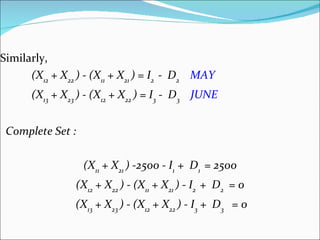
Similarly, (X 12  + X 22  ) - (X 11  + X 21  ) = I 2  -  D 2   MAY (X 13  + X 23  ) - (X 12  + X 22  ) = I 3  -  D 3   JUNE Complete Set : (X 11  + X 21  ) -2500 - I 1  +  D 1  = 2500 (X 12  + X 22  ) - (X 11  + X 21  ) - I 2  +  D 2   = 0 (X 13  + X 23  ) - (X 12  + X 22  ) - I 3  +  D 3   = 0
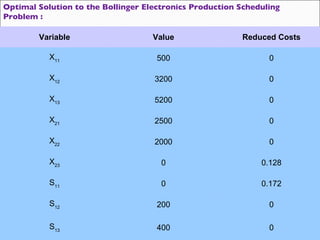
Optimal Solution to the Bollinger Electronics Production Scheduling Problem : Variable Value Reduced Costs X 11 500 0 X 12 3200 0 X 13 5200 0 X 21 2500 0 X 22 2000 0 X 23 0 0.128 S 11 0 0.172 S 12 200 0 S 13 400 0
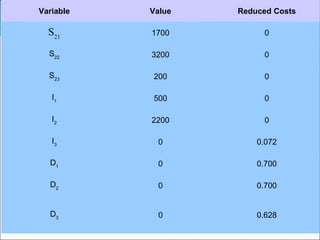
Variable Value Reduced Costs S 21 1700 0 S 22 3200 0 S 23 200 0 I 1 500 0 I 2 2200 0 I 3 0 0.072 D 1 0 0.700 D 2 0 0.700 D 3 0 0.628
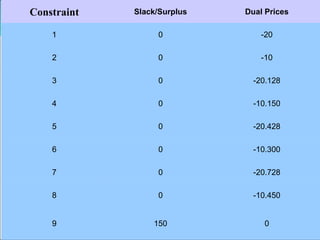
Constraint Slack/Surplus Dual Prices 1 0 -20 2 0 -10 3 0 -20.128 4 0 -10.150 5 0 -20.428 6 0 -10.300 7 0 -20.728 8 0 -10.450 9 150 0
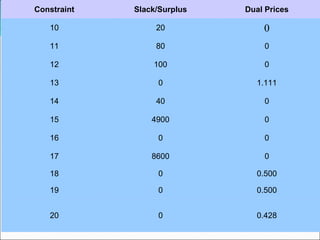
Constraint Slack/Surplus Dual Prices 10 20 0 11 80 0 12 100 0 13 0 1.111 14 40 0 15 4900 0 16 0 0 17 8600 0 18 0 0.500 19 0 0.500 20 0 0.428
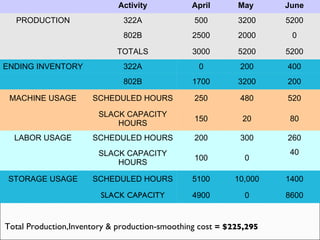
Total Production,Inventory & production-smoothing cost  = $225,295 Activity April May  June PRODUCTION 322A 500 3200 5200 802B 2500 2000 0 TOTALS 3000 5200 5200 ENDING INVENTORY 322A 0 200 400 802B 1700 3200 200 MACHINE USAGE SCHEDULED HOURS 250 480 520 SLACK CAPACITY HOURS 150 20 80 LABOR USAGE SCHEDULED HOURS 200 300 260 SLACK CAPACITY HOURS 100 0 40 STORAGE USAGE SCHEDULED HOURS 5100 10,000 1400 SLACK CAPACITY 4900 0 8600
Conclusion 2 product,3 month scheduling problem developed into 18-variable, 20-constraints LPP. Here we were considered only 1 type of machine process, 1 type of labor and 1 type of storage area. In large production system,variables and constraints difficult to track manually. Linear Programming Models can provide significant advantage in developing cost saving production schedules.
 

Production scheduling

  • 1.
  • 2.
    Production Scheduling Dealswith multi-period planning. Linear programming could be used. Solution to this problem enables the managers to establish an efficient low-cost production schedule for one or more products over several time period . Production Scheduling Problem is recursive.
  • 3.
    Why Linear Programmingis Used? Let us consider the case of Bollinger Electronics Company,Which Produces two different Electronic Components For A Major Airplane Engine Manufacture For A Period Of Three Months. THREE-MONTH DEMAND SCHEDULE FOR BOLLINGER ELECTRONICS COMPANY Component April May June 322A 1000 3000 5000 802B 1000 500 3000
  • 4.
    Production Manager WillWant To Identify The Following : Total production Cost Inventory Holding Cost Change-in-production-level Cost Component April May June 322A 1000 3000 5000 802B 1000 500 3000
  • 5.
    Formulating Linear Programmingmodel : Let X im denote production volume in units for product i in month m. i=1,2 m=1,2,3 i=1 means component 322A m=1 means April If 322A costs $20 per unit produced and 802B costs $10 per unit produced, then Total production cost = 20X 11 + 20X 12 +20X 13 +10X 21 +10X 22 +10X 23 Component April May June 322A 1000 3000 5000 802B 1000 500 3000
  • 6.
    Let Sim denotes Inventory level for product i at the end of month m. If Inventory Holding costa are 1.5 percentage of cost of product (i.e 0.015 * $20 = $0.30 per unit for 322A and .015 * $10 = $0.15 per unit for 802B) Inventory Holding Cost = 0.30s 11 +0.30s 12 +0.30s 13 +0.15S 21 + 0.15S 22 +0.15S 23 Component April May June 322A 1000 3000 5000 802B 1000 500 3000
  • 7.
    2 additional variablescould be defined to incorporate fluctuations in production levels from month to month. I m = increase in the total production level necessary during month m. D m = decrease in the total production level necessary during month m. Let I m for any month be 0.50 and D m be 0.20 Change-in-production-level costs = 0.50I 1 + 0.50I 2 + 0.50I 3 + 0.20D 1 + 0.20D 2 + 0.20D 3 Component April May June 322A 1000 3000 5000 802B 1000 500 3000
  • 8.
    Combinig all thethree costs, Objective function becomes : Min 20X 11 + 20X 12 +20X 13 +10X 21 +10X 22 +10X 23 +0.30s 11 +0.30s 12 +0.30s 13 +0.15S 21 + 0.15S 22 +0.15S 23 +0.50I 1 + 0.50I 2 + 0.50I 3 + 0.20D 1 + 0.20D 2 + 0.20D 3 Component April May June 322A 1000 3000 5000 802B 1000 500 3000
  • 9.
    Making the constraints: To guarantee schedule meets customer demand, it must me in the form : This Month's Demand = Ending Inventory From Previous Month + Current Production - Ending Inventory for This Month
  • 10.
    Let the inventoriesat the beginning of 3 month scheduling period were 500 units for component 322A and 200 units for component 802B. Demand in first month : 500 + X 11 -S 11 = 1000 200 + X 21 -S 21 =1000 => X 11 – S 11 = 500 X 21 – S 21 = 800 Component April May June 322A 1000 3000 5000 802B 1000 500 3000
  • 11.
    Demand in secondmonth : S 11 + X 12 - S 12 = 3000 S 21 + X 22 - S 22 = 500 Demand in third month : S 12 + X 13 - S 13 = 5000 S 22 + X 23 - S 23 = 3000 Component April May June 322A 1000 3000 5000 802B 1000 500 3000
  • 12.
    If the companyspecifies a minimum inventory level at the end of the 3 month period of at least 400 units of component 322A and at least 200 units of component 802B, then S 13 >= 400 S 23 >= 200
  • 13.
    Following table showsmachine,labor and storage capacity available: Following table shows machine,labor and storage space requirement needed: MONTH MACHNE CAPACITY (HOURS) LABOR CAPACITY (HOURS) STORAGE CAPACITY (HOURS) APRIL 400 300 10,000 MAY 500 300 10,000 JUNE 600 300 10,000 COMPONENT MACHINE (HOURS/UNIT) LABOR (HOURS/UNIT) STORAGE (SQUARE FEET/UNIT) 322A 0.10 0.05 2 802B 0.08 0.07 3
  • 14.
    Machine Capacity :0.10X 11 + 0.08X 21 <= 400 Month 1 0.10X 12 + 0.08X 22 <= 500 Month 2 0.10X 13 + 0.08X 23 <= 600 Month 3 MONTH MACHNE CAPACITY (HOURS) LABOR CAPACITY (HOURS) STORAGE CAPACITY (HOURS) APRIL 400 300 10,000 MAY 500 300 10,000 JUNE 600 300 10,000 COMPONENT MACHINE (HOURS/UNIT) LABOR (HOURS/UNIT) STORAGE (SQUARE FEET/UNIT) 322A 0.10 0.05 2 802B 0.08 0.07 3
  • 15.
    Labor Capacity :0.05X 11 + 0.07X 21 <= 300 Month 1 0.05X 12 + 0.07X 22 <= 300 Month 2 0.05X 13 + 0.07X 23 <= 300 Month 3 MONTH MACHNE CAPACITY (HOURS) LABOR CAPACITY (HOURS) STORAGE CAPACITY (HOURS) APRIL 400 300 10,000 MAY 500 300 10,000 JUNE 600 300 10,000 COMPONENT MACHINE (HOURS/UNIT) LABOR (HOURS/UNIT) STORAGE (SQUARE FEET/UNIT) 322A 0.10 0.05 2 802B 0.08 0.07 3
  • 16.
    Storage Capacity :2X 11 + 3S 21 <= 10,000 Month 1 2X 12 + 3S 22 <= 10,000 Month 2 2X 13 + 3S 23 <= 10,000 Month 3 MONTH MACHNE CAPACITY (HOURS) LABOR CAPACITY (HOURS) STORAGE CAPACITY (HOURS) APRIL 400 300 10,000 MAY 500 300 10,000 JUNE 600 300 10,000 COMPONENT MACHINE (HOURS/UNIT) LABOR (HOURS/UNIT) STORAGE (SQUARE FEET/UNIT) 322A 0.10 0.05 2 802B 0.08 0.07 3
  • 17.
    Suppose the productionlevels for march had been 1500 units of component 322A and 1000 units of component 802B for a total production level of 1500 + 1000 = 2500 units Amount of change in production of April is : April production – March production = Change (X 11 + X 21 ) -2500 = Change Change can be positive or negative (X 11 + X 21 ) -2500 = I 1 - D 1
  • 18.
    Similarly, (X 12 + X 22 ) - (X 11 + X 21 ) = I 2 - D 2 MAY (X 13 + X 23 ) - (X 12 + X 22 ) = I 3 - D 3 JUNE Complete Set : (X 11 + X 21 ) -2500 - I 1 + D 1 = 2500 (X 12 + X 22 ) - (X 11 + X 21 ) - I 2 + D 2 = 0 (X 13 + X 23 ) - (X 12 + X 22 ) - I 3 + D 3 = 0
  • 19.
    Optimal Solution tothe Bollinger Electronics Production Scheduling Problem : Variable Value Reduced Costs X 11 500 0 X 12 3200 0 X 13 5200 0 X 21 2500 0 X 22 2000 0 X 23 0 0.128 S 11 0 0.172 S 12 200 0 S 13 400 0
  • 20.
    Variable Value ReducedCosts S 21 1700 0 S 22 3200 0 S 23 200 0 I 1 500 0 I 2 2200 0 I 3 0 0.072 D 1 0 0.700 D 2 0 0.700 D 3 0 0.628
  • 21.
    Constraint Slack/Surplus DualPrices 1 0 -20 2 0 -10 3 0 -20.128 4 0 -10.150 5 0 -20.428 6 0 -10.300 7 0 -20.728 8 0 -10.450 9 150 0
  • 22.
    Constraint Slack/Surplus DualPrices 10 20 0 11 80 0 12 100 0 13 0 1.111 14 40 0 15 4900 0 16 0 0 17 8600 0 18 0 0.500 19 0 0.500 20 0 0.428
  • 23.
    Total Production,Inventory &production-smoothing cost = $225,295 Activity April May June PRODUCTION 322A 500 3200 5200 802B 2500 2000 0 TOTALS 3000 5200 5200 ENDING INVENTORY 322A 0 200 400 802B 1700 3200 200 MACHINE USAGE SCHEDULED HOURS 250 480 520 SLACK CAPACITY HOURS 150 20 80 LABOR USAGE SCHEDULED HOURS 200 300 260 SLACK CAPACITY HOURS 100 0 40 STORAGE USAGE SCHEDULED HOURS 5100 10,000 1400 SLACK CAPACITY 4900 0 8600
  • 24.
    Conclusion 2 product,3month scheduling problem developed into 18-variable, 20-constraints LPP. Here we were considered only 1 type of machine process, 1 type of labor and 1 type of storage area. In large production system,variables and constraints difficult to track manually. Linear Programming Models can provide significant advantage in developing cost saving production schedules.
  • 25.