CONVENTIONAL ROUTES OF
STRAIN IMPROVEMENT
COURSE TITLE :
MICROBIAL
BIOTECHNOLOGY
COURSE
CODE :
MBIO 407
SUBMITTED BY:
182001031- MST IKTARA JANNAT
182005031- AL AMIN HOSSAIN
182006031- RAMISAANJUM
182007031- MD SHAMIM HOSSAIN
161008031- MST MOUSUMI AKTER
SUBMITTED TO:
MD ABU ZIHAD
ASSISTANT PROFESSOR
MICROBIOLOGY DEPARTMENT
PRIMEASIA UNIVERSITY
STRAIN
 Strain is a genetic variant or sub-type of
a microorganism.
 A Strain is a group of species with one/
more characteristics that distinguish it
from other sub groups of the same species
of the strain.
 Each strain is identified by a name,
number or letter.
 Example:- E.coli Strain K12.
IDEAL CHARACTERISTCS OF STRAIN
Rapid growth
Genetic stability
Non-toxicity to humans
Ability to use cheaper
substrates
Elimination of the
production of
compounds that may
interfere with
downstream processing
To improve the use of
carbon and nitrogen
sources.
The Science and
Technology of manipulating
and improving microbial
strains in order to enhance
their metabolic capacities is
known as Strain
Improvement.
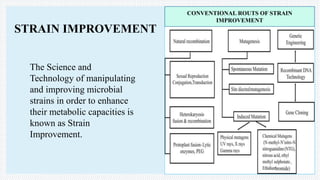
STRAIN IMPROVEMENT
CONVENTIONAL ROUTS OF STRAIN
IMPROVEMENT
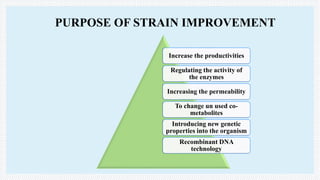
Increase the productivities
Regulating the activity of
the enzymes
Increasing the permeability
To change un used co-
metabolites
Introducing new genetic
properties into the organism
Recombinant DNA
technology
PURPOSE OF STRAIN IMPROVEMENT
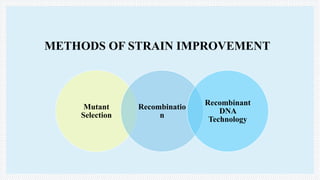
Mutant
Selection
Recombinatio
n
Recombinant
DNA
Technology
METHODS OF STRAIN IMPROVEMENT
TWO TYPES OF MUTATION
MUTATION
 Any change that occurs in the DNA of a gene is referred
as mutation.
 Thus, mutations result in a structural change in the
genome.
1.The spontaneous mutations occur at a low frequency,
and usually are not suitable for industrial purposes.
2. The induced mutations by mutagenic agents are very
suitable for industrial purposes.
*Site-directed mutagenesis is also important for strain
improvement.
MUTATION
SITE DIRECTED MUTAGENESIS
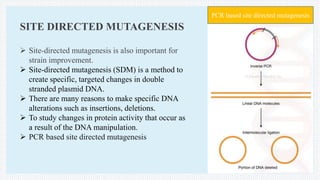
 Site-directed mutagenesis is also important for
strain improvement.
 Site-directed mutagenesis (SDM) is a method to
create specific, targeted changes in double
stranded plasmid DNA.
 There are many reasons to make specific DNA
alterations such as insertions, deletions.
 To study changes in protein activity that occur as
a result of the DNA manipulation.
 PCR based site directed mutagenesis
PCR based site directed mutagenesis
Selection of Mutants:
Selection and isolation of the appropriate mutant strains
developed is very important for their industrial use.
Random screening:
 The mutated strains are randomly selected and checked for
their ability to produce the desired industrial product.
 This can be done with model fermentation units.
 The strains with maximum yield can be selected.
 Random screening is costly and tedious procedure.
 But many a times, this is the only way to find the right strain
of mutants developed.
Selective isolation of mutants
1. Isolation of antibiotic
resistant strains:
 The mutated strains are grown on a
selective medium containing an antibiotic.
 The wild strains are killed while the
mutant strains with antibiotic resistance
can grow. Such strains may be useful in
industries.
Isolation of antimetabolite strains:
2. Isolation of antimetabolite
resistant strains:
 Antimetabolites which have structural
similarities with metabolites can block the
normal metabolic pathways and kill the
cells.
 The mutant strains resistant to
antimetabolites can be selected for
industrial purposes.
3. Isolation of auxotrophic
mutants:
An auxotrophic mutant is characterized by a
defect in one of the biosynthetic pathways.
As a result, it requires a specific compound
for its normal growth. For instance, tyr
mutants of Corynebacterium glutamicus
require tyrosine for their growth while they
can accumulate phenylalanine. The isolation
of such mutants can be done by growing
them on a complete agar medium that can
specifically support the biochemically
defective mutant.
3. Isolation of
auxotrophic mutants
Reports on strain improvement by mutation-
 • Karana and Medicherla (2006)- lipase from Aspergillus
japonicus MTCC 1975- mutation using UV, HNO2, NTG showed
127%, 177%, 276% higher lipase yield than parent strain
respectively.
 • First superior penicillin producing mutant, Penicillium
chrysogenum X-1612,was isolated after X ray mutagenesis.
RECOMBINATION
 Recombination as formation of new gene combinations among those present in different
strains.
 Recombination used for both genetic analysis as well as strain improvement
 And to generate new products.
Recombination based on:-
Transformation
When foreign DNA is absorbed by, and
integrates with the genome of the donor cell.
• Cells in which transformation can occur are
‘competent’ cells. • The method therefore has
good industrial potential.
Transformation of A. chrysogenum is a
common technique used in our strain
improvement programs. Therefore, the
availability of a new selection marker will
permit the re-transformation of recombinant
strains previously transformed with resistance
markers such as phleomycin or hygromycin.
Transduction
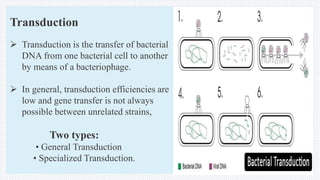
 Transduction is the transfer of bacterial
DNA from one bacterial cell to another
by means of a bacteriophage.
 In general, transduction efficiencies are
low and gene transfer is not always
possible between unrelated strains,
Two types:
• General Transduction
• Specialized Transduction.
CONJUGATION
 Conjugation involves cell to cell contact
or through sex pili and the transfer of
plasmids.
 Plasmids play an important role in the
formation of some industrial products,
including many antibiotics.
CONJUGATION
Protoplast Fusion
(Hybridization)
The fusion of two cells in tissue
culture.
The two different strains after
removal of cell wall are forced
to fuse using Polyethylene
Glycol (PEG).
The method has great industrial
potential and experimentally
has been used to achieve higher
yields of antibiotics through
fusion with protoplasts from
different fungi.
Protoplast Fusion
RECOMBINATION DNA
TECHNOLOGY
 Recombination DNA technology involves
the isolation and cloning of genes of interest,
production of the necessary gene constructs
using appropriate
enzymes and then transfer and expression of
these genes into an suitable host
organism.
This technique has been used to achieve 2 broad
objectives:
RECOMBINANT
PROTEINS
 These are the proteins
produced by the transferred
gene / transgene.
 They themselves are of
commercial value.
 Ex: Insulin, Interferons etc.
are produced in Bacteria.
RECOMBINANT PROTEINS
METABOLIC
ENGINEERING
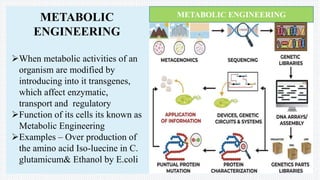
When metabolic activities of an
organism are modified by
introducing into it transgenes,
which affect enzymatic,
transport and regulatory
Function of its cells its known as
Metabolic Engineering
Examples – Over production of
the amino acid Iso-luecine in C.
glutamicum& Ethanol by E.coli
METABOLIC ENGINEERING
There are many advantages of genetic recombination:
1. By crossing high product yielding mutant strains with wild-type
strains, the fermentation process can be further increased.
2. Different mutant strains with high-yielding properties can be combined
by recombination.
3. There is gradual decline in the product yield after each stage of
mutation, due to undesirable mutations. This can be prevented by using
recombination.
APPLICATIONS
 Large scale Production of vaccines, Enzymes,
Interferon, growth factors, blood clotting
factors.
 In the field of Microbiology to improve the
microbe’s productivities or characteristics.
 Treatment of Genetic diseases like SCID by
rDNA technology.
 Production of medically useful biological
products like insulin.
CONCLUSION
 In recent years , recombinant DNA technology has also been
applied.
 The promise of the future is via extensive of new genetic
techniques-Metabolic engineering and Genomic shuffling.
 The choice of approaches which should be taken will be driven by
the economics of the biotechnological process and the genetic tools
available for the strain of interest.
REFERENCES : http://www.yourarticlelibrary.com/micro-biology/strain- improve Ament
https://www.researchgate.net/.../226497441_Strain_impro vement
https://www.jic.ac.uk/.../Marinelli%20Lecture%202%20pa rt%201.pdf
http://technologyinscience.blogspot.in/2012/08/strain- improvement-importance-of-pure.html#
http://www.cabri.org/guidelines/micro- organisms/M300.html A text book of Molecular Biology,
Genetic Engineering and Industrial Biotechnology by B.D Singh
THANK YOU

Strain improvement

  • 1.
    CONVENTIONAL ROUTES OF STRAINIMPROVEMENT COURSE TITLE : MICROBIAL BIOTECHNOLOGY COURSE CODE : MBIO 407 SUBMITTED BY: 182001031- MST IKTARA JANNAT 182005031- AL AMIN HOSSAIN 182006031- RAMISAANJUM 182007031- MD SHAMIM HOSSAIN 161008031- MST MOUSUMI AKTER SUBMITTED TO: MD ABU ZIHAD ASSISTANT PROFESSOR MICROBIOLOGY DEPARTMENT PRIMEASIA UNIVERSITY
  • 2.
    STRAIN  Strain isa genetic variant or sub-type of a microorganism.  A Strain is a group of species with one/ more characteristics that distinguish it from other sub groups of the same species of the strain.  Each strain is identified by a name, number or letter.  Example:- E.coli Strain K12.
  • 3.
    IDEAL CHARACTERISTCS OFSTRAIN Rapid growth Genetic stability Non-toxicity to humans Ability to use cheaper substrates Elimination of the production of compounds that may interfere with downstream processing To improve the use of carbon and nitrogen sources.
  • 4.
    The Science and Technologyof manipulating and improving microbial strains in order to enhance their metabolic capacities is known as Strain Improvement. STRAIN IMPROVEMENT CONVENTIONAL ROUTS OF STRAIN IMPROVEMENT
  • 5.
    Increase the productivities Regulatingthe activity of the enzymes Increasing the permeability To change un used co- metabolites Introducing new genetic properties into the organism Recombinant DNA technology PURPOSE OF STRAIN IMPROVEMENT
  • 6.
  • 7.
    TWO TYPES OFMUTATION MUTATION  Any change that occurs in the DNA of a gene is referred as mutation.  Thus, mutations result in a structural change in the genome. 1.The spontaneous mutations occur at a low frequency, and usually are not suitable for industrial purposes. 2. The induced mutations by mutagenic agents are very suitable for industrial purposes. *Site-directed mutagenesis is also important for strain improvement. MUTATION
  • 8.
    SITE DIRECTED MUTAGENESIS Site-directed mutagenesis is also important for strain improvement.  Site-directed mutagenesis (SDM) is a method to create specific, targeted changes in double stranded plasmid DNA.  There are many reasons to make specific DNA alterations such as insertions, deletions.  To study changes in protein activity that occur as a result of the DNA manipulation.  PCR based site directed mutagenesis PCR based site directed mutagenesis
  • 9.
    Selection of Mutants: Selectionand isolation of the appropriate mutant strains developed is very important for their industrial use. Random screening:  The mutated strains are randomly selected and checked for their ability to produce the desired industrial product.  This can be done with model fermentation units.  The strains with maximum yield can be selected.  Random screening is costly and tedious procedure.  But many a times, this is the only way to find the right strain of mutants developed.
  • 10.
    Selective isolation ofmutants 1. Isolation of antibiotic resistant strains:  The mutated strains are grown on a selective medium containing an antibiotic.  The wild strains are killed while the mutant strains with antibiotic resistance can grow. Such strains may be useful in industries.
  • 11.
    Isolation of antimetabolitestrains: 2. Isolation of antimetabolite resistant strains:  Antimetabolites which have structural similarities with metabolites can block the normal metabolic pathways and kill the cells.  The mutant strains resistant to antimetabolites can be selected for industrial purposes.
  • 12.
    3. Isolation ofauxotrophic mutants: An auxotrophic mutant is characterized by a defect in one of the biosynthetic pathways. As a result, it requires a specific compound for its normal growth. For instance, tyr mutants of Corynebacterium glutamicus require tyrosine for their growth while they can accumulate phenylalanine. The isolation of such mutants can be done by growing them on a complete agar medium that can specifically support the biochemically defective mutant. 3. Isolation of auxotrophic mutants
  • 13.
    Reports on strainimprovement by mutation-  • Karana and Medicherla (2006)- lipase from Aspergillus japonicus MTCC 1975- mutation using UV, HNO2, NTG showed 127%, 177%, 276% higher lipase yield than parent strain respectively.  • First superior penicillin producing mutant, Penicillium chrysogenum X-1612,was isolated after X ray mutagenesis.
  • 14.
    RECOMBINATION  Recombination asformation of new gene combinations among those present in different strains.  Recombination used for both genetic analysis as well as strain improvement  And to generate new products. Recombination based on:-
  • 15.
    Transformation When foreign DNAis absorbed by, and integrates with the genome of the donor cell. • Cells in which transformation can occur are ‘competent’ cells. • The method therefore has good industrial potential. Transformation of A. chrysogenum is a common technique used in our strain improvement programs. Therefore, the availability of a new selection marker will permit the re-transformation of recombinant strains previously transformed with resistance markers such as phleomycin or hygromycin.
  • 16.
    Transduction  Transduction isthe transfer of bacterial DNA from one bacterial cell to another by means of a bacteriophage.  In general, transduction efficiencies are low and gene transfer is not always possible between unrelated strains, Two types: • General Transduction • Specialized Transduction.
  • 17.
    CONJUGATION  Conjugation involvescell to cell contact or through sex pili and the transfer of plasmids.  Plasmids play an important role in the formation of some industrial products, including many antibiotics. CONJUGATION
  • 18.
    Protoplast Fusion (Hybridization) The fusionof two cells in tissue culture. The two different strains after removal of cell wall are forced to fuse using Polyethylene Glycol (PEG). The method has great industrial potential and experimentally has been used to achieve higher yields of antibiotics through fusion with protoplasts from different fungi. Protoplast Fusion
  • 19.
    RECOMBINATION DNA TECHNOLOGY  RecombinationDNA technology involves the isolation and cloning of genes of interest, production of the necessary gene constructs using appropriate enzymes and then transfer and expression of these genes into an suitable host organism. This technique has been used to achieve 2 broad objectives:
  • 20.
    RECOMBINANT PROTEINS  These arethe proteins produced by the transferred gene / transgene.  They themselves are of commercial value.  Ex: Insulin, Interferons etc. are produced in Bacteria. RECOMBINANT PROTEINS
  • 21.
    METABOLIC ENGINEERING When metabolic activitiesof an organism are modified by introducing into it transgenes, which affect enzymatic, transport and regulatory Function of its cells its known as Metabolic Engineering Examples – Over production of the amino acid Iso-luecine in C. glutamicum& Ethanol by E.coli METABOLIC ENGINEERING
  • 22.
    There are manyadvantages of genetic recombination: 1. By crossing high product yielding mutant strains with wild-type strains, the fermentation process can be further increased. 2. Different mutant strains with high-yielding properties can be combined by recombination. 3. There is gradual decline in the product yield after each stage of mutation, due to undesirable mutations. This can be prevented by using recombination.
  • 23.
    APPLICATIONS  Large scaleProduction of vaccines, Enzymes, Interferon, growth factors, blood clotting factors.  In the field of Microbiology to improve the microbe’s productivities or characteristics.  Treatment of Genetic diseases like SCID by rDNA technology.  Production of medically useful biological products like insulin.
  • 24.
    CONCLUSION  In recentyears , recombinant DNA technology has also been applied.  The promise of the future is via extensive of new genetic techniques-Metabolic engineering and Genomic shuffling.  The choice of approaches which should be taken will be driven by the economics of the biotechnological process and the genetic tools available for the strain of interest.
  • 25.
    REFERENCES : http://www.yourarticlelibrary.com/micro-biology/strain-improve Ament https://www.researchgate.net/.../226497441_Strain_impro vement https://www.jic.ac.uk/.../Marinelli%20Lecture%202%20pa rt%201.pdf http://technologyinscience.blogspot.in/2012/08/strain- improvement-importance-of-pure.html# http://www.cabri.org/guidelines/micro- organisms/M300.html A text book of Molecular Biology, Genetic Engineering and Industrial Biotechnology by B.D Singh THANK YOU