MARYUM ATIQUE
M.Sc Chemistry
University of
Agriculture, FSD
Protein purification is a series of processes
intended to isolate a single type of protein from
a complex mixture.
 Protein purification is vital for the
characterization of the function, structure and
interactions of the protein of interest.
 The starting material is usually a biological
tissue or a microbial culture.
 The various steps in the purification process may
free the protein from a matrix that confines
it, separate the protein and non-protein parts of
the mixture, and finally separate the desired
protein from all other proteins.

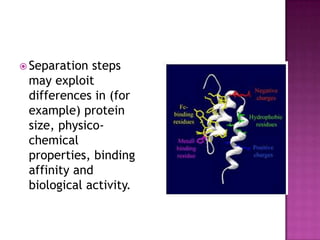
 Separation

steps
may exploit
differences in (for
example) protein
size, physicochemical
properties, binding
affinity and
biological activity.
 preparative

analytical
 Preparative purifications aim to produce a
relatively large quantity of purified proteins
for subsequent use. Examples include the
preparation of commercial products such as
enzymes (e.g. lactase)
 Analytical purification produces a relatively
small amount of a protein for a variety of
research or analytical purposes, including
identification, quantification

 An

analytical purification generally utilizes three
properties to separate proteins.
 First, proteins may be purified according to their
isoelectric points by running them through a pH graded
gel or an ion exchange column.
 Second, proteins can be separated according to their size
or molecular weight via size exclusion chromatography
or by SDS-PAGE (sodium dodecyl sulfate-polyacrylamide
gel electrophoresis) analysis
 Thirdly, proteins may be separated by
polarity/hydrophobicity via high performance liquid
chromatography or reversed-phase chromatography.
 Extraction
 Depending

on the source, the protein has to
be brought into solution by breaking the
tissue or cells containing it.
 There are several methods to achieve this:
 Repeated freezing and thawing,
 sonication,
 homogenization by high pressure,
 filtration, or permeabilization by organic
solvents.
In bulk protein purification, a common first step
to isolate proteins is precipitation with
ammonium sulfate (NH4)2SO4.
 This is performed by adding increasing amounts
of ammonium sulfate and collecting the
different fractions of precipitate protein.
Ammonium sulphate can be removed by dialysis.
 The hydrophobic groups on the proteins gets
exposed to the atmosphere and it attracts other
protein hydrophobic groups and gets aggregated.
Protein precipitated will be large enough to be
visible.
 One advantage of this method is that it can be
performed inexpensively with very large
volumes.

 Usually

a protein purification protocol
contains one or more chromatographic steps.
 The basic procedure in chromatography is to
flow the solution containing the protein
through a column packed with various
materials.
 Usually proteins are detected as they are
coming off the column by their absorbance
at 280 nm.
 Using

porous
matrix
 Based on different
sizes of proteins
 Anion

exchange
resins (positive
charge ) separate
negatively charged
compounds
 cation exchange
resins (negative
charge) separate
positively charged
molecules






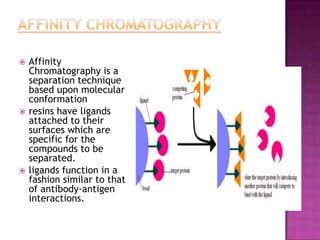
Affinity
Chromatography is a
separation technique
based upon molecular
conformation
resins have ligands
attached to their
surfaces which are
specific for the
compounds to be
separated.
ligands function in a
fashion similar to that
of antibody-antigen
interactions.


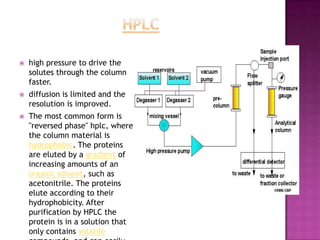
high pressure to drive the
solutes through the column
faster.



diffusion is limited and the
resolution is improved.



The most common form is
"reversed phase" hplc, where
the column material is
hydrophobic. The proteins
are eluted by a gradient of
increasing amounts of an
organic solvent, such as
acetonitrile. The proteins
elute according to their
hydrophobicity. After
purification by HPLC the
protein is in a solution that
only contains volatile






Resins used in the
column are amphiphiles
with both hydrophobic
and hydrophilic regions.
The hydrophobic part of
the resin attracts
hydrophobic region on
the proteins.
The greater the
hydrophobic region on
the protein the stronger
the attraction between
the gel and that
particular protein.


Gel electrophoresis is a common
laboratory technique that can be used
both as preparative and analytical
method.



The principle of electrophoresis relies on
the movement of a charged ion in an
electric field. In these conditions, the
proteins are unfolded and coated with
negatively charged detergent molecules.
The proteins in SDS-PAGE are separated on
the sole basis of their size.



In analytical methods, the protein
migrates as bands based on size. Each
band can be detected using stains such as
Coomassie blue dye or silver stain.
Preparative methods to purify large
amounts of protein require the extraction
of the protein from the electrophoretic
gel. This extraction may involve excision
of the gel containing a band, or eluting
the band directly off the gel as it runs off
the end of the gel.

Techniques for protein purification

  • 1.
  • 2.
    Protein purification isa series of processes intended to isolate a single type of protein from a complex mixture.  Protein purification is vital for the characterization of the function, structure and interactions of the protein of interest.  The starting material is usually a biological tissue or a microbial culture.  The various steps in the purification process may free the protein from a matrix that confines it, separate the protein and non-protein parts of the mixture, and finally separate the desired protein from all other proteins. 
  • 3.
     Separation steps may exploit differencesin (for example) protein size, physicochemical properties, binding affinity and biological activity.
  • 4.
     preparative analytical  Preparativepurifications aim to produce a relatively large quantity of purified proteins for subsequent use. Examples include the preparation of commercial products such as enzymes (e.g. lactase)  Analytical purification produces a relatively small amount of a protein for a variety of research or analytical purposes, including identification, quantification 
  • 5.
     An analytical purificationgenerally utilizes three properties to separate proteins.  First, proteins may be purified according to their isoelectric points by running them through a pH graded gel or an ion exchange column.  Second, proteins can be separated according to their size or molecular weight via size exclusion chromatography or by SDS-PAGE (sodium dodecyl sulfate-polyacrylamide gel electrophoresis) analysis  Thirdly, proteins may be separated by polarity/hydrophobicity via high performance liquid chromatography or reversed-phase chromatography.
  • 6.
     Extraction  Depending onthe source, the protein has to be brought into solution by breaking the tissue or cells containing it.  There are several methods to achieve this:  Repeated freezing and thawing,  sonication,  homogenization by high pressure,  filtration, or permeabilization by organic solvents.
  • 7.
    In bulk proteinpurification, a common first step to isolate proteins is precipitation with ammonium sulfate (NH4)2SO4.  This is performed by adding increasing amounts of ammonium sulfate and collecting the different fractions of precipitate protein. Ammonium sulphate can be removed by dialysis.  The hydrophobic groups on the proteins gets exposed to the atmosphere and it attracts other protein hydrophobic groups and gets aggregated. Protein precipitated will be large enough to be visible.  One advantage of this method is that it can be performed inexpensively with very large volumes. 
  • 8.
     Usually a proteinpurification protocol contains one or more chromatographic steps.  The basic procedure in chromatography is to flow the solution containing the protein through a column packed with various materials.  Usually proteins are detected as they are coming off the column by their absorbance at 280 nm.
  • 9.
     Using porous matrix  Basedon different sizes of proteins
  • 10.
     Anion exchange resins (positive charge) separate negatively charged compounds  cation exchange resins (negative charge) separate positively charged molecules
  • 11.
       Affinity Chromatography is a separationtechnique based upon molecular conformation resins have ligands attached to their surfaces which are specific for the compounds to be separated. ligands function in a fashion similar to that of antibody-antigen interactions.
  • 12.
     high pressure todrive the solutes through the column faster.  diffusion is limited and the resolution is improved.  The most common form is "reversed phase" hplc, where the column material is hydrophobic. The proteins are eluted by a gradient of increasing amounts of an organic solvent, such as acetonitrile. The proteins elute according to their hydrophobicity. After purification by HPLC the protein is in a solution that only contains volatile
  • 13.
       Resins used inthe column are amphiphiles with both hydrophobic and hydrophilic regions. The hydrophobic part of the resin attracts hydrophobic region on the proteins. The greater the hydrophobic region on the protein the stronger the attraction between the gel and that particular protein.
  • 14.
     Gel electrophoresis isa common laboratory technique that can be used both as preparative and analytical method.  The principle of electrophoresis relies on the movement of a charged ion in an electric field. In these conditions, the proteins are unfolded and coated with negatively charged detergent molecules. The proteins in SDS-PAGE are separated on the sole basis of their size.  In analytical methods, the protein migrates as bands based on size. Each band can be detected using stains such as Coomassie blue dye or silver stain. Preparative methods to purify large amounts of protein require the extraction of the protein from the electrophoretic gel. This extraction may involve excision of the gel containing a band, or eluting the band directly off the gel as it runs off the end of the gel.