Protein Purification techniques
PROTEIN PURIFICATION
 To isolate a single type of protein from a complex
mixture
 vital for characterization of
• function
• structure
• interactions of the protein of interest.
 Starting material is a biological tissue or a microbial
culture
PURPOSE
 To identify the function of a protein
 To identify the structure of a protein
 To produce a commercial product
 To produce a large quantity of purified proteins like
enzyme etc.
 To produce a small quantity of a protein for research
purposes
STEPS FOR PROTEIN
PURIFICATION
 Extracting pure proteins from cells
 Stabilizing the proteins in solution
 Separation :
 Protein precipitation (salting in and salting out) ,
Filtration , dialysis
 Chromatography: ( gel filtration , ion exchange ,
affinity chromatography, hydrophobic interaction
chromatography , isoelectric focusing)
 Analytical methods ( HPLC , MS)
 Verification ( SDS PAGE , western blotting , ELISA )
BASIS OF PROTEIN
SEPARATION
 Solubility
 Binding interactions
 Surface-exposed hydrophobic residues
 Charged surface residues
 Isoelectric point
 Size and shape
EXTRACTION
 For exraction ,cell lysis is required which is done by:
 osmotic lysis
 freeze- thaw lysis
 detergent lysis
 enzymatic lysis
STABILIZATION
 goal is to maintain biological activity
 Threats are:
 temperature
 proteases
 mechanical destruction
 SOLUTION:
 use additives, protease inhibitors and maintain
temperature
PROTEIN PRECIPITATION
 Ammonium sulphate precipitation:
purify proteins by altering their solubility
 Salting in:
At low salt conc, protein solubility increases by
increasing salt conc
 Salting out:
protein solubility decreases by further increase in
salt conc
 Dehydration of proteins results in precipitation
DIAYSIS
 Done to remove ammonium sulphate
 Passage of solutes through semipermeable membrane
 Pores in dialysis membrane are of certain size
 remove ammonium and sulphate ions
 not allow passage of proteins
DIAYSIS
CHROMATOGRAPHY
 separating mixtures into components depending upon difference
in
• size
• charge
• mass
• solubility
• Adsorption
SIZE EXCLUSION
CHROMATOGRAPHY
 Using porous matrix
 Based on different sizes of proteins
ION EXCHANGE
CHROMATOGRAPHY
 Anion exchange resins (+ve) separate negatively
charged compounds
 cation exchange resins (-ve ) separate positively
charged molecules
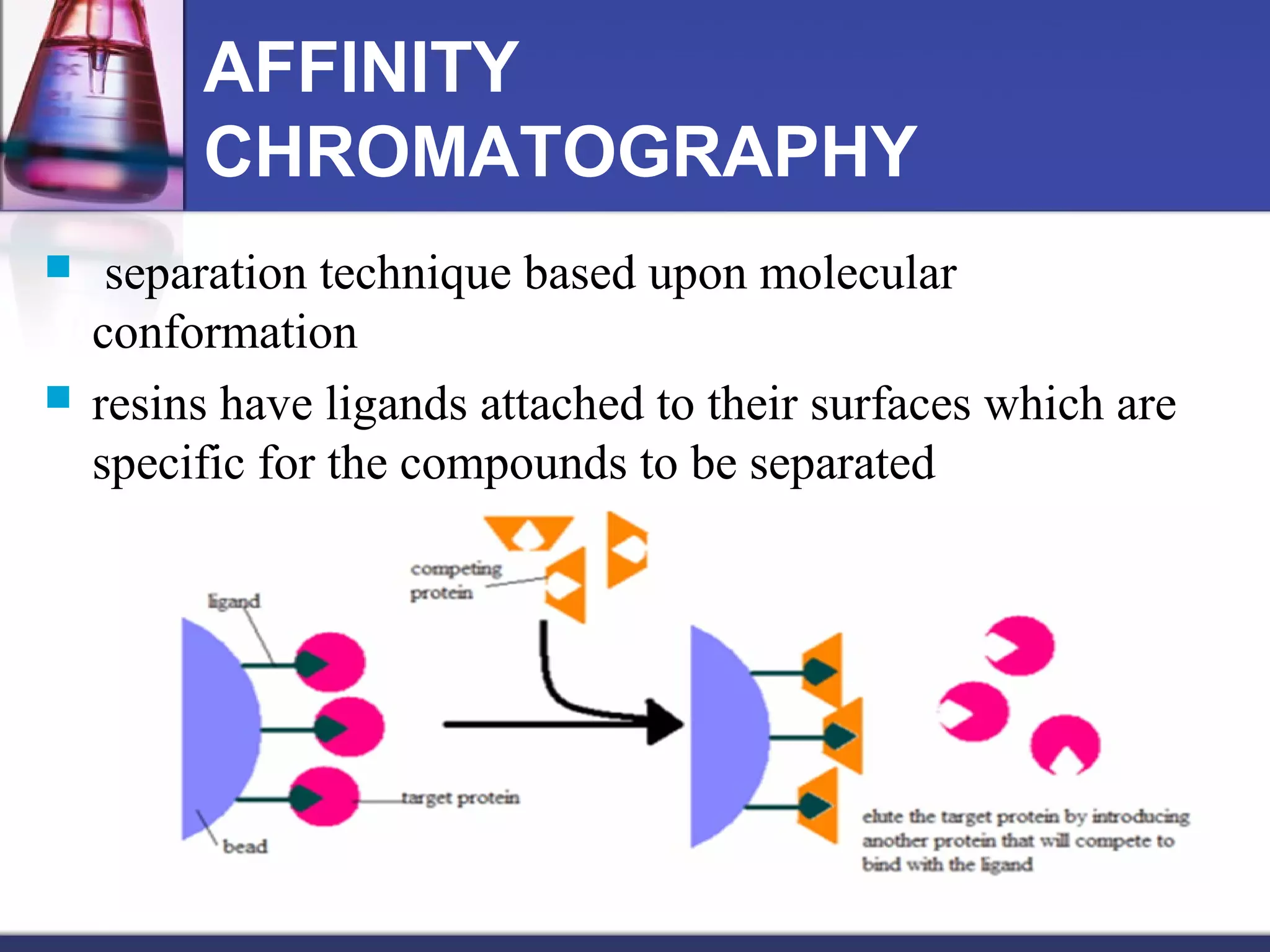
AFFINITY
CHROMATOGRAPHY
 separation technique based upon molecular
conformation
 resins have ligands attached to their surfaces which are
specific for the compounds to be separated
HYDROPHOBIC INTERACTION
CHROMATOGRAPHY
 Resins used in the column are amphiphiles
 The hydrophobic part of the resin attracts hydrophobic
region on the proteins
 greater the hydrophobic region on the protein, stronger
the attraction between the gel and protein
ISOELECTRIC FOCUSING
2D GEL ELECTROPHORESIS
ANALYTICAL TECHNIQUES
 HPLC
 Mass spectrometery
HIGH PERFORMANCE LIQUID
CHROMATOGRAPHY
MASS SPECTROMTERY
VERIFICATION
 SDS-PAGE
 Western blotting
 ELISA
SDS-PAGE
WESTERN BLOTTING
ELISA
PROTEIN PRESERVATION
 preservation is done by lyophilization
 Lyophilization/ freeze drying
• Sample is frozen
• Vacuum for removal of water
• Ice crystals sublimate to water vapour directly
• Containers are sealed
LYPHOLIZATION STEPS
APPLICATIONS
Protein purification techniques

Protein purification techniques