PurchasingPurchasing
• Purchasing is an activity concerned with the
acquisition of product.
• Obtaining the right product, in the right
amount, at the right time, at the right price.
• Purchasing is defined as ‘function concerned
with the search, selection, purchase, receipt,
storage, requisition, issuing and finally
production of food in accordance with the
catering policy of the hotel.
Aims of Purchasing PolicyAims of Purchasing Policy
• To set down the principles of purchasing.
• To set down the rules for purchase transactions.
• To help in selection of suppliers.
• Market Identification.
• Policy should clearly define the purchasing
function.
• Policy should assist in purchasing.
• Procedure for purchasing.
• Policy should aim at settling down the standards for
all the products which is to be purchased (SPS).
Methods Of PurchasingMethods Of Purchasing
• Open Market.
• Centralized Purchasing
• Contract Purchasing
• Standing Order Purchasing
• Fortnightly Purchasing
Open MarketOpen Market
• A committee of 3 persons (purchase officer,
accounts men and one person from f & B).
• After considering the rates and the quality the most
advantages is selected.
• Quality must not be sacrificed while comparing the
prices.
• The advantage of this purchased is that only desired
standard of quality will be purchased at lowest
possible rate.
• Suitable for Capital Goods
Contract PurchasingContract Purchasing
• The food items that requires frequent purchase calls for
contract purchases.
• The annual requirement is marked out and the tenders are
invited.
• The tenders evaluated
• The contract is signed with the supplier
• If the supplier fails to supply the indented items we have a
clause in the contract according to which we can buy the
indented items at the market rate prevalent and debit the
amount to the supplier’s account, this is known as risk
purchase.
• The tenders are awarded for items like mutton, fish, poultry,
egg, dairy products, fruits and vegetables.
Centralized PurchasingCentralized Purchasing
• All the H.O.D. combine together under a single
head and purchase all the necessary items on a large
scale.
• Advantages
• Better control and co-ordination because all the
H.O.D. are working under single head or
department.
• Better discount is gained.
• Few people are involved in purchasing.
• Economic and profit potential of purchasing policy
making it a profit rather than a cost center.
Standing Order PurchasingStanding Order Purchasing
• Milk and dairy product purchasing are normally made by
this method, which is often used for specific items only.
• The deliveryman will replenish the stock and this saves a
considerable amount of time for receiving person.
• Formal agreement are made for this type of delivery in
advance and reviewed from time to time.
• One of the disadvantages of this system is that there is
dependence on one vendor and delays may be caused by
unexpected problems.
• It works out well for those items that are purchased daily or
weekly or several times in a week or month.
Periodical/ fortnightly / bi weeklyPeriodical/ fortnightly / bi weekly::
• Method is used to purchase grocery.
• H.O.D. would complete the stock in hand and
fill in the wanted quantity of each item.
• Purchase officer would sent out a copy of the
list of each supplier in which the supplier is
required to quote the rates on receipt of
quotation.
• These would be entered into a master
quotation list and the decision is then made
about where the order for each items are to be
placed.
• Based on the requirement in the next week/
Fortnight and the storage space available.
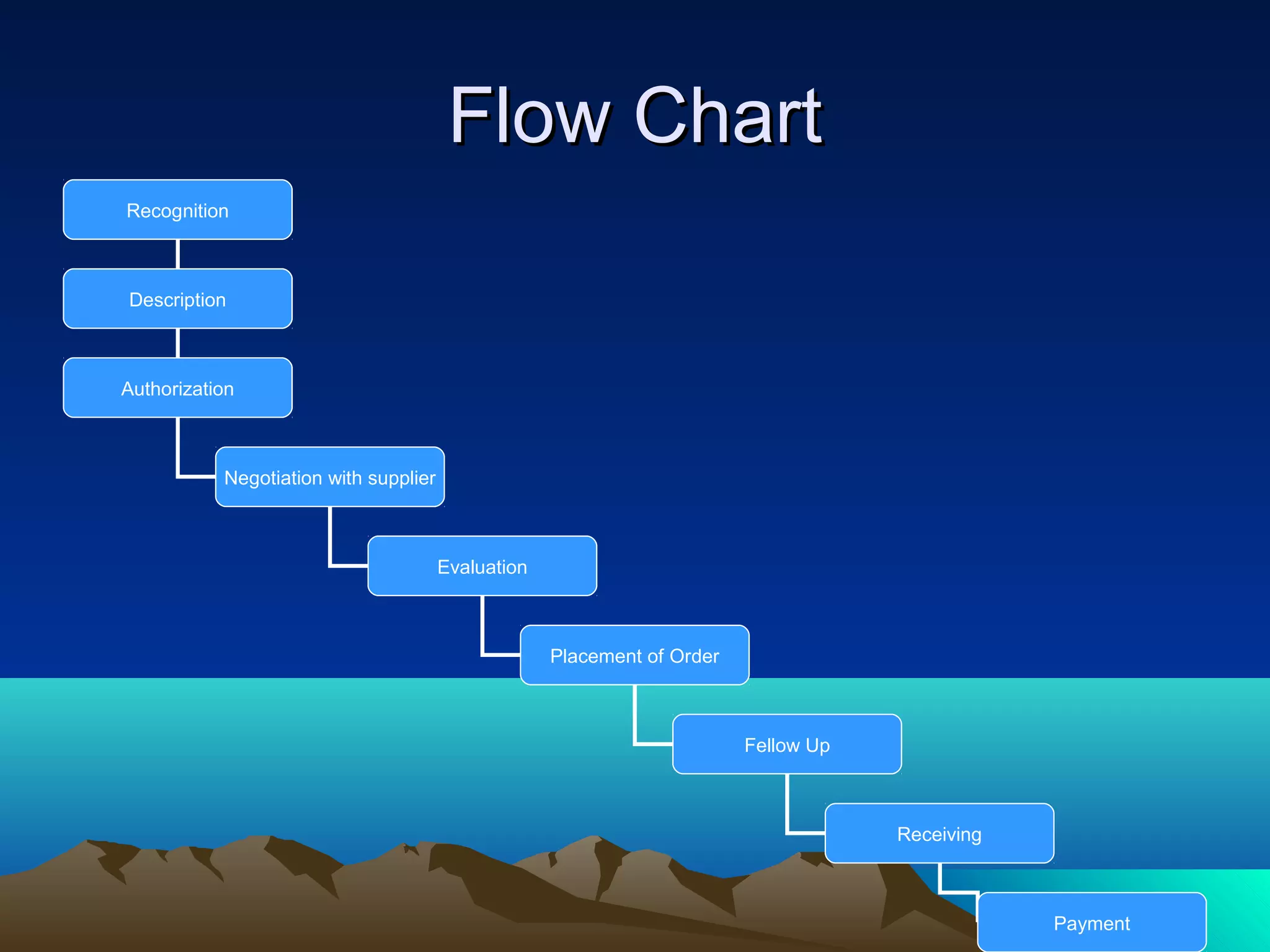
Flow ChartFlow Chart
Recognition
Description
Authorization
Negotiation with supplier
Evaluation
Placement of Order
Fellow Up
Receiving
Payment
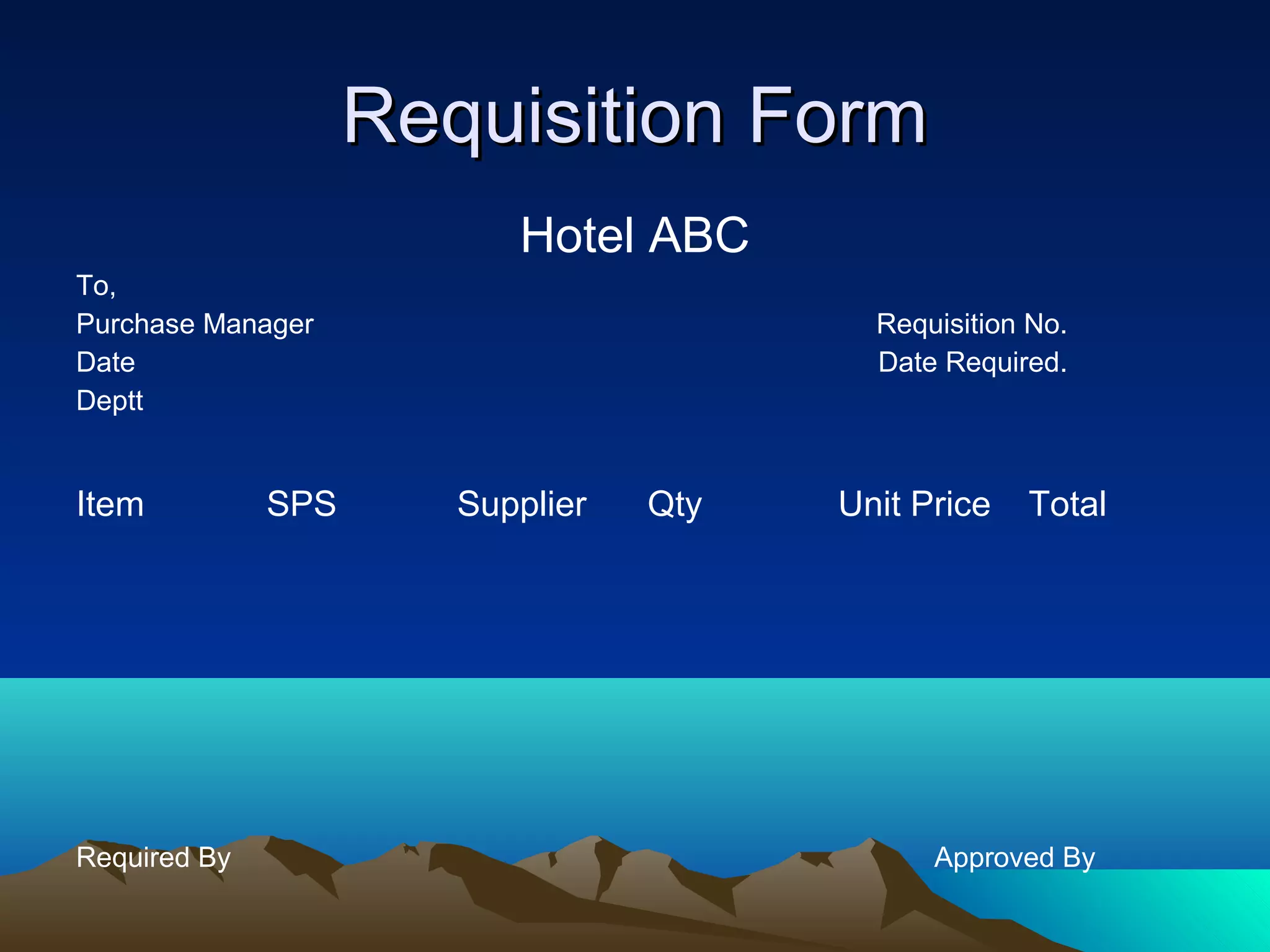
Requisition FormRequisition Form
Hotel ABC
To,
Purchase Manager Requisition No.
Date Date Required.
Deptt
Item SPS Supplier Qty Unit Price Total
Required By Approved By
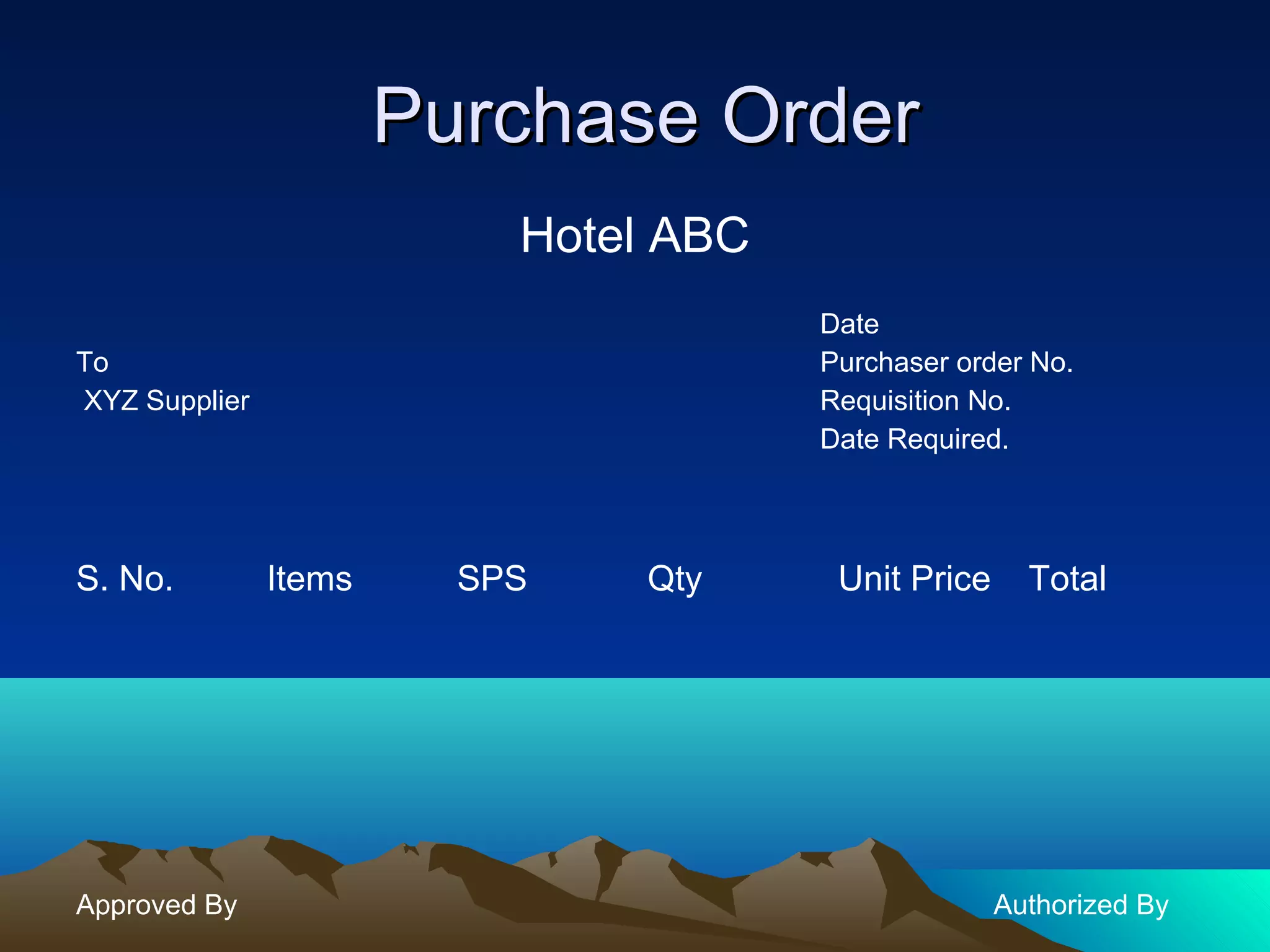
Purchase OrderPurchase Order
Hotel ABC
Date
To Purchaser order No.
XYZ Supplier Requisition No.
Date Required.
S. No. Items SPS Qty Unit Price Total
Approved By Authorized By
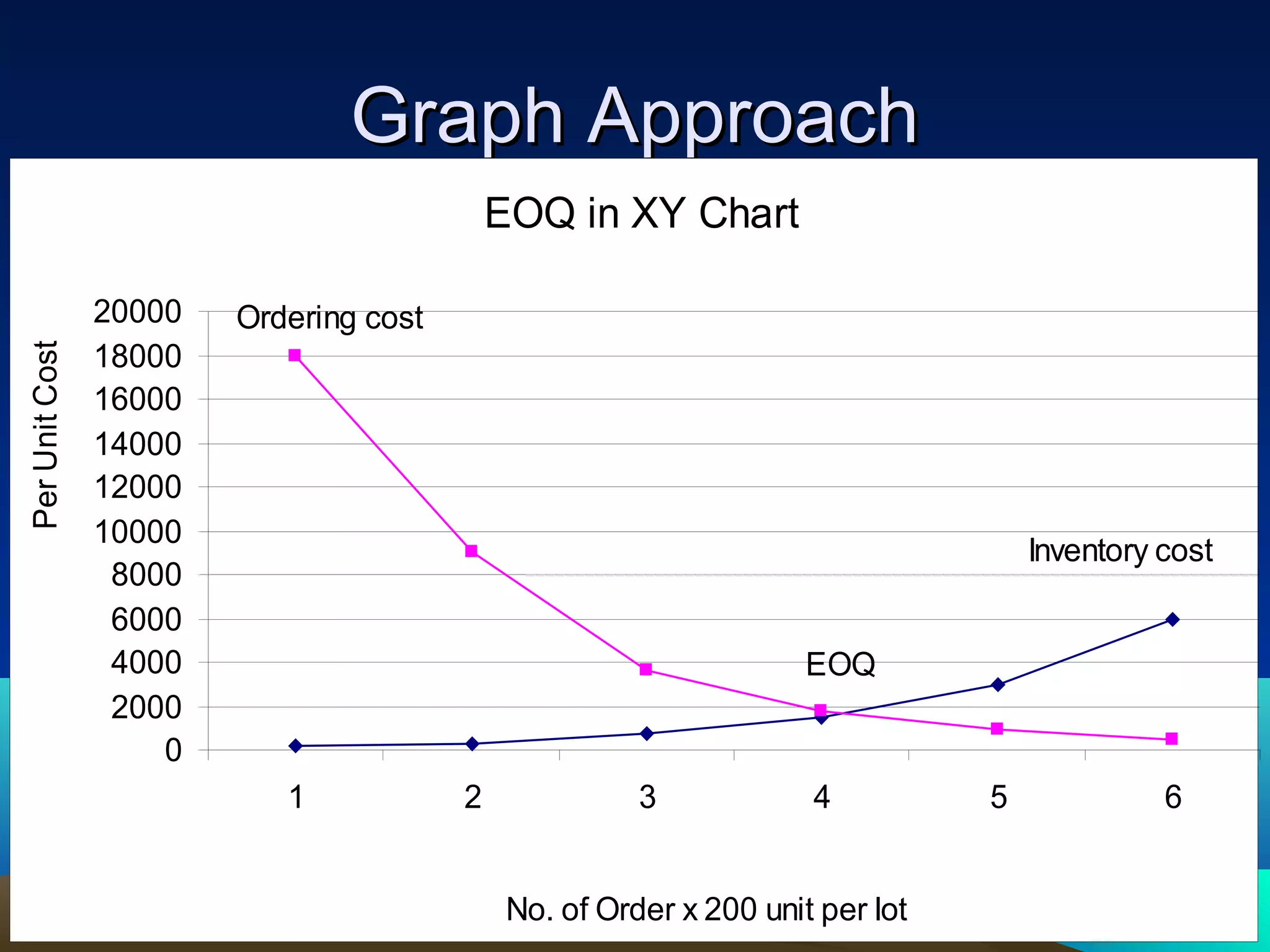
Economic Order QuantityEconomic Order Quantity
• It is the optimum or the most favorable
quantity which should be purchased each
time when purchases are to be made but
attempt to find out the quantity that
minimizes purchasing cost and also
minimizes inventory cost.
Ordering CostOrdering Cost
• The ordering cost is associated with acquisition of
purchased items and getting purchased items into
company’s store room.
• It includes the total operating
• Expenses of purchasing and receiving department,
• Expenses of purchase order and invoice payment,
• Data processing cost,
• Clerical and administrative cost, follow up,
• Cost on accounting,
• Transports cost
• This is a fixed cost per lot, hence variable cost per unit.
Carrying/Holding/ Inventory costCarrying/Holding/ Inventory cost
 These costs are associated with holding a given
level of inventories on hand and vary with the
level and the length of time held .
 It includes storage, spoilage, pilferage, energy
requirement, space requirement and
maintenance cost, taxes, depreciation
insurance, product deterioration, staffing and
their salary, handling cost, equipment
requirement and opportunity cost on investment
tied in inventory.
Cont..Cont..
1. These costs are difficult to determine and are
calculated on annual basis as a percentage of
inventory.
2. The cost of inventory decreases inversely as the
number of order increases. The smaller the size of
each order, lower the average inventory carried,
hence lower cost of carrying the inventory.
3. Carrying cost differ with each organization
depending upon the conditions like interest on
capital, insurance, depreciation,.
4. Taking into account the contribution of all these
factors it is quite common to find recurring annual
Formula ApproachFormula Approach
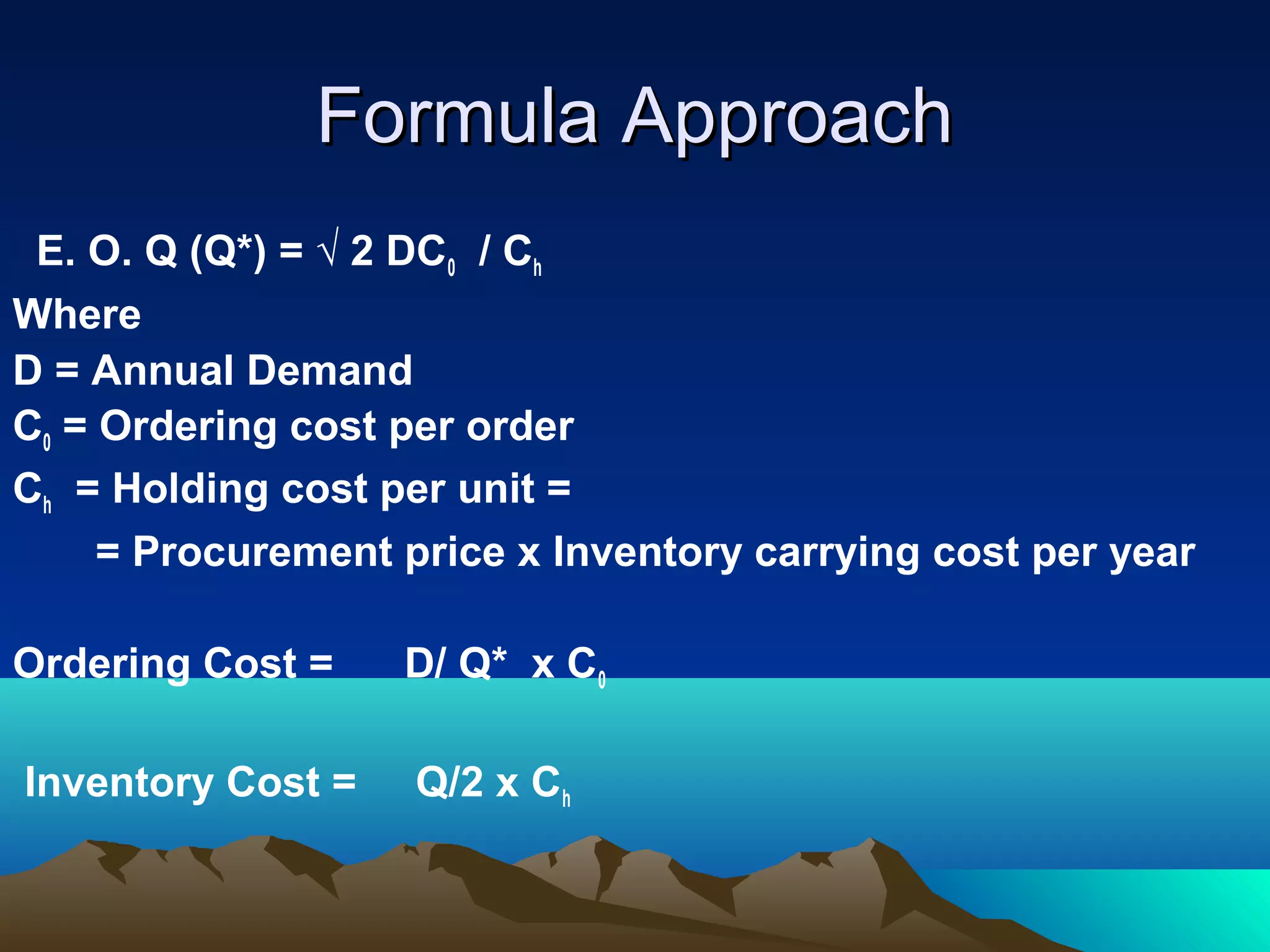
E. O. Q (Q*) = √ 2 DC0 / Ch
Where
D = Annual Demand
C0 = Ordering cost per order
Ch = Holding cost per unit =
= Procurement price x Inventory carrying cost per year
Ordering Cost = D/ Q* x C0
Inventory Cost = Q/2 x Ch
Graph ApproachGraph Approach
EOQ in XY Chart
0
2000
4000
6000
8000
10000
12000
14000
16000
18000
20000
1 2 3 4 5 6
No. of Order x 200 unit per lot
PerUnitCost
EOQ
Inventory cost
Ordering cost
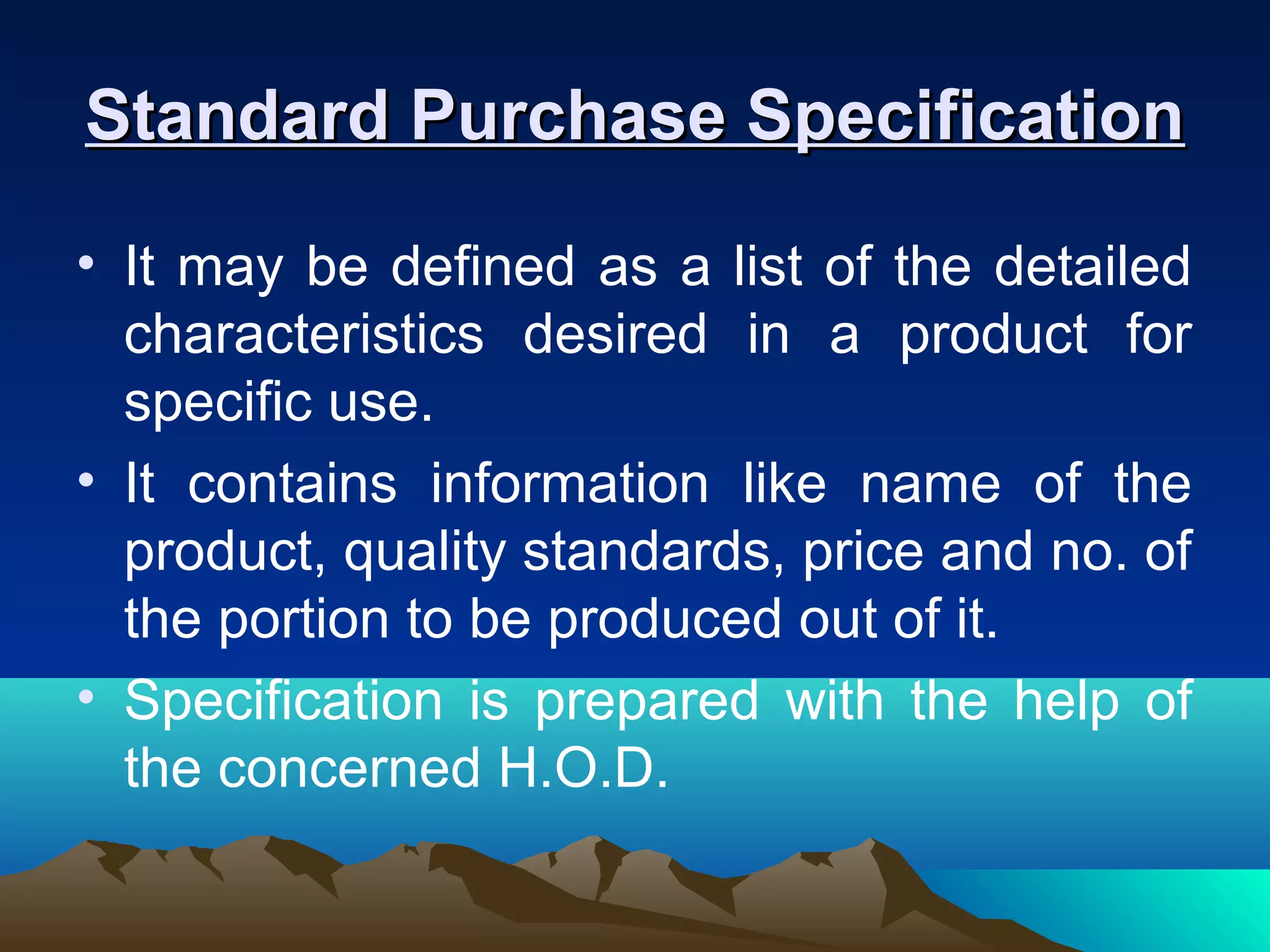
Standard Purchase SpecificationStandard Purchase Specification
• It may be defined as a list of the detailed
characteristics desired in a product for
specific use.
• It contains information like name of the
product, quality standards, price and no. of
the portion to be produced out of it.
• Specification is prepared with the help of
the concerned H.O.D.
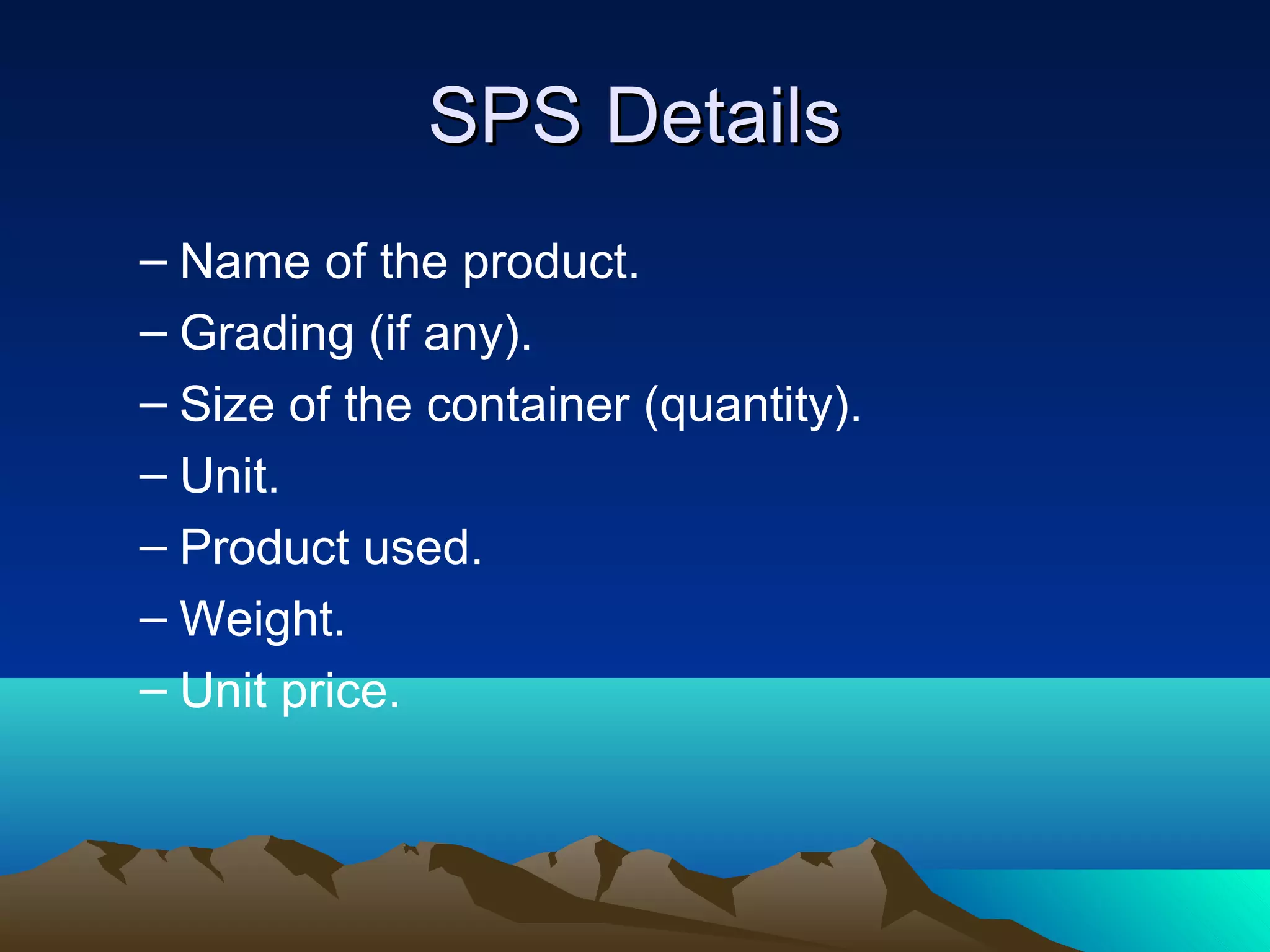
SPS DetailsSPS Details
– Name of the product.
– Grading (if any).
– Size of the container (quantity).
– Unit.
– Product used.
– Weight.
– Unit price.
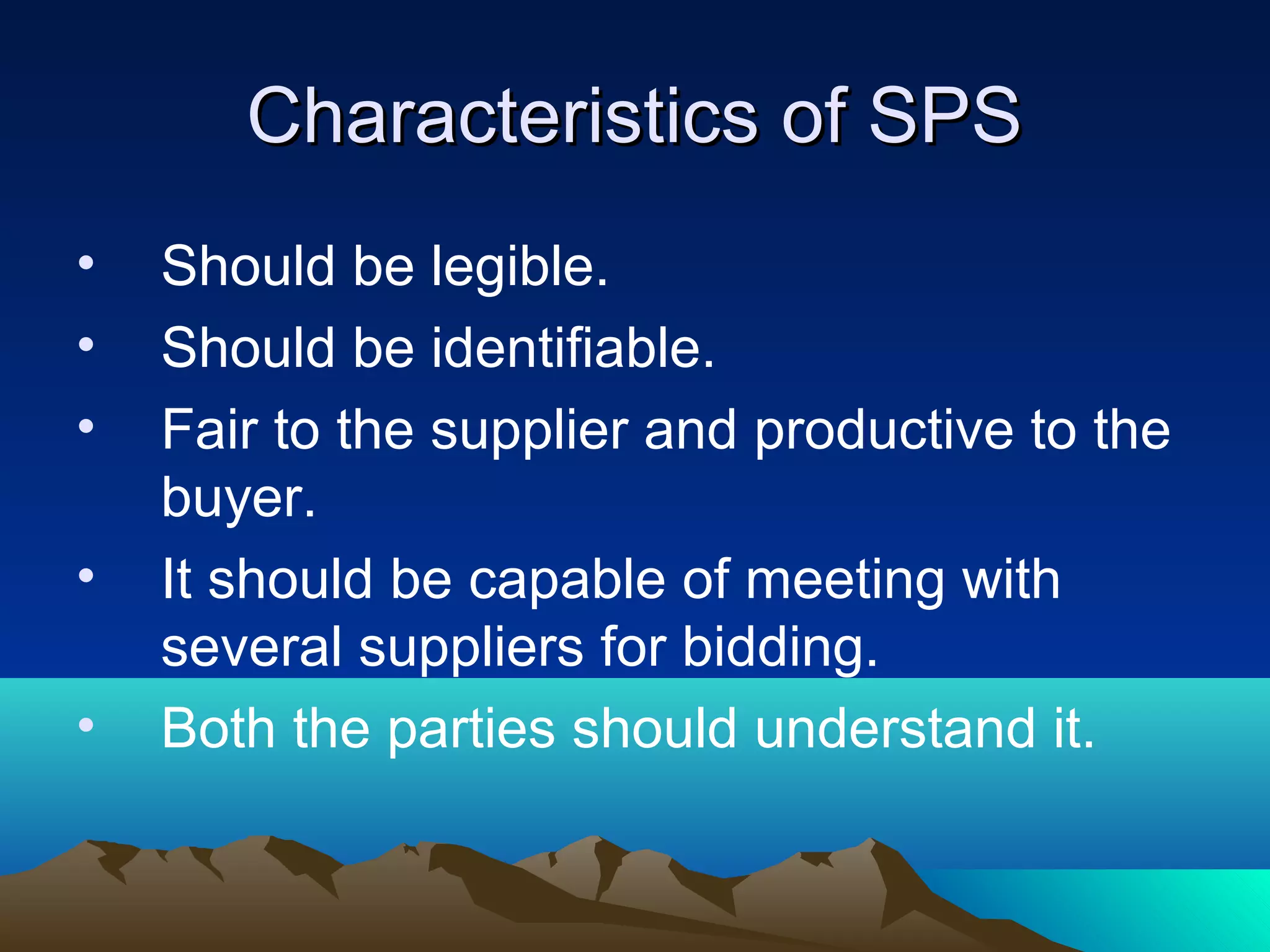
Characteristics of SPSCharacteristics of SPS
• Should be legible.
• Should be identifiable.
• Fair to the supplier and productive to the
buyer.
• It should be capable of meeting with
several suppliers for bidding.
• Both the parties should understand it.
AdvantageAdvantage
• Quality assurance.
• It helps the supplier to supply the right product.
• It helps the receiving clerk to identify the right
product.
• Right price.
• It helps in maximizing the output.
• It helps in producing the right amount of
portion.
• All the purchasing procedures get easier.
• S.PS. is a tool of management control.
• Wastage is minimized.
Duties of the Purchase OfficerDuties of the Purchase Officer
• The purchase of all food items for the establishment.
• Ensuring Continuously of all Commodity.
• Responsibility for the efficient operation and the control of
the purchasing,
• Formulation of SPS
• Reporting to the management .
• Research in relations to the requirements for New Market.
• Establishing good contacts with the traders.
• Issuing a contract or purchase order.
• Inventory and portion control measures.
• Selection of Supplier
AttributesAttributes
• Negotiating Skills
• Technical Skills
• Commodity Knowledge.
• Knowledge of Market.
• Supplier knowledge.
• Managerial characteristics.
QualificationsQualifications
• He should be a commerce graduate.
• Diploma in hotel management.
• 5 years of experience in food and
beverage operations.
Selection of SupplierSelection of Supplier
Consists of Three Phases
Survey
• Enquiry
• Evaluation
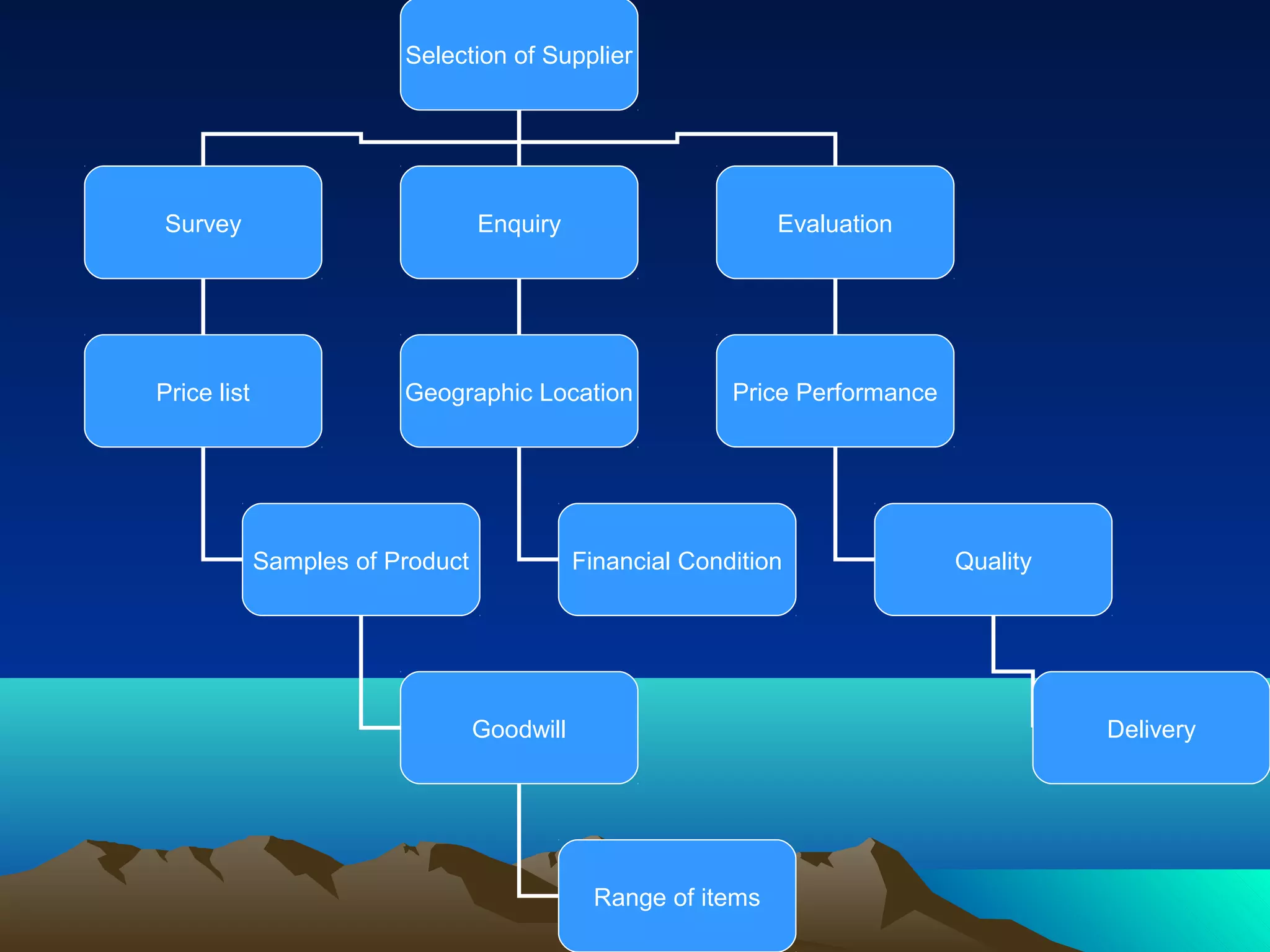
Selection of Supplier
Survey Enquiry Evaluation
Geographic LocationPrice list
Samples of Product
Goodwill
Range of items
Financial Condition
Price Performance
Quality
Delivery

Purchasing

  • 1.
    PurchasingPurchasing • Purchasing isan activity concerned with the acquisition of product. • Obtaining the right product, in the right amount, at the right time, at the right price. • Purchasing is defined as ‘function concerned with the search, selection, purchase, receipt, storage, requisition, issuing and finally production of food in accordance with the catering policy of the hotel.
  • 2.
    Aims of PurchasingPolicyAims of Purchasing Policy • To set down the principles of purchasing. • To set down the rules for purchase transactions. • To help in selection of suppliers. • Market Identification. • Policy should clearly define the purchasing function. • Policy should assist in purchasing. • Procedure for purchasing. • Policy should aim at settling down the standards for all the products which is to be purchased (SPS).
  • 3.
    Methods Of PurchasingMethodsOf Purchasing • Open Market. • Centralized Purchasing • Contract Purchasing • Standing Order Purchasing • Fortnightly Purchasing
  • 4.
    Open MarketOpen Market •A committee of 3 persons (purchase officer, accounts men and one person from f & B). • After considering the rates and the quality the most advantages is selected. • Quality must not be sacrificed while comparing the prices. • The advantage of this purchased is that only desired standard of quality will be purchased at lowest possible rate. • Suitable for Capital Goods
  • 5.
    Contract PurchasingContract Purchasing •The food items that requires frequent purchase calls for contract purchases. • The annual requirement is marked out and the tenders are invited. • The tenders evaluated • The contract is signed with the supplier • If the supplier fails to supply the indented items we have a clause in the contract according to which we can buy the indented items at the market rate prevalent and debit the amount to the supplier’s account, this is known as risk purchase. • The tenders are awarded for items like mutton, fish, poultry, egg, dairy products, fruits and vegetables.
  • 6.
    Centralized PurchasingCentralized Purchasing •All the H.O.D. combine together under a single head and purchase all the necessary items on a large scale. • Advantages • Better control and co-ordination because all the H.O.D. are working under single head or department. • Better discount is gained. • Few people are involved in purchasing. • Economic and profit potential of purchasing policy making it a profit rather than a cost center.
  • 7.
    Standing Order PurchasingStandingOrder Purchasing • Milk and dairy product purchasing are normally made by this method, which is often used for specific items only. • The deliveryman will replenish the stock and this saves a considerable amount of time for receiving person. • Formal agreement are made for this type of delivery in advance and reviewed from time to time. • One of the disadvantages of this system is that there is dependence on one vendor and delays may be caused by unexpected problems. • It works out well for those items that are purchased daily or weekly or several times in a week or month.
  • 8.
    Periodical/ fortnightly /bi weeklyPeriodical/ fortnightly / bi weekly:: • Method is used to purchase grocery. • H.O.D. would complete the stock in hand and fill in the wanted quantity of each item. • Purchase officer would sent out a copy of the list of each supplier in which the supplier is required to quote the rates on receipt of quotation. • These would be entered into a master quotation list and the decision is then made about where the order for each items are to be placed. • Based on the requirement in the next week/ Fortnight and the storage space available.
  • 9.
    Flow ChartFlow Chart Recognition Description Authorization Negotiationwith supplier Evaluation Placement of Order Fellow Up Receiving Payment
  • 10.
    Requisition FormRequisition Form HotelABC To, Purchase Manager Requisition No. Date Date Required. Deptt Item SPS Supplier Qty Unit Price Total Required By Approved By
  • 11.
    Purchase OrderPurchase Order HotelABC Date To Purchaser order No. XYZ Supplier Requisition No. Date Required. S. No. Items SPS Qty Unit Price Total Approved By Authorized By
  • 12.
    Economic Order QuantityEconomicOrder Quantity • It is the optimum or the most favorable quantity which should be purchased each time when purchases are to be made but attempt to find out the quantity that minimizes purchasing cost and also minimizes inventory cost.
  • 13.
    Ordering CostOrdering Cost •The ordering cost is associated with acquisition of purchased items and getting purchased items into company’s store room. • It includes the total operating • Expenses of purchasing and receiving department, • Expenses of purchase order and invoice payment, • Data processing cost, • Clerical and administrative cost, follow up, • Cost on accounting, • Transports cost • This is a fixed cost per lot, hence variable cost per unit.
  • 14.
    Carrying/Holding/ Inventory costCarrying/Holding/Inventory cost  These costs are associated with holding a given level of inventories on hand and vary with the level and the length of time held .  It includes storage, spoilage, pilferage, energy requirement, space requirement and maintenance cost, taxes, depreciation insurance, product deterioration, staffing and their salary, handling cost, equipment requirement and opportunity cost on investment tied in inventory.
  • 15.
    Cont..Cont.. 1. These costsare difficult to determine and are calculated on annual basis as a percentage of inventory. 2. The cost of inventory decreases inversely as the number of order increases. The smaller the size of each order, lower the average inventory carried, hence lower cost of carrying the inventory. 3. Carrying cost differ with each organization depending upon the conditions like interest on capital, insurance, depreciation,. 4. Taking into account the contribution of all these factors it is quite common to find recurring annual
  • 16.
    Formula ApproachFormula Approach E.O. Q (Q*) = √ 2 DC0 / Ch Where D = Annual Demand C0 = Ordering cost per order Ch = Holding cost per unit = = Procurement price x Inventory carrying cost per year Ordering Cost = D/ Q* x C0 Inventory Cost = Q/2 x Ch
  • 17.
    Graph ApproachGraph Approach EOQin XY Chart 0 2000 4000 6000 8000 10000 12000 14000 16000 18000 20000 1 2 3 4 5 6 No. of Order x 200 unit per lot PerUnitCost EOQ Inventory cost Ordering cost
  • 18.
    Standard Purchase SpecificationStandardPurchase Specification • It may be defined as a list of the detailed characteristics desired in a product for specific use. • It contains information like name of the product, quality standards, price and no. of the portion to be produced out of it. • Specification is prepared with the help of the concerned H.O.D.
  • 19.
    SPS DetailsSPS Details –Name of the product. – Grading (if any). – Size of the container (quantity). – Unit. – Product used. – Weight. – Unit price.
  • 20.
    Characteristics of SPSCharacteristicsof SPS • Should be legible. • Should be identifiable. • Fair to the supplier and productive to the buyer. • It should be capable of meeting with several suppliers for bidding. • Both the parties should understand it.
  • 21.
    AdvantageAdvantage • Quality assurance. •It helps the supplier to supply the right product. • It helps the receiving clerk to identify the right product. • Right price. • It helps in maximizing the output. • It helps in producing the right amount of portion. • All the purchasing procedures get easier. • S.PS. is a tool of management control. • Wastage is minimized.
  • 22.
    Duties of thePurchase OfficerDuties of the Purchase Officer • The purchase of all food items for the establishment. • Ensuring Continuously of all Commodity. • Responsibility for the efficient operation and the control of the purchasing, • Formulation of SPS • Reporting to the management . • Research in relations to the requirements for New Market. • Establishing good contacts with the traders. • Issuing a contract or purchase order. • Inventory and portion control measures. • Selection of Supplier
  • 23.
    AttributesAttributes • Negotiating Skills •Technical Skills • Commodity Knowledge. • Knowledge of Market. • Supplier knowledge. • Managerial characteristics.
  • 24.
    QualificationsQualifications • He shouldbe a commerce graduate. • Diploma in hotel management. • 5 years of experience in food and beverage operations.
  • 25.
    Selection of SupplierSelectionof Supplier Consists of Three Phases Survey • Enquiry • Evaluation
  • 26.
    Selection of Supplier SurveyEnquiry Evaluation Geographic LocationPrice list Samples of Product Goodwill Range of items Financial Condition Price Performance Quality Delivery