UNIT – I
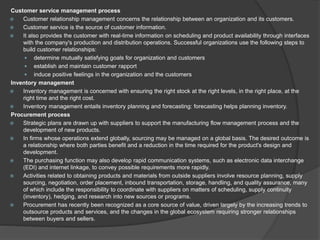
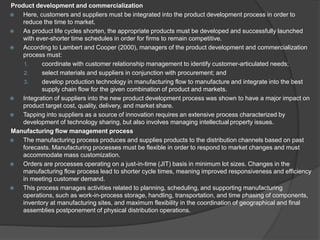
ORGANIZING THE PURCHASE FUNCTION
Purchasing
 Purchase function provides materials to the factory
without which the materials cannot move.
 Purchasing or purchase management basically is a
function in any enterprise that works to save money and
enhance profits.
 The main function of this department is to procure the
material or inputs that are needed for production.
 A 1% saving in cost is equivalent to 10% increase in
turnover
 Purchasing is generally responsible for spending more
than 50 percent of all the revenues the firm receives as
income from sales.
 More money is often spent for purchases of materials and
services than for any other expense, and the spend in
services is rapidly increasing
IMPORTANCE OF PURCHASE MANAGEMENT
 Purchasing management is supposed to be a very
important department of materials management in
any organization.
 Purchase staff has to manage various vendors and
external agencies and thus they represent their
organization’s reputation to the larger world.
 They are responsible for negotiating and then
finalizing big deals which might mean a lot to their
company.
 Other than that, purchasing management
helps in the following:
1. Controlling the costs
2. Stabilizing the prices
3. Supply Chain Management
4. Customer Satisfaction
Controlling the costs
 The purchasing management has to analyze and
decide the best suppliers as per the quality of
products and most reasonable cost.
 They also review many other factors like if the
vendor or supplier can guarantee timely
shipments, what’s their reputation in the industry
and relevant experience.
 Changing the vendors again and again is
expensive; therefore, finding the best and
reliable vendor is very important for controlling
costs.
Stabilizing the prices
 In case the production cost goes up and down,
other functions face roadblocks.
 For example, the marketing function gets
confused about what price should be charged to
the customers, the finance department faces
problem in calculating profits and the accounts
cannot gauge the company’s cash flow.
 Purchasing managers are the ones who are
responsible for stabilizing the production cost by
negotiating with suppliers and making long
contracts for mutual benefit.
Supply Chain Management
 Buyers also ensure that the material or supplies
are received on time and are of the expected
quality.
 In case the shipment is delayed or is not of the
expected standard, it would affect the complete
production chain.
 Hence, this function is of utmost importance
across all industries.
Customer Satisfaction
 Purchase management is responsible for
customer satisfaction in the following ways:
 Working towards the best quality of the products
 Ensuring on-time deliveries.
 When the purchase department opts for
highest quality of supplies or ingredients
at reasonable costs, it results in cost
savings, which are further passed on to the
customers.
 Therefore, purchasing management has a
critical role to play in customer’s experience
with the final products and the organization.
Tactical Purchasing Vs Strategic Sourcing
Tactical Purchasing
 Tactical purchasing is based on the
short term, transactional activity
that you often find in small and
medium manufacturing companies.
 It uses a routine approach that is
often reactive, when it comes to
purchasing materials and supplies.
It involves using fast quote and
order processes to keep production
running smoothly.
 It’s worth noting everything is
well-managed internally to make
sure the business has all the
materials they need at the right
price and the right time.
Strategic Sourcing
 Strategic sourcing, also known as
strategic procurement, is the more
long-term strategy, using a
systematic approach to obtain the
things the business needs, focusing
on the lowest risk to the supply
line, and the lowest total cost of
ownership, or TCO, possible.
 It’s more about anticipating the
future needs of an organisation,
supply chain relationship
management and choosing
suppliers to work with based on
factors other than price and
availability.
Tactical vs. Strategic Purchasing
 Tactical purchasing doesn’t focus on the entire
company’s needs, and it doesn’t aim to truly
understand how a vendor’s capabilities could support
the organisation’s larger needs.
 It focuses on the production department’s needs,
while strategic sourcing looks at the big picture.
Objectives of Purchasing
 The purchasing objective is sometimes understood as
buying materials of the right quality, in the right
quantity, at the right time, at the right price, and from
the right source.
 This is a broad generalisation, indicating the scope of
purchasing function, which involves policy decisions
and analysis of various alternative possibilities prior
to their act of purchase.
The specific objectives of purchasing are:
 To pay reasonably low prices for the best values
obtainable, negotiating and executing all company
commitments.
 To keep inventories as low as is consistent with
maintaining production.
 To develop satisfactory sources of supply and
maintain good relations with them.
 To secure good vendor performance including
prompt deliveries and acceptable quality.
 To locate new materials or products as required.
 To develop good procedures, together with adequate
controls and purchasing policy.
 To implement such programmes as value
analysis, cost analysis, and make-or-buy to
reduce cost of purchases.
 To secure high caliber personnel and allow each
to develop to his maximum ability.
 To maintain as economical a department as is
possible, commensurate with good performance.
 To keep top management informed of material
development which could affect company profit
or performance.
 To achieve a high degree of co-operation and co-
ordination with other departments in the
organisation.
Purchasing Cycle
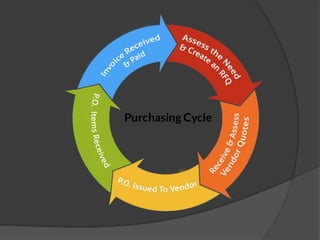
 The purchasing cycle is also called the
procurement cycle or procure-to-pay (P2P) is the
process by which you order, obtain, and pay for
the goods and services your business needs.
 Purchasing cycle the steps taken to order and pay
for products that a business requires.
 The purchasing cycle determines the frequency
that products are purchased.
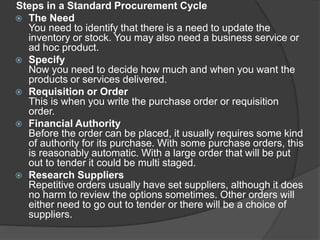
Steps in a Standard Procurement Cycle
 The Need
You need to identify that there is a need to update the
inventory or stock. You may also need a business service or
ad hoc product.
 Specify
Now you need to decide how much and when you want the
products or services delivered.
 Requisition or Order
This is when you write the purchase order or requisition
order.
 Financial Authority
Before the order can be placed, it usually requires some kind
of authority for its purchase. With some purchase orders, this
is reasonably automatic. With a large order that will be put
out to tender it could be multi staged.
 Research Suppliers
Repetitive orders usually have set suppliers, although it does
no harm to review the options sometimes. Other orders will
either need to go out to tender or there will be a choice of
suppliers.
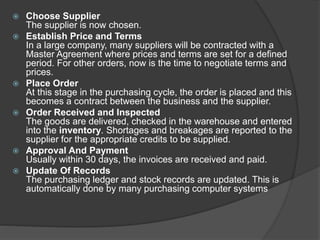
 Choose Supplier
The supplier is now chosen.
 Establish Price and Terms
In a large company, many suppliers will be contracted with a
Master Agreement where prices and terms are set for a defined
period. For other orders, now is the time to negotiate terms and
prices.
 Place Order
At this stage in the purchasing cycle, the order is placed and this
becomes a contract between the business and the supplier.
 Order Received and Inspected
The goods are delivered, checked in the warehouse and entered
into the inventory. Shortages and breakages are reported to the
supplier for the appropriate credits to be supplied.
 Approval And Payment
Usually within 30 days, the invoices are received and paid.
 Update Of Records
The purchasing ledger and stock records are updated. This is
automatically done by many purchasing computer systems
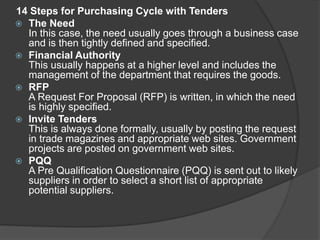
14 Steps for Purchasing Cycle with Tenders
 The Need
In this case, the need usually goes through a business case
and is then tightly defined and specified.
 Financial Authority
This usually happens at a higher level and includes the
management of the department that requires the goods.
 RFP
A Request For Proposal (RFP) is written, in which the need
is highly specified.
 Invite Tenders
This is always done formally, usually by posting the request
in trade magazines and appropriate web sites. Government
projects are posted on government web sites.
 PQQ
A Pre Qualification Questionnaire (PQQ) is sent out to likely
suppliers in order to select a short list of appropriate
potential suppliers.
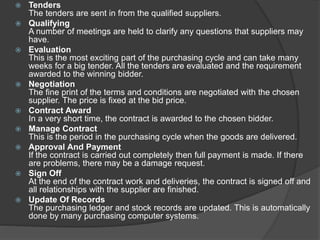
 Tenders
The tenders are sent in from the qualified suppliers.
 Qualifying
A number of meetings are held to clarify any questions that suppliers may
have.
 Evaluation
This is the most exciting part of the purchasing cycle and can take many
weeks for a big tender. All the tenders are evaluated and the requirement
awarded to the winning bidder.
 Negotiation
The fine print of the terms and conditions are negotiated with the chosen
supplier. The price is fixed at the bid price.
 Contract Award
In a very short time, the contract is awarded to the chosen bidder.
 Manage Contract
This is the period in the purchasing cycle when the goods are delivered.
 Approval And Payment
If the contract is carried out completely then full payment is made. If there
are problems, there may be a damage request.
 Sign Off
At the end of the contract work and deliveries, the contract is signed off and
all relationships with the supplier are finished.
 Update Of Records
The purchasing ledger and stock records are updated. This is automatically
done by many purchasing computer systems.
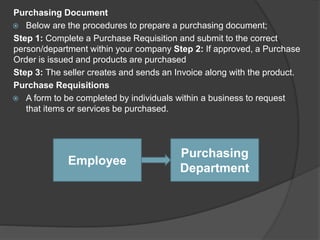
Purchasing Document
 Below are the procedures to prepare a purchasing document;
Step 1: Complete a Purchase Requisition and submit to the correct
person/department within your company Step 2: If approved, a Purchase
Order is issued and products are purchased
Step 3: The seller creates and sends an Invoice along with the product.
Purchase Requisitions
 A form to be completed by individuals within a business to request
that items or services be purchased.
Employee
Purchasing
Department
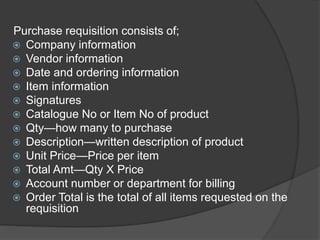
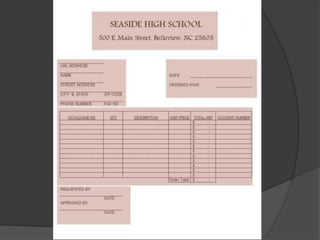
Purchase requisition consists of;
 Company information
 Vendor information
 Date and ordering information
 Item information
 Signatures
 Catalogue No or Item No of product
 Qty—how many to purchase
 Description—written description of product
 Unit Price—Price per item
 Total Amt—Qty X Price
 Account number or department for billing
 Order Total is the total of all items requested on the
requisition
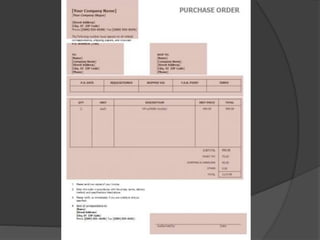
Purchase Orders
 Purchase order consists of;
 Company information
 Vendor information
 Date and ordering information
 Item information
 Signatures
Invoice
 A form that the seller/supplier completes and
sends to the buyer during the month indicating
how much is owed for items bought or
services rendered and the due date for
payment/payment terms.
Seller Buyer
 Invoice Consists of the following details;
1. Company information
2. Customer information
3. Date and ordering information
4. Item information
5. Comments
Types of Purchase Orders
 Made as a request from a buyer to a seller, a PO (Purchase
Order) details what goods or services are being purchased.
 Buyers send purchase orders to the seller as intent to make a
purchase in the near future. Additional details included are the
price of items, expected delivery schedule and payment terms.
 As a form of a binding contract, purchase orders protect both the
buyer and the seller by making the details of the arrangement
clear.
 For a wholesale distributor, you will likely issue purchase orders to
stock your own goods.
 Since you'll also be likely to receive them, we've outlined the four
types of purchase orders so that you know how to deal with them
in either scenario.
4 Types of Purchase Orders
 Depending on how much information the buyer can share
regarding their upcoming purchase, there are 4 varieties of
purchase orders.
1. Standard Purchase Order
2. Blanket Purchase Order
3. Contract Purchase Order
4. Planned Purchase Order
Standard Purchase Order
 The most widely used of purchase orders, the standard purchase
order details the items to be purchased, quantities, payment terms
and the delivery date.
 Standard purchase orders are typically used for one-time
purchases.
 An example of a standard purchase order would be when a
company agrees to buy 10 reams of paper for the price of $2 each,
which will be delivered within two weeks and paid within 30 days
upon delivery.
Blanket Purchase Order
 A blanket purchase order incorporates several potential orders into
one.
 This type of purchase order typically outlines the items and total
quantity needed.
 It may or may not include pricing.
 If it does include pricing, it may include price breaks that the seller
is willing to offer.
 For example, a company may decide to order reams of copy paper,
but they're not sure when or how often they'll need to order.
 In this instance, the company may issue a blanket purchase order
to initiate the purchasing process.
Contract Purchase Order
 With a contract purchase order, the buyer does not know which item or items
will be ordered.
 Instead, you agree upon terms and conditions with your supplier with the idea
that items and quantities will be known in the future.
 This type of purchase order acts more like a binding agreement that the seller
will purchase from you in the future.
 Often set for a year as the time period, contract purchase orders essentially
act like a legal document.
 During the contract period, the buyer can send in a standard purchase order
that includes the details needed for each purchase.
Planned Purchase Order
 For a planned purchase order, most order details are known.
 Known items may include the items, pricing and payment terms. However, the
delivery date is typically unknown.
 Essentially, the buyer is committing to a price and quantity, but not on a
delivery schedule.
 As an example, a company may know that they are going to purchase three
printers at a certain price.
 Once the needed delivery schedule is known, you can generate a
standard purchase order.
 No matter which type of purchase order you use, be sure to be clear and
concise with order details.
 This important type of arrangement not only protects the buyer, but the seller.
 So, if you're not using purchase orders, now is the time to get started.
Improving the Purchasing Process
 Stock level warnings – too high, too low
 Procurement software integration with other systems and applications e.g.
ERP, EDI, eCommerce, WMS etc.
 Short shelf life stock warnings
 Warnings of upcoming manufacturing requirements
 Details of new sales or projects won
 Purchase order workflow approval with support for complex authorisation
hierarchies driven automatically by nature and value of goods being
purchased
 Chasing suppliers asking them to confirm POs have been received
 Chasing suppliers for confirmation that goods will be delivered on time
 Warning when an item is receipted into stock with margin that is too low or
has been receipted at a buy price that is different to the expected cost price
 Seasonal stock warnings
 Procurement bidding software
 Spot documents not properly completed e.g. POs with no duty rate
 Alerts showing goods due in that have not turned up on time
 Automated price change notifications to sales team whenever a price is
altered
 Order confirmations sent automatically to suppliers
 Identify unusual trends in product use or sales
Types of Business Purchase Decisions
 The types of business purchase decisions of interest to marketers
are:
1. New Purchases
2. Modified Re-buy
3. Straight Re-buy
New Purchase
 These purchases are ones the buyer has never or rarely made
before
 Also called as New Task Purchases
 It can be considered as either minor or major depending on the
total cost or overall importance of the purchase.
 In either case, the buyer will spend considerably more time
evaluating alternatives.
 For example, if faced with a major New Task Purchase involving a
complex items, such as computer systems, buildings, robotic
assembly lines, etc., the purchase cycle from first recognizing the
need to placement of the order may be months or even years.
 For marketers, the goal when selling to a buyer facing a New Task
Purchase is to make sure to be included in the set of evaluated
products as discussed in Step 2 of the business purchasing
process.
Straight Repurchases
 These business purchase decisions involve routine
ordering.
 In most cases, buyers simply reorder the same
products or services that were previously purchased.
 In fact, many larger companies have programmed
repurchases into an automated ordering system that
initiates electronic orders when inventory falls below
a certain predetermined level.
 For the supplier benefiting from the repurchase, this
situation is ideal since the purchaser is not looking to
evaluate other products.
 For competitors, who are not getting the order, it may
require extensive marketing efforts to persuade the
buyer to consider other product or service options.
Modified Re-buy
 These purchases occur when products or services
previously considered a straight re-purchase are now
under a re-evaluation process.
 There are many reasons why a product is moved to
the status of a Modified Repurchase.
 Some of these reasons include: end of purchase
contract period, change in who is involved in making
the purchase; supplier is removed from an approved
suppliers list; mandate from top level of organization to
re-evaluate all purchasing; or strong marketing effort
by competitors.
 In this circumstance, the incumbent supplier faces the
same challenges they may have faced when they
initially convinced the buyer to make the purchase.
 For competitors, the door is now open and they must
work hard to make sure their message is heard by
those in charge of the purchase decision.
There are various ways to improve the procurement process; some
are minor changes that focus on improving part of the process
such as creating essential internal documentation. Other major
changes can go as far as improving the whole process. Here are
some examples of ways to improve the procurement process
which adds value to an organization:
Incorporating a contract management system
 Technology creates wonders! So why not make the most of it as
it can help you save lots of time and be more efficient.
 One way of using technology to improve the procurement
process is by incorporating a contract management system.
Let’s admit it: creating contracts is time consuming and
businesses often work with hundreds of vendors every year.
 Using a contract management system will alleviate the whole
task of creating new contracts every time you onboard a new
supplier.
 It will help you understand which contract can be reused from
one supplier to the next.
 This will allow you to create standard contract templates which
will require only minor updates when they are used.
Increasing employee capability through training and
development
 Training and development remains one of the key factors that
lead to a successful business.
 A three-year researched project commissioned by Middlesex
University’s institute for work based learning found that from a
4300 workers sample, 74% felt that they were not achieving their
full potential at work due to lack of development opportunities.
The result of this research highlights the importance of training
and development to ensure successful business continuity. It
benefits not only the employees’ personal evolution but also
impacts on the company’s productivity and profitability as a whole.
It reinforces the goodwill of the business, allows it to maintain the
competitive edge and leads to higher customer satisfaction, lower
costs and faster growth. The emergence of innovative training
solutions is increasingly being adopted by leading procurement
organizations. For instance: high-impact eLearning solutions
combined with simulations where employees can apply what they
are learning in their jobs. As a form of effective communication,
training can lead to an increase in productivity and allow
employees to make the best decisions for the company’s
progress.
 There are various ways to improve the
procurement process; some are minor changes
that focus on improving part of the process
such as creating essential internal
documentation.
 Other major changes can go as far as
improving the whole process.
 Here are some examples of ways to improve
the procurement process which adds value to
an organization:
 Incorporating a contract management system
 Maintain good supplier relationships
 Reduce Expenses
 Using analytical and negotiation skills
Incorporating a contract management system
 Technology creates wonders! So why not make the
most of it as it can help you save lots of time and be
more efficient.
 One way of using technology to improve the
procurement process is by incorporating a contract
management system.
 Let’s admit it: creating contracts is time consuming
and businesses often work with hundreds of vendors
every year.
 Using a contract management system will alleviate
the whole task of creating new contracts every time
you onboard a new supplier. It will help you
understand which contract can be reused from one
supplier to the next.
 This will allow you to create standard contract
templates which will require only minor updates when
they are used.
Maintain good supplier relationships
 A procurement professional needs to be surrounded by a group of
happy and qualified suppliers.
 Of course, a bid request can be put out to new vendors whenever
you need a product and service but those bids will take a huge
amount of time to finalize.
 Having to start over again every time you need to issue a bid
request involves a long process of researching each new supplier,
learn about their industry position and identify their negotiation
tactics.
 To prevent this from happening, it is better to maintain a good
relationship with a group of suppliers you can trust. Streamlining the
procurement in this way will make your job more efficient.
 Besides, it might also increase your goodwill as a happy supplier
might tell others how good you are to work with which might lead to
new sourcing avenues.
 All you need to do is: be fair with the suppliers in your business
dealings, ensure that they are paid on time, put out detailed and
straightforward RFPs and appreciate their professionalism and
skills
Reduce Expenses
 One of the most appreciated qualities of procurement
professionals is the ability to reduce costs while
procuring the items a company need.
 The one question which comes to the mind is how?
The key is to think carefully before making a purchase.
 It sounds easy but any procurement professional will
understand this point since they might get tempted to
create purchase orders for every request that comes
at their desk.
 This is where the trap lies, leading to unnecessary
expenses! According to Caps research, for every one
dollar you spend on supply management gives you an
estimated return of $6.77.
 This leads us to understand that when you take the
time to identify, research, acquire and manage the
products and services you company rely on, you are
more apt to reduce expenses considerably.
Purchasing position with an organization
 Organizational structure refers to the hierarchy of decision-
making power within a department.
 Built like a pyramid, the employee at the top has the most
decision-making responsibility.
 While each job is considered vital to the department,
everyone answers to the person above him.
 Each business refines its organizational chart based upon
particular needs.
 The structure of one purchasing department won't
necessarily look like another, although there are positions
that appear within most hierarchies.
Director
 The department director may be given any number of
titles, including "procurement manager," "director of
procurement" or "lead buyer."
 This individual is ultimately responsible for the purchasing
department, it's day-to-day operations and how efficiently it
operates.
Deputy Director
 The deputy director is second in control.
 While companies may have different titles for this position, the
deputy director essentially takes cues from the director, helping
operate the daily activities of the department.
Senior Buyers
 In a manufacturing business, a senior buyer must know which
materials are needed and in what quantity they should be purchased.
 The purchasing department must maintain a balance between the
amount of material coming in and what will be used in the
manufacturing process, so corporate funds don't get bogged down
by materials sitting unused on shelves.
 In consumer-driven businesses, the senior buyer must be able to
predict what consumers will want to buy. Mistakes in that regard can
cost the business money and damage its reputation. Senior buyers
report to the deputy director.
Assistant Buyers
 Assistant buyers answer to senior buyers but have their own
responsibility for staying abreast of current inventory and trends.
 Assistant buyers also focus on evaluating suppliers -- finding the
most reliable supply source at the greatest cost savings to the
company.
Support Staff
 Purchasing departments often work closely
together in a team approach -- with each member
of the team handling specific tasks -- but come
together as a whole to make important decisions.
 Administrative assistants and clerks are part of
that team.
 They are often multi-talented employees in that
they are capable of handling any number of tasks
at once in order to help the department work as a
cohesive unit.
 It's not unusual for administrators or clerks to
move into a buyer's position once they have
become familiar with the department.
Organizing the purchase function
 The superintendent shall organize the purchasing function in a manner
intended to meet the purchasing goals of the board.
 The purchasing function includes the following responsibilities:
1. making purchases for all departments in accordance with applicable laws and
regulations, including the requirements of the State Division of Purchase and
Contract when applicable, board policy, the superintendent's directives, good
purchasing practices and ethical principles;
2. establishing and enforcing a system for approving and accounting for purchases;
3. maintaining appropriate records on price quotations of supplies most frequently
purchased;
4. maintaining other supplemental data to assist in making purchases at the most
economical prices possible;
5. maintaining NC E-Procurement compliance and making purchases through the E-
Procurement Service to the extent appropriate to maximize savings and efficiency
in the purchasing function;
6. establishing a practical degree of standardization of equipment, supplies and
materials with sufficient flexibility to meet unique needs of schools and
departments;
7. operating a central inventory warehouse;
8. supervising the receiving of all materials, including establishing procedures to
ensure received goods are properly inspected, counted and documented;
9. maintaining lists of potential bidders for various types of materials, equipment and
supplies;
10. providing information regarding bidding opportunities to vendors;
11. providing information and service to schools and departments that wish to make
purchases; and
12. maintaining current information on all applicable laws, regulations, board policies
and administrative procedures.
Activities of Supply Chain Management
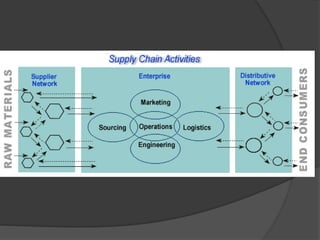
Supply Chain Management:
 Supply chain management is the process of
delivering a product from raw material to the
consumer.
 It includes supply planning, product planning,
demand planning, sales and operations
planning, and supply management.
Supply Chain Management process
 The supply chain management process is
composed of four main parts: product portfolio
management, demand management, S&OP,
and supply management.
Demand management
 Demand management consists of three parts: demand
planning, merchandise planning, and trade promotion
planning.
 Demand planning is the process of forecasting demand to
make sure products can be reliably delivered. Effective
demand planning can improve the accuracy of revenue
forecasts, align inventory levels with peaks and troughs in
demand, and enhance profitability for a particular channel or
product.
 Merchandise planning is a systematic approach to planning,
buying, and selling merchandise to maximize the return on
investment (ROI) while simultaneously making merchandise
available at the places, times, prices, and quantities that the
market demands.
 Trade promotion planning is a marketing technique to
increase demand for products in retail stores based on
special pricing, display fixtures, demonstrations, value-added
bonuses, no-obligation gifts, and other promotions. Trade
promotions help drive short-term consumer demand for
products normally sold in retail environments.
Supply management
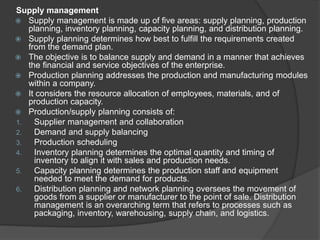
 Supply management is made up of five areas: supply planning, production
planning, inventory planning, capacity planning, and distribution planning.
 Supply planning determines how best to fulfill the requirements created
from the demand plan.
 The objective is to balance supply and demand in a manner that achieves
the financial and service objectives of the enterprise.
 Production planning addresses the production and manufacturing modules
within a company.
 It considers the resource allocation of employees, materials, and of
production capacity.
 Production/supply planning consists of:
1. Supplier management and collaboration
2. Demand and supply balancing
3. Production scheduling
4. Inventory planning determines the optimal quantity and timing of
inventory to align it with sales and production needs.
5. Capacity planning determines the production staff and equipment
needed to meet the demand for products.
6. Distribution planning and network planning oversees the movement of
goods from a supplier or manufacturer to the point of sale. Distribution
management is an overarching term that refers to processes such as
packaging, inventory, warehousing, supply chain, and logistics.
Sales and operations planning (S&OP)
 Sales and operations planning (S&OP) is a
monthly integrated business management process
that empowers leadership to focus on key supply
chain drivers, including sales, marketing, demand
management, production, inventory management,
and new product introduction.
 With an eye on financial and business impact, the
goal of S&OP is to enable executives to make
better-informed decisions through a dynamic
connection of plans and strategies across the
business.
 Often repeated on a monthly basis, S&OP enables
effective supply chain management and focuses
the resources of an organization on delivering what
their customers need while staying profitable.
Product portfolio management
 Product portfolio management is the process
from creating a product idea creation to market
introduction. of creating an idea for a product and
following through on it until the product is
introduced to the market.
 A company must have an exit strategy for its
product when it reaches the end of its profitable
life or in case the product doesn’t sell well.
 Product portfolio management includes:
 New product introduction
 End-of-life planning
 Cannibalization planning
 Commercialization and ramp planning
 Contribution margin analysis
 Portfolio management
 Brand, portfolio, and platform planning
Supply chain management best practices
 To succeed in a growing global market, you need a supply chain
that’s connected from start to finish, across your enterprise and
beyond.
 Here are five steps we recommend to achieve connected supply
chain planning.
Why supply chain management is Important
 A positive or negative impact on the supply chain resounds
throughout the business. There are two core areas to the
impact: customer happiness and ROI.
 Happy customer = happy business = higher performance
 In January 2018, Tobin Moore from Optoro pointed out this striking
statistic at Retail’s Big Show: If a customer is happy with the way
their return process was handled, they’re 71 percent more likely to
become a repeat customer.
 A smooth return process means an effective supply chain, one that’s
well connected and involves communication along the chain. When
the supply chain meets or exceeds the expectations of the
customer, it’s because of efficiencies. The entire business benefits
through higher-order rates, positive sentiment in the customer’s
mind, and lower cost-to-serve for the business.
 Higher performance = more cost efficiency = higher
pressure?
 Higher performance is measured in terms of the efficiency of
all processes and people to move goods and services to
market along the supply chain.
 Increased supply chain efficiency can translate to pressure
on the team and their capabilities, as costs and budgets are
held flat or reduced when they’re expected to move the
same or a greater volume of product at the same or a higher
quality level.
 Improvements to profits for the business are measured via
metrics like working capital turnover or cash conversion
performance; as business health improves, profitable cash
management and revenue conversion are the result.
Flattening the cost curve often becomes a challenge unless
two factors are considered: new capabilities (process and
data) that drive faster, higher-quality decisions; and using a
tool that scales favorably for the value it delivers for the
business
UNIT – II
PURCHASING POLICIES AND
PROCEDURES
Buyer-Seller Relationship
 Buyers and sellers in mature industrial markets can turn single
transactions into long-term beneficial relationships by a deeper
understanding of the complex connection between the two.
 A “must-do” for the sellers, in particular, is to understand patterns
of investment and reward, and effectively manage the process
that defines the dynamics of buyer-seller evolution.
 The buyer is the person or organization that purchases products
from suppliers.
 A buyer could be a manufacturer purchasing raw materials a
customer buying a finished product from a retailer.
 The relationship between the buyer and seller can be either short
term (one off or low commitment purchases) or long term,
involving regular purchases based on established agreements.
 Both short term and long term buyer and seller relationships have
advantages and disadvantages.
 Short term relations can be useful when a degree of flexibility is
required.
 For example, short term agreements give the buyer the option to
switch suppliers for their next purchase.
 They can also be beneficial in markets where the prices of materials are
volatile and long term commitments are not appropriate.
 The high level of competition to win short term contracts can also
provide opportunities for price discounting and special deals to be done.
 However, short term arrangements also have their disadvantages. They
generally provide little scope for payment and order flexibility.
 For example, a new supplier on a short term agreement will want a
definite order and prompt payment.
 There is no trust built up over time between parties, so building Buyer
and Seller Relations the opportunity to share market information is also
reduced.
 There are many advantages that come as a result of building strong
buyer and seller relations over a period of time.
 There is a greater commitment from both groups which means that you
will be better able to rely on them when it comes to orders and
payments.
 There may also be more scope for discounts after the relationship is
established and there may be more flexibility in the timing of payments.
 Trust between the buyer and seller is developed over time and this may
allow for the sharing of information, forecasts, knowledge and customers
between the buyer and seller.
 However, long term buyer and seller relationships generally
involve a high level of commitment and work to maintain.
Entering into long term contracts may be involved so it is
important to have accurate forecasts about the future
performance and needs of both businesses.
 Supply chain partnerships can be formed between
organizations to provide a level of stability and encourage
long term commitment from different parties towards
achieving results.
 Three critical aspects of supply chain partnerships are:
recognizing opportunities that would benefit from a
partnership, selecting the right partners and meeting your
requirements as a partner.
 Generally, most organizations will have a balance of both
long term and short term relationships with their buyers and
sellers. This balance can provide some of the benefits of
both, while also reducing the amount of associated risks
potential problems.
Buyer and Sales Representative Interaction:
 The most important part of buyer-seller relationship is the
interaction between a representative of the buying organization
(buyer) and a representative of the selling organization (sales
representative or sales representative).
 There are many other persons from both the organizations
involved in the relationship, but the basic building block of the
relationship is based on buyer and sales rep’ interactions. When
the buyer and the sales representative meet, the nature of their
interactions depend upon their roles, behavior and perceptions.
Buyer’s Perception of Sales Representative:
 There are two major perceptions held by buyers of sales
representatives. One is the stereotypical description of the sales
reps, as “talkative”, “easy going”, “manipulative”, “competitive”,
“optimistic”, and “excitable”.
 An industrial buyer, who does not have previous experience with
a particular sales representative, may respond to the sales
representative in terms of the stereotype which he has of sales
representative in the general.
 The second major perception of the buyer depends on the
reputation of the company which a sales representative
represents.
 Generally, the sales representative of a company with
better reputation always gets a more favourable initial
response from the industrial purchasers.
 For example – a sales engineer working with a reputed
company like Larsen & Toubro (L&T), often got a positive
response from the industrial customers.
 However, when the same sales engineer changes the job
to a less reputed company, as a sales executive, the
response was not encouraging, as he had to wait for a long
time before he was called in for discussions.
The Role Played by Industrial Buyer:
 An analysis of industrial buyer behaviour indicates that
personal needs, interaction in the buying centre, an
organizational objectives (or needs) determine the
response of a buyer to the selling efforts by a sales rep.
 For example – an industrial buyer may be motivated by a
personal need for salary increment and promotion in his
job, and also by a social or organizational need to satisfy
the user department. A buying decision may allow the buyer
to satisfy both the sets of needs.
The specific personal and social needs will decide:
1. Whether the buyer meets with a sales rep,
2. Which parts of sales rep’s presentation he listens,
3. The influence of sales presentation on his decision to buy.
Purchasing policies
 A purchasing policy is a collection of rules that control the
requisition process.
 Purchasing policies help procurement administrators implement
their procurement strategy by creating a policy structure that is
aligned with the organization’s strategic purchasing
requirements.
 A purchasing policy consists of a set of policy rules. When you
define a policy rule, you first select a rule type. You then create a
rule for the rule type by defining the settings, the start date, and
the end date for the rule.
 For example, an administrator creates a policy, selects
the Catalog policy rule type, and then adds a catalog policy rule
to the policy.
 This catalog policy rule specifies that the Adventure catalog must
be used for internal procurement.
 After the purchasing policy is associated with a particular
organization, employees of that organization see the Adventure
catalog when they create requisitions.
Assigning policies to organizations
 Before a policy can take effect, it must be associated with
an organization.
 Purchasing policies are associated with the Procurement
internal control hierarchy purpose. Therefore, purchasing
policies apply only to organizations in hierarchies that have
a hierarchy purpose of Procurement internal control.
 You can also select organizations from the flat list of legal
entities in the Company Info table. These legal entities are
designated in the policy framework as “Companies.”
Determining which rule to apply
 Depending on how you configure your purchasing policies,
multiple rules can affect the users in an organization.
 The following examples illustrate different ways that you
can configure purchasing policies and specify how policies
are applied when a transaction occurs.
Example 1: Simple purchasing policy configuration
 Organizations that are small and less complex can set up purchasing
policies by legal entity, and can use only the Companies organization
hierarchy.
 For Fabrikam, a small business, purchasing requirements vary little
across the organization.
 Purchasing rules vary only among the organization's legal entities. For
example, employees of Fabrikam Canada and employees of Fabrikam
U.S. purchase goods and services from different catalogs and different
vendors. Therefore, Fabrikam sets up its purchasing policies at the
legal-entity level.
 Fabrikam creates two purchasing policies. Policy A applies to its U.S.
legal entity, 1111. Policy B applies to its Canadian legal entity, 2222.
When an employee in legal entity 1111 creates a purchase requisition,
the policy rules are derived from policy A. For example, the product
catalog that the employee sees is specified in the catalog policy rule for
policy A.
 When an employee in legal entity 2222 creates a purchase requisition,
the policy rules are derived from policy B.
 Note: If an employee of legal entity 1111 purchases an item on behalf of
an employee of legal entity 2222, the policy rules that are specified for
legal entity 2222 (that is, the policy rules from policy B) are applied.
Example 2: Complex purchasing policy configuration
 In the previous example, all purchasing rules were defined in a
single organization hierarchy, the Companies organization
hierarchy.
 However, a complex organization might define policies for
multiple organization hierarchies.
 Contoso is a large company that requires complex purchasing
rules to control the requisition process.
 Contoso has defined rules for two different organization
hierarchies: Department and Global purchasing control.
 Policy 123 is defined for the Department organization hierarchy
for the Sales UK – Sales department. In policy 123, the purchase
requisition control rule specifies that restrictions must be
enforced for minimum order quantities.
 In this rule, the Enforce minimum order quantity
restrictions option is selected.
 Policy 456 is defined for the Global purchasing control
organization hierarchy for the Sales and Marketing department.
In policy 456, the purchase requisition control rule doesn't specify
that restrictions must be enforced for minimum order quantities.
In this rule, the Enforce minimum order quantity
restrictions option is de-selected.
 Sam works in the Sales UK – Sales department in Contoso’s United Kingdom
office. The policies for both the Department and Global purchasing control
organization hierarchies apply to his department. When Sam creates a purchase
requisition, the system must determine which policy to apply. The system
administrator set up the purchasing policy parameters to specify that purchasing
policies must be applied in the following order of precedence:
1. Global purchasing control
2. Department
3. Companies
 Therefore, policy 456 is applied to the purchase requisition that Sam creates,
and no minimum order quantity is required for the purchase requisition.
Purchasing Policy Rules
Catalog policy rule
 The catalog policy rule determines which procurement catalog users see when
they create purchase requisitions.
 If a user has been granted permission to order products on behalf of another
user, the requisition uses the catalog policy rule that is defined for the requester’s
legal entity and operating unit to determine which catalog to display.
 Before you can define a catalog policy rule, you must create and publish a
procurement catalog.
Category access policy rule
 The category access policy rule determines which categories users have access
to when they create purchase requisitions. If no rule is specified, all the
procurement categories can be added to the purchase requisition.
 Select the Include parent rule option to apply the category access policy rule of
the parent organization to the category.
 In the Available categories pane, select the categories
that the rule applies to. When you select a category, all
categories that are higher in the hierarchy are also added
to the Selected categories list.
 Select the Include subcategories option to apply the rule
to all subcategories of the selected category.
Category policy rule
 The category policy rule defines how users can select
vendors for each category.
 It also defines requirements for the receiving and invoicing
processes.
Re-approval rule for purchase orders
 The re-approval rule is an optional rule that defines the
criteria for requiring re-approval when a purchase order is
changed.
 The selected fields are evaluated in the purchase order
workflow when the "Requires purchase order re-approval"
condition is set up in the workflow.
Purchase requisition RFQ rule
 The purchase requisition RFQ rule defines criteria for requiring a request
for quotation (RFQ) for a purchase requisition line.
 If a line meets the conditions, the "informal RFQ" or "formal RFQ" stamp
appears on the requisition line.
Purchase requisition control rule
 The purchase requisition control rule for requisitions of
type consumption is an optional rule. When you create rules of this type,
you can set options on various tabs:
 On the Workflow submission tab, you can configure the fields that must
be entered on the requisition line for the requisition to be submitted for
approval.
 On the Order quantities tab, you can configure the fields that are
required on the purchase requisition under certain conditions. You can
also enforce order quantities.
 On the Dates tab, you can configure whether the accounting date is the
same as the requested date
 On the Address tab, you can define whether the user is allowed to create
new addresses in the system to apply to the purchase requisition.
Requisition purpose rule
 The requisition purpose rule is an optional rule that determines the type of
requisition purpose that is allowed for a specific legal entity.
 Unless another purpose is indicated in this rule, requisitions automatically
have a purpose of Consumption when they are created.
Replenishment category access policy rule
 The replenishment category access policy rule is an
optional rule that determines the products that are available
to fulfill requisition demand for a specific legal entity when
the requisition purpose is Replenishment.
Replenishment control rule
 The replenishment control rule is an optional rule that
defines the fields that must be entered on the requisition line
for the requisition to be submitted for approval when the
requisition purpose is Replenishment.
Purchase order creation and demand consolidation rule
 The purchase order creation and demand consolidation rule
defines the policy rules to use when a purchase order is
generated from an approved purchase requisition. When
you create rules of this type, you can set options on various
tabs:
 On the Purchase order split tab, you can define
criteria for splitting purchase requisition lines onto
separate purchase orders.
 On the Price/discount transfer tab, you can
define when to recalculate the price agreement
when a purchase order is created:
 Only if no trade agreement – Prices and discounts
are transferred from the purchase requisition only if
there is no applicable trade agreement or base price.
If a trade agreement or base price exists for the item
or vendor, the prices and discounts are recalculated
based on the trade agreement or the base price, and
are applied to the purchase order. Unless otherwise
specified, this is the default behavior.
 Always – Prices and discounts are always transferred
from the purchase requisition.
 You can also allow the requester to change the method of price
and discount transfer for individual purchase requisition lines,
regardless of the price/discount transfer rule that is defined.
 Select the Allow manual override per purchase requisition
line option to enable this capability.
 On the Item description transfer tab, you can transfer the item
description from the requisition when it originates from an RFQ.
 On the Price Tolerance tab, you can define rules to route
approved purchase requisitions back through the review process
when the price of a procurement catalog item increases. Set the
maximum amount that the net amount on a line item on a
purchase requisition can increase between the time when the
purchase requisition is approved and the time when the
purchase order is created. The net amount is calculated by
using the following formula: ([Quantity × (Unit price – Discount) ÷
Price unit] + Purchase miscellaneous charges) × (100 –
Discount percent) ÷ 100 Purchase requisition lines that exceed
the price tolerance that you set are held for manual processing.
The rules that you configure on the Error processing tab
determine how the purchase requisition lines are processed.
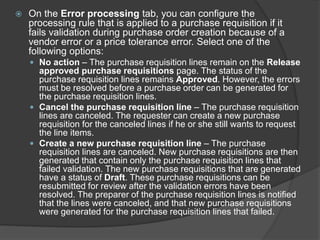
 On the Error processing tab, you can configure the
processing rule that is applied to a purchase requisition if it
fails validation during purchase order creation because of a
vendor error or a price tolerance error. Select one of the
following options:
 No action – The purchase requisition lines remain on the Release
approved purchase requisitions page. The status of the
purchase requisition lines remains Approved. However, the errors
must be resolved before a purchase order can be generated for
the purchase requisition lines.
 Cancel the purchase requisition line – The purchase requisition
lines are canceled. The requester can create a new purchase
requisition for the canceled lines if he or she still wants to request
the line items.
 Create a new purchase requisition line – The purchase
requisition lines are canceled. New purchase requisitions are then
generated that contain only the purchase requisition lines that
failed validation. The new purchase requisitions that are generated
have a status of Draft. These purchase requisitions can be
resubmitted for review after the validation errors have been
resolved. The preparer of the purchase requisition lines is notified
that the lines were canceled, and that new purchase requisitions
were generated for the purchase requisition lines that failed.
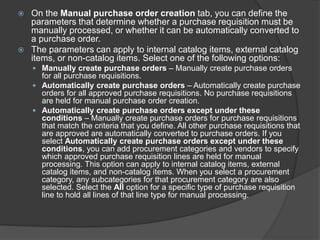
 On the Manual purchase order creation tab, you can define the
parameters that determine whether a purchase requisition must be
manually processed, or whether it can be automatically converted to
a purchase order.
 The parameters can apply to internal catalog items, external catalog
items, or non-catalog items. Select one of the following options:
 Manually create purchase orders – Manually create purchase orders
for all purchase requisitions.
 Automatically create purchase orders – Automatically create purchase
orders for all approved purchase requisitions. No purchase requisitions
are held for manual purchase order creation.
 Automatically create purchase orders except under these
conditions – Manually create purchase orders for purchase requisitions
that match the criteria that you define. All other purchase requisitions that
are approved are automatically converted to purchase orders. If you
select Automatically create purchase orders except under these
conditions, you can add procurement categories and vendors to specify
which approved purchase requisition lines are held for manual
processing. This option can apply to internal catalog items, external
catalog items, and non-catalog items. When you select a procurement
category, any subcategories for that procurement category are also
selected. Select the All option for a specific type of purchase requisition
line to hold all lines of that line type for manual processing.
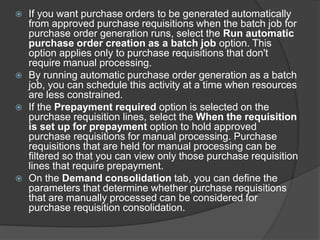
 If you want purchase orders to be generated automatically
from approved purchase requisitions when the batch job for
purchase order generation runs, select the Run automatic
purchase order creation as a batch job option. This
option applies only to purchase requisitions that don't
require manual processing.
 By running automatic purchase order generation as a batch
job, you can schedule this activity at a time when resources
are less constrained.
 If the Prepayment required option is selected on the
purchase requisition lines, select the When the requisition
is set up for prepayment option to hold approved
purchase requisitions for manual processing. Purchase
requisitions that are held for manual processing can be
filtered so that you can view only those purchase requisition
lines that require prepayment.
 On the Demand consolidation tab, you can define the
parameters that determine whether purchase requisitions
that are manually processed can be considered for
purchase requisition consolidation.
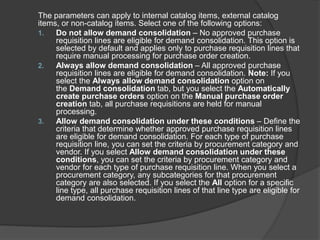
The parameters can apply to internal catalog items, external catalog
items, or non-catalog items. Select one of the following options:
1. Do not allow demand consolidation – No approved purchase
requisition lines are eligible for demand consolidation. This option is
selected by default and applies only to purchase requisition lines that
require manual processing for purchase order creation.
2. Always allow demand consolidation – All approved purchase
requisition lines are eligible for demand consolidation. Note: If you
select the Always allow demand consolidation option on
the Demand consolidation tab, but you select the Automatically
create purchase orders option on the Manual purchase order
creation tab, all purchase requisitions are held for manual
processing.
3. Allow demand consolidation under these conditions – Define the
criteria that determine whether approved purchase requisition lines
are eligible for demand consolidation. For each type of purchase
requisition line, you can set the criteria by procurement category and
vendor. If you select Allow demand consolidation under these
conditions, you can set the criteria by procurement category and
vendor for each type of purchase requisition line. When you select a
procurement category, any subcategories for that procurement
category are also selected. If you select the All option for a specific
line type, all purchase requisition lines of that line type are eligible for
demand consolidation.
Purchasing Procedure
 It’s often considered interchangeable with the
term procurement process, but the purchasing process itself
is more confined to actually obtaining goods and services,
while procurement refers to the overall framework
established to optimize that purchasing for maximum value,
savings, and efficiency.
 A better synonym for the purchasing process is the procure-
to-pay (P2P) process.
 The purchasing process is, at its most basic, as simple as
conducting a transaction. Much in the same way a
consumer might research and purchase the best appliance
for their home, your procurement team uses the purchasing
process to requisition goods and services through your
supply chain.
 The primary benefit of a formal process for purchasing is
avoiding waste due to fraud, rogue spend, theft, and other
financial pitfalls that accompany undocumented, non-
optimized buying habits.
 But because procurement sits at the heart of the value
creation process for your company, formalizing and
optimizing your purchasing process is also important to:
1. Creating and efficient and effective buying process for not just
direct spend (e.g., raw materials) but indirect spend (e.g., office
supplies, IT services, etc.).
2. Successful supplier relationship management.
3. Optimal supply chain management and strategic sourcing (for
both cost savings and value)
4. Streamlining the procurement cycle and all its sub-processes.
5. Providing a solid audit trail for internal and external review.
6. Establishing a model for business process management that
can be applied across your entire organization.
 The purchasing process is a cycle, with each step requiring
the exchange of information and various approvals to move
forward.
 Every business will have its own unique touches to add, but
generally speaking, the purchasing process follows a well-
established pattern of events.
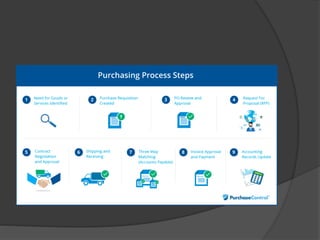
Purchasing process steps:
1. Needs Analysis
2. Purchase Requisition to Purchase Order
3. Purchase Order Review and Approval
4. Requests for Proposal
5. Contract Negotiation and Approval
6. Shipping and Receiving
7. Three-Way Matching
8. Invoice Approval and Payment
9. Accounting Records Update
1. Needs Analysis
 At this stage, the company recognizes and documents a need for
goods or services to solve a particular problem.
 The procurement team describes the need to be met, and works
with others to determine how best to do so.
 For example, a company facing high travel expenses might invest
in more fuel-efficient company transportation for its sales staff, or
reduce the amount of travel required for remote employees by
investing in advanced telecommunication software.
2. Purchase Requisition to Purchase Order
 The “purchasing” portion of the purchasing process kicks off with a purchase
requisition submitted to the purchasing department or purchasing manager by
the individual, team, or department requesting the goods or services.
 The purchase requisition contains full details on the items or services to be
obtained.
 Purchase requests below established budget thresholds are automatically
updated to purchase orders, and submitted to the preferred supplier for that
item or service.
 More expensive purchases, or unexpected purchases not in the budget, will be
forwarded to the appropriate individuals for review and approval before they
can be transferred to POs.
 Rejected purchase requisitions are returned to the issuing party for review and
correction or clarification as needed.
3. Purchase Order Review and Approval
 Approved purchase orders are sent to accounting to verify the funds exist in the
appropriate budget to cover the requested goods and services.
4. Requests for Proposal
 POs that receive budget approval are returned to the procurement department
and, as required, used to create requests for proposal (RFPs), also known
as requests for quotation, or RFQs.
 These are dispatched to vendors to solicit bids to fulfill the order for goods or
services.
 Potential suppliers submit their bids, and are carefully reviewed based on their
performance history, compliance records, and important characteristics such as
average lead times, reputation, and price.
5. Contract Negotiation and Approval
 The vendor with the winning bid is then awarded a contract, which is
further refined before signing to ensure optimal terms and conditions
and to ensure a mutually satisfactory arrangement for both parties.
 Once the contract is signed, the purchase order is a legally binding
agreement between buyer and seller.
6. Shipping and Receiving
 The supplier delivers the goods or services within the agreed-upon
timeframe.
 Once they’ve been received (in the case of goods) or performed (in the
case of services), the purchaser carefully reviews the goods and
services to ensure they’ve received what was promised, and notifies the
vendor of any issues.
7. Three-Way Matching
 A cornerstone of spend management, three-way-matching is the
comparison of shipping documents/packing slips with the original
purchase order and the invoice issued by the supplier. This comparison
is used to ensure all the information related to the transaction is
accurate.
 Discrepancies must be rectified as soon as possible to avoid additional
charges, delays in production and payment, or damage to supplier
relationships.
8. Invoice Approval and Payment
 Successfully matched orders are approved for
payment.
 Any modifications or additional charges may require
another layer of approvals before payment can be
issued. Once approved, payment is issued to the
vendor.
 Ideally, such payments are made with the goal of
capturing early payment discounts and other
incentives while avoiding late payment fees.
9. Accounting Records Update
 Completed orders are recorded in the company’s
books, and all documents related to the transaction
are securely stored in a centralized location.
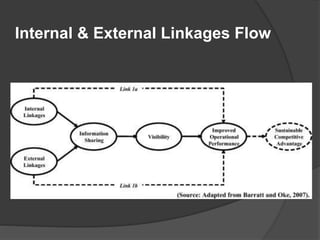
Internal & External Linkages and Flow of
Purchasing
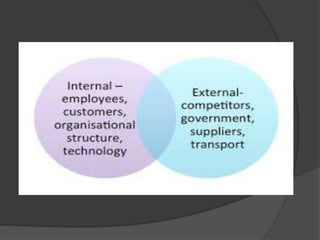
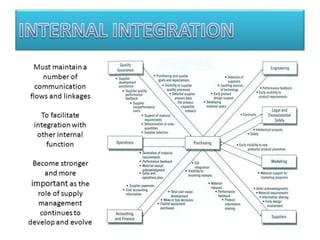
 Internal integration depends on interconnections
among Marketing/ Sales, Purchasing, Production and
Logistics department
 The external purchasing refers to the network of
activities outside of a company such as
transportation, and the environmental factors
 It's the series of processes that are essential to get
products or services from requisition
to purchase order and invoice approval.
 While purchasing is the overarching process of
obtaining necessary goods and services on behalf of
an organization
Internal & External Linkages Flow
Internal Linkage
 The purpose of creating internal linkages has
been to enhance information sharing
 Must maintain a number of communication
flows and linkages to facilitate integration
with other internal function
 Becomes stronger and more important as the
role of supply management continues to
develop and evolve
External Integration
 Supply management represents the external face of the
organization
 Serve as the primary vehicle to integrate external suppliers and
other entities into the organization
 Acts as a liaison with external parties on multiple fronts
(materials, new technology, information and services)
 Linkages: Suppliers Local Communities Government
 There have been two separate approaches to considering the
impact of information sharing via external linkages on supply
chain performance.
 Secondly, there has been a relatively small amount of empirical
research that links the sharing of information to supply chain
performance:
 continuous replenishment for reducing cost of goods;
 customer perceptions of logistics service provider's performance;
 information sharing as an antecedent to JIT purchasing;
 new product performance; and
 supplier performance
Buyer - Supplier Relationship:
 It is defined using 3 different concepts;
1. Contractual
2. Collaborative
3. Strategic alliances
Contractual Buyer - Supplier Relationship:
 The relationship between a buyer and supplier can be complex, because
each one (Buyer and Supplier) wants to maximize its time, resources and
cash investment; these may be competing priorities that can straining the
relationship.
 The buyer is the person or organization that purchases products from
suppliers.
 A buyer could be a manufacturer purchasing raw materials a customer
buying a finished product from a retailer.
 The relationship between the buyer and supplier can be either short term
or long term, involving regular purchases based on established
agreements.
 Both short term and long term buyer and supplier relationships have
advantages and disadvantages.
 Short term relations can be useful when a degree of flexibility is required.
For example, short term agreements give the buyer the option to switch
suppliers for their next purchase.
 They can also be beneficial in markets where the prices of materials are
volatile and long term commitments are not appropriate. The high level of
competition to win short term contracts can also provide opportunities for
price discounting and special deals to be done.
 However, short term buyer and supplier relationship also have
so many disadvantages.
 They generally provide little scope for payment and order
flexibility.
 For example, a new supplier on a short term agreement will
want a definite order and prompt payment.
 There is no trust built up over time between parties, so the
opportunity to share market information is also reduced.
 Buyer-supplier relationships refer to commercial transactions
between organizations for the purchase and supply of goods
or services.
 Although inter organizational transactions have always been
important in purchasing and marketing practice, it is only
comparatively recently that interest in buyer-supplier
relationships has spread across a range of management
disciplines reflecting global changes in production methods
and work organization in the late 20th century that have made
the management of external relationships central to
understanding contemporary organizational practices and
performance.
 Across a wide range of industrial sectors, there has been a trend
over the past 20 years away from traditionally arm’s length or
adversarial relationships with suppliers, toward various forms of
obligations or relational contracting.
 These more-cooperative forms of contracting commonly involve
the establishment of long-term strategic partnerships or alliances,
and have often occurred in tandem with the outsourcing of
business functions and rationalization of supply bases.
 There are many advantages that come as a result of building
strong buyer and supplier relations over a period of time.
 There is a greater commitment from both groups which means
that you will be better able to rely on them when it comes to
orders and payments.
 There may also be more scope for discounts after the relationship
is established and there may be more flexibility in the timing of
payments.
 Trust between the buyer and supplier is developed over time and
this may allow for the sharing of information, forecasts,
knowledge and customers between the buyer and supplier.
 However, long term buyer and supplier relationships
generally involve a high level of commitment and work to
maintain. Entering into long term contracts may be involved
so it is important to have accurate forecasts about the future
performance and needs of both businesses.
 Supply chain partnerships can be formed between
organizations to provide a level of stability and encourage
long term commitment from different parties towards
achieving results.
 Three critical aspects of supply chain partnerships are:
recognizing opportunities that would benefit from a
partnership, selecting the right partners and meeting your
requirements as a partner.
 Generally, most organizations will have a balance of both
long term and short term relationships with their buyers and
suppliers.
 This balance can provide some of the benefits of both, while
also reducing the amount of associated risks potential
problems.
Collaborative Buyer-Supplier relationship
 buyers and suppliers have recognized that a purely transactional
approach is rarely optimal for either party. Supply chain efficiency
depends,
 in part, on the availability of information to both parties. Information
exchange is best facilitated through collaborative relationships in
which buyers and suppliers work together to build efficient systems.
 There is, of course, a human component to such relationships, but
digitization through eCommerce applications, eProcurement
platforms, and the integration of the two has a major role to play.
 Cultivating collaborative supplier relationships is not primarily about
making those relationships more friendly or ethical, but about
building relationships that create value for both parties.
 Last year, the University of Tennessee published End-to-End
Supply Chain Collaboration, a white paper discussing how
businesses can improve supply chain efficiency and effectiveness.
 Their supply chain improvement model rests on six pillars:
integration, synchronization, collaboration, digitization, waste
elimination, and the use of platforms.
 Businesses that achieve those aims can maximize supply chain value for both
suppliers and buyers, but none of them can be realized to their full potential without
collaboration. With collaboration based on common values, a commitment to
efficient end-to-end processes, and reliable and predictable workflows, there is far
more likelihood of realizing the true value of the supply chain than with purely
transactional relationships.
 In short, better supplier relationships can help procurement professionals to
maximize their value to employers.
 In a blog post, eProcurement platform provider Jaggaer made similar points,
detailing how improving supplier relationships unlocks procurement value, enabling
more informed, collaborative, and faster supply decisions; the elimination of
inefficiencies and excess cost; and collaborative risk management. Suppliers and
buyers who collaborate are better able to find creative solutions to supply chain
challenges.
 It’s no surprise that an eProcurement platform recognizes the benefits of supply
chain collaboration.
 As I mentioned earlier, digitization, integration, and the use of platforms are key to
the cultivation of close collaborative relationships. On the buy-side, that means
eProcurement.
 On the sell-side, eCommerce applications allow suppliers to provide the digital
platforms buyers demand.
 The missing piece is often integration between buyer and seller platforms,
integration that can facilitate the exchange of procurement data like purchase orders
and invoices without error-prone manual labor.
 Much of this can be summed up with one word: automation. Automation, built on
platform integration, is an important enabler of collaborative relationships between
buyers and suppliers, which, in turn, are critical to finding value in the modern
supply chain.
Strategic Buyer-Supplier Partnership
 The strategic supplier partnership is the pinnacle
of supplier relationships and takes a more holistic
management approach to be successful.
 When making decisions about very strategic
engagements, consider each of the below
elements to ensure that the partner selection is
well-founded.
 Shared Investment
 Shared Planning & Management Systems
 Shared Communications
 Shared Risk
 Shared Reward
Cross functional sourcing terms for improving the SC performance and
relationship
 The collective strength of a team from roles in finance, manufacturing,
planning and logistics expands the procurement department's range of
expertise.
 A high performing cross-functional sourcing team can support the
procurement department in its efforts to locate new sources of supply and
solve a range of complex supplier related problems.
 Members of this team can come from such functions as finance, quality,
manufacturing, planning, logistics, field service, engineering and research
and development.
 These subject matter experts often have a tangential connection to the
supplier community in their daily jobs. Their collective strength lies in their
functional skills, providing a multiplier effect of technical and business
knowledge that expands the range of expertise of the procurement
department.
 A financial cost accountant is familiar with building and analyzing financial
models that would help in negotiations.
 The manufacturing engineer is a problem solver who works closely with
operations to overcome manufacturing related problems. Planners have
visibility to production schedules and inventory levels.
 Field service engineers have direct feedback from customers on
performance and service issues that can be valuable to procurement and
suppliers alike.
 Managing a cross-functional sourcing team can be a
challenge for the procurement leader given the diversity of
team members, their variable understanding of the
procurement process and their ability and commitment to
work well in a team-based approach.
 As with any cross-functional team, their efficacy matures
over time as members become more familiar with the
supplier community and their role in the team's
management.
 Here are four ways to increase sourcing team effectiveness.
1. Own the process
 The leader of the sourcing team is based in procurement
and is legally and functionally responsible for the
commercial relationship with the supplier.
 It is up to the procurement leader to coalesce input and
recommendations from team members into effective
sourcing and supplier support decisions.
 At the end of the day, the procurement department has the
ultimate responsibility for supplier performance.
2. Find the right mix of people
 One of the joys of working in procurement is the opportunity to
work with a variety of people across functions in the company.
 Procurement executives are professional relationship builders,
allowing them to identify potential members of the core sourcing
team and be aware of the range of potential subject matter
experts.
 The best sourcing teams have members who over time have
turned into strong colleagues and even friends.
 They understand each other, respect personal and professional
boundaries and learn from each other.
 Work with the key group and add specific expertise as the need
arises to maintain flexibility and reduce burnout.
 Colleagues who comprise the cross-functional sourcing teams
typically have other job responsibilities and are often on loan for a
defined period of time, or for the duration of the project.
 Adjust to the realization of competing priorities and internal politics
impacting their schedules and commitments. Be flexible and ready
to adjust to a changing cast.
3. Train the team members in procurement
 Just as procurement professionals depend on experts from
other fields, they need to demonstrate their knowledge to
others.
 As procurement professionals, it is important to train the
team members on the intricacies of the procurement process
and the unique needs of working with suppliers.
 Still, the team leader has the overall responsibility for the
supplier and should control all flow of information to and
from the supplier.
 Sourcing team members should not negotiate directly with a
supplier, make commitments to purchase or work beyond
their scope of responsibility or authority.
4. Let the team mature naturally
 Over time, confidence may develop within the sourcing team
that allows for individual members to work directly with
suppliers without the direct oversight of the procurement
leader.
 Some members of the team may establish relationships with
suppliers, often in aligned functions.
 Long-term sourcing projects, like outsourcing a
manufacturing line or finding suppliers to support
a new product, require a long ramp up process to
get suppliers running at full speed.
 In some cases, the sourcing team leader may
deploy members to visit suppliers and solve
problems.
 Establish a simple communication protocol within
the sourcing team to maintain an accurate flow of
information.
 For the optimum cross-functional sourcing team,
identify a core group of colleagues from aligned
functions who want to work together, add specific
expertise as needed and create an interesting
and fulfilling environment.
 Soon colleagues will clamor to get on your team.
Advantages of Cross functional sourcing
 Below are the advantages of Cross Functional sourcing team;
1. Gain a better insight
2. Engaged employees
3. Spurring innovative ideas
4. Exercising communication skills
5. Developing management skills
6. Leadership roles
7. Break stereotype and benefit from diversity
8. Build team spirit
1. Gain a better insight
 To bring a gulp of creative ideas, cross-functional collaboration is
a great choice.
 Creativity is a group process. When the project managers, put
together people who are experts in different subjects, each with
unique skills sets, it will bring out some new perspectives.
 This method of collaboration will bring new insights to the team to
bring up creative solutions and enhance development.
 With each team member bringing their skills and knowledge to the
table, the work will progress and thrive bringing solutions quicker.
2. Engaged employees
 In the past few years, employee engagement seems to be declining.
 According to a 2013 Gallup Poll, 63% of employees are “not engaged” by
their current work.
 This makes a big difference to the overall productivity of the organization.
 Therefore, shifting to team-oriented structures can boost team bonding,
improving workplace dynamics.
 With a strong leader handling a cross-functional team will help in
combating silo mentality and bridge the gap between team members.
3. Spurring innovative ideas
 It is said that cross-functional team is a calculated investment for teams
to sip in productivity and work together.
 This is because a collaborative team brings new insights with which
comes innovation.
 It is a great way to boost creative minds to pool ideas together that
separates businesses from their competitors.
 When different minds playing different roles are brought together, they
think outside of the box to substantially bring better results.
 When people think in new ways, it helps them make smart mistakes, take
better risks and spur innovation and creativity.
4. Exercising communication skills
 Effective communication is the cornerstone of any team for
successful projects.
 It is an art that can make or break your team. Clear and
concise communication encourages sharing of ideas between
cross-functional teams.
 Having a cross-functional team means bringing in a diverse
group of people who can develop their struggles and strengths
of communicating by discussing constructive feedback and
understanding diversity issues.
5. Developing management skills
 Cross-functionality has another great value in honing
management skills.
 Of course, managing a team doesn’t come naturally to
everyone, it should be polished by learning through
experiences.
 When the teams are put together, your management skills will
really be put to the test.
 You will need to develop special skill sets to work with diverse
backgrounds and work styles and effectively lead a cross-
functional team going through unique challenges.
6. Leadership roles
 Well, when you are working together with teams from
different departments, you get the chance of being the boss
or maybe leading the way for your team.
 The manager can give chance to other folks in the team to
lead the project so they learn to be in the leadership role
and can pump new life into the project.
7. Break stereotype and benefit from diversity
 As it involves people from different areas, a team will know
the strengths of other teams.
 When a tech team meets non-tech team, they understand
each other’s efforts and take advantage of their knowledge.
 You start sharing common goals and foster a bit of
understanding.
 This type of understanding that breaks the stereotype, is a
boon for the business.
 Also, the diverse group of people of different age,
background and thoughts can bring new innovation to the
table.
8. Further, build team spirit
 The process of cross-functional teamwork will give you an
opportunity to make a team of high performers so they can bring
out something huge, grow more reliant and take big challenges.
 Together they can create a sense of unity and learn a more about
patience.
 Many teams in big organizations find it a challenge to create a
cross-functional collaboration to go an extra mile.
 So, you need to capitalize on times so you cross-functional teams
deliver its best to a complete advantage.
 As you decide that your project needs a cross-functional, adopt
the cross-functional collaboration best practices to help you make
a collaborative team.
 Identify who has the best skill sets along
 Make sure the right people are selected
 Build ongoing relationships with stakeholders
 Invest in a collaboration software
 Encourage cooperation between different units
 Goals should be mutually supportive
UNIT – III
Purchasing Strategy
Development Process
Purchasing and Corporate Strategy
Purchasing Strategy
 In most industrial firms, material constitutes 60–80 percent of the total revenue
dollars.
 Purchased inputs offer a potential source for helping a company develop leverage
against its competitors.
 Purchasing can give the firm advantages over its competitors.
 In essence, firms must design their purchasing actions to emphasize the competitive
strategy.
Purchasing and Competitive Strategy Linkage
 Purchasing professionals are expected to develop options that can help business
units remain competitive.
 Purchasing managers need to devise purchasing actions such that they are
consistent with each other and with the firm’s competitive strategy.
 The competitive priorities are a key determinant of the importance given to different
criteria in purchasing material
 The buyer performance measures or reward criteria are other factors that influence
the purchase criteria.
Competitive Strategy
 A firm can compete in two broad alternate ways. It can either seek competitive
advantages on cost or choose to differentiate itself from its competitors on some
attributes of the product or in the way it markets its product.
○ Cost and differentiation—is important but too broad to be useful for management faced with day-to-day
decision making.
○ The competitive strategy must be articulated in terms of competitive priorities. Key environmental
factors also must be considered.
Competitive Priorities
 The competitive priorities operationalize the firm’s competitive strategy.
 The two generic competitive advantages—delivery speed and reliability—
are operationalized in terms of cost, quality performance, quality conformity,
product flexibility, volume flexibility, and customer service.
Purchasing Criteria
 The criteria in buying material must reflect firms’ competitive priorities.
 A firm competing on cost must give high priority to purchasing costs.
 A firm competing on flexibility must give high priority to lead time in buying
material.
 With short lead times, the company can be more flexible; and develop the
ability to respond to changing situations quickly. Lead times are also
important in achieving superior customer service.
 Suppliers with short lead times and who are reliable in meeting their due
dates minimize the problem of material shortages for the manufacturer; as a
result, the company’s production can be more dependable in meeting the
customers’ due dates.
 The criterion on which the buyer’s performance is evaluated can influence
the effectiveness of purchasing actions and effectiveness in making the firm
competitive.
 Cost variance seems to be the dominant criterion in evaluating performance
of purchasing decision makers.
 As competitive forces increase, customers demand
better products, faster delivery, increased service, and
decreased costs.
 As firms become more competitive, a rippling effect is
experienced by the suppliers.
 As inventory levels are reduced throughout the supply
chain, each member becomes less insulated from
demand variation.
 Companies participate in a variety of supplier
relationships and take on a variety of roles.
 Each company can be a supplier, customer, or end-
user of products.
 Supplier partnerships can be categorized using five
factors:
1. Degree of risk/reward,
2. Type of relationship,
3. Information,
4. Planning, and
5. Asset ownership.
Supply Chain Relationship Environment
 In dynamic business environments, maintaining a competitive
advantage is a major survival factor.
 The advent of supply chain management has led to a more
complicated operating environment.
 Not only does the individual firm have to maintain its
competitive edge, the entire supply chain must be competitive.
 Competitive and industrial ranking can be used as a tool for
achieving continuous improvement in the industrial supply
chain.
Supply Chain Relationship Pegging
 The supply chain relationship pegging system consists of four
phases.
 Phase I is an assessment of the current performance gaps in
the process. In this phase, the performance gaps should be
prioritized based on the firm’s strategic direction and the
relative cost of taking action versus not taking action.
 Phase II consists of questionnaire development, interviews, or
other data collection methods
 Phase III is the classification and analysis phase
 The final phase (Phase IV) is the interpretation stage.
Integrated Buying Model
 The decision maker faces multiple goals in making the buying
decision.
 The cost per unit, quality, and lead time are some of the issues that a
decision maker faces in making the buying decision.
1. Cost
2. Quality Level
3. Lead Time
Materials Cost
 The cost per unit of material depends on the volume or amount
purchased, the quality level desired, and the desired lead time
 Material procured in larger volume enables the firm to buy at
discounts.
Quality Level
 The quality level of material purchased must meet the desired
objective as defined by the firm’s competitive priorities
 The lower the acceptable defect rate, the higher the quality level of
the material purchased
 Six sigma suppliers focus on
1. effects per million units as a standard metric,
2. provision of extensive employee training, and
3. the reduction of non-value-added activities.
Lead Time
 Supplier lead time affects a firm’s flexibility and
service to its own customers.
 Firms that compete in volatile markets and face
rapidly changing product or technology require
greater flexibility than firms competing in stable
markets
 With short lead times, the company can be
responsive to external changes.
 The more uncertainty there is in a vendor’s lead
times, the more difficult it is to manage the
production process.
Constraints
 A buyer must not only satisfy cost, quality, and
lead-time goals, but also stay within quantity and
budgetary constraints.
 The buyer must ensure that the right quantity of
material is purchased to satisfy the demand;
otherwise, shortages may occur, resulting in
poor customer service.
 The budget limitations may constrain the
amount of material that can be purchased at any
instant. The buyer may have to give up quantity
discounts, if the storage or budget resource is
not available.
Purchasing Strategic Plan
 There are a number of important challenges facing
materials managers and executives in the future.
 The opportunities, if pursued, will be unlimited; if not
pursued, devastating to the firm’s survival.
 In order to take full advantage of the challenges, the
purchasing function must be integrated into the firm’s
overall strategic plan.
Developing a Strategic Sourcing Plan
 The development of a strategic purchasing plan requires
the following: –
1. A complete understanding of corporate strategies and
marketing plans
2. An extensive evaluation/study of current suppliers, how
performance is measured, and the expectation of suppliers
relative to the industry.
3. Study of the degree of global purchasing opportunities.
4. Identification of total costs associated with current purchasing
department/function, budgets, staffing, and so forth.
The Strategic Sourcing Plan
 Phase 1. Sourcing Audit
 The sourcing audit is used as a diagnostic process that identifies
opportunities for increased profitability.
 Phase 2. Organizational Development
 This phase involves development of sourcing strategies; setting of
clearly outlined areas to cut costs and improve profitability;
establishment of a sourcing control system based on frequent analysis
and systematic approach; formulation of incentive programs; and
provisions for training by taking advantage of local ISM seminars and
in-house sessions on how to establish purchasing monitoring systems.
 Phase 3. Implementation and Evaluation
 In this phase, a thorough indoctrination of the company with sourcing
strategy, implementation of new procedures, monitoring of sourcing
activities, feedback mechanism for evaluation, and refinement of
sourcing processes is conducted.
 Phase 4. In-House Training Sessions
 Classes should be conducted in groups of no more than 15 individuals.
 Appropriate purchasing and other management personnel from the
company will attend these sessions to learn state-of-the-art purchasing
techniques, negotiation strategies, and cost containment methods.
Types of Purchasing Strategies
The following are 9 fundamental purchasing strategies that purchasing agents
have found help them make the best purchase decisions for their company or
business:
1. Supplier Optimization: Supplier optimization chooses a solid mix of
vendors who can provide the goods that the company will need in order to
meet their business needs. Suppliers who cannot meet both the pricing and
quantity of goods that companies need are being weeded out. This is the
most common of the common fundamental purchasing strategies for
businesses. The biggest advantage to this strategy for companies is that
only the best suppliers are left and their needs are more likely to be met.
2. TQM: Total quality management TQM) is another common way that
companies are optimizing their supply of goods and products. The TQM
procedure allows businesses and companies to help increase the quality of
their products while also reducing their total cost to obtain the supplies. The
lesser the costs a company incurs to acquire the product, the more the
company can cut prices to customers while not sacrificing their bottom
dollar or profit margin. In fact, many companies will see profit margins
increase as products become more affordable and more people can afford
to do business with the company.
3. Centralized Purchasing: Centralized purchasing can help limit waste as
all products are purchased from one central location. In many ways, it can
also help optimize the supply of products as there is only one variable in
the process of getting the needed supplies or products to the consumer as
there are less factors to rely on as less vendors are providing the product.
4. Risk Management: Businesses and companies all operate in a world of
some uncertainty. This uncertainty can pertain to a variety of things from
how the market will perform to how their business will do in the upcoming
year and everything in between. Chains of supply can be interrupted for a
variety of different reasons, which means that many companies will have to
study these risks and understand which risks are reasonable and which
ones are not. Other risks include everything from the potential for things
like labor stoppages to supply chain issues to inventory issues that may
arise throughout the time a business is operational.
5. Global Sourcing: Global sourcing allows a company to reach out to other
parts of and places in the world to get the supplies they need to run their
business when those resources are not readily available at a reasonable
price in their homeland. Global sourcing allows economies to intertwine
with each other as products are not shipped only throughout the same
country, but between nations all throughout the world. This allows people
throughout the entire world to be more productive when they have the
materials they need to run their businesses by reaching out to others who
have the "pieces of the puzzle" that they don't.
6. Vendor Development: The world of business is a fierce competition and
this holds true for vendors, too. Companies look for vendors who are
continually developing and offering new, better products to the businesses
looking to purchase them. The businesses and companies that seek
vendors who are constantly developing and improving their products
sooner will be the ones that end up getting ahead in the competitive
business world simply by having a better product to offer the consumer.
7. Focus On Quality: Companies and businesses need to focus on only purchasing
from vendors that offer top-quality products. In a world where the costs of living are
consistently rising, many more people are much more aware of every dollar they
spend. They expect quality for the money they are spending on the product.
Ensuring that your vendor that supplies top-quality products will entice more
people to buy your company's product and improve sales as well as revenue.
8. Green Purchasing: Green purchasing is becoming more and more common as
more companies seek to move to "green" production of their goods. Abiding by
"green" standards is not only better for the government, but many consumers will
opt to choose those products over those that are not proven to be as good for the
environment around them. In many cases, businesses and companies who
produce "green" products experience cost reductions in creating their products.
Many also experience an increase in consumer spending on their products as
more and more people purchase their product that is "green" and environmentally
friendly, rather than a competitor's product that is not environmentally friendly.
9. Continue Negotiations: Continue negotiations with vendors on a consistent basis
to ensure you are getting the best prices for the products you are purchasing. As
costs to produce goods lower over time, some vendors may have better prices
available for businesses that use them as a supplier. Constantly negotiating
ensures that you are getting the best prices and quality of goods possible at any
given time.
These are just 9 of the fundamental purchasing strategies that will help companies and businesses get the quality
goods and products that are needed for their businesses to operate optimally. While there is no one single
method that is better than another or more recommended than another, it will all depend on the business or
company and what strategy (or combination of strategies) can best meet those needs.
Stages of supply chain management strategy evolution
There are four stages to the evolution of such a supply chain network:
 Stage 1: Supply Management. The most basic stage, built around an internal
MRP system that is lead-time driven. It includes tier-one suppliers only. Most
planned vendor interaction is through documentation and seldom involves status
reporting. Communications are transactional and include quoting, purchase
orders, and releases.
 Stage 2: Supply Chain Management. This stage is characterized by an increased
scope and includes tier-two suppliers and beyond. There is also increased
interest in status reporting, some data sharing among participants, and generally
more complex interrelationships. Communications are transactional with the
addition of data flow.
 Stage 3: Supply Chain Integration. Includes programs that benefit all members of
the chain. It elevates supply to collaborative involvement among the members,
including strategic planning and risk sharing. Communications at this level go
well beyond transactions and data and include information of all types.
 Stage 4: Demand-Supply Network Collaboration. Cooperative interaction and
proactive behavior based on critical information that flows freely and
simultaneously throughout the supply network. It is sometimes referred to as the
glass pipe. I know of no examples of this stage in the electronics industry.
Stages of supply chain management strategy evolution
Integration era
 This era of supply-chain-management studies was highlighted with the development of electronic
data interchange (EDI) systems in the 1960s, and developed through the 1990s by the
introduction of enterprise resource planning (ERP) systems.
 This era has continued to develop into the 21st century with the expansion of Internet-based
collaborative systems.
 This era of supply-chain evolution is characterized by both increasing value added and reducing
costs through integration.
 A supply chain can be classified as a stage 1, 2 or 3 network. In a stage 1–type supply chain,
systems such as production, storage, distribution, and material control are not linked and are
independent of each other. In a stage 2 supply chain, these are integrated under one plan and
enterprise resource planning (ERP) is enabled.
 A stage 3 supply chain is one that achieves vertical integration with upstream suppliers and
downstream customers.
 An example of this kind of supply chain is Tesco.
Globalization era
 It is the third movement of supply-chain-management development, the globalization era, can be
characterized by the attention given to global systems of supplier relationships and the expansion
of supply chains beyond national boundaries and into other continents.
 Although the use of global sources in organisations' supply chains can be traced back several
decades (e.g., in the oil industry), it was not until the late 1980s that a considerable number of
organizations started to integrate global sources into their core business.
 This era is characterized by the globalization of supply-chain management in organizations with
the goal of increasing their competitive advantage, adding value, and reducing costs through
global sourcing.
Specialization era (phase I): outsourced manufacturing and distribution
• In the 1990s, companies began to focus on "core competencies" and
specialization.
• They abandoned vertical integration, sold off non-core operations, and outsourced
those functions to other companies.
• This changed management requirements, as the supply chain extended beyond
the company walls and management was distributed across specialized supply-
chain partnerships.
• This transition also refocused the fundamental perspectives of each organization.
• Original equipment manufacturers (OEMs) became brand owners that required
visibility deep into their supply base. They had to control the entire supply chain
from above, instead of from within. Contract manufacturers had to manage bills of
material with different part-numbering schemes from multiple OEMs and support
customer requests for work-in-process visibility and vendor-managed
inventory (VMI).
• The specialization model creates manufacturing and distribution networks
composed of several individual supply chains specific to producers, suppliers, and
customers that work together to design, manufacture, distribute, market, sell, and
service a product.
• This set of partners may change according to a given market, region, or channel,
resulting in a proliferation of trading partner environments, each with its own
unique characteristics and demands.
Specialization era (phase II): supply-chain management as a service
 Specialization within the supply chain began in the 1980s with the inception of transportation
brokerages, warehouse management (storage and inventory), and non-asset-based carriers,
and has matured beyond transportation and logistics into aspects of supply planning,
collaboration, execution, and performance management.
 Market forces sometimes demand rapid changes from suppliers, logistics providers, locations, or
customers in their role as components of supply-chain networks.
 This variability has significant effects on supply-chain infrastructure, from the foundation layers
of establishing and managing electronic communication between trading partners, to more
complex requirements such as the configuration of processes and work flows that are essential
to the management of the network itself.
 Supply-chain specialization enables companies to improve their overall competencies in the
same way that outsourced manufacturing and distribution has done; it allows them to focus on
their core competencies and assemble networks of specific, best-in-class partners to contribute
to the overall value chain itself, thereby increasing overall performance and efficiency.
 The ability to quickly obtain and deploy this domain-specific supply-chain expertise without
developing and maintaining an entirely unique and complex competency in house is a leading
reason why supply-chain specialization is gaining popularity.
 Outsourced technology hosting for supply-chain solutions debuted in the late 1990s and has
taken root primarily in transportation and collaboration categories.
 This has progressed from the application service provider (ASP) model from roughly 1998
through 2003, to the on-demand model from approximately 2003 through 2006, to the software
as a service (SaaS) model currently in focus today.
Supply-chain management 2.0 (SCM 2.0)
 Building on globalization and specialization, the term "SCM 2.0" has
been coined to describe both changes within supply chains
themselves as well as the evolution of processes, methods, and
tools to manage them in this new "era".
 The growing popularity of collaborative platforms is highlighted by
the rise of TradeCard's supply-chain-collaboration platform, which
connects multiple buyers and suppliers with financial institutions,
enabling them to conduct automated supply-chain finance
transactions.
 Web 2.0 is a trend in the use of the World Wide Web that is meant
to increase creativity, information sharing, and collaboration among
users.
 At its core, the common attribute of Web 2.0 is to help navigate the
vast information available on the Web in order to find what is being
bought. It is the notion of a usable pathway.
 SCM 2.0 replicates this notion in supply chain operations.
 It is the pathway to SCM results, a combination of processes,
methodologies, tools, and delivery options to guide companies to
their results quickly as the complexity and speed of the supply-chain
increase due to global competition; rapid price fluctuations; changing
oil prices; short product life cycles; expanded specialization; near-,
far-, and off-shoring; and talent scarcity.
Business-process integration
 Successful SCM requires a change from managing individual functions to integrating activities into key
supply-chain processes.
 In an example scenario, a purchasing department places orders as its requirements become known. The
marketing department, responding to customer demand, communicates with several distributors and
retailers as it attempts to determine ways to satisfy this demand. Information shared between supply-chain
partners can only be fully leveraged through process integration.
 Supply-chain business-process integration involves collaborative work between buyers and suppliers, joint
product development, common systems, and shared information. According to Lambert and Cooper
(2000), operating an integrated supply chain requires a continuous information flow. However, in many
companies, management has concluded that optimizing product flows cannot be accomplished without
implementing a process approach. The key supply-chain processes stated by Lambert (2004) are:
 Customer-relationship management
 Customer-service management
 Demand-management style
 Order fulfillment
 Manufacturing-flow management
 Supplier-relationship management
 Product development and commercialization
 Returns management
 Much has been written about demand management. Best-in-class companies have similar characteristics,
which include the following:
 Internal and external collaboration
 Initiatives to reduce lead time
 Tighter feedback from customer and market demand
 Customer-level forecasting
 One could suggest other critical supply business processes that combine these processes stated by
Lambert, such as:
Customer service management process
 Customer relationship management concerns the relationship between an organization and its customers.
 Customer service is the source of customer information.
 It also provides the customer with real-time information on scheduling and product availability through interfaces
with the company's production and distribution operations. Successful organizations use the following steps to
build customer relationships:
 determine mutually satisfying goals for organization and customers
 establish and maintain customer rapport
 induce positive feelings in the organization and the customers
Inventory management
 Inventory management is concerned with ensuring the right stock at the right levels, in the right place, at the
right time and the right cost.
 Inventory management entails inventory planning and forecasting: forecasting helps planning inventory.
Procurement process
 Strategic plans are drawn up with suppliers to support the manufacturing flow management process and the
development of new products.
 In firms whose operations extend globally, sourcing may be managed on a global basis. The desired outcome is
a relationship where both parties benefit and a reduction in the time required for the product's design and
development.
 The purchasing function may also develop rapid communication systems, such as electronic data interchange
(EDI) and internet linkage, to convey possible requirements more rapidly.
 Activities related to obtaining products and materials from outside suppliers involve resource planning, supply
sourcing, negotiation, order placement, inbound transportation, storage, handling, and quality assurance, many
of which include the responsibility to coordinate with suppliers on matters of scheduling, supply continuity
(inventory), hedging, and research into new sources or programs.
 Procurement has recently been recognized as a core source of value, driven largely by the increasing trends to
outsource products and services, and the changes in the global ecosystem requiring stronger relationships
between buyers and sellers.
Product development and commercialization
 Here, customers and suppliers must be integrated into the product development process in order to
reduce the time to market.
 As product life cycles shorten, the appropriate products must be developed and successfully launched
with ever-shorter time schedules in order for firms to remain competitive.
 According to Lambert and Cooper (2000), managers of the product development and commercialization
process must:
1. coordinate with customer relationship management to identify customer-articulated needs;
2. select materials and suppliers in conjunction with procurement; and
3. develop production technology in manufacturing flow to manufacture and integrate into the best
supply chain flow for the given combination of product and markets.
 Integration of suppliers into the new product development process was shown to have a major impact on
product target cost, quality, delivery, and market share.
 Tapping into suppliers as a source of innovation requires an extensive process characterized by
development of technology sharing, but also involves managing intellectual property issues.
Manufacturing flow management process
 The manufacturing process produces and supplies products to the distribution channels based on past
forecasts. Manufacturing processes must be flexible in order to respond to market changes and must
accommodate mass customization.
 Orders are processes operating on a just-in-time (JIT) basis in minimum lot sizes. Changes in the
manufacturing flow process lead to shorter cycle times, meaning improved responsiveness and efficiency
in meeting customer demand.
 This process manages activities related to planning, scheduling, and supporting manufacturing
operations, such as work-in-process storage, handling, transportation, and time phasing of components,
inventory at manufacturing sites, and maximum flexibility in the coordination of geographical and final
assemblies postponement of physical distribution operations.
Physical distribution
 This concerns the movement of a finished product or service to customers.
 In physical distribution, the customer is the final destination of a marketing
channel, and the availability of the product or service is a vital part of each
channel participant's marketing effort.
 It is also through the physical distribution process that the time and space of
customer service become an integral part of marketing.
 Thus it links a marketing channel with its customers (i.e., it links
manufacturers, wholesalers, and retailers).
Outsourcing/partnerships
 This includes not just the outsourcing of the procurement of materials and
components, but also the outsourcing of services that traditionally have been
provided in-house.
 The logic of this trend is that the company will increasingly focus on those
activities in the value chain in which it has a distinctive advantage and
outsource everything else.
 This movement has been particularly evident in logistics, where the provision
of transport, storage, and inventory control is increasingly subcontracted to
specialists or logistics partners.
 Also, managing and controlling this network of partners and suppliers
requires a blend of central and local involvement: strategic decisions are
taken centrally, while the monitoring and control of supplier performance and
day-to-day liaison with logistics partners are best managed locally.
Performance measurement
 Experts found a strong relationship from the largest arcs of supplier and customer
integration to market share and profitability. Taking advantage of supplier capabilities
and emphasizing a long-term supply-chain perspective in customer relationships can
both be correlated with a firm's performance.
 As logistics competency becomes a critical factor in creating and maintaining
competitive advantage, measuring logistics performance becomes increasingly
important, because the difference between profitable and unprofitable operations
becomes narrower.
 A.T. Kearney Consultants (1985) noted that firms engaging in comprehensive
performance measurement realized improvements in overall productivity.
 According to experts internal measures are generally collected and analyzed by the
firm, including cost, customer service, productivity, asset measurement, and quality.
 External performance is measured through customer perception measures and "best
practice" benchmarking.
Warehousing management
 To reduce a company's cost and expenses, warehousing management is concerned
with storage, reducing manpower cost, dispatching authority with on time delivery,
loading & unloading facilities with proper area, inventory management system etc.
Workflow management
 Integrating suppliers and customers tightly into a workflow (or business process) and
thereby achieving an efficient and effective supply chain is a key goal of workflow
management.
UNIT – IV
PROCUREMENT
TECHNOLOGY
IT systems in procurement
B2C e-commerce:
 There are five major activities involved in
conducting B2C e-commerce.
Information flow
Information
flow
Information
sharing
Payment
Ordering
Ordering
Fulfilment
1. Information Sharing: A B2C e-commerce may use some or all of the following
applications and technologies to share information with customers: Online
advertisements, e-mail, newsgroups/ discussion groups, company web site,
online catalogs, message board systems, bulletin board systems, multiparty
conferencing.
2. Ordering: A customer may use electronic e-mail or forms available on the
company's web site to order a product from a B2C site. A mouse click sends the
essential information relating to the requested piece(s) to the B2C site.
3. Payment: Credit cards, electronic checks, and digital cash are among the
popular options that the customer has as options for paying for the goods or
services.
4. Fulfillment: Fulfillment that is responsible for physically delivering the product
or service from the merchant to the customer. In case of physical products
(books, videos, CDs), the filled order can be sent to the customer using regular
mail, Cargo, FedEx, or UPS. As expected for faster delivery, the customer has
to pay additional money. In case of digital products (software, music, electronic
documents), the e-business uses digital documentations to assure security,
integrity, and privacy of the product. It may also include delivery address
verification and digital warehousing that stores digital products on a computer
until they are delivered. The e-business can handle its own fulfillment
operations or out source this function to third parties with moderate costs.
5. Service and Support: It is much cheaper to maintain current customers than
to attract new customers.
 For this reason, e-businesses should do whatever that they can in order to
provide timely, high-quality service and support to their customers.
 As e-commerce companies lack a traditional physical presence and need other
ways to maintain current customers, service and support are even more
important in e-commerce than traditional businesses.
 The following are some examples of technologies and applications used for
providing service and support: (E-mail confirmation, periodic news flash, and
online surveys may also be used as marketing tools.).
 E-mail confirmation: In most cases, the e-mail confirmation provides the
customer with a confirmation number that the customer can use to trace the
product or service. E-mail confirmation promises the customer that a particular
order has been processed and that the customer should receive the product/
service by a certain date.
 Periodic news flash: They used to give customers with the latest information
on the company or on a particular product or offering.
 Online Surveys: Their results can assist the e-commerce site to provide better
services and support to its customers based on what has been collected in the
survey, even though online surveys are mostly used as a marketing tool.
 Help desks: They provide answers to common problems or provide advice for
using products or services. They are used for the same purpose as in traditional
businesses,
 Assured secure transactions & assured online auctions: They guarantee
customers that the e-commerce site covers all the security and issues. As many
customers still do not feel comfortable conducting business, the security and
privacy services are especially important
E-Procurement
 The term ‘e-Procurement’ is used, and often misused, to refer to a wide range of
procurement activities via the Internet. This could be anything from ordering goods from
websites like Amazon through to a fully functioning business-to-business supplier
exchange.
 For our intents and purposes, the term ‘e-Procurement’ refers to the use of technology
to exchange data that relates to the procurement of supplies. In a functioning e-
Procurement environment, the majority of the data exchange and validation (e.g.
matching purchase orders to invoices) is automated to save time and reduce costs.
e-Requisition
 eRequisition is a powerful, cloud-based purchase order approval system that integrates
with QuickBooks Online and Desktop (Pro, Premier, Enterprise).
 eRequisition is best used by businesses with a need for a purchase order approval
process using: QuickBooks or no accounting system.
Raising E-requisitions
1. E-requisition is used to request procurement of goods or services, defining the
specifications and covering other details such as what is needed, when it is needed,
and where it is needed. From the e-requisition, a buyer will source the necessary
goods or services, evaluate the offers of relevant suppliers, and conclude the process
by placing a Purchase Order with a specified supplier.
2. Once general planning for procurement is complete, an e-requisition for goods or
services is raised by a United Nations Development Programme (UNDP) employee
and submitted for approval to the appropriate Project Manager.
e-Catalogues
 The electronic exchange of trading documents such as
requisitions, purchase orders, and invoices is a proven
concept. E-Invoicing solutions such as Causeway’s
Tradex platform have been increasing the productivity of
companies for years.
 A more recent technologic development that operates in
parallel with e-Trading hubs such as Tradex is the e-
Catalogue.
 Again, this is a term that is often misused, so it is
important to understand that a true e-Catalogue is more
than a PDF sales brochure or a spreadsheet that lists all
of a vendor’s products. Instead, an e-Catalogue is an
online resource that both lists a vendor’s
products and enables online ordering and payment.
 As such, e-Catalogues deliver many benefits for both
buyers and vendors that traditional procurement
methods do not.
The difference between traditional methods of procurement and e-
Catalogues
 There are numerous ways to differentiate between traditional
methods of procurement and e-Catalogues.
 For example, e-Catalogues make it easy for vendors to include
detailed information about their products so that the buyer can assess
the suitability of a product at a glance. Traditional catalogues often do
not have the same ease of functionality.
 Similarly, suppliers can easily update product and pricing information.
Updates are automatically reflected across the entire e-Catalogue
system, therefore buyers can be confident that they are working with
the latest information.
 As a result, e-Catalogues are particularly useful for streamlining the
procurement of goods and services that are used frequently. This is
where the biggest time-savings are achieved.
 Once the products have been selected, the buyer can issue an e-
Requisition to begin the order process.
 Crucially, e-Catalogues from a range of approved vendors can be
brought together in a single portal so the buyer only needs to visit one
site to meet all his/her procurement requirements.
 This ease and speed of functionality can only be achieved by
integrating traditional methods of procurement with modern
technology.
Bringing it together in Causeway’s Tradex portal
 As previously mentioned, Causeway’s Tradex e-Invoicing solution
has been enabling companies to exchange trading documents for
many years.
 The functionality of Tradex has now been enhanced with the
introduction of three new modules: e-Catalogues & e-Requisitions,
Tradex Document Store, and Supplier Management.
 This enhanced functionality for Tradex provides organisations with
the ability to create requisitions and purchase orders within an
online environment that integrates seamlessly with their Enterprise
Resource Planning (ERP) system.
 Buyers can select items from a list of products/catalogues which
are uploaded into the Tradex portal by suppliers. All
products/catalogues are vetted and approved using the Supplier
Management module, and all prices are reviewed and accepted
prior to being made available for end users to request or
purchase.
 Once the products have been selected, an e-Requisition is raised
and a purchase order can be generated and sent directly to the
chosen supplier through the Tradex portal. The supplier can then
respond by sending an electronic invoice, also through the Tradex
portal.
E-Ordering
 E-ordering was developed to optimise existing communication
flows relating to orders. Where E-Invoicing is very
interesting for the customer who receives many invoices, E-
Ordering is interesting and useful for the supplier who receives
many orders.
 Usually, a customer places an order by means of a phone call
or PDF.
 The supplier then needs to transfer the data of the order into
their own system. When you receive many orders, this can be
a time-consuming job.
 E-Ordering is actually ordering goods and services through
Internet technology.
 By means of E-Ordering, workers within the organization can
electronically request, view, order and receive products and
services via a catalog ordering system.
 Once an employee has done its order request, this (possibly
automatically through approval procedures) is approved and
converted into electronic orders to suppliers.
E-Sourcing
 Electronic sourcing is a small but important part of the overall
eProcurement process.
 It involves everything from inviting potential suppliers to tender, collecting
supplier information, running tender processes and/or holding eAuctions,
analysing and evaluating responses, and finally, awarding them with a
contract.
 Pre-purchase questionnaire –before doing business with any supplier, it is
imperative to identify if they’re appropriate to do business with. Organisations
achieve this with pre-purchase questionnaires (PQQ), which are detailed documents
designed to assess the suitability of a supplier. PQQ’s are common in the public
sector, but in other industries the process can be called request for information (RFI).
 Invitation to tender – invitation to tender (ITT), also known as call for tenders, is a
process for generating competing offers from different suppliers. Once they have
filled out a PQQ and have been selected to go to the next stage of the sourcing
process, suppliers are sent an ITT.
 Request for quotation – this is a process where price, is the primary factor for
choosing a supplier. Buyers send out forms for suppliers, asking all of them the
prices of services they can render. Request for quotations (RFQs) can be used prior
to a RFI and ITT if a buyer is seeking to understand price ranges in the market.
 Evaluation – once the requested evaluation formats have been sent and received,
an evaluation process takes place, where the prospective buyers evaluate whether
the information they’ve been provided with makes them a viable supplier or not.
 eAuction – much like RFIs, PQQs and RFQs, eAuctions can be run at any point in
the eSourcing process. It can follow a tender, it can be used after a tender process or
run as a standalone event for finished goods.Once suppliers have been selected,
they are invited to participate in an eAuction – a process where suppliers bid on the
right to deliver the contract they’ve been invited to tender for.
 Contract award – once the tendering processes and/or eAuctions have concluded,
and a buyer has been selected, a contract is awarded to the winning supplier.
Elements of this process can be automated, automatically sending the winning
bidder a contract.
Benefits of E-sourcing
E-Payment
 One of the most popular payment forms online are credit and
debit cards. Besides them, there are also alternative payment
methods, such as bank transfers, electronic wallets, smart
cards or bitcoin wallet (bitcoin is the most popular
cryptocurrency).
 E-payment methods could be classified into two areas, credit
payment systems and cash payment systems.
Credit Payment System
 Credit Card — A form of the e-payment system which
requires the use of the card issued by a financial institute to
the cardholder for making payments online or through an
electronic device, without the use of cash.
 E-wallet — A form of prepaid account that stores user’s
financial data, like debit and credit card information to make
an online transaction easier.
 Smart card — A plastic card with a microprocessor that can
be loaded with funds to make transactions; also known as a
chip card.
Cash Payment System
 Direct debit — A financial transaction in which the
account holder instructs the bank to collect a
specific amount of money from his account
electronically to pay for goods or services.
 E-check — A digital version of an old paper check.
It’s an electronic transfer of money from a bank
account, usually checking account, without the use
of the paper check.
 E-cash is a form of an electronic payment system,
where a certain amount of money is stored on a
client’s device and made accessible for online
transactions.
 Stored-value card — A card with a certain amount
of money that can be used to perform the
transaction in the issuer store. A typical example of
stored-value cards are gift cards.
Enterprise Resource Planning (ERP)
 Enterprise resource planning (ERP) is the
integrated management of main business
processes, often in real time and mediated by
software and technology.
ERP Modules and Their Features
 Below are the various modules of ERP;
1. Finance
2. Procurement
3. Manufacturing
4. Inventory Management
5. Order Management
6. Warehouse Management
7. Supply Chain Management
8. Customer Relationship Management
9. Project Service Resource Management
10. Workforce Management
11. Human Resource Management
12. Ecommerce
13. Marketing Automation
Finance
 The finance and accounting module is the most important ERP
module because it allows businesses to understand their current
financial state and future outlook.
 Key features of this module include tracking accounts payable (AP)
and accounts receivable (AR) and managing the general ledger.
 It also creates and stores crucial financial documents like balance
sheets, payment receipts and tax statements.
 The finance module can automate tasks related to billing, vendor
payments and account reconciliation, helping the accounting
department close the books in a timely manner and comply with
current revenue recognition standards.
 It also has the data that financial planning and analysis employees
need to prepare key reports, including profit and loss (P&L)
statements and board reports, and run scenario plans.
Procurement
 The procurement module, also known as the purchasing module,
helps an organization secure the materials or products it needs to
manufacture and/or sell goods.
 Companies can keep a list of approved vendors in this module and
tie those suppliers to certain items. The module can automate
requests for a quote, then track and analyze the quotes that come in.
 Once a company accepts a quote, the procurement module helps the
purchasing department prepare and send out purchase orders.
 It can then track that purchase order as the seller turns it into a sales
order and ships the goods, automatically updating inventory levels
once the order arrives.
Manufacturing
 The earliest version of ERP, material requirements planning (MRP)
systems, were designed for manufacturers, and manufacturing
remains a key piece of ERP.
 Today, ERP systems typically have a production management or
manufacturing execution system (MES).
 The manufacturing module helps manufacturers plan production and
make sure they have everything they need for planned production
runs, like raw materials and machinery capacity.
 During the manufacturing process, it can update the status of goods-
in-progress and help companies track actual output against forecasted
production.
 It also provides a real-time picture of the shop floor, capturing real-
time information on items in progress and finished goods.
 It can calculate the average time to produce an item and then
compare supply with forecasted demand to plan adequate production.
Inventory Management
 The inventory management module enables inventory control by
tracking item quantities and location down to individual Stock
Keeping Units (SKU).
 This module offers a complete picture of not only current but also
incoming inventory, through an integration with the procurement
tool.
 This piece of software helps businesses manage inventory costs,
making sure they have sufficient stock without tying up too much
cash in inventory.
 An inventory management application can weigh sales trends
against available product to helps companies make informed
decisions that boost margins and increase inventory turn (a
measure of how often inventory is sold over a certain period).
 It can help prevent stockouts and delays, which enhances
customer service.
 Businesses that lack other supply chain management modules
may also use the inventory management application to handle
purchase orders, sales orders and shipping.
 Larger organizations will need a version of this solution that can
track inventory across multiple locations.
Order Management
 An order management module tracks orders from
receipt to delivery.
 This piece of the ERP feeds all orders to the
warehouse, distribution center or retail store after
customers place them and tracks their status as
they’re prepared, fulfilled and shipped to the
customer.
 The order management module prevents orders from
being lost and boosts on-time delivery rates to keep
customers happy and cut unnecessary expenses for
expedited shipping.
 More advanced order management applications can
help a company determine the most cost-effective
option for fulfilling an order—a store vs. a warehouse
vs. a third-party fulfillment partner, for example—
based on available inventory and the buyer’s
location.
Warehouse Management
 A warehouse management module can deliver a rapid return on
investment for businesses that operate their own warehouses.
 This application can efficiently guide warehouse employees
through all warehouse processes based on the layout of the
facility, from putaway when shipments arrive to picking to
packing and shipping.
 It can also help companies plan labor based on expected order
volume.
 The warehouse management module can support different
picking strategies like batch picking, wave picking and zone
picking depending on which is most efficient for a given
business, and some modules can show employees the most
efficient pick path.
 When the warehouse management module is integrated with
inventory management and order management applications,
employees can quickly find the right products and get shipments
out the door quickly.
 Faster delivery ultimately increases customer satisfaction.
Supply Chain Management
 A supply chain management module tracks each
step in the movement of supplies and goods
throughout the supply chain, from sub-suppliers to
suppliers to manufacturers to distributors to retailers
or consumers.
 It can also manage any materials or products
returned for refund or replacement.
 As noted earlier, supply chain management can
include a wide array of modules like procurement,
inventory management, manufacturing, order
management and warehouse management.
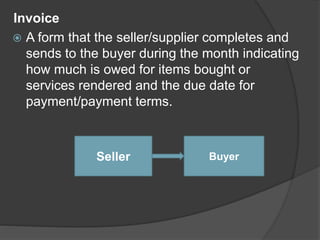
 However, it may have functionality beyond the core
capabilities of those modules.
Customer Relationship Management (CRM)
 The customer relationship management (CRM)
module stores all customer and prospect information.
 That includes the company’s communication history
with a person—the date and time of calls and emails,
for example—and their purchase history.
 A CRM improves customer service because staffers
can easily access all the information they need when
working with a customer.
 Many businesses also use CRM to manage sales
leads and opportunities.
 It can track communication with prospects and
suggest which customers should be targeted for
certain promotions or cross-sell opportunities.
 More robust CRM modules may support customer
segmentation (enabling more targeted marketing)
and advanced contact managers and reporting tools.
Professional Services Automation (Service
Resource Management)
 A professional services automation (PSA) module,
also called a service resource management module,
allows an organization to plan and manage projects.
 Services-based businesses often use this module.
 The application tracks the status of projects,
managing human and capital resources throughout,
and allows managers to approve expenses and
timesheets.
 It facilitates collaboration between teams by keeping
all related documents in a shared place. Additionally,
the PSA module can automatically prepare and send
bills to clients based on rules around the billing cycle.
Workforce Management
 A workforce management module is similar to a
human resource management module but is
designed for companies with more hourly than
salaried employees.
 It can monitor workers’ attendance and hours and
measure things like employee productivity and
absenteeism.
 Payroll could also fall under the workforce
management module.
 A payroll sub-module automatically distributes
paychecks to employees on a set schedule with the
appropriate taxes deducted and handles expense
reimbursement.
 It can also provide reports on payroll expenses, total
overtime hours and similar KPIs.
Human Resources Management
 A human resource management (HRM) or human
capital management (HCM) module usually
encompasses all the features of workforce
management application and offers additional
capabilities.
 HRM could be viewed as CRM for employees.
 This popular module has detailed records on all
employees and stores documents like performance
reviews, job descriptions and offer letters.
 It tracks not only hours worked but also paid time off
(PTO)/sick days and benefits information.
 Since the HRM module stores a vast amount of
information on every employee across the
organization, it eliminates a lot of duplicate or
inaccurate data that many organizations store in
various spreadsheets.
Ecommerce
 Certain ERP vendors offer an ecommerce module for
businesses that want to sell online. This module allows
companies to quickly launch a business-to-business
(B2B) or business-to-consumer (B2C) ecommerce
website.
 Leading commerce applications include user-friendly
tools that allow employees to easily add new items,
update product content (item descriptions, titles, specs,
images, etc.) and change the look and feel of the
website.
 When the ecommerce application is integrated with other
ERP applications, all payment, order and inventory
information feeds [from the ecommerce module] into the
shared database.
 That ensures all transactions are added to the ledger,
out-of-stock items are removed from the site and orders
ship on time.
Marketing Automation
 Like with ecommerce, certain software providers
have developed a marketing automation module.
 A marketing module manages marketing campaigns
across digital channels like email, web, social media
and SMS.
 It can automate email sends based on campaign
rules and has advanced customer segmentation
features, so customers only receive relevant
messages.
 Marketing automation software, whether part of the
ERP system or a separate solution, can provide
detailed reports on the performance of campaigns to
shape future marketing plans and spend.
 These applications increase leads, customer loyalty
and, over time, sales.
EDI (Electronic data interchange)
 Electronic data interchange (EDI) is the intercompany communication
of business documents in a standard format.
 The simple definition of EDI is a standard electronic format that
replaces paper-based documents like purchase orders or invoices.
 By automating paper-based transactions (PDF, 669 KB),
organizations can save time and eliminate errors caused by manual
processing that are costly to fix.
 With EDI transactions, information moves directly from a computer
application in one organization to a computer application in another.
 EDI standards define the location and order of information in a
document format.
 This automated capability enables data to be shared rapidly instead
of the hours, days, or weeks required with paper documents or other
methods.
 Today, industries use EDI integration to share a range of document
types — from purchase orders to invoices to requests for quotations
to loan applications and more.
 In most instances, these organizations are trading partners that
exchange goods and services frequently as part of their supply chains
and business-to-business (B2B) networks.
 In general, EDI transmissions break down into
two basic types:
1. Point-to-point or direct connections. Two
computers or systems connect with no intermediary
over the internet, generally with secure protocols.
2. Value-added network (VAN). A third-party network
manages data transmission, generally with a mail
boxing paradigm.
Code of Ethics Procurement
Ref: Code of Ethics Procurement
Types and risks of unethical behavior
Types of Unethical Behaviors:
1. Accepting supplier favors & gifts
2. Conflict of interest
3. Confidentiality of information
4. Fair and unbiased treatment
5. Integrity
 Accepting supplier favors & gifts:
Accepting gifts, favors and freebies from suppliers is the
most common unethical practice. This may affect buyer’s
decision to evaluate and select a supplier.
 Conflict of interest:
Conflicts of interest arise when buyers or their close
family/friends have direct financial interest in a supplier’s
organization. This is a major unethical practice and a serious
breach of ethics
 Confidentiality of information:
Confidential information should be shared only when needed and
with the persons who are liable to get the same as part of their
profession. Confidential information should be carefully shared
with the internal and external world. There are various kinds of
information that need to be protected; otherwise it could hamper
the business adversely. Some of the examples are pricing, T&Cs,
personnel information of customers, commercial information of
suppliers in case of an RFx process, cost break up, any
businesss and trade secrets etc.
 Fair and unbiased treatment:
All suppliers should be treated fairly and in an unbiased manner.
Any biased treatment to any particular vendor raises unethical
behavior.
 Integrity:
Integrity is the quality of being honest and having strong moral
principles. Any compromise on the integrity has a negative impact
on the overall procurement process.
Risks of unethical behavior
 Below are the most significant risks of unethical
behavior;
1. Increased risk of doing business and the possibility of
bankruptcy and severely damaged company brand and
image.
2. Decreased productivity.
3. Increased misconduct and conflict internally.
4. Decreased performance levels of employees.
5. Increased employee turnover and more challenging
employee recruitment.
Value Engineering
 Value Engineering (VE) is concerned with new products. It
is applied during product development.
 The focus is on reducing costs, improving function or both,
by way of teamwork-based product evaluation and analysis.
 This takes place before any capital is invested in tooling,
plant or equipment.
Value Analysis
 Value Analysis (VA) is concerned with existing products. It
involves a current product being analysed and evaluated by
a team, to reduce costs, improve product function or both.
 Value Analysis exercises use a plan which step-by-step,
methodically evaluates the product in a range of areas.
 These include costs, function, alternative components and
design aspects such as ease of manufacture and assembly.
Process Mapping
 Process mapping is the graphical representation with illustrative descriptions
of how things get done. It helps the participants to visualize the details of the
process closely and guides decision making.
 One can identify the major areas of strengths and weaknesses in the
existing process, such that the contribution of individual steps in the process
are recognized.
 Further, it helps to reduce the cycle times and defects in the process and
enhances its productivity.
Types of process maps
 There are two major types of process maps- that are process flowchart and
deployment flowchart.
Process flowchart:
 A process flowchart is a simple process map that provides the visual
representation of the sequence of activities along with their points of
decisions.
 These flowcharts provide the basic details of the process, which can later be
augmented by adding the roles of different staffs.
Deployment flowchart:
 These process maps provide the interactions between different departments
and the roles performed by different people in the organization.
 Also termed as ‘swim- lane’ charts, these process maps have vertical lines
showing the movement of process from person to person.
Negotiation Planning & Tactics
Steps in Negotiation planning
Step 1: Work Out What You Want
Step 2: Establish What You’re Prepared to Give Up
Step 3: Clarify Authority Limits
Step 4: Do Your Homework
Step 5: Decide On What Techniques to Use
Step 1: Work Out What You Want
 First, you need to work out what it is that you are
actually after.
 Think about what you must get out of this negotiation
and what you would like to have.
 For example, if you are negotiating a job package for
a job you could note down your desired salary, the
car allowance you are after, the health package,
childcare vouchers, whatever it is that you think you
could get from the negotiation to start a new job.
Step 2: Establish What You’re Prepared to Give Up
 Think about what concessions you are prepared to
make.
 For example, if you are negotiating with a supplier,
maybe you’d give up super fast delivery for a
discount on the price.
Step 3: Clarify Authority Limits
 Work out, and confirm with your manager, what
authority you have for this discussion and at what
point you’ll have to step away from the deal and let
someone else carry on the negotiation.
 If you have to back out halfway through then your
supplier or whomever it is you are negotiating with
will have to start from scratch with someone else.
Step 4: Do Your Homework
 This can be quite a large and time-consuming
step, but it’s definitely worth it.
 Gather some information on the market value of
similar deals.
 Research similar procurements either internally
or externally using publicly available information.
 If it’s to do with negotiating terms for a new job,
check out the salaries and packages they have
offered people in the past through other job
adverts or websites like Glassdoor.
Step 5: Decide On What Techniques to Use
 Review what techniques would be useful in this
negotiation.
 This involves planning a great location for the
discussion: a noisy open office isn’t the best
place to be asking for a pay increase.
 Think about what would work best for you: a
neutral location like a coffee shop? Your offices
instead of your supplier’s offices?
 You can also think about how you are going to
approach the conversations.
Negotiation Tactics
1. Listen more than you talk.
2. Use timing to your advantage.
3. Always find the right way to frame the negotiation.
4. Always get when you give.
5. Always be willing to walk
Listen more than you talk
 It's easy to go into a negotiation focused only on what you'll say,
especially when you're nervous.
 The goal of a negotiation isn't just to get what you want, but
also to help the other side get what they want
 To do that, you need to actually know what the other side wants
-- which means you have to listen.
 Finding common ground means knowing common ground exists
 In most situations, price isn't the only thing on the table. Maybe
the other side would appreciate a longer delivery schedule. Or a
larger down payment. Or to book revenue as soon as possible.
Use timing to your advantage
 Often the best time to buy a car is at the end of
the month; salespeople need to hit their quotas,
dealerships want to "make" their month, etc. The
same is true with real estate; house sales (and
property leases) are generally weaker in the
winter months, which means owners are more
likely to negotiate.
 And you can also use back-end timing to your
advantage.
 Say you want to lease a property starting in
March. If you sign a 12-month lease, the owner
will have to find another tenant next March. But if
you ask for a 15-month lease, the property will be
open at the start of prime rental season, which
means he or she should be happier to accept a
lower rent amount.
Always find the right way to frame the negotiation.
 In Negotiating the Impossible, Deepak Malhotra shows how
properly framing a negotiation means finding the best perspective
from which to view the negotiation. Maybe the frame is money. Or
time. Or delivery schedule. Or quality.
 In the landlord example above, price isn't the only frame. So is
time. In my house-buying example, price was a frame -- but so
was time, and so was the seller's risk if I couldn't come up with the
down payment.
 Frame a negotiation correctly and you can make it easier to
negotiate on the points that matter to you.
 For example, say you need a certain service performed. If you're
willing to wait for that service to be performed -- or to be
performed more slowly than normal -- the provider may be able to
accept a lower price, since your job can be fit into the margins of
the provider's schedule.
 Or if you're buying a car, implicitly framing the negotiation by
waiting until the end of the month and then saying you want to buy
a car right away frames the negotiation in terms of time for the
salesperson. Or frame it by going to the dealership near the end of
the day: The salesperson will be more eager to make a deal, since
customers who leave saying "I'll be back" rarely do come back
Always get when you give.
 You send a proposal to a customer and he asks for a 10
percent discount. Simply saying yes sends a terrible
message; in effect, that means your original price was
too high.
 Whenever you make a concession, make sure you
receive something in return. Maybe you will provide a 10
percent discount, but your delivery schedule will be
extended. Or you'll need a larger deposit.
 Keep in mind you can also use the same approach as a
buyer. Don't just say "I need you to knock 10 percent off
the price." Say "I can only afford to pay $X, but in return
you can space out deliveries over the next two months."
Or "I can only afford to pay $X, but I will be glad to sign
a longer-term contract under those terms."
 That way you aren't just competing; you're finding
common ground by finding terms that work for both of
you.
Always be willing to walk.
 Granted, sometimes that's not possible. If your delivery truck has
broken down and you need to make deliveries today, walking away
from the truck rental counter isn't really an option.
 But that's a practical need, not an emotional need. In most cases,
your need is emotional: You want this building; you want this car;
you want this house. Even though there are other options, you
want this one.
 When you're negotiating, never want this one -- at least not unless
the price, terms, etc., are also what you want.
 How will you know? Decide those things ahead of time. Know your
numbers. Know the terms you're willing to accept. Know the value
of what you're getting -- and of what you will provide.
 The best way to be a great negotiator is to take emotion out of the
equation. When it's objective -- when it doesn't feel personal -- you
won't get hung up on winning or losing. You'll just calmly work
toward getting the best deal you can.
 And this means, oddly enough, you're much more likely to "win.
Types of Purchasing Contract
1. Fixed Price Contracts
2. Fixed Firm Price (FFP)
3. Fixed Price Incentive Fee (FPIF)
4. Fixed Price with Economic Price Adjustment (FP-EPA)
5. Possible Pitfalls of Fixed Price Contracts
Fixed Price Contracts
 This is the best contract type when someone knows
exactly what the scope of work is.
 Also known as a lump sum contract, this contract is
the best way to keep costs low when you can predict
the scope.
 For instance, if an organization needs services from
a vendor, and the scope is clearly defined, the
contract makes sure the organization only pays a
specified amount for the required work.
Fixed Firm Price (FFP)
 This is the simplest subtype, as it features both a fixed
price and time frame.
 The contract states the price and the deadline for the
project, such as $5,000 and the end of the month. If the
seller makes mistakes or otherwise causes the costs to
increase, the price remains at $5,000 and the seller is
responsible for the difference.
Fixed Price Incentive Fee (FPIF)
 This is the same as the FFP contract, with the addition
of a monetary incentive so that the seller does a better
job or completes the project ahead of schedule.
 The contact can specify the fee along with the terms of
when it is received, such as when the project is
completed below the estimated cost, before the
estimated completion date, or in the case of exemplary
performance.
 This contract is best used when you want to ensure the
project will be completed on time or below cost.
Fixed Price with Economic Price Adjustment (FP-EPA)
 This contract type is most often used when the project
is expected to take a long time, to protect the seller from
inflation that may occur over the duration.
 For instance, this type of contract allows for a clause
that gives the contractor a certain percentage increase
after a predetermined amount of time.
 Generally, organizations based on the percentage on
the consumer price index or the CPI.
Possible Pitfalls of Fixed Price Contracts
 For this to be the most effective contract type, you must
have a clearly defined scope at contract signing.
 If there is any ambiguity, the seller may ask for more
money if it seems the scope has changed in any
manner.
 This can easily cause projects to go over budget.
Purchasing and supply chain performance
measurement
 Measuring purchasing performance is important, as the
purchasing department plays an increasingly important
role in the supply chain during an economic downturn.
 A reduction in the cost of raw material and services can
allow companies to competitively market the price of
their finished goods in order to win business.
Purchasing Efficiency
 Administrative costs are the basis for measuring
purchasing efficiency.
 This performance measurement does not relate to the
number of purchased items that the department has
procured.
 The measurement relates to how well the purchasing
department is performing in the activities they are
expected to perform against the budget that is in place
for the department.
Purchasing Effectiveness
 The price that the purchasing department paid for
an item is not necessarily a good measurement of
purchasing performance.
 The price of an item may fluctuate due to market
conditions, its availability, and other demand
pressures.
 Therefore, the purchasing department may not be
able to control the price.
Purchasing Functionality
 Purchasing performance can be measured against
the functional requirements of the purchasing
function.
 The primary function of the department is to
provide the correct item at the required time at the
lowest possible cost.
Performance Measurements
 The performance of the purchasing function can
be measured using a variety of measurements.
 A company can decide which of these
measurements of effectiveness are relevant to
the performance of their purchasing department.
 The measurements can include:
1. Cost Saving
2. Increased Quality
3. Purchasing Improvements
4. Transportation Improvements
1. Cost Saving
 If the purchasing department procures an item at a
lower price than they did previously, then it is a cost-
saving.
 This can occur when a new supplier is found, a less
costly substitute item is used, a new contract has
been signed with the vendor, a cheaper
transportation method has been found, or the
purchasing department has negotiated a lower price
with the existing supplier.
2. Increased Quality
 When an item has improved quality either by using a
different supplier or by negotiating with the existing
supplier, the improvement will be reflected in a
reduction of waste or production resources.
3. Purchasing Improvements
 Efficiencies in the methods used in the purchasing
department will increase effectiveness.
 These can include the introduction of EDI, e-
procurement systems, vendor-managed inventory
and pay on receipt processes.
4. Transportation Improvements
 When a purchasing department negotiates with a
carrier or number of carriers to reduce the cost of
transporting items from the vendor to the production
facilities, the unit cost of the item will be reduced.
 This cost-saving can be used as a measurement of
effectiveness.
THE END

Purchasing & supply chain management

  • 1.
    UNIT – I ORGANIZINGTHE PURCHASE FUNCTION
  • 2.
    Purchasing  Purchase functionprovides materials to the factory without which the materials cannot move.  Purchasing or purchase management basically is a function in any enterprise that works to save money and enhance profits.  The main function of this department is to procure the material or inputs that are needed for production.  A 1% saving in cost is equivalent to 10% increase in turnover  Purchasing is generally responsible for spending more than 50 percent of all the revenues the firm receives as income from sales.  More money is often spent for purchases of materials and services than for any other expense, and the spend in services is rapidly increasing
  • 3.
    IMPORTANCE OF PURCHASEMANAGEMENT  Purchasing management is supposed to be a very important department of materials management in any organization.  Purchase staff has to manage various vendors and external agencies and thus they represent their organization’s reputation to the larger world.  They are responsible for negotiating and then finalizing big deals which might mean a lot to their company.
  • 4.
     Other thanthat, purchasing management helps in the following: 1. Controlling the costs 2. Stabilizing the prices 3. Supply Chain Management 4. Customer Satisfaction
  • 5.
    Controlling the costs The purchasing management has to analyze and decide the best suppliers as per the quality of products and most reasonable cost.  They also review many other factors like if the vendor or supplier can guarantee timely shipments, what’s their reputation in the industry and relevant experience.  Changing the vendors again and again is expensive; therefore, finding the best and reliable vendor is very important for controlling costs.
  • 6.
    Stabilizing the prices In case the production cost goes up and down, other functions face roadblocks.  For example, the marketing function gets confused about what price should be charged to the customers, the finance department faces problem in calculating profits and the accounts cannot gauge the company’s cash flow.  Purchasing managers are the ones who are responsible for stabilizing the production cost by negotiating with suppliers and making long contracts for mutual benefit.
  • 7.
    Supply Chain Management Buyers also ensure that the material or supplies are received on time and are of the expected quality.  In case the shipment is delayed or is not of the expected standard, it would affect the complete production chain.  Hence, this function is of utmost importance across all industries.
  • 8.
    Customer Satisfaction  Purchasemanagement is responsible for customer satisfaction in the following ways:  Working towards the best quality of the products  Ensuring on-time deliveries.  When the purchase department opts for highest quality of supplies or ingredients at reasonable costs, it results in cost savings, which are further passed on to the customers.  Therefore, purchasing management has a critical role to play in customer’s experience with the final products and the organization.
  • 9.
    Tactical Purchasing VsStrategic Sourcing Tactical Purchasing  Tactical purchasing is based on the short term, transactional activity that you often find in small and medium manufacturing companies.  It uses a routine approach that is often reactive, when it comes to purchasing materials and supplies. It involves using fast quote and order processes to keep production running smoothly.  It’s worth noting everything is well-managed internally to make sure the business has all the materials they need at the right price and the right time. Strategic Sourcing  Strategic sourcing, also known as strategic procurement, is the more long-term strategy, using a systematic approach to obtain the things the business needs, focusing on the lowest risk to the supply line, and the lowest total cost of ownership, or TCO, possible.  It’s more about anticipating the future needs of an organisation, supply chain relationship management and choosing suppliers to work with based on factors other than price and availability.
  • 10.
    Tactical vs. StrategicPurchasing  Tactical purchasing doesn’t focus on the entire company’s needs, and it doesn’t aim to truly understand how a vendor’s capabilities could support the organisation’s larger needs.  It focuses on the production department’s needs, while strategic sourcing looks at the big picture.
  • 11.
    Objectives of Purchasing The purchasing objective is sometimes understood as buying materials of the right quality, in the right quantity, at the right time, at the right price, and from the right source.  This is a broad generalisation, indicating the scope of purchasing function, which involves policy decisions and analysis of various alternative possibilities prior to their act of purchase.
  • 12.
    The specific objectivesof purchasing are:  To pay reasonably low prices for the best values obtainable, negotiating and executing all company commitments.  To keep inventories as low as is consistent with maintaining production.  To develop satisfactory sources of supply and maintain good relations with them.  To secure good vendor performance including prompt deliveries and acceptable quality.  To locate new materials or products as required.  To develop good procedures, together with adequate controls and purchasing policy.
  • 13.
     To implementsuch programmes as value analysis, cost analysis, and make-or-buy to reduce cost of purchases.  To secure high caliber personnel and allow each to develop to his maximum ability.  To maintain as economical a department as is possible, commensurate with good performance.  To keep top management informed of material development which could affect company profit or performance.  To achieve a high degree of co-operation and co- ordination with other departments in the organisation.
  • 14.
    Purchasing Cycle  Thepurchasing cycle is also called the procurement cycle or procure-to-pay (P2P) is the process by which you order, obtain, and pay for the goods and services your business needs.  Purchasing cycle the steps taken to order and pay for products that a business requires.  The purchasing cycle determines the frequency that products are purchased.
  • 16.
    Steps in aStandard Procurement Cycle  The Need You need to identify that there is a need to update the inventory or stock. You may also need a business service or ad hoc product.  Specify Now you need to decide how much and when you want the products or services delivered.  Requisition or Order This is when you write the purchase order or requisition order.  Financial Authority Before the order can be placed, it usually requires some kind of authority for its purchase. With some purchase orders, this is reasonably automatic. With a large order that will be put out to tender it could be multi staged.  Research Suppliers Repetitive orders usually have set suppliers, although it does no harm to review the options sometimes. Other orders will either need to go out to tender or there will be a choice of suppliers.
  • 17.
     Choose Supplier Thesupplier is now chosen.  Establish Price and Terms In a large company, many suppliers will be contracted with a Master Agreement where prices and terms are set for a defined period. For other orders, now is the time to negotiate terms and prices.  Place Order At this stage in the purchasing cycle, the order is placed and this becomes a contract between the business and the supplier.  Order Received and Inspected The goods are delivered, checked in the warehouse and entered into the inventory. Shortages and breakages are reported to the supplier for the appropriate credits to be supplied.  Approval And Payment Usually within 30 days, the invoices are received and paid.  Update Of Records The purchasing ledger and stock records are updated. This is automatically done by many purchasing computer systems
  • 18.
    14 Steps forPurchasing Cycle with Tenders  The Need In this case, the need usually goes through a business case and is then tightly defined and specified.  Financial Authority This usually happens at a higher level and includes the management of the department that requires the goods.  RFP A Request For Proposal (RFP) is written, in which the need is highly specified.  Invite Tenders This is always done formally, usually by posting the request in trade magazines and appropriate web sites. Government projects are posted on government web sites.  PQQ A Pre Qualification Questionnaire (PQQ) is sent out to likely suppliers in order to select a short list of appropriate potential suppliers.
  • 19.
     Tenders The tendersare sent in from the qualified suppliers.  Qualifying A number of meetings are held to clarify any questions that suppliers may have.  Evaluation This is the most exciting part of the purchasing cycle and can take many weeks for a big tender. All the tenders are evaluated and the requirement awarded to the winning bidder.  Negotiation The fine print of the terms and conditions are negotiated with the chosen supplier. The price is fixed at the bid price.  Contract Award In a very short time, the contract is awarded to the chosen bidder.  Manage Contract This is the period in the purchasing cycle when the goods are delivered.  Approval And Payment If the contract is carried out completely then full payment is made. If there are problems, there may be a damage request.  Sign Off At the end of the contract work and deliveries, the contract is signed off and all relationships with the supplier are finished.  Update Of Records The purchasing ledger and stock records are updated. This is automatically done by many purchasing computer systems.
  • 20.
    Purchasing Document  Beloware the procedures to prepare a purchasing document; Step 1: Complete a Purchase Requisition and submit to the correct person/department within your company Step 2: If approved, a Purchase Order is issued and products are purchased Step 3: The seller creates and sends an Invoice along with the product. Purchase Requisitions  A form to be completed by individuals within a business to request that items or services be purchased. Employee Purchasing Department
  • 21.
    Purchase requisition consistsof;  Company information  Vendor information  Date and ordering information  Item information  Signatures  Catalogue No or Item No of product  Qty—how many to purchase  Description—written description of product  Unit Price—Price per item  Total Amt—Qty X Price  Account number or department for billing  Order Total is the total of all items requested on the requisition
  • 23.
    Purchase Orders  Purchaseorder consists of;  Company information  Vendor information  Date and ordering information  Item information  Signatures
  • 25.
    Invoice  A formthat the seller/supplier completes and sends to the buyer during the month indicating how much is owed for items bought or services rendered and the due date for payment/payment terms. Seller Buyer
  • 26.
     Invoice Consistsof the following details; 1. Company information 2. Customer information 3. Date and ordering information 4. Item information 5. Comments
  • 28.
    Types of PurchaseOrders  Made as a request from a buyer to a seller, a PO (Purchase Order) details what goods or services are being purchased.  Buyers send purchase orders to the seller as intent to make a purchase in the near future. Additional details included are the price of items, expected delivery schedule and payment terms.  As a form of a binding contract, purchase orders protect both the buyer and the seller by making the details of the arrangement clear.  For a wholesale distributor, you will likely issue purchase orders to stock your own goods.  Since you'll also be likely to receive them, we've outlined the four types of purchase orders so that you know how to deal with them in either scenario. 4 Types of Purchase Orders  Depending on how much information the buyer can share regarding their upcoming purchase, there are 4 varieties of purchase orders. 1. Standard Purchase Order 2. Blanket Purchase Order 3. Contract Purchase Order 4. Planned Purchase Order
  • 29.
    Standard Purchase Order The most widely used of purchase orders, the standard purchase order details the items to be purchased, quantities, payment terms and the delivery date.  Standard purchase orders are typically used for one-time purchases.  An example of a standard purchase order would be when a company agrees to buy 10 reams of paper for the price of $2 each, which will be delivered within two weeks and paid within 30 days upon delivery. Blanket Purchase Order  A blanket purchase order incorporates several potential orders into one.  This type of purchase order typically outlines the items and total quantity needed.  It may or may not include pricing.  If it does include pricing, it may include price breaks that the seller is willing to offer.  For example, a company may decide to order reams of copy paper, but they're not sure when or how often they'll need to order.  In this instance, the company may issue a blanket purchase order to initiate the purchasing process.
  • 30.
    Contract Purchase Order With a contract purchase order, the buyer does not know which item or items will be ordered.  Instead, you agree upon terms and conditions with your supplier with the idea that items and quantities will be known in the future.  This type of purchase order acts more like a binding agreement that the seller will purchase from you in the future.  Often set for a year as the time period, contract purchase orders essentially act like a legal document.  During the contract period, the buyer can send in a standard purchase order that includes the details needed for each purchase. Planned Purchase Order  For a planned purchase order, most order details are known.  Known items may include the items, pricing and payment terms. However, the delivery date is typically unknown.  Essentially, the buyer is committing to a price and quantity, but not on a delivery schedule.  As an example, a company may know that they are going to purchase three printers at a certain price.  Once the needed delivery schedule is known, you can generate a standard purchase order.  No matter which type of purchase order you use, be sure to be clear and concise with order details.  This important type of arrangement not only protects the buyer, but the seller.  So, if you're not using purchase orders, now is the time to get started.
  • 31.
    Improving the PurchasingProcess  Stock level warnings – too high, too low  Procurement software integration with other systems and applications e.g. ERP, EDI, eCommerce, WMS etc.  Short shelf life stock warnings  Warnings of upcoming manufacturing requirements  Details of new sales or projects won  Purchase order workflow approval with support for complex authorisation hierarchies driven automatically by nature and value of goods being purchased  Chasing suppliers asking them to confirm POs have been received  Chasing suppliers for confirmation that goods will be delivered on time  Warning when an item is receipted into stock with margin that is too low or has been receipted at a buy price that is different to the expected cost price  Seasonal stock warnings  Procurement bidding software  Spot documents not properly completed e.g. POs with no duty rate  Alerts showing goods due in that have not turned up on time  Automated price change notifications to sales team whenever a price is altered  Order confirmations sent automatically to suppliers  Identify unusual trends in product use or sales
  • 32.
    Types of BusinessPurchase Decisions  The types of business purchase decisions of interest to marketers are: 1. New Purchases 2. Modified Re-buy 3. Straight Re-buy New Purchase  These purchases are ones the buyer has never or rarely made before  Also called as New Task Purchases  It can be considered as either minor or major depending on the total cost or overall importance of the purchase.  In either case, the buyer will spend considerably more time evaluating alternatives.  For example, if faced with a major New Task Purchase involving a complex items, such as computer systems, buildings, robotic assembly lines, etc., the purchase cycle from first recognizing the need to placement of the order may be months or even years.  For marketers, the goal when selling to a buyer facing a New Task Purchase is to make sure to be included in the set of evaluated products as discussed in Step 2 of the business purchasing process.
  • 33.
    Straight Repurchases  Thesebusiness purchase decisions involve routine ordering.  In most cases, buyers simply reorder the same products or services that were previously purchased.  In fact, many larger companies have programmed repurchases into an automated ordering system that initiates electronic orders when inventory falls below a certain predetermined level.  For the supplier benefiting from the repurchase, this situation is ideal since the purchaser is not looking to evaluate other products.  For competitors, who are not getting the order, it may require extensive marketing efforts to persuade the buyer to consider other product or service options.
  • 34.
    Modified Re-buy  Thesepurchases occur when products or services previously considered a straight re-purchase are now under a re-evaluation process.  There are many reasons why a product is moved to the status of a Modified Repurchase.  Some of these reasons include: end of purchase contract period, change in who is involved in making the purchase; supplier is removed from an approved suppliers list; mandate from top level of organization to re-evaluate all purchasing; or strong marketing effort by competitors.  In this circumstance, the incumbent supplier faces the same challenges they may have faced when they initially convinced the buyer to make the purchase.  For competitors, the door is now open and they must work hard to make sure their message is heard by those in charge of the purchase decision.
  • 35.
    There are variousways to improve the procurement process; some are minor changes that focus on improving part of the process such as creating essential internal documentation. Other major changes can go as far as improving the whole process. Here are some examples of ways to improve the procurement process which adds value to an organization: Incorporating a contract management system  Technology creates wonders! So why not make the most of it as it can help you save lots of time and be more efficient.  One way of using technology to improve the procurement process is by incorporating a contract management system. Let’s admit it: creating contracts is time consuming and businesses often work with hundreds of vendors every year.  Using a contract management system will alleviate the whole task of creating new contracts every time you onboard a new supplier.  It will help you understand which contract can be reused from one supplier to the next.  This will allow you to create standard contract templates which will require only minor updates when they are used.
  • 36.
    Increasing employee capabilitythrough training and development  Training and development remains one of the key factors that lead to a successful business.  A three-year researched project commissioned by Middlesex University’s institute for work based learning found that from a 4300 workers sample, 74% felt that they were not achieving their full potential at work due to lack of development opportunities. The result of this research highlights the importance of training and development to ensure successful business continuity. It benefits not only the employees’ personal evolution but also impacts on the company’s productivity and profitability as a whole. It reinforces the goodwill of the business, allows it to maintain the competitive edge and leads to higher customer satisfaction, lower costs and faster growth. The emergence of innovative training solutions is increasingly being adopted by leading procurement organizations. For instance: high-impact eLearning solutions combined with simulations where employees can apply what they are learning in their jobs. As a form of effective communication, training can lead to an increase in productivity and allow employees to make the best decisions for the company’s progress.
  • 37.
     There arevarious ways to improve the procurement process; some are minor changes that focus on improving part of the process such as creating essential internal documentation.  Other major changes can go as far as improving the whole process.  Here are some examples of ways to improve the procurement process which adds value to an organization:  Incorporating a contract management system  Maintain good supplier relationships  Reduce Expenses  Using analytical and negotiation skills
  • 38.
    Incorporating a contractmanagement system  Technology creates wonders! So why not make the most of it as it can help you save lots of time and be more efficient.  One way of using technology to improve the procurement process is by incorporating a contract management system.  Let’s admit it: creating contracts is time consuming and businesses often work with hundreds of vendors every year.  Using a contract management system will alleviate the whole task of creating new contracts every time you onboard a new supplier. It will help you understand which contract can be reused from one supplier to the next.  This will allow you to create standard contract templates which will require only minor updates when they are used.
  • 39.
    Maintain good supplierrelationships  A procurement professional needs to be surrounded by a group of happy and qualified suppliers.  Of course, a bid request can be put out to new vendors whenever you need a product and service but those bids will take a huge amount of time to finalize.  Having to start over again every time you need to issue a bid request involves a long process of researching each new supplier, learn about their industry position and identify their negotiation tactics.  To prevent this from happening, it is better to maintain a good relationship with a group of suppliers you can trust. Streamlining the procurement in this way will make your job more efficient.  Besides, it might also increase your goodwill as a happy supplier might tell others how good you are to work with which might lead to new sourcing avenues.  All you need to do is: be fair with the suppliers in your business dealings, ensure that they are paid on time, put out detailed and straightforward RFPs and appreciate their professionalism and skills
  • 40.
    Reduce Expenses  Oneof the most appreciated qualities of procurement professionals is the ability to reduce costs while procuring the items a company need.  The one question which comes to the mind is how? The key is to think carefully before making a purchase.  It sounds easy but any procurement professional will understand this point since they might get tempted to create purchase orders for every request that comes at their desk.  This is where the trap lies, leading to unnecessary expenses! According to Caps research, for every one dollar you spend on supply management gives you an estimated return of $6.77.  This leads us to understand that when you take the time to identify, research, acquire and manage the products and services you company rely on, you are more apt to reduce expenses considerably.
  • 41.
    Purchasing position withan organization  Organizational structure refers to the hierarchy of decision- making power within a department.  Built like a pyramid, the employee at the top has the most decision-making responsibility.  While each job is considered vital to the department, everyone answers to the person above him.  Each business refines its organizational chart based upon particular needs.  The structure of one purchasing department won't necessarily look like another, although there are positions that appear within most hierarchies. Director  The department director may be given any number of titles, including "procurement manager," "director of procurement" or "lead buyer."  This individual is ultimately responsible for the purchasing department, it's day-to-day operations and how efficiently it operates.
  • 42.
    Deputy Director  Thedeputy director is second in control.  While companies may have different titles for this position, the deputy director essentially takes cues from the director, helping operate the daily activities of the department. Senior Buyers  In a manufacturing business, a senior buyer must know which materials are needed and in what quantity they should be purchased.  The purchasing department must maintain a balance between the amount of material coming in and what will be used in the manufacturing process, so corporate funds don't get bogged down by materials sitting unused on shelves.  In consumer-driven businesses, the senior buyer must be able to predict what consumers will want to buy. Mistakes in that regard can cost the business money and damage its reputation. Senior buyers report to the deputy director. Assistant Buyers  Assistant buyers answer to senior buyers but have their own responsibility for staying abreast of current inventory and trends.  Assistant buyers also focus on evaluating suppliers -- finding the most reliable supply source at the greatest cost savings to the company.
  • 43.
    Support Staff  Purchasingdepartments often work closely together in a team approach -- with each member of the team handling specific tasks -- but come together as a whole to make important decisions.  Administrative assistants and clerks are part of that team.  They are often multi-talented employees in that they are capable of handling any number of tasks at once in order to help the department work as a cohesive unit.  It's not unusual for administrators or clerks to move into a buyer's position once they have become familiar with the department.
  • 44.
    Organizing the purchasefunction  The superintendent shall organize the purchasing function in a manner intended to meet the purchasing goals of the board.  The purchasing function includes the following responsibilities: 1. making purchases for all departments in accordance with applicable laws and regulations, including the requirements of the State Division of Purchase and Contract when applicable, board policy, the superintendent's directives, good purchasing practices and ethical principles; 2. establishing and enforcing a system for approving and accounting for purchases; 3. maintaining appropriate records on price quotations of supplies most frequently purchased; 4. maintaining other supplemental data to assist in making purchases at the most economical prices possible; 5. maintaining NC E-Procurement compliance and making purchases through the E- Procurement Service to the extent appropriate to maximize savings and efficiency in the purchasing function; 6. establishing a practical degree of standardization of equipment, supplies and materials with sufficient flexibility to meet unique needs of schools and departments; 7. operating a central inventory warehouse; 8. supervising the receiving of all materials, including establishing procedures to ensure received goods are properly inspected, counted and documented; 9. maintaining lists of potential bidders for various types of materials, equipment and supplies; 10. providing information regarding bidding opportunities to vendors; 11. providing information and service to schools and departments that wish to make purchases; and 12. maintaining current information on all applicable laws, regulations, board policies and administrative procedures.
  • 45.
    Activities of SupplyChain Management Supply Chain Management:  Supply chain management is the process of delivering a product from raw material to the consumer.  It includes supply planning, product planning, demand planning, sales and operations planning, and supply management. Supply Chain Management process  The supply chain management process is composed of four main parts: product portfolio management, demand management, S&OP, and supply management.
  • 47.
    Demand management  Demandmanagement consists of three parts: demand planning, merchandise planning, and trade promotion planning.  Demand planning is the process of forecasting demand to make sure products can be reliably delivered. Effective demand planning can improve the accuracy of revenue forecasts, align inventory levels with peaks and troughs in demand, and enhance profitability for a particular channel or product.  Merchandise planning is a systematic approach to planning, buying, and selling merchandise to maximize the return on investment (ROI) while simultaneously making merchandise available at the places, times, prices, and quantities that the market demands.  Trade promotion planning is a marketing technique to increase demand for products in retail stores based on special pricing, display fixtures, demonstrations, value-added bonuses, no-obligation gifts, and other promotions. Trade promotions help drive short-term consumer demand for products normally sold in retail environments.
  • 48.
    Supply management  Supplymanagement is made up of five areas: supply planning, production planning, inventory planning, capacity planning, and distribution planning.  Supply planning determines how best to fulfill the requirements created from the demand plan.  The objective is to balance supply and demand in a manner that achieves the financial and service objectives of the enterprise.  Production planning addresses the production and manufacturing modules within a company.  It considers the resource allocation of employees, materials, and of production capacity.  Production/supply planning consists of: 1. Supplier management and collaboration 2. Demand and supply balancing 3. Production scheduling 4. Inventory planning determines the optimal quantity and timing of inventory to align it with sales and production needs. 5. Capacity planning determines the production staff and equipment needed to meet the demand for products. 6. Distribution planning and network planning oversees the movement of goods from a supplier or manufacturer to the point of sale. Distribution management is an overarching term that refers to processes such as packaging, inventory, warehousing, supply chain, and logistics.
  • 49.
    Sales and operationsplanning (S&OP)  Sales and operations planning (S&OP) is a monthly integrated business management process that empowers leadership to focus on key supply chain drivers, including sales, marketing, demand management, production, inventory management, and new product introduction.  With an eye on financial and business impact, the goal of S&OP is to enable executives to make better-informed decisions through a dynamic connection of plans and strategies across the business.  Often repeated on a monthly basis, S&OP enables effective supply chain management and focuses the resources of an organization on delivering what their customers need while staying profitable.
  • 50.
    Product portfolio management Product portfolio management is the process from creating a product idea creation to market introduction. of creating an idea for a product and following through on it until the product is introduced to the market.  A company must have an exit strategy for its product when it reaches the end of its profitable life or in case the product doesn’t sell well.  Product portfolio management includes:  New product introduction  End-of-life planning  Cannibalization planning  Commercialization and ramp planning  Contribution margin analysis  Portfolio management  Brand, portfolio, and platform planning
  • 51.
    Supply chain managementbest practices  To succeed in a growing global market, you need a supply chain that’s connected from start to finish, across your enterprise and beyond.  Here are five steps we recommend to achieve connected supply chain planning. Why supply chain management is Important  A positive or negative impact on the supply chain resounds throughout the business. There are two core areas to the impact: customer happiness and ROI.  Happy customer = happy business = higher performance  In January 2018, Tobin Moore from Optoro pointed out this striking statistic at Retail’s Big Show: If a customer is happy with the way their return process was handled, they’re 71 percent more likely to become a repeat customer.  A smooth return process means an effective supply chain, one that’s well connected and involves communication along the chain. When the supply chain meets or exceeds the expectations of the customer, it’s because of efficiencies. The entire business benefits through higher-order rates, positive sentiment in the customer’s mind, and lower cost-to-serve for the business.
  • 52.
     Higher performance= more cost efficiency = higher pressure?  Higher performance is measured in terms of the efficiency of all processes and people to move goods and services to market along the supply chain.  Increased supply chain efficiency can translate to pressure on the team and their capabilities, as costs and budgets are held flat or reduced when they’re expected to move the same or a greater volume of product at the same or a higher quality level.  Improvements to profits for the business are measured via metrics like working capital turnover or cash conversion performance; as business health improves, profitable cash management and revenue conversion are the result. Flattening the cost curve often becomes a challenge unless two factors are considered: new capabilities (process and data) that drive faster, higher-quality decisions; and using a tool that scales favorably for the value it delivers for the business
  • 53.
    UNIT – II PURCHASINGPOLICIES AND PROCEDURES
  • 54.
    Buyer-Seller Relationship  Buyersand sellers in mature industrial markets can turn single transactions into long-term beneficial relationships by a deeper understanding of the complex connection between the two.  A “must-do” for the sellers, in particular, is to understand patterns of investment and reward, and effectively manage the process that defines the dynamics of buyer-seller evolution.  The buyer is the person or organization that purchases products from suppliers.  A buyer could be a manufacturer purchasing raw materials a customer buying a finished product from a retailer.  The relationship between the buyer and seller can be either short term (one off or low commitment purchases) or long term, involving regular purchases based on established agreements.  Both short term and long term buyer and seller relationships have advantages and disadvantages.  Short term relations can be useful when a degree of flexibility is required.  For example, short term agreements give the buyer the option to switch suppliers for their next purchase.
  • 55.
     They canalso be beneficial in markets where the prices of materials are volatile and long term commitments are not appropriate.  The high level of competition to win short term contracts can also provide opportunities for price discounting and special deals to be done.  However, short term arrangements also have their disadvantages. They generally provide little scope for payment and order flexibility.  For example, a new supplier on a short term agreement will want a definite order and prompt payment.  There is no trust built up over time between parties, so building Buyer and Seller Relations the opportunity to share market information is also reduced.  There are many advantages that come as a result of building strong buyer and seller relations over a period of time.  There is a greater commitment from both groups which means that you will be better able to rely on them when it comes to orders and payments.  There may also be more scope for discounts after the relationship is established and there may be more flexibility in the timing of payments.  Trust between the buyer and seller is developed over time and this may allow for the sharing of information, forecasts, knowledge and customers between the buyer and seller.
  • 56.
     However, longterm buyer and seller relationships generally involve a high level of commitment and work to maintain. Entering into long term contracts may be involved so it is important to have accurate forecasts about the future performance and needs of both businesses.  Supply chain partnerships can be formed between organizations to provide a level of stability and encourage long term commitment from different parties towards achieving results.  Three critical aspects of supply chain partnerships are: recognizing opportunities that would benefit from a partnership, selecting the right partners and meeting your requirements as a partner.  Generally, most organizations will have a balance of both long term and short term relationships with their buyers and sellers. This balance can provide some of the benefits of both, while also reducing the amount of associated risks potential problems.
  • 57.
    Buyer and SalesRepresentative Interaction:  The most important part of buyer-seller relationship is the interaction between a representative of the buying organization (buyer) and a representative of the selling organization (sales representative or sales representative).  There are many other persons from both the organizations involved in the relationship, but the basic building block of the relationship is based on buyer and sales rep’ interactions. When the buyer and the sales representative meet, the nature of their interactions depend upon their roles, behavior and perceptions. Buyer’s Perception of Sales Representative:  There are two major perceptions held by buyers of sales representatives. One is the stereotypical description of the sales reps, as “talkative”, “easy going”, “manipulative”, “competitive”, “optimistic”, and “excitable”.  An industrial buyer, who does not have previous experience with a particular sales representative, may respond to the sales representative in terms of the stereotype which he has of sales representative in the general.  The second major perception of the buyer depends on the reputation of the company which a sales representative represents.
  • 58.
     Generally, thesales representative of a company with better reputation always gets a more favourable initial response from the industrial purchasers.  For example – a sales engineer working with a reputed company like Larsen & Toubro (L&T), often got a positive response from the industrial customers.  However, when the same sales engineer changes the job to a less reputed company, as a sales executive, the response was not encouraging, as he had to wait for a long time before he was called in for discussions. The Role Played by Industrial Buyer:  An analysis of industrial buyer behaviour indicates that personal needs, interaction in the buying centre, an organizational objectives (or needs) determine the response of a buyer to the selling efforts by a sales rep.  For example – an industrial buyer may be motivated by a personal need for salary increment and promotion in his job, and also by a social or organizational need to satisfy the user department. A buying decision may allow the buyer to satisfy both the sets of needs.
  • 59.
    The specific personaland social needs will decide: 1. Whether the buyer meets with a sales rep, 2. Which parts of sales rep’s presentation he listens, 3. The influence of sales presentation on his decision to buy. Purchasing policies  A purchasing policy is a collection of rules that control the requisition process.  Purchasing policies help procurement administrators implement their procurement strategy by creating a policy structure that is aligned with the organization’s strategic purchasing requirements.  A purchasing policy consists of a set of policy rules. When you define a policy rule, you first select a rule type. You then create a rule for the rule type by defining the settings, the start date, and the end date for the rule.  For example, an administrator creates a policy, selects the Catalog policy rule type, and then adds a catalog policy rule to the policy.  This catalog policy rule specifies that the Adventure catalog must be used for internal procurement.  After the purchasing policy is associated with a particular organization, employees of that organization see the Adventure catalog when they create requisitions.
  • 60.
    Assigning policies toorganizations  Before a policy can take effect, it must be associated with an organization.  Purchasing policies are associated with the Procurement internal control hierarchy purpose. Therefore, purchasing policies apply only to organizations in hierarchies that have a hierarchy purpose of Procurement internal control.  You can also select organizations from the flat list of legal entities in the Company Info table. These legal entities are designated in the policy framework as “Companies.” Determining which rule to apply  Depending on how you configure your purchasing policies, multiple rules can affect the users in an organization.  The following examples illustrate different ways that you can configure purchasing policies and specify how policies are applied when a transaction occurs.
  • 61.
    Example 1: Simplepurchasing policy configuration  Organizations that are small and less complex can set up purchasing policies by legal entity, and can use only the Companies organization hierarchy.  For Fabrikam, a small business, purchasing requirements vary little across the organization.  Purchasing rules vary only among the organization's legal entities. For example, employees of Fabrikam Canada and employees of Fabrikam U.S. purchase goods and services from different catalogs and different vendors. Therefore, Fabrikam sets up its purchasing policies at the legal-entity level.  Fabrikam creates two purchasing policies. Policy A applies to its U.S. legal entity, 1111. Policy B applies to its Canadian legal entity, 2222. When an employee in legal entity 1111 creates a purchase requisition, the policy rules are derived from policy A. For example, the product catalog that the employee sees is specified in the catalog policy rule for policy A.  When an employee in legal entity 2222 creates a purchase requisition, the policy rules are derived from policy B.  Note: If an employee of legal entity 1111 purchases an item on behalf of an employee of legal entity 2222, the policy rules that are specified for legal entity 2222 (that is, the policy rules from policy B) are applied.
  • 62.
    Example 2: Complexpurchasing policy configuration  In the previous example, all purchasing rules were defined in a single organization hierarchy, the Companies organization hierarchy.  However, a complex organization might define policies for multiple organization hierarchies.  Contoso is a large company that requires complex purchasing rules to control the requisition process.  Contoso has defined rules for two different organization hierarchies: Department and Global purchasing control.  Policy 123 is defined for the Department organization hierarchy for the Sales UK – Sales department. In policy 123, the purchase requisition control rule specifies that restrictions must be enforced for minimum order quantities.  In this rule, the Enforce minimum order quantity restrictions option is selected.  Policy 456 is defined for the Global purchasing control organization hierarchy for the Sales and Marketing department. In policy 456, the purchase requisition control rule doesn't specify that restrictions must be enforced for minimum order quantities. In this rule, the Enforce minimum order quantity restrictions option is de-selected.
  • 63.
     Sam worksin the Sales UK – Sales department in Contoso’s United Kingdom office. The policies for both the Department and Global purchasing control organization hierarchies apply to his department. When Sam creates a purchase requisition, the system must determine which policy to apply. The system administrator set up the purchasing policy parameters to specify that purchasing policies must be applied in the following order of precedence: 1. Global purchasing control 2. Department 3. Companies  Therefore, policy 456 is applied to the purchase requisition that Sam creates, and no minimum order quantity is required for the purchase requisition. Purchasing Policy Rules Catalog policy rule  The catalog policy rule determines which procurement catalog users see when they create purchase requisitions.  If a user has been granted permission to order products on behalf of another user, the requisition uses the catalog policy rule that is defined for the requester’s legal entity and operating unit to determine which catalog to display.  Before you can define a catalog policy rule, you must create and publish a procurement catalog. Category access policy rule  The category access policy rule determines which categories users have access to when they create purchase requisitions. If no rule is specified, all the procurement categories can be added to the purchase requisition.  Select the Include parent rule option to apply the category access policy rule of the parent organization to the category.
  • 64.
     In theAvailable categories pane, select the categories that the rule applies to. When you select a category, all categories that are higher in the hierarchy are also added to the Selected categories list.  Select the Include subcategories option to apply the rule to all subcategories of the selected category. Category policy rule  The category policy rule defines how users can select vendors for each category.  It also defines requirements for the receiving and invoicing processes. Re-approval rule for purchase orders  The re-approval rule is an optional rule that defines the criteria for requiring re-approval when a purchase order is changed.  The selected fields are evaluated in the purchase order workflow when the "Requires purchase order re-approval" condition is set up in the workflow.
  • 65.
    Purchase requisition RFQrule  The purchase requisition RFQ rule defines criteria for requiring a request for quotation (RFQ) for a purchase requisition line.  If a line meets the conditions, the "informal RFQ" or "formal RFQ" stamp appears on the requisition line. Purchase requisition control rule  The purchase requisition control rule for requisitions of type consumption is an optional rule. When you create rules of this type, you can set options on various tabs:  On the Workflow submission tab, you can configure the fields that must be entered on the requisition line for the requisition to be submitted for approval.  On the Order quantities tab, you can configure the fields that are required on the purchase requisition under certain conditions. You can also enforce order quantities.  On the Dates tab, you can configure whether the accounting date is the same as the requested date  On the Address tab, you can define whether the user is allowed to create new addresses in the system to apply to the purchase requisition. Requisition purpose rule  The requisition purpose rule is an optional rule that determines the type of requisition purpose that is allowed for a specific legal entity.  Unless another purpose is indicated in this rule, requisitions automatically have a purpose of Consumption when they are created.
  • 66.
    Replenishment category accesspolicy rule  The replenishment category access policy rule is an optional rule that determines the products that are available to fulfill requisition demand for a specific legal entity when the requisition purpose is Replenishment. Replenishment control rule  The replenishment control rule is an optional rule that defines the fields that must be entered on the requisition line for the requisition to be submitted for approval when the requisition purpose is Replenishment. Purchase order creation and demand consolidation rule  The purchase order creation and demand consolidation rule defines the policy rules to use when a purchase order is generated from an approved purchase requisition. When you create rules of this type, you can set options on various tabs:
  • 67.
     On thePurchase order split tab, you can define criteria for splitting purchase requisition lines onto separate purchase orders.  On the Price/discount transfer tab, you can define when to recalculate the price agreement when a purchase order is created:  Only if no trade agreement – Prices and discounts are transferred from the purchase requisition only if there is no applicable trade agreement or base price. If a trade agreement or base price exists for the item or vendor, the prices and discounts are recalculated based on the trade agreement or the base price, and are applied to the purchase order. Unless otherwise specified, this is the default behavior.  Always – Prices and discounts are always transferred from the purchase requisition.
  • 68.
     You canalso allow the requester to change the method of price and discount transfer for individual purchase requisition lines, regardless of the price/discount transfer rule that is defined.  Select the Allow manual override per purchase requisition line option to enable this capability.  On the Item description transfer tab, you can transfer the item description from the requisition when it originates from an RFQ.  On the Price Tolerance tab, you can define rules to route approved purchase requisitions back through the review process when the price of a procurement catalog item increases. Set the maximum amount that the net amount on a line item on a purchase requisition can increase between the time when the purchase requisition is approved and the time when the purchase order is created. The net amount is calculated by using the following formula: ([Quantity × (Unit price – Discount) ÷ Price unit] + Purchase miscellaneous charges) × (100 – Discount percent) ÷ 100 Purchase requisition lines that exceed the price tolerance that you set are held for manual processing. The rules that you configure on the Error processing tab determine how the purchase requisition lines are processed.
  • 69.
     On theError processing tab, you can configure the processing rule that is applied to a purchase requisition if it fails validation during purchase order creation because of a vendor error or a price tolerance error. Select one of the following options:  No action – The purchase requisition lines remain on the Release approved purchase requisitions page. The status of the purchase requisition lines remains Approved. However, the errors must be resolved before a purchase order can be generated for the purchase requisition lines.  Cancel the purchase requisition line – The purchase requisition lines are canceled. The requester can create a new purchase requisition for the canceled lines if he or she still wants to request the line items.  Create a new purchase requisition line – The purchase requisition lines are canceled. New purchase requisitions are then generated that contain only the purchase requisition lines that failed validation. The new purchase requisitions that are generated have a status of Draft. These purchase requisitions can be resubmitted for review after the validation errors have been resolved. The preparer of the purchase requisition lines is notified that the lines were canceled, and that new purchase requisitions were generated for the purchase requisition lines that failed.
  • 70.
     On theManual purchase order creation tab, you can define the parameters that determine whether a purchase requisition must be manually processed, or whether it can be automatically converted to a purchase order.  The parameters can apply to internal catalog items, external catalog items, or non-catalog items. Select one of the following options:  Manually create purchase orders – Manually create purchase orders for all purchase requisitions.  Automatically create purchase orders – Automatically create purchase orders for all approved purchase requisitions. No purchase requisitions are held for manual purchase order creation.  Automatically create purchase orders except under these conditions – Manually create purchase orders for purchase requisitions that match the criteria that you define. All other purchase requisitions that are approved are automatically converted to purchase orders. If you select Automatically create purchase orders except under these conditions, you can add procurement categories and vendors to specify which approved purchase requisition lines are held for manual processing. This option can apply to internal catalog items, external catalog items, and non-catalog items. When you select a procurement category, any subcategories for that procurement category are also selected. Select the All option for a specific type of purchase requisition line to hold all lines of that line type for manual processing.
  • 71.
     If youwant purchase orders to be generated automatically from approved purchase requisitions when the batch job for purchase order generation runs, select the Run automatic purchase order creation as a batch job option. This option applies only to purchase requisitions that don't require manual processing.  By running automatic purchase order generation as a batch job, you can schedule this activity at a time when resources are less constrained.  If the Prepayment required option is selected on the purchase requisition lines, select the When the requisition is set up for prepayment option to hold approved purchase requisitions for manual processing. Purchase requisitions that are held for manual processing can be filtered so that you can view only those purchase requisition lines that require prepayment.  On the Demand consolidation tab, you can define the parameters that determine whether purchase requisitions that are manually processed can be considered for purchase requisition consolidation.
  • 72.
    The parameters canapply to internal catalog items, external catalog items, or non-catalog items. Select one of the following options: 1. Do not allow demand consolidation – No approved purchase requisition lines are eligible for demand consolidation. This option is selected by default and applies only to purchase requisition lines that require manual processing for purchase order creation. 2. Always allow demand consolidation – All approved purchase requisition lines are eligible for demand consolidation. Note: If you select the Always allow demand consolidation option on the Demand consolidation tab, but you select the Automatically create purchase orders option on the Manual purchase order creation tab, all purchase requisitions are held for manual processing. 3. Allow demand consolidation under these conditions – Define the criteria that determine whether approved purchase requisition lines are eligible for demand consolidation. For each type of purchase requisition line, you can set the criteria by procurement category and vendor. If you select Allow demand consolidation under these conditions, you can set the criteria by procurement category and vendor for each type of purchase requisition line. When you select a procurement category, any subcategories for that procurement category are also selected. If you select the All option for a specific line type, all purchase requisition lines of that line type are eligible for demand consolidation.
  • 73.
    Purchasing Procedure  It’soften considered interchangeable with the term procurement process, but the purchasing process itself is more confined to actually obtaining goods and services, while procurement refers to the overall framework established to optimize that purchasing for maximum value, savings, and efficiency.  A better synonym for the purchasing process is the procure- to-pay (P2P) process.  The purchasing process is, at its most basic, as simple as conducting a transaction. Much in the same way a consumer might research and purchase the best appliance for their home, your procurement team uses the purchasing process to requisition goods and services through your supply chain.  The primary benefit of a formal process for purchasing is avoiding waste due to fraud, rogue spend, theft, and other financial pitfalls that accompany undocumented, non- optimized buying habits.
  • 74.
     But becauseprocurement sits at the heart of the value creation process for your company, formalizing and optimizing your purchasing process is also important to: 1. Creating and efficient and effective buying process for not just direct spend (e.g., raw materials) but indirect spend (e.g., office supplies, IT services, etc.). 2. Successful supplier relationship management. 3. Optimal supply chain management and strategic sourcing (for both cost savings and value) 4. Streamlining the procurement cycle and all its sub-processes. 5. Providing a solid audit trail for internal and external review. 6. Establishing a model for business process management that can be applied across your entire organization.  The purchasing process is a cycle, with each step requiring the exchange of information and various approvals to move forward.  Every business will have its own unique touches to add, but generally speaking, the purchasing process follows a well- established pattern of events.
  • 76.
    Purchasing process steps: 1.Needs Analysis 2. Purchase Requisition to Purchase Order 3. Purchase Order Review and Approval 4. Requests for Proposal 5. Contract Negotiation and Approval 6. Shipping and Receiving 7. Three-Way Matching 8. Invoice Approval and Payment 9. Accounting Records Update 1. Needs Analysis  At this stage, the company recognizes and documents a need for goods or services to solve a particular problem.  The procurement team describes the need to be met, and works with others to determine how best to do so.  For example, a company facing high travel expenses might invest in more fuel-efficient company transportation for its sales staff, or reduce the amount of travel required for remote employees by investing in advanced telecommunication software.
  • 77.
    2. Purchase Requisitionto Purchase Order  The “purchasing” portion of the purchasing process kicks off with a purchase requisition submitted to the purchasing department or purchasing manager by the individual, team, or department requesting the goods or services.  The purchase requisition contains full details on the items or services to be obtained.  Purchase requests below established budget thresholds are automatically updated to purchase orders, and submitted to the preferred supplier for that item or service.  More expensive purchases, or unexpected purchases not in the budget, will be forwarded to the appropriate individuals for review and approval before they can be transferred to POs.  Rejected purchase requisitions are returned to the issuing party for review and correction or clarification as needed. 3. Purchase Order Review and Approval  Approved purchase orders are sent to accounting to verify the funds exist in the appropriate budget to cover the requested goods and services. 4. Requests for Proposal  POs that receive budget approval are returned to the procurement department and, as required, used to create requests for proposal (RFPs), also known as requests for quotation, or RFQs.  These are dispatched to vendors to solicit bids to fulfill the order for goods or services.  Potential suppliers submit their bids, and are carefully reviewed based on their performance history, compliance records, and important characteristics such as average lead times, reputation, and price.
  • 78.
    5. Contract Negotiationand Approval  The vendor with the winning bid is then awarded a contract, which is further refined before signing to ensure optimal terms and conditions and to ensure a mutually satisfactory arrangement for both parties.  Once the contract is signed, the purchase order is a legally binding agreement between buyer and seller. 6. Shipping and Receiving  The supplier delivers the goods or services within the agreed-upon timeframe.  Once they’ve been received (in the case of goods) or performed (in the case of services), the purchaser carefully reviews the goods and services to ensure they’ve received what was promised, and notifies the vendor of any issues. 7. Three-Way Matching  A cornerstone of spend management, three-way-matching is the comparison of shipping documents/packing slips with the original purchase order and the invoice issued by the supplier. This comparison is used to ensure all the information related to the transaction is accurate.  Discrepancies must be rectified as soon as possible to avoid additional charges, delays in production and payment, or damage to supplier relationships.
  • 79.
    8. Invoice Approvaland Payment  Successfully matched orders are approved for payment.  Any modifications or additional charges may require another layer of approvals before payment can be issued. Once approved, payment is issued to the vendor.  Ideally, such payments are made with the goal of capturing early payment discounts and other incentives while avoiding late payment fees. 9. Accounting Records Update  Completed orders are recorded in the company’s books, and all documents related to the transaction are securely stored in a centralized location.
  • 80.
    Internal & ExternalLinkages and Flow of Purchasing  Internal integration depends on interconnections among Marketing/ Sales, Purchasing, Production and Logistics department  The external purchasing refers to the network of activities outside of a company such as transportation, and the environmental factors  It's the series of processes that are essential to get products or services from requisition to purchase order and invoice approval.  While purchasing is the overarching process of obtaining necessary goods and services on behalf of an organization
  • 82.
    Internal & ExternalLinkages Flow
  • 83.
    Internal Linkage  Thepurpose of creating internal linkages has been to enhance information sharing  Must maintain a number of communication flows and linkages to facilitate integration with other internal function  Becomes stronger and more important as the role of supply management continues to develop and evolve
  • 85.
    External Integration  Supplymanagement represents the external face of the organization  Serve as the primary vehicle to integrate external suppliers and other entities into the organization  Acts as a liaison with external parties on multiple fronts (materials, new technology, information and services)  Linkages: Suppliers Local Communities Government  There have been two separate approaches to considering the impact of information sharing via external linkages on supply chain performance.  Secondly, there has been a relatively small amount of empirical research that links the sharing of information to supply chain performance:  continuous replenishment for reducing cost of goods;  customer perceptions of logistics service provider's performance;  information sharing as an antecedent to JIT purchasing;  new product performance; and  supplier performance
  • 86.
    Buyer - SupplierRelationship:  It is defined using 3 different concepts; 1. Contractual 2. Collaborative 3. Strategic alliances Contractual Buyer - Supplier Relationship:  The relationship between a buyer and supplier can be complex, because each one (Buyer and Supplier) wants to maximize its time, resources and cash investment; these may be competing priorities that can straining the relationship.  The buyer is the person or organization that purchases products from suppliers.  A buyer could be a manufacturer purchasing raw materials a customer buying a finished product from a retailer.  The relationship between the buyer and supplier can be either short term or long term, involving regular purchases based on established agreements.  Both short term and long term buyer and supplier relationships have advantages and disadvantages.  Short term relations can be useful when a degree of flexibility is required. For example, short term agreements give the buyer the option to switch suppliers for their next purchase.  They can also be beneficial in markets where the prices of materials are volatile and long term commitments are not appropriate. The high level of competition to win short term contracts can also provide opportunities for price discounting and special deals to be done.
  • 87.
     However, shortterm buyer and supplier relationship also have so many disadvantages.  They generally provide little scope for payment and order flexibility.  For example, a new supplier on a short term agreement will want a definite order and prompt payment.  There is no trust built up over time between parties, so the opportunity to share market information is also reduced.  Buyer-supplier relationships refer to commercial transactions between organizations for the purchase and supply of goods or services.  Although inter organizational transactions have always been important in purchasing and marketing practice, it is only comparatively recently that interest in buyer-supplier relationships has spread across a range of management disciplines reflecting global changes in production methods and work organization in the late 20th century that have made the management of external relationships central to understanding contemporary organizational practices and performance.
  • 88.
     Across awide range of industrial sectors, there has been a trend over the past 20 years away from traditionally arm’s length or adversarial relationships with suppliers, toward various forms of obligations or relational contracting.  These more-cooperative forms of contracting commonly involve the establishment of long-term strategic partnerships or alliances, and have often occurred in tandem with the outsourcing of business functions and rationalization of supply bases.  There are many advantages that come as a result of building strong buyer and supplier relations over a period of time.  There is a greater commitment from both groups which means that you will be better able to rely on them when it comes to orders and payments.  There may also be more scope for discounts after the relationship is established and there may be more flexibility in the timing of payments.  Trust between the buyer and supplier is developed over time and this may allow for the sharing of information, forecasts, knowledge and customers between the buyer and supplier.
  • 89.
     However, longterm buyer and supplier relationships generally involve a high level of commitment and work to maintain. Entering into long term contracts may be involved so it is important to have accurate forecasts about the future performance and needs of both businesses.  Supply chain partnerships can be formed between organizations to provide a level of stability and encourage long term commitment from different parties towards achieving results.  Three critical aspects of supply chain partnerships are: recognizing opportunities that would benefit from a partnership, selecting the right partners and meeting your requirements as a partner.  Generally, most organizations will have a balance of both long term and short term relationships with their buyers and suppliers.  This balance can provide some of the benefits of both, while also reducing the amount of associated risks potential problems.
  • 90.
    Collaborative Buyer-Supplier relationship buyers and suppliers have recognized that a purely transactional approach is rarely optimal for either party. Supply chain efficiency depends,  in part, on the availability of information to both parties. Information exchange is best facilitated through collaborative relationships in which buyers and suppliers work together to build efficient systems.  There is, of course, a human component to such relationships, but digitization through eCommerce applications, eProcurement platforms, and the integration of the two has a major role to play.  Cultivating collaborative supplier relationships is not primarily about making those relationships more friendly or ethical, but about building relationships that create value for both parties.  Last year, the University of Tennessee published End-to-End Supply Chain Collaboration, a white paper discussing how businesses can improve supply chain efficiency and effectiveness.  Their supply chain improvement model rests on six pillars: integration, synchronization, collaboration, digitization, waste elimination, and the use of platforms.
  • 91.
     Businesses thatachieve those aims can maximize supply chain value for both suppliers and buyers, but none of them can be realized to their full potential without collaboration. With collaboration based on common values, a commitment to efficient end-to-end processes, and reliable and predictable workflows, there is far more likelihood of realizing the true value of the supply chain than with purely transactional relationships.  In short, better supplier relationships can help procurement professionals to maximize their value to employers.  In a blog post, eProcurement platform provider Jaggaer made similar points, detailing how improving supplier relationships unlocks procurement value, enabling more informed, collaborative, and faster supply decisions; the elimination of inefficiencies and excess cost; and collaborative risk management. Suppliers and buyers who collaborate are better able to find creative solutions to supply chain challenges.  It’s no surprise that an eProcurement platform recognizes the benefits of supply chain collaboration.  As I mentioned earlier, digitization, integration, and the use of platforms are key to the cultivation of close collaborative relationships. On the buy-side, that means eProcurement.  On the sell-side, eCommerce applications allow suppliers to provide the digital platforms buyers demand.  The missing piece is often integration between buyer and seller platforms, integration that can facilitate the exchange of procurement data like purchase orders and invoices without error-prone manual labor.  Much of this can be summed up with one word: automation. Automation, built on platform integration, is an important enabler of collaborative relationships between buyers and suppliers, which, in turn, are critical to finding value in the modern supply chain.
  • 92.
    Strategic Buyer-Supplier Partnership The strategic supplier partnership is the pinnacle of supplier relationships and takes a more holistic management approach to be successful.  When making decisions about very strategic engagements, consider each of the below elements to ensure that the partner selection is well-founded.  Shared Investment  Shared Planning & Management Systems  Shared Communications  Shared Risk  Shared Reward
  • 93.
    Cross functional sourcingterms for improving the SC performance and relationship  The collective strength of a team from roles in finance, manufacturing, planning and logistics expands the procurement department's range of expertise.  A high performing cross-functional sourcing team can support the procurement department in its efforts to locate new sources of supply and solve a range of complex supplier related problems.  Members of this team can come from such functions as finance, quality, manufacturing, planning, logistics, field service, engineering and research and development.  These subject matter experts often have a tangential connection to the supplier community in their daily jobs. Their collective strength lies in their functional skills, providing a multiplier effect of technical and business knowledge that expands the range of expertise of the procurement department.  A financial cost accountant is familiar with building and analyzing financial models that would help in negotiations.  The manufacturing engineer is a problem solver who works closely with operations to overcome manufacturing related problems. Planners have visibility to production schedules and inventory levels.  Field service engineers have direct feedback from customers on performance and service issues that can be valuable to procurement and suppliers alike.
  • 94.
     Managing across-functional sourcing team can be a challenge for the procurement leader given the diversity of team members, their variable understanding of the procurement process and their ability and commitment to work well in a team-based approach.  As with any cross-functional team, their efficacy matures over time as members become more familiar with the supplier community and their role in the team's management.  Here are four ways to increase sourcing team effectiveness. 1. Own the process  The leader of the sourcing team is based in procurement and is legally and functionally responsible for the commercial relationship with the supplier.  It is up to the procurement leader to coalesce input and recommendations from team members into effective sourcing and supplier support decisions.  At the end of the day, the procurement department has the ultimate responsibility for supplier performance.
  • 95.
    2. Find theright mix of people  One of the joys of working in procurement is the opportunity to work with a variety of people across functions in the company.  Procurement executives are professional relationship builders, allowing them to identify potential members of the core sourcing team and be aware of the range of potential subject matter experts.  The best sourcing teams have members who over time have turned into strong colleagues and even friends.  They understand each other, respect personal and professional boundaries and learn from each other.  Work with the key group and add specific expertise as the need arises to maintain flexibility and reduce burnout.  Colleagues who comprise the cross-functional sourcing teams typically have other job responsibilities and are often on loan for a defined period of time, or for the duration of the project.  Adjust to the realization of competing priorities and internal politics impacting their schedules and commitments. Be flexible and ready to adjust to a changing cast.
  • 96.
    3. Train theteam members in procurement  Just as procurement professionals depend on experts from other fields, they need to demonstrate their knowledge to others.  As procurement professionals, it is important to train the team members on the intricacies of the procurement process and the unique needs of working with suppliers.  Still, the team leader has the overall responsibility for the supplier and should control all flow of information to and from the supplier.  Sourcing team members should not negotiate directly with a supplier, make commitments to purchase or work beyond their scope of responsibility or authority. 4. Let the team mature naturally  Over time, confidence may develop within the sourcing team that allows for individual members to work directly with suppliers without the direct oversight of the procurement leader.  Some members of the team may establish relationships with suppliers, often in aligned functions.
  • 97.
     Long-term sourcingprojects, like outsourcing a manufacturing line or finding suppliers to support a new product, require a long ramp up process to get suppliers running at full speed.  In some cases, the sourcing team leader may deploy members to visit suppliers and solve problems.  Establish a simple communication protocol within the sourcing team to maintain an accurate flow of information.  For the optimum cross-functional sourcing team, identify a core group of colleagues from aligned functions who want to work together, add specific expertise as needed and create an interesting and fulfilling environment.  Soon colleagues will clamor to get on your team.
  • 98.
    Advantages of Crossfunctional sourcing  Below are the advantages of Cross Functional sourcing team; 1. Gain a better insight 2. Engaged employees 3. Spurring innovative ideas 4. Exercising communication skills 5. Developing management skills 6. Leadership roles 7. Break stereotype and benefit from diversity 8. Build team spirit 1. Gain a better insight  To bring a gulp of creative ideas, cross-functional collaboration is a great choice.  Creativity is a group process. When the project managers, put together people who are experts in different subjects, each with unique skills sets, it will bring out some new perspectives.  This method of collaboration will bring new insights to the team to bring up creative solutions and enhance development.  With each team member bringing their skills and knowledge to the table, the work will progress and thrive bringing solutions quicker.
  • 99.
    2. Engaged employees In the past few years, employee engagement seems to be declining.  According to a 2013 Gallup Poll, 63% of employees are “not engaged” by their current work.  This makes a big difference to the overall productivity of the organization.  Therefore, shifting to team-oriented structures can boost team bonding, improving workplace dynamics.  With a strong leader handling a cross-functional team will help in combating silo mentality and bridge the gap between team members. 3. Spurring innovative ideas  It is said that cross-functional team is a calculated investment for teams to sip in productivity and work together.  This is because a collaborative team brings new insights with which comes innovation.  It is a great way to boost creative minds to pool ideas together that separates businesses from their competitors.  When different minds playing different roles are brought together, they think outside of the box to substantially bring better results.  When people think in new ways, it helps them make smart mistakes, take better risks and spur innovation and creativity.
  • 100.
    4. Exercising communicationskills  Effective communication is the cornerstone of any team for successful projects.  It is an art that can make or break your team. Clear and concise communication encourages sharing of ideas between cross-functional teams.  Having a cross-functional team means bringing in a diverse group of people who can develop their struggles and strengths of communicating by discussing constructive feedback and understanding diversity issues. 5. Developing management skills  Cross-functionality has another great value in honing management skills.  Of course, managing a team doesn’t come naturally to everyone, it should be polished by learning through experiences.  When the teams are put together, your management skills will really be put to the test.  You will need to develop special skill sets to work with diverse backgrounds and work styles and effectively lead a cross- functional team going through unique challenges.
  • 101.
    6. Leadership roles Well, when you are working together with teams from different departments, you get the chance of being the boss or maybe leading the way for your team.  The manager can give chance to other folks in the team to lead the project so they learn to be in the leadership role and can pump new life into the project. 7. Break stereotype and benefit from diversity  As it involves people from different areas, a team will know the strengths of other teams.  When a tech team meets non-tech team, they understand each other’s efforts and take advantage of their knowledge.  You start sharing common goals and foster a bit of understanding.  This type of understanding that breaks the stereotype, is a boon for the business.  Also, the diverse group of people of different age, background and thoughts can bring new innovation to the table.
  • 102.
    8. Further, buildteam spirit  The process of cross-functional teamwork will give you an opportunity to make a team of high performers so they can bring out something huge, grow more reliant and take big challenges.  Together they can create a sense of unity and learn a more about patience.  Many teams in big organizations find it a challenge to create a cross-functional collaboration to go an extra mile.  So, you need to capitalize on times so you cross-functional teams deliver its best to a complete advantage.  As you decide that your project needs a cross-functional, adopt the cross-functional collaboration best practices to help you make a collaborative team.  Identify who has the best skill sets along  Make sure the right people are selected  Build ongoing relationships with stakeholders  Invest in a collaboration software  Encourage cooperation between different units  Goals should be mutually supportive
  • 103.
    UNIT – III PurchasingStrategy Development Process
  • 104.
    Purchasing and CorporateStrategy Purchasing Strategy  In most industrial firms, material constitutes 60–80 percent of the total revenue dollars.  Purchased inputs offer a potential source for helping a company develop leverage against its competitors.  Purchasing can give the firm advantages over its competitors.  In essence, firms must design their purchasing actions to emphasize the competitive strategy. Purchasing and Competitive Strategy Linkage  Purchasing professionals are expected to develop options that can help business units remain competitive.  Purchasing managers need to devise purchasing actions such that they are consistent with each other and with the firm’s competitive strategy.  The competitive priorities are a key determinant of the importance given to different criteria in purchasing material  The buyer performance measures or reward criteria are other factors that influence the purchase criteria. Competitive Strategy  A firm can compete in two broad alternate ways. It can either seek competitive advantages on cost or choose to differentiate itself from its competitors on some attributes of the product or in the way it markets its product. ○ Cost and differentiation—is important but too broad to be useful for management faced with day-to-day decision making. ○ The competitive strategy must be articulated in terms of competitive priorities. Key environmental factors also must be considered.
  • 105.
    Competitive Priorities  Thecompetitive priorities operationalize the firm’s competitive strategy.  The two generic competitive advantages—delivery speed and reliability— are operationalized in terms of cost, quality performance, quality conformity, product flexibility, volume flexibility, and customer service. Purchasing Criteria  The criteria in buying material must reflect firms’ competitive priorities.  A firm competing on cost must give high priority to purchasing costs.  A firm competing on flexibility must give high priority to lead time in buying material.  With short lead times, the company can be more flexible; and develop the ability to respond to changing situations quickly. Lead times are also important in achieving superior customer service.  Suppliers with short lead times and who are reliable in meeting their due dates minimize the problem of material shortages for the manufacturer; as a result, the company’s production can be more dependable in meeting the customers’ due dates.  The criterion on which the buyer’s performance is evaluated can influence the effectiveness of purchasing actions and effectiveness in making the firm competitive.  Cost variance seems to be the dominant criterion in evaluating performance of purchasing decision makers.
  • 106.
     As competitiveforces increase, customers demand better products, faster delivery, increased service, and decreased costs.  As firms become more competitive, a rippling effect is experienced by the suppliers.  As inventory levels are reduced throughout the supply chain, each member becomes less insulated from demand variation.  Companies participate in a variety of supplier relationships and take on a variety of roles.  Each company can be a supplier, customer, or end- user of products.  Supplier partnerships can be categorized using five factors: 1. Degree of risk/reward, 2. Type of relationship, 3. Information, 4. Planning, and 5. Asset ownership.
  • 107.
    Supply Chain RelationshipEnvironment  In dynamic business environments, maintaining a competitive advantage is a major survival factor.  The advent of supply chain management has led to a more complicated operating environment.  Not only does the individual firm have to maintain its competitive edge, the entire supply chain must be competitive.  Competitive and industrial ranking can be used as a tool for achieving continuous improvement in the industrial supply chain. Supply Chain Relationship Pegging  The supply chain relationship pegging system consists of four phases.  Phase I is an assessment of the current performance gaps in the process. In this phase, the performance gaps should be prioritized based on the firm’s strategic direction and the relative cost of taking action versus not taking action.  Phase II consists of questionnaire development, interviews, or other data collection methods  Phase III is the classification and analysis phase  The final phase (Phase IV) is the interpretation stage.
  • 108.
    Integrated Buying Model The decision maker faces multiple goals in making the buying decision.  The cost per unit, quality, and lead time are some of the issues that a decision maker faces in making the buying decision. 1. Cost 2. Quality Level 3. Lead Time Materials Cost  The cost per unit of material depends on the volume or amount purchased, the quality level desired, and the desired lead time  Material procured in larger volume enables the firm to buy at discounts. Quality Level  The quality level of material purchased must meet the desired objective as defined by the firm’s competitive priorities  The lower the acceptable defect rate, the higher the quality level of the material purchased  Six sigma suppliers focus on 1. effects per million units as a standard metric, 2. provision of extensive employee training, and 3. the reduction of non-value-added activities.
  • 109.
    Lead Time  Supplierlead time affects a firm’s flexibility and service to its own customers.  Firms that compete in volatile markets and face rapidly changing product or technology require greater flexibility than firms competing in stable markets  With short lead times, the company can be responsive to external changes.  The more uncertainty there is in a vendor’s lead times, the more difficult it is to manage the production process.
  • 110.
    Constraints  A buyermust not only satisfy cost, quality, and lead-time goals, but also stay within quantity and budgetary constraints.  The buyer must ensure that the right quantity of material is purchased to satisfy the demand; otherwise, shortages may occur, resulting in poor customer service.  The budget limitations may constrain the amount of material that can be purchased at any instant. The buyer may have to give up quantity discounts, if the storage or budget resource is not available.
  • 111.
    Purchasing Strategic Plan There are a number of important challenges facing materials managers and executives in the future.  The opportunities, if pursued, will be unlimited; if not pursued, devastating to the firm’s survival.  In order to take full advantage of the challenges, the purchasing function must be integrated into the firm’s overall strategic plan. Developing a Strategic Sourcing Plan  The development of a strategic purchasing plan requires the following: – 1. A complete understanding of corporate strategies and marketing plans 2. An extensive evaluation/study of current suppliers, how performance is measured, and the expectation of suppliers relative to the industry. 3. Study of the degree of global purchasing opportunities. 4. Identification of total costs associated with current purchasing department/function, budgets, staffing, and so forth.
  • 112.
    The Strategic SourcingPlan  Phase 1. Sourcing Audit  The sourcing audit is used as a diagnostic process that identifies opportunities for increased profitability.  Phase 2. Organizational Development  This phase involves development of sourcing strategies; setting of clearly outlined areas to cut costs and improve profitability; establishment of a sourcing control system based on frequent analysis and systematic approach; formulation of incentive programs; and provisions for training by taking advantage of local ISM seminars and in-house sessions on how to establish purchasing monitoring systems.  Phase 3. Implementation and Evaluation  In this phase, a thorough indoctrination of the company with sourcing strategy, implementation of new procedures, monitoring of sourcing activities, feedback mechanism for evaluation, and refinement of sourcing processes is conducted.  Phase 4. In-House Training Sessions  Classes should be conducted in groups of no more than 15 individuals.  Appropriate purchasing and other management personnel from the company will attend these sessions to learn state-of-the-art purchasing techniques, negotiation strategies, and cost containment methods.
  • 113.
    Types of PurchasingStrategies The following are 9 fundamental purchasing strategies that purchasing agents have found help them make the best purchase decisions for their company or business: 1. Supplier Optimization: Supplier optimization chooses a solid mix of vendors who can provide the goods that the company will need in order to meet their business needs. Suppliers who cannot meet both the pricing and quantity of goods that companies need are being weeded out. This is the most common of the common fundamental purchasing strategies for businesses. The biggest advantage to this strategy for companies is that only the best suppliers are left and their needs are more likely to be met. 2. TQM: Total quality management TQM) is another common way that companies are optimizing their supply of goods and products. The TQM procedure allows businesses and companies to help increase the quality of their products while also reducing their total cost to obtain the supplies. The lesser the costs a company incurs to acquire the product, the more the company can cut prices to customers while not sacrificing their bottom dollar or profit margin. In fact, many companies will see profit margins increase as products become more affordable and more people can afford to do business with the company. 3. Centralized Purchasing: Centralized purchasing can help limit waste as all products are purchased from one central location. In many ways, it can also help optimize the supply of products as there is only one variable in the process of getting the needed supplies or products to the consumer as there are less factors to rely on as less vendors are providing the product.
  • 114.
    4. Risk Management:Businesses and companies all operate in a world of some uncertainty. This uncertainty can pertain to a variety of things from how the market will perform to how their business will do in the upcoming year and everything in between. Chains of supply can be interrupted for a variety of different reasons, which means that many companies will have to study these risks and understand which risks are reasonable and which ones are not. Other risks include everything from the potential for things like labor stoppages to supply chain issues to inventory issues that may arise throughout the time a business is operational. 5. Global Sourcing: Global sourcing allows a company to reach out to other parts of and places in the world to get the supplies they need to run their business when those resources are not readily available at a reasonable price in their homeland. Global sourcing allows economies to intertwine with each other as products are not shipped only throughout the same country, but between nations all throughout the world. This allows people throughout the entire world to be more productive when they have the materials they need to run their businesses by reaching out to others who have the "pieces of the puzzle" that they don't. 6. Vendor Development: The world of business is a fierce competition and this holds true for vendors, too. Companies look for vendors who are continually developing and offering new, better products to the businesses looking to purchase them. The businesses and companies that seek vendors who are constantly developing and improving their products sooner will be the ones that end up getting ahead in the competitive business world simply by having a better product to offer the consumer.
  • 115.
    7. Focus OnQuality: Companies and businesses need to focus on only purchasing from vendors that offer top-quality products. In a world where the costs of living are consistently rising, many more people are much more aware of every dollar they spend. They expect quality for the money they are spending on the product. Ensuring that your vendor that supplies top-quality products will entice more people to buy your company's product and improve sales as well as revenue. 8. Green Purchasing: Green purchasing is becoming more and more common as more companies seek to move to "green" production of their goods. Abiding by "green" standards is not only better for the government, but many consumers will opt to choose those products over those that are not proven to be as good for the environment around them. In many cases, businesses and companies who produce "green" products experience cost reductions in creating their products. Many also experience an increase in consumer spending on their products as more and more people purchase their product that is "green" and environmentally friendly, rather than a competitor's product that is not environmentally friendly. 9. Continue Negotiations: Continue negotiations with vendors on a consistent basis to ensure you are getting the best prices for the products you are purchasing. As costs to produce goods lower over time, some vendors may have better prices available for businesses that use them as a supplier. Constantly negotiating ensures that you are getting the best prices and quality of goods possible at any given time. These are just 9 of the fundamental purchasing strategies that will help companies and businesses get the quality goods and products that are needed for their businesses to operate optimally. While there is no one single method that is better than another or more recommended than another, it will all depend on the business or company and what strategy (or combination of strategies) can best meet those needs.
  • 116.
    Stages of supplychain management strategy evolution There are four stages to the evolution of such a supply chain network:  Stage 1: Supply Management. The most basic stage, built around an internal MRP system that is lead-time driven. It includes tier-one suppliers only. Most planned vendor interaction is through documentation and seldom involves status reporting. Communications are transactional and include quoting, purchase orders, and releases.  Stage 2: Supply Chain Management. This stage is characterized by an increased scope and includes tier-two suppliers and beyond. There is also increased interest in status reporting, some data sharing among participants, and generally more complex interrelationships. Communications are transactional with the addition of data flow.  Stage 3: Supply Chain Integration. Includes programs that benefit all members of the chain. It elevates supply to collaborative involvement among the members, including strategic planning and risk sharing. Communications at this level go well beyond transactions and data and include information of all types.  Stage 4: Demand-Supply Network Collaboration. Cooperative interaction and proactive behavior based on critical information that flows freely and simultaneously throughout the supply network. It is sometimes referred to as the glass pipe. I know of no examples of this stage in the electronics industry.
  • 117.
    Stages of supplychain management strategy evolution Integration era  This era of supply-chain-management studies was highlighted with the development of electronic data interchange (EDI) systems in the 1960s, and developed through the 1990s by the introduction of enterprise resource planning (ERP) systems.  This era has continued to develop into the 21st century with the expansion of Internet-based collaborative systems.  This era of supply-chain evolution is characterized by both increasing value added and reducing costs through integration.  A supply chain can be classified as a stage 1, 2 or 3 network. In a stage 1–type supply chain, systems such as production, storage, distribution, and material control are not linked and are independent of each other. In a stage 2 supply chain, these are integrated under one plan and enterprise resource planning (ERP) is enabled.  A stage 3 supply chain is one that achieves vertical integration with upstream suppliers and downstream customers.  An example of this kind of supply chain is Tesco. Globalization era  It is the third movement of supply-chain-management development, the globalization era, can be characterized by the attention given to global systems of supplier relationships and the expansion of supply chains beyond national boundaries and into other continents.  Although the use of global sources in organisations' supply chains can be traced back several decades (e.g., in the oil industry), it was not until the late 1980s that a considerable number of organizations started to integrate global sources into their core business.  This era is characterized by the globalization of supply-chain management in organizations with the goal of increasing their competitive advantage, adding value, and reducing costs through global sourcing.
  • 118.
    Specialization era (phaseI): outsourced manufacturing and distribution • In the 1990s, companies began to focus on "core competencies" and specialization. • They abandoned vertical integration, sold off non-core operations, and outsourced those functions to other companies. • This changed management requirements, as the supply chain extended beyond the company walls and management was distributed across specialized supply- chain partnerships. • This transition also refocused the fundamental perspectives of each organization. • Original equipment manufacturers (OEMs) became brand owners that required visibility deep into their supply base. They had to control the entire supply chain from above, instead of from within. Contract manufacturers had to manage bills of material with different part-numbering schemes from multiple OEMs and support customer requests for work-in-process visibility and vendor-managed inventory (VMI). • The specialization model creates manufacturing and distribution networks composed of several individual supply chains specific to producers, suppliers, and customers that work together to design, manufacture, distribute, market, sell, and service a product. • This set of partners may change according to a given market, region, or channel, resulting in a proliferation of trading partner environments, each with its own unique characteristics and demands.
  • 119.
    Specialization era (phaseII): supply-chain management as a service  Specialization within the supply chain began in the 1980s with the inception of transportation brokerages, warehouse management (storage and inventory), and non-asset-based carriers, and has matured beyond transportation and logistics into aspects of supply planning, collaboration, execution, and performance management.  Market forces sometimes demand rapid changes from suppliers, logistics providers, locations, or customers in their role as components of supply-chain networks.  This variability has significant effects on supply-chain infrastructure, from the foundation layers of establishing and managing electronic communication between trading partners, to more complex requirements such as the configuration of processes and work flows that are essential to the management of the network itself.  Supply-chain specialization enables companies to improve their overall competencies in the same way that outsourced manufacturing and distribution has done; it allows them to focus on their core competencies and assemble networks of specific, best-in-class partners to contribute to the overall value chain itself, thereby increasing overall performance and efficiency.  The ability to quickly obtain and deploy this domain-specific supply-chain expertise without developing and maintaining an entirely unique and complex competency in house is a leading reason why supply-chain specialization is gaining popularity.  Outsourced technology hosting for supply-chain solutions debuted in the late 1990s and has taken root primarily in transportation and collaboration categories.  This has progressed from the application service provider (ASP) model from roughly 1998 through 2003, to the on-demand model from approximately 2003 through 2006, to the software as a service (SaaS) model currently in focus today.
  • 120.
    Supply-chain management 2.0(SCM 2.0)  Building on globalization and specialization, the term "SCM 2.0" has been coined to describe both changes within supply chains themselves as well as the evolution of processes, methods, and tools to manage them in this new "era".  The growing popularity of collaborative platforms is highlighted by the rise of TradeCard's supply-chain-collaboration platform, which connects multiple buyers and suppliers with financial institutions, enabling them to conduct automated supply-chain finance transactions.  Web 2.0 is a trend in the use of the World Wide Web that is meant to increase creativity, information sharing, and collaboration among users.  At its core, the common attribute of Web 2.0 is to help navigate the vast information available on the Web in order to find what is being bought. It is the notion of a usable pathway.  SCM 2.0 replicates this notion in supply chain operations.  It is the pathway to SCM results, a combination of processes, methodologies, tools, and delivery options to guide companies to their results quickly as the complexity and speed of the supply-chain increase due to global competition; rapid price fluctuations; changing oil prices; short product life cycles; expanded specialization; near-, far-, and off-shoring; and talent scarcity.
  • 121.
    Business-process integration  SuccessfulSCM requires a change from managing individual functions to integrating activities into key supply-chain processes.  In an example scenario, a purchasing department places orders as its requirements become known. The marketing department, responding to customer demand, communicates with several distributors and retailers as it attempts to determine ways to satisfy this demand. Information shared between supply-chain partners can only be fully leveraged through process integration.  Supply-chain business-process integration involves collaborative work between buyers and suppliers, joint product development, common systems, and shared information. According to Lambert and Cooper (2000), operating an integrated supply chain requires a continuous information flow. However, in many companies, management has concluded that optimizing product flows cannot be accomplished without implementing a process approach. The key supply-chain processes stated by Lambert (2004) are:  Customer-relationship management  Customer-service management  Demand-management style  Order fulfillment  Manufacturing-flow management  Supplier-relationship management  Product development and commercialization  Returns management  Much has been written about demand management. Best-in-class companies have similar characteristics, which include the following:  Internal and external collaboration  Initiatives to reduce lead time  Tighter feedback from customer and market demand  Customer-level forecasting  One could suggest other critical supply business processes that combine these processes stated by Lambert, such as:
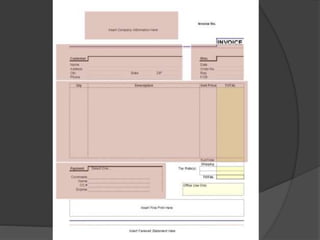
  • 122.
    Customer service managementprocess  Customer relationship management concerns the relationship between an organization and its customers.  Customer service is the source of customer information.  It also provides the customer with real-time information on scheduling and product availability through interfaces with the company's production and distribution operations. Successful organizations use the following steps to build customer relationships:  determine mutually satisfying goals for organization and customers  establish and maintain customer rapport  induce positive feelings in the organization and the customers Inventory management  Inventory management is concerned with ensuring the right stock at the right levels, in the right place, at the right time and the right cost.  Inventory management entails inventory planning and forecasting: forecasting helps planning inventory. Procurement process  Strategic plans are drawn up with suppliers to support the manufacturing flow management process and the development of new products.  In firms whose operations extend globally, sourcing may be managed on a global basis. The desired outcome is a relationship where both parties benefit and a reduction in the time required for the product's design and development.  The purchasing function may also develop rapid communication systems, such as electronic data interchange (EDI) and internet linkage, to convey possible requirements more rapidly.  Activities related to obtaining products and materials from outside suppliers involve resource planning, supply sourcing, negotiation, order placement, inbound transportation, storage, handling, and quality assurance, many of which include the responsibility to coordinate with suppliers on matters of scheduling, supply continuity (inventory), hedging, and research into new sources or programs.  Procurement has recently been recognized as a core source of value, driven largely by the increasing trends to outsource products and services, and the changes in the global ecosystem requiring stronger relationships between buyers and sellers.
  • 123.
    Product development andcommercialization  Here, customers and suppliers must be integrated into the product development process in order to reduce the time to market.  As product life cycles shorten, the appropriate products must be developed and successfully launched with ever-shorter time schedules in order for firms to remain competitive.  According to Lambert and Cooper (2000), managers of the product development and commercialization process must: 1. coordinate with customer relationship management to identify customer-articulated needs; 2. select materials and suppliers in conjunction with procurement; and 3. develop production technology in manufacturing flow to manufacture and integrate into the best supply chain flow for the given combination of product and markets.  Integration of suppliers into the new product development process was shown to have a major impact on product target cost, quality, delivery, and market share.  Tapping into suppliers as a source of innovation requires an extensive process characterized by development of technology sharing, but also involves managing intellectual property issues. Manufacturing flow management process  The manufacturing process produces and supplies products to the distribution channels based on past forecasts. Manufacturing processes must be flexible in order to respond to market changes and must accommodate mass customization.  Orders are processes operating on a just-in-time (JIT) basis in minimum lot sizes. Changes in the manufacturing flow process lead to shorter cycle times, meaning improved responsiveness and efficiency in meeting customer demand.  This process manages activities related to planning, scheduling, and supporting manufacturing operations, such as work-in-process storage, handling, transportation, and time phasing of components, inventory at manufacturing sites, and maximum flexibility in the coordination of geographical and final assemblies postponement of physical distribution operations.
  • 124.
    Physical distribution  Thisconcerns the movement of a finished product or service to customers.  In physical distribution, the customer is the final destination of a marketing channel, and the availability of the product or service is a vital part of each channel participant's marketing effort.  It is also through the physical distribution process that the time and space of customer service become an integral part of marketing.  Thus it links a marketing channel with its customers (i.e., it links manufacturers, wholesalers, and retailers). Outsourcing/partnerships  This includes not just the outsourcing of the procurement of materials and components, but also the outsourcing of services that traditionally have been provided in-house.  The logic of this trend is that the company will increasingly focus on those activities in the value chain in which it has a distinctive advantage and outsource everything else.  This movement has been particularly evident in logistics, where the provision of transport, storage, and inventory control is increasingly subcontracted to specialists or logistics partners.  Also, managing and controlling this network of partners and suppliers requires a blend of central and local involvement: strategic decisions are taken centrally, while the monitoring and control of supplier performance and day-to-day liaison with logistics partners are best managed locally.
  • 125.
    Performance measurement  Expertsfound a strong relationship from the largest arcs of supplier and customer integration to market share and profitability. Taking advantage of supplier capabilities and emphasizing a long-term supply-chain perspective in customer relationships can both be correlated with a firm's performance.  As logistics competency becomes a critical factor in creating and maintaining competitive advantage, measuring logistics performance becomes increasingly important, because the difference between profitable and unprofitable operations becomes narrower.  A.T. Kearney Consultants (1985) noted that firms engaging in comprehensive performance measurement realized improvements in overall productivity.  According to experts internal measures are generally collected and analyzed by the firm, including cost, customer service, productivity, asset measurement, and quality.  External performance is measured through customer perception measures and "best practice" benchmarking. Warehousing management  To reduce a company's cost and expenses, warehousing management is concerned with storage, reducing manpower cost, dispatching authority with on time delivery, loading & unloading facilities with proper area, inventory management system etc. Workflow management  Integrating suppliers and customers tightly into a workflow (or business process) and thereby achieving an efficient and effective supply chain is a key goal of workflow management.
  • 126.
  • 127.
    IT systems inprocurement B2C e-commerce:  There are five major activities involved in conducting B2C e-commerce. Information flow Information flow Information sharing Payment Ordering Ordering Fulfilment
  • 128.
    1. Information Sharing:A B2C e-commerce may use some or all of the following applications and technologies to share information with customers: Online advertisements, e-mail, newsgroups/ discussion groups, company web site, online catalogs, message board systems, bulletin board systems, multiparty conferencing. 2. Ordering: A customer may use electronic e-mail or forms available on the company's web site to order a product from a B2C site. A mouse click sends the essential information relating to the requested piece(s) to the B2C site. 3. Payment: Credit cards, electronic checks, and digital cash are among the popular options that the customer has as options for paying for the goods or services. 4. Fulfillment: Fulfillment that is responsible for physically delivering the product or service from the merchant to the customer. In case of physical products (books, videos, CDs), the filled order can be sent to the customer using regular mail, Cargo, FedEx, or UPS. As expected for faster delivery, the customer has to pay additional money. In case of digital products (software, music, electronic documents), the e-business uses digital documentations to assure security, integrity, and privacy of the product. It may also include delivery address verification and digital warehousing that stores digital products on a computer until they are delivered. The e-business can handle its own fulfillment operations or out source this function to third parties with moderate costs.
  • 129.
    5. Service andSupport: It is much cheaper to maintain current customers than to attract new customers.  For this reason, e-businesses should do whatever that they can in order to provide timely, high-quality service and support to their customers.  As e-commerce companies lack a traditional physical presence and need other ways to maintain current customers, service and support are even more important in e-commerce than traditional businesses.  The following are some examples of technologies and applications used for providing service and support: (E-mail confirmation, periodic news flash, and online surveys may also be used as marketing tools.).  E-mail confirmation: In most cases, the e-mail confirmation provides the customer with a confirmation number that the customer can use to trace the product or service. E-mail confirmation promises the customer that a particular order has been processed and that the customer should receive the product/ service by a certain date.  Periodic news flash: They used to give customers with the latest information on the company or on a particular product or offering.  Online Surveys: Their results can assist the e-commerce site to provide better services and support to its customers based on what has been collected in the survey, even though online surveys are mostly used as a marketing tool.  Help desks: They provide answers to common problems or provide advice for using products or services. They are used for the same purpose as in traditional businesses,  Assured secure transactions & assured online auctions: They guarantee customers that the e-commerce site covers all the security and issues. As many customers still do not feel comfortable conducting business, the security and privacy services are especially important
  • 130.
    E-Procurement  The term‘e-Procurement’ is used, and often misused, to refer to a wide range of procurement activities via the Internet. This could be anything from ordering goods from websites like Amazon through to a fully functioning business-to-business supplier exchange.  For our intents and purposes, the term ‘e-Procurement’ refers to the use of technology to exchange data that relates to the procurement of supplies. In a functioning e- Procurement environment, the majority of the data exchange and validation (e.g. matching purchase orders to invoices) is automated to save time and reduce costs. e-Requisition  eRequisition is a powerful, cloud-based purchase order approval system that integrates with QuickBooks Online and Desktop (Pro, Premier, Enterprise).  eRequisition is best used by businesses with a need for a purchase order approval process using: QuickBooks or no accounting system. Raising E-requisitions 1. E-requisition is used to request procurement of goods or services, defining the specifications and covering other details such as what is needed, when it is needed, and where it is needed. From the e-requisition, a buyer will source the necessary goods or services, evaluate the offers of relevant suppliers, and conclude the process by placing a Purchase Order with a specified supplier. 2. Once general planning for procurement is complete, an e-requisition for goods or services is raised by a United Nations Development Programme (UNDP) employee and submitted for approval to the appropriate Project Manager.
  • 131.
    e-Catalogues  The electronicexchange of trading documents such as requisitions, purchase orders, and invoices is a proven concept. E-Invoicing solutions such as Causeway’s Tradex platform have been increasing the productivity of companies for years.  A more recent technologic development that operates in parallel with e-Trading hubs such as Tradex is the e- Catalogue.  Again, this is a term that is often misused, so it is important to understand that a true e-Catalogue is more than a PDF sales brochure or a spreadsheet that lists all of a vendor’s products. Instead, an e-Catalogue is an online resource that both lists a vendor’s products and enables online ordering and payment.  As such, e-Catalogues deliver many benefits for both buyers and vendors that traditional procurement methods do not.
  • 132.
    The difference betweentraditional methods of procurement and e- Catalogues  There are numerous ways to differentiate between traditional methods of procurement and e-Catalogues.  For example, e-Catalogues make it easy for vendors to include detailed information about their products so that the buyer can assess the suitability of a product at a glance. Traditional catalogues often do not have the same ease of functionality.  Similarly, suppliers can easily update product and pricing information. Updates are automatically reflected across the entire e-Catalogue system, therefore buyers can be confident that they are working with the latest information.  As a result, e-Catalogues are particularly useful for streamlining the procurement of goods and services that are used frequently. This is where the biggest time-savings are achieved.  Once the products have been selected, the buyer can issue an e- Requisition to begin the order process.  Crucially, e-Catalogues from a range of approved vendors can be brought together in a single portal so the buyer only needs to visit one site to meet all his/her procurement requirements.  This ease and speed of functionality can only be achieved by integrating traditional methods of procurement with modern technology.
  • 133.
    Bringing it togetherin Causeway’s Tradex portal  As previously mentioned, Causeway’s Tradex e-Invoicing solution has been enabling companies to exchange trading documents for many years.  The functionality of Tradex has now been enhanced with the introduction of three new modules: e-Catalogues & e-Requisitions, Tradex Document Store, and Supplier Management.  This enhanced functionality for Tradex provides organisations with the ability to create requisitions and purchase orders within an online environment that integrates seamlessly with their Enterprise Resource Planning (ERP) system.  Buyers can select items from a list of products/catalogues which are uploaded into the Tradex portal by suppliers. All products/catalogues are vetted and approved using the Supplier Management module, and all prices are reviewed and accepted prior to being made available for end users to request or purchase.  Once the products have been selected, an e-Requisition is raised and a purchase order can be generated and sent directly to the chosen supplier through the Tradex portal. The supplier can then respond by sending an electronic invoice, also through the Tradex portal.
  • 134.
    E-Ordering  E-ordering wasdeveloped to optimise existing communication flows relating to orders. Where E-Invoicing is very interesting for the customer who receives many invoices, E- Ordering is interesting and useful for the supplier who receives many orders.  Usually, a customer places an order by means of a phone call or PDF.  The supplier then needs to transfer the data of the order into their own system. When you receive many orders, this can be a time-consuming job.  E-Ordering is actually ordering goods and services through Internet technology.  By means of E-Ordering, workers within the organization can electronically request, view, order and receive products and services via a catalog ordering system.  Once an employee has done its order request, this (possibly automatically through approval procedures) is approved and converted into electronic orders to suppliers.
  • 136.
    E-Sourcing  Electronic sourcingis a small but important part of the overall eProcurement process.  It involves everything from inviting potential suppliers to tender, collecting supplier information, running tender processes and/or holding eAuctions, analysing and evaluating responses, and finally, awarding them with a contract.
  • 137.
     Pre-purchase questionnaire–before doing business with any supplier, it is imperative to identify if they’re appropriate to do business with. Organisations achieve this with pre-purchase questionnaires (PQQ), which are detailed documents designed to assess the suitability of a supplier. PQQ’s are common in the public sector, but in other industries the process can be called request for information (RFI).  Invitation to tender – invitation to tender (ITT), also known as call for tenders, is a process for generating competing offers from different suppliers. Once they have filled out a PQQ and have been selected to go to the next stage of the sourcing process, suppliers are sent an ITT.  Request for quotation – this is a process where price, is the primary factor for choosing a supplier. Buyers send out forms for suppliers, asking all of them the prices of services they can render. Request for quotations (RFQs) can be used prior to a RFI and ITT if a buyer is seeking to understand price ranges in the market.  Evaluation – once the requested evaluation formats have been sent and received, an evaluation process takes place, where the prospective buyers evaluate whether the information they’ve been provided with makes them a viable supplier or not.  eAuction – much like RFIs, PQQs and RFQs, eAuctions can be run at any point in the eSourcing process. It can follow a tender, it can be used after a tender process or run as a standalone event for finished goods.Once suppliers have been selected, they are invited to participate in an eAuction – a process where suppliers bid on the right to deliver the contract they’ve been invited to tender for.  Contract award – once the tendering processes and/or eAuctions have concluded, and a buyer has been selected, a contract is awarded to the winning supplier. Elements of this process can be automated, automatically sending the winning bidder a contract.
  • 138.
  • 139.
    E-Payment  One ofthe most popular payment forms online are credit and debit cards. Besides them, there are also alternative payment methods, such as bank transfers, electronic wallets, smart cards or bitcoin wallet (bitcoin is the most popular cryptocurrency).  E-payment methods could be classified into two areas, credit payment systems and cash payment systems. Credit Payment System  Credit Card — A form of the e-payment system which requires the use of the card issued by a financial institute to the cardholder for making payments online or through an electronic device, without the use of cash.  E-wallet — A form of prepaid account that stores user’s financial data, like debit and credit card information to make an online transaction easier.  Smart card — A plastic card with a microprocessor that can be loaded with funds to make transactions; also known as a chip card.
  • 140.
    Cash Payment System Direct debit — A financial transaction in which the account holder instructs the bank to collect a specific amount of money from his account electronically to pay for goods or services.  E-check — A digital version of an old paper check. It’s an electronic transfer of money from a bank account, usually checking account, without the use of the paper check.  E-cash is a form of an electronic payment system, where a certain amount of money is stored on a client’s device and made accessible for online transactions.  Stored-value card — A card with a certain amount of money that can be used to perform the transaction in the issuer store. A typical example of stored-value cards are gift cards.
  • 141.
    Enterprise Resource Planning(ERP)  Enterprise resource planning (ERP) is the integrated management of main business processes, often in real time and mediated by software and technology. ERP Modules and Their Features  Below are the various modules of ERP; 1. Finance 2. Procurement 3. Manufacturing 4. Inventory Management 5. Order Management 6. Warehouse Management 7. Supply Chain Management 8. Customer Relationship Management 9. Project Service Resource Management 10. Workforce Management 11. Human Resource Management 12. Ecommerce 13. Marketing Automation
  • 143.
    Finance  The financeand accounting module is the most important ERP module because it allows businesses to understand their current financial state and future outlook.  Key features of this module include tracking accounts payable (AP) and accounts receivable (AR) and managing the general ledger.  It also creates and stores crucial financial documents like balance sheets, payment receipts and tax statements.  The finance module can automate tasks related to billing, vendor payments and account reconciliation, helping the accounting department close the books in a timely manner and comply with current revenue recognition standards.  It also has the data that financial planning and analysis employees need to prepare key reports, including profit and loss (P&L) statements and board reports, and run scenario plans. Procurement  The procurement module, also known as the purchasing module, helps an organization secure the materials or products it needs to manufacture and/or sell goods.  Companies can keep a list of approved vendors in this module and tie those suppliers to certain items. The module can automate requests for a quote, then track and analyze the quotes that come in.
  • 144.
     Once acompany accepts a quote, the procurement module helps the purchasing department prepare and send out purchase orders.  It can then track that purchase order as the seller turns it into a sales order and ships the goods, automatically updating inventory levels once the order arrives. Manufacturing  The earliest version of ERP, material requirements planning (MRP) systems, were designed for manufacturers, and manufacturing remains a key piece of ERP.  Today, ERP systems typically have a production management or manufacturing execution system (MES).  The manufacturing module helps manufacturers plan production and make sure they have everything they need for planned production runs, like raw materials and machinery capacity.  During the manufacturing process, it can update the status of goods- in-progress and help companies track actual output against forecasted production.  It also provides a real-time picture of the shop floor, capturing real- time information on items in progress and finished goods.  It can calculate the average time to produce an item and then compare supply with forecasted demand to plan adequate production.
  • 145.
    Inventory Management  Theinventory management module enables inventory control by tracking item quantities and location down to individual Stock Keeping Units (SKU).  This module offers a complete picture of not only current but also incoming inventory, through an integration with the procurement tool.  This piece of software helps businesses manage inventory costs, making sure they have sufficient stock without tying up too much cash in inventory.  An inventory management application can weigh sales trends against available product to helps companies make informed decisions that boost margins and increase inventory turn (a measure of how often inventory is sold over a certain period).  It can help prevent stockouts and delays, which enhances customer service.  Businesses that lack other supply chain management modules may also use the inventory management application to handle purchase orders, sales orders and shipping.  Larger organizations will need a version of this solution that can track inventory across multiple locations.
  • 146.
    Order Management  Anorder management module tracks orders from receipt to delivery.  This piece of the ERP feeds all orders to the warehouse, distribution center or retail store after customers place them and tracks their status as they’re prepared, fulfilled and shipped to the customer.  The order management module prevents orders from being lost and boosts on-time delivery rates to keep customers happy and cut unnecessary expenses for expedited shipping.  More advanced order management applications can help a company determine the most cost-effective option for fulfilling an order—a store vs. a warehouse vs. a third-party fulfillment partner, for example— based on available inventory and the buyer’s location.
  • 147.
    Warehouse Management  Awarehouse management module can deliver a rapid return on investment for businesses that operate their own warehouses.  This application can efficiently guide warehouse employees through all warehouse processes based on the layout of the facility, from putaway when shipments arrive to picking to packing and shipping.  It can also help companies plan labor based on expected order volume.  The warehouse management module can support different picking strategies like batch picking, wave picking and zone picking depending on which is most efficient for a given business, and some modules can show employees the most efficient pick path.  When the warehouse management module is integrated with inventory management and order management applications, employees can quickly find the right products and get shipments out the door quickly.  Faster delivery ultimately increases customer satisfaction.
  • 148.
    Supply Chain Management A supply chain management module tracks each step in the movement of supplies and goods throughout the supply chain, from sub-suppliers to suppliers to manufacturers to distributors to retailers or consumers.  It can also manage any materials or products returned for refund or replacement.  As noted earlier, supply chain management can include a wide array of modules like procurement, inventory management, manufacturing, order management and warehouse management.  However, it may have functionality beyond the core capabilities of those modules.
  • 149.
    Customer Relationship Management(CRM)  The customer relationship management (CRM) module stores all customer and prospect information.  That includes the company’s communication history with a person—the date and time of calls and emails, for example—and their purchase history.  A CRM improves customer service because staffers can easily access all the information they need when working with a customer.  Many businesses also use CRM to manage sales leads and opportunities.  It can track communication with prospects and suggest which customers should be targeted for certain promotions or cross-sell opportunities.  More robust CRM modules may support customer segmentation (enabling more targeted marketing) and advanced contact managers and reporting tools.
  • 150.
    Professional Services Automation(Service Resource Management)  A professional services automation (PSA) module, also called a service resource management module, allows an organization to plan and manage projects.  Services-based businesses often use this module.  The application tracks the status of projects, managing human and capital resources throughout, and allows managers to approve expenses and timesheets.  It facilitates collaboration between teams by keeping all related documents in a shared place. Additionally, the PSA module can automatically prepare and send bills to clients based on rules around the billing cycle.
  • 151.
    Workforce Management  Aworkforce management module is similar to a human resource management module but is designed for companies with more hourly than salaried employees.  It can monitor workers’ attendance and hours and measure things like employee productivity and absenteeism.  Payroll could also fall under the workforce management module.  A payroll sub-module automatically distributes paychecks to employees on a set schedule with the appropriate taxes deducted and handles expense reimbursement.  It can also provide reports on payroll expenses, total overtime hours and similar KPIs.
  • 152.
    Human Resources Management A human resource management (HRM) or human capital management (HCM) module usually encompasses all the features of workforce management application and offers additional capabilities.  HRM could be viewed as CRM for employees.  This popular module has detailed records on all employees and stores documents like performance reviews, job descriptions and offer letters.  It tracks not only hours worked but also paid time off (PTO)/sick days and benefits information.  Since the HRM module stores a vast amount of information on every employee across the organization, it eliminates a lot of duplicate or inaccurate data that many organizations store in various spreadsheets.
  • 153.
    Ecommerce  Certain ERPvendors offer an ecommerce module for businesses that want to sell online. This module allows companies to quickly launch a business-to-business (B2B) or business-to-consumer (B2C) ecommerce website.  Leading commerce applications include user-friendly tools that allow employees to easily add new items, update product content (item descriptions, titles, specs, images, etc.) and change the look and feel of the website.  When the ecommerce application is integrated with other ERP applications, all payment, order and inventory information feeds [from the ecommerce module] into the shared database.  That ensures all transactions are added to the ledger, out-of-stock items are removed from the site and orders ship on time.
  • 154.
    Marketing Automation  Likewith ecommerce, certain software providers have developed a marketing automation module.  A marketing module manages marketing campaigns across digital channels like email, web, social media and SMS.  It can automate email sends based on campaign rules and has advanced customer segmentation features, so customers only receive relevant messages.  Marketing automation software, whether part of the ERP system or a separate solution, can provide detailed reports on the performance of campaigns to shape future marketing plans and spend.  These applications increase leads, customer loyalty and, over time, sales.
  • 155.
    EDI (Electronic datainterchange)  Electronic data interchange (EDI) is the intercompany communication of business documents in a standard format.  The simple definition of EDI is a standard electronic format that replaces paper-based documents like purchase orders or invoices.  By automating paper-based transactions (PDF, 669 KB), organizations can save time and eliminate errors caused by manual processing that are costly to fix.  With EDI transactions, information moves directly from a computer application in one organization to a computer application in another.  EDI standards define the location and order of information in a document format.  This automated capability enables data to be shared rapidly instead of the hours, days, or weeks required with paper documents or other methods.  Today, industries use EDI integration to share a range of document types — from purchase orders to invoices to requests for quotations to loan applications and more.  In most instances, these organizations are trading partners that exchange goods and services frequently as part of their supply chains and business-to-business (B2B) networks.
  • 156.
     In general,EDI transmissions break down into two basic types: 1. Point-to-point or direct connections. Two computers or systems connect with no intermediary over the internet, generally with secure protocols. 2. Value-added network (VAN). A third-party network manages data transmission, generally with a mail boxing paradigm. Code of Ethics Procurement Ref: Code of Ethics Procurement
  • 157.
    Types and risksof unethical behavior Types of Unethical Behaviors: 1. Accepting supplier favors & gifts 2. Conflict of interest 3. Confidentiality of information 4. Fair and unbiased treatment 5. Integrity  Accepting supplier favors & gifts: Accepting gifts, favors and freebies from suppliers is the most common unethical practice. This may affect buyer’s decision to evaluate and select a supplier.  Conflict of interest: Conflicts of interest arise when buyers or their close family/friends have direct financial interest in a supplier’s organization. This is a major unethical practice and a serious breach of ethics
  • 158.
     Confidentiality ofinformation: Confidential information should be shared only when needed and with the persons who are liable to get the same as part of their profession. Confidential information should be carefully shared with the internal and external world. There are various kinds of information that need to be protected; otherwise it could hamper the business adversely. Some of the examples are pricing, T&Cs, personnel information of customers, commercial information of suppliers in case of an RFx process, cost break up, any businesss and trade secrets etc.  Fair and unbiased treatment: All suppliers should be treated fairly and in an unbiased manner. Any biased treatment to any particular vendor raises unethical behavior.  Integrity: Integrity is the quality of being honest and having strong moral principles. Any compromise on the integrity has a negative impact on the overall procurement process.
  • 159.
    Risks of unethicalbehavior  Below are the most significant risks of unethical behavior; 1. Increased risk of doing business and the possibility of bankruptcy and severely damaged company brand and image. 2. Decreased productivity. 3. Increased misconduct and conflict internally. 4. Decreased performance levels of employees. 5. Increased employee turnover and more challenging employee recruitment.
  • 160.
    Value Engineering  ValueEngineering (VE) is concerned with new products. It is applied during product development.  The focus is on reducing costs, improving function or both, by way of teamwork-based product evaluation and analysis.  This takes place before any capital is invested in tooling, plant or equipment. Value Analysis  Value Analysis (VA) is concerned with existing products. It involves a current product being analysed and evaluated by a team, to reduce costs, improve product function or both.  Value Analysis exercises use a plan which step-by-step, methodically evaluates the product in a range of areas.  These include costs, function, alternative components and design aspects such as ease of manufacture and assembly.
  • 161.
    Process Mapping  Processmapping is the graphical representation with illustrative descriptions of how things get done. It helps the participants to visualize the details of the process closely and guides decision making.  One can identify the major areas of strengths and weaknesses in the existing process, such that the contribution of individual steps in the process are recognized.  Further, it helps to reduce the cycle times and defects in the process and enhances its productivity. Types of process maps  There are two major types of process maps- that are process flowchart and deployment flowchart. Process flowchart:  A process flowchart is a simple process map that provides the visual representation of the sequence of activities along with their points of decisions.  These flowcharts provide the basic details of the process, which can later be augmented by adding the roles of different staffs. Deployment flowchart:  These process maps provide the interactions between different departments and the roles performed by different people in the organization.  Also termed as ‘swim- lane’ charts, these process maps have vertical lines showing the movement of process from person to person.
  • 162.
    Negotiation Planning &Tactics Steps in Negotiation planning Step 1: Work Out What You Want Step 2: Establish What You’re Prepared to Give Up Step 3: Clarify Authority Limits Step 4: Do Your Homework Step 5: Decide On What Techniques to Use Step 1: Work Out What You Want  First, you need to work out what it is that you are actually after.  Think about what you must get out of this negotiation and what you would like to have.  For example, if you are negotiating a job package for a job you could note down your desired salary, the car allowance you are after, the health package, childcare vouchers, whatever it is that you think you could get from the negotiation to start a new job.
  • 163.
    Step 2: EstablishWhat You’re Prepared to Give Up  Think about what concessions you are prepared to make.  For example, if you are negotiating with a supplier, maybe you’d give up super fast delivery for a discount on the price. Step 3: Clarify Authority Limits  Work out, and confirm with your manager, what authority you have for this discussion and at what point you’ll have to step away from the deal and let someone else carry on the negotiation.  If you have to back out halfway through then your supplier or whomever it is you are negotiating with will have to start from scratch with someone else.
  • 164.
    Step 4: DoYour Homework  This can be quite a large and time-consuming step, but it’s definitely worth it.  Gather some information on the market value of similar deals.  Research similar procurements either internally or externally using publicly available information.  If it’s to do with negotiating terms for a new job, check out the salaries and packages they have offered people in the past through other job adverts or websites like Glassdoor.
  • 165.
    Step 5: DecideOn What Techniques to Use  Review what techniques would be useful in this negotiation.  This involves planning a great location for the discussion: a noisy open office isn’t the best place to be asking for a pay increase.  Think about what would work best for you: a neutral location like a coffee shop? Your offices instead of your supplier’s offices?  You can also think about how you are going to approach the conversations.
  • 166.
    Negotiation Tactics 1. Listenmore than you talk. 2. Use timing to your advantage. 3. Always find the right way to frame the negotiation. 4. Always get when you give. 5. Always be willing to walk Listen more than you talk  It's easy to go into a negotiation focused only on what you'll say, especially when you're nervous.  The goal of a negotiation isn't just to get what you want, but also to help the other side get what they want  To do that, you need to actually know what the other side wants -- which means you have to listen.  Finding common ground means knowing common ground exists  In most situations, price isn't the only thing on the table. Maybe the other side would appreciate a longer delivery schedule. Or a larger down payment. Or to book revenue as soon as possible.
  • 167.
    Use timing toyour advantage  Often the best time to buy a car is at the end of the month; salespeople need to hit their quotas, dealerships want to "make" their month, etc. The same is true with real estate; house sales (and property leases) are generally weaker in the winter months, which means owners are more likely to negotiate.  And you can also use back-end timing to your advantage.  Say you want to lease a property starting in March. If you sign a 12-month lease, the owner will have to find another tenant next March. But if you ask for a 15-month lease, the property will be open at the start of prime rental season, which means he or she should be happier to accept a lower rent amount.
  • 168.
    Always find theright way to frame the negotiation.  In Negotiating the Impossible, Deepak Malhotra shows how properly framing a negotiation means finding the best perspective from which to view the negotiation. Maybe the frame is money. Or time. Or delivery schedule. Or quality.  In the landlord example above, price isn't the only frame. So is time. In my house-buying example, price was a frame -- but so was time, and so was the seller's risk if I couldn't come up with the down payment.  Frame a negotiation correctly and you can make it easier to negotiate on the points that matter to you.  For example, say you need a certain service performed. If you're willing to wait for that service to be performed -- or to be performed more slowly than normal -- the provider may be able to accept a lower price, since your job can be fit into the margins of the provider's schedule.  Or if you're buying a car, implicitly framing the negotiation by waiting until the end of the month and then saying you want to buy a car right away frames the negotiation in terms of time for the salesperson. Or frame it by going to the dealership near the end of the day: The salesperson will be more eager to make a deal, since customers who leave saying "I'll be back" rarely do come back
  • 169.
    Always get whenyou give.  You send a proposal to a customer and he asks for a 10 percent discount. Simply saying yes sends a terrible message; in effect, that means your original price was too high.  Whenever you make a concession, make sure you receive something in return. Maybe you will provide a 10 percent discount, but your delivery schedule will be extended. Or you'll need a larger deposit.  Keep in mind you can also use the same approach as a buyer. Don't just say "I need you to knock 10 percent off the price." Say "I can only afford to pay $X, but in return you can space out deliveries over the next two months." Or "I can only afford to pay $X, but I will be glad to sign a longer-term contract under those terms."  That way you aren't just competing; you're finding common ground by finding terms that work for both of you.
  • 170.
    Always be willingto walk.  Granted, sometimes that's not possible. If your delivery truck has broken down and you need to make deliveries today, walking away from the truck rental counter isn't really an option.  But that's a practical need, not an emotional need. In most cases, your need is emotional: You want this building; you want this car; you want this house. Even though there are other options, you want this one.  When you're negotiating, never want this one -- at least not unless the price, terms, etc., are also what you want.  How will you know? Decide those things ahead of time. Know your numbers. Know the terms you're willing to accept. Know the value of what you're getting -- and of what you will provide.  The best way to be a great negotiator is to take emotion out of the equation. When it's objective -- when it doesn't feel personal -- you won't get hung up on winning or losing. You'll just calmly work toward getting the best deal you can.  And this means, oddly enough, you're much more likely to "win.
  • 171.
    Types of PurchasingContract 1. Fixed Price Contracts 2. Fixed Firm Price (FFP) 3. Fixed Price Incentive Fee (FPIF) 4. Fixed Price with Economic Price Adjustment (FP-EPA) 5. Possible Pitfalls of Fixed Price Contracts Fixed Price Contracts  This is the best contract type when someone knows exactly what the scope of work is.  Also known as a lump sum contract, this contract is the best way to keep costs low when you can predict the scope.  For instance, if an organization needs services from a vendor, and the scope is clearly defined, the contract makes sure the organization only pays a specified amount for the required work.
  • 172.
    Fixed Firm Price(FFP)  This is the simplest subtype, as it features both a fixed price and time frame.  The contract states the price and the deadline for the project, such as $5,000 and the end of the month. If the seller makes mistakes or otherwise causes the costs to increase, the price remains at $5,000 and the seller is responsible for the difference. Fixed Price Incentive Fee (FPIF)  This is the same as the FFP contract, with the addition of a monetary incentive so that the seller does a better job or completes the project ahead of schedule.  The contact can specify the fee along with the terms of when it is received, such as when the project is completed below the estimated cost, before the estimated completion date, or in the case of exemplary performance.  This contract is best used when you want to ensure the project will be completed on time or below cost.
  • 173.
    Fixed Price withEconomic Price Adjustment (FP-EPA)  This contract type is most often used when the project is expected to take a long time, to protect the seller from inflation that may occur over the duration.  For instance, this type of contract allows for a clause that gives the contractor a certain percentage increase after a predetermined amount of time.  Generally, organizations based on the percentage on the consumer price index or the CPI. Possible Pitfalls of Fixed Price Contracts  For this to be the most effective contract type, you must have a clearly defined scope at contract signing.  If there is any ambiguity, the seller may ask for more money if it seems the scope has changed in any manner.  This can easily cause projects to go over budget.
  • 174.
    Purchasing and supplychain performance measurement  Measuring purchasing performance is important, as the purchasing department plays an increasingly important role in the supply chain during an economic downturn.  A reduction in the cost of raw material and services can allow companies to competitively market the price of their finished goods in order to win business. Purchasing Efficiency  Administrative costs are the basis for measuring purchasing efficiency.  This performance measurement does not relate to the number of purchased items that the department has procured.  The measurement relates to how well the purchasing department is performing in the activities they are expected to perform against the budget that is in place for the department.
  • 175.
    Purchasing Effectiveness  Theprice that the purchasing department paid for an item is not necessarily a good measurement of purchasing performance.  The price of an item may fluctuate due to market conditions, its availability, and other demand pressures.  Therefore, the purchasing department may not be able to control the price. Purchasing Functionality  Purchasing performance can be measured against the functional requirements of the purchasing function.  The primary function of the department is to provide the correct item at the required time at the lowest possible cost.
  • 176.
    Performance Measurements  Theperformance of the purchasing function can be measured using a variety of measurements.  A company can decide which of these measurements of effectiveness are relevant to the performance of their purchasing department.  The measurements can include: 1. Cost Saving 2. Increased Quality 3. Purchasing Improvements 4. Transportation Improvements
  • 177.
    1. Cost Saving If the purchasing department procures an item at a lower price than they did previously, then it is a cost- saving.  This can occur when a new supplier is found, a less costly substitute item is used, a new contract has been signed with the vendor, a cheaper transportation method has been found, or the purchasing department has negotiated a lower price with the existing supplier. 2. Increased Quality  When an item has improved quality either by using a different supplier or by negotiating with the existing supplier, the improvement will be reflected in a reduction of waste or production resources.
  • 178.
    3. Purchasing Improvements Efficiencies in the methods used in the purchasing department will increase effectiveness.  These can include the introduction of EDI, e- procurement systems, vendor-managed inventory and pay on receipt processes. 4. Transportation Improvements  When a purchasing department negotiates with a carrier or number of carriers to reduce the cost of transporting items from the vendor to the production facilities, the unit cost of the item will be reduced.  This cost-saving can be used as a measurement of effectiveness.
  • 179.