MODULE 2 PART 2
MA
TERIALSAND SALES
MANAGEMENT
MATERIALS MANAGEMENT
⚫Materials refers to all those commodities which are
used in the production of goods and rendering services
⚫Raw materials, components, packing materials and
finished products are included in the list of materials
⚫Material management is concerned with the
determination of materials requirement, purchase,
storage, and release for use in production.
⚫It also includes constant care to maintain the materials
in good conditions and safeguard them against all
hazards and losses from the time of purchase till its
use.
⚫Material management is defined as the function
responsible for the coordination of planning, sourcing,
purchasing, moving, storing and controlling materials
in an optimum manner so as to provide a pre-decided
service to the customer at a minimum cost.
Objectives of material management can be
full filled by the following functions
⚫1. Material planning.
⚫2. Procurement or purchasing of materials.
⚫3. Receiving and Warehousing.
⚫4. Storage and store-administration.
⚫5. Inventory control.
⚫6. Standardization, simplification and Value-analysis.
⚫7. External transportation (i.e., traffic, shipping, etc.)
an materials handling (i.e., internal transportation).
⚫8. Disposal of scrap, surplus and obsolete materials.
Purchase department
⚫In any industry before starting the process of
production, prime requirement is to procure raw
materials, machinery and tools that go into the
production and other materials required for the
maintenance work.
⚫In small industries the function of purchase is
performed by the works superintendent, but in case of
large industries, a separate department, known as
purchase department is provided for the purchasing of
material.
⚫Purchases the materials, machinery and tool which are
required for the production.
Objectives of purchasing department
⚫To maintain regular flow of materials
⚫ To purchase at a competitive price the right quality, in
right quantity and at a right time from a right source.
⚫To ensure higher productivity
⚫To ensure the production of a better quality production
at a competitive cost
⚫ To ensure a better margin of profit
Functions of purchase department
⚫ Maintain records of available and reliable suppliers, and
prices of materials
⚫ To prepare and update list of materials required by different
departments of the organization within a specified span of
time.
⚫ Place and follow-up purchase orders
⚫ Maintain records of all purchases
⚫ To make sure through inspection that right kind (i.e.
quantity, quality, etc.) of material has been purchased.
⚫ TO act as a mediator between the vendors and different
departments of the concern such as production, quality,
control, finance, maintenance, etc.
⚫To check if the material has been purchased at right
time and at economical rates.
⚫To keep an uninterrupted supply of materials so that
production continues with least capital tied in
inventories.
⚫To prepare purchasing budget.
⚫To ensure that prompt payments are made to the
suppliers in the interest of good public relations
Methods of purchasing
⚫(a) Purchasing by requirement
⚫(b) Purchasing for a specific future period
⚫(c) Market purchasing
⚫(d) Speculative purchasing
⚫(e) Contract purchasing
⚫(f) Central purchase organization.
⚫(g)Through Directorate general of Supplies and Disposal
(a) Purchasing by Requirements:
⚫ In this method, the required quantity of materials for any
particular job are purchased, when the job is in hand. This
method is suit for the industries, having less working
capital.
⚫ Advantages
⚫The market fluctuations will not affect as costing is based on
the market rates.
⚫Small storage space will be required.
⚫ Less inventory carrying cost.
⚫ Disadvantages
⚫The selling price will be higher.
⚫ Profits are limited since the orders are for small quantities
⚫Sudden demands cannot be met.
⚫Bargaining cannot be had due to the small amount involved
(b) Purchasing for a specific future period
⚫ Under this method, the materials are purchased in bulk for
specific future period to maintain the flow of production.
The standard items which are in regular use are purchased
by this method
⚫ Advantages
⚫As the order is received, production can at once be started
⚫The market fluctuations will not affect to a small size.
⚫The involved working capital will be less.
⚫Less storage space is needed.
⚫Cost analysis is easier.
⚫ Disadvantages
⚫This cannot be adopted for large scale industries.
c)Market purchasing
⚫ This type of purchasing is generally made to take advantage
of prize fluctuations.
⚫ Raw materials are generally purchased on this basis.
⚫ When the raw materials are available at low price, they are
procured in bulk quantities, to get greater margin of profit
in finished goods.
⚫ Advantages
⚫Profit will be more if demand increases
⚫Production will be continues
⚫ Disadvantages
⚫More capital is required
⚫More storage space is required
⚫
d)Speculative purchasing
⚫ Purchases are made not according to the requirement.
⚫ Purchased with a view that there will be a greater demand
in the future.
⚫ Purchases are made in excess of actual requirement.
⚫ Advantages
⚫Profit will be more if demand increases
⚫Production will be continuous
⚫ Disadvantages
⚫More capital is required
⚫More storage space is required
⚫If speculation goes wrong, then the profit on the finished
product is reduced.
e) Contract purchasing
⚫Contracts are given to suppliers for large amounts of
future requirements(for 2,3 years), subject to review
and cancellation with an appropriate period of notice
⚫Eg: pig iron, coal, coke etc
⚫Advantages
⚫It avoids necessity for keeping stocks
⚫The purchase is not affected by market fluctuations and
the supply ensured
⚫Disadvantages
⚫The supply may not be regular, as it is out of control of
production department
f) Central purchase organisation
⚫ Large industries or certain big govt industries may have section wise
stores at different places and each section may have a separate store.
⚫ To avoid the margin of middle man, central purchase organization
makes direct dealings with the manufactures and distributes the
material to section wise stores.
⚫ There by reducing the malpractices
⚫ Makes the direct dealings with the manufactures and distributes the
material to section wise store.
⚫ Advantages
⚫ Astrict control and check is possible
⚫ It can have direct dealing with manufacturer and can get things as per
specifications
⚫ Disadvantages
⚫ There may be delay in getting material from central stores to sectional
stores
g) Through directorate general of supplies
and disposal
⚫The Directorate General of supplies and disposal
provides supply of different products at relatively
cheaper rates for different government organizations.
⚫This department enters into contract with various
organisations for supply of certain materials to various
government organizations during the year at agreed
rates.
⚫These suppliers have to certify that they shall not
supply to other purchasers same material at lesser rate
during the contract year.
Purchase procedure
⚫ Seven stages.
⚫ Main aim is to purchase quality materials at competitive price.
⚫ Steps:
⚫ 1. Receipt and analysis of requirements and processing of
requisitions.
⚫ 2. Choice and location of potential suppliers.
⚫ 3. Request, receipt and analysis of quotations
⚫ 4. Placing of orders.
⚫ 5. Follow up and expediting the purchase orders.
after
⚫ 6. V
erification of supplier’s invoices for payment
processing discrepancies and rejections.
⚫ 7. Closing completed orders and maintenance of records.
INVENTORY
⚫ Scientific method of finding out how much stock should be
maintained in order to meet the production demands and be
able to provide right type of material at right time in the
right quantities & at competitive prices.
⚫ Aim =>promotion of smooth factory operation
⚫ It is a detailed list of movable goods such as raw materials,
materials in process, finished products, general supplies
and equipments which are necessary to manufacture a
product and to maintain the equipment and machinery in
good working order.
⚫ The quantity and value of every item is also mentioned in
the list.
The need of inventory control
⚫To maintain a reserve of goods that will ensure
manufacturing according to the production plan.
⚫To promote smooth factory operation and to prevent
piling up, idle machine time, proper quantity of
material must be on hand when it is wanted.
⚫To take advantages of seasonal fluctuations of prices of
materials, increase of sales and so profit and avoiding
transportation delays.
Inventory control techniques
⚫1.ABC analysis or selective control analysis
⚫2. System of re-ordering
⚫3. Economic order quantity (EOQ) model
Classification of inventory
⚫ 1. classification according to function material flow
⚫ Production inventory: Items going into final product such as
raw materials, finished parts.
⚫Work in process inventory: items in semi finished items or
products required at different stages of manufacturing of the
product.
⚫Finished goods inventory: are finished goods or final products
ready for dispatch to users or to distributors.
⚫Operating and maintenance inventory: Items like consumables
or maintenance or repair items which do not form part of final
product.
⚫ Miscellaneous inventory: Items other than above mentioned
such as unsaleable products or scrap arising from production
process.
⚫2. Conventional classification
⚫Direct inventories: Items in any form which will be a part
final product
⚫Indirect inventories: Items which will not be a part final
product but are very essential such as lubricants, cutting
fluids etc
⚫Finished products inventories: Items ready for dispatch
⚫Purchased parts inventories: Semi finished or finished
parts used for assembling
INVENTORY MODELS
⚫3 types
⚫ Economic order quantity (EOQ) model
⚫ ABC analysis or selective control analysis
⚫ System or reordering
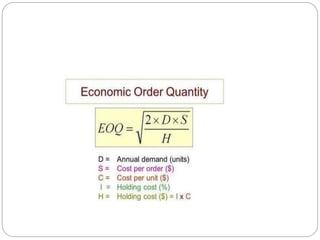
1. EOQ (Economic order quantity)
⚫ Definitions
⚫ Economic Order Quantity (EOQ) is the order quantity that
minimizes total inventory costs.
⚫ Order Quantity is the number of units added to inventory
each time an order is placed.
⚫ Total Inventory Costs is the sum of inventory acquisition cost,
ordering cost, and holding cost.
⚫ Ordering Cost is the cost incurred in ordering inventory from
suppliers excluding the cost of purchase such as delivery costs
and order processing costs.
⚫ Holding Cost, also known as carrying cost, is the total cost of
holding inventory such as warehousing cost and obsolescence
cost.
EOQ
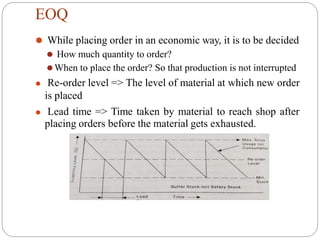
⚫ While placing order in an economic way, it is to be decided
⚫ How much quantity to order?
⚫When to place the order? So that production is not interrupted
⚫ Re-order level => The level of material at which new order
is placed
⚫ Lead time => Time taken by material to reach shop after
placing orders before the material gets exhausted.
⚫ Max stock- Maximum quantity of material that can be kept
⚫ Min stock- Quantity below which material is not allowed to
fall
⚫ Standard Order- it is the difference between maximum and
minimum quantity. (Max stock – Min stock ). Also called
economic purchase inventory size or economic order
quantity
⚫ Reorder point- The level of material at which new order is
placed
⚫ Lead or procurement time- Time between placing order &
receiving material.
⚫ Reorder level = lead time x consumption
⚫ Buffer or safety stock - Stock which is used only if lead
time increases than expected.
⚫ Cycle time- Time difference between two successive orders
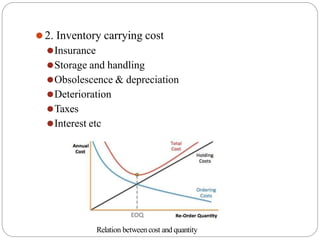
EOQ COST
⚫The evaluation of the most economic ordering quantity
to be purchased involves calculation of two costs:
⚫1. Procurement cost or ordering cost or buying cost
⚫Calling quotation
⚫Processing quotations
⚫Placing purchase orders
⚫Receiving & inspection
⚫Verifying & payment of bills
⚫Other incidental charges etc
⚫2. Inventory carrying cost
⚫Insurance
⚫Storage and handling
⚫Obsolescence & depreciation
⚫Deterioration
⚫Taxes
⚫Interest etc
Relation betweencost and quantity
ABC analysis
⚫ As the size of industry increases, the number of items to be
purchased and then to be taken care of also increases.
⚫ Always better control
⚫ How much valued the item is and controlling it to what extent is
the interest of the organisation.
⚫ ABC analysis is meant for relative inventory control in which
max attention can be given to items which consume more money
and a fair attention can be given to medium valued items ,while
the attention for low value items can be reduced to routine
procedure only.
⚫ This policy can be applied in various other aspects of materials
management such as purchase ,sales, inspection ,inventory
control ,store keeping etc
ABC analysis
Classification of ABC analysis
(based on % of items & % value of
items)
⚫Aclass
item
⚫B class
item
⚫C class
item
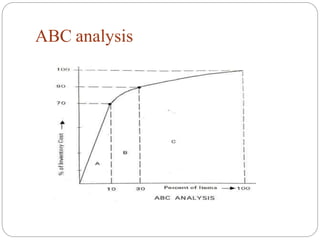
A-class item
⚫There are high valued but are limited or few in number.
⚫They constitute 10% of items but account for 70 % of total
inventory cost.
⚫They need careful and close inventory control, proper
handling and storage facilities.
⚫Such items being costly are purchased in small quantities
often and just before their use.
⚫This increases the procurement costs and involves a little
risk of non availability.
B-class item
⚫These are medium valued and their number lies in
betweenAand C items.
⚫They constitute 20 % of total inventory cost and about
20% of the total items, they need moderate control.
⚫More important than c-item.
⚫Less costly
⚫Asafety stock up to 3 months may be kept.
C-class item
of the total inventory cost and 70 %
⚫Low valued.
⚫Max number item
⚫Constitute 10 %
of total items.
⚫Do not need any control.
⚫Least important items like pins, washer, rubber bands,
etc.
Advantages of ABC Analysis
⚫All effort concentrated in genuine area
⚫Most effective & economical method
⚫Helps in placing orders, deciding quantity of
purchase, safety stock etc
Stores & store management
⚫ Store- Unworked material is known as store & place
where they are kept is called Store room
⚫ Stock- Finished material ready for sale & place where
they are kept is called stock room.
⚫ In small company store & stock rooms are the same
while in big companies they are different
⚫ Storage- Holding all kinds of stores, materials, semi &
fully processed goods in custody.
Types of stores
⚫ Raw materials
⚫ Consumable stores
⚫ Inflammable stores
⚫ Chemicals like carbide,sulphuric acid etc.
⚫ Machinery and equipment
⚫ Hand tools
⚫ Furniture
⚫ Finished products
⚫ Scrap
⚫ Unserviceable stores
⚫ Empties and packages
⚫ Inspection and measuring instruments
⚫ Stationary
Store management
Responsibility of store management-
⚫To receive materials, to protect them in storage from
damage or theft , to issue the materials in right
quantities at the right time and to the right place and
provide the services promptly and at least cost.
Objectives of store management
⚫To receive, handle and issue goods economically and
efficiently
⚫To see that the stocks should not fall below the
minimum and goes above the maximum
⚫To arrange for systematic and efficient storage
materials
⚫To maintain records of movement of stock.
⚫To ensure right time delivery to customers
⚫To level out irregularities in purchasing
⚫To have uninterrupted flow of materials
⚫To prevent any theft, wastage, deterioration of stock
⚫To utilise available space and labour effectively
Functions of stores department and the
duties of store keeper
⚫ To identify all items of stock and plan the store for
optimum utilisation of cubic space
⚫ To receive all types of materials , goods and equipment
including manufactured products in the factory and record
them with their cost.
⚫ Correct positioning of all materials and supplies in the
stores.
⚫ To prevent overstocking and under stocking of materials.
⚫ To prevent unauthorised entry to store
⚫ To ensure uninterrupted supply of materials and stores without
delay to various production and service departments of the
organisation.
⚫ To maintain stocks safely and in good condition by taking all
precautions to all protect materials from pilferage, theft fire and
other risks.
⚫ To minimise the storage costs, To make sure that the stores are
kept clean and in good order.
⚫ To ensure proper and continuous control over materials.
⚫ To ensure most effective utilisation of available storage space
and workers engaged in the process of storekeeping.
⚫ To record and update and issues of materials
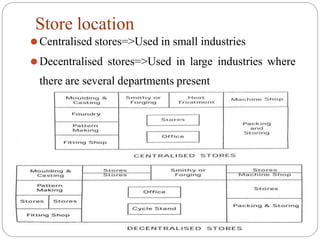
Store location
⚫Centralised stores=>Used in small industries
⚫Decentralised stores=>Used in large industries where
there are several departments present
•
Centralised stores
⚫A centralized store is that store which receives
materials for and issues them to all departments,
divisions and production floors of the company. Such a
store is only one in the company which receives
materials for and issues to all who need them.
⚫The materials required for all the departments and
branches are stored and issued by only one store.
Decentralised stores
⚫A decentralized store is that type of store which
receives materials for and issues them to only one
department and not to the whole company. The
decentralized store may be in many numbers in the
company, as each department has its own such store.
⚫Purchasing and handling of materials are undertaken
by each and every department separately
STORES LAYOUT
⚫ The internal arrangement of store depot is known as layout.
⚫ The efficiency of store keeping depends on how and in
what way the internal arrangement is planned.
⚫ Features of good layout are as follows
⚫Max utilisation of available space
⚫Greater efficiency of store depot
⚫Easier accessibility
⚫Maximum security to goods & records
⚫Minimization of spoilage & other losses.
Factors to be considered while designing
the layout
⚫ A section adjacent to the store should be kept reserved for the receipt of
materials and for its inspection before storage.
⚫ Store layout should be such that it provides for easy receipt, storage
and disbursement of materials, nearest to the point of use.
⚫ The available floor space is split as receiving section, inspection area,
bulk storage area, storage space , issue area , scrap yard etc.
⚫ Layout should ensure easy movement of materials.
⚫ Layout should provide proper preservation to protect from rain, sun,
humidity, moisture, insects etc.
⚫Clear and adequate lighting should be there
⚫Selection of place depends on the material that’s is to
be stored
⚫Proper placement of fire extinguisher, sand bags,
buckets etc
⚫A passage should be provided for the transportation of
vehicles in and out of the store
Store records
⚫ 1. Inward & outward registers
⚫ Materials dispatch receipt RR details entered in inward register
⚫ Materials dispatched from store entries made in outward reg
⚫ 2. Stock register
⚫ Dead stock- Non consumables like machinery, furniture details are
entered –
⚫ Consumable register-Consumables like diesel, lubricants details
entered
⚫ 3. Daily receipt register
⚫ Daily incoming items details entered & after inspection it is entered
in stock register
⚫ 4. Issue register
⚫ Details of items issued are entered in this register
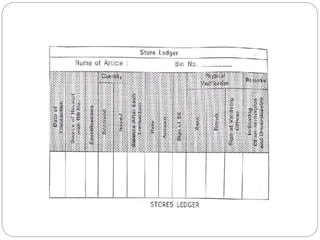
⚫ 5. Store ledger
⚫ Details record of receipt and issue of materials w.r.t quantity ,
quality & value are kept here and thus balance items if any is known
⚫ Separate sheet for each article is kept
⚫6. Surplus stock register
⚫Purchases which don’t come for long use are kept here
inorder for easy handling of stock register
⚫7. Suspense register
⚫Defective items or items received in excess entered here
⚫8. Condemned article register
⚫Unserviceable items are kept here.
⚫9. Loan register
⚫Non consumable items issued from store for temporary
period on loan is entered here.
⚫10. Empty containers & package register
⚫Empty containers & packages disposed off at convenient
intervals by auction kept here.
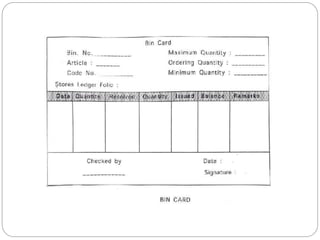
Bin Card
⚫Card attached to each bin, rack, shelf or other
containers for stores.
⚫Record of all materials entering bin or leaving bin is
entered here. It agrees store ledger register
⚫During inspection they are checked & inspector puts
initials on it.
Cardex method
⚫ Used when items in the stores are in 1000’s
⚫ Steel almirah with number of shelves. Each drawer contains
cards in every shelf can be drawn out.
⚫ Datas entered
⚫Code no of item , its size & material particulars
⚫Max quantity & minimum quantity of order
⚫List of suppliers
⚫Standard quantity to be ordered
⚫Due supply data
⚫Quantity received
⚫Quantity issued
⚫ Balance
Importance of sales department
manager
⚫Small organization- Only marketing manager
⚫Large organization- Marketing & sales
present
⚫Sales management- process of distributing goods from
the producer to the ultimate users.
⚫It consists of advertising, selling, transporting,
handling & financing or risk-tasking.
Functions of sales Department
⚫Studying consumer’s psychology & demand
⚫Studying market fluctuations
⚫Preparing marketing plan
⚫Preparing sales budgets from marketing plan
⚫Planning advertising
⚫Creating communication network for department
⚫Handling recruitment, training, compensation etc of
sales staffs etc
Sales Forecasting
⚫Sales forecasting- An estimate of the sales potential of
the firm in future i.e the quantity & quality of future
sales.
⚫ Types of forecasting
⚫Short Term => 3months or 6 months or 1 year.
⚫Long Term => 5 year, 10 year or even 20 year.
Importance of sales forecasting
⚫Determines production volume considering facilities
available like capital, equipment etc
⚫Forms basis of sales budget, production budget etc
⚫Helps in deciding policies
⚫Facilitates in deciding extent of advertising
⚫Helps in preparing production & purchasing schedules
⚫Helps in taking decisions like plant expansion

A5WSOQ8EJTl0Kfi9471.pptx

  • 1.
    MODULE 2 PART2 MA TERIALSAND SALES MANAGEMENT
  • 2.
    MATERIALS MANAGEMENT ⚫Materials refersto all those commodities which are used in the production of goods and rendering services ⚫Raw materials, components, packing materials and finished products are included in the list of materials ⚫Material management is concerned with the determination of materials requirement, purchase, storage, and release for use in production. ⚫It also includes constant care to maintain the materials in good conditions and safeguard them against all hazards and losses from the time of purchase till its use.
  • 3.
    ⚫Material management isdefined as the function responsible for the coordination of planning, sourcing, purchasing, moving, storing and controlling materials in an optimum manner so as to provide a pre-decided service to the customer at a minimum cost.
  • 4.
    Objectives of materialmanagement can be full filled by the following functions ⚫1. Material planning. ⚫2. Procurement or purchasing of materials. ⚫3. Receiving and Warehousing. ⚫4. Storage and store-administration. ⚫5. Inventory control. ⚫6. Standardization, simplification and Value-analysis. ⚫7. External transportation (i.e., traffic, shipping, etc.) an materials handling (i.e., internal transportation). ⚫8. Disposal of scrap, surplus and obsolete materials.
  • 5.
    Purchase department ⚫In anyindustry before starting the process of production, prime requirement is to procure raw materials, machinery and tools that go into the production and other materials required for the maintenance work. ⚫In small industries the function of purchase is performed by the works superintendent, but in case of large industries, a separate department, known as purchase department is provided for the purchasing of material. ⚫Purchases the materials, machinery and tool which are required for the production.
  • 6.
    Objectives of purchasingdepartment ⚫To maintain regular flow of materials ⚫ To purchase at a competitive price the right quality, in right quantity and at a right time from a right source. ⚫To ensure higher productivity ⚫To ensure the production of a better quality production at a competitive cost ⚫ To ensure a better margin of profit
  • 7.
    Functions of purchasedepartment ⚫ Maintain records of available and reliable suppliers, and prices of materials ⚫ To prepare and update list of materials required by different departments of the organization within a specified span of time. ⚫ Place and follow-up purchase orders ⚫ Maintain records of all purchases ⚫ To make sure through inspection that right kind (i.e. quantity, quality, etc.) of material has been purchased. ⚫ TO act as a mediator between the vendors and different departments of the concern such as production, quality, control, finance, maintenance, etc.
  • 8.
    ⚫To check ifthe material has been purchased at right time and at economical rates. ⚫To keep an uninterrupted supply of materials so that production continues with least capital tied in inventories. ⚫To prepare purchasing budget. ⚫To ensure that prompt payments are made to the suppliers in the interest of good public relations
  • 9.
    Methods of purchasing ⚫(a)Purchasing by requirement ⚫(b) Purchasing for a specific future period ⚫(c) Market purchasing ⚫(d) Speculative purchasing ⚫(e) Contract purchasing ⚫(f) Central purchase organization. ⚫(g)Through Directorate general of Supplies and Disposal
  • 10.
    (a) Purchasing byRequirements: ⚫ In this method, the required quantity of materials for any particular job are purchased, when the job is in hand. This method is suit for the industries, having less working capital. ⚫ Advantages ⚫The market fluctuations will not affect as costing is based on the market rates. ⚫Small storage space will be required. ⚫ Less inventory carrying cost. ⚫ Disadvantages ⚫The selling price will be higher. ⚫ Profits are limited since the orders are for small quantities ⚫Sudden demands cannot be met. ⚫Bargaining cannot be had due to the small amount involved
  • 11.
    (b) Purchasing fora specific future period ⚫ Under this method, the materials are purchased in bulk for specific future period to maintain the flow of production. The standard items which are in regular use are purchased by this method ⚫ Advantages ⚫As the order is received, production can at once be started ⚫The market fluctuations will not affect to a small size. ⚫The involved working capital will be less. ⚫Less storage space is needed. ⚫Cost analysis is easier. ⚫ Disadvantages ⚫This cannot be adopted for large scale industries.
  • 12.
    c)Market purchasing ⚫ Thistype of purchasing is generally made to take advantage of prize fluctuations. ⚫ Raw materials are generally purchased on this basis. ⚫ When the raw materials are available at low price, they are procured in bulk quantities, to get greater margin of profit in finished goods. ⚫ Advantages ⚫Profit will be more if demand increases ⚫Production will be continues ⚫ Disadvantages ⚫More capital is required ⚫More storage space is required ⚫
  • 13.
    d)Speculative purchasing ⚫ Purchasesare made not according to the requirement. ⚫ Purchased with a view that there will be a greater demand in the future. ⚫ Purchases are made in excess of actual requirement. ⚫ Advantages ⚫Profit will be more if demand increases ⚫Production will be continuous ⚫ Disadvantages ⚫More capital is required ⚫More storage space is required ⚫If speculation goes wrong, then the profit on the finished product is reduced.
  • 14.
    e) Contract purchasing ⚫Contractsare given to suppliers for large amounts of future requirements(for 2,3 years), subject to review and cancellation with an appropriate period of notice ⚫Eg: pig iron, coal, coke etc ⚫Advantages ⚫It avoids necessity for keeping stocks ⚫The purchase is not affected by market fluctuations and the supply ensured ⚫Disadvantages ⚫The supply may not be regular, as it is out of control of production department
  • 15.
    f) Central purchaseorganisation ⚫ Large industries or certain big govt industries may have section wise stores at different places and each section may have a separate store. ⚫ To avoid the margin of middle man, central purchase organization makes direct dealings with the manufactures and distributes the material to section wise stores. ⚫ There by reducing the malpractices ⚫ Makes the direct dealings with the manufactures and distributes the material to section wise store. ⚫ Advantages ⚫ Astrict control and check is possible ⚫ It can have direct dealing with manufacturer and can get things as per specifications ⚫ Disadvantages ⚫ There may be delay in getting material from central stores to sectional stores
  • 16.
    g) Through directorategeneral of supplies and disposal ⚫The Directorate General of supplies and disposal provides supply of different products at relatively cheaper rates for different government organizations. ⚫This department enters into contract with various organisations for supply of certain materials to various government organizations during the year at agreed rates. ⚫These suppliers have to certify that they shall not supply to other purchasers same material at lesser rate during the contract year.
  • 17.
    Purchase procedure ⚫ Sevenstages. ⚫ Main aim is to purchase quality materials at competitive price. ⚫ Steps: ⚫ 1. Receipt and analysis of requirements and processing of requisitions. ⚫ 2. Choice and location of potential suppliers. ⚫ 3. Request, receipt and analysis of quotations ⚫ 4. Placing of orders. ⚫ 5. Follow up and expediting the purchase orders. after ⚫ 6. V erification of supplier’s invoices for payment processing discrepancies and rejections. ⚫ 7. Closing completed orders and maintenance of records.
  • 18.
    INVENTORY ⚫ Scientific methodof finding out how much stock should be maintained in order to meet the production demands and be able to provide right type of material at right time in the right quantities & at competitive prices. ⚫ Aim =>promotion of smooth factory operation ⚫ It is a detailed list of movable goods such as raw materials, materials in process, finished products, general supplies and equipments which are necessary to manufacture a product and to maintain the equipment and machinery in good working order. ⚫ The quantity and value of every item is also mentioned in the list.
  • 19.
    The need ofinventory control ⚫To maintain a reserve of goods that will ensure manufacturing according to the production plan. ⚫To promote smooth factory operation and to prevent piling up, idle machine time, proper quantity of material must be on hand when it is wanted. ⚫To take advantages of seasonal fluctuations of prices of materials, increase of sales and so profit and avoiding transportation delays.
  • 20.
    Inventory control techniques ⚫1.ABCanalysis or selective control analysis ⚫2. System of re-ordering ⚫3. Economic order quantity (EOQ) model
  • 21.
    Classification of inventory ⚫1. classification according to function material flow ⚫ Production inventory: Items going into final product such as raw materials, finished parts. ⚫Work in process inventory: items in semi finished items or products required at different stages of manufacturing of the product. ⚫Finished goods inventory: are finished goods or final products ready for dispatch to users or to distributors. ⚫Operating and maintenance inventory: Items like consumables or maintenance or repair items which do not form part of final product. ⚫ Miscellaneous inventory: Items other than above mentioned such as unsaleable products or scrap arising from production process.
  • 22.
    ⚫2. Conventional classification ⚫Directinventories: Items in any form which will be a part final product ⚫Indirect inventories: Items which will not be a part final product but are very essential such as lubricants, cutting fluids etc ⚫Finished products inventories: Items ready for dispatch ⚫Purchased parts inventories: Semi finished or finished parts used for assembling
  • 23.
    INVENTORY MODELS ⚫3 types ⚫Economic order quantity (EOQ) model ⚫ ABC analysis or selective control analysis ⚫ System or reordering
  • 24.
    1. EOQ (Economicorder quantity) ⚫ Definitions ⚫ Economic Order Quantity (EOQ) is the order quantity that minimizes total inventory costs. ⚫ Order Quantity is the number of units added to inventory each time an order is placed. ⚫ Total Inventory Costs is the sum of inventory acquisition cost, ordering cost, and holding cost. ⚫ Ordering Cost is the cost incurred in ordering inventory from suppliers excluding the cost of purchase such as delivery costs and order processing costs. ⚫ Holding Cost, also known as carrying cost, is the total cost of holding inventory such as warehousing cost and obsolescence cost.
  • 25.
    EOQ ⚫ While placingorder in an economic way, it is to be decided ⚫ How much quantity to order? ⚫When to place the order? So that production is not interrupted ⚫ Re-order level => The level of material at which new order is placed ⚫ Lead time => Time taken by material to reach shop after placing orders before the material gets exhausted.
  • 26.
    ⚫ Max stock-Maximum quantity of material that can be kept ⚫ Min stock- Quantity below which material is not allowed to fall ⚫ Standard Order- it is the difference between maximum and minimum quantity. (Max stock – Min stock ). Also called economic purchase inventory size or economic order quantity ⚫ Reorder point- The level of material at which new order is placed ⚫ Lead or procurement time- Time between placing order & receiving material. ⚫ Reorder level = lead time x consumption ⚫ Buffer or safety stock - Stock which is used only if lead time increases than expected. ⚫ Cycle time- Time difference between two successive orders
  • 27.
    EOQ COST ⚫The evaluationof the most economic ordering quantity to be purchased involves calculation of two costs: ⚫1. Procurement cost or ordering cost or buying cost ⚫Calling quotation ⚫Processing quotations ⚫Placing purchase orders ⚫Receiving & inspection ⚫Verifying & payment of bills ⚫Other incidental charges etc
  • 29.
    ⚫2. Inventory carryingcost ⚫Insurance ⚫Storage and handling ⚫Obsolescence & depreciation ⚫Deterioration ⚫Taxes ⚫Interest etc Relation betweencost and quantity
  • 30.
    ABC analysis ⚫ Asthe size of industry increases, the number of items to be purchased and then to be taken care of also increases. ⚫ Always better control ⚫ How much valued the item is and controlling it to what extent is the interest of the organisation. ⚫ ABC analysis is meant for relative inventory control in which max attention can be given to items which consume more money and a fair attention can be given to medium valued items ,while the attention for low value items can be reduced to routine procedure only. ⚫ This policy can be applied in various other aspects of materials management such as purchase ,sales, inspection ,inventory control ,store keeping etc
  • 31.
  • 32.
    Classification of ABCanalysis (based on % of items & % value of items) ⚫Aclass item ⚫B class item ⚫C class item
  • 33.
    A-class item ⚫There arehigh valued but are limited or few in number. ⚫They constitute 10% of items but account for 70 % of total inventory cost. ⚫They need careful and close inventory control, proper handling and storage facilities. ⚫Such items being costly are purchased in small quantities often and just before their use. ⚫This increases the procurement costs and involves a little risk of non availability.
  • 34.
    B-class item ⚫These aremedium valued and their number lies in betweenAand C items. ⚫They constitute 20 % of total inventory cost and about 20% of the total items, they need moderate control. ⚫More important than c-item. ⚫Less costly ⚫Asafety stock up to 3 months may be kept.
  • 35.
    C-class item of thetotal inventory cost and 70 % ⚫Low valued. ⚫Max number item ⚫Constitute 10 % of total items. ⚫Do not need any control. ⚫Least important items like pins, washer, rubber bands, etc.
  • 36.
    Advantages of ABCAnalysis ⚫All effort concentrated in genuine area ⚫Most effective & economical method ⚫Helps in placing orders, deciding quantity of purchase, safety stock etc
  • 37.
    Stores & storemanagement ⚫ Store- Unworked material is known as store & place where they are kept is called Store room ⚫ Stock- Finished material ready for sale & place where they are kept is called stock room. ⚫ In small company store & stock rooms are the same while in big companies they are different ⚫ Storage- Holding all kinds of stores, materials, semi & fully processed goods in custody.
  • 38.
    Types of stores ⚫Raw materials ⚫ Consumable stores ⚫ Inflammable stores ⚫ Chemicals like carbide,sulphuric acid etc. ⚫ Machinery and equipment ⚫ Hand tools ⚫ Furniture ⚫ Finished products ⚫ Scrap ⚫ Unserviceable stores ⚫ Empties and packages ⚫ Inspection and measuring instruments ⚫ Stationary
  • 39.
    Store management Responsibility ofstore management- ⚫To receive materials, to protect them in storage from damage or theft , to issue the materials in right quantities at the right time and to the right place and provide the services promptly and at least cost.
  • 40.
    Objectives of storemanagement ⚫To receive, handle and issue goods economically and efficiently ⚫To see that the stocks should not fall below the minimum and goes above the maximum ⚫To arrange for systematic and efficient storage materials ⚫To maintain records of movement of stock. ⚫To ensure right time delivery to customers ⚫To level out irregularities in purchasing ⚫To have uninterrupted flow of materials ⚫To prevent any theft, wastage, deterioration of stock ⚫To utilise available space and labour effectively
  • 41.
    Functions of storesdepartment and the duties of store keeper ⚫ To identify all items of stock and plan the store for optimum utilisation of cubic space ⚫ To receive all types of materials , goods and equipment including manufactured products in the factory and record them with their cost. ⚫ Correct positioning of all materials and supplies in the stores. ⚫ To prevent overstocking and under stocking of materials. ⚫ To prevent unauthorised entry to store
  • 42.
    ⚫ To ensureuninterrupted supply of materials and stores without delay to various production and service departments of the organisation. ⚫ To maintain stocks safely and in good condition by taking all precautions to all protect materials from pilferage, theft fire and other risks. ⚫ To minimise the storage costs, To make sure that the stores are kept clean and in good order. ⚫ To ensure proper and continuous control over materials. ⚫ To ensure most effective utilisation of available storage space and workers engaged in the process of storekeeping. ⚫ To record and update and issues of materials
  • 43.
    Store location ⚫Centralised stores=>Usedin small industries ⚫Decentralised stores=>Used in large industries where there are several departments present •
  • 44.
    Centralised stores ⚫A centralizedstore is that store which receives materials for and issues them to all departments, divisions and production floors of the company. Such a store is only one in the company which receives materials for and issues to all who need them. ⚫The materials required for all the departments and branches are stored and issued by only one store.
  • 45.
    Decentralised stores ⚫A decentralizedstore is that type of store which receives materials for and issues them to only one department and not to the whole company. The decentralized store may be in many numbers in the company, as each department has its own such store. ⚫Purchasing and handling of materials are undertaken by each and every department separately
  • 46.
    STORES LAYOUT ⚫ Theinternal arrangement of store depot is known as layout. ⚫ The efficiency of store keeping depends on how and in what way the internal arrangement is planned. ⚫ Features of good layout are as follows ⚫Max utilisation of available space ⚫Greater efficiency of store depot ⚫Easier accessibility ⚫Maximum security to goods & records ⚫Minimization of spoilage & other losses.
  • 47.
    Factors to beconsidered while designing the layout ⚫ A section adjacent to the store should be kept reserved for the receipt of materials and for its inspection before storage. ⚫ Store layout should be such that it provides for easy receipt, storage and disbursement of materials, nearest to the point of use. ⚫ The available floor space is split as receiving section, inspection area, bulk storage area, storage space , issue area , scrap yard etc. ⚫ Layout should ensure easy movement of materials. ⚫ Layout should provide proper preservation to protect from rain, sun, humidity, moisture, insects etc.
  • 48.
    ⚫Clear and adequatelighting should be there ⚫Selection of place depends on the material that’s is to be stored ⚫Proper placement of fire extinguisher, sand bags, buckets etc ⚫A passage should be provided for the transportation of vehicles in and out of the store
  • 49.
    Store records ⚫ 1.Inward & outward registers ⚫ Materials dispatch receipt RR details entered in inward register ⚫ Materials dispatched from store entries made in outward reg ⚫ 2. Stock register ⚫ Dead stock- Non consumables like machinery, furniture details are entered – ⚫ Consumable register-Consumables like diesel, lubricants details entered ⚫ 3. Daily receipt register ⚫ Daily incoming items details entered & after inspection it is entered in stock register ⚫ 4. Issue register ⚫ Details of items issued are entered in this register ⚫ 5. Store ledger ⚫ Details record of receipt and issue of materials w.r.t quantity , quality & value are kept here and thus balance items if any is known ⚫ Separate sheet for each article is kept
  • 51.
    ⚫6. Surplus stockregister ⚫Purchases which don’t come for long use are kept here inorder for easy handling of stock register ⚫7. Suspense register ⚫Defective items or items received in excess entered here ⚫8. Condemned article register ⚫Unserviceable items are kept here. ⚫9. Loan register ⚫Non consumable items issued from store for temporary period on loan is entered here. ⚫10. Empty containers & package register ⚫Empty containers & packages disposed off at convenient intervals by auction kept here.
  • 52.
    Bin Card ⚫Card attachedto each bin, rack, shelf or other containers for stores. ⚫Record of all materials entering bin or leaving bin is entered here. It agrees store ledger register ⚫During inspection they are checked & inspector puts initials on it.
  • 54.
    Cardex method ⚫ Usedwhen items in the stores are in 1000’s ⚫ Steel almirah with number of shelves. Each drawer contains cards in every shelf can be drawn out. ⚫ Datas entered ⚫Code no of item , its size & material particulars ⚫Max quantity & minimum quantity of order ⚫List of suppliers ⚫Standard quantity to be ordered ⚫Due supply data ⚫Quantity received ⚫Quantity issued ⚫ Balance
  • 55.
    Importance of salesdepartment manager ⚫Small organization- Only marketing manager ⚫Large organization- Marketing & sales present ⚫Sales management- process of distributing goods from the producer to the ultimate users. ⚫It consists of advertising, selling, transporting, handling & financing or risk-tasking.
  • 56.
    Functions of salesDepartment ⚫Studying consumer’s psychology & demand ⚫Studying market fluctuations ⚫Preparing marketing plan ⚫Preparing sales budgets from marketing plan ⚫Planning advertising ⚫Creating communication network for department ⚫Handling recruitment, training, compensation etc of sales staffs etc
  • 57.
    Sales Forecasting ⚫Sales forecasting-An estimate of the sales potential of the firm in future i.e the quantity & quality of future sales. ⚫ Types of forecasting ⚫Short Term => 3months or 6 months or 1 year. ⚫Long Term => 5 year, 10 year or even 20 year.
  • 58.
    Importance of salesforecasting ⚫Determines production volume considering facilities available like capital, equipment etc ⚫Forms basis of sales budget, production budget etc ⚫Helps in deciding policies ⚫Facilitates in deciding extent of advertising ⚫Helps in preparing production & purchasing schedules ⚫Helps in taking decisions like plant expansion