Food cost controlFood cost control
• It can be defined as guidance and regulation of cost of
operations.
• Under taking to guide and regulate cost needs to
ensure that they are in accordance of the
predetermined objectives of the business.
• Guidance and regulations of cost are set as per
expressed in the policy statements and budget of
undertakings:
Cont..Cont..
• Food cost control means :
• You have a stick to your predetermined standards.
• Set standards appropriate to your market before you
buy, prepare and sell food.
• Cost control procedures.
What is Food Cost?What is Food Cost?
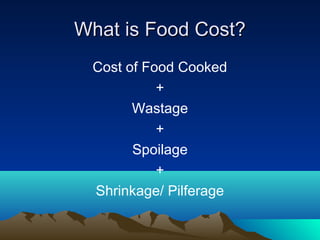
Cost of Food Cooked
+
Wastage
+
Spoilage
+
Shrinkage/ Pilferage
What isWhat is NotNot Food Cost Control?Food Cost Control?
Bringing down the cost at the expense of
• Quality & Guest Satisfaction
Attitude:
• Penny Wise, Pound Foolish
• Golden Goose
Why should you Control Food Cost ?Why should you Control Food Cost ?
• Rs.1 Saved = Rs.10 Sales
• Adds Straight to the Bottom Line
• Competitive World
How do you Control Cost?How do you Control Cost?
1. Shrinkage/ Pilferage
Short Term: Better Security System
Long Term: Create a working atmosphere,
where people belong and are proud to
be contributing to the growth of the
company
How do you Control Cost?How do you Control Cost?
2. Spoilage
• Better Storage Facilities
• Better Kitchen Design
• Stock Management
How do you Control Cost?How do you Control Cost?
3. Wastage
• Temporary / Stressful / Negative / Life
reducing way: Policing
• Permanent / Enjoyable / Positive / Life
enhancing way: Bring in a culture of High
Performance
How do you Control Cost?How do you Control Cost?
4. Cost of Food Cooked
• Planning the Quantity
• Ensuring the Quality
ObjectiveObjective
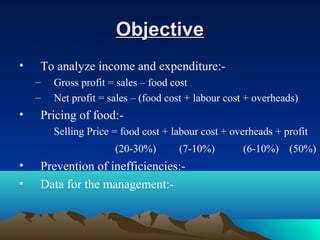
• To analyze income and expenditure:-
– Gross profit = sales – food cost
– Net profit = sales – (food cost + labour cost + overheads)
• Pricing of food:-
Selling Price = food cost + labour cost + overheads + profit
(20-30%) (7-10%) (6-10%) (50%)
• Prevention of inefficiencies:-
• Data for the management:-
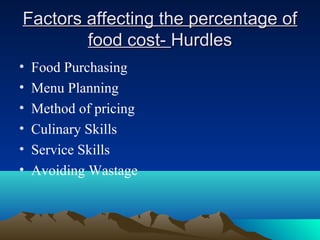
Factors affecting the percentage ofFactors affecting the percentage of
food cost-food cost- HurdlesHurdles
• Food Purchasing
• Menu Planning
• Method of pricing
• Culinary Skills
• Service Skills
• Avoiding Wastage
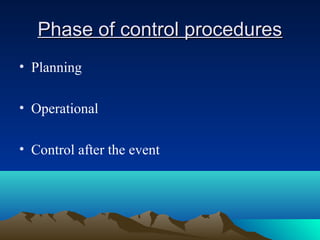
Phase of control proceduresPhase of control procedures
• Planning
• Operational
• Control after the event
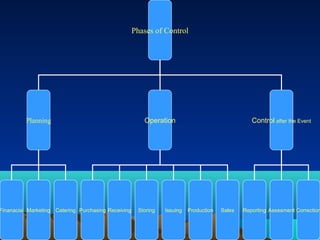
Phases of Control
Planning Operation Control after the Event
Finanacial Marketing Catering Purchasing Receiving Storing Issuing Production Sales Reporting Assesment Correction
Financial PlanningFinancial Planning
• Budget- Whole organization & single unit
• Total Revenue
• Expenditure
• Borrowing
• Profit
• Shares
• Debentures
MarketingMarketing
• Segment
• Clientele
• Turn over
• Market Share
• Average Spending Power
• Choice
• Trends
• Advertisement
• Promotions
CateringCatering
• The type of customer
• The type of menu
• Beverage provision necessary for operation
• Food quality standard
• Method of pricing
• Type and quality of service
• Degree and décor and comfort
• Type and style of table and chairs
OperationsOperations
• Purchasing
• Receiving
• Storing
• Issuing
• Production control
• Sales control
Management control after theManagement control after the
eventevent
• F & B cost reporting
• Assessment
• Correction
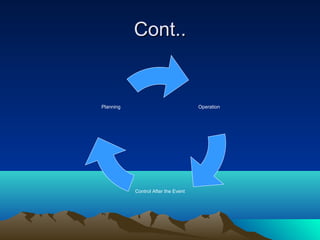
Cont..Cont..
Operation
Control After the Event
Planning
METHOD OF FOOD CONTROLMETHOD OF FOOD CONTROL
• a) Weekly/monthly food cost report-
This system is used by small organization
where manager controls each activity as
daily routine. It is a reconciliation report of
daily activities. The calculation procedure
is
• Opening stock + total purchase for the
period – closing stock = total food sale
• b) Daily food cost report- This method is
used in medium sized operation.
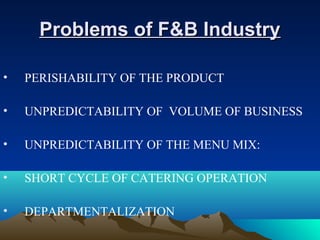
Problems of F&B IndustryProblems of F&B Industry
• PERISHABILITY OF THE PRODUCT
• UNPREDICTABILITY OF VOLUME OF BUSINESS
• UNPREDICTABILITY OF THE MENU MIX:
• SHORT CYCLE OF CATERING OPERATION
• DEPARTMENTALIZATION

Food cost control

  • 1.
    Food cost controlFoodcost control • It can be defined as guidance and regulation of cost of operations. • Under taking to guide and regulate cost needs to ensure that they are in accordance of the predetermined objectives of the business. • Guidance and regulations of cost are set as per expressed in the policy statements and budget of undertakings:
  • 2.
    Cont..Cont.. • Food costcontrol means : • You have a stick to your predetermined standards. • Set standards appropriate to your market before you buy, prepare and sell food. • Cost control procedures.
  • 3.
    What is FoodCost?What is Food Cost? Cost of Food Cooked + Wastage + Spoilage + Shrinkage/ Pilferage
  • 4.
    What isWhat isNotNot Food Cost Control?Food Cost Control? Bringing down the cost at the expense of • Quality & Guest Satisfaction Attitude: • Penny Wise, Pound Foolish • Golden Goose
  • 5.
    Why should youControl Food Cost ?Why should you Control Food Cost ? • Rs.1 Saved = Rs.10 Sales • Adds Straight to the Bottom Line • Competitive World
  • 6.
    How do youControl Cost?How do you Control Cost? 1. Shrinkage/ Pilferage Short Term: Better Security System Long Term: Create a working atmosphere, where people belong and are proud to be contributing to the growth of the company
  • 7.
    How do youControl Cost?How do you Control Cost? 2. Spoilage • Better Storage Facilities • Better Kitchen Design • Stock Management
  • 8.
    How do youControl Cost?How do you Control Cost? 3. Wastage • Temporary / Stressful / Negative / Life reducing way: Policing • Permanent / Enjoyable / Positive / Life enhancing way: Bring in a culture of High Performance
  • 9.
    How do youControl Cost?How do you Control Cost? 4. Cost of Food Cooked • Planning the Quantity • Ensuring the Quality
  • 10.
    ObjectiveObjective • To analyzeincome and expenditure:- – Gross profit = sales – food cost – Net profit = sales – (food cost + labour cost + overheads) • Pricing of food:- Selling Price = food cost + labour cost + overheads + profit (20-30%) (7-10%) (6-10%) (50%) • Prevention of inefficiencies:- • Data for the management:-
  • 11.
    Factors affecting thepercentage ofFactors affecting the percentage of food cost-food cost- HurdlesHurdles • Food Purchasing • Menu Planning • Method of pricing • Culinary Skills • Service Skills • Avoiding Wastage
  • 12.
    Phase of controlproceduresPhase of control procedures • Planning • Operational • Control after the event
  • 13.
    Phases of Control PlanningOperation Control after the Event Finanacial Marketing Catering Purchasing Receiving Storing Issuing Production Sales Reporting Assesment Correction
  • 14.
    Financial PlanningFinancial Planning •Budget- Whole organization & single unit • Total Revenue • Expenditure • Borrowing • Profit • Shares • Debentures
  • 15.
    MarketingMarketing • Segment • Clientele •Turn over • Market Share • Average Spending Power • Choice • Trends • Advertisement • Promotions
  • 16.
    CateringCatering • The typeof customer • The type of menu • Beverage provision necessary for operation • Food quality standard • Method of pricing • Type and quality of service • Degree and décor and comfort • Type and style of table and chairs
  • 17.
    OperationsOperations • Purchasing • Receiving •Storing • Issuing • Production control • Sales control
  • 18.
    Management control aftertheManagement control after the eventevent • F & B cost reporting • Assessment • Correction
  • 19.
  • 20.
    METHOD OF FOODCONTROLMETHOD OF FOOD CONTROL • a) Weekly/monthly food cost report- This system is used by small organization where manager controls each activity as daily routine. It is a reconciliation report of daily activities. The calculation procedure is • Opening stock + total purchase for the period – closing stock = total food sale
  • 21.
    • b) Dailyfood cost report- This method is used in medium sized operation.
  • 22.
    Problems of F&BIndustryProblems of F&B Industry • PERISHABILITY OF THE PRODUCT • UNPREDICTABILITY OF VOLUME OF BUSINESS • UNPREDICTABILITY OF THE MENU MIX: • SHORT CYCLE OF CATERING OPERATION • DEPARTMENTALIZATION