Housekeeping
Basic knowledge in housekeeping
DESINGED BY Sunil Kumar
Research Scholar/ Food Production Faculty
Institute of Hotel and Tourism Management,
MAHARSHI DAYANAND UNIVERSITY, ROHTAK
Haryana- 124001 INDIA Ph. No. 09996000499
email: skihm86@yahoo.com , balhara86@gmail.com
linkedin:- in.linkedin.com/in/ihmsunilkumar
facebook: www.facebook.com/ihmsunilkumar
webpage: chefsunilkumar.tripod.com
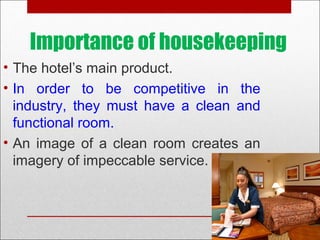
Importance of housekeeping
• The hotel’s main product.
• In order to be competitive in the
industry, they must have a clean and
functional room.
• An image of a clean room creates an
imagery of impeccable service.
Housekeeping Department
Your Safety: Lifting heavy objects
• Get help when lifting heavy items.
• Follow these safe lifting methods:
• Bend your legs , not your back, when you pick up
something heavy.
• Hold the heavy item close to your body.
• Move to face the heavy object before you lift
instead of twisting your body.
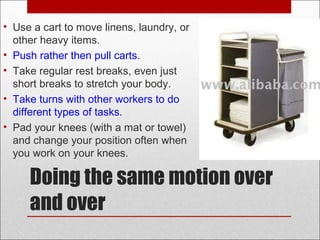
Doing the same motion over
and over
• Use a cart to move linens, laundry, or
other heavy items.
• Push rather then pull carts.
• Take regular rest breaks, even just
short breaks to stretch your body.
• Take turns with other workers to do
different types of tasks.
• Pad your knees (with a mat or towel)
and change your position often when
you work on your knees.
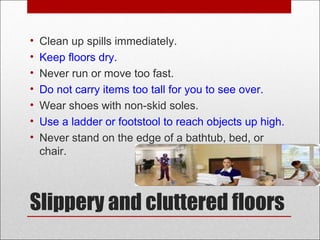
Slippery and cluttered floors
• Clean up spills immediately.
• Keep floors dry.
• Never run or move too fast.
• Do not carry items too tall for you to see over.
• Wear shoes with non-skid soles.
• Use a ladder or footstool to reach objects up high.
• Never stand on the edge of a bathtub, bed, or
chair.
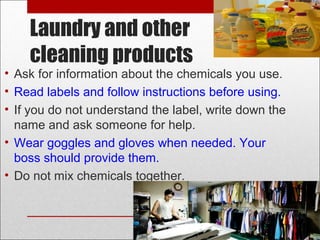
Laundry and other
cleaning products
• Ask for information about the chemicals you use.
• Read labels and follow instructions before using.
• If you do not understand the label, write down the
name and ask someone for help.
• Wear goggles and gloves when needed. Your
boss should provide them.
• Do not mix chemicals together.
Handling abusive guest
• If you are being yelled at or harassed by
anyone, get help from a co-worker or your
boss.
• If someone continues to harass you at work,
get help from a trusted friend or community
organization outside the workplace.
• Do not work alone in a hotel room if hotel
guests are present.
Diseases from hotel
guests
• Wash hands with soap often, especially after
handling soiled linen or cleaning the
bathroom.
• When you handle trash cans or bags, watch
out for syringes, razor blades, or other things
that might hurt you or spread disease.
Study guide
• Research on new technologies featured on rooms
• Provide pictures on your favorite hotel guest rooms.
Explain why it is your ideal room and provide a short
description on the features of the room.
• Why is housekeeping an important department in the
hotel?
• Why do we need to learn the room attendant pre-
requisites?
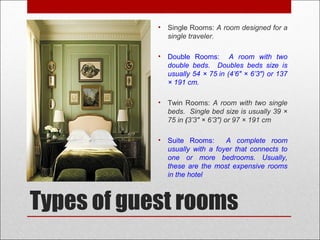
Types of guest rooms
• Single Rooms: A room designed for a
single traveler.
• Double Rooms: A room with two
double beds. Doubles beds size is
usually 54 × 75 in (4’6″ × 6’3″) or 137
× 191 cm.
• Twin Rooms: A room with two single
beds. Single bed size is usually 39 ×
75 in (3’3" × 6’3″) or 97 × 191 cm
• Suite Rooms: A complete room
usually with a foyer that connects to
one or more bedrooms. Usually,
these are the most expensive rooms
in the hotel
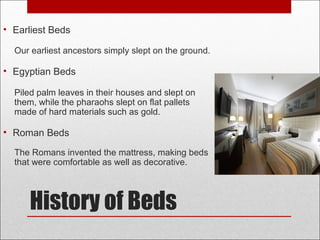
History of Beds
• Earliest Beds
Our earliest ancestors simply slept on the ground.
• Egyptian Beds
Piled palm leaves in their houses and slept on
them, while the pharaohs slept on flat pallets
made of hard materials such as gold.
• Roman Beds
The Romans invented the mattress, making beds
that were comfortable as well as decorative.
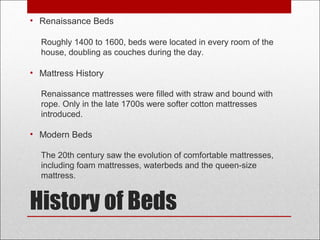
History of Beds
• Renaissance Beds
Roughly 1400 to 1600, beds were located in every room of the
house, doubling as couches during the day.
• Mattress History
Renaissance mattresses were filled with straw and bound with
rope. Only in the late 1700s were softer cotton mattresses
introduced.
• Modern Beds
The 20th century saw the evolution of comfortable mattresses,
including foam mattresses, waterbeds and the queen-size
mattress.
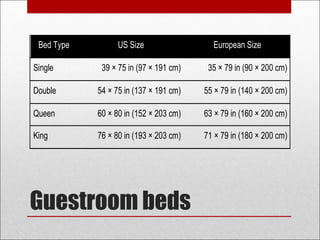
Guestroom beds
Bed Type US Size European Size
Single 39 × 75 in (97 × 191 cm) 35 × 79 in (90 × 200 cm)
Double 54 × 75 in (137 × 191 cm) 55 × 79 in (140 × 200 cm)
Queen 60 × 80 in (152 × 203 cm) 63 × 79 in (160 × 200 cm)
King 76 × 80 in (193 × 203 cm) 71 × 79 in (180 × 200 cm)
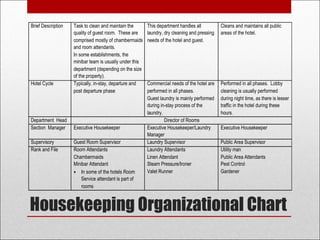
Housekeeping Organizational
Chart
Brief Description Task to clean and maintain the
quality of guest room. These are
comprised mostly of chambermaids
and room attendants.
In some establishments, the
minibar team is usually under this
department (depending on the size
of the property).
This department handles all
laundry, dry cleaning and pressing
needs of the hotel and guest.
Cleans and maintains all public
areas of the hotel.
Hotel Cycle Typically, in-stay, departure and
post departure phase
Commercial needs of the hotel are
performed in all phases.
Guest laundry is mainly performed
during in-stay process of the
laundry.
Performed in all phases. Lobby
cleaning is usually performed
during night time, as there is lesser
traffic in the hotel during these
hours.
Department Head Director of Rooms
Section Manager Executive Housekeeper Executive Housekeeper/Laundry
Manager
Executive Housekeeper
Supervisory Guest Room Supervisor Laundry Supervisor Public Area Supervisor
Rank and File Room Attendants
Chambermaids
Minibar Attendant
· In some of the hotels Room
Service attendant is part of
rooms
Laundry Attendants
Linen Attendant
Steam Pressure/Ironer
Valet Runner
Utility man
Public Area Attendants
Pest Control
Gardener
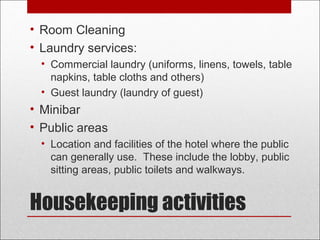
Housekeeping activities
• Room Cleaning
• Laundry services:
• Commercial laundry (uniforms, linens, towels, table
napkins, table cloths and others)
• Guest laundry (laundry of guest)
• Minibar
• Public areas
• Location and facilities of the hotel where the public
can generally use. These include the lobby, public
sitting areas, public toilets and walkways.
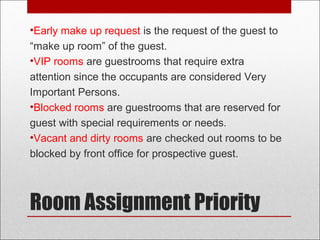
Room Assignment Priority
•Early make up request is the request of the guest to
“make up room” of the guest.
•VIP rooms are guestrooms that require extra
attention since the occupants are considered Very
Important Persons.
•Blocked rooms are guestrooms that are reserved for
guest with special requirements or needs.
•Vacant and dirty rooms are checked out rooms to be
blocked by front office for prospective guest.
Room Assignment Priority
• Late Checkout rooms are guestrooms are request
made by the occupant and subsequently granted
extension of check-out beyond the standard check-
out time.
• DND (Do not disturb) as per request of
guest(signage), rooms are not to be cleaned until
specific request of guest.
• No service rooms are guestrooms requested by
guest that his room not be cleaned.
Study guide
• What are the different types of guestrooms?
• Discuss the history of Bed
• What are the different sizes of bed?
• Select one job in housekeeping and research on his
competencies
• What are the different room assignment priorities?
Why do we need to know this as future room
attendants?
• What are the different housekeeping activities?
Chemicals
Toilet bowl cleaner
• A toilet Bowl cleaner kills
germs and get out hard
water deposits such as
bowl ring in the toilet bowl.
• Most toilet bowl cleaners
may contain hydrochloric
or phosphoric acids.
These acids aids in
removing all kinds of dirt,
stains, rust and others
from bowls and urinals.
• An effective toilet bowl
cleaner kills a wide range
of disease-and odor-
causing bacteria. There
are commercial cleaners
readily available in stores.
For larger hotels,
distributors and suppliers
sell industrial cleaners.
Chemicals
All purpose cleaner
• An all purpose cleaner
concentrated general-
purpose cleaner should
be gentle on the hands
and be tolerable for any
furniture surface. A good
number of all purpose
cleaners have a PH level
of 11 to 12.
• Most of the all-purpose
cleaners nowadays are
equipped will germ killing
formulation.
Chemicals
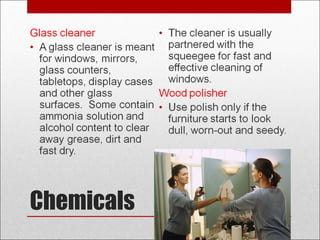
Glass cleaner
• A glass cleaner is meant
for windows, mirrors,
glass counters,
tabletops, display cases
and other glass
surfaces. Some contain
ammonia solution and
alcohol content to clear
away grease, dirt and
fast dry.
• The cleaner is usually
partnered with the
squeegee for fast and
effective cleaning of
windows.
Wood polisher
• Use polish only if the
furniture starts to look
dull, worn-out and seedy.
Chemicals
Chrome & brass polisher
• Metal polishes contain
solvents and detergents to
remove tarnishes, mild
abrasives and oil to
brighten and slow down the
tarnish process in metals.
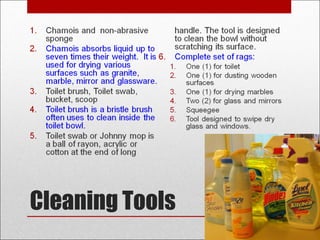
Cleaning Tools
1. Chamois and non-abrasive
sponge
2. Chamois absorbs liquid up to
seven times their weight. It is
used for drying various
surfaces such as granite,
marble, mirror and glassware.
3. Toilet brush, Toilet swab,
bucket, scoop
4. Toilet brush is a bristle brush
often uses to clean inside the
toilet bowl.
5. Toilet swab or Johnny mop is
a ball of rayon, acrylic or
cotton at the end of long
handle. The tool is designed
to clean the bowl without
scratching its surface.
6. Complete set of rags:
1. One (1) for toilet
2. One (1) for dusting wooden
surfaces
3. One (1) for drying marbles
4. Two (2) for glass and mirrors
5. Squeegee
6. Tool designed to swipe dry
glass and windows.
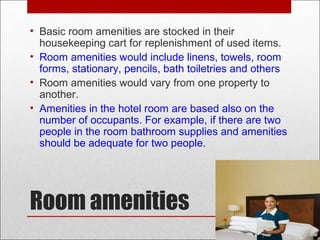
Room amenities
• Basic room amenities are stocked in their
housekeeping cart for replenishment of used items.
• Room amenities would include linens, towels, room
forms, stationary, pencils, bath toiletries and others
• Room amenities would vary from one property to
another.
• Amenities in the hotel room are based also on the
number of occupants. For example, if there are two
people in the room bathroom supplies and
amenities should be adequate for two people.
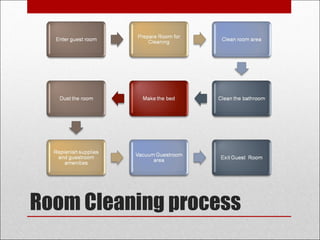
Room Cleaning process
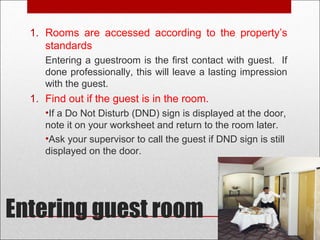
Entering guest room
1. Rooms are accessed according to the property’s
standards
Entering a guestroom is the first contact with guest. If
done professionally, this will leave a lasting impression
with the guest.
2. Find out if the guest is in the room.
•If a Do Not Disturb (DND) sign is displayed at the door,
note it on your worksheet and return to the room later.
•Ask your supervisor to call the guest if DND sign is still
displayed on the door.
Entering guest room
3. Properly introduce yourself in entering the room.
• Knock the door announcing “Housekeeping” and step back
for about three feet from the main door so that the guests
can see you from the door eye viewer.
• If there is no reply from the room, after 10 seconds knock
for the second time announcing “Housekeeping”.
• After the third attempted knocking the door, simultaneously
use your master key and announcing “Housekeeping” in
opening the room. When you are reasonably sure that there
is no occupant, open the door wide.
Entering guest room
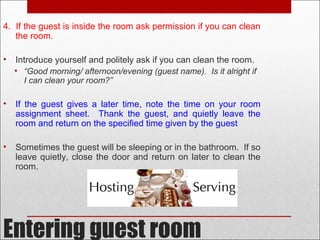
4. If the guest is inside the room ask permission if you can clean
the room.
• Introduce yourself and politely ask if you can clean the room.
• “Good morning/ afternoon/evening (guest name). Is it alright if
I can clean your room?”
• If the guest gives a later time, note the time on your room
assignment sheet. Thank the guest, and quietly leave the
room and return on the specified time given by the guest
• Sometimes the guest will be sleeping or in the bathroom. If so
leave quietly, close the door and return on later to clean the
room.
Entering guest room
5. Prop open the guest room door
• Use doorstopper
• Time and motion from going to the housekeeping cart
6. Position your cart
• Blocks the room from possible intruders

House keeping basics

  • 1.
    Housekeeping Basic knowledge inhousekeeping DESINGED BY Sunil Kumar Research Scholar/ Food Production Faculty Institute of Hotel and Tourism Management, MAHARSHI DAYANAND UNIVERSITY, ROHTAK Haryana- 124001 INDIA Ph. No. 09996000499 email: skihm86@yahoo.com , balhara86@gmail.com linkedin:- in.linkedin.com/in/ihmsunilkumar facebook: www.facebook.com/ihmsunilkumar webpage: chefsunilkumar.tripod.com
  • 2.
    Importance of housekeeping •The hotel’s main product. • In order to be competitive in the industry, they must have a clean and functional room. • An image of a clean room creates an imagery of impeccable service.
  • 3.
  • 4.
    Your Safety: Liftingheavy objects • Get help when lifting heavy items. • Follow these safe lifting methods: • Bend your legs , not your back, when you pick up something heavy. • Hold the heavy item close to your body. • Move to face the heavy object before you lift instead of twisting your body.
  • 5.
    Doing the samemotion over and over • Use a cart to move linens, laundry, or other heavy items. • Push rather then pull carts. • Take regular rest breaks, even just short breaks to stretch your body. • Take turns with other workers to do different types of tasks. • Pad your knees (with a mat or towel) and change your position often when you work on your knees.
  • 6.
    Slippery and clutteredfloors • Clean up spills immediately. • Keep floors dry. • Never run or move too fast. • Do not carry items too tall for you to see over. • Wear shoes with non-skid soles. • Use a ladder or footstool to reach objects up high. • Never stand on the edge of a bathtub, bed, or chair.
  • 7.
    Laundry and other cleaningproducts • Ask for information about the chemicals you use. • Read labels and follow instructions before using. • If you do not understand the label, write down the name and ask someone for help. • Wear goggles and gloves when needed. Your boss should provide them. • Do not mix chemicals together.
  • 8.
    Handling abusive guest •If you are being yelled at or harassed by anyone, get help from a co-worker or your boss. • If someone continues to harass you at work, get help from a trusted friend or community organization outside the workplace. • Do not work alone in a hotel room if hotel guests are present.
  • 9.
    Diseases from hotel guests •Wash hands with soap often, especially after handling soiled linen or cleaning the bathroom. • When you handle trash cans or bags, watch out for syringes, razor blades, or other things that might hurt you or spread disease.
  • 10.
    Study guide • Researchon new technologies featured on rooms • Provide pictures on your favorite hotel guest rooms. Explain why it is your ideal room and provide a short description on the features of the room. • Why is housekeeping an important department in the hotel? • Why do we need to learn the room attendant pre- requisites?
  • 11.
    Types of guestrooms • Single Rooms: A room designed for a single traveler. • Double Rooms: A room with two double beds. Doubles beds size is usually 54 × 75 in (4’6″ × 6’3″) or 137 × 191 cm. • Twin Rooms: A room with two single beds. Single bed size is usually 39 × 75 in (3’3" × 6’3″) or 97 × 191 cm • Suite Rooms: A complete room usually with a foyer that connects to one or more bedrooms. Usually, these are the most expensive rooms in the hotel
  • 12.
    History of Beds •Earliest Beds Our earliest ancestors simply slept on the ground. • Egyptian Beds Piled palm leaves in their houses and slept on them, while the pharaohs slept on flat pallets made of hard materials such as gold. • Roman Beds The Romans invented the mattress, making beds that were comfortable as well as decorative.
  • 13.
    History of Beds •Renaissance Beds Roughly 1400 to 1600, beds were located in every room of the house, doubling as couches during the day. • Mattress History Renaissance mattresses were filled with straw and bound with rope. Only in the late 1700s were softer cotton mattresses introduced. • Modern Beds The 20th century saw the evolution of comfortable mattresses, including foam mattresses, waterbeds and the queen-size mattress.
  • 14.
    Guestroom beds Bed TypeUS Size European Size Single 39 × 75 in (97 × 191 cm) 35 × 79 in (90 × 200 cm) Double 54 × 75 in (137 × 191 cm) 55 × 79 in (140 × 200 cm) Queen 60 × 80 in (152 × 203 cm) 63 × 79 in (160 × 200 cm) King 76 × 80 in (193 × 203 cm) 71 × 79 in (180 × 200 cm)
  • 15.
    Housekeeping Organizational Chart Brief DescriptionTask to clean and maintain the quality of guest room. These are comprised mostly of chambermaids and room attendants. In some establishments, the minibar team is usually under this department (depending on the size of the property). This department handles all laundry, dry cleaning and pressing needs of the hotel and guest. Cleans and maintains all public areas of the hotel. Hotel Cycle Typically, in-stay, departure and post departure phase Commercial needs of the hotel are performed in all phases. Guest laundry is mainly performed during in-stay process of the laundry. Performed in all phases. Lobby cleaning is usually performed during night time, as there is lesser traffic in the hotel during these hours. Department Head Director of Rooms Section Manager Executive Housekeeper Executive Housekeeper/Laundry Manager Executive Housekeeper Supervisory Guest Room Supervisor Laundry Supervisor Public Area Supervisor Rank and File Room Attendants Chambermaids Minibar Attendant · In some of the hotels Room Service attendant is part of rooms Laundry Attendants Linen Attendant Steam Pressure/Ironer Valet Runner Utility man Public Area Attendants Pest Control Gardener
  • 16.
    Housekeeping activities • RoomCleaning • Laundry services: • Commercial laundry (uniforms, linens, towels, table napkins, table cloths and others) • Guest laundry (laundry of guest) • Minibar • Public areas • Location and facilities of the hotel where the public can generally use. These include the lobby, public sitting areas, public toilets and walkways.
  • 17.
    Room Assignment Priority •Earlymake up request is the request of the guest to “make up room” of the guest. •VIP rooms are guestrooms that require extra attention since the occupants are considered Very Important Persons. •Blocked rooms are guestrooms that are reserved for guest with special requirements or needs. •Vacant and dirty rooms are checked out rooms to be blocked by front office for prospective guest.
  • 18.
    Room Assignment Priority •Late Checkout rooms are guestrooms are request made by the occupant and subsequently granted extension of check-out beyond the standard check- out time. • DND (Do not disturb) as per request of guest(signage), rooms are not to be cleaned until specific request of guest. • No service rooms are guestrooms requested by guest that his room not be cleaned.
  • 19.
    Study guide • Whatare the different types of guestrooms? • Discuss the history of Bed • What are the different sizes of bed? • Select one job in housekeeping and research on his competencies • What are the different room assignment priorities? Why do we need to know this as future room attendants? • What are the different housekeeping activities?
  • 20.
    Chemicals Toilet bowl cleaner •A toilet Bowl cleaner kills germs and get out hard water deposits such as bowl ring in the toilet bowl. • Most toilet bowl cleaners may contain hydrochloric or phosphoric acids. These acids aids in removing all kinds of dirt, stains, rust and others from bowls and urinals. • An effective toilet bowl cleaner kills a wide range of disease-and odor- causing bacteria. There are commercial cleaners readily available in stores. For larger hotels, distributors and suppliers sell industrial cleaners.
  • 21.
    Chemicals All purpose cleaner •An all purpose cleaner concentrated general- purpose cleaner should be gentle on the hands and be tolerable for any furniture surface. A good number of all purpose cleaners have a PH level of 11 to 12. • Most of the all-purpose cleaners nowadays are equipped will germ killing formulation.
  • 22.
    Chemicals Glass cleaner • Aglass cleaner is meant for windows, mirrors, glass counters, tabletops, display cases and other glass surfaces. Some contain ammonia solution and alcohol content to clear away grease, dirt and fast dry. • The cleaner is usually partnered with the squeegee for fast and effective cleaning of windows. Wood polisher • Use polish only if the furniture starts to look dull, worn-out and seedy.
  • 23.
    Chemicals Chrome & brasspolisher • Metal polishes contain solvents and detergents to remove tarnishes, mild abrasives and oil to brighten and slow down the tarnish process in metals.
  • 24.
    Cleaning Tools 1. Chamoisand non-abrasive sponge 2. Chamois absorbs liquid up to seven times their weight. It is used for drying various surfaces such as granite, marble, mirror and glassware. 3. Toilet brush, Toilet swab, bucket, scoop 4. Toilet brush is a bristle brush often uses to clean inside the toilet bowl. 5. Toilet swab or Johnny mop is a ball of rayon, acrylic or cotton at the end of long handle. The tool is designed to clean the bowl without scratching its surface. 6. Complete set of rags: 1. One (1) for toilet 2. One (1) for dusting wooden surfaces 3. One (1) for drying marbles 4. Two (2) for glass and mirrors 5. Squeegee 6. Tool designed to swipe dry glass and windows.
  • 25.
    Room amenities • Basicroom amenities are stocked in their housekeeping cart for replenishment of used items. • Room amenities would include linens, towels, room forms, stationary, pencils, bath toiletries and others • Room amenities would vary from one property to another. • Amenities in the hotel room are based also on the number of occupants. For example, if there are two people in the room bathroom supplies and amenities should be adequate for two people.
  • 26.
  • 27.
    Entering guest room 1.Rooms are accessed according to the property’s standards Entering a guestroom is the first contact with guest. If done professionally, this will leave a lasting impression with the guest. 2. Find out if the guest is in the room. •If a Do Not Disturb (DND) sign is displayed at the door, note it on your worksheet and return to the room later. •Ask your supervisor to call the guest if DND sign is still displayed on the door.
  • 28.
    Entering guest room 3.Properly introduce yourself in entering the room. • Knock the door announcing “Housekeeping” and step back for about three feet from the main door so that the guests can see you from the door eye viewer. • If there is no reply from the room, after 10 seconds knock for the second time announcing “Housekeeping”. • After the third attempted knocking the door, simultaneously use your master key and announcing “Housekeeping” in opening the room. When you are reasonably sure that there is no occupant, open the door wide.
  • 29.
    Entering guest room 4.If the guest is inside the room ask permission if you can clean the room. • Introduce yourself and politely ask if you can clean the room. • “Good morning/ afternoon/evening (guest name). Is it alright if I can clean your room?” • If the guest gives a later time, note the time on your room assignment sheet. Thank the guest, and quietly leave the room and return on the specified time given by the guest • Sometimes the guest will be sleeping or in the bathroom. If so leave quietly, close the door and return on later to clean the room.
  • 30.
    Entering guest room 5.Prop open the guest room door • Use doorstopper • Time and motion from going to the housekeeping cart 6. Position your cart • Blocks the room from possible intruders