BEVERAGE CONTROL
can be defined as a process used by
managers to direct, regulate, and restrain
the actions of people so that the established
goals of an enterprise may be achieved.
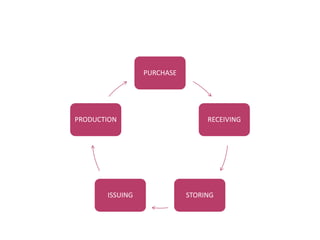
PURCHASE
RECEIVING
STORINGISSUING
PRODUCTION
• establishing standards and standard
procedures,
• training staff to follow those standards and
standard procedures,
• monitoring staff performance and comparing
it with established standards,
• and taking remedial actions as needed
PURCHASE CONTROL
• The primary purposes of beverage purchasing
controls are:
1. To maintain an appropriate supply of ingredients
for producing beverage products
2. To ensure that the quality of ingredients
purchased is appropriate for their intended use.
3. To ensure that ingredients are purchased at
optimum prices As always, the key to successful
control is to establish suitable standards and
standard procedures.
• Establishing standards for beverage
purchasing
For beverage purchasing, standards must be
developed for:
1. Quality- call brands and pouring brands
2. Quantity- perishability is not a critical factor
in establishing quantity standards for
beverages.
3. Price
Quantity standards- The principal factors used to
establish quantity standards for beverage
purchasing are:
1. Frequency with which management chooses to
place orders
2. Storage space available
3. Funds available for inventory purchases
4. Delivery schedules set by purveyors
5. Minimum order requirements set by purveyors
6. Price discounts for volume orders
7. Price specials available
8. Limited availability of some items
Standards for price-
Control states and license states
Establishing standard procedure for Beverage
purchasing
1. Determining order quantities
Periodic order method
Perpetual order method
2. Processing orders
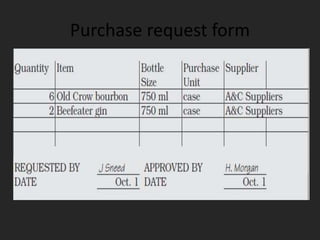
Purchase request form
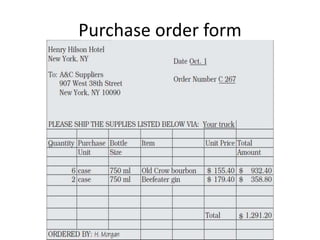
Purchase orders
Purchase request form
Purchase order form
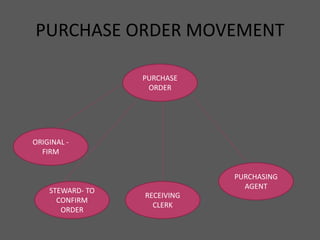
PURCHASE ORDER MOVEMENT
PURCHASE
ORDER
ORIGINAL -
FIRM
STEWARD- TO
CONFIRM
ORDER
RECEIVING
CLERK
PURCHASING
AGENT
RECEIVING
The primary goal of receiving control is to
ensure that deliveries received conform
exactly to orders placed. In practice, this
means that beverage deliveries must be
compared with beverage orders in regard to
quantity, quality, and price.
The standards established for receiving are quite
simple.
1. The quantity of an item delivered must equal
the quantity ordered.
2. The quality of an item delivered must the
same as the quality ordered.
3. The price on the invoice for each item
delivered should be the same as the price
quoted or listed when the order was placed.
• Establishing Standard Procedures
1. Maintain an up-to-date file of all beverage
orders placed.
2. Remove the record of the order from the file
when a delivery arrives and compare it with
the invoice presented by the delivery driver
to verify that quantities, qualities, and prices
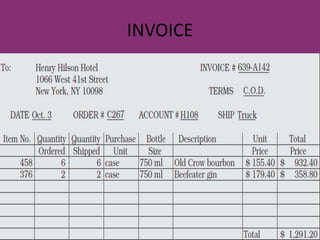
on the invoice conform to the order. the
picture illustrates a typical beverage invoice
INVOICE
3. Complete the following before the delivery
driver leaves the premises.
• Check brands, dates, or both, as appropriate,
to verify that the quality of beverages
delivered conforms to the invoice.
• Count or weigh goods delivered to verify that
the quantity received also conforms to the
invoice.
4. Compare the invoice with the order to verify
that goods received conform to the order
placed.
5. Call to the attention of both management and
the delivery driver:
• Any broken or leaking containers
• Any bottles with broken seals or missing labels
6. Note all discrepancies between delivered
goods and the invoice on the invoice itself.
7. Sign the original invoice to acknowledge
receipt of the goods, and return the signed
copy to the driver. Retain the duplicate copy
for internal record keeping.
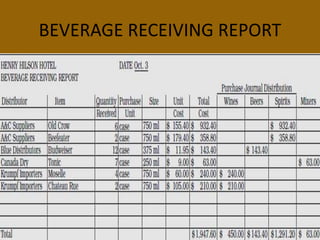
8. Record the invoice on the beverage receiving
report.
9. Notify the person responsible for storing
beverages that a delivery has been received.
BEVERAGE RECEIVING REPORT
THE CYCLE CONTINUES…………………..
Coming up STORING
ISSUING
PRODUCTION
STORING CONTROL
Establishing Standards
Storing control is established in beverage
operations to achieve three important
objectives:
1. To prevent pilferage
2. To ensure accessibility when needed
3. To preserve quality
• The following standards are critical to effective
storing control:
1. To prevent pilferage, it is clearly necessary to
make all beverage storage areas secure.
2. To ensure accessibility of products when
needed, the storage facility must be organized
so that each individual brand and product can
be found quickly.
3. To maintain product quality, each item in the
beverage inventory must be stored
appropriately,
• Establishing Standard Procedures – PROCEDURE TO
MAKE BEVERAGE AREAS SECURE
• Because beverage products are prone to theft,
• There are two ways to maintain the necessary degree
of security.
-assign responsibility
-keep the beverage storage facility locked and to issue a
single key to one person,
NOTE- SOLUTION TO PROBLEM to place a second key in a
safe or a similar secure location and require that
anyone using it sign for it and write a short explanation
of why it is needed
• installing closed-circuit television cameras
• A security guard
• to install special locks that print on paper tape
the times at which the doors on which they
are installed are unlocked and relocked.
Procedures to Organize the Beverage Storage
Facility
• Ensuring accessibility means storing beverage
products in an organized manner, so that each
stored item is always kept in the same place and
thus can be found quickly when needed
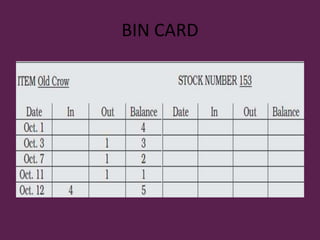
• BIN CARDS- When properly used, bin cards
include essential information (type of beverage,
brand name, and bottle size, for example). They
may also include an identification number for
beverages. Some establishments assign a code
number from a master list to each item in the
beverage inventory and record that code number
on the bin card.
BIN CARD
Procedures to Maximize Shelf Life of Stored
Beverages
Procedures for maximizing the shelf life of
stored beverages may be divided into two
categories:
1. Those dealing with temperature, humidity,
and light in the storage facilities
2. Those dealing with the manner in which
bottles and other containers are handled and
shelved
• Shelving and Handling Bottles and Other
Containers
• There are special racks designed to store
wines in the proper position.
ISSUING CONTROL
Establishing Standards
Issuing control is established in hotel and
restaurant beverage operations to achieve two
important objectives:
1. To ensure the timely release of beverages
from inventory in the needed quantities
2. To prevent the misuse of alcoholic beverages
between release from inventory and delivery
to the bar
Establishing Standard Procedures
To ensure that the essential issuing standards
identified previously will be met, it is
necessary to establish appropriate standard
procedures for issuing beverages:
1. Establishing par stocks for bars
2. Setting up a requisition system
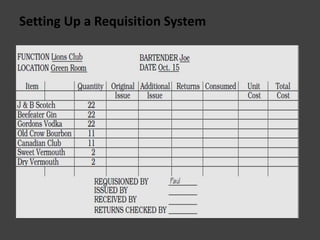
Setting Up a Requisition System
PRODUCTION CONTROL
Objectives of beverage production control
Control over beverage production is established
to achieve two primary objectives:
1. To ensure that all drinks are prepared
according to management’s specifications
2. To guard against excessive costs that can
develop in the production process
Establishing Standards and Standard
Procedures for Production
• Standards for quantities of equipment
• For proportion of ingredients
• Drink size must be standardized
• Employees must be trained with these
standards
Establishing Quantity Standards and Standard
Procedures
Devices for Measuring Standard Quantities
A plain shot glass
A lined shot glass
The jigger
The pourer
Automatic dispenser
Free pour
glassware
Establishing Quality Standards and Standard
Procedures
Standard recipe
It should be clear that to control costs, one must
establish control over the ingredients that go
into each drink, as well as over the
proportions of the ingredients to one another.
In other words, standard drink recipes must
be established so that bar personnel will know
the exact quantity of each ingredient to use in
order to produce any given drink.
Establishing Standard Portion Costs
Straight Drinks
The cost of straight drinks, served with or
without mixers, can be determined by first
dividing the standard portion size in ounces
into the number of ounces in the bottle to find
the number of standard drinks contained in
each bottle. This number is then divided into
the cost of the bottle to find the standard cost
of the drink.
Mixed Drinks and Cocktails
It is particularly important to determine the
standard costs of cocktails and other mixed
drinks. These drinks, typically prepared from
standard recipes, normally have several
ingredients and may require two or more
alcoholic beverages. Consequently, mixed
drinks are usually more expensive to make
than straight drinks. Knowledge of the cost
per drink is important for making intelligent
pricing decisions.
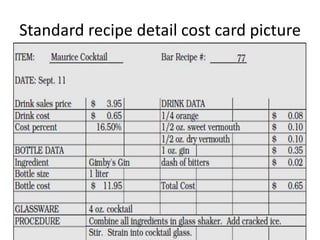
Standard recipe detail cost card picture
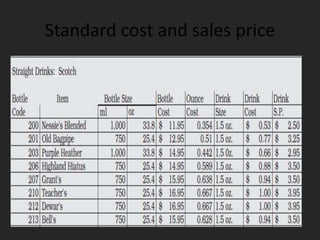
Standard cost and sales price
BAR FRAUDS
Frauds by customer
Customer walking without paying
Bringing foreign article
Customer making unnecessary complaints
Using false credit card
Counterfeit currency
• Thefts by waiter and waitress-
Intentional omission of items
Reusing of checks-
Over charging-
Incorrect addition-
Substitution-
Falsification of tips or other charges-
Incorrect change-
Split rings-
Bar tenders fraud or errors
Cashier theft or error
Cashier keeps the money and pockets or destroys a
check.
Cashier changes the total of check after collection.
Cashier bunches sales, split-rings, or under rings.
Cashier gives uncorrected change.
Cashier performs incorrect addition.
Cashier falsifies payout or adds items to complimentary
checks and removes them from other checks.
Thanks for listening

Beverage control

  • 1.
    BEVERAGE CONTROL can bedefined as a process used by managers to direct, regulate, and restrain the actions of people so that the established goals of an enterprise may be achieved.
  • 2.
  • 3.
    • establishing standardsand standard procedures, • training staff to follow those standards and standard procedures, • monitoring staff performance and comparing it with established standards, • and taking remedial actions as needed
  • 4.
    PURCHASE CONTROL • Theprimary purposes of beverage purchasing controls are: 1. To maintain an appropriate supply of ingredients for producing beverage products 2. To ensure that the quality of ingredients purchased is appropriate for their intended use. 3. To ensure that ingredients are purchased at optimum prices As always, the key to successful control is to establish suitable standards and standard procedures.
  • 5.
    • Establishing standardsfor beverage purchasing For beverage purchasing, standards must be developed for: 1. Quality- call brands and pouring brands 2. Quantity- perishability is not a critical factor in establishing quantity standards for beverages. 3. Price
  • 6.
    Quantity standards- Theprincipal factors used to establish quantity standards for beverage purchasing are: 1. Frequency with which management chooses to place orders 2. Storage space available 3. Funds available for inventory purchases 4. Delivery schedules set by purveyors 5. Minimum order requirements set by purveyors 6. Price discounts for volume orders 7. Price specials available 8. Limited availability of some items
  • 7.
    Standards for price- Controlstates and license states
  • 8.
    Establishing standard procedurefor Beverage purchasing 1. Determining order quantities Periodic order method Perpetual order method 2. Processing orders Purchase request form Purchase orders
  • 9.
  • 10.
  • 11.
    PURCHASE ORDER MOVEMENT PURCHASE ORDER ORIGINAL- FIRM STEWARD- TO CONFIRM ORDER RECEIVING CLERK PURCHASING AGENT
  • 12.
    RECEIVING The primary goalof receiving control is to ensure that deliveries received conform exactly to orders placed. In practice, this means that beverage deliveries must be compared with beverage orders in regard to quantity, quality, and price.
  • 13.
    The standards establishedfor receiving are quite simple. 1. The quantity of an item delivered must equal the quantity ordered. 2. The quality of an item delivered must the same as the quality ordered. 3. The price on the invoice for each item delivered should be the same as the price quoted or listed when the order was placed.
  • 14.
    • Establishing StandardProcedures 1. Maintain an up-to-date file of all beverage orders placed. 2. Remove the record of the order from the file when a delivery arrives and compare it with the invoice presented by the delivery driver to verify that quantities, qualities, and prices on the invoice conform to the order. the picture illustrates a typical beverage invoice
  • 15.
  • 16.
    3. Complete thefollowing before the delivery driver leaves the premises. • Check brands, dates, or both, as appropriate, to verify that the quality of beverages delivered conforms to the invoice. • Count or weigh goods delivered to verify that the quantity received also conforms to the invoice.
  • 17.
    4. Compare theinvoice with the order to verify that goods received conform to the order placed. 5. Call to the attention of both management and the delivery driver: • Any broken or leaking containers • Any bottles with broken seals or missing labels
  • 18.
    6. Note alldiscrepancies between delivered goods and the invoice on the invoice itself. 7. Sign the original invoice to acknowledge receipt of the goods, and return the signed copy to the driver. Retain the duplicate copy for internal record keeping. 8. Record the invoice on the beverage receiving report. 9. Notify the person responsible for storing beverages that a delivery has been received.
  • 19.
  • 20.
  • 21.
    STORING CONTROL Establishing Standards Storingcontrol is established in beverage operations to achieve three important objectives: 1. To prevent pilferage 2. To ensure accessibility when needed 3. To preserve quality
  • 22.
    • The followingstandards are critical to effective storing control: 1. To prevent pilferage, it is clearly necessary to make all beverage storage areas secure. 2. To ensure accessibility of products when needed, the storage facility must be organized so that each individual brand and product can be found quickly. 3. To maintain product quality, each item in the beverage inventory must be stored appropriately,
  • 23.
    • Establishing StandardProcedures – PROCEDURE TO MAKE BEVERAGE AREAS SECURE • Because beverage products are prone to theft, • There are two ways to maintain the necessary degree of security. -assign responsibility -keep the beverage storage facility locked and to issue a single key to one person, NOTE- SOLUTION TO PROBLEM to place a second key in a safe or a similar secure location and require that anyone using it sign for it and write a short explanation of why it is needed
  • 24.
    • installing closed-circuittelevision cameras • A security guard • to install special locks that print on paper tape the times at which the doors on which they are installed are unlocked and relocked.
  • 25.
    Procedures to Organizethe Beverage Storage Facility • Ensuring accessibility means storing beverage products in an organized manner, so that each stored item is always kept in the same place and thus can be found quickly when needed • BIN CARDS- When properly used, bin cards include essential information (type of beverage, brand name, and bottle size, for example). They may also include an identification number for beverages. Some establishments assign a code number from a master list to each item in the beverage inventory and record that code number on the bin card.
  • 26.
  • 27.
    Procedures to MaximizeShelf Life of Stored Beverages Procedures for maximizing the shelf life of stored beverages may be divided into two categories: 1. Those dealing with temperature, humidity, and light in the storage facilities 2. Those dealing with the manner in which bottles and other containers are handled and shelved
  • 28.
    • Shelving andHandling Bottles and Other Containers • There are special racks designed to store wines in the proper position.
  • 29.
    ISSUING CONTROL Establishing Standards Issuingcontrol is established in hotel and restaurant beverage operations to achieve two important objectives: 1. To ensure the timely release of beverages from inventory in the needed quantities 2. To prevent the misuse of alcoholic beverages between release from inventory and delivery to the bar
  • 30.
    Establishing Standard Procedures Toensure that the essential issuing standards identified previously will be met, it is necessary to establish appropriate standard procedures for issuing beverages: 1. Establishing par stocks for bars 2. Setting up a requisition system
  • 31.
    Setting Up aRequisition System
  • 32.
    PRODUCTION CONTROL Objectives ofbeverage production control Control over beverage production is established to achieve two primary objectives: 1. To ensure that all drinks are prepared according to management’s specifications 2. To guard against excessive costs that can develop in the production process
  • 33.
    Establishing Standards andStandard Procedures for Production • Standards for quantities of equipment • For proportion of ingredients • Drink size must be standardized • Employees must be trained with these standards
  • 34.
    Establishing Quantity Standardsand Standard Procedures Devices for Measuring Standard Quantities A plain shot glass A lined shot glass The jigger The pourer Automatic dispenser Free pour glassware
  • 35.
    Establishing Quality Standardsand Standard Procedures Standard recipe It should be clear that to control costs, one must establish control over the ingredients that go into each drink, as well as over the proportions of the ingredients to one another. In other words, standard drink recipes must be established so that bar personnel will know the exact quantity of each ingredient to use in order to produce any given drink.
  • 36.
    Establishing Standard PortionCosts Straight Drinks The cost of straight drinks, served with or without mixers, can be determined by first dividing the standard portion size in ounces into the number of ounces in the bottle to find the number of standard drinks contained in each bottle. This number is then divided into the cost of the bottle to find the standard cost of the drink.
  • 37.
    Mixed Drinks andCocktails It is particularly important to determine the standard costs of cocktails and other mixed drinks. These drinks, typically prepared from standard recipes, normally have several ingredients and may require two or more alcoholic beverages. Consequently, mixed drinks are usually more expensive to make than straight drinks. Knowledge of the cost per drink is important for making intelligent pricing decisions.
  • 38.
    Standard recipe detailcost card picture
  • 39.
    Standard cost andsales price
  • 40.
    BAR FRAUDS Frauds bycustomer Customer walking without paying Bringing foreign article Customer making unnecessary complaints Using false credit card Counterfeit currency
  • 41.
    • Thefts bywaiter and waitress- Intentional omission of items Reusing of checks- Over charging- Incorrect addition- Substitution- Falsification of tips or other charges- Incorrect change- Split rings-
  • 42.
    Bar tenders fraudor errors Cashier theft or error Cashier keeps the money and pockets or destroys a check. Cashier changes the total of check after collection. Cashier bunches sales, split-rings, or under rings. Cashier gives uncorrected change. Cashier performs incorrect addition. Cashier falsifies payout or adds items to complimentary checks and removes them from other checks.
  • 43.