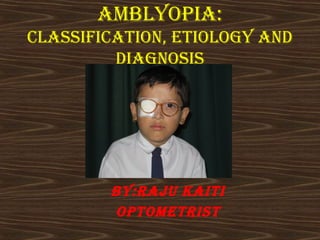
AMBLYOPIA: 
cLAssIfIcAtIOn, etIOLOgY And 
dIAgnOsIs 
BY:RAJU KAItI 
OPtOMetRIst
AMBLYOPIA 
• Defn 
– “A unilateral or bilateral decrease of visual acuity 
caused by pattern vision deprivation or abnormal 
binocular interaction for which no obvious causes 
can be detected by physical examination of the 
eye and cannot be corrected by optical or surgical 
means but in appropriate cases is reversible by 
therapeutic measures.’
• Researches have pointed to the fact that 
amblyopia was not simply a reduction in the 
visual acuity in an eye, but a complex visual 
processing disorder that involved the decrement 
virtually in all areas of visual functions including- 
– Accommodative accuracy and facility 
– Fixation stability 
– Pursuit and saccadic accuracy 
– Localization in space 
– Contrast sensitivity
• Amblyopia originated from Greek word: 
Amblyos - dullness / blunt 
Ops – vision 
• Condition in which the observer sees nothing & 
patient very little 
• Significance difference in acuity between eyes may 
be sign of amblyopia 
• Mainly result due to visual stimulus deprivation / 
suppression usually associated with strabismus or 
anisometropia
• conflicting inputs from the two eyes to the visual 
cortex that result in active suppression and 
development of amblyopia in non dominant eye 
• usually unilateral 
• Bilateral amblyopia can occur when high 
hypermetropic (+4D) or myopic (-8 D) or astigmatic 
refractive error not corrected during visual 
immaturity 
• Defective VA even after correction 
• may be due to organic causes
AMBLYOPIA 
• Prevalence 
– Variable 
– 2.0 -2.5 % of general population 
– Preschool/school age children : 4-5.3%
sensItIve PeRIOd 
 Developmental time frame early in life during which 
there is robust plasticity within the visual system, 
particularly the visual cortex. 
– Retinocortical connection not firmly established 
– Period – sensitive /critical / susceptible period 
– Strabismic amblyopia – 7 years 
– Sensitive period for recovery - ? 8 years 
• Critical period - 2 months of age
RIsK fActORs 
• 4 times more prevalent in 
– LBW & Premature baby 
• 6 times more in 
– delayed milestones & CNS disorders 
• parent with amblyopia 
• Maternal smoking
• Criteria for Excellent VA 
-early retinal stimulation of each eye 
-proper ocular alignment 
-binocularity 
- stereopsis
• Any blurred retinal image 
• Difference in VA b/w two eyes 
• Leads to abnormal fixation 
• Inhibition of visual cortex 
Amblyopia
11
12
cLAssIfIcAtIOn 
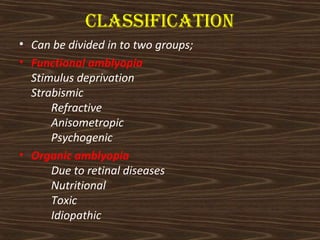
• Can be divided in to two groups; 
• Functional amblyopia 
Stimulus deprivation 
Strabismic 
Refractive 
Anisometropic 
Psychogenic 
• Organic amblyopia 
Due to retinal diseases 
Nutritional 
Toxic 
Idiopathic
stIMULAtIOn dePRIvAtIOn AMBLYOPIA 
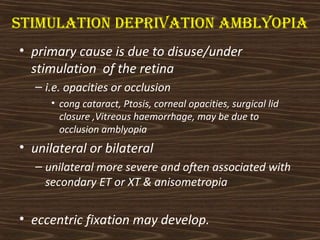
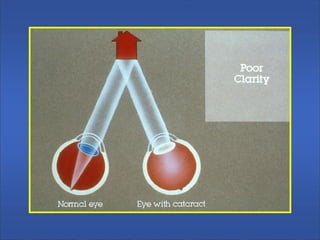
• primary cause is due to disuse/under 
stimulation of the retina 
– i.e. opacities or occlusion 
• cong cataract, Ptosis, corneal opacities, surgical lid 
closure ,Vitreous haemorrhage, may be due to 
occlusion amblyopia 
• unilateral or bilateral 
– unilateral more severe and often associated with 
secondary ET or XT & anisometropia 
• eccentric fixation may develop.
15
• Pattern deprivation amblyopia 
- dense congenital cataract 
-corneal opacity (Peters' anomaly ) 
-corneal opacity ( Trauma, Infections, HSV) 
- large uncorrected refractive errors 
-Nystagmus - poor visual outcome
stIMULUs dePRIvAtIOn AMBLYOPIA 
Aphakia 
Congenital cataract 
Corneal scar Congenital ptosis
• WHICH IS MORE LIKELY TO PRODUCE 
AMBLYOPIA-UNILATERAL OR BILATERAL 
PTOSIOS.WHY?????? 
Unilateral ocular abnormalities are much more likely to 
lead amblyopia than binocular ones. If one eye has a 
competitive advantage over the other, its afferent 
connections become stronger and more numerous 
while those of other eye atrophied and retract.
StrabiSmic amblyopia 
• occurs as a result of neural changes in the deviated eye 
• pt having one eye for fixation in unilateral rather than 
alternating fixation more likely to develop Strabismic 
amblyopia 
• often seen in ET than XT 
– the fovea of the deviated eye has to compete with a strong 
temporal hemi field of the fellow eye 
• always unilateral & caused by active inhibition 
• aetiology similar to that of suppression. 
– thus called suppression amblyopia.
• turning and consequent disuse of one eye will 
arrest the development of VA –amb. of arrest. 
– if amblyopia of arrest is allowed to persist suppression 
amblyopia develops – amblyopia of extinction. 
• constant untreated acquired ET under 3 years will 
dev strabismus amb in100% of cases 
• doesn’t occur in X(T)
aniSometropic amblyopia 
o abnormal binocular interaction caused by unequal fovea 
images in the two eyes causes dev of the Anisometropic 
amb. 
o always unilateral. 
o active inhibition of the fovea as the Strabismic amb. 
o 30% of the cases are associated with strabismus. 
o with reduction in central VA , overall reduction of the 
contrast sensitivity
22
• it occurs when dioptric power differs over 
+1D in hyperopes , more than –3D in myopes 
&more than 1.5 D in astigmatism. 
• when corrected optically resulting 
aneisokonia may be amblypiogenic factor 
since retinal images of dif sizes present an 
obstacle fusion 
• more common in anisohyperopia than 
anisomyopia
refractive amblyopia 
• caused by uncorrected ref error where there is blur image 
at all distance 
• may be unilateral or bilateral 
• if unilateral then Anisometropic amblyopia 
• meridional amb. occurs in principal meridian of high 
uncorrected astigmatism.
refractive : iSoametropic 
• Hyperopia : > + 5.00 Ds 
• Myopia : > -8.00 Ds 
• Astigmatism : > +/- 2.50 Ds 
• Cause 
– Equal pattern deprivation 
• Other term 
– Meridional amblyopia 
• Selective visual deprivation for visual stimuli of a certain spatial 
orientation
pSychogenic amblyopia 
• also called hysterical amblyopia. 
• occurs as a visual conversion reaction.
organic amblyopia 
 Irreversible type which results from some pathological or 
anatomical abnormalities of the retina 
Retinal eye diseases 
eg.-neonatal macular hemorrhage receptor 
dystrophy pathogenic lesion 
affecting the fovea & surrounding retinal area such as 
toxoplasmosis chorioretinitis ,a 
retinoblastoma, traumatic retinal lesion 
May be associated with abnormality of visual 
pathway
• Nutritional amblyopia 
-Occurs from nutrition deficiencies 
• Toxic amblyopia - 
visual loss due to damage to the optic nerve fibrosis due 
to effect of exogenous or endogenous poisons 
• -Its types are as follows: 
– tobacco amblyopia 
– ethyl alcohol amblyopia 
– methyl alcohol amblyopia 
– quinine amblyopia 
– ethambutol amblyopia
Tobacco amblyopia 
Typically occurs in men in pipe smokers, heavy 
drinkers ,diet deficiencies in protein & vit.B complex 
deficiencies 
Pathogenesis: 
Toxic agent – cyanide found in tobacco 
Excessive tobacco smoking - Excessive 
cyanide in blood – degeneration of ganglion cells 
particularly in macular lesion – 
degeneration of papillomacular bundle in the 
nerve - toxic amblyopia
• Characterized by gradually progressive impairment in the 
central vision 
• Patient complains of fogginess & difficulty in doing near 
works 
• V.F.-B/L centrocaecal scotoma with diffuse margins, 
defects more for red than white 
• Fundus: normal/slight temporal pallor 
• ethyl alcohol amblyopia 
Usually in association with tobacco amblyopia 
May occur in 
nonsmoker but heavy drinkers suffering from chronic 
gastritis 
• Clinical picture same as tobacco amblyopia
MEthyl alcohol amblyopia 
It is typically acute usually resulting in optic atrophy & 
permanent blindness 
Etiology : 
usually occurs due to intake of wood alcohol or 
methylated spirit in cheap adulterated /fortified 
beverages 
- sometimes may be due to inhalation of fumes in 
industries
• Pathogenesis; Metabolized very slowly thus stays in body 
for longer period of time – oxidized in to formic acid & 
formaldehyde in the tissues -toxic agents cause edema 
followed by degeneration of the ganglion cells of the retina 
resulting in complete blindness due to optic atrophy 
• Clinical features: 
• Symptoms: 
• In acute poisoning - headache , vomiting ,nausea ,dizziness, 
abdominal pain 
• Presence of characteristic odor 
• Patient usually brought with complete blindness noticed 
after 2-3 days
• Fundus: mild disc edema , markly narrowed blood 
vessels 
FINALLY: B/L primary optic atrophy
• Quinine amblyopia 
o May occur even with small doses of the drugs in susceptible 
individuals. 
• Near total blindness ,deafness & tinnitus 
• Pupil –fixed & dilated 
• Fundus - retinal edema , marked pallor of the disc , extreme 
attenuation of retinal vessels 
• V.F.-markly contracted
• Ethambutol amblyopia 
• Caused due to anti -tubercular drugs 
• Used in doses of 15mg/kg per day 
• usually occurs in patient who have associated 
alcoholism & diabetes 
• Fundus: sign of papillitis
• Idiopathic amblyopia 
• -unknown etiology 
• -may be cortical or sub cortical
• Is color vision affected in amblyopia?? 
– Generally not affected 
– Mild abnormalities reported in severe amblyopia, 
particularly those with loss of foveal fixation 
• Does amblyopia cause a relative afferent 
pupillary defect?? 
– Generally not affected 
– Pathologic changes located in posterior visual 
pathway, not in retina or optic nerve
??? Necessity for testiNg 
AmblyopiA 
• Differential Diagnosis and prognosis . 
• Differentiating the functional from the organic 
amblyopia. 
• The decision , type and extent of the amblyopia 
therapy depends on the test results. 
• Guides the therapy.
DetectioN & iNvestigAtioN 
• Full routine examination 
• History and symptoms 
• age of onset 
• onset of strabismus 
• previous treatment; with glasses ,occlusion 
• V.A measurement 
first amblyopic eye then non-amblyopic eye 
-line acuity 
-Single letter acuity
• Line acuity 
Called morphoscopic acuity 
Ask the patient to read until the real limit of 
acuity is reached 
Where there is eccentric fixation , small 
foveal scotoma may result in patient missing 
out letters 
• Single letter acuity 
called angular acuity 
E cube , S.G charts- measure minimum 
recognizable acuity in children 
Usually higher V.A with angular acuity than 
morphoscopic acuity called crowding 
phenomenon due to contour interaction
spAtiAl iNterActioN (crowDiNg 
pheNomeNoN) 
• Persons with amblyopia have increased difficulty identifying 
test letters when they are presented in a linear or two-dimensional 
array rather than as isolated characters. - 
"separation difficulty/ crowding phenomenon" 
– when figures near the limit of resolution are surrounded 
by other closely spaced forms 
• A similar effect can be produce by placing interactive bars 
around a single letter
• In the normal fovea, contour interaction 
– when forms are separated by a distance of 1 to 3 
minutes of arc (0.4 to 0.6 times the overall size of 
6 meter Snellen letter) 
– In the normal periphery its extent is much greater. 
• In the amblyopic fovea, 
– contour interaction typically extends over an 
increased distance, to a degree that is roughly 
proportional to the reduction in acuity.
• Crowding phenomenon more enhanced in Strabismic 
amblyopia 
• Contrast sensitivity 
Strabismic & Anisometropic amblyopia -Have 
poorer C.S than normal eye 
• Electrodiognostic tests 
Helps in detecting the presence of organic 
amblyopia in which there is no response to 
treatment
• Pinhole 
Helps to confirms the presence of amblyopia if 
VA is not improved with its use 
• Bruckner test 
• Fixation pattern & amblyopia in strabismus 
• Presence of free alteration indicates equal V.A 
• No alternate fixation ,likely to suppress so develops 
amblyopia 
• Eccentric fixation may be present
ecceNtric fixAtioN 
• Unfavorable prognostic factor for therapy. 
• Objectively determined by Visuoscopy 
• Subjectively determined when the patient fixating 
the centre of the rotating field that creates the 
Haidingers brush effect , and the brush is seen 
eccentric to the central fixation spot rather than 
superimposed on it.
• Eccentric fixation tests 
• Visuoscope / fixation graticule present in 
ophthalmoscope 
• Area used for fixation is noted 
Parafoveal fixation- 1-3 degrees 
paramacular fixation- 3-5 degrees peripheral 
fixation- more than 5 degrees
• Neutral density filter 
• difference between organic & strabismus amblyopia 
• In strabismus amblyopia, there is eccentric fixation 
amblyopic eye is not affected by the filter as the 
slightly peripheral retina adapts better since 
it contains rod & cones 
• In organic amblyopia –usually central fixation, likely 
to be reduction of several lines
• After image transfer method 
• asked to indicate the position of the after Image 
in relation to the fixation point in eccentric 
fixation ,image will appear slightly to the side of 
the fixation pattern
telescope test 
• Chart is viewed with amblyopic eye with 
2.5xtelescope. 
• If organic amblyopia acuity increase by a factor 
of 2.5 
• (20100 improve to 2040) 
• If further improvement in visual acuity it is 
functional amblyopia. 
• (20100 to 2025)
coNtrAst seNsitivity fuNctioN 
• Useful in predicating the degree and the rate of 
improvement before amblyopia therapy. 
• Mild , middle spatial frequency (6to 12 
cyclesdegree) support a better prognosis for 
recovery.
Visually EVokEd PotEntial 
tEsting 
• Stimulus subtense is increased in size(lower spatial 
frequency)until a minute of arc size is found where the 
monocular wave form looks similar with regard to 
latency and amplitude. 
• The higher the spatial frequency at which this occurs , 
the better the prognosis for improvement. 
• Below 14 minutes of arc the prognosis is excellent 
below 55 minutes it is poor.
• Entopic phenomenon 
Haidingers brushes and Maxwell's spot 
• These phenomenon are centered on the fovea, 
eccentrically fixing patient will not see them at 
the point of fixation 
-will be slightly to the side of fixation 
Some cannot see at all
• Perimetry method 
• Amsler charts 
Used to show early signs of organic amb where 
there is typically a small dense central scotoma 
• Past pointing test 
• Gives an indication if the localization of objects in 
space has been disturbed with an amblyopic eye
TTyyppee PPrrooggnnoossiiss TTrreeaattmmeenntt 
OOrrggaanniicc 
NNuuttrriittiioonnaall 
GGoooodd 
TToobbaaccccoo 
GGoooodd 
TTooxxiicc 
PPoooorr ––ffaaiirr 
ccoonnggeenniittaall 
PPoooorr 
DDiieett 
AAbbssttiinneennccee 
MMeeddiiccaall aatttteennttiioonn 
FFuunnccttiioonnaall vviissiioonn 
tthheerraappyy 
FFuunnccttiioonnaall 
HHyysstteerriiccaall 
LLiigghhtt 
ddeepprriivvaattiioonn 
RReeffrraaccttiivvee 
SSttrraabbiissmmiicc 
GGoooodd 
PPoooorr 
GGoooodd 
GGoooodd 
PPssyycchhootthheerraappyy 
RReemmoovvee oobbssttaaccllee 
OOpphhtthhaallmmiicc lleennsseess 
FFuunnccttiioonnaall vviissiioonn 
tthheerraappyy
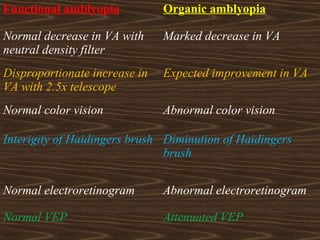
Functional amblyopia Organic amblyopia 
Normal decrease in VA with 
neutral density filter 
Marked decrease in VA 
Disproportionate increase in 
VA with 2.5x telescope 
Expected improvement in VA 
Normal color vision Abnormal color vision 
Interigity of Haidingers brush Diminution of Haidingers 
brush 
Normal electroretinogram Abnormal electroretinogram 
Normal VEP Attenuated VEP
Prognostic Factors in amblyoPia 
Positive factor Negative factor 
functional organic 
Central fixation Eccentric fixation 
Random dot stereopsis No random dot stereopsis 
Short duration Long duration 
Young patient ,motivated Older patient, un -motivated
diagnosis 
• Amblyopia – Diagnosis of exclusion 
U/L amblyopia 
- fixation behavior differs in two eyes 
-difference –not eliminated by corrective 
lenses 
• Not attributable to a structural abnormalities
diagnosis 
B/L amblyopia 
- diagnosed when sig. Refractive errors present 
- fixation behaviors falls below the N range 
- acuity is not normalized by corrective lenses 
- reduced VA is not attributable to the ocular 
findings
PrEVEntion & Early dEtEction 
• Paramount important 
• Infants & children- susceptible to permanent central 
loss 
• Screening program 
- Red reflex test ( media opacity ) 
-Penlight corneal reflex (Hirschberg test) 
-Cover test 
-Binocular red reflex test (Buckner test)
• Others : 
• Photographic Screening 
• Auto refractive devices 
• Refractive errors & Amblyopia – can be 
detected by VA screening of normal children > 
3 years
• Unfortunately cases – missed 
• Children with risk factors for Amblyopia 
• Referral system: 
• -Premature baby 
-Low birth weight 6 mo 
- Prenatal complications 
-CNS & delayed milestones 18 mo 
-Genetic syndromes with others
diagnosing thE risk oF amblyoPia 
MEAC approach
•Monitor qualitative fixation: 
– VA evaluation-measure gross fixation abilities 
• Evaluate red reflex: 
– Bruckner test-whiter/brighter reflex represents a 
Strabismic eye 
• Alignment evaluation: 
– Hirschberg with infant or CT for toddler 
• Compare refractive error: 
– Cycloplegic refraction
thumb occludEr (Fixation 
PrEFErEncE)
Glasses wear Patching good eye

Amblyopia

  • 1.
    AMBLYOPIA: cLAssIfIcAtIOn, etIOLOgYAnd dIAgnOsIs BY:RAJU KAItI OPtOMetRIst
  • 2.
    AMBLYOPIA • Defn – “A unilateral or bilateral decrease of visual acuity caused by pattern vision deprivation or abnormal binocular interaction for which no obvious causes can be detected by physical examination of the eye and cannot be corrected by optical or surgical means but in appropriate cases is reversible by therapeutic measures.’
  • 3.
    • Researches havepointed to the fact that amblyopia was not simply a reduction in the visual acuity in an eye, but a complex visual processing disorder that involved the decrement virtually in all areas of visual functions including- – Accommodative accuracy and facility – Fixation stability – Pursuit and saccadic accuracy – Localization in space – Contrast sensitivity
  • 4.
    • Amblyopia originatedfrom Greek word: Amblyos - dullness / blunt Ops – vision • Condition in which the observer sees nothing & patient very little • Significance difference in acuity between eyes may be sign of amblyopia • Mainly result due to visual stimulus deprivation / suppression usually associated with strabismus or anisometropia
  • 5.
    • conflicting inputsfrom the two eyes to the visual cortex that result in active suppression and development of amblyopia in non dominant eye • usually unilateral • Bilateral amblyopia can occur when high hypermetropic (+4D) or myopic (-8 D) or astigmatic refractive error not corrected during visual immaturity • Defective VA even after correction • may be due to organic causes
  • 6.
    AMBLYOPIA • Prevalence – Variable – 2.0 -2.5 % of general population – Preschool/school age children : 4-5.3%
  • 7.
    sensItIve PeRIOd Developmental time frame early in life during which there is robust plasticity within the visual system, particularly the visual cortex. – Retinocortical connection not firmly established – Period – sensitive /critical / susceptible period – Strabismic amblyopia – 7 years – Sensitive period for recovery - ? 8 years • Critical period - 2 months of age
  • 8.
    RIsK fActORs •4 times more prevalent in – LBW & Premature baby • 6 times more in – delayed milestones & CNS disorders • parent with amblyopia • Maternal smoking
  • 9.
    • Criteria forExcellent VA -early retinal stimulation of each eye -proper ocular alignment -binocularity - stereopsis
  • 10.
    • Any blurredretinal image • Difference in VA b/w two eyes • Leads to abnormal fixation • Inhibition of visual cortex Amblyopia
  • 11.
  • 12.
  • 13.
    cLAssIfIcAtIOn • Canbe divided in to two groups; • Functional amblyopia Stimulus deprivation Strabismic Refractive Anisometropic Psychogenic • Organic amblyopia Due to retinal diseases Nutritional Toxic Idiopathic
  • 14.
    stIMULAtIOn dePRIvAtIOn AMBLYOPIA • primary cause is due to disuse/under stimulation of the retina – i.e. opacities or occlusion • cong cataract, Ptosis, corneal opacities, surgical lid closure ,Vitreous haemorrhage, may be due to occlusion amblyopia • unilateral or bilateral – unilateral more severe and often associated with secondary ET or XT & anisometropia • eccentric fixation may develop.
  • 15.
  • 16.
    • Pattern deprivationamblyopia - dense congenital cataract -corneal opacity (Peters' anomaly ) -corneal opacity ( Trauma, Infections, HSV) - large uncorrected refractive errors -Nystagmus - poor visual outcome
  • 17.
    stIMULUs dePRIvAtIOn AMBLYOPIA Aphakia Congenital cataract Corneal scar Congenital ptosis
  • 18.
    • WHICH ISMORE LIKELY TO PRODUCE AMBLYOPIA-UNILATERAL OR BILATERAL PTOSIOS.WHY?????? Unilateral ocular abnormalities are much more likely to lead amblyopia than binocular ones. If one eye has a competitive advantage over the other, its afferent connections become stronger and more numerous while those of other eye atrophied and retract.
  • 19.
    StrabiSmic amblyopia •occurs as a result of neural changes in the deviated eye • pt having one eye for fixation in unilateral rather than alternating fixation more likely to develop Strabismic amblyopia • often seen in ET than XT – the fovea of the deviated eye has to compete with a strong temporal hemi field of the fellow eye • always unilateral & caused by active inhibition • aetiology similar to that of suppression. – thus called suppression amblyopia.
  • 20.
    • turning andconsequent disuse of one eye will arrest the development of VA –amb. of arrest. – if amblyopia of arrest is allowed to persist suppression amblyopia develops – amblyopia of extinction. • constant untreated acquired ET under 3 years will dev strabismus amb in100% of cases • doesn’t occur in X(T)
  • 21.
    aniSometropic amblyopia oabnormal binocular interaction caused by unequal fovea images in the two eyes causes dev of the Anisometropic amb. o always unilateral. o active inhibition of the fovea as the Strabismic amb. o 30% of the cases are associated with strabismus. o with reduction in central VA , overall reduction of the contrast sensitivity
  • 22.
  • 23.
    • it occurswhen dioptric power differs over +1D in hyperopes , more than –3D in myopes &more than 1.5 D in astigmatism. • when corrected optically resulting aneisokonia may be amblypiogenic factor since retinal images of dif sizes present an obstacle fusion • more common in anisohyperopia than anisomyopia
  • 24.
    refractive amblyopia •caused by uncorrected ref error where there is blur image at all distance • may be unilateral or bilateral • if unilateral then Anisometropic amblyopia • meridional amb. occurs in principal meridian of high uncorrected astigmatism.
  • 25.
    refractive : iSoametropic • Hyperopia : > + 5.00 Ds • Myopia : > -8.00 Ds • Astigmatism : > +/- 2.50 Ds • Cause – Equal pattern deprivation • Other term – Meridional amblyopia • Selective visual deprivation for visual stimuli of a certain spatial orientation
  • 26.
    pSychogenic amblyopia •also called hysterical amblyopia. • occurs as a visual conversion reaction.
  • 27.
    organic amblyopia Irreversible type which results from some pathological or anatomical abnormalities of the retina Retinal eye diseases eg.-neonatal macular hemorrhage receptor dystrophy pathogenic lesion affecting the fovea & surrounding retinal area such as toxoplasmosis chorioretinitis ,a retinoblastoma, traumatic retinal lesion May be associated with abnormality of visual pathway
  • 28.
    • Nutritional amblyopia -Occurs from nutrition deficiencies • Toxic amblyopia - visual loss due to damage to the optic nerve fibrosis due to effect of exogenous or endogenous poisons • -Its types are as follows: – tobacco amblyopia – ethyl alcohol amblyopia – methyl alcohol amblyopia – quinine amblyopia – ethambutol amblyopia
  • 29.
    Tobacco amblyopia Typicallyoccurs in men in pipe smokers, heavy drinkers ,diet deficiencies in protein & vit.B complex deficiencies Pathogenesis: Toxic agent – cyanide found in tobacco Excessive tobacco smoking - Excessive cyanide in blood – degeneration of ganglion cells particularly in macular lesion – degeneration of papillomacular bundle in the nerve - toxic amblyopia
  • 30.
    • Characterized bygradually progressive impairment in the central vision • Patient complains of fogginess & difficulty in doing near works • V.F.-B/L centrocaecal scotoma with diffuse margins, defects more for red than white • Fundus: normal/slight temporal pallor • ethyl alcohol amblyopia Usually in association with tobacco amblyopia May occur in nonsmoker but heavy drinkers suffering from chronic gastritis • Clinical picture same as tobacco amblyopia
  • 31.
    MEthyl alcohol amblyopia It is typically acute usually resulting in optic atrophy & permanent blindness Etiology : usually occurs due to intake of wood alcohol or methylated spirit in cheap adulterated /fortified beverages - sometimes may be due to inhalation of fumes in industries
  • 32.
    • Pathogenesis; Metabolizedvery slowly thus stays in body for longer period of time – oxidized in to formic acid & formaldehyde in the tissues -toxic agents cause edema followed by degeneration of the ganglion cells of the retina resulting in complete blindness due to optic atrophy • Clinical features: • Symptoms: • In acute poisoning - headache , vomiting ,nausea ,dizziness, abdominal pain • Presence of characteristic odor • Patient usually brought with complete blindness noticed after 2-3 days
  • 33.
    • Fundus: milddisc edema , markly narrowed blood vessels FINALLY: B/L primary optic atrophy
  • 34.
    • Quinine amblyopia o May occur even with small doses of the drugs in susceptible individuals. • Near total blindness ,deafness & tinnitus • Pupil –fixed & dilated • Fundus - retinal edema , marked pallor of the disc , extreme attenuation of retinal vessels • V.F.-markly contracted
  • 35.
    • Ethambutol amblyopia • Caused due to anti -tubercular drugs • Used in doses of 15mg/kg per day • usually occurs in patient who have associated alcoholism & diabetes • Fundus: sign of papillitis
  • 36.
    • Idiopathic amblyopia • -unknown etiology • -may be cortical or sub cortical
  • 37.
    • Is colorvision affected in amblyopia?? – Generally not affected – Mild abnormalities reported in severe amblyopia, particularly those with loss of foveal fixation • Does amblyopia cause a relative afferent pupillary defect?? – Generally not affected – Pathologic changes located in posterior visual pathway, not in retina or optic nerve
  • 38.
    ??? Necessity fortestiNg AmblyopiA • Differential Diagnosis and prognosis . • Differentiating the functional from the organic amblyopia. • The decision , type and extent of the amblyopia therapy depends on the test results. • Guides the therapy.
  • 39.
    DetectioN & iNvestigAtioN • Full routine examination • History and symptoms • age of onset • onset of strabismus • previous treatment; with glasses ,occlusion • V.A measurement first amblyopic eye then non-amblyopic eye -line acuity -Single letter acuity
  • 40.
    • Line acuity Called morphoscopic acuity Ask the patient to read until the real limit of acuity is reached Where there is eccentric fixation , small foveal scotoma may result in patient missing out letters • Single letter acuity called angular acuity E cube , S.G charts- measure minimum recognizable acuity in children Usually higher V.A with angular acuity than morphoscopic acuity called crowding phenomenon due to contour interaction
  • 41.
    spAtiAl iNterActioN (crowDiNg pheNomeNoN) • Persons with amblyopia have increased difficulty identifying test letters when they are presented in a linear or two-dimensional array rather than as isolated characters. - "separation difficulty/ crowding phenomenon" – when figures near the limit of resolution are surrounded by other closely spaced forms • A similar effect can be produce by placing interactive bars around a single letter
  • 43.
    • In thenormal fovea, contour interaction – when forms are separated by a distance of 1 to 3 minutes of arc (0.4 to 0.6 times the overall size of 6 meter Snellen letter) – In the normal periphery its extent is much greater. • In the amblyopic fovea, – contour interaction typically extends over an increased distance, to a degree that is roughly proportional to the reduction in acuity.
  • 44.
    • Crowding phenomenonmore enhanced in Strabismic amblyopia • Contrast sensitivity Strabismic & Anisometropic amblyopia -Have poorer C.S than normal eye • Electrodiognostic tests Helps in detecting the presence of organic amblyopia in which there is no response to treatment
  • 45.
    • Pinhole Helpsto confirms the presence of amblyopia if VA is not improved with its use • Bruckner test • Fixation pattern & amblyopia in strabismus • Presence of free alteration indicates equal V.A • No alternate fixation ,likely to suppress so develops amblyopia • Eccentric fixation may be present
  • 46.
    ecceNtric fixAtioN •Unfavorable prognostic factor for therapy. • Objectively determined by Visuoscopy • Subjectively determined when the patient fixating the centre of the rotating field that creates the Haidingers brush effect , and the brush is seen eccentric to the central fixation spot rather than superimposed on it.
  • 47.
    • Eccentric fixationtests • Visuoscope / fixation graticule present in ophthalmoscope • Area used for fixation is noted Parafoveal fixation- 1-3 degrees paramacular fixation- 3-5 degrees peripheral fixation- more than 5 degrees
  • 48.
    • Neutral densityfilter • difference between organic & strabismus amblyopia • In strabismus amblyopia, there is eccentric fixation amblyopic eye is not affected by the filter as the slightly peripheral retina adapts better since it contains rod & cones • In organic amblyopia –usually central fixation, likely to be reduction of several lines
  • 49.
    • After imagetransfer method • asked to indicate the position of the after Image in relation to the fixation point in eccentric fixation ,image will appear slightly to the side of the fixation pattern
  • 50.
    telescope test •Chart is viewed with amblyopic eye with 2.5xtelescope. • If organic amblyopia acuity increase by a factor of 2.5 • (20100 improve to 2040) • If further improvement in visual acuity it is functional amblyopia. • (20100 to 2025)
  • 51.
    coNtrAst seNsitivity fuNctioN • Useful in predicating the degree and the rate of improvement before amblyopia therapy. • Mild , middle spatial frequency (6to 12 cyclesdegree) support a better prognosis for recovery.
  • 52.
    Visually EVokEd PotEntial tEsting • Stimulus subtense is increased in size(lower spatial frequency)until a minute of arc size is found where the monocular wave form looks similar with regard to latency and amplitude. • The higher the spatial frequency at which this occurs , the better the prognosis for improvement. • Below 14 minutes of arc the prognosis is excellent below 55 minutes it is poor.
  • 53.
    • Entopic phenomenon Haidingers brushes and Maxwell's spot • These phenomenon are centered on the fovea, eccentrically fixing patient will not see them at the point of fixation -will be slightly to the side of fixation Some cannot see at all
  • 54.
    • Perimetry method • Amsler charts Used to show early signs of organic amb where there is typically a small dense central scotoma • Past pointing test • Gives an indication if the localization of objects in space has been disturbed with an amblyopic eye
  • 55.
    TTyyppee PPrrooggnnoossiiss TTrreeaattmmeenntt OOrrggaanniicc NNuuttrriittiioonnaall GGoooodd TToobbaaccccoo GGoooodd TTooxxiicc PPoooorr ––ffaaiirr ccoonnggeenniittaall PPoooorr DDiieett AAbbssttiinneennccee MMeeddiiccaall aatttteennttiioonn FFuunnccttiioonnaall vviissiioonn tthheerraappyy FFuunnccttiioonnaall HHyysstteerriiccaall LLiigghhtt ddeepprriivvaattiioonn RReeffrraaccttiivvee SSttrraabbiissmmiicc GGoooodd PPoooorr GGoooodd GGoooodd PPssyycchhootthheerraappyy RReemmoovvee oobbssttaaccllee OOpphhtthhaallmmiicc lleennsseess FFuunnccttiioonnaall vviissiioonn tthheerraappyy
  • 56.
    Functional amblyopia Organicamblyopia Normal decrease in VA with neutral density filter Marked decrease in VA Disproportionate increase in VA with 2.5x telescope Expected improvement in VA Normal color vision Abnormal color vision Interigity of Haidingers brush Diminution of Haidingers brush Normal electroretinogram Abnormal electroretinogram Normal VEP Attenuated VEP
  • 57.
    Prognostic Factors inamblyoPia Positive factor Negative factor functional organic Central fixation Eccentric fixation Random dot stereopsis No random dot stereopsis Short duration Long duration Young patient ,motivated Older patient, un -motivated
  • 58.
    diagnosis • Amblyopia– Diagnosis of exclusion U/L amblyopia - fixation behavior differs in two eyes -difference –not eliminated by corrective lenses • Not attributable to a structural abnormalities
  • 59.
    diagnosis B/L amblyopia - diagnosed when sig. Refractive errors present - fixation behaviors falls below the N range - acuity is not normalized by corrective lenses - reduced VA is not attributable to the ocular findings
  • 60.
    PrEVEntion & EarlydEtEction • Paramount important • Infants & children- susceptible to permanent central loss • Screening program - Red reflex test ( media opacity ) -Penlight corneal reflex (Hirschberg test) -Cover test -Binocular red reflex test (Buckner test)
  • 61.
    • Others : • Photographic Screening • Auto refractive devices • Refractive errors & Amblyopia – can be detected by VA screening of normal children > 3 years
  • 62.
    • Unfortunately cases– missed • Children with risk factors for Amblyopia • Referral system: • -Premature baby -Low birth weight 6 mo - Prenatal complications -CNS & delayed milestones 18 mo -Genetic syndromes with others
  • 63.
    diagnosing thE riskoF amblyoPia MEAC approach
  • 64.
    •Monitor qualitative fixation: – VA evaluation-measure gross fixation abilities • Evaluate red reflex: – Bruckner test-whiter/brighter reflex represents a Strabismic eye • Alignment evaluation: – Hirschberg with infant or CT for toddler • Compare refractive error: – Cycloplegic refraction
  • 65.
  • 67.