

ď‚— The pupil is an aperture present in the
centre of the iris.
ď‚— Normall one pupil in each eye, more than
one pupil this congenital anomaly is called
polycoria
ď‚— Located in slightly nasal of the iris
ď‚— In normal room light, a healthy human
pupil has a diameter of about 3-4 mm
ď‚— In bright light, the pupil has a diameter of
about 1.5 mm
ď‚— In dim light the diameter is enlarged to
about 8 mm
ď‚— The size of the pupil small at birth, largest
during adolescence ,and smaller with
increasing age
ď‚— Tends to dilate during emotional stress and
constrict during sleep
ď‚— Isocoria : two pupil are equal in size
ď‚— Functions of pupil:
1. limit the amount of light reaching to the
retina.
2. Contol the amount of chromatic abberation &
spherical abberration in the retinal image
ď‚— Colour:
ď‚— It appears greyish black ( deppending upon
the condotion of the structure located
behind it
ď‚— Aphakia : jet black
ď‚— Leukocoria: white coloured pupil
Pupillary reflex
ď‚— The size of the pupil is controlled by involuntary
constriction and dilation of the iris in order to
regulate the intensity of light entering the eye.
This is known as the pupillary reflex.
ď‚— Pupillary reflex divided in to two
1.light reflex
2.near reflex
Light reflex
ď‚— Direct light reflex : constriction of pupil to which
light is shone
ď‚— Consensual light reflex : constriction of other
pupil when light is shone one eye
ď‚— Light reflex is initiated by rods &cones
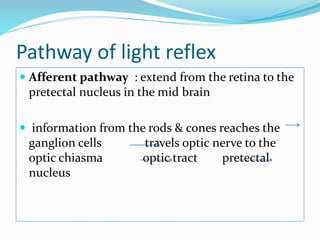
Pathway of light reflex
ď‚— Afferent pathway : extend from the retina to the
pretectal nucleus in the mid brain
ď‚— information from the rods & cones reaches the
ganglion cells travels optic nerve to the
optic chiasma optic tract pretectal
nucleus
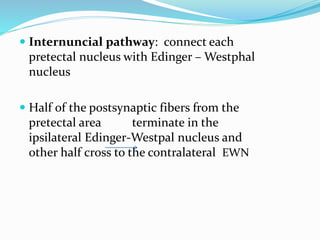
ď‚— Internuncial pathway: connect each
pretectal nucleus with Edinger – Westphal
nucleus
ď‚— Half of the postsynaptic fibers from the
pretectal area terminate in the
ipsilateral Edinger-Westpal nucleus and
other half cross to the contralateral EWN
ď‚—Efferent pathway :
EWN 3rd cranial nerve
(oculomotor) cilliary ganglion
innervate the sphincter pupillae
Near reflex pathway
ď‚— Near reflex is occur looking near object.
ď‚— consists of two components
1.convergence reflex
2. accomodation reflex
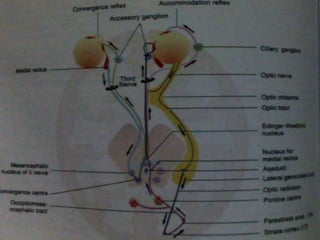
Pathway of convergence reflex
ď‚—Afferent path way : medial rectus
mesencephalic nucleus of the 5th nerve
convergence centre in the tectal or pretectal region
ď‚— Internuncial pathway : convergence centre
EWN
ď‚— Efferent pathway : EWN 3rd cranial nerve
(oculomotor) cilliary ganglion
innervate the sphincter pupillae
Pathway of accomodation reflex
ď‚— Afferent path way : extend from retina to
optic nerve optic chiasma optic tract
lateral geniculate body
optic radiation striate cortex
Parastriate cortex
ď‚— Internuncial pathway : parastriate cortex
EWN (via occipito-mesencephalic tract & pontine
centre)
ď‚— Efferent pathway : EWN 3rd cranial nerve
(oculomotor) cilliary ganglion
innervate the sphincter pupillae
Thank you

Pupil anatomy and physiology

  • 2.
    ď‚— The pupilis an aperture present in the centre of the iris. ď‚— Normall one pupil in each eye, more than one pupil this congenital anomaly is called polycoria ď‚— Located in slightly nasal of the iris
  • 3.
    ď‚— In normalroom light, a healthy human pupil has a diameter of about 3-4 mm ď‚— In bright light, the pupil has a diameter of about 1.5 mm ď‚— In dim light the diameter is enlarged to about 8 mm
  • 4.
    ď‚— The sizeof the pupil small at birth, largest during adolescence ,and smaller with increasing age ď‚— Tends to dilate during emotional stress and constrict during sleep ď‚— Isocoria : two pupil are equal in size
  • 5.
    ď‚— Functions ofpupil: 1. limit the amount of light reaching to the retina. 2. Contol the amount of chromatic abberation & spherical abberration in the retinal image
  • 6.
    ď‚— Colour: ď‚— Itappears greyish black ( deppending upon the condotion of the structure located behind it ď‚— Aphakia : jet black ď‚— Leukocoria: white coloured pupil
  • 7.
    Pupillary reflex ď‚— Thesize of the pupil is controlled by involuntary constriction and dilation of the iris in order to regulate the intensity of light entering the eye. This is known as the pupillary reflex. ď‚— Pupillary reflex divided in to two 1.light reflex 2.near reflex
  • 8.
    Light reflex ď‚— Directlight reflex : constriction of pupil to which light is shone ď‚— Consensual light reflex : constriction of other pupil when light is shone one eye ď‚— Light reflex is initiated by rods &cones
  • 9.
    Pathway of lightreflex ď‚— Afferent pathway : extend from the retina to the pretectal nucleus in the mid brain ď‚— information from the rods & cones reaches the ganglion cells travels optic nerve to the optic chiasma optic tract pretectal nucleus
  • 10.
     Internuncial pathway:connect each pretectal nucleus with Edinger – Westphal nucleus  Half of the postsynaptic fibers from the pretectal area terminate in the ipsilateral Edinger-Westpal nucleus and other half cross to the contralateral EWN
  • 11.
    ď‚—Efferent pathway : EWN3rd cranial nerve (oculomotor) cilliary ganglion innervate the sphincter pupillae
  • 12.
    Near reflex pathway ď‚—Near reflex is occur looking near object. ď‚— consists of two components 1.convergence reflex 2. accomodation reflex
  • 13.
    Pathway of convergencereflex ď‚—Afferent path way : medial rectus mesencephalic nucleus of the 5th nerve convergence centre in the tectal or pretectal region ď‚— Internuncial pathway : convergence centre EWN
  • 14.
    ď‚— Efferent pathway: EWN 3rd cranial nerve (oculomotor) cilliary ganglion innervate the sphincter pupillae
  • 15.
    Pathway of accomodationreflex ď‚— Afferent path way : extend from retina to optic nerve optic chiasma optic tract lateral geniculate body optic radiation striate cortex Parastriate cortex
  • 16.
    ď‚— Internuncial pathway: parastriate cortex EWN (via occipito-mesencephalic tract & pontine centre) ď‚— Efferent pathway : EWN 3rd cranial nerve (oculomotor) cilliary ganglion innervate the sphincter pupillae
  • 18.