4/8/2020
INTRAOCULAR PRESSURE
AND
TONOGRAPHY
MAAZ UL HAQ
C.L gupta eye institute
INTRA OCULAR PRESSURE
o Pressure exerted by intraocular contents on the coats of
the eyeball. Or fluid pressure of the aqueous humor inside
the eye
o Maintained by a dynamic equilibrium between theAH
formation,AH outflow, and episcleral venous pressure.
o Normal IOP = 10.5 to 20.5 mm Hg, however mean
pressure is 15.5±2.57 mm Hg
4/8/2020
FACTORS INFLUENCING THE INTRA-OCULAR
PRESSURE
A) Long term changes B) Short term changes
I. Heredity
II. Age
III. Sex
IV. Race
V. Refractive error
VI. Valsalva manoeuvre??
I. Systemic venous pressure
II. Mechanical pressure on the
globe
III. Diurnal variation
IV. Seasonal variation
V. Systemic hyperthermia
VI. Effects of general anesthesia
VII. Effects of drugs
VIII. Blockage of aqueous circulation
4/8/2020
Short term changes in the IOP
4/8/2020
I. SVP
II. Mechanical pressure on the globe from outside initially raises
the IOP by indentation but after some time due to aqueous
outflow IOP returns to normal and by prolonged pressure
decreases below the initial level
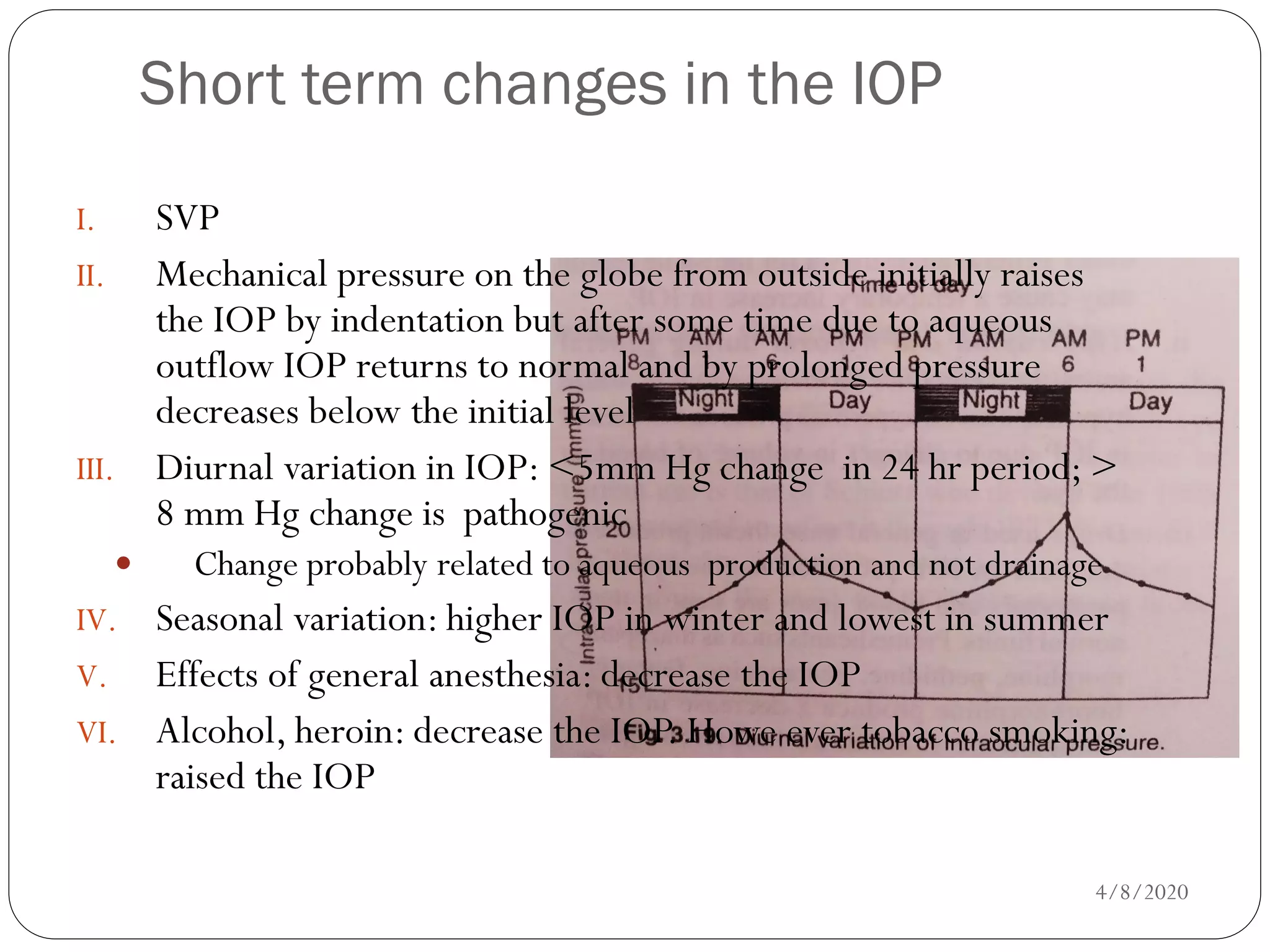
III. Diurnal variation in IOP: <5mm Hg change in 24 hr period; >
8 mm Hg change is pathogenic
 Change probably related to aqueous production and not drainage
IV. Seasonal variation: higher IOP in winter and lowest in summer
V. Effects of general anesthesia: decrease the IOP
VI. Alcohol, heroin: decrease the IOP. Howe ever tobacco smoking:
raised the IOP
4/8/2020
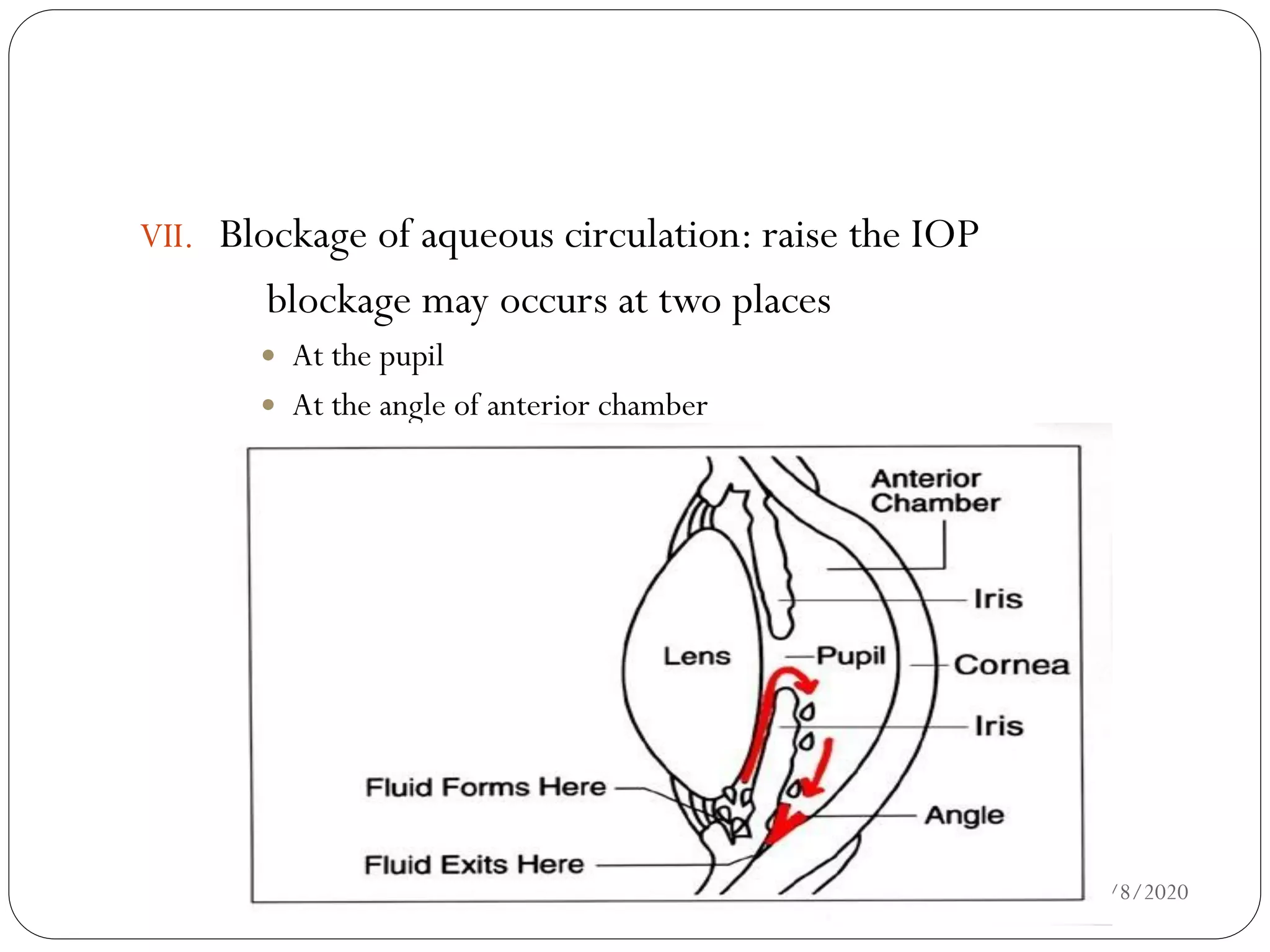
VII. Blockage of aqueous circulation: raise the IOP
blockage may occurs at two places
 At the pupil
 At the angle of anterior chamber
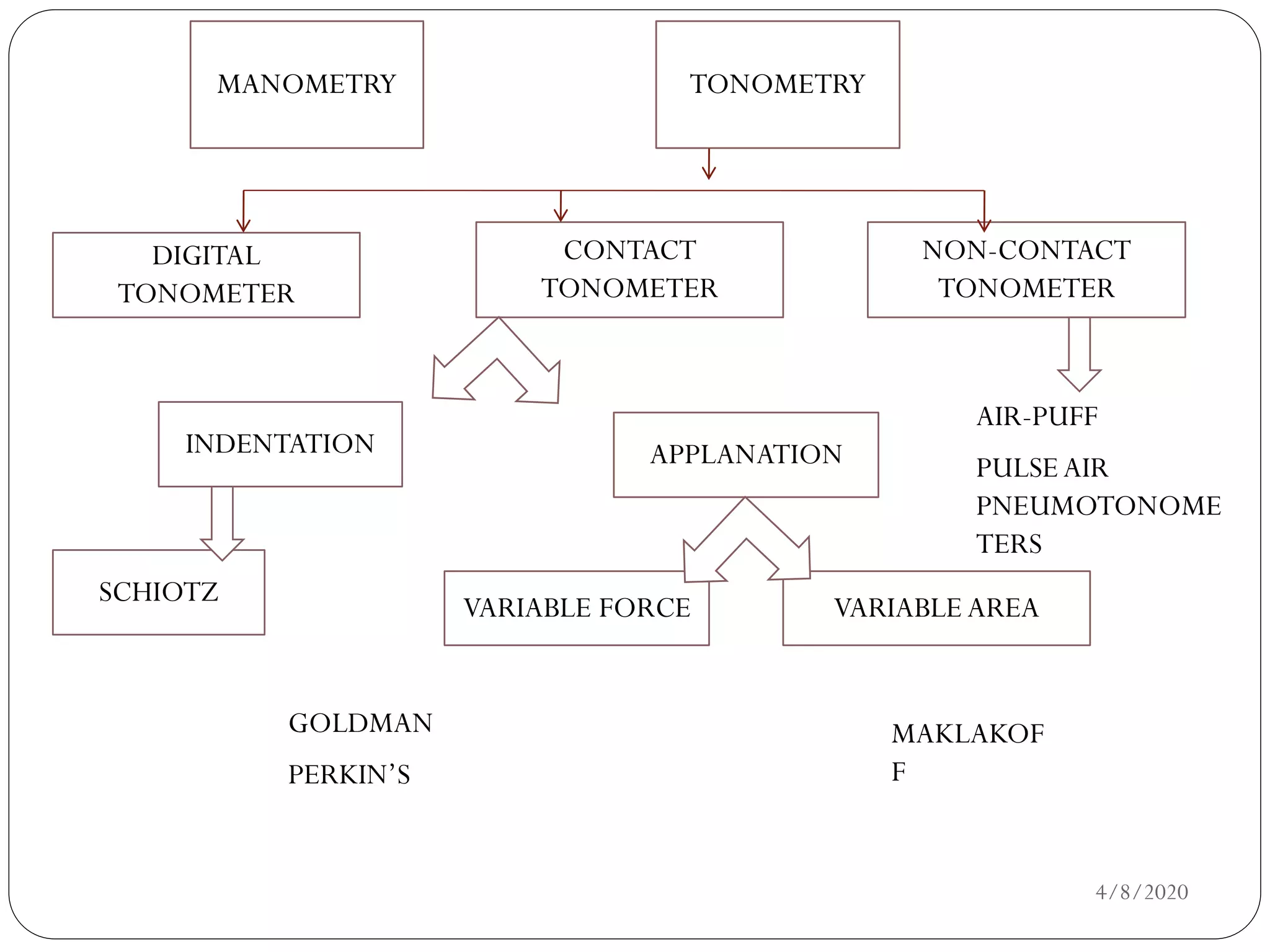
DIGITAL
TONOMETER
CONTACT
TONOMETER
NON-CONTACT
TONOMETER
INDENTATION APPLANATION
MANOMETRY TONOMETRY
SCHIOTZ
VARIABLE FORCE VARIABLE AREA
GOLDMAN
PERKIN’S
MAKLAKOF
F
AIR-PUFF
PULSEAIR
PNEUMOTONOME
TERS
4/8/2020
Manometry
4/8/2020
 It is the direct measure of IOP.
 Needle is induced either into the
anterior chamber or into the vitreous
which is then connected with a suitable
mercury or water monometer to measure
the IOP
Disadvantages:
 Not practical method for routine human
beings
 Needs general anesthesia which has its other effect on the IOP
TONOMETRY
 Tonometry is the procedure to measure the intraocular
pressure of an eye
 It is the most important technique in evaluation of
glaucoma patients
 The instrument used to measure the IOP isTONOMETER
METHODS OF TONOMETRY
 Indentation tonometry
 Applanation tonometry
INDENTATION TONOMETRY
 Indentation tonometry is based on the fact that a plunger
will indent a soft eye more than a hard eye
 Previously used tonometer was Schiotz tonometer which
was invented in 1905
SCHIOTZ TONOMETER
It consists of:
• Handle (finger rest) for holding the instrument in
vertical direction
• Footplate which rest on cornea
• Plunger which moves freely within a shaft in the
footplate
• Bent lever whose short arm rests on the upper end of
the plunger and a long arm which acts as a pointer
needle.The degree to which plunger indents the cornea
is indicated by the movement of this needle on a scale.
• Weight:A 5.5gm wt is permanently fixed to the plunger,
which can be increased to 7.5 and 10 gm.
Procedures
 After anaesthetising the cornea with paracaine, patient is made to
lie supine on couch and instructed to fix at a target on ceiling.
 Then the examiner separates the lids with left hand and gently
rest the footplate of the tonometer vertically on the center of the
cornea followed by the deflection of the needle, reading on the
scale is recorded as soon as possible as the needle becomes
steady.
Cont…
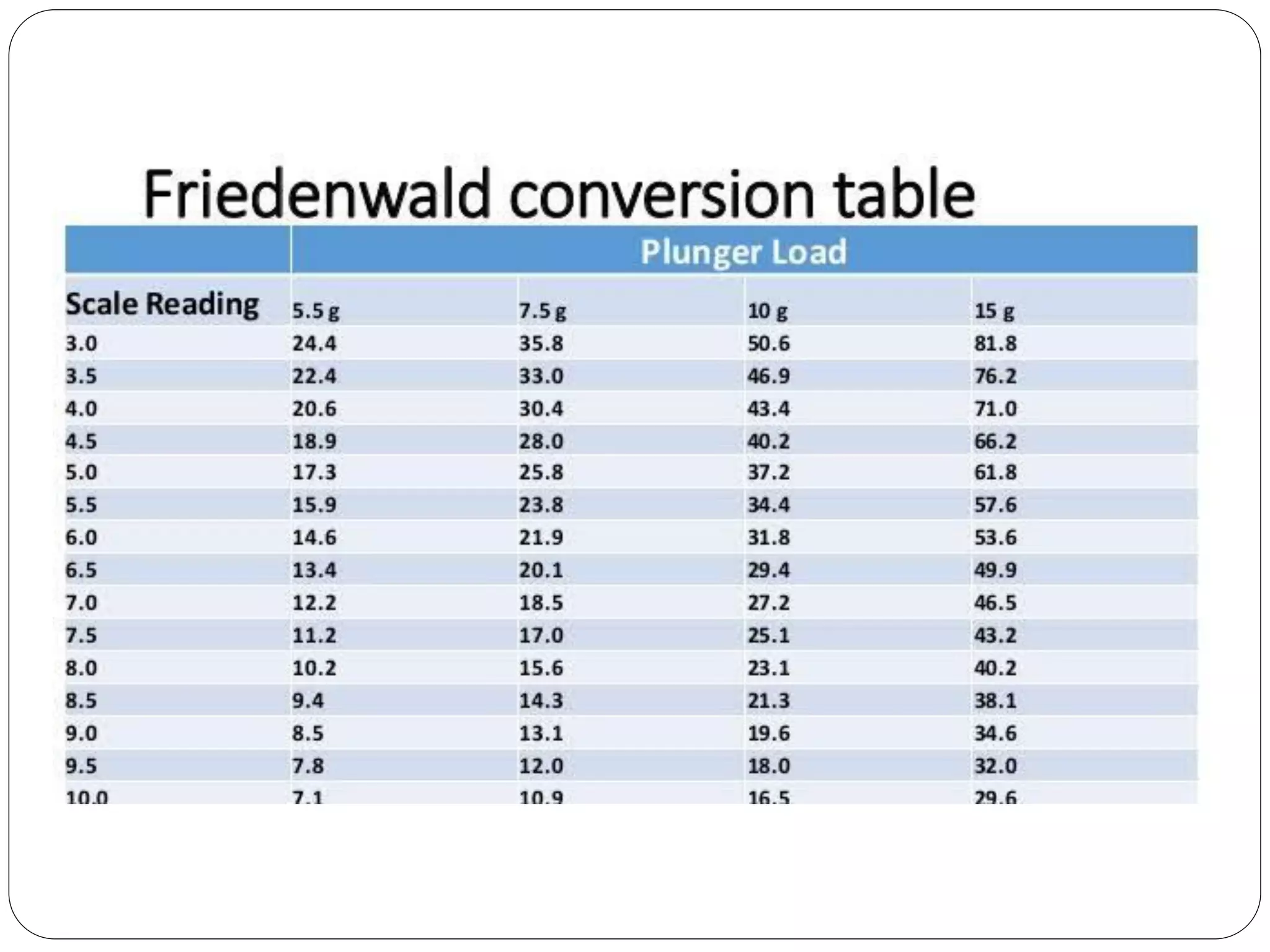
 If the scale reading is less than 3, additional weight should
be added to make it 7.5gm or 10gm and then IOP is
recorded from a conversion table.
 Advantage:it is cheap, handy and easy to use.
 Disadvantage:it gives a false reading when used in eyes with
abnormal scleral rigidity.
Applanation Tonometry
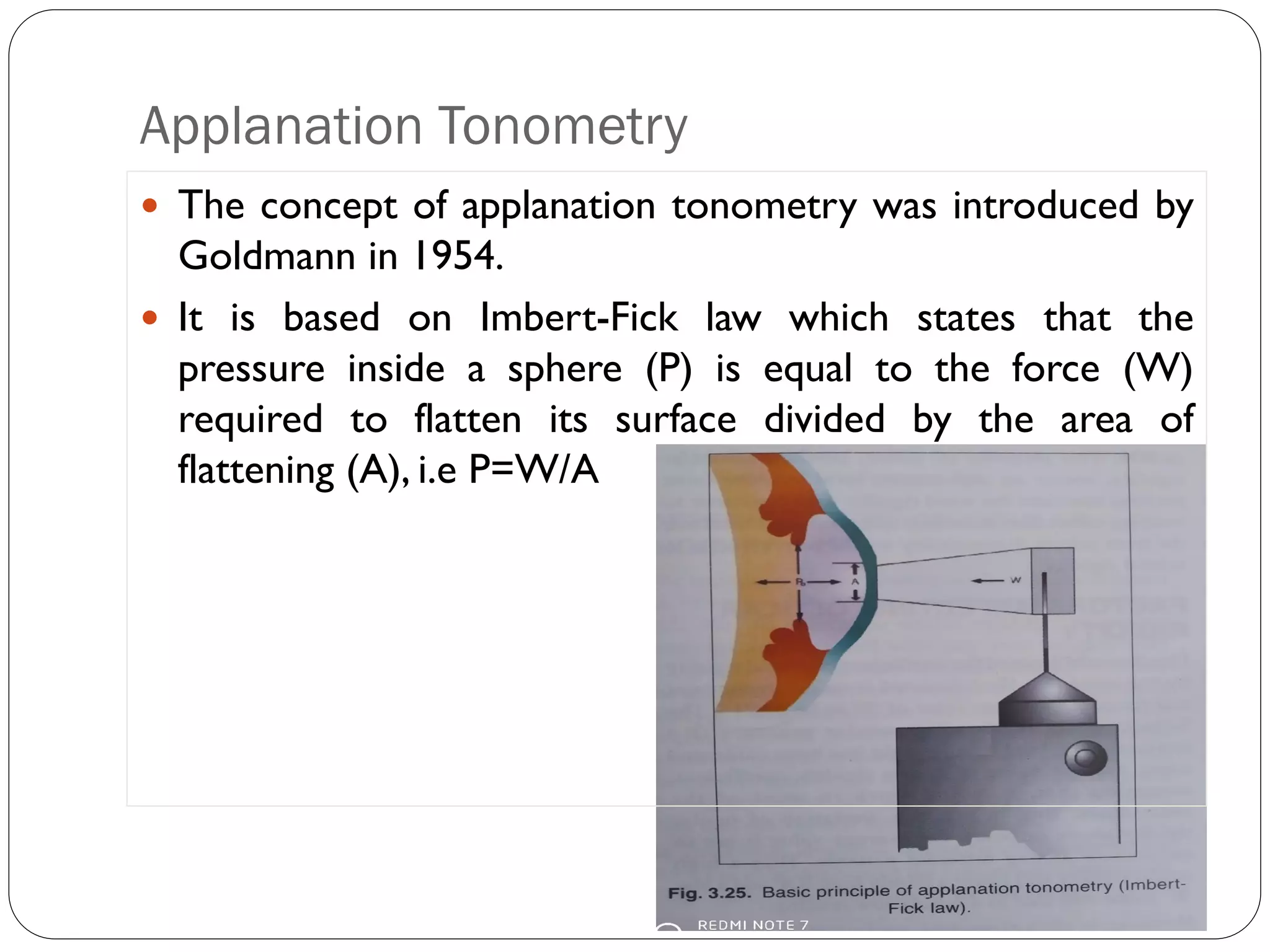
 The concept of applanation tonometry was introduced by
Goldmann in 1954.
 It is based on Imbert-Fick law which states that the
pressure inside a sphere (P) is equal to the force (W)
required to flatten its surface divided by the area of
flattening (A), i.e P=W/A
Commonly used tonometer are
 Goldmann tonometer
 Perkin’s tonometer
 Pneumatic tonometer
 Air Puff tonometer
 Tono-pen
Goldmann Tonometer
 It is the most popular and
accurate tonometer.
 It consists of a double prism
mounted on a standard slit
lamp.The prism applanates
the cornea in an area of 3.06
mm diameter.
Techniques
• After anaesthetising the cornea with paracaine and
staining the tear film with fluorescien patient is made to sit
in front of slit lamp.
• The cornea and biprism are illuminated with cobalt blue
light from slit lamp.
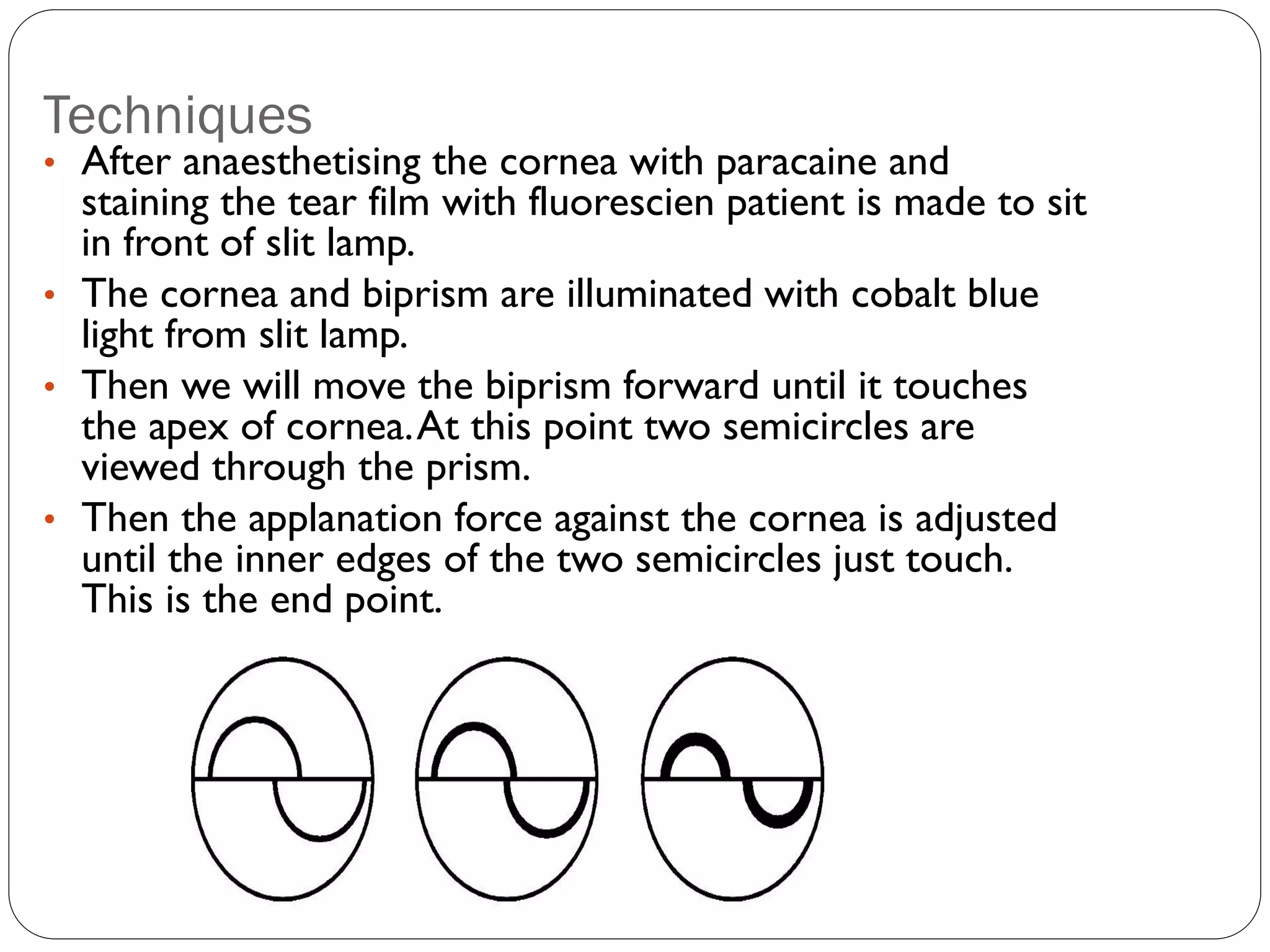
• Then we will move the biprism forward until it touches
the apex of cornea.At this point two semicircles are
viewed through the prism.
• Then the applanation force against the cornea is adjusted
until the inner edges of the two semicircles just touch.
This is the end point.
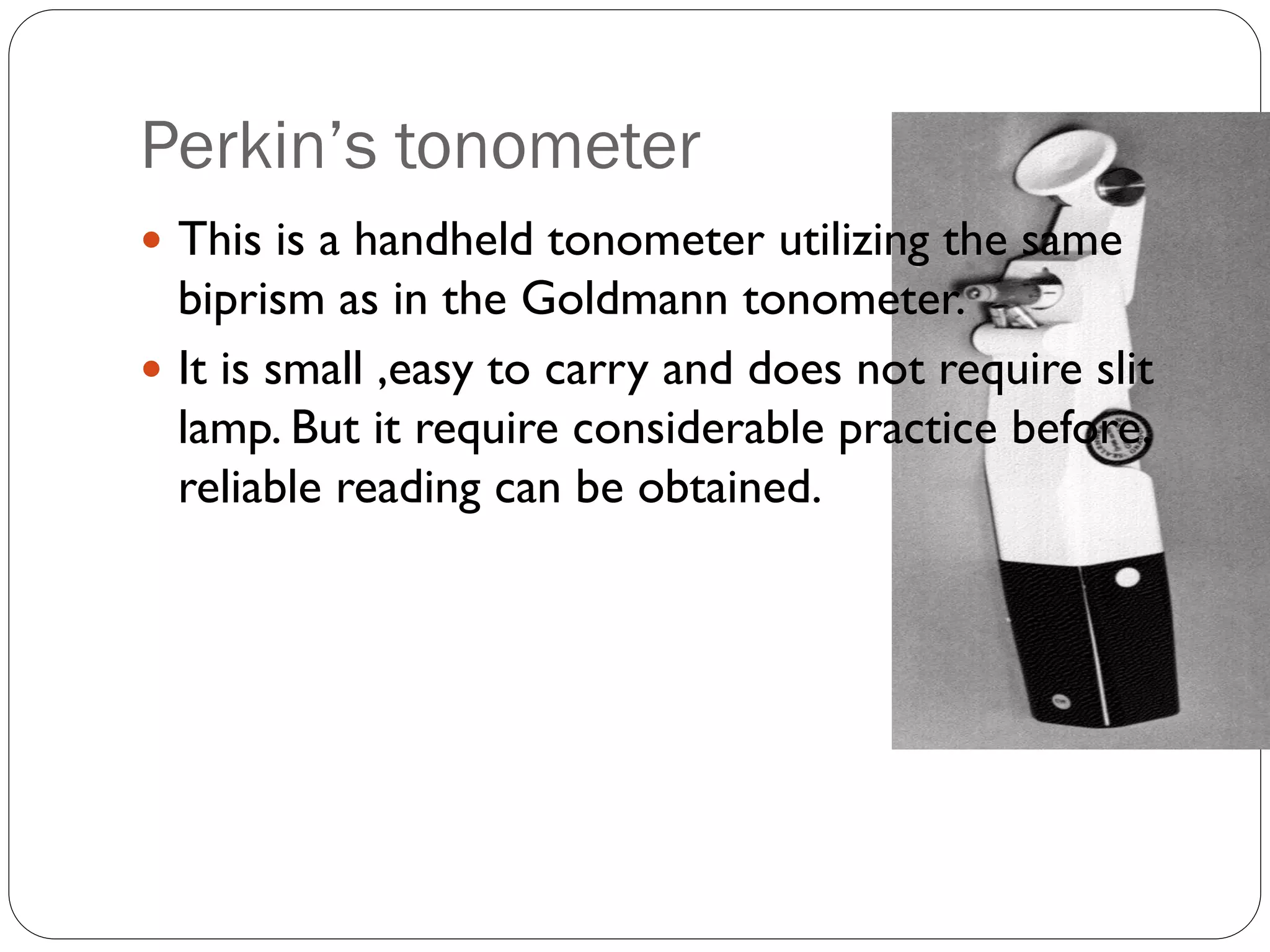
Perkin’s tonometer
 This is a handheld tonometer utilizing the same
biprism as in the Goldmann tonometer.
 It is small ,easy to carry and does not require slit
lamp. But it require considerable practice before,
reliable reading can be obtained.
Advantage
 It does not require slit lamp.
 It is useful in patient who can not cooperate on
slit lamp ex. Bedridden patient, small children.
 It is useful in Patients who has deep eyes where
Goldmann tonometer can not reach.
Air puff tonometer (Non contact tonometer)
 It is a non-contact tonometer
 It uses a rapid air pulse to applanate the cornea.
 It is useful for measuring IOP in children and other non-
compliant patient groups.
 It is accomplished without the instrument contacting the
cornea which reduce the potential for disease
transmission.
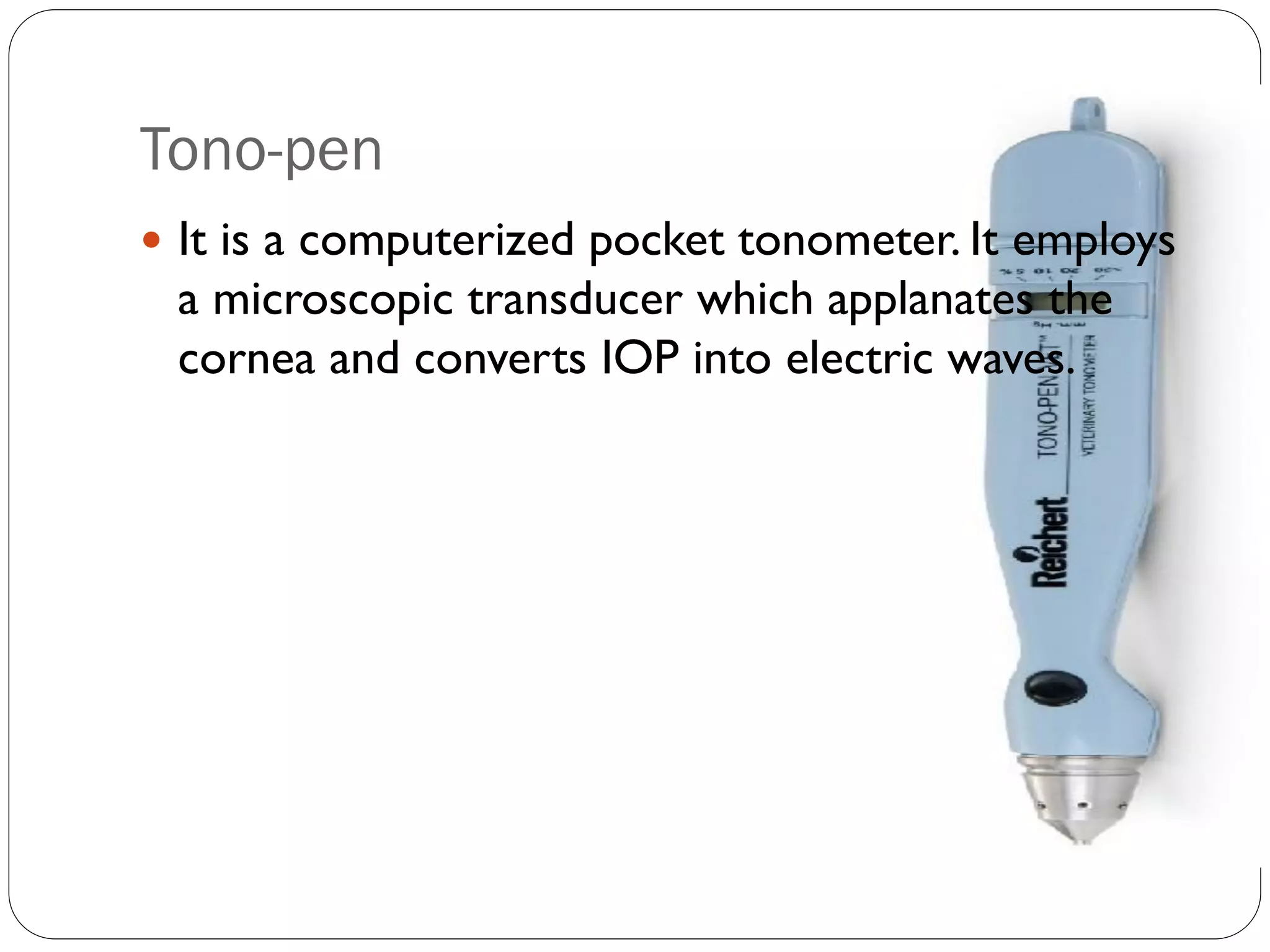
Tono-pen
 It is a computerized pocket tonometer. It employs
a microscopic transducer which applanates the
cornea and converts IOP into electric waves.
4/8/2020
4/8/2020

Iop

  • 1.
  • 2.
    INTRA OCULAR PRESSURE oPressure exerted by intraocular contents on the coats of the eyeball. Or fluid pressure of the aqueous humor inside the eye o Maintained by a dynamic equilibrium between theAH formation,AH outflow, and episcleral venous pressure. o Normal IOP = 10.5 to 20.5 mm Hg, however mean pressure is 15.5±2.57 mm Hg 4/8/2020
  • 3.
    FACTORS INFLUENCING THEINTRA-OCULAR PRESSURE A) Long term changes B) Short term changes I. Heredity II. Age III. Sex IV. Race V. Refractive error VI. Valsalva manoeuvre?? I. Systemic venous pressure II. Mechanical pressure on the globe III. Diurnal variation IV. Seasonal variation V. Systemic hyperthermia VI. Effects of general anesthesia VII. Effects of drugs VIII. Blockage of aqueous circulation 4/8/2020
  • 4.
    Short term changesin the IOP 4/8/2020 I. SVP II. Mechanical pressure on the globe from outside initially raises the IOP by indentation but after some time due to aqueous outflow IOP returns to normal and by prolonged pressure decreases below the initial level III. Diurnal variation in IOP: <5mm Hg change in 24 hr period; > 8 mm Hg change is pathogenic  Change probably related to aqueous production and not drainage IV. Seasonal variation: higher IOP in winter and lowest in summer V. Effects of general anesthesia: decrease the IOP VI. Alcohol, heroin: decrease the IOP. Howe ever tobacco smoking: raised the IOP
  • 5.
    4/8/2020 VII. Blockage ofaqueous circulation: raise the IOP blockage may occurs at two places  At the pupil  At the angle of anterior chamber
  • 6.
    DIGITAL TONOMETER CONTACT TONOMETER NON-CONTACT TONOMETER INDENTATION APPLANATION MANOMETRY TONOMETRY SCHIOTZ VARIABLEFORCE VARIABLE AREA GOLDMAN PERKIN’S MAKLAKOF F AIR-PUFF PULSEAIR PNEUMOTONOME TERS 4/8/2020
  • 7.
    Manometry 4/8/2020  It isthe direct measure of IOP.  Needle is induced either into the anterior chamber or into the vitreous which is then connected with a suitable mercury or water monometer to measure the IOP Disadvantages:  Not practical method for routine human beings  Needs general anesthesia which has its other effect on the IOP
  • 8.
    TONOMETRY  Tonometry isthe procedure to measure the intraocular pressure of an eye  It is the most important technique in evaluation of glaucoma patients  The instrument used to measure the IOP isTONOMETER
  • 9.
    METHODS OF TONOMETRY Indentation tonometry  Applanation tonometry
  • 10.
    INDENTATION TONOMETRY  Indentationtonometry is based on the fact that a plunger will indent a soft eye more than a hard eye  Previously used tonometer was Schiotz tonometer which was invented in 1905
  • 11.
    SCHIOTZ TONOMETER It consistsof: • Handle (finger rest) for holding the instrument in vertical direction • Footplate which rest on cornea • Plunger which moves freely within a shaft in the footplate • Bent lever whose short arm rests on the upper end of the plunger and a long arm which acts as a pointer needle.The degree to which plunger indents the cornea is indicated by the movement of this needle on a scale. • Weight:A 5.5gm wt is permanently fixed to the plunger, which can be increased to 7.5 and 10 gm.
  • 13.
    Procedures  After anaesthetisingthe cornea with paracaine, patient is made to lie supine on couch and instructed to fix at a target on ceiling.  Then the examiner separates the lids with left hand and gently rest the footplate of the tonometer vertically on the center of the cornea followed by the deflection of the needle, reading on the scale is recorded as soon as possible as the needle becomes steady.
  • 14.
    Cont…  If thescale reading is less than 3, additional weight should be added to make it 7.5gm or 10gm and then IOP is recorded from a conversion table.  Advantage:it is cheap, handy and easy to use.  Disadvantage:it gives a false reading when used in eyes with abnormal scleral rigidity.
  • 15.
    Applanation Tonometry  Theconcept of applanation tonometry was introduced by Goldmann in 1954.  It is based on Imbert-Fick law which states that the pressure inside a sphere (P) is equal to the force (W) required to flatten its surface divided by the area of flattening (A), i.e P=W/A
  • 16.
    Commonly used tonometerare  Goldmann tonometer  Perkin’s tonometer  Pneumatic tonometer  Air Puff tonometer  Tono-pen
  • 17.
    Goldmann Tonometer  Itis the most popular and accurate tonometer.  It consists of a double prism mounted on a standard slit lamp.The prism applanates the cornea in an area of 3.06 mm diameter.
  • 18.
    Techniques • After anaesthetisingthe cornea with paracaine and staining the tear film with fluorescien patient is made to sit in front of slit lamp. • The cornea and biprism are illuminated with cobalt blue light from slit lamp. • Then we will move the biprism forward until it touches the apex of cornea.At this point two semicircles are viewed through the prism. • Then the applanation force against the cornea is adjusted until the inner edges of the two semicircles just touch. This is the end point.
  • 19.
    Perkin’s tonometer  Thisis a handheld tonometer utilizing the same biprism as in the Goldmann tonometer.  It is small ,easy to carry and does not require slit lamp. But it require considerable practice before, reliable reading can be obtained.
  • 20.
    Advantage  It doesnot require slit lamp.  It is useful in patient who can not cooperate on slit lamp ex. Bedridden patient, small children.  It is useful in Patients who has deep eyes where Goldmann tonometer can not reach.
  • 21.
    Air puff tonometer(Non contact tonometer)  It is a non-contact tonometer  It uses a rapid air pulse to applanate the cornea.  It is useful for measuring IOP in children and other non- compliant patient groups.  It is accomplished without the instrument contacting the cornea which reduce the potential for disease transmission.
  • 23.
    Tono-pen  It isa computerized pocket tonometer. It employs a microscopic transducer which applanates the cornea and converts IOP into electric waves.
  • 24.
  • 25.