Pulp
The dental pulp is the soft connected tissue that supports the dentin.
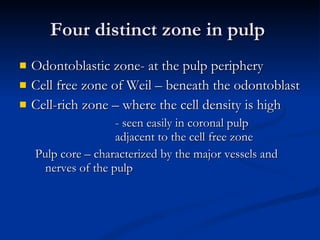
Four distinct zone in pulp  Odontoblastic zone- at the pulp periphery  Cell free zone of Weil – beneath the odontoblast Cell-rich zone – where the cell density is high  - seen easily in coronal pulp  adjacent to the cell free zone Pulp core – characterized by the major vessels and nerves of the pulp
 
Odontoblast  The most distinctive cell of the pulp and the most easily to recognized.  The number of odontoblast is estimated in a range of 59,000 to 76,000 per square millimeters in coronal dentin
 
 
The cervical loop area: (1) dental follicle cells, (2) dental mesenchyme, (3) Odontoblasts, (4) Dentin, (5) stellate reticulum, (6) outer enamel epithelium, (7)inner enamel epithelium, (8) ameloblasts, (9) enamel.
Fibroblast The cells occuring in greatest number in the pulp Particularly numerous in coronal portion of the pulp, wherethey form the cell rich zone.  The function of fibroblast is to form and maintain the pulp matrix, which consist of collagen and ground substance. Appear as flattened spindle-shaped cell with dense nuclei.
 
Undifferentiated ectomesenchymal cells  Represents the pool from which connective tissue cell of the pulp are derived. This cell are found throughout the cell-rich area and the pulp core and often are related to blood vessels  Appear as large polyhedral cell possessing a large, lightly stained centrally placed nucleus.
 
Macrophages  Tend to be located in the pulp center. Appear as a large oval or spindled shaped cells. Pulp macrophages are involved in the eliminations of dead cells
 
Lymphocytes  In normal pulps, T lymphocytes are found, but B lymphocytes are scarce.
Dendritic cells Are found in and around the odontoblast layer in nonerupted teeth and in erupted teeth beneath the odontoblast layer. Same function as Langerhans’ cells found in epithelium
 
Matrix and ground substance The extracellular compartment of the pulp or matrix, consist of collagen fibers and ground substance. The fibers are principally type I and type III collagen. In young pulps, single fibrils of collagen are found scattered between the pulp cell.
Innervation of dentin-pulp complex The dental pulp is innervated richly. Nerves enter the pulp through the apical foramen, along with the afferent blood vessels, and together with the neurovascular bundles.
 
Dentin sensitivity On of the unusual features of the pulp-dentin complex is the sensitivity.  The extreme sensitivity of this complex is difficult to explain, because this characteristics provides apparent evolutionary benefit.
Pulp stones Pulp stone, or denticles, frequently found in pulp tissue They are discrete calcified masses calcium-phosphorus rations comparable to that of dentin. May contain tubules and may be surrounded by cells resembling odontoblast.


Pulp

  • 1.
  • 2.
    The dental pulpis the soft connected tissue that supports the dentin.
  • 3.
    Four distinct zonein pulp Odontoblastic zone- at the pulp periphery Cell free zone of Weil – beneath the odontoblast Cell-rich zone – where the cell density is high - seen easily in coronal pulp adjacent to the cell free zone Pulp core – characterized by the major vessels and nerves of the pulp
  • 4.
  • 5.
    Odontoblast Themost distinctive cell of the pulp and the most easily to recognized. The number of odontoblast is estimated in a range of 59,000 to 76,000 per square millimeters in coronal dentin
  • 6.
  • 7.
  • 8.
    The cervical looparea: (1) dental follicle cells, (2) dental mesenchyme, (3) Odontoblasts, (4) Dentin, (5) stellate reticulum, (6) outer enamel epithelium, (7)inner enamel epithelium, (8) ameloblasts, (9) enamel.
  • 9.
    Fibroblast The cellsoccuring in greatest number in the pulp Particularly numerous in coronal portion of the pulp, wherethey form the cell rich zone. The function of fibroblast is to form and maintain the pulp matrix, which consist of collagen and ground substance. Appear as flattened spindle-shaped cell with dense nuclei.
  • 10.
  • 11.
    Undifferentiated ectomesenchymal cells Represents the pool from which connective tissue cell of the pulp are derived. This cell are found throughout the cell-rich area and the pulp core and often are related to blood vessels Appear as large polyhedral cell possessing a large, lightly stained centrally placed nucleus.
  • 12.
  • 13.
    Macrophages Tendto be located in the pulp center. Appear as a large oval or spindled shaped cells. Pulp macrophages are involved in the eliminations of dead cells
  • 14.
  • 15.
    Lymphocytes Innormal pulps, T lymphocytes are found, but B lymphocytes are scarce.
  • 16.
    Dendritic cells Arefound in and around the odontoblast layer in nonerupted teeth and in erupted teeth beneath the odontoblast layer. Same function as Langerhans’ cells found in epithelium
  • 17.
  • 18.
    Matrix and groundsubstance The extracellular compartment of the pulp or matrix, consist of collagen fibers and ground substance. The fibers are principally type I and type III collagen. In young pulps, single fibrils of collagen are found scattered between the pulp cell.
  • 19.
    Innervation of dentin-pulpcomplex The dental pulp is innervated richly. Nerves enter the pulp through the apical foramen, along with the afferent blood vessels, and together with the neurovascular bundles.
  • 20.
  • 21.
    Dentin sensitivity Onof the unusual features of the pulp-dentin complex is the sensitivity. The extreme sensitivity of this complex is difficult to explain, because this characteristics provides apparent evolutionary benefit.
  • 22.
    Pulp stones Pulpstone, or denticles, frequently found in pulp tissue They are discrete calcified masses calcium-phosphorus rations comparable to that of dentin. May contain tubules and may be surrounded by cells resembling odontoblast.
  • 23.
  • 24.