PR ESENTED BY
JigyashaTimsina
BDS 2nd year
AGING
 Definition : Refers to irreversible and inevitable
change that occurs with time
 It is also defined as sum of all morphological and
functional alteration in an organism that leads to
functional impairement
BIOLOGICAL AGING PROCESS IS :
 Universal : detectable in all members of the
species
 Progressive: develop gradually and
irreversibly
 Deleterious : harmful to the survival of
individual
AGING AND THE HARD
TISSUES
ENAMEL DENTIN
CEMENTUM
ALVEOLAR
BONE
DENTAL
HARD
TISSUES
ENAMEL CHANGES
 Attrition
 Change in permeability
 Discoloration
 Chemical and surface
changes
ATTRITION
 Physiological wear of occlusal or incisal and
proximal surfaces of teeth resulting in a
decrease in vertical dimension
 In severe attrition dentin may be exposed
CHANGE IN PERMEABILITY
 Young enamel acts as a semi-permeable
membrane and permits slow passage of water
and molecular substances through the pores
between the crystals.
 With age the enamel crystals grow in size and
the pores between them is obliterated
resulting in reduced permeability of the
enamel.
DISCOLORATION
 Normal: white to
yellowish white.
 With age darkening seen.
 Thought to be because of:
I. Loss of enamel rods-
this loss alters the light
reflection of enamel
and results tooth color
change.
II. Deepening of dentin
color seen through
progressively thinning
layer of enamel.
CHEMICAL AND SURFACE CHANGES
 Increase in fluoride and nitrogen content.
 Water and organic content decrease with age.
 Reduction in organic content reduces chance
of caries in teeth with age.
 Loss of Perikymata
DENTIN
The main changes in dentin associated
with aging are
 Increase in sclerotic dentin.
 Increase in the number of dead
tracts.
 Increase in formation of reparative
and reactive dentin.
 Vitality of dentin
DEAD TRACTS
 In normal dentin the odontoblastic
processes may disintegrate and the
empty tubules get filled with air. These
are called dead tracts.
 They appear black in transmitted light
and white in reflected light.
 In narrow pulpal horns degeneration of
odontoblast seen due to crowding of
odontoblasts.
 thought to be the initial step in the
formation of sclerotic dentin.
Dead tract
SCLEROTIC
DENTINTRANSPARENT DENTIN
 Refers to the dentinal tubules that have
become occluded with calcified materials.
 It may be result of the aging process and
called physiologic dentin sclerosis or may
occur due to some irritation like caries,
attrition, abrasion and called reactive dentin
sclerosis
 When this occurs in several tubules in the
same area , the dentin assumes a glassy
appearance and become transparent
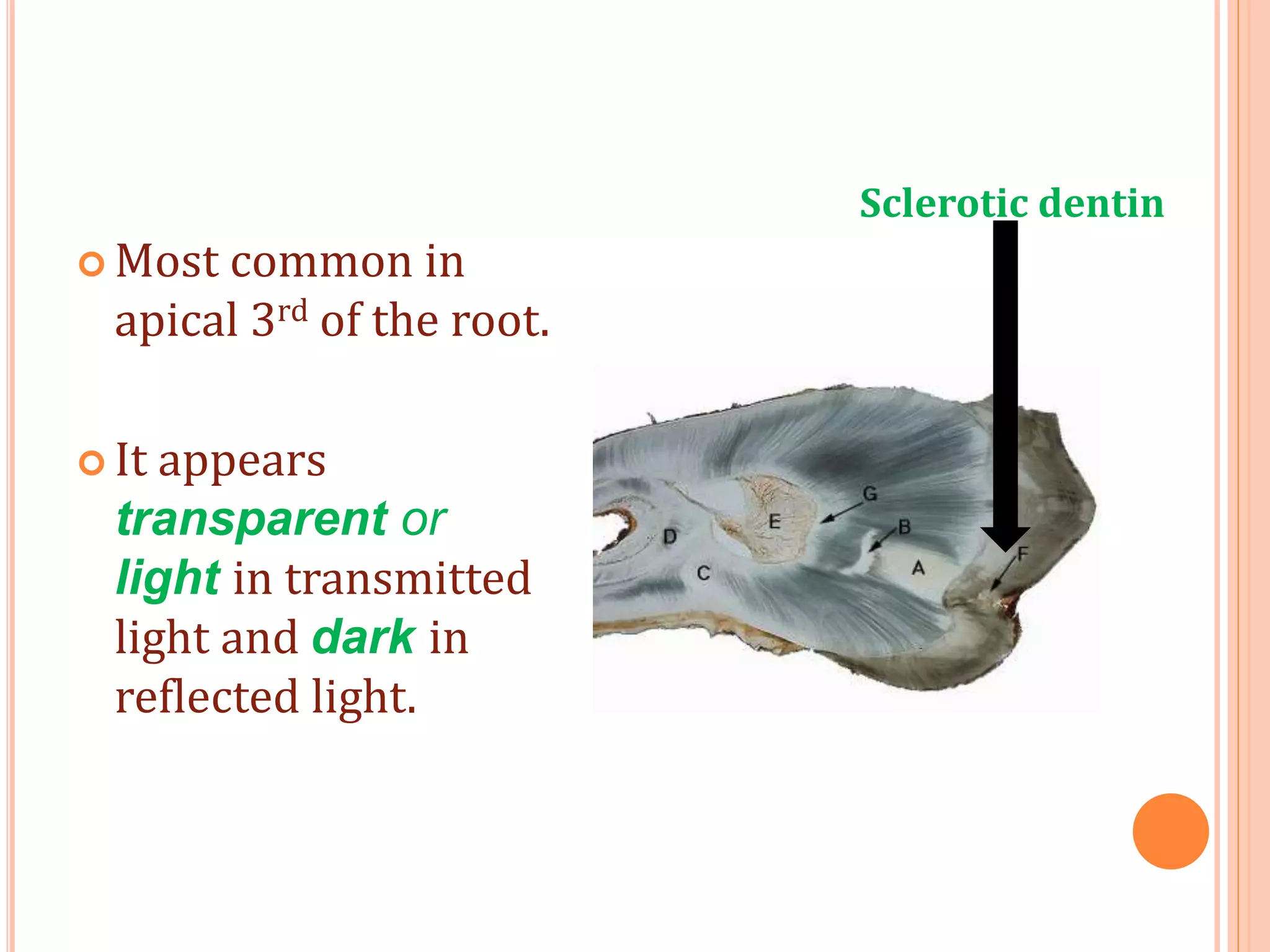
 Most common in
apical 3rd of the root.
 It appears
transparent or
light in transmitted
light and dark in
reflected light.
Sclerotic dentin
REPARATIVE –REACTIVE DENTIN
 If the provoking stimulus cause destruction
of the original odontoblasts, the new, less
tubular dentin formed by newly
differentiated odontoblast like cells is called
Reparative dentin.
 However if the odontoblast survive the
provoking stimuli the dentin produced by
them is called Reactionary dentin
Reparative dentin
Reactive dentin
VITALITY OF DENTIN
 Since the odontoblasts do not degenerate
normally, dentin is laid down throughout life.
 Although after the teeth have erupted and
become functional dentinogenesis slows and
further dentin formation is at much slower
rate
CEMENTUM
 Hypercementosis .
 Cementicles.
 Change in permeability.
 Cementum re-absorption and
repair
HYPERCEMENTOSIS
 It is an abnormal thickening of the cementum.
 may be generalized or localized ,diffused or
limited.
 Hypercementosis is termed cementum
hypertrophy if the overgrowth improves the
functional qualities of the cementum and is
termed cementum hyperplasia if it is not
correlated with increased function.
FIG :
A
FIG : B
CEMENTICLES
 They are ovoid or round
calcified structure that are
formed as a result of
calcification of the
degenerated periodontal
tissue or the epithelial
rests of Malssez.
 Cementicles may be:
1. Free in the periodontal
ligament.
2. Attached the cementum
3. Embedded in the
cementum FC-free
cementicle
SC-sessile
cementicle
 Permeability : The permeability of cementum
decreases gradually by age.
The permeability from the periodontal side is lost except in
the most recently formed layer of cementum, while that
from the dentine side remains only in the apical region.
 Cementum Resorption and Repair: Cementum
resorption can occur after trauma or excessive occlusal
forces .
After resorption ceases, the damage is usually repaired.
If the repair establishes the former outline of the root
surface it is called anatomic repair. However if only a thin
layer of cementum is deposited and the root outline is not
constructed it is called functional repair.
ALVEOLAR BONE
 Bone resorption is
the major age
change in alveolar
bone.
 Common site of
resorption- labial
aspect of alveolar
crest.
Bone
reabsorption
Decrease in
height and width
of the jaw
Distance between
the crest of the
alveolar bone and
cemento-enamel
junction increase
Alveolar sockets
appear jagged
and uneven
OTHER CHANGES
 The marrow space have fatty infiltration.
 Loss of maxillary bone is accompanied by
increase in size of maxillary sinus.
 Internal trabecular arrangement is more open
which indicate bone loss.
REFERENCES
 Orban’s oral histology and embryology
 Ten Cate’s oral histology
 Oral anatomy ,histology and embryology
Berkovitz , Holland , Moxham
 age change in dental hard tissue

age change in dental hard tissue

  • 1.
  • 2.
    AGING  Definition :Refers to irreversible and inevitable change that occurs with time  It is also defined as sum of all morphological and functional alteration in an organism that leads to functional impairement
  • 3.
    BIOLOGICAL AGING PROCESSIS :  Universal : detectable in all members of the species  Progressive: develop gradually and irreversibly  Deleterious : harmful to the survival of individual
  • 4.
    AGING AND THEHARD TISSUES
  • 5.
  • 6.
    ENAMEL CHANGES  Attrition Change in permeability  Discoloration  Chemical and surface changes
  • 7.
    ATTRITION  Physiological wearof occlusal or incisal and proximal surfaces of teeth resulting in a decrease in vertical dimension  In severe attrition dentin may be exposed
  • 9.
    CHANGE IN PERMEABILITY Young enamel acts as a semi-permeable membrane and permits slow passage of water and molecular substances through the pores between the crystals.  With age the enamel crystals grow in size and the pores between them is obliterated resulting in reduced permeability of the enamel.
  • 10.
    DISCOLORATION  Normal: whiteto yellowish white.  With age darkening seen.  Thought to be because of: I. Loss of enamel rods- this loss alters the light reflection of enamel and results tooth color change. II. Deepening of dentin color seen through progressively thinning layer of enamel.
  • 11.
    CHEMICAL AND SURFACECHANGES  Increase in fluoride and nitrogen content.  Water and organic content decrease with age.  Reduction in organic content reduces chance of caries in teeth with age.  Loss of Perikymata
  • 12.
    DENTIN The main changesin dentin associated with aging are  Increase in sclerotic dentin.  Increase in the number of dead tracts.  Increase in formation of reparative and reactive dentin.  Vitality of dentin
  • 13.
    DEAD TRACTS  Innormal dentin the odontoblastic processes may disintegrate and the empty tubules get filled with air. These are called dead tracts.  They appear black in transmitted light and white in reflected light.  In narrow pulpal horns degeneration of odontoblast seen due to crowding of odontoblasts.  thought to be the initial step in the formation of sclerotic dentin. Dead tract
  • 14.
    SCLEROTIC DENTINTRANSPARENT DENTIN  Refersto the dentinal tubules that have become occluded with calcified materials.  It may be result of the aging process and called physiologic dentin sclerosis or may occur due to some irritation like caries, attrition, abrasion and called reactive dentin sclerosis  When this occurs in several tubules in the same area , the dentin assumes a glassy appearance and become transparent
  • 15.
     Most commonin apical 3rd of the root.  It appears transparent or light in transmitted light and dark in reflected light. Sclerotic dentin
  • 16.
    REPARATIVE –REACTIVE DENTIN If the provoking stimulus cause destruction of the original odontoblasts, the new, less tubular dentin formed by newly differentiated odontoblast like cells is called Reparative dentin.  However if the odontoblast survive the provoking stimuli the dentin produced by them is called Reactionary dentin
  • 17.
  • 18.
    VITALITY OF DENTIN Since the odontoblasts do not degenerate normally, dentin is laid down throughout life.  Although after the teeth have erupted and become functional dentinogenesis slows and further dentin formation is at much slower rate
  • 19.
    CEMENTUM  Hypercementosis . Cementicles.  Change in permeability.  Cementum re-absorption and repair
  • 20.
    HYPERCEMENTOSIS  It isan abnormal thickening of the cementum.  may be generalized or localized ,diffused or limited.  Hypercementosis is termed cementum hypertrophy if the overgrowth improves the functional qualities of the cementum and is termed cementum hyperplasia if it is not correlated with increased function.
  • 21.
  • 22.
    CEMENTICLES  They areovoid or round calcified structure that are formed as a result of calcification of the degenerated periodontal tissue or the epithelial rests of Malssez.  Cementicles may be: 1. Free in the periodontal ligament. 2. Attached the cementum 3. Embedded in the cementum FC-free cementicle SC-sessile cementicle
  • 23.
     Permeability :The permeability of cementum decreases gradually by age. The permeability from the periodontal side is lost except in the most recently formed layer of cementum, while that from the dentine side remains only in the apical region.  Cementum Resorption and Repair: Cementum resorption can occur after trauma or excessive occlusal forces . After resorption ceases, the damage is usually repaired. If the repair establishes the former outline of the root surface it is called anatomic repair. However if only a thin layer of cementum is deposited and the root outline is not constructed it is called functional repair.
  • 24.
    ALVEOLAR BONE  Boneresorption is the major age change in alveolar bone.  Common site of resorption- labial aspect of alveolar crest.
  • 25.
    Bone reabsorption Decrease in height andwidth of the jaw Distance between the crest of the alveolar bone and cemento-enamel junction increase Alveolar sockets appear jagged and uneven
  • 26.
    OTHER CHANGES  Themarrow space have fatty infiltration.  Loss of maxillary bone is accompanied by increase in size of maxillary sinus.  Internal trabecular arrangement is more open which indicate bone loss.
  • 27.
    REFERENCES  Orban’s oralhistology and embryology  Ten Cate’s oral histology  Oral anatomy ,histology and embryology Berkovitz , Holland , Moxham