PULP
CONTENT:
• DEFINITION
• ORIGIN OF PULP
• DEVELOPMENT
• GENERAL FEATURES
• STRUCTURAL FEATURES
• HISTOLOGICAL ZONES OF PULP
• CELLS OF PULP
• EXTRACELLULAR MATRIX
• NERVES
• FUNCTIONS OF DENTAL PULP
• AGE CHANGES
• CLINICAL CONSIDERATION
DEFINITION
Dental pulp ,only soft tissue occupies
the center of each tooth and consists
of soft connective tissue enclosed by
dentin.
orban’s oral histology and embryology,12edition
The dental pulp is a delicate connective
tissue liberally interpersed with tiny
blood vessels , lymphatic , nerves ,and
undifferentiated connective tissue cells.
Shafer’s textbook of oral pathology ,7 edition
The dental pulp is the soft connective
tissue that supports the dentin.
Oral histology development ,structure,and function
Richard ten cate ,5 edition
Origin of the pulp
Central polyhedral cells and
Peripheral columnar cells
↓undergo
Mitosis
↓increase activity
Neural crest cells migrate
↓
Condense around
Ectomesenchymal cells
↓
Condensed area adjacent to
enamel organ called
dental papilla
Dental papilla is primordium of the pulp
DEVELOPEMENT
Development of dental pulp begins
at↓
8th week (embryonic life)
↓
undifferentiated mesenchymal cells
↓ differentiated
stellate shaped fibroblasts
↓
Enamel organ peripheral cells
↓ ↓
Ameloblasts odontoblasts
↓during the process
Dental papilla is called pulp organ
GENERAL FEATURES:
•Coronal pulp
•Radicular pulp
•Apical foramen
•Accessory canal
CORONAL PULP
Number of pulpal horns
↓depends
cuspal number
•Coronal and radicular pulp joins at cervical region
RADICULAR PULP
Radicular pulp
•Extends from cervical
region of crown to
root apex.
•Matured the root ,
narrower the radicular
pulp
APICAL FORAMEN (funnel shaped)
Location and shape of apical foramen undergo changes
as a result of funtional influences on the teeth
•Average size of apical foramen
maxillary teeth 0.4mm
mandibular teeth 0.3mm
•As the root develops,apical foramen becomes narrower
ACCESSORY CANALS
•Occurs where there is premature loss of root sheath cells
•Occurs where developing root encounters a blood vessel
•With increase in age number of canal decreases due to calcification
of their contained soft tissues..
STRUCTURAL FEATURES
HISTOLOGICAL ZONES OF PULP
Zones-from outer to inner zone Description
Odontoblastic layer Lines the outer pulpal wall and consists of
the cell bodies of odontoblast. Secondary
dentin may form in this area from the
apposition of odontoblast.
Cell-free zone(weil’s zone) Fewer cells than odontoblastic layer.
Nerve and capillary plexus are located
here
Cell-rich zone Increased density of cells as compared to
cell-free zone and also a more extensive
vascular system
Pulpal-core Located in the center of the pulp
chamber, which has many cells and an
extensive vascular supply, similar to cell-
rich zone
Cells of pulp:
•Odontoblasts
•Fibroblasts
•Undifferentiated cells
•Defence cells
•An odontoblast is a biological cell of neural crest origin
that is part of the outer surface of the dental pulp, and
whose biological function is dentinogenesis.
•Survive for as long as the tooth is vital.
•Odontoblasts cannot divide but subodontoblasts can
Polarized columnar cells with processes extending
within a tubule
•In root region, cells are more cuboidal.
•They are about 5 to 7 µm in diameter and 25 to 40 µm in
length.
ODONTOBLATS:
Odontoblastic cell layer has:
• A membrane-like properties
• Acts as a barrier to protect the dental pulp from outside
irritants
• A limited permeability due to:
1.Desmosomes
2.Tight junctions
3.Gap junctions
4.Undergo apoptotic cell death
by apoptotic cell markers like
BCL2.
FUNCTIONS OF ODONTOBLASTS:
•Synthesis of organic matrix
•Synthesis of non collagenous substances like
sialoprotein , phosphophoryn , osteonectin
and osteoprontin
•Intracellular accumulation of calcium
•Degradation of organic matrix
•Stellate shaped cells with star-like extensions.
•Most numerous type of cells in pulp.
•Linked by adherense type junctions & gap junctions.
•These cells are active in pulpal collagen production.
•In older pulps they are rounded or spindle shaped
with short processes termed fibrocytes.
FIBROBLASTS:
•They have a dual function with pathways for both
synthesis and degradation in the same cell.
•Play a role in inflammation and healing by secreting
angiogenic factors like FGF-2 and VEGF.
•In cell cultures they form mineralized tissue like
bone on stimulation
Functions:
• Production of fibers & ground substance and
participate in their degradation
• May produce bone-like mineralized tissue as a response
to pulpal injury
• Production of GFs and cytokines
Undifferentiated cells:
•Primitive mesenchymal cells.
•Appear larger than fibroblasts and are
polyhedral in shape.
•They are believed to be totipotent and can
differentiate into odontoblasts, fibroblasts or
macrophages.
•Found along the pulp vessels in cell rich zone.
Defense cells:
•T-lymphocytes
In small amounts
Increase in pulpal injuries
•Macrophages & antigen-presenting cells
Around blood vessels
Around the odontoblastic layer
•Mast cells and plasma cells are also seen.
•Dendritic cells:
Found in contact with the cell membranes of endothelial cells.
Express macrophage related antigens like CD14 and CD68.
They present the antigen to the T-cells.
They have an important role to play in immunosurveillance.
EXTRACELLULAR MATRIX
•Connective tissue fibers
•Collagen
•Elastin
•Fibronectin
•Ground substance
•Proteoglycans
•Glycosaminoglycans
•Basement membrane
Collagen fibres
•Extra cellular structural protein,major constituent of
connective tissue
•Collagen fibers appear throughout the pulp
young fine fibers ranging in diameter from 10-12mm.
•Pulp collagen fibers do not contribute to dentin matrix
production.
•After root completion pulp matures and bundles of
collagen fibers increase in number
•They scattered throughout the coronal or radicular
pulp,or they appear in bundles.These are termed
diffuse or bundle collagen
•Most prevalent in root canals,especially near
apical region.
•Type I:
Present as thick striated fibrils
Responsible for pulp architecture
•Type III:
Thinner fibrils,mainly distributed in
cell free and cell rich zones
Contributes to the elasticity of pulp
•Type IV:
Present along the basement membrane of blood
vessels
•Type V and VI:
Seen to form dense meshwork of thin microfibrils
through out the stroma
ELASTIC FIBER
1. This has the ability to expand and contract like a rubber band
2. Elastic fibers are first formed in bundles of thin micro filaments called
Oxytalan fibers
3. Elastin is then deposited in between oxytalan fibers.
4. Always associated with larger blood vessels
FIBRONECTIN
1.It plays a role in cell-cell & cell-matrix adhesion
2.Has a major effect on the proliferation,differentiation & organization of
cells. Seen around the blood vessels
3. Also found in odontoblast layer with fibers passing into predentin
GROUND SUBSTANCE
• It is a structureless mass,makes up the bulk of the pulp
• Consists of complexes of proteins,carbohydrate and water.
• Broadly classified as
Glycoaminoglycans
Proteoglycans
GLYCOSAMINOGLYCANS
•GAG found in pulp is mainly chondroitin sulphate,dermatan sulphate &
hyaluronic acid
•Proteoglycans occupy larger area and they provide protection against
compression.
•During dentinogenesis,the ground substance show affinity for collagen
and influence fibrinogenesis
•They have capacity to bind with calcium and help in
mineralisation
BASEMENT MEMBRANE
• It is a sheet like arrangement of extra cellular protein matrix at the
epithelial-mesenchymal interface
• Basement membrane is a product of connective tissue and epithelium
• It is composed of
Collagen type IV
Laminin-adhesive glycoprotein
Fibronectin
Heparin sulfate
• Collagen IV provides binding sites for the rest of basement membrane
components
• Laminin binds to both cells of connective tissue and epithelium
• In mature pulp,basement membrane forms interface along endothelial
cells & schwann cells
Nerves
•Dental pulp is highly innervated
•Two types of nerve fibers
25% are myelinated afferents
90% of which are narrow Aδ fibers
10% are wider Aβ fibers
Unmyelinated C fibers
Found in close association with blood vessels
Many are sympathetic in nature
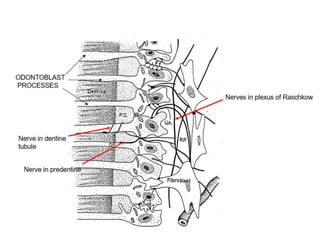
Some nerve endings terminate on or in association with the odontoblasts and
others in the predentinal tubules of the crown.
In the cell-free zone plexus of Raschkow can be seen.
The peripheral axons form a network of nerves located adjacent to
cell rich zone.
This is termed the parietal layer of nerves , also known as the plexus
of Rashkow
Functions of the Dental Pulp
Nutrition: blood supply for dentin.
Sensory: changes in temperature, vibration and chemical that affect the dentin
and pulp.
Formative: the pulp involve in the support, maintenance and continued
formation of dentin.
Defensive: triggering of inflammatory and immune response.
Protective: Development and formation of secondary and tertiary dentin which
increase the coverage of the pulp.
AGE CHANGES
•Cell changes
•Fibrosis
•Vascular changes
•Pulp stones
•Diffuse calcifications
Cell Changes
• Appearance of fewer cells in aging pulp
• Cells are characterized by a decrease in size and no of cytoplasmic
organelles
• Active pulpal fibrocyte (or) fibroblast has abundant rough-surfaced
endoplasmic reticulum notable golgi complex, numerous mitochondria
•Fibroblast exhibit less perinuclear cytoplasm, long thin cytoplasmic
processes
FIBROSIS
•Accumulation of both:
Diffuse fibrillar components
Bundles of collagen fibres
• Fiber bundles may appear arranged longitudinally in the radicular pulp
and more diffuse in coronal pulp
• Collagen accumulation also occurs in some older pulps
• Increase in fibers in the pulp organ is gradual and generalized
VASCULAR CHANGES
• Atherosclerotic plaques may appear in pulpal vessels.
• Calcifications are found that surround vessels.
• Calcification is found most often in the region near the apical foramen.
Pulp Stones(denticles)
• Appearing in either or both coronal and root portions of the pulp organ
• Develop in teeth that appear to be normal in other respects
• Asymptomatic unless they impinge on nerves (or)blood vessels
• Seen in functional as well as embedded unerupted teeth.
Classification
1. True denticles
2. False denticles
3. Diffuse calcifications
True denticles
• True denticles are similar in structure to dentin
• They have dental tubules and contain processes of the odontoblasts
• Usually located close to the apical foramen
•Development of true denticles is caused by the inclusion of remnants
of the epithelial root sheath with in the pulp
• Epithelial remnants induce the cells of pulp to differentiate into
odontoblasts then form the dentin mass.
H&E section of true denticle
False denticles
• They do not exhibit dentinal tubules
• They appear as concentric layers of calcified tissue
• Some cases these calcification sites appear within a bundle of
collagen fibers.
• Some cases they appear in pulp free of collagen accumulations
• Some cases arises around vessels
• Center of these concentric layers of calcified tissues there may be
remnants of necrotic and calcified cells
• Calcification of thrombi in blood vessels called phleholiths, may also
serve as nidi for false denticles
• An denticles begin as small nodules but increase in size by
incremental growth
• Classified as free, attached (or) embedded depending on their
relation to the dentin
a) Free denticle – entirely surrounded by pulp tissue
b) Attached denticle – Partly fused with the dentin
c) Embedded denticles – Entirely surrounded by dentin
• Incidence as well as the size of pulp stones increase with age.
False calcification seen along the
walls of the blood vessel
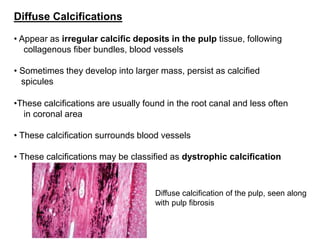
Diffuse Calcifications
• Appear as irregular calcific deposits in the pulp tissue, following
collagenous fiber bundles, blood vessels
• Sometimes they develop into larger mass, persist as calcified
spicules
•These calcifications are usually found in the root canal and less often
in coronal area
• These calcification surrounds blood vessels
• These calcifications may be classified as dystrophic calcification
Diffuse calcification of the pulp, seen along
with pulp fibrosis
CLINICAL CONSIDERATIONS
1. Anatomic considerations
2. Factors to be considered during endodontic treatment.
3. Effect of Operative Procedures
4. Effect of dental materials on pulp
5. Effects subsequent to restoration
OPERATIVE PROCEDURES
Anatomic considerations
1) Shape of the pulp chamber and its extensions into the cusps pulpal
horns is important.
2) Wide pulp chamber into tooth of young person will make a deep
cavity preparation hazardous
3) The pulpal horns project high into the cusps exposure of pulp can
occur
4) If opening a pulp chamber for treatment its size and variation in
shape must be taken into consideration
FACTORS TO BE CONSIDERED DURING ENTODONTIC TREATMENT
5) Age advance , the pulp chamber becomes smaller difficult to locate
the root canals.
6) Shape of the apical foramen and its location may play an important
part in treatment of root canals.
7) Accessory canals, and multiple canals are rarely seen in
roentgenograms
FACTORS TO BE CONSIDERED DURING OPERATIVE PROCEDURES
8) The pulp is highly responsive to stimuli, even slight stimulus cause
inflammatory cell infiltration.
9) Dehydration causes pulpal damage operative procedures
producing this condition should be avoided.
CONTENT
•INTRODUCTION
•DEFINITION
•PHYSICAL CHARACTERISTICS
•CHEMICAL COMPOSITION
•CLASSIFICATION OF CEMENTUM
•CEMENTOGENESIS
•MINERALIZATION
•CEMENTUM ASSOCIATED CELLS
•CEMENTOENAMEL JUNCTION
•CEMENTODENTINAL JUNCTION
•FUNCTION OF CEMENTUM
•DEVELOPMENTAL ANOMALIES OF CEMENTUM
• Cementum is a mineralized connective tissue that covers
the roots of the teeth.
• Derived from Latin “caementum”, quarry stone.
• Component of tooth as well as periodontium.
• Provides anchorage for collagen fibre bundles of
periodontal ligament.
• Therefore, root surface area covered by it represents the
ground available for connective tissue attachment.
INTRODUCTION
DEFINITION
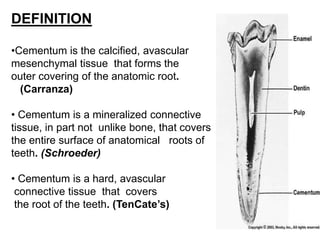
•Cementum is the calcified, avascular
mesenchymal tissue that forms the
outer covering of the anatomic root.
(Carranza)
• Cementum is a mineralized connective
tissue, in part not unlike bone, that covers
the entire surface of anatomical roots of
teeth. (Schroeder)
• Cementum is a hard, avascular
connective tissue that covers
the root of the teeth. (TenCate’s)
PHYSICAL CHARACTERISTICS
•Hardness < Dentin.
•Light yellow in color and lacks luster.
• Lighter in color than dentin, however it may not be
distinguished on
basis of color alone.
•Permeability of cellular cementum is greater than that of
acellular
cementum. With age, the permeability of cementum decreases.
•Thinnest at CEMENTOENAMEL JUNCTION (20-50 um)
•Thickest towards the APEX (150-200 um)
COMPOSITION
•Dry weight basis:
45-50% inorganic substances which consists of calcium and phosphate in the
form of hydroxyapetite crystals.
50-55% organic material and water.
•Organic matrix of cementum consists of :
Type I collagen ( 90%)
Type III collagen ( 5% )
Non collagenous proteins.
•By volume:
45% inorganic
35% organic
20% water
•Two main sources of collagen fibers
1.Sharpeys fibers ( Extrinsic) are the embedded portion of the
principal fibers of periodontal ligament and formed by
fibroblasts.
2.Fibers that belong to the cementum matrix ( intrinsic) and
produced by cementoblast.
•Due to its lower crystallinity of mineral component :
–has the highest Flouride content
–Readily decalcifies in the presence of acidic conditions.
Non collagenous
• Non- collagenous proteins- play important role in matrix deposition,
initiation and control of mineralization and matrix remodelling.
Include: Bone sialoprotein, osteopontin,tenascin, fibronectin, osteocalcin .
•Proteoglycans- Chondroitin sulphate,hyaluronate, heparan sulfate,
biglycan and osteoadherin.
Growth factors- TGFß, bone morphogenetic proteins (BMP’s),Platelet
derived growth factors, Osteoprotegerin (OPG).
Cementum derived growth factor seen exclusively in cementum.
is an insulin like molecule.
Enhance proliferation of gingival fibroblasts and periodontal ligament cells.
Cementum can be classified based on following criteria
1.Based on location on teeth
• Coronal cementum
• Radicular cementum
2.Based on cellularity
• Acellular cementum (primary)
• Cellular cementum (secondary)
CLASSIFICATION
3.Based on presence or absence of collagen fibrils in organic matrix
• Fibrillar cementum
• Afibrillar cementum
4.On the basis of location, structure, function, rate of
formation, biochemical composition and degree of
mineralization cementum can be classified as:-
• Acellular Afibrillar Cementum. (AAC )
• Acellular Extrinsic Fiber Cementum. (AEFC)
• Cellular Mixed Stratified Cementum. (CMSC)
• Cellular Intrinsic Fiber Cementum. (CIFC)
• Intermediate cementum.
Acellular Afibrillar Cementum (AAC)
•FIBERS -ABSENT
•CELLS- ABSENT
•FORMED BY-CEMENTOBLASTS
•LOCATION- CORONAL CEMENTUM
•THICKNESS- 1-15μm
Acellular Extrinsic Fiber Cementum (AEFC)
•FIBERS- DENSELY PACKED BUNDLES OF SHARPEY’S FIBRES
•CELLS-ABSENT
•FORMED BY –FIBROBLASTS & CEMENTOBLASTS
•LOCATION -CERVICAL THIRD OF ROOT
•THICKNESS - 30-230μm
Cellular Intrinsic Fiber Cementum (CIFC)
•FIBERS - INTRINSIC FIBRES
•CELLS - PRESENT
•FORMED BY - CEMENTOBLASTS
•LOCATION - RESORPTION LACUNAE
Cellular Mixed Stratified Cementum (CMSC)
•FIBERS- EXTRINSIC SHARPEY’S & INTRINSIC FIBRES
•CELLS - PRESENT
•FORMED BY - FIBROBLASTS & CEMENTOBLASTS
•LOCATION - APICAL 1/3rd OF ROOT & FURCATION
•THICKNESS - 100 -1000μm
INTERMEDIATE CEMENTUM
•CELLS - CELLULAR REMNANTS OF HERTWIGS SHEATH
•LOCATION – CEMENTODENTINAL JUNCTION
•THICKNESS - 10μm
RADICULAR CEMENTUM
• Derivative of dental follicle, covers the entire dentin of the root from CEJ
to the apex
• It extends partially into apical foramen to line the apical walls of the root
canal
CORONAL CEMENTUM
• In humans it is restricted to areas of reduced enamel epithelium
ACELLULAR CEMENTUM
• First formed cementum
• Covers cervial third or half of the root
• Contains sharpey’s fibers and intrinsic fibers but no cells
• Formed before tooth reaches occlusal plane
• Thickness-30-230micrometers
CELLULAR CEMENTUM
• Formed after tooth reaches occlusal plane
• More irregular
• Contains cementocytes in lacunae communicating with each other through
anastomosing canaliculi
• Sharpey’s fibers occupy smaller portion. Intrinsic fibers are more in
proportion.
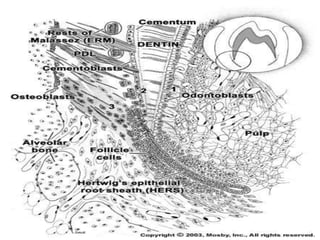
CEMENTOGENESIS
•Formation of cementum is known as cementogenesis
•Cementum formation takes place along the entire root.
•At the advancing root edge, HERTWIG’S EPITHELIAL
ROOT SHEATH (HERS), which is derived from the
extension of inner and outer enamel epithelium releases
enamel proteins.
•HERS possibly sends inductive message to the
ectomesenchymal cells of pulp.
•These ectomesenchymal cells of pulp
now differentiate into odontoblasts and
produce a layer of predentin along the
inner aspect of HERS.
•Once dentin formation is underway,
breaks occur in HERS.
•Therefore the inner layer of dental
follicle comes in contact with
predentin.
•Cells of the dental follicle now
differentiate into CEMENTOBLASTS
which are the main cells responsible
for cementum formation.
MINERALIZATION
•Mineralization begins in the depth of precementum.
•Fine hydroxyapatite crystals are deposited, first between and then within the collagen
fibrils by a process that is identical to the mineralization of bone tissue.
•Zander & Hurzeler examined the thickness of cementum on extracted human teeth
from individuals of varying ages & concluded that the mean,linear rate of cementum
deposition on single-rooted teeth is about 3 pm per year, (but varying greatly with
tooth type, root surface area, and type of cementum being formed).
•A similar rate has been found for acellular extrinsic fiber cementum in premolars and
in nonfunctioning, impacted teeth
•The width of the precementum layer is about 3-5 um.
•Process of establishing the appropriate condition for crystallization & growth of the
individual crystals in cementum normally are extremely slow and extend over a period
of several months
The development of cementum has been subdivided into:
1.Pre-functional stage
2.Functional stage
1.Prefunctional portion of the cementum is formed during root
development & is extremely long lasting process.
2.The functional development of cementum, commences when the
tooth is about to reach the occlusal level & is associated with the attachment
of root to the surrounding bone & continues throughout life. It is mainly
during this stage that adaptive & reparative processes are carried out by the
biological responsiveness of cementum.
CELLS OF THE CEMENTUM
• CEMENTOBLASTS
•CEMENTOCYTES
•CEMENTOCLASTS
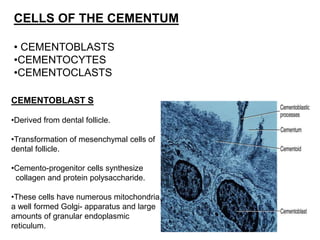
CEMENTOBLAST S
•Derived from dental follicle.
•Transformation of mesenchymal cells of
dental follicle.
•Cemento-progenitor cells synthesize
collagen and protein polysaccharide.
•These cells have numerous mitochondria,
a well formed Golgi- apparatus and large
amounts of granular endoplasmic
reticulum.
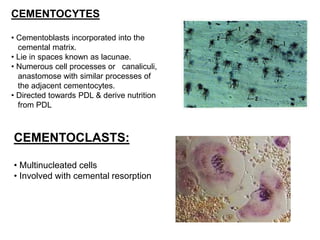
CEMENTOCYTES
• Cementoblasts incorporated into the
cemental matrix.
• Lie in spaces known as lacunae.
• Numerous cell processes or canaliculi,
anastomose with similar processes of
the adjacent cementocytes.
• Directed towards PDL & derive nutrition
from PDL
CEMENTOCLASTS:
• Multinucleated cells
• Involved with cemental resorption
CEMENTOIDS
• Unmineralized layer of cementum
on cemental
surface(precementum)
• New layer forms as old calcifies
• 3 to 5 micrometer
• Lined by cementoblasts
• Connective tissue fibers from PDL
pass between the cementoblasts
• Embedded portion- Sharpeys
fibers
CEMENTO ENAMEL JUNCTION
The junction between the cementum and enamel at the cervical region of
the tooth is termed Cemento-Enamel junction
FOUR TYPES OF RELATION EXISTS
•In about 60% cases cementum overlaps the cervical end of enamel.
•In approx. 30% of all teeth cementum meets the cervical end of
enamel.
•In 10% cases enamel and cementum do not meet which can cause
accentuated sensitivity because of exposed dentin.
•In about 1.6% of cases enamel overlaps cementum.
•Gap Junction: enamel epithelium in the cervical portion of the root is delayed in its
separation from dentin
•Overlap Junction: when connective tissue cells, probably Cementoblasts, come
in contact with enamel they produce a laminated, electron-dense, reticular material
termed afibrillar cementum
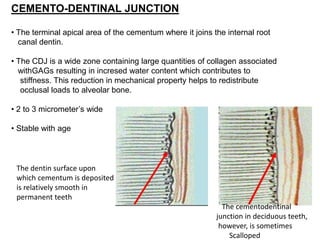
CEMENTO-DENTINAL JUNCTION
• The terminal apical area of the cementum where it joins the internal root
canal dentin.
• The CDJ is a wide zone containing large quantities of collagen associated
withGAGs resulting in incresed water content which contributes to
stiffness. This reduction in mechanical property helps to redistribute
occlusal loads to alveolar bone.
• 2 to 3 micrometer’s wide
• Stable with age
The dentin surface upon
which cementum is deposited
is relatively smooth in
permanent teeth
The cementodentinal
junction in deciduous teeth,
however, is sometimes
Scalloped
INCREMENTAL LINES
• Called lines of salter seen during the process of cementogenesis.
• The period of rests are associated with these lines
• These lines are closer in acellular cementum as this is formed slowly
• Whereas in cellular cementum, theses lines are widely spaced
because of increased rate of formation.
FUNCTIONS
•ANCHORAGE
•ADAPTATION
•REPAIR and RESORPTION
ANCHORAGE
•To furnish a medium for the attachment of collagen fibers that bind the tooth to
alveolar bone.
•Connective tissue attachment to the tooth impossible without cementum.
•EXAMPLE- in hypophosphatasia, loosening and premature loss of anterior
deciduous teeth occurs. The exfoliated teeth are characterized by an almost total
absence of cementum
ADAPTATION
•Continuous deposition of cementum is of functional importance.
–Cementum is not resorbed under normal conditions.
–As the most superficial layer of cementum ages, a new layer is
deposited that keeps the attachment apparatus intact.
REPAIR
•Serves as a major reparative tissue for root surfaces.
•Damage to roots such as fractures and resorptions can be repaired
by the deposition of new cementum.
DEVELOPMENTAL ANOMALIES ASSOCIATED WITH
CEMENTOGENISIS
Cemental Hyperplasia or Hypercementosis –
Refers to abnormal thickening of cementum.
It is largely an age related phenomenon
It can be –
Localized to one tooth
Generalized- affect the entire dentition.
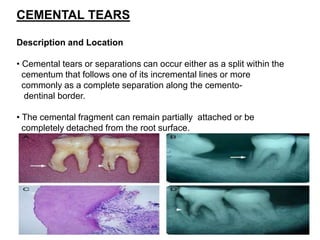
CEMENTAL TEARS
Description and Location
• Cemental tears or separations can occur either as a split within the
cementum that follows one of its incremental lines or more
commonly as a complete separation along the cemento-
dentinal border.
• The cemental fragment can remain partially attached or be
completely detached from the root surface.
ANKYLOSIS
• Fusion of cementum and alveolar bone with obliterated PDL
• Occurs in teeth with cemental resorption
• After periodontal inflammation, tooth replantation, occlusaltrauma.
• Results in resorption of root and its gradual replacement by bone.
• Lack physiological mobility, metallic percussion
• No proprioception because pressure receptors in periodontal
ligament are deleted or not function correctly.
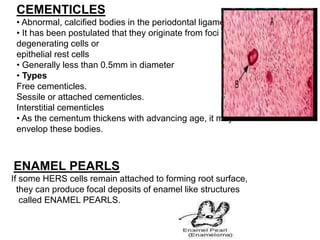
CEMENTICLES
• Abnormal, calcified bodies in the periodontal ligament
• It has been postulated that they originate from foci of
degenerating cells or
epithelial rest cells
• Generally less than 0.5mm in diameter
• Types
Free cementicles.
Sessile or attached cementicles.
Interstitial cementicles
• As the cementum thickens with advancing age, it may
envelop these bodies.
ENAMEL PEARLS
If some HERS cells remain attached to forming root surface,
they can produce focal deposits of enamel like structures
called ENAMEL PEARLS.
Cementum forms a functional unit which is designed to maintain tooth
support, integrity, and protection.
Minor, non-pathological resorption defects on the root surface are generally
reversible and heal by reparative cementum formation.
Irreversible damage may occur when the cementum is exposed to the
environment of a pocket or oral cavity.
CONCUSION
THE PRESEVATION OF A HEALTHY PULP DURING OPERATIVE
PROCEDURES AND SUCCESSFUL MANAGEMENT IN CASES OF
DISEASES ARE TWO OF MOST IMPORTANT CHALLENGE TO THE
CLINICAL DENTIST.
 Pulp and cementum

Pulp and cementum

  • 2.
  • 3.
    CONTENT: • DEFINITION • ORIGINOF PULP • DEVELOPMENT • GENERAL FEATURES • STRUCTURAL FEATURES • HISTOLOGICAL ZONES OF PULP • CELLS OF PULP • EXTRACELLULAR MATRIX • NERVES • FUNCTIONS OF DENTAL PULP • AGE CHANGES • CLINICAL CONSIDERATION
  • 4.
    DEFINITION Dental pulp ,onlysoft tissue occupies the center of each tooth and consists of soft connective tissue enclosed by dentin. orban’s oral histology and embryology,12edition The dental pulp is a delicate connective tissue liberally interpersed with tiny blood vessels , lymphatic , nerves ,and undifferentiated connective tissue cells. Shafer’s textbook of oral pathology ,7 edition The dental pulp is the soft connective tissue that supports the dentin. Oral histology development ,structure,and function Richard ten cate ,5 edition
  • 5.
    Origin of thepulp Central polyhedral cells and Peripheral columnar cells ↓undergo Mitosis ↓increase activity Neural crest cells migrate ↓ Condense around Ectomesenchymal cells ↓ Condensed area adjacent to enamel organ called dental papilla
  • 6.
    Dental papilla isprimordium of the pulp
  • 7.
    DEVELOPEMENT Development of dentalpulp begins at↓ 8th week (embryonic life) ↓ undifferentiated mesenchymal cells ↓ differentiated stellate shaped fibroblasts ↓ Enamel organ peripheral cells ↓ ↓ Ameloblasts odontoblasts ↓during the process Dental papilla is called pulp organ
  • 8.
    GENERAL FEATURES: •Coronal pulp •Radicularpulp •Apical foramen •Accessory canal
  • 9.
    CORONAL PULP Number ofpulpal horns ↓depends cuspal number •Coronal and radicular pulp joins at cervical region
  • 10.
    RADICULAR PULP Radicular pulp •Extendsfrom cervical region of crown to root apex. •Matured the root , narrower the radicular pulp
  • 11.
    APICAL FORAMEN (funnelshaped) Location and shape of apical foramen undergo changes as a result of funtional influences on the teeth
  • 12.
    •Average size ofapical foramen maxillary teeth 0.4mm mandibular teeth 0.3mm •As the root develops,apical foramen becomes narrower
  • 13.
    ACCESSORY CANALS •Occurs wherethere is premature loss of root sheath cells •Occurs where developing root encounters a blood vessel •With increase in age number of canal decreases due to calcification of their contained soft tissues..
  • 14.
  • 15.
    HISTOLOGICAL ZONES OFPULP Zones-from outer to inner zone Description Odontoblastic layer Lines the outer pulpal wall and consists of the cell bodies of odontoblast. Secondary dentin may form in this area from the apposition of odontoblast. Cell-free zone(weil’s zone) Fewer cells than odontoblastic layer. Nerve and capillary plexus are located here Cell-rich zone Increased density of cells as compared to cell-free zone and also a more extensive vascular system Pulpal-core Located in the center of the pulp chamber, which has many cells and an extensive vascular supply, similar to cell- rich zone
  • 17.
  • 19.
    •An odontoblast isa biological cell of neural crest origin that is part of the outer surface of the dental pulp, and whose biological function is dentinogenesis. •Survive for as long as the tooth is vital. •Odontoblasts cannot divide but subodontoblasts can Polarized columnar cells with processes extending within a tubule •In root region, cells are more cuboidal. •They are about 5 to 7 µm in diameter and 25 to 40 µm in length. ODONTOBLATS:
  • 20.
    Odontoblastic cell layerhas: • A membrane-like properties • Acts as a barrier to protect the dental pulp from outside irritants • A limited permeability due to: 1.Desmosomes 2.Tight junctions 3.Gap junctions 4.Undergo apoptotic cell death by apoptotic cell markers like BCL2.
  • 21.
    FUNCTIONS OF ODONTOBLASTS: •Synthesisof organic matrix •Synthesis of non collagenous substances like sialoprotein , phosphophoryn , osteonectin and osteoprontin •Intracellular accumulation of calcium •Degradation of organic matrix
  • 22.
    •Stellate shaped cellswith star-like extensions. •Most numerous type of cells in pulp. •Linked by adherense type junctions & gap junctions. •These cells are active in pulpal collagen production. •In older pulps they are rounded or spindle shaped with short processes termed fibrocytes. FIBROBLASTS:
  • 23.
    •They have adual function with pathways for both synthesis and degradation in the same cell. •Play a role in inflammation and healing by secreting angiogenic factors like FGF-2 and VEGF. •In cell cultures they form mineralized tissue like bone on stimulation Functions: • Production of fibers & ground substance and participate in their degradation • May produce bone-like mineralized tissue as a response to pulpal injury • Production of GFs and cytokines
  • 24.
    Undifferentiated cells: •Primitive mesenchymalcells. •Appear larger than fibroblasts and are polyhedral in shape. •They are believed to be totipotent and can differentiate into odontoblasts, fibroblasts or macrophages. •Found along the pulp vessels in cell rich zone.
  • 25.
    Defense cells: •T-lymphocytes In smallamounts Increase in pulpal injuries •Macrophages & antigen-presenting cells Around blood vessels Around the odontoblastic layer •Mast cells and plasma cells are also seen. •Dendritic cells: Found in contact with the cell membranes of endothelial cells. Express macrophage related antigens like CD14 and CD68. They present the antigen to the T-cells. They have an important role to play in immunosurveillance.
  • 26.
    EXTRACELLULAR MATRIX •Connective tissuefibers •Collagen •Elastin •Fibronectin •Ground substance •Proteoglycans •Glycosaminoglycans •Basement membrane
  • 27.
    Collagen fibres •Extra cellularstructural protein,major constituent of connective tissue •Collagen fibers appear throughout the pulp young fine fibers ranging in diameter from 10-12mm. •Pulp collagen fibers do not contribute to dentin matrix production. •After root completion pulp matures and bundles of collagen fibers increase in number •They scattered throughout the coronal or radicular pulp,or they appear in bundles.These are termed diffuse or bundle collagen •Most prevalent in root canals,especially near apical region.
  • 28.
    •Type I: Present asthick striated fibrils Responsible for pulp architecture •Type III: Thinner fibrils,mainly distributed in cell free and cell rich zones Contributes to the elasticity of pulp •Type IV: Present along the basement membrane of blood vessels •Type V and VI: Seen to form dense meshwork of thin microfibrils through out the stroma
  • 29.
    ELASTIC FIBER 1. Thishas the ability to expand and contract like a rubber band 2. Elastic fibers are first formed in bundles of thin micro filaments called Oxytalan fibers 3. Elastin is then deposited in between oxytalan fibers. 4. Always associated with larger blood vessels FIBRONECTIN 1.It plays a role in cell-cell & cell-matrix adhesion 2.Has a major effect on the proliferation,differentiation & organization of cells. Seen around the blood vessels 3. Also found in odontoblast layer with fibers passing into predentin
  • 30.
    GROUND SUBSTANCE • Itis a structureless mass,makes up the bulk of the pulp • Consists of complexes of proteins,carbohydrate and water. • Broadly classified as Glycoaminoglycans Proteoglycans GLYCOSAMINOGLYCANS •GAG found in pulp is mainly chondroitin sulphate,dermatan sulphate & hyaluronic acid •Proteoglycans occupy larger area and they provide protection against compression. •During dentinogenesis,the ground substance show affinity for collagen and influence fibrinogenesis •They have capacity to bind with calcium and help in mineralisation
  • 31.
    BASEMENT MEMBRANE • Itis a sheet like arrangement of extra cellular protein matrix at the epithelial-mesenchymal interface • Basement membrane is a product of connective tissue and epithelium • It is composed of Collagen type IV Laminin-adhesive glycoprotein Fibronectin Heparin sulfate • Collagen IV provides binding sites for the rest of basement membrane components • Laminin binds to both cells of connective tissue and epithelium • In mature pulp,basement membrane forms interface along endothelial cells & schwann cells
  • 32.
    Nerves •Dental pulp ishighly innervated •Two types of nerve fibers 25% are myelinated afferents 90% of which are narrow Aδ fibers 10% are wider Aβ fibers Unmyelinated C fibers Found in close association with blood vessels Many are sympathetic in nature Some nerve endings terminate on or in association with the odontoblasts and others in the predentinal tubules of the crown. In the cell-free zone plexus of Raschkow can be seen. The peripheral axons form a network of nerves located adjacent to cell rich zone. This is termed the parietal layer of nerves , also known as the plexus of Rashkow
  • 34.
    Functions of theDental Pulp Nutrition: blood supply for dentin. Sensory: changes in temperature, vibration and chemical that affect the dentin and pulp. Formative: the pulp involve in the support, maintenance and continued formation of dentin. Defensive: triggering of inflammatory and immune response. Protective: Development and formation of secondary and tertiary dentin which increase the coverage of the pulp.
  • 35.
    AGE CHANGES •Cell changes •Fibrosis •Vascularchanges •Pulp stones •Diffuse calcifications Cell Changes • Appearance of fewer cells in aging pulp • Cells are characterized by a decrease in size and no of cytoplasmic organelles • Active pulpal fibrocyte (or) fibroblast has abundant rough-surfaced endoplasmic reticulum notable golgi complex, numerous mitochondria •Fibroblast exhibit less perinuclear cytoplasm, long thin cytoplasmic processes
  • 36.
    FIBROSIS •Accumulation of both: Diffusefibrillar components Bundles of collagen fibres • Fiber bundles may appear arranged longitudinally in the radicular pulp and more diffuse in coronal pulp • Collagen accumulation also occurs in some older pulps • Increase in fibers in the pulp organ is gradual and generalized VASCULAR CHANGES • Atherosclerotic plaques may appear in pulpal vessels. • Calcifications are found that surround vessels. • Calcification is found most often in the region near the apical foramen.
  • 37.
    Pulp Stones(denticles) • Appearingin either or both coronal and root portions of the pulp organ • Develop in teeth that appear to be normal in other respects • Asymptomatic unless they impinge on nerves (or)blood vessels • Seen in functional as well as embedded unerupted teeth. Classification 1. True denticles 2. False denticles 3. Diffuse calcifications
  • 38.
    True denticles • Truedenticles are similar in structure to dentin • They have dental tubules and contain processes of the odontoblasts • Usually located close to the apical foramen •Development of true denticles is caused by the inclusion of remnants of the epithelial root sheath with in the pulp • Epithelial remnants induce the cells of pulp to differentiate into odontoblasts then form the dentin mass. H&E section of true denticle
  • 39.
    False denticles • Theydo not exhibit dentinal tubules • They appear as concentric layers of calcified tissue • Some cases these calcification sites appear within a bundle of collagen fibers. • Some cases they appear in pulp free of collagen accumulations • Some cases arises around vessels • Center of these concentric layers of calcified tissues there may be remnants of necrotic and calcified cells • Calcification of thrombi in blood vessels called phleholiths, may also serve as nidi for false denticles
  • 40.
    • An denticlesbegin as small nodules but increase in size by incremental growth • Classified as free, attached (or) embedded depending on their relation to the dentin a) Free denticle – entirely surrounded by pulp tissue b) Attached denticle – Partly fused with the dentin c) Embedded denticles – Entirely surrounded by dentin • Incidence as well as the size of pulp stones increase with age. False calcification seen along the walls of the blood vessel
  • 41.
    Diffuse Calcifications • Appearas irregular calcific deposits in the pulp tissue, following collagenous fiber bundles, blood vessels • Sometimes they develop into larger mass, persist as calcified spicules •These calcifications are usually found in the root canal and less often in coronal area • These calcification surrounds blood vessels • These calcifications may be classified as dystrophic calcification Diffuse calcification of the pulp, seen along with pulp fibrosis
  • 42.
    CLINICAL CONSIDERATIONS 1. Anatomicconsiderations 2. Factors to be considered during endodontic treatment. 3. Effect of Operative Procedures 4. Effect of dental materials on pulp 5. Effects subsequent to restoration OPERATIVE PROCEDURES Anatomic considerations 1) Shape of the pulp chamber and its extensions into the cusps pulpal horns is important. 2) Wide pulp chamber into tooth of young person will make a deep cavity preparation hazardous 3) The pulpal horns project high into the cusps exposure of pulp can occur 4) If opening a pulp chamber for treatment its size and variation in shape must be taken into consideration
  • 43.
    FACTORS TO BECONSIDERED DURING ENTODONTIC TREATMENT 5) Age advance , the pulp chamber becomes smaller difficult to locate the root canals. 6) Shape of the apical foramen and its location may play an important part in treatment of root canals. 7) Accessory canals, and multiple canals are rarely seen in roentgenograms FACTORS TO BE CONSIDERED DURING OPERATIVE PROCEDURES 8) The pulp is highly responsive to stimuli, even slight stimulus cause inflammatory cell infiltration. 9) Dehydration causes pulpal damage operative procedures producing this condition should be avoided.
  • 45.
    CONTENT •INTRODUCTION •DEFINITION •PHYSICAL CHARACTERISTICS •CHEMICAL COMPOSITION •CLASSIFICATIONOF CEMENTUM •CEMENTOGENESIS •MINERALIZATION •CEMENTUM ASSOCIATED CELLS •CEMENTOENAMEL JUNCTION •CEMENTODENTINAL JUNCTION •FUNCTION OF CEMENTUM •DEVELOPMENTAL ANOMALIES OF CEMENTUM
  • 46.
    • Cementum isa mineralized connective tissue that covers the roots of the teeth. • Derived from Latin “caementum”, quarry stone. • Component of tooth as well as periodontium. • Provides anchorage for collagen fibre bundles of periodontal ligament. • Therefore, root surface area covered by it represents the ground available for connective tissue attachment. INTRODUCTION
  • 47.
    DEFINITION •Cementum is thecalcified, avascular mesenchymal tissue that forms the outer covering of the anatomic root. (Carranza) • Cementum is a mineralized connective tissue, in part not unlike bone, that covers the entire surface of anatomical roots of teeth. (Schroeder) • Cementum is a hard, avascular connective tissue that covers the root of the teeth. (TenCate’s)
  • 48.
    PHYSICAL CHARACTERISTICS •Hardness <Dentin. •Light yellow in color and lacks luster. • Lighter in color than dentin, however it may not be distinguished on basis of color alone. •Permeability of cellular cementum is greater than that of acellular cementum. With age, the permeability of cementum decreases. •Thinnest at CEMENTOENAMEL JUNCTION (20-50 um) •Thickest towards the APEX (150-200 um)
  • 49.
    COMPOSITION •Dry weight basis: 45-50%inorganic substances which consists of calcium and phosphate in the form of hydroxyapetite crystals. 50-55% organic material and water. •Organic matrix of cementum consists of : Type I collagen ( 90%) Type III collagen ( 5% ) Non collagenous proteins. •By volume: 45% inorganic 35% organic 20% water
  • 50.
    •Two main sourcesof collagen fibers 1.Sharpeys fibers ( Extrinsic) are the embedded portion of the principal fibers of periodontal ligament and formed by fibroblasts. 2.Fibers that belong to the cementum matrix ( intrinsic) and produced by cementoblast. •Due to its lower crystallinity of mineral component : –has the highest Flouride content –Readily decalcifies in the presence of acidic conditions.
  • 51.
    Non collagenous • Non-collagenous proteins- play important role in matrix deposition, initiation and control of mineralization and matrix remodelling. Include: Bone sialoprotein, osteopontin,tenascin, fibronectin, osteocalcin . •Proteoglycans- Chondroitin sulphate,hyaluronate, heparan sulfate, biglycan and osteoadherin. Growth factors- TGFß, bone morphogenetic proteins (BMP’s),Platelet derived growth factors, Osteoprotegerin (OPG). Cementum derived growth factor seen exclusively in cementum. is an insulin like molecule. Enhance proliferation of gingival fibroblasts and periodontal ligament cells.
  • 52.
    Cementum can beclassified based on following criteria 1.Based on location on teeth • Coronal cementum • Radicular cementum 2.Based on cellularity • Acellular cementum (primary) • Cellular cementum (secondary) CLASSIFICATION 3.Based on presence or absence of collagen fibrils in organic matrix • Fibrillar cementum • Afibrillar cementum
  • 53.
    4.On the basisof location, structure, function, rate of formation, biochemical composition and degree of mineralization cementum can be classified as:- • Acellular Afibrillar Cementum. (AAC ) • Acellular Extrinsic Fiber Cementum. (AEFC) • Cellular Mixed Stratified Cementum. (CMSC) • Cellular Intrinsic Fiber Cementum. (CIFC) • Intermediate cementum.
  • 54.
    Acellular Afibrillar Cementum(AAC) •FIBERS -ABSENT •CELLS- ABSENT •FORMED BY-CEMENTOBLASTS •LOCATION- CORONAL CEMENTUM •THICKNESS- 1-15μm Acellular Extrinsic Fiber Cementum (AEFC) •FIBERS- DENSELY PACKED BUNDLES OF SHARPEY’S FIBRES •CELLS-ABSENT •FORMED BY –FIBROBLASTS & CEMENTOBLASTS •LOCATION -CERVICAL THIRD OF ROOT •THICKNESS - 30-230μm
  • 55.
    Cellular Intrinsic FiberCementum (CIFC) •FIBERS - INTRINSIC FIBRES •CELLS - PRESENT •FORMED BY - CEMENTOBLASTS •LOCATION - RESORPTION LACUNAE Cellular Mixed Stratified Cementum (CMSC) •FIBERS- EXTRINSIC SHARPEY’S & INTRINSIC FIBRES •CELLS - PRESENT •FORMED BY - FIBROBLASTS & CEMENTOBLASTS •LOCATION - APICAL 1/3rd OF ROOT & FURCATION •THICKNESS - 100 -1000μm
  • 56.
    INTERMEDIATE CEMENTUM •CELLS -CELLULAR REMNANTS OF HERTWIGS SHEATH •LOCATION – CEMENTODENTINAL JUNCTION •THICKNESS - 10μm RADICULAR CEMENTUM • Derivative of dental follicle, covers the entire dentin of the root from CEJ to the apex • It extends partially into apical foramen to line the apical walls of the root canal CORONAL CEMENTUM • In humans it is restricted to areas of reduced enamel epithelium
  • 57.
    ACELLULAR CEMENTUM • Firstformed cementum • Covers cervial third or half of the root • Contains sharpey’s fibers and intrinsic fibers but no cells • Formed before tooth reaches occlusal plane • Thickness-30-230micrometers CELLULAR CEMENTUM • Formed after tooth reaches occlusal plane • More irregular • Contains cementocytes in lacunae communicating with each other through anastomosing canaliculi • Sharpey’s fibers occupy smaller portion. Intrinsic fibers are more in proportion.
  • 58.
    CEMENTOGENESIS •Formation of cementumis known as cementogenesis •Cementum formation takes place along the entire root. •At the advancing root edge, HERTWIG’S EPITHELIAL ROOT SHEATH (HERS), which is derived from the extension of inner and outer enamel epithelium releases enamel proteins. •HERS possibly sends inductive message to the ectomesenchymal cells of pulp.
  • 59.
    •These ectomesenchymal cellsof pulp now differentiate into odontoblasts and produce a layer of predentin along the inner aspect of HERS. •Once dentin formation is underway, breaks occur in HERS. •Therefore the inner layer of dental follicle comes in contact with predentin. •Cells of the dental follicle now differentiate into CEMENTOBLASTS which are the main cells responsible for cementum formation.
  • 61.
    MINERALIZATION •Mineralization begins inthe depth of precementum. •Fine hydroxyapatite crystals are deposited, first between and then within the collagen fibrils by a process that is identical to the mineralization of bone tissue. •Zander & Hurzeler examined the thickness of cementum on extracted human teeth from individuals of varying ages & concluded that the mean,linear rate of cementum deposition on single-rooted teeth is about 3 pm per year, (but varying greatly with tooth type, root surface area, and type of cementum being formed). •A similar rate has been found for acellular extrinsic fiber cementum in premolars and in nonfunctioning, impacted teeth •The width of the precementum layer is about 3-5 um. •Process of establishing the appropriate condition for crystallization & growth of the individual crystals in cementum normally are extremely slow and extend over a period of several months
  • 62.
    The development ofcementum has been subdivided into: 1.Pre-functional stage 2.Functional stage 1.Prefunctional portion of the cementum is formed during root development & is extremely long lasting process. 2.The functional development of cementum, commences when the tooth is about to reach the occlusal level & is associated with the attachment of root to the surrounding bone & continues throughout life. It is mainly during this stage that adaptive & reparative processes are carried out by the biological responsiveness of cementum.
  • 63.
    CELLS OF THECEMENTUM • CEMENTOBLASTS •CEMENTOCYTES •CEMENTOCLASTS CEMENTOBLAST S •Derived from dental follicle. •Transformation of mesenchymal cells of dental follicle. •Cemento-progenitor cells synthesize collagen and protein polysaccharide. •These cells have numerous mitochondria, a well formed Golgi- apparatus and large amounts of granular endoplasmic reticulum.
  • 64.
    CEMENTOCYTES • Cementoblasts incorporatedinto the cemental matrix. • Lie in spaces known as lacunae. • Numerous cell processes or canaliculi, anastomose with similar processes of the adjacent cementocytes. • Directed towards PDL & derive nutrition from PDL CEMENTOCLASTS: • Multinucleated cells • Involved with cemental resorption
  • 65.
    CEMENTOIDS • Unmineralized layerof cementum on cemental surface(precementum) • New layer forms as old calcifies • 3 to 5 micrometer • Lined by cementoblasts • Connective tissue fibers from PDL pass between the cementoblasts • Embedded portion- Sharpeys fibers
  • 66.
    CEMENTO ENAMEL JUNCTION Thejunction between the cementum and enamel at the cervical region of the tooth is termed Cemento-Enamel junction FOUR TYPES OF RELATION EXISTS •In about 60% cases cementum overlaps the cervical end of enamel. •In approx. 30% of all teeth cementum meets the cervical end of enamel. •In 10% cases enamel and cementum do not meet which can cause accentuated sensitivity because of exposed dentin. •In about 1.6% of cases enamel overlaps cementum.
  • 67.
    •Gap Junction: enamelepithelium in the cervical portion of the root is delayed in its separation from dentin •Overlap Junction: when connective tissue cells, probably Cementoblasts, come in contact with enamel they produce a laminated, electron-dense, reticular material termed afibrillar cementum
  • 68.
    CEMENTO-DENTINAL JUNCTION • Theterminal apical area of the cementum where it joins the internal root canal dentin. • The CDJ is a wide zone containing large quantities of collagen associated withGAGs resulting in incresed water content which contributes to stiffness. This reduction in mechanical property helps to redistribute occlusal loads to alveolar bone. • 2 to 3 micrometer’s wide • Stable with age The dentin surface upon which cementum is deposited is relatively smooth in permanent teeth The cementodentinal junction in deciduous teeth, however, is sometimes Scalloped
  • 69.
    INCREMENTAL LINES • Calledlines of salter seen during the process of cementogenesis. • The period of rests are associated with these lines • These lines are closer in acellular cementum as this is formed slowly • Whereas in cellular cementum, theses lines are widely spaced because of increased rate of formation.
  • 70.
    FUNCTIONS •ANCHORAGE •ADAPTATION •REPAIR and RESORPTION ANCHORAGE •Tofurnish a medium for the attachment of collagen fibers that bind the tooth to alveolar bone. •Connective tissue attachment to the tooth impossible without cementum. •EXAMPLE- in hypophosphatasia, loosening and premature loss of anterior deciduous teeth occurs. The exfoliated teeth are characterized by an almost total absence of cementum
  • 71.
    ADAPTATION •Continuous deposition ofcementum is of functional importance. –Cementum is not resorbed under normal conditions. –As the most superficial layer of cementum ages, a new layer is deposited that keeps the attachment apparatus intact. REPAIR •Serves as a major reparative tissue for root surfaces. •Damage to roots such as fractures and resorptions can be repaired by the deposition of new cementum.
  • 72.
    DEVELOPMENTAL ANOMALIES ASSOCIATEDWITH CEMENTOGENISIS Cemental Hyperplasia or Hypercementosis – Refers to abnormal thickening of cementum. It is largely an age related phenomenon It can be – Localized to one tooth Generalized- affect the entire dentition.
  • 73.
    CEMENTAL TEARS Description andLocation • Cemental tears or separations can occur either as a split within the cementum that follows one of its incremental lines or more commonly as a complete separation along the cemento- dentinal border. • The cemental fragment can remain partially attached or be completely detached from the root surface.
  • 74.
    ANKYLOSIS • Fusion ofcementum and alveolar bone with obliterated PDL • Occurs in teeth with cemental resorption • After periodontal inflammation, tooth replantation, occlusaltrauma. • Results in resorption of root and its gradual replacement by bone. • Lack physiological mobility, metallic percussion • No proprioception because pressure receptors in periodontal ligament are deleted or not function correctly.
  • 75.
    CEMENTICLES • Abnormal, calcifiedbodies in the periodontal ligament • It has been postulated that they originate from foci of degenerating cells or epithelial rest cells • Generally less than 0.5mm in diameter • Types Free cementicles. Sessile or attached cementicles. Interstitial cementicles • As the cementum thickens with advancing age, it may envelop these bodies. ENAMEL PEARLS If some HERS cells remain attached to forming root surface, they can produce focal deposits of enamel like structures called ENAMEL PEARLS.
  • 76.
    Cementum forms afunctional unit which is designed to maintain tooth support, integrity, and protection. Minor, non-pathological resorption defects on the root surface are generally reversible and heal by reparative cementum formation. Irreversible damage may occur when the cementum is exposed to the environment of a pocket or oral cavity. CONCUSION THE PRESEVATION OF A HEALTHY PULP DURING OPERATIVE PROCEDURES AND SUCCESSFUL MANAGEMENT IN CASES OF DISEASES ARE TWO OF MOST IMPORTANT CHALLENGE TO THE CLINICAL DENTIST.