Pulp
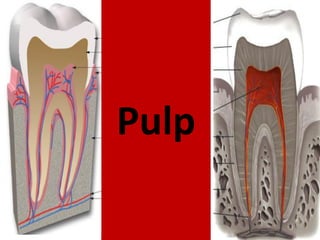
Pulp
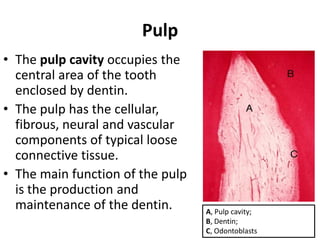
• The pulp cavity occupies the
  central area of the tooth
  enclosed by dentin.
• The pulp has the cellular,
  fibrous, neural and vascular
  components of typical loose
  connective tissue.
• The main function of the pulp
  is the production and
  maintenance of the dentin.      A, Pulp cavity;
                                  B, Dentin;
                                  C, Odontoblasts
Nerve Plexus of Raschkow
• Sensory nerve fibers that originate from
  inferior and superior alveolar nerves
  innervate the odontoblastic layer of the
  pulp cavity.
• These nerves enter the tooth through
  the apical foramen as myelinated nerve
  bundles.
• They branch to form the
  subodontoblastic nerve plexus of
  Raschkow which is separated from the
  odontoblasts by a cell-free zone of
  Weil.
• In addition to the sensory nerves,
  sympathetic nerve bundles also enter
  the tooth to innervate blood vessels.
                                             A, Odontoblasts;
                                             B, Cell-free zone of Weil;
                                             C, Nerve plexus of Raschkow
Vascular supply of pulp cavity
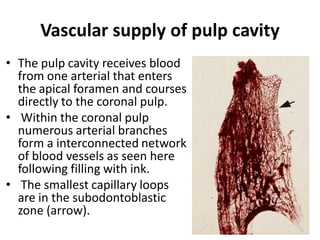
• The pulp cavity receives blood
  from one arterial that enters
  the apical foramen and courses
  directly to the coronal pulp.
• Within the coronal pulp
  numerous arterial branches
  form a interconnected network
  of blood vessels as seen here
  following filling with ink.
• The smallest capillary loops
  are in the subodontoblastic
  zone (arrow).
Structures within the pulp cavity


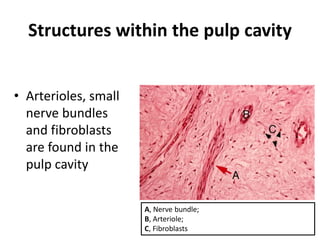
• Arterioles, small
  nerve bundles
  and fibroblasts
  are found in the
  pulp cavity


                      A, Nerve bundle;
                      B, Arteriole;
                      C, Fibroblasts
Structures within the pulp cavity
• Arterioles can be
  distinguished from
  venules within the
  pulp cavity by the
  thickness and
  contours of their
  vascular walls.


                       A, Arteriole; B, Venule;
                       C, Nerve bundle (cut in cross-section)
Subodontoblastic region

• Below the odontoblastic
  layer is the cell-free zone
  of Weil followed by a
  cell-rich zone which is
  thought to provide
  replacement cells for
  odontoblasts that die.
• Within these zones are
  the nerve plexus of           A, Cell-rich zone;
  Raschkow and capillary        B, Cell-free zone;
                                C, Odontoblastic layer;
  network.                      D, Dentin
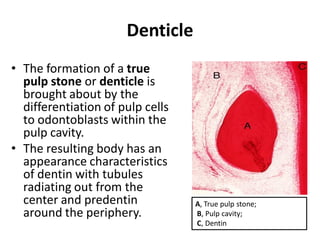
Denticle
• The formation of a true
  pulp stone or denticle is
  brought about by the
  differentiation of pulp cells
  to odontoblasts within the
  pulp cavity.
• The resulting body has an
  appearance characteristics
  of dentin with tubules
  radiating out from the
  center and predentin            A, True pulp stone;
  around the periphery.           B, Pulp cavity;
                                  C, Dentin
False pulp stone
• The formation of a false
  pulp stone is caused by the
  nonspecific calcification of
  tissue around a central
  nucleus within the pulp
  cavity.
• This pulp stone is
  characterized by concentric
  layers of mineralization
  rather than radiating
  tubules as seen in true pulp
  stones.
                                 A, False pulp stone; B, Pulp cavity
Regions of the pulp cavity


• The pulp cavity can be
  divided into two main
  regions: the coronal pulp
  is located within the
  crown of the tooth and
  the radicular pulp is
  located within the root.
                              A, Coronal pulp;
                              B, Radicular pulp
This slide from:
Sharifa Abdulla Alhaj
This slide from:
Dalia.
Good
Luck
All
       Done by: Bedour Al-Arfaj.
‫أدعيه قبل المذاكره وبعدها...‬
                                                                 ‫قبل المذاكرة‬

‫اللهم أنً اسألك فهم النبٌٌن و حفظ المرسلٌن و المالئكة المقربٌن ، اللهم أجعل ألسنتنا عامرة بذكرك و قلوبنا بخشٌتك و أسرارنا‬
                               ‫بطاعتك أنك على كل شًء قدٌر .. حسبنا هللا و نعم الوكٌل‬
                                                              ‫بعد المذاكرة‬
        ‫اللهم أنً استودعتك ما قرأت و ما حفظت و ما تعلمت فرده عند حاجتً الٌه انك على كل شًء قدٌر ، حسبنا هللا و نعم الوكٌل‬
                                                              ‫يوم اإلمتحان‬
                                 ‫اللهم أنً توكلت علٌك و سلمت امري الٌك ال ملجأ و منجا منك إال الٌك‬
                                                              ‫دخول القاعة‬
                          ‫رب أدخلنً مدخل صدق و أخرجنً مخرج صدق و أجعل لً من لدنك سلطانا نصٌرا‬
                                                            ‫قبل البدء بالحل‬
‫رب أشرح لً صدري و ٌسر لً أمري و احلل عقدة من لسانً ٌفقه قولً بسم هللا الفتاح ، اللهم ال سهل أال ما جعلته سهال و انت تجعل الحزن اذا‬
                                                      ‫شئت سهال ٌا ارحم الراحمٌن‬
                                                             ‫أثناء األمتحان‬
           ‫ال إله اال انت سبحانك أنً كنت من الظالمٌن ٌا حً ٌا قٌوم برحمتك أستغٌث ، رب ان مسنً الضر أنك أرحم الراحمٌن‬
                                                              ‫عند النسيان‬
                                       ‫اللهم ٌا جامع الناس فً ٌوم ال رٌب فٌه أجمعنً و ضالتً‬
                                                              ‫بعد األنتهاء‬
                                       ‫الحمد هلل الذي هدانا لهذا و ما كنا لنهتدي لوال أن هدانا هللا‬

Pulp

  • 1.
  • 2.
    Pulp • The pulpcavity occupies the central area of the tooth enclosed by dentin. • The pulp has the cellular, fibrous, neural and vascular components of typical loose connective tissue. • The main function of the pulp is the production and maintenance of the dentin. A, Pulp cavity; B, Dentin; C, Odontoblasts
  • 3.
    Nerve Plexus ofRaschkow • Sensory nerve fibers that originate from inferior and superior alveolar nerves innervate the odontoblastic layer of the pulp cavity. • These nerves enter the tooth through the apical foramen as myelinated nerve bundles. • They branch to form the subodontoblastic nerve plexus of Raschkow which is separated from the odontoblasts by a cell-free zone of Weil. • In addition to the sensory nerves, sympathetic nerve bundles also enter the tooth to innervate blood vessels. A, Odontoblasts; B, Cell-free zone of Weil; C, Nerve plexus of Raschkow
  • 4.
    Vascular supply ofpulp cavity • The pulp cavity receives blood from one arterial that enters the apical foramen and courses directly to the coronal pulp. • Within the coronal pulp numerous arterial branches form a interconnected network of blood vessels as seen here following filling with ink. • The smallest capillary loops are in the subodontoblastic zone (arrow).
  • 5.
    Structures within thepulp cavity • Arterioles, small nerve bundles and fibroblasts are found in the pulp cavity A, Nerve bundle; B, Arteriole; C, Fibroblasts
  • 6.
    Structures within thepulp cavity • Arterioles can be distinguished from venules within the pulp cavity by the thickness and contours of their vascular walls. A, Arteriole; B, Venule; C, Nerve bundle (cut in cross-section)
  • 7.
    Subodontoblastic region • Belowthe odontoblastic layer is the cell-free zone of Weil followed by a cell-rich zone which is thought to provide replacement cells for odontoblasts that die. • Within these zones are the nerve plexus of A, Cell-rich zone; Raschkow and capillary B, Cell-free zone; C, Odontoblastic layer; network. D, Dentin
  • 8.
    Denticle • The formationof a true pulp stone or denticle is brought about by the differentiation of pulp cells to odontoblasts within the pulp cavity. • The resulting body has an appearance characteristics of dentin with tubules radiating out from the center and predentin A, True pulp stone; around the periphery. B, Pulp cavity; C, Dentin
  • 9.
    False pulp stone •The formation of a false pulp stone is caused by the nonspecific calcification of tissue around a central nucleus within the pulp cavity. • This pulp stone is characterized by concentric layers of mineralization rather than radiating tubules as seen in true pulp stones. A, False pulp stone; B, Pulp cavity
  • 10.
    Regions of thepulp cavity • The pulp cavity can be divided into two main regions: the coronal pulp is located within the crown of the tooth and the radicular pulp is located within the root. A, Coronal pulp; B, Radicular pulp
  • 12.
  • 13.
  • 14.
    Good Luck All Done by: Bedour Al-Arfaj.
  • 15.
    ‫أدعيه قبل المذاكرهوبعدها...‬ ‫قبل المذاكرة‬ ‫اللهم أنً اسألك فهم النبٌٌن و حفظ المرسلٌن و المالئكة المقربٌن ، اللهم أجعل ألسنتنا عامرة بذكرك و قلوبنا بخشٌتك و أسرارنا‬ ‫بطاعتك أنك على كل شًء قدٌر .. حسبنا هللا و نعم الوكٌل‬ ‫بعد المذاكرة‬ ‫اللهم أنً استودعتك ما قرأت و ما حفظت و ما تعلمت فرده عند حاجتً الٌه انك على كل شًء قدٌر ، حسبنا هللا و نعم الوكٌل‬ ‫يوم اإلمتحان‬ ‫اللهم أنً توكلت علٌك و سلمت امري الٌك ال ملجأ و منجا منك إال الٌك‬ ‫دخول القاعة‬ ‫رب أدخلنً مدخل صدق و أخرجنً مخرج صدق و أجعل لً من لدنك سلطانا نصٌرا‬ ‫قبل البدء بالحل‬ ‫رب أشرح لً صدري و ٌسر لً أمري و احلل عقدة من لسانً ٌفقه قولً بسم هللا الفتاح ، اللهم ال سهل أال ما جعلته سهال و انت تجعل الحزن اذا‬ ‫شئت سهال ٌا ارحم الراحمٌن‬ ‫أثناء األمتحان‬ ‫ال إله اال انت سبحانك أنً كنت من الظالمٌن ٌا حً ٌا قٌوم برحمتك أستغٌث ، رب ان مسنً الضر أنك أرحم الراحمٌن‬ ‫عند النسيان‬ ‫اللهم ٌا جامع الناس فً ٌوم ال رٌب فٌه أجمعنً و ضالتً‬ ‫بعد األنتهاء‬ ‫الحمد هلل الذي هدانا لهذا و ما كنا لنهتدي لوال أن هدانا هللا‬