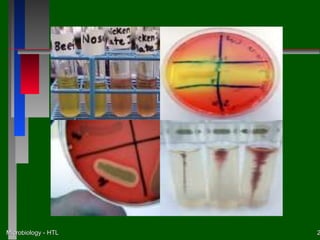
Bacterial Staining & Culture

                      Stains & Types of Dyes
                     Cultivating Microorganisms


Microbiology - HTL
Microbiology - HTL
What Organisms need to grow
            s   Nutrition
            s   Carbon
            s   Oxygen
            s   Nitrogen
            s   Phosphorus
            s   Sulfur
            s   Trace elements
            s   Organic growth
                factors
Microbiology - HTL
Chemical requirements:
            s   Carbon – structural backbone of living matter
            s   Nitrogen – form the amino group of the amino
                acids of proteins
                     • Nitrogen fixation – Cyanobacteria, Rhizobium
            s   Sulfur – Synthesize sulfur containing amino
                acids and vitamins.
                     • Eg. Thiamine and Biotin
            s   Phosphorus – synthesis of Nucleic acids and
                the phospholipids of the cell membranes


Microbiology - HTL
More chemicals:
            s   Other elements:      s   Trace elements
                     •   Potassium       •   Iron
                     •   Magnesium       •   Copper
                     •   Calcium         •   Molybdenum
                                         •   Zinc
            s   Used as cofactors
                for enzymes


Microbiology - HTL
Microbiology - HTL
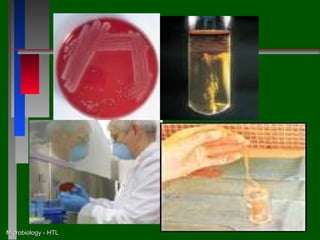
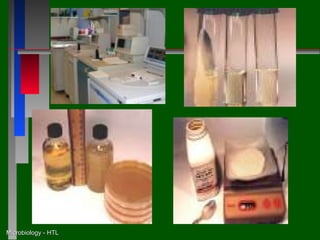
Culture Media
            s   Anything that possesses nutritional and
                environmental requirements for bacterial

                growth
            s   Culture -- is a group of organisms obtained in
                a culture media
            s   Colony – is a culture containing group of
                bacteria forming on a solid culture medium as
                a result of separated division of 1 or a few
                organisms

Microbiology - HTL
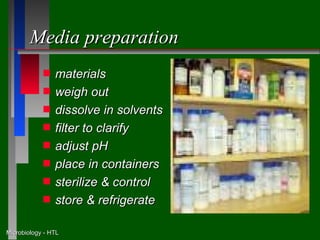
Media preparation
            s   materials
            s   weigh out
            s   dissolve in solvents
            s   filter to clarify
            s   adjust pH
            s   place in containers
            s   sterilize & control
            s   store & refrigerate

Microbiology - HTL
Ingredients of a culture media:
               s     protein
               s     nitrogen
               s     carbohydrate
               s     solidifying agents    /agar & gelatin
                     • Agar – polysaccharide extracts of seaweeds and
                       are most commonly used as base medium
               s     chemical substance
               s     dyes & indicators
               s     enriching substance – e.g. chocolate, blood,
                     glycerine, egg, albumin
Microbiology - HTL
Microbiology - HTL   1
Types of media (consistency)
               s     Liquid / broth - motility, transport , enrichment,
                     biochemical tests
                     • Eg. Thioglycolate broth, BHI, TSB, Nutrient broth
               s     semi-solid - 0.25% agar + liquid
                     motility, anaerobic culture, stock culture,
                     microaerophiles, & biochemical tests
                     • SIM, Fletcher
               s     solid - 1-2% agar
                     used for studying colonies
                     • BAP, CAP, MSA, EMB, TSI, SCA


Microbiology - HTL                                                         1
Types of Culture – ( specie )
            s Pure culture – made up of only one
              pure specie
            s Mixed culture – made up of organisms
              belonging to different specie
            s Stock Culture – pure culture of
              organism used as a source of supply for
              industry, research or academic uses.


Microbiology - HTL                                      1
Microbiology - HTL   1
Types of media – (composition)
            s Synthetic Culture Medium – exact
              composition is known or ingredients are
              known
            s Non-synthetic – exact composition is
              not known
            s Tissue culture medium – used for
              culturing living cells
                     • Eg. Human cancer cell lines


Microbiology - HTL                                      1
Type of media – (method of
        dispensing or distributed)
            s Plated Medium – dispensed in
              petridishes
            s Tube medium – dispensed in test tubes
                     •   Slant
                     •   Butt
                     •   Butt/slant


Microbiology - HTL                                    1
Types of Media – (B ased on use)
            s   Simple medium – supports the growth of
                fastidious microorganisms
                     • Used for routine cultivation and maintenance
                       of microorganisms
                        – Eg. Nutrient broth, Nutrient agar
            s   Enrichment medium – containing nutritive
                suplements needed for some microbes to
                growth
                        – Eg. Peptone water – growth of V. cholera


Microbiology - HTL                                                    1
Continued…
            s   Enriched medium – containing nutritive
                supplements for growth of some
                microorganisms
                     • Eg. BAP – contains Factor V ( Coenzyme –
                       heat labile factor  Nicotinamide
                       dinucleotide) & Factor X (Hemin  heat
                       stable factor)


Microbiology - HTL                                                1
More…
            s   Differential Medium – distinguishes organism
                growing together by differences in their
                cultural characteristic
                     • Eg. EMB, MCA, MSA, TCBS (Trypticase Citratr
                       Bile Salt Agar ), SSA
            s   Selective Medium – promotes growth of
                desirable organism but at the same time
                inhibiting the growth of others.
                     • Used for culture of specific organism


Microbiology - HTL                                                   1
Last na…
            s   Special/Specific culture medium
                     • Same as the purpose of selective culture
                       medium
                     • Used to isolate hard to isolate or grow
                       strains
                     • Eg. Petrognani, Lowenstein, Petroffs – for
                       Mycobacterium tuberculosis
                     • Thayer Martin medium – Neisseria
                     • McBride Agar – Listeria monocytogenes

Microbiology - HTL                                                  1
Microbiology - HTL   2
Types of media ( function)
    s Defined  - Glucose
    s Complex - egg, blood, beef, yeast, milk
    s Selective - SPS agar (Clostridium)
    s Differential - Blood agar
    s Selective/differential - MacConkey agar
         Crystal violet / lactose
    s Enrichment - Nitrogen free media


Microbiology - HTL                              2
Bacterial Colony:
            s Colonies – groups of bacteria forming
              on certain solid media as a result of
              several divisions of one or several
              specific type of organism
            s Only one type of bacteria will be found
              in a bacterial colony


Microbiology - HTL                                      2
Types of colonies:
            s   S or smooth colonies
                     •   Uniform texture and homogenecity
                     •   Forms glistening texture
                     •   Easily emulsified in Normal saline solution
                     •   Usually associated with virulent organisms
                     •   Eg. Gram negative organisms ( Neisseria )


Microbiology - HTL                                                     2
M or mucoid colonies
            s Associated with capsulated & virulent
              organisms
            s Exhibits slimy or watery confluent
              appearance and are positive to string
              test which indicates presence of Gm –
              organisms like K. pneumoniae in EMB
              agar – demonstrated with 3% KOH


Microbiology - HTL                                    2
R or rough colonies
            s Granulated in appearance and hard to
              emulsify in NSS
            s Eg. Corynebacterium diptheriae


Microbiology - HTL                                   2
Possible descriptions of bacterial
        growth on agar slants:
            s Arborescent- branched
            s Beaded
            s Echinulate – pointed
            s Filiform – even
            s Rhizoid – rootlike
            s Spreading


Microbiology - HTL                           2
Providing a suitable environment
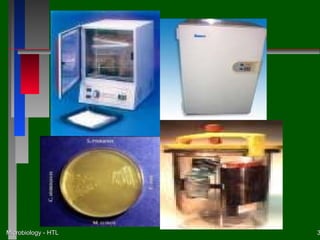
            s Oxygen Requirement
            s Temperature
            s pH
            s Osmotic Pressure
            s Hydrostatic Pressure
            s Salt Concentration


Microbiology - HTL                         2
Oxygen & Temperature
        requirements :
            s   Obligate aerobes     s   Thermophilic
            s   Facultative aerobe       • above 50
            s   Obligate anaerobe    s   Mesophilic
            s   Facultative              • best at 37
                anaerobe             s   Psychrophiles
            s   Microaerophiles          • below 5
            s   Capnophiles          s   MGT, mGT , OGT
                                     s   Hyperthermophiles
Microbiology - HTL                                           2
Microbiology - HTL   3
pH, Hydrostatic & Osmotic
        pressure
            s   pH scale 1-14        s   Buffers: chemicals
                 • Acidophiles           that is used to
                 • Alkaliphiles          neutralize the acids
                                         and maintain the
            s   wide range but           proper pH
                internally usually
                neutral 6.5-7.5
            s   Methods
                 • colorimetric
                 • electrometric
Microbiology - HTL                                              3
Osmotic pressure:
            s Osmoprotectants         – concentration of
                solutes > solvent
                     • High conc  Plasmolysis
                     • Low conc  Plasmoptosis
            s Halophiles
                       – high salt concentration
            s atmospheres - barotolerant


Microbiology - HTL                                         3
Microbiology - HTL   3
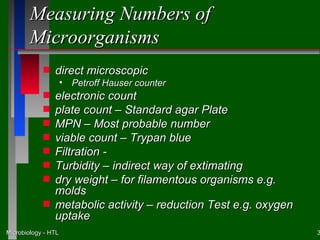
Measuring Numbers of
        Microorganisms
            s   direct microscopic
                     • Petroff Hauser counter
            s   electronic count
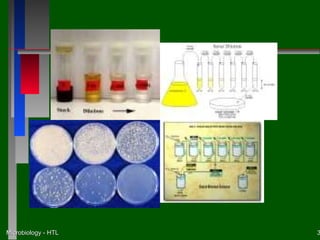
            s   plate count – Standard agar Plate
            s   MPN – Most probable number
            s   viable count – Trypan blue
            s   Filtration -
            s   Turbidity – indirect way of extimating
            s   dry weight – for filamentous organisms e.g.
                molds
            s   metabolic activity – reduction Test e.g. oxygen
                uptake
Microbiology - HTL                                                3
Microbiology - HTL   3
Growth of Microorganisms

            s Population - microbial growth
            s Doubling time/Generation Time
                     • Time interval until the completion of
                       next bacterial division
            s Growthrate
            s Exponential growth


Microbiology - HTL                                             3
Microbiology - HTL   3
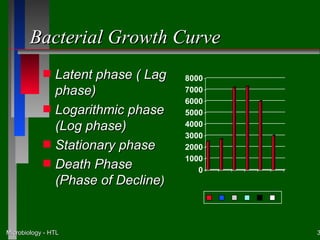
Bacterial Growth Curve
            s   Latent phase ( Lag   8000
                phase)               7000
                                     6000
            s   Logarithmic phase    5000
                (Log phase)          4000
                                     3000
            s   Stationary phase     2000
                                     1000
            s   Death Phase             0
                (Phase of Decline)


Microbiology - HTL                          3
The way microrganisms die

            s Rate of microbial death
                - temperature, type of microbe,
                  physiologic state, presence of other
                  substances that might protect
            s Decimal reduction time - D value
                (time in minutes -- 90% population)
            s Thermal death point - TDP
            s Thermal death time - TDT

Microbiology - HTL                                       4
Bacterial Death
            s   Death is due to
                     • Lack of food
                     • Accumulation of toxins & dead debris
                     • Development of unfavorable conditions
            s   Death is the complete ceasation of
                multiplication


Microbiology - HTL                                             4
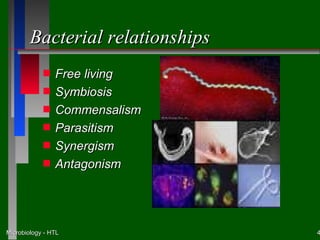
Bacterial relationships
            s   Free living
            s   Symbiosis
            s   Commensalism
            s   Parasitism
            s   Synergism
            s   Antagonism


Microbiology - HTL                4
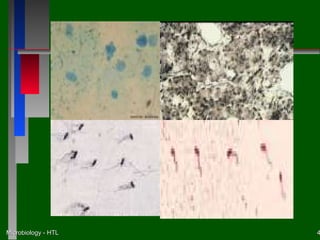
Common Types of Staining
            s   Simple Stain         s   Types of Dyes:
                • methylene blue         • Basic -Safranin ,
                                           carbol fuchsin,
            s   Differential stain         Methylene blue
                • Gram’s Stain           • Acidic - Eosin,
                • Acid Fast Stain          acid fuchsin,
                                           congo red
            s   Special Stain
                                     s   Mordants
                • Wirtz Conklin
                                     s   Decolorizers
                • Leifson
Microbiology - HTL                                             4
Microbiology - HTL   4
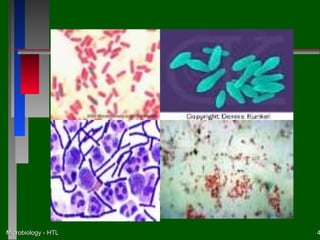
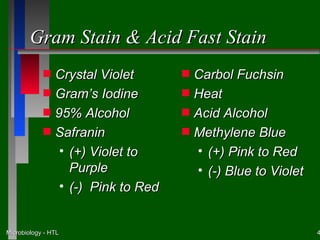
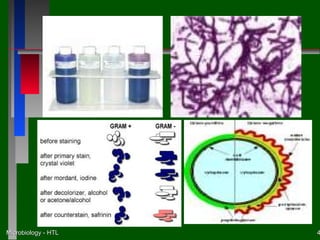
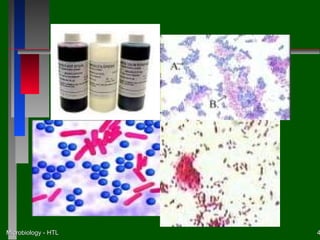
Gram Stain & Acid Fast Stain
            s   Crystal Violet       s   Carbol Fuchsin
            s   Gram’s Iodine        s   Heat
            s   95% Alcohol          s   Acid Alcohol
            s   Safranin             s   Methylene Blue
                 • (+) Violet to         • (+) Pink to Red
                   Purple                • (-) Blue to Violet
                 • (-) Pink to Red


Microbiology - HTL                                              4
Microbiology - HTL   4

Module 3a culture and staining

  • 1.
    Bacterial Staining &Culture Stains & Types of Dyes Cultivating Microorganisms Microbiology - HTL
  • 2.
  • 3.
    What Organisms needto grow s Nutrition s Carbon s Oxygen s Nitrogen s Phosphorus s Sulfur s Trace elements s Organic growth factors Microbiology - HTL
  • 4.
    Chemical requirements: s Carbon – structural backbone of living matter s Nitrogen – form the amino group of the amino acids of proteins • Nitrogen fixation – Cyanobacteria, Rhizobium s Sulfur – Synthesize sulfur containing amino acids and vitamins. • Eg. Thiamine and Biotin s Phosphorus – synthesis of Nucleic acids and the phospholipids of the cell membranes Microbiology - HTL
  • 5.
    More chemicals: s Other elements: s Trace elements • Potassium • Iron • Magnesium • Copper • Calcium • Molybdenum • Zinc s Used as cofactors for enzymes Microbiology - HTL
  • 6.
  • 7.
    Culture Media s Anything that possesses nutritional and environmental requirements for bacterial growth s Culture -- is a group of organisms obtained in a culture media s Colony – is a culture containing group of bacteria forming on a solid culture medium as a result of separated division of 1 or a few organisms Microbiology - HTL
  • 8.
    Media preparation s materials s weigh out s dissolve in solvents s filter to clarify s adjust pH s place in containers s sterilize & control s store & refrigerate Microbiology - HTL
  • 9.
    Ingredients of aculture media: s protein s nitrogen s carbohydrate s solidifying agents /agar & gelatin • Agar – polysaccharide extracts of seaweeds and are most commonly used as base medium s chemical substance s dyes & indicators s enriching substance – e.g. chocolate, blood, glycerine, egg, albumin Microbiology - HTL
  • 10.
  • 11.
    Types of media(consistency) s Liquid / broth - motility, transport , enrichment, biochemical tests • Eg. Thioglycolate broth, BHI, TSB, Nutrient broth s semi-solid - 0.25% agar + liquid motility, anaerobic culture, stock culture, microaerophiles, & biochemical tests • SIM, Fletcher s solid - 1-2% agar used for studying colonies • BAP, CAP, MSA, EMB, TSI, SCA Microbiology - HTL 1
  • 12.
    Types of Culture– ( specie ) s Pure culture – made up of only one pure specie s Mixed culture – made up of organisms belonging to different specie s Stock Culture – pure culture of organism used as a source of supply for industry, research or academic uses. Microbiology - HTL 1
  • 13.
  • 14.
    Types of media– (composition) s Synthetic Culture Medium – exact composition is known or ingredients are known s Non-synthetic – exact composition is not known s Tissue culture medium – used for culturing living cells • Eg. Human cancer cell lines Microbiology - HTL 1
  • 15.
    Type of media– (method of dispensing or distributed) s Plated Medium – dispensed in petridishes s Tube medium – dispensed in test tubes • Slant • Butt • Butt/slant Microbiology - HTL 1
  • 16.
    Types of Media– (B ased on use) s Simple medium – supports the growth of fastidious microorganisms • Used for routine cultivation and maintenance of microorganisms – Eg. Nutrient broth, Nutrient agar s Enrichment medium – containing nutritive suplements needed for some microbes to growth – Eg. Peptone water – growth of V. cholera Microbiology - HTL 1
  • 17.
    Continued… s Enriched medium – containing nutritive supplements for growth of some microorganisms • Eg. BAP – contains Factor V ( Coenzyme – heat labile factor  Nicotinamide dinucleotide) & Factor X (Hemin  heat stable factor) Microbiology - HTL 1
  • 18.
    More… s Differential Medium – distinguishes organism growing together by differences in their cultural characteristic • Eg. EMB, MCA, MSA, TCBS (Trypticase Citratr Bile Salt Agar ), SSA s Selective Medium – promotes growth of desirable organism but at the same time inhibiting the growth of others. • Used for culture of specific organism Microbiology - HTL 1
  • 19.
    Last na… s Special/Specific culture medium • Same as the purpose of selective culture medium • Used to isolate hard to isolate or grow strains • Eg. Petrognani, Lowenstein, Petroffs – for Mycobacterium tuberculosis • Thayer Martin medium – Neisseria • McBride Agar – Listeria monocytogenes Microbiology - HTL 1
  • 20.
  • 21.
  • 22.
    Types of media( function) s Defined - Glucose s Complex - egg, blood, beef, yeast, milk s Selective - SPS agar (Clostridium) s Differential - Blood agar s Selective/differential - MacConkey agar Crystal violet / lactose s Enrichment - Nitrogen free media Microbiology - HTL 2
  • 23.
    Bacterial Colony: s Colonies – groups of bacteria forming on certain solid media as a result of several divisions of one or several specific type of organism s Only one type of bacteria will be found in a bacterial colony Microbiology - HTL 2
  • 24.
    Types of colonies: s S or smooth colonies • Uniform texture and homogenecity • Forms glistening texture • Easily emulsified in Normal saline solution • Usually associated with virulent organisms • Eg. Gram negative organisms ( Neisseria ) Microbiology - HTL 2
  • 25.
    M or mucoidcolonies s Associated with capsulated & virulent organisms s Exhibits slimy or watery confluent appearance and are positive to string test which indicates presence of Gm – organisms like K. pneumoniae in EMB agar – demonstrated with 3% KOH Microbiology - HTL 2
  • 26.
    R or roughcolonies s Granulated in appearance and hard to emulsify in NSS s Eg. Corynebacterium diptheriae Microbiology - HTL 2
  • 27.
    Possible descriptions ofbacterial growth on agar slants: s Arborescent- branched s Beaded s Echinulate – pointed s Filiform – even s Rhizoid – rootlike s Spreading Microbiology - HTL 2
  • 28.
    Providing a suitableenvironment s Oxygen Requirement s Temperature s pH s Osmotic Pressure s Hydrostatic Pressure s Salt Concentration Microbiology - HTL 2
  • 29.
    Oxygen & Temperature requirements : s Obligate aerobes s Thermophilic s Facultative aerobe • above 50 s Obligate anaerobe s Mesophilic s Facultative • best at 37 anaerobe s Psychrophiles s Microaerophiles • below 5 s Capnophiles s MGT, mGT , OGT s Hyperthermophiles Microbiology - HTL 2
  • 30.
  • 31.
    pH, Hydrostatic &Osmotic pressure s pH scale 1-14 s Buffers: chemicals • Acidophiles that is used to • Alkaliphiles neutralize the acids and maintain the s wide range but proper pH internally usually neutral 6.5-7.5 s Methods • colorimetric • electrometric Microbiology - HTL 3
  • 32.
    Osmotic pressure: s Osmoprotectants – concentration of solutes > solvent • High conc  Plasmolysis • Low conc  Plasmoptosis s Halophiles – high salt concentration s atmospheres - barotolerant Microbiology - HTL 3
  • 33.
  • 34.
    Measuring Numbers of Microorganisms s direct microscopic • Petroff Hauser counter s electronic count s plate count – Standard agar Plate s MPN – Most probable number s viable count – Trypan blue s Filtration - s Turbidity – indirect way of extimating s dry weight – for filamentous organisms e.g. molds s metabolic activity – reduction Test e.g. oxygen uptake Microbiology - HTL 3
  • 35.
  • 36.
  • 37.
    Growth of Microorganisms s Population - microbial growth s Doubling time/Generation Time • Time interval until the completion of next bacterial division s Growthrate s Exponential growth Microbiology - HTL 3
  • 38.
  • 39.
    Bacterial Growth Curve s Latent phase ( Lag 8000 phase) 7000 6000 s Logarithmic phase 5000 (Log phase) 4000 3000 s Stationary phase 2000 1000 s Death Phase 0 (Phase of Decline) Microbiology - HTL 3
  • 40.
    The way microrganismsdie s Rate of microbial death - temperature, type of microbe, physiologic state, presence of other substances that might protect s Decimal reduction time - D value (time in minutes -- 90% population) s Thermal death point - TDP s Thermal death time - TDT Microbiology - HTL 4
  • 41.
    Bacterial Death s Death is due to • Lack of food • Accumulation of toxins & dead debris • Development of unfavorable conditions s Death is the complete ceasation of multiplication Microbiology - HTL 4
  • 42.
    Bacterial relationships s Free living s Symbiosis s Commensalism s Parasitism s Synergism s Antagonism Microbiology - HTL 4
  • 43.
    Common Types ofStaining s Simple Stain s Types of Dyes: • methylene blue • Basic -Safranin , carbol fuchsin, s Differential stain Methylene blue • Gram’s Stain • Acidic - Eosin, • Acid Fast Stain acid fuchsin, congo red s Special Stain s Mordants • Wirtz Conklin s Decolorizers • Leifson Microbiology - HTL 4
  • 44.
  • 45.
  • 46.
    Gram Stain &Acid Fast Stain s Crystal Violet s Carbol Fuchsin s Gram’s Iodine s Heat s 95% Alcohol s Acid Alcohol s Safranin s Methylene Blue • (+) Violet to • (+) Pink to Red Purple • (-) Blue to Violet • (-) Pink to Red Microbiology - HTL 4
  • 47.
  • 48.