PPuullmmoonnaarryy 
VVeennttiillaattiioonn 
And 
lluunngg ccaappaacciittyy 
BBYY 
RRAANNAA DDAASS
External respiration can be divided 
into 
4 major functional events 
1) Ventilation 
2) Diffusion 
3) Transport of O2 and CO2 in the 
blood, body fluids, to and from 
the cells 
4) Regulation of ventilation
PULMONARY VENTILATION 
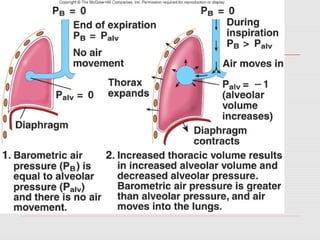
 BOYLE’S LAW 
 Gas pressure in closed container is 
inversely proportional to volume of 
container 
 Pressure differences and Air flows
Mechanics of pulmonary 
v e n t i l a t i o n 
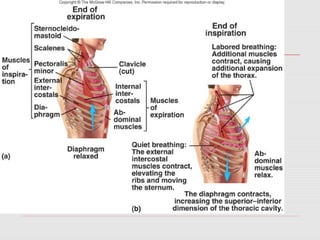
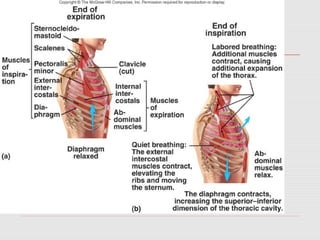
Diaphragm – which increase and decrease the vertical 
diameter of the chest cavity. 
Intercostal muscles – affect the anteroposterior 
diameter of the chest cavity by moving the ribs. 
Internal intercostal muscle (downward and backward) 
 lower the ribs and sternum  reducing the 
anteroposterior diameter 
External intercostal muscle (downward and forward)  
raise the ribs and sternum  increasing the 
anteroposterior diameter of the thoracic cavity
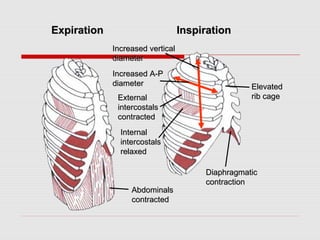
EExxppiirraattiioonn IInnssppiirraattiioonn 
IInnccrreeaasseedd vveerrttiiccaall 
ddiiaammeetteerr 
IInnccrreeaasseedd AA--PP 
ddiiaammeetteerr 
EExxtteerrnnaall 
iinntteerrccoossttaallss 
ccoonnttrraacctteedd 
IInntteerrnnaall 
iinntteerrccoossttaallss 
rreellaaxxeedd 
AAbbddoommiinnaallss 
ccoonnttrraacctteedd 
EElleevvaatteedd 
rriibb ccaaggee 
DDiiaapphhrraaggmmaattiicc 
ccoonnttrraaccttiioonn
Inspiration/Inhalation 
 Diaphragm & Intercostal muscles 
 Increases volume in thoracic cavity as 
muscles contract 
 Volume of lungs increases 
 Intrapulmonary pressure decreases 
(758 mm Hg)
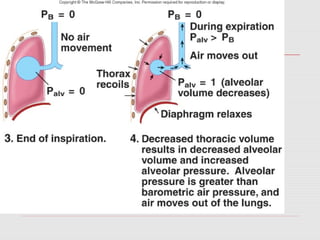
Expiration/Exhalation 
 Muscles relax 
 Volume of thoracic cavity decreases 
 Volume of lungs decreases 
 Intrapulmonary pressure increases 
(763 mm Hg) 
 Forced expiration is active
Factors that influence 
pulmonary air flow 
 F = P/R 
 Diameter of airways, esp. bronchioles 
 Sympathetic & Parasympathetic NS
Various pressure in the lungs 
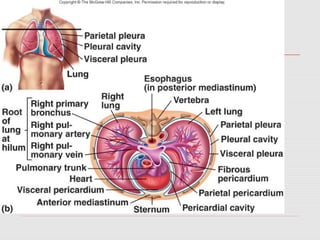
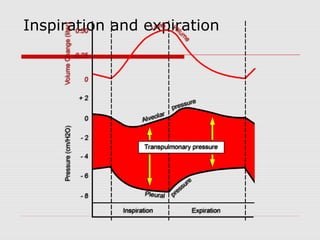
Pleural pressure – is the pressure of fluid in the narrow 
space between the visceral and parietal pleura, 
normally slightly negative pressure 
The normal pleural pressure at the beginning of 
inspiration is –5cm of H2O (it reach about –7.5cm of 
H2O due to movement of the chest cage) 
The pleural pressure at the beginning of expiration is 
–7.5cm of H2O to reach –5cm of H2O
Alveolar pressure 
Alveolar pressure: – is the pressure inside the lung 
alveoli 
During inspiration: ¯ –1cm of H2O (this slight 
negative pressure is enough to move about 0.5 liter 
of air into the lungs in the first 2 second of 
inspiration) 
During expiration: it rises to about +1cm of H2O (this 
forces 0.5 liter of inspired air out of the lungs during 
the 2 to 3 seconds of expiration
Inspiration and expiration
T h e work done in breathing 
the work of inspiration can be divided into 3 
fractions: 
The work required to expand the lungs against its 
elastic forces called compliance work or elastic work. 
The work required to overcome the viscosity of the 
lung and chest wall structures called tissue 
resistance work. 
The work required to overcome airway resistance 
called airway resistance work. 
Work energy required for respiration: 
during normal quiet respiration = 2 to 3% of the total 
work energy (­ to 50 fold in exercise, ­ airway 
resistance).
Pulmonary volumes and 
c apacities 
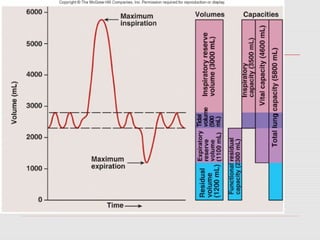
1) Tidal volume – is the volume of air inspired or expired with 
each normal breath = 500ml in young adult man. 
2) Inspiratory reserve volume – is the extra volume of air 
that can be inspired over and beyond the normal tidal volume 
= 3000ml. 
3) Expiratory reserve volume – is the extra amount of air 
that can be expired by forceful expiration after the end of a 
normal tidal expiration ~ 1100ml. 
4) Residual volume – is the extra volume of air that still 
remain in the lungs after the most forceful expiration ~ 
1200ml.
The pulmonary capacities 
1) Inspiratory capacity – is the volume of air inspired by a maximal 
inspiratory effort after normal expiration = 3500ml = 
inspiratory reserve volume + tidal volume. 
2) The functional residual capacity – is the volume of air remaining in 
the lungs after normal expiration = 2300ml = expiratory reserve 
volume + residual volume. 
3) The vital capacity – is the volume of air expired by a maximal 
expiratory effort after maximal inspiration ~ 4600ml = 
inspiratory reserve volume + tidal volume + expiratory reserve 
volume. 
4) Total lung capacity – is the maximum volume of air that can be 
accommodated in the lungs ~ 5800ml = vital capacity + residual 
volume. 
5) Minute respiratory volume – is the volume of air breathed in or out 
of the lungs each minute = respiratory rate x tidal volume = 12 
X 500ml = 6000ml/min. 
All lung volume and capacity are about 20 to 25% less in women 
than in men and are greater in athletic persons than in small 
and asthenic persons.
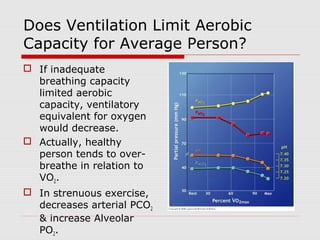
Does Ventilation Limit Aerobic 
Capacity for Average Person? 
 If inadequate 
breathing capacity 
limited aerobic 
capacity, ventilatory 
equivalent for oxygen 
would decrease. 
 Actually, healthy 
person tends to over-breathe 
in relation to 
VO2. 
 In strenuous exercise, 
decreases arterial PCO2 
& increase Alveolar 
PO2.
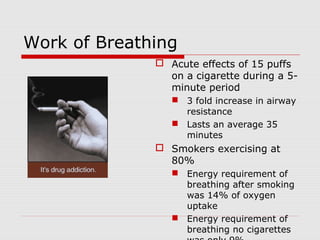
Work of Breathing 
 Acute effects of 15 puffs 
on a cigarette during a 5- 
minute period 
 3 fold increase in airway 
resistance 
 Lasts an average 35 
minutes 
 Smokers exercising at 
80% 
 Energy requirement of 
breathing after smoking 
was 14% of oxygen 
uptake 
 Energy requirement of 
breathing no cigarettes 
was only 9%.
THANK YOU.

Pulmonary Ventilation and Lung Capacity

  • 1.
    PPuullmmoonnaarryy VVeennttiillaattiioonn And lluunngg ccaappaacciittyy BBYY RRAANNAA DDAASS
  • 2.
    External respiration canbe divided into 4 major functional events 1) Ventilation 2) Diffusion 3) Transport of O2 and CO2 in the blood, body fluids, to and from the cells 4) Regulation of ventilation
  • 3.
    PULMONARY VENTILATION BOYLE’S LAW  Gas pressure in closed container is inversely proportional to volume of container  Pressure differences and Air flows
  • 4.
    Mechanics of pulmonary v e n t i l a t i o n Diaphragm – which increase and decrease the vertical diameter of the chest cavity. Intercostal muscles – affect the anteroposterior diameter of the chest cavity by moving the ribs. Internal intercostal muscle (downward and backward)  lower the ribs and sternum  reducing the anteroposterior diameter External intercostal muscle (downward and forward)  raise the ribs and sternum  increasing the anteroposterior diameter of the thoracic cavity
  • 6.
    EExxppiirraattiioonn IInnssppiirraattiioonn IInnccrreeaasseeddvveerrttiiccaall ddiiaammeetteerr IInnccrreeaasseedd AA--PP ddiiaammeetteerr EExxtteerrnnaall iinntteerrccoossttaallss ccoonnttrraacctteedd IInntteerrnnaall iinntteerrccoossttaallss rreellaaxxeedd AAbbddoommiinnaallss ccoonnttrraacctteedd EElleevvaatteedd rriibb ccaaggee DDiiaapphhrraaggmmaattiicc ccoonnttrraaccttiioonn
  • 7.
    Inspiration/Inhalation  Diaphragm& Intercostal muscles  Increases volume in thoracic cavity as muscles contract  Volume of lungs increases  Intrapulmonary pressure decreases (758 mm Hg)
  • 9.
    Expiration/Exhalation  Musclesrelax  Volume of thoracic cavity decreases  Volume of lungs decreases  Intrapulmonary pressure increases (763 mm Hg)  Forced expiration is active
  • 12.
    Factors that influence pulmonary air flow  F = P/R  Diameter of airways, esp. bronchioles  Sympathetic & Parasympathetic NS
  • 13.
    Various pressure inthe lungs Pleural pressure – is the pressure of fluid in the narrow space between the visceral and parietal pleura, normally slightly negative pressure The normal pleural pressure at the beginning of inspiration is –5cm of H2O (it reach about –7.5cm of H2O due to movement of the chest cage) The pleural pressure at the beginning of expiration is –7.5cm of H2O to reach –5cm of H2O
  • 14.
    Alveolar pressure Alveolarpressure: – is the pressure inside the lung alveoli During inspiration: ¯ –1cm of H2O (this slight negative pressure is enough to move about 0.5 liter of air into the lungs in the first 2 second of inspiration) During expiration: it rises to about +1cm of H2O (this forces 0.5 liter of inspired air out of the lungs during the 2 to 3 seconds of expiration
  • 16.
  • 17.
    T h ework done in breathing the work of inspiration can be divided into 3 fractions: The work required to expand the lungs against its elastic forces called compliance work or elastic work. The work required to overcome the viscosity of the lung and chest wall structures called tissue resistance work. The work required to overcome airway resistance called airway resistance work. Work energy required for respiration: during normal quiet respiration = 2 to 3% of the total work energy (­ to 50 fold in exercise, ­ airway resistance).
  • 18.
    Pulmonary volumes and c apacities 1) Tidal volume – is the volume of air inspired or expired with each normal breath = 500ml in young adult man. 2) Inspiratory reserve volume – is the extra volume of air that can be inspired over and beyond the normal tidal volume = 3000ml. 3) Expiratory reserve volume – is the extra amount of air that can be expired by forceful expiration after the end of a normal tidal expiration ~ 1100ml. 4) Residual volume – is the extra volume of air that still remain in the lungs after the most forceful expiration ~ 1200ml.
  • 19.
    The pulmonary capacities 1) Inspiratory capacity – is the volume of air inspired by a maximal inspiratory effort after normal expiration = 3500ml = inspiratory reserve volume + tidal volume. 2) The functional residual capacity – is the volume of air remaining in the lungs after normal expiration = 2300ml = expiratory reserve volume + residual volume. 3) The vital capacity – is the volume of air expired by a maximal expiratory effort after maximal inspiration ~ 4600ml = inspiratory reserve volume + tidal volume + expiratory reserve volume. 4) Total lung capacity – is the maximum volume of air that can be accommodated in the lungs ~ 5800ml = vital capacity + residual volume. 5) Minute respiratory volume – is the volume of air breathed in or out of the lungs each minute = respiratory rate x tidal volume = 12 X 500ml = 6000ml/min. All lung volume and capacity are about 20 to 25% less in women than in men and are greater in athletic persons than in small and asthenic persons.
  • 21.
    Does Ventilation LimitAerobic Capacity for Average Person?  If inadequate breathing capacity limited aerobic capacity, ventilatory equivalent for oxygen would decrease.  Actually, healthy person tends to over-breathe in relation to VO2.  In strenuous exercise, decreases arterial PCO2 & increase Alveolar PO2.
  • 22.
    Work of Breathing  Acute effects of 15 puffs on a cigarette during a 5- minute period  3 fold increase in airway resistance  Lasts an average 35 minutes  Smokers exercising at 80%  Energy requirement of breathing after smoking was 14% of oxygen uptake  Energy requirement of breathing no cigarettes was only 9%.
  • 23.