The respiratory system
Dr. Rana AWADA
Nasal cavity
Pharynx
Esophagus
Clavicle
UPPER
RESPIRATORY
SYSTEM
LOWER
RESPIRATORY
SYSTEM
RIGH
T
LUNG
Bronchioles
Bronchus
Trachea
Larynx
Tongue
Nose
Ribs Diaphragm
LEFT
LUNG
RIGHT
LUNG
Structurally, the
respiratory system
consists of two parts:
Structures of the Respiratory System
Nose
External nose – portion visible on face
The interior structures of the external nose have three functions:
• warming, moistening, and filtering incoming air;
• detecting olfactory stimuli;
• modifying speech vibrations as they pass through the large, hollow resonating
chambers.
Internal nose – large cavity beyond nasal vestibule
• Internal nares or choanae
• Ducts from paranasal sinuses and nasolacrimal ducts open into internal nose
• Nasal cavity divided by nasal septum and subdivide cavity into meatuses: Increase
surface are and prevents dehydration
• Olfactory receptors in olfactory epithelium
Cilia and mucus
The epithelial surfaces of the airways, from nose to the lungs:
Ø contain cilia that transport the mucus to the pharynx
Ø Mucus are secreted by the goblet cells
Functions:
• Mucus is important to keep the lungs clear of particle matter and many bacteria that enter
the body on dust particles.
• warmed the air moving into body by the heat providing by the presence of the capillaries
Each lung is enclosed and protected by a double-layered membrane known as the
pleural membrane:
The visceral pleura: covers the external surface of lung
The parietal pleura: covers the wall of the thoracic cavity
The pleural cavity: a space between the two layers,
contains a lubricating fluid (intrapleural fluid).
This pleural fluid reduces friction between
the membranes, allowing them to slide easily
over one another during breathing.
Lungs
Functionally, the respiratory system consists of two parts:
1. Conducting zone – Filter, warm and conducts air to lungs
Nose, pharynx, larynx, trachea, bronchi, bronchioles and terminal bronchioles
Functions of the Respiratory System
2. Respiratory zone – main site of gas exchange between air and blood
Respiratory bronchioles, alveolar ducts, alveolar sacs, and alveoli
Functions of the Respiratory System
Alveoli highly important for Gas Exchange
Dr. Lina SABRA-MAKKE
Components of Alveolus
Lungs receive blood from
Pulmonary artery- deoxygenated blood
Bronchial arteries – oxygenated blood to perfuse the muscular walls of bronchi
and bronchioles
a) Type I alveolar cells:
• thin epithelial cells
•Make up most of the alveolar
walls
b) Type II alveolar cells:
• thick epithelial cells that
produce a detergent; Surfactant
c) Alveolar macrophages:
• phagocytosis and defense
The main types of alveolar cells
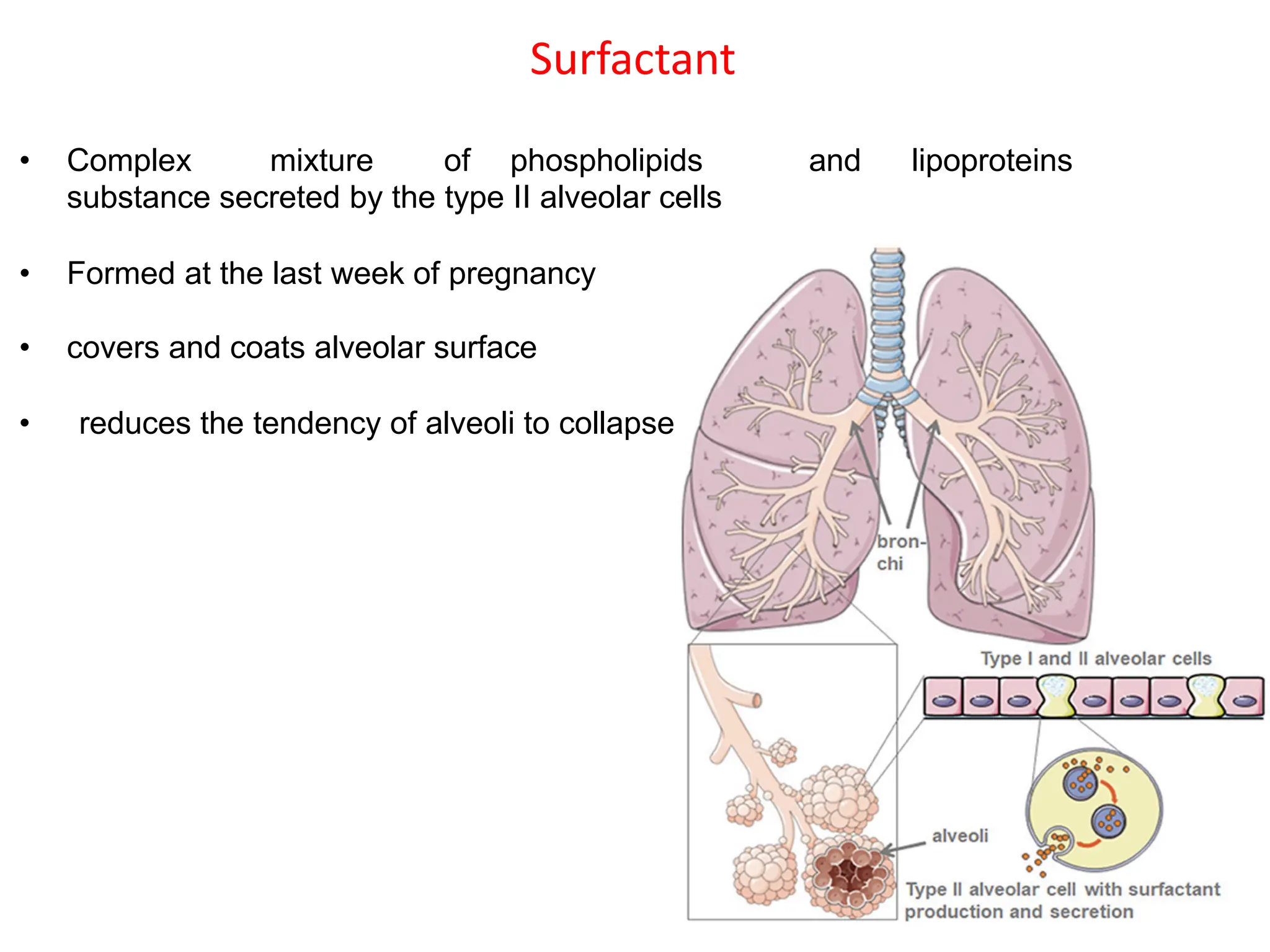
Surfactant
• Complex mixture of phospholipids and lipoproteins
substance secreted by the type II alveolar cells
• Formed at the last week of pregnancy
• covers and coats alveolar surface
• reduces the tendency of alveoli to collapse
• In the lungs we have two
major cholinergic and adrenergic
receptors subtypes: M3 cholinergic and
β2 adrenergic receptors
• Stimulation of M3 receptors causes
bronchoconstriction while the
stimulation of β2 receptors causes a
bronchodilation.
ü Its is useful to note that an asthma is a chronic inflammation of smooth
airways and is characterized by an intense broncho- constriction.
ü We used an adrenaline to calm this problem.
ü Thus, β2- adrenergic drugs (Ventolin: Salbutamol) are used in the treatment
of asthma
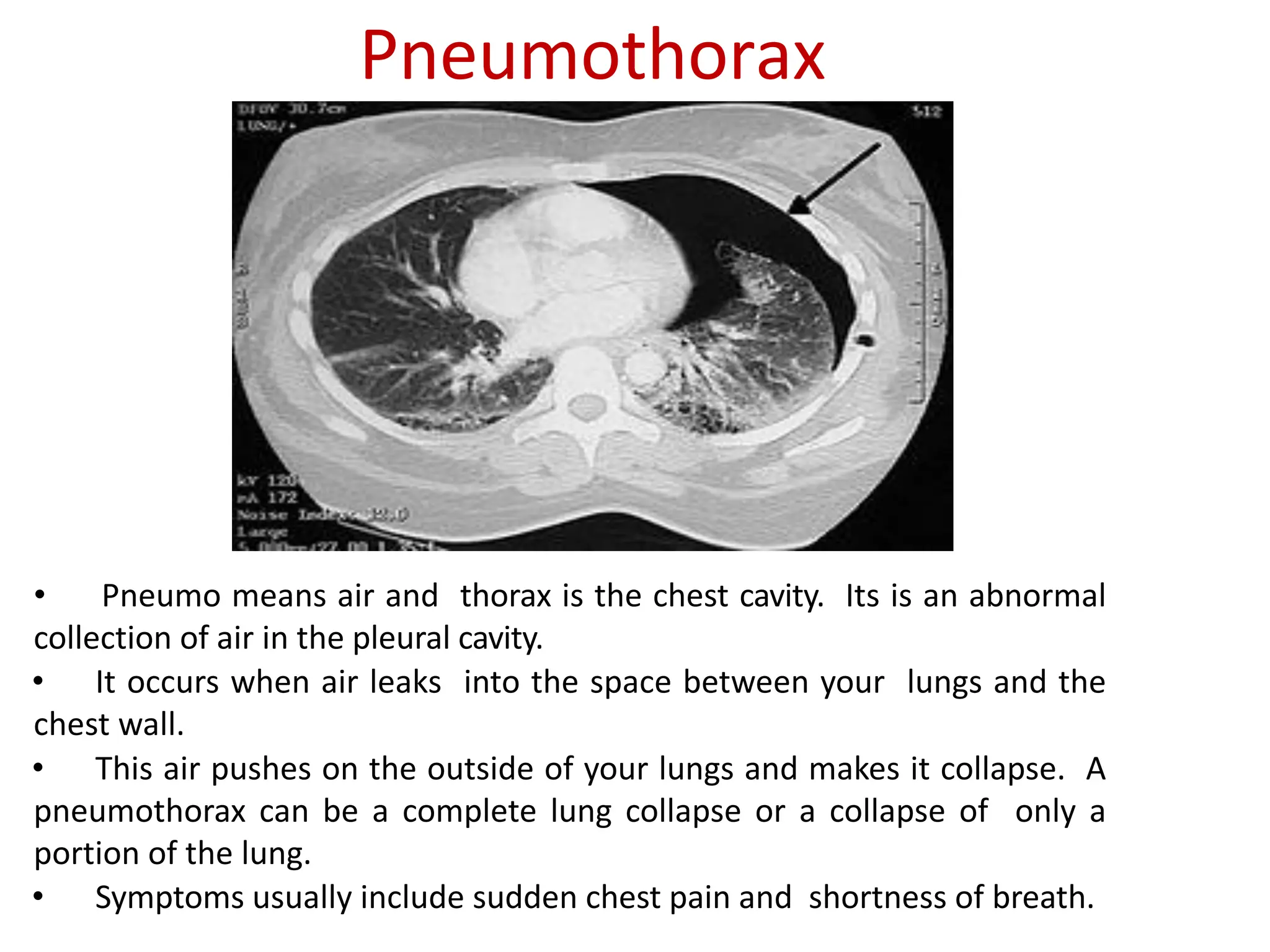
Pneumothorax
• Pneumo means air and thorax is the chest cavity. Its is an abnormal
collection of air in the pleural cavity.
• It occurs when air leaks into the space between your lungs and the
chest wall.
• This air pushes on the outside of your lungs and makes it collapse. A
pneumothorax can be a complete lung collapse or a collapse of only a
portion of the lung.
• Symptoms usually include sudden chest pain and shortness of breath.
Pulmonary ventilation
The process of gas exchange in the body, called respiration, has three basic
steps:
1. Pulmonary ventilation ( pulmon- lung), or breathing, is the inhalation
(inflow) and exhalation (outflow) of air and involves the exchange of air
between the atmosphere and the alveoli of the lungs.
2. External (pulmonary) respiration is the exchange of gases between the
alveoli of the lungs and the blood in pulmonary capillaries across the
respiratory membrane. In this process, pulmonary capillary blood gains
O2 and loses CO2.
3. Internal (tissue) respiration is the exchange of gases between blood in
systemic capillaries and tissue cells. In this step the blood loses O2 and
gains CO2. Within cells, the metabolic reactions that consume O2 and
give off CO2 during the production of ATP are termed cellular respiration
Factors Affecting Pulmonary Ventilation
Lung compliance
• Ability of the lungs to be expanded, stretched, or inflated.
• Depends on Elasticity of the lung tissue refers to the ability of the lung to
inflate easily.
Surface Tension
• The force of attraction between liquid molecules.
• Surfactant reduces the surface tension in the alveoli allowing them to easily
expand to twice their size with each breath and it interferes with the
attraction between fluid molecules.
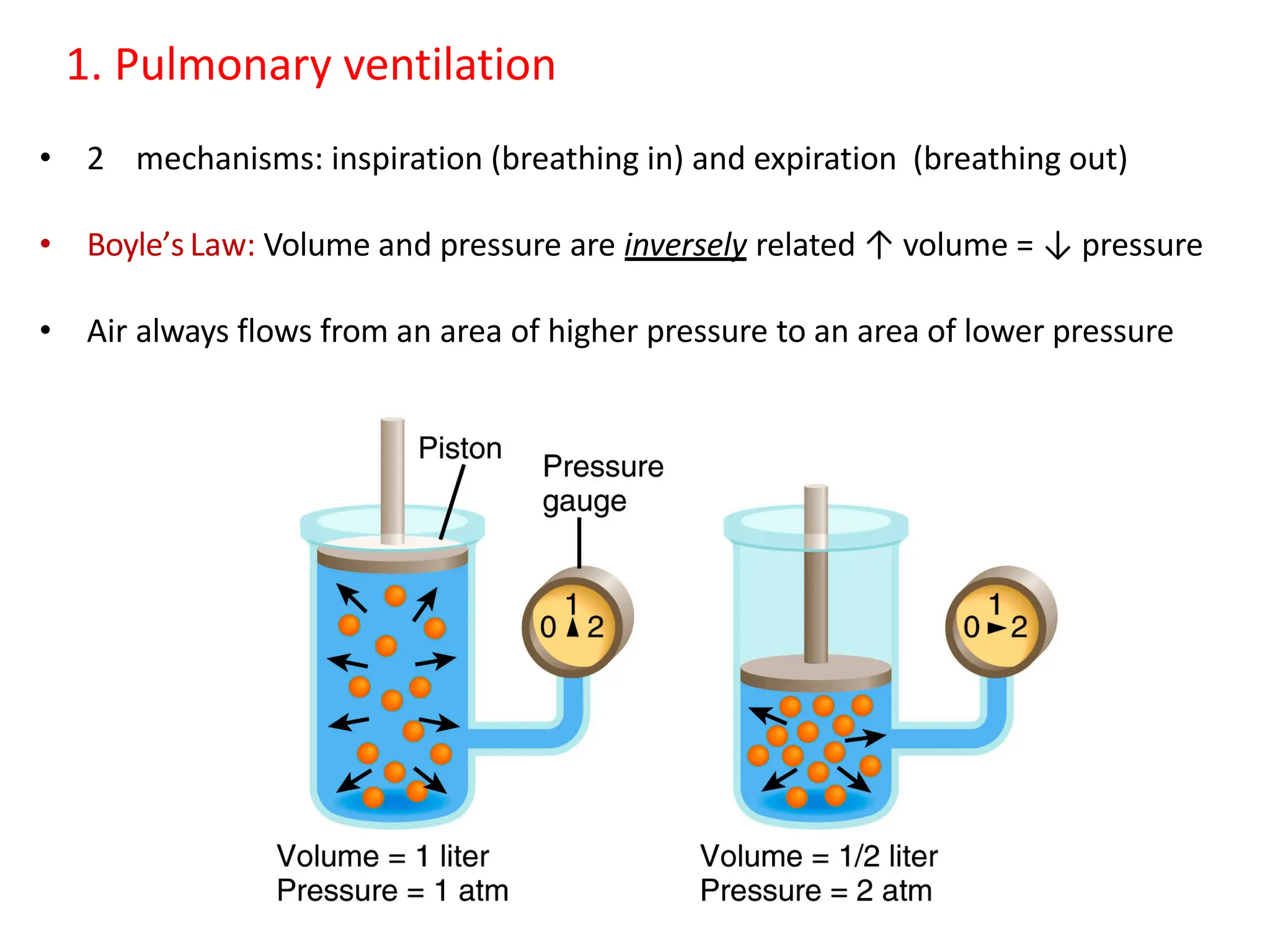
1. Pulmonary ventilation
• 2 mechanisms: inspiration (breathing in) and expiration (breathing out)
• Boyle’s Law: Volume and pressure are inversely related ↑ volume = ↓ pressure
• Air always flows from an area of higher pressure to an area of lower pressure
Pulmonary Pressures
Pressure gradient: The difference between intrapulmonary and atmospheric
pressures
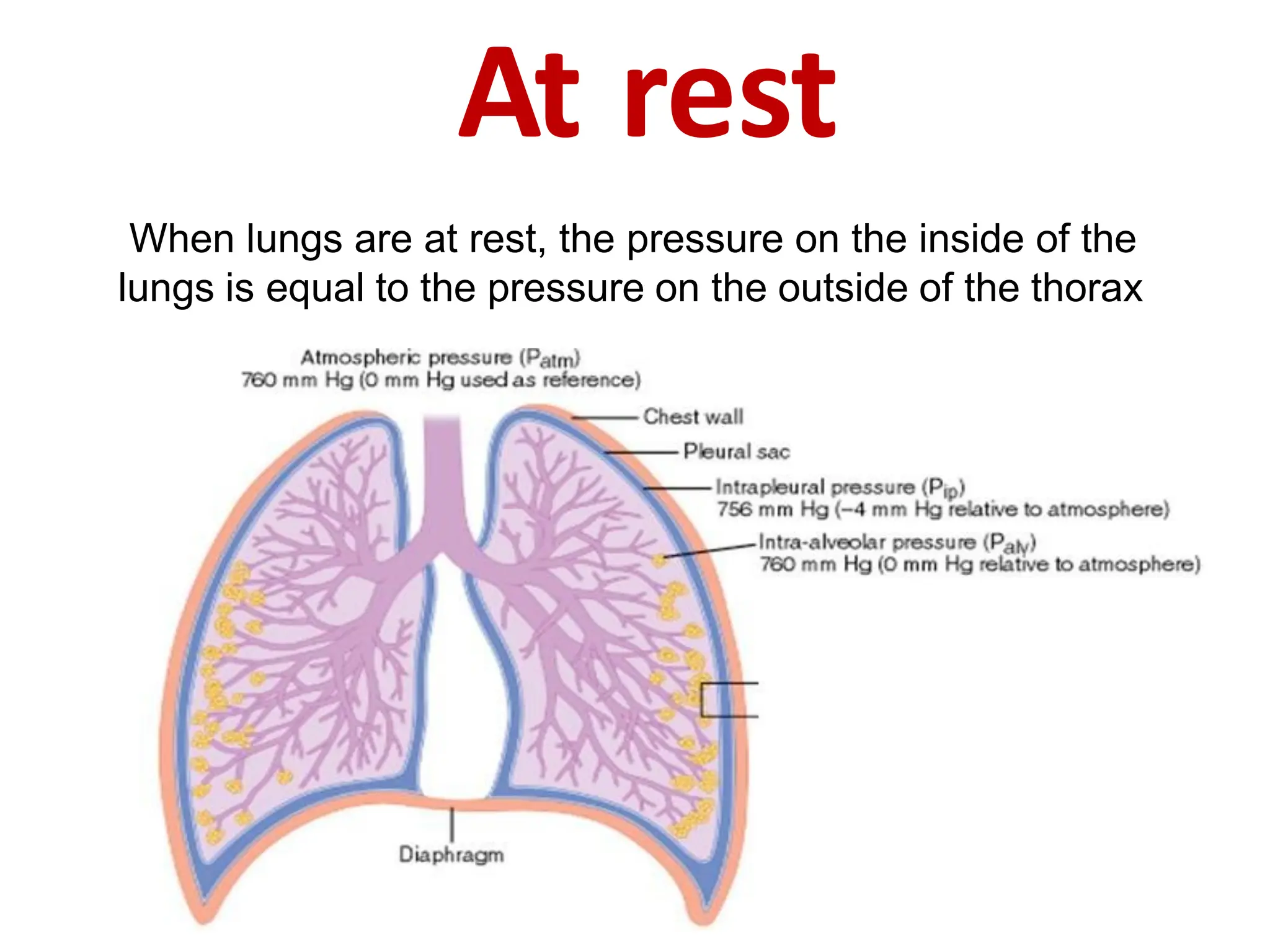
• Atmospheric pressure: The pressure exerted by the weight of
the air in atmosphere (~ 760 mmHg at sea level)
• Intra-alveolar (Intrapulmonary) pressure: The pressure inside the lungs
• Intrapleural pressure: The pressure inside the pleural space.
• Transpulmonary pressure The difference betweenthe intra-
alveolar and intrapleural pressures.
Exhalation
Exhalation results from elastic recoil of the
chest wall and lungs, both of which have a
natural tendency to spring back after they
have been stretched.
Exhalation starts when the inspiratory
muscles relax. As the diaphragm relaxes, its
dome moves superiorly owing to its
elasticity. As the external intercostals relax,
the ribs are depressed.
These movements decrease the vertical,
lateral, and anteroposterior diameters of
the thoracic cavity, which decreases lung
volume.
In turn, the alveolar pressure increases to
about 762 mmHg. Air then flows from the
area of higher pressure in the alveoli to the
area of lower pressure in the atmosphere
Airway resistance
• The flow of air through the airways depends on both the
pressure difference and the resistance
• Airway resistance is most affected by changes in the diameter
of the bronchioles
– ↓ diameter of the bronchioles = ↑ airway resistance
• During inspiration, the resistance to airflow decreases
• During expiration, the resistance to airflow increases
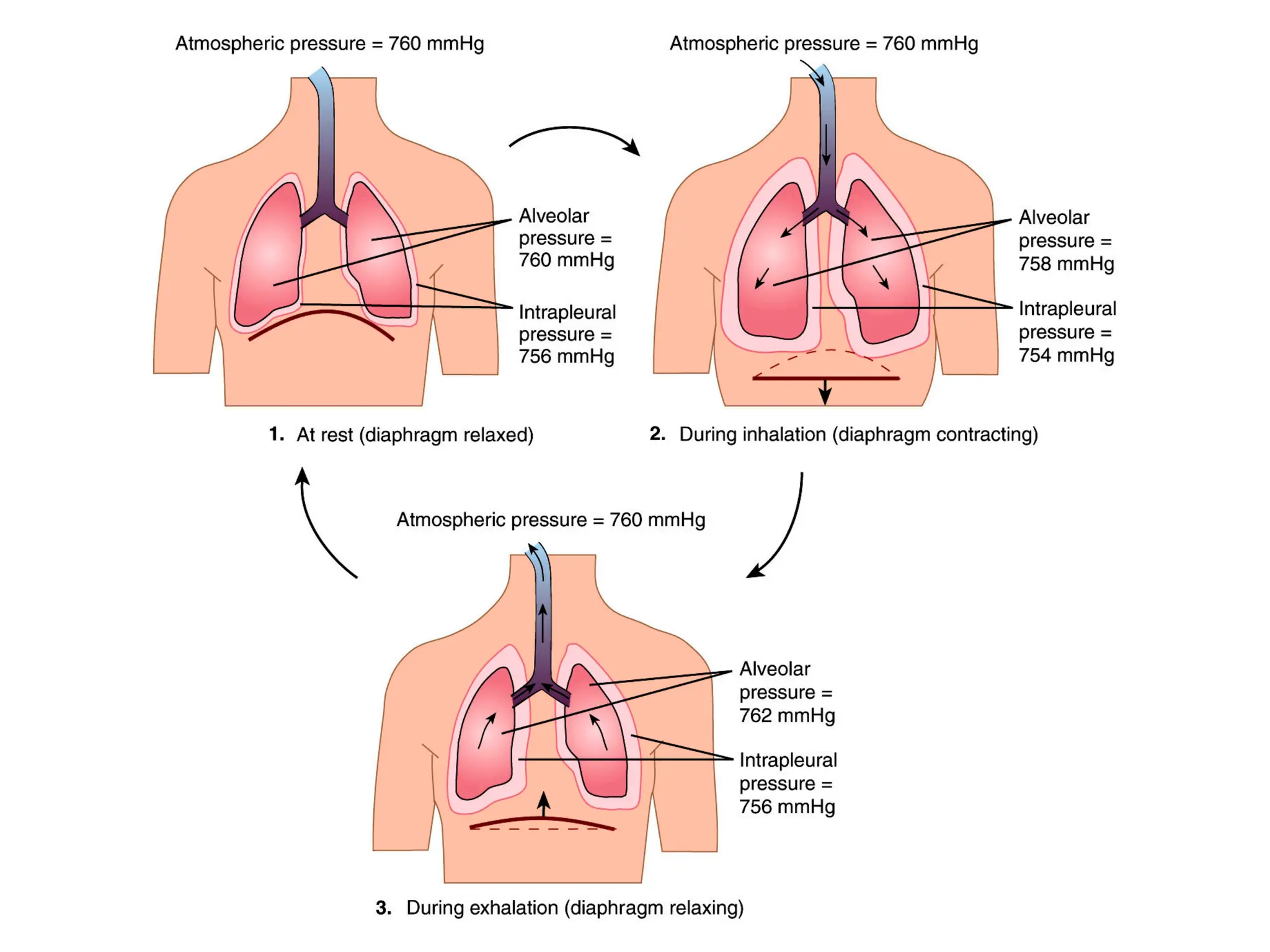
At rest
When lungs are at rest, the pressure on the inside of the
lungs is equal to the pressure on the outside of the thorax
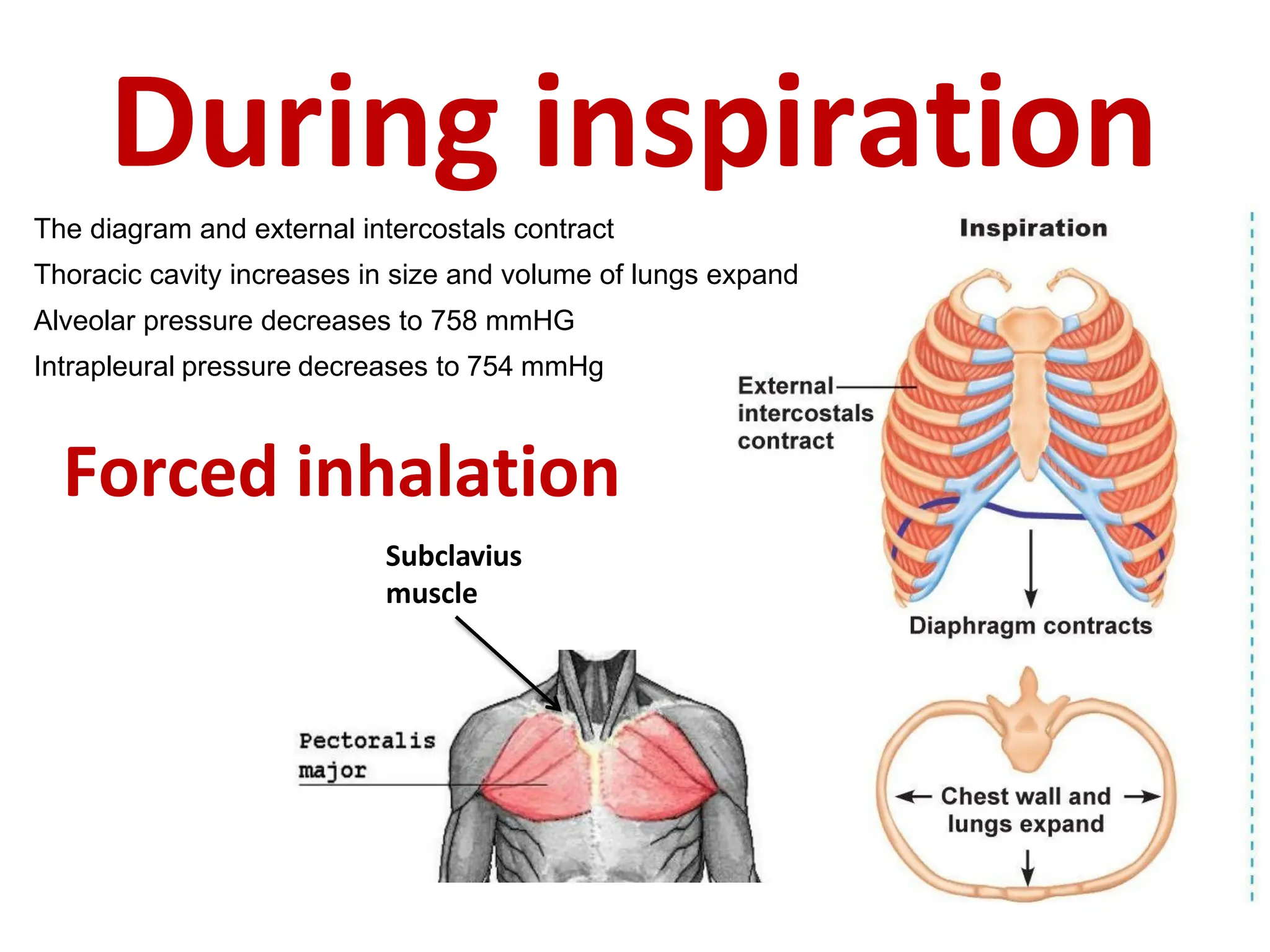
During inspiration
The diagram and external intercostals contract
Thoracic cavity increases in size and volume of lungs expand
Alveolar pressure decreases to 758 mmHG
Intrapleural pressure decreases to 754 mmHg
Subclavius
muscle
Forced inhalation
During exhalation
The diaphragm and external intercostals relax
Thoracic cavity decreases in size and lungs recoil
Alveor pressure increases to 762 mmHg
Intrapleural pressure increases to 756 mmHg
Forced exhalation
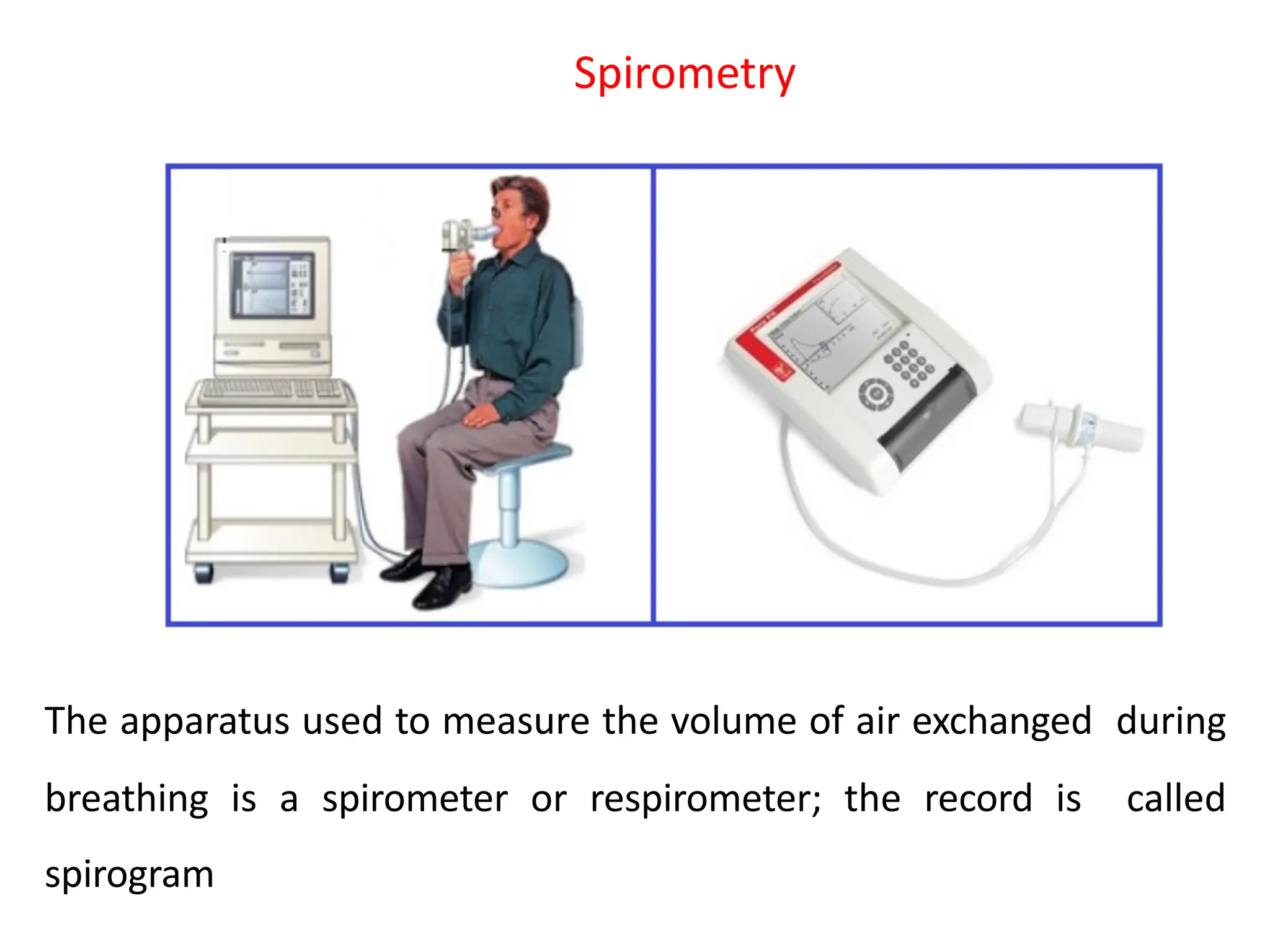
Spirometry
The apparatus used to measure the volume of air exchanged during
breathing is a spirometer or respirometer; the record is called
spirogram
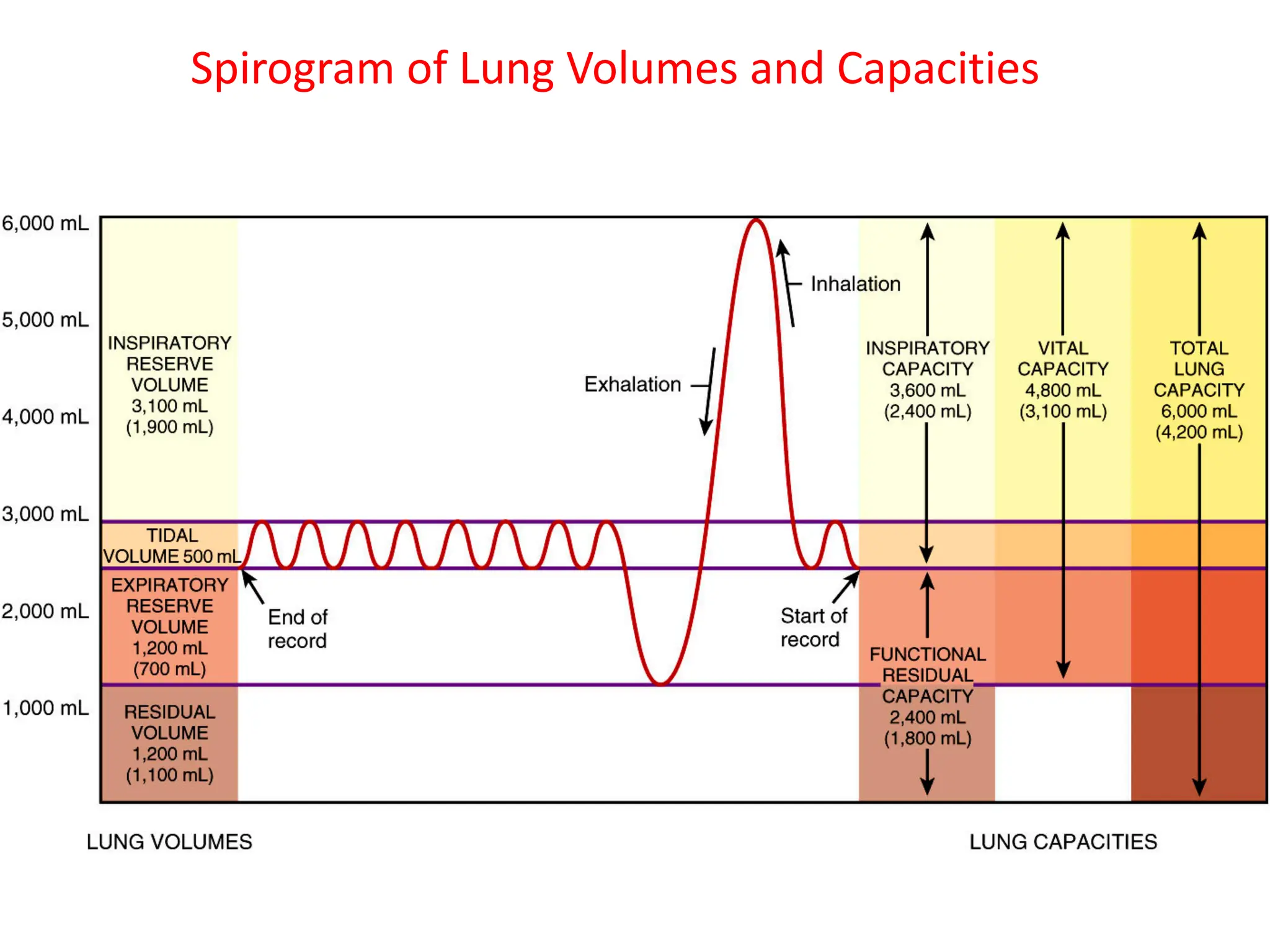
Spirogram of Lung Volumes and Capacities
Lung volumes and capacities
Lung Volumes
• Tidal Volume (VT)
– amount of air entering/leaving
lungs in a single, “normal” breath
– 500 ml at rest
• Inspiratory Reserve Volume (IRV)
– additional volume of air that can
be maximally inspired beyond
VT by forced inspiration
– 3100 ml. at rest
• Expiratory Reserve Volume (ERV)
– additional volume of air that can
be maximally expired beyond VT
by forced expiration
– 1200 ml. at rest
• Residual Volume (RV)
– volume of air that
remain in the lungs
after a forced
maximum expiration,
keeping the lungs
partially inflated
– 1200 ml. at rest
Lung Volumes
Lung Capacities
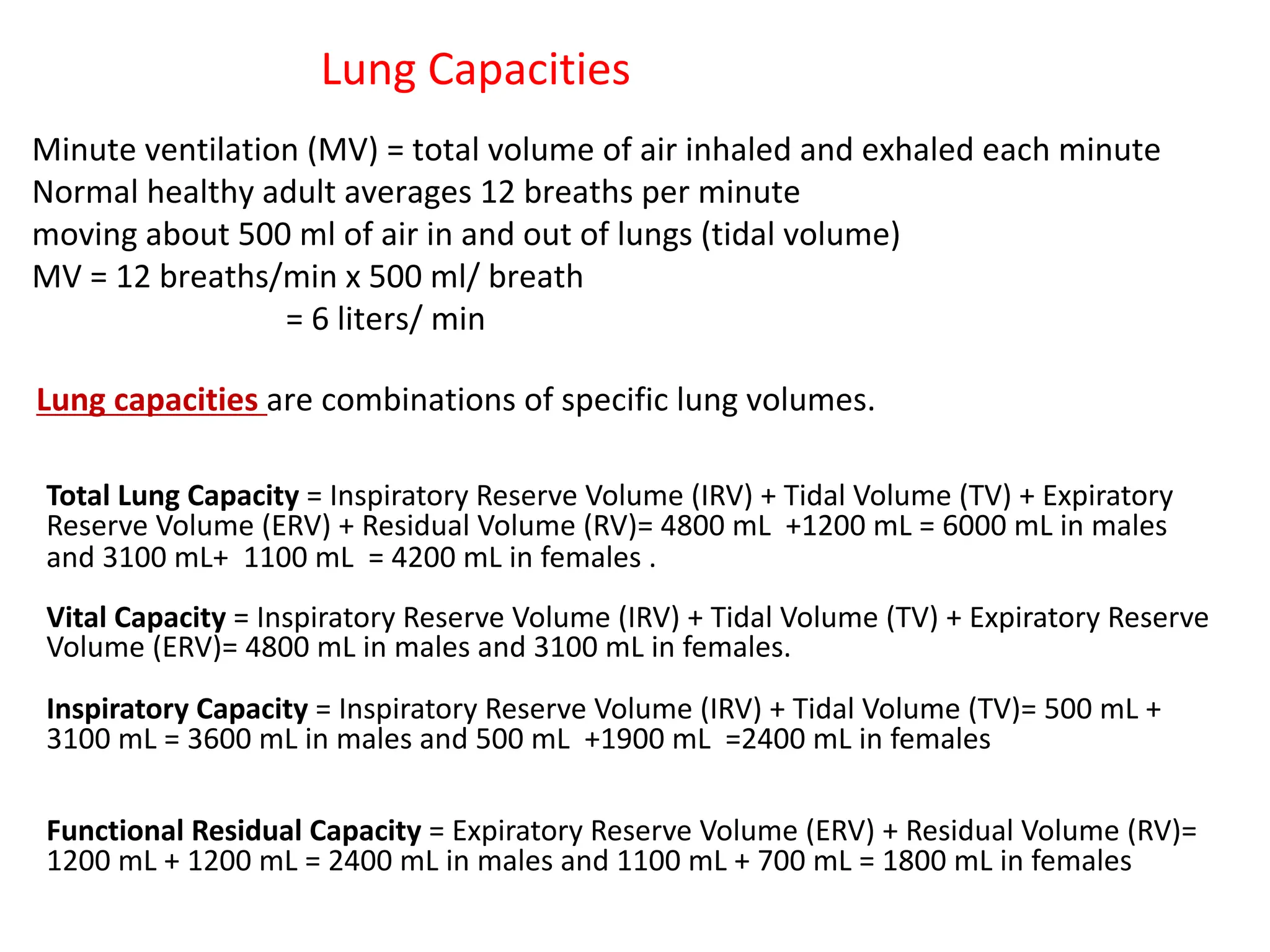
Minute ventilation (MV) = total volume of air inhaled and exhaled each minute
Normal healthy adult averages 12 breaths per minute
moving about 500 ml of air in and out of lungs (tidal volume)
MV = 12 breaths/min x 500 ml/ breath
= 6 liters/ min
Lung capacities are combinations of specific lung volumes.
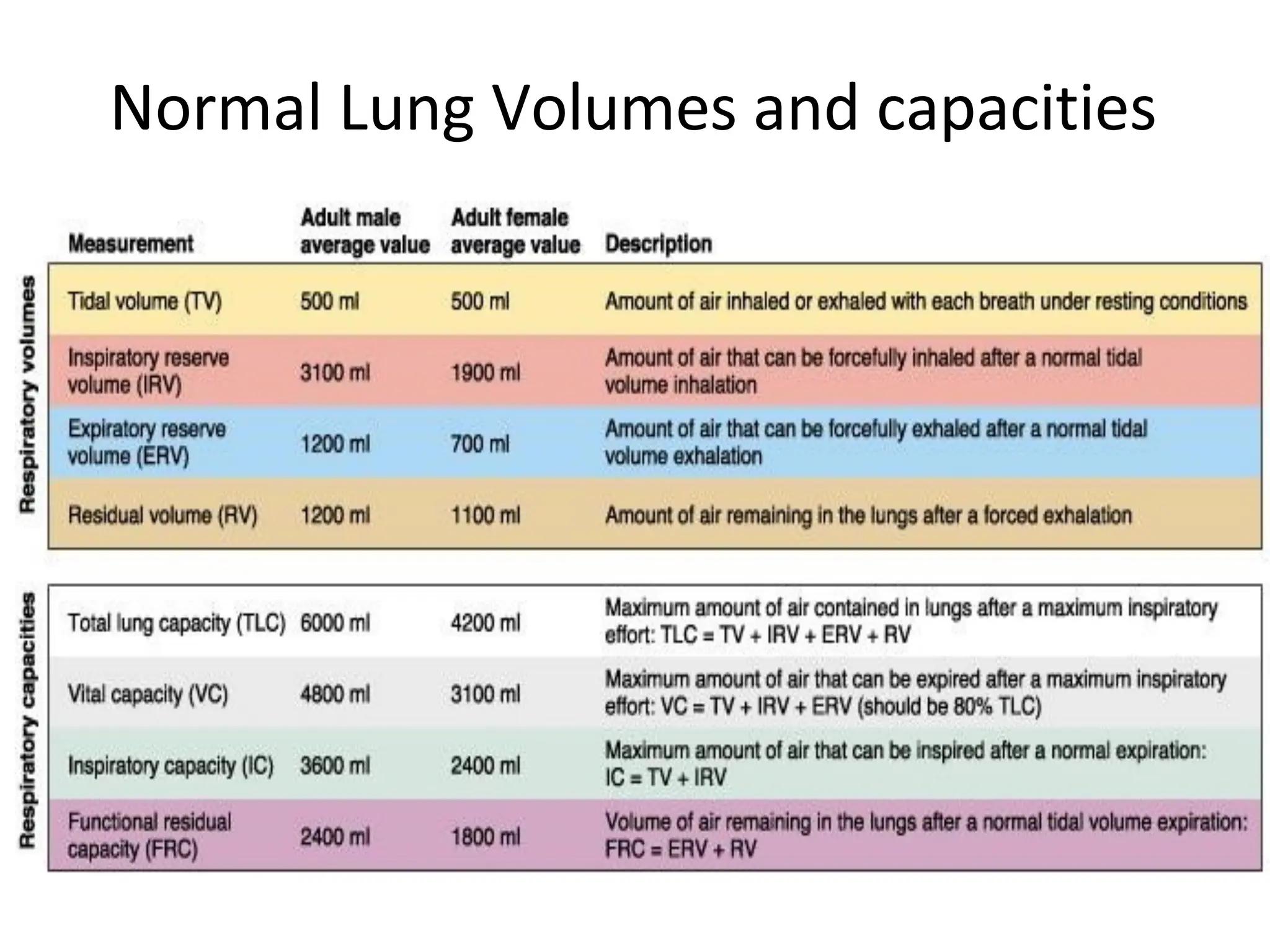
Total Lung Capacity = Inspiratory Reserve Volume (IRV) + Tidal Volume (TV) + Expiratory
Reserve Volume (ERV) + Residual Volume (RV)= 4800 mL +1200 mL = 6000 mL in males
and 3100 mL+ 1100 mL = 4200 mL in females .
Vital Capacity = Inspiratory Reserve Volume (IRV) + Tidal Volume (TV) + Expiratory Reserve
Volume (ERV)= 4800 mL in males and 3100 mL in females.
Inspiratory Capacity = Inspiratory Reserve Volume (IRV) + Tidal Volume (TV)= 500 mL +
3100 mL = 3600 mL in males and 500 mL +1900 mL =2400 mL in females
Functional Residual Capacity = Expiratory Reserve Volume (ERV) + Residual Volume (RV)=
1200 mL + 1200 mL = 2400 mL in males and 1100 mL + 700 mL = 1800 mL in females
Normal Lung Volumes and capacities
Minute ventilation
The total volume of air inspired and expired each minute
minute ventilation (ml/min)
=
tidal volume (L/breath)
0.5 L/ breath x
x respiratory rate (breaths/min)
15 cycles/min
7.5 L/min
Anatomic dead space
• In any average adult, about 70 % of the tidal volume actually
reaches the respiratory portion of the respiratory system,
while 30% remains in air spaces of the conducting portion of
the respiratory system. These areas are known as the
anatomic dead space (VD) that does not undergo respiratory
exchange
• Role: Warms and filtered the air
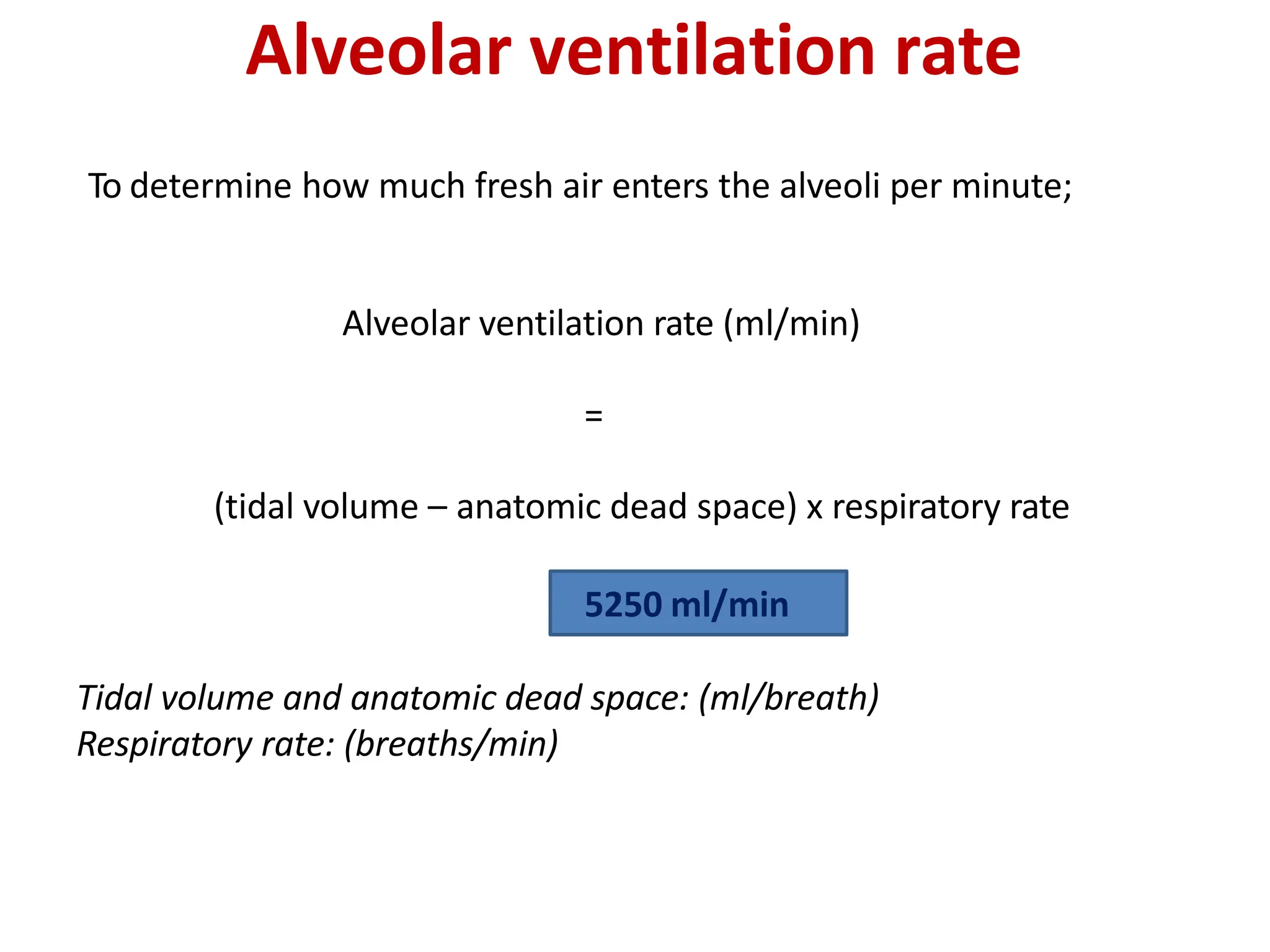
Alveolar ventilation rate
To determine how much fresh air enters the alveoli per minute;
Alveolar ventilation rate (ml/min)
=
(tidal volume – anatomic dead space) x respiratory rate
5250 ml/min
Tidal volume and anatomic dead space: (ml/breath)
Respiratory rate: (breaths/min)
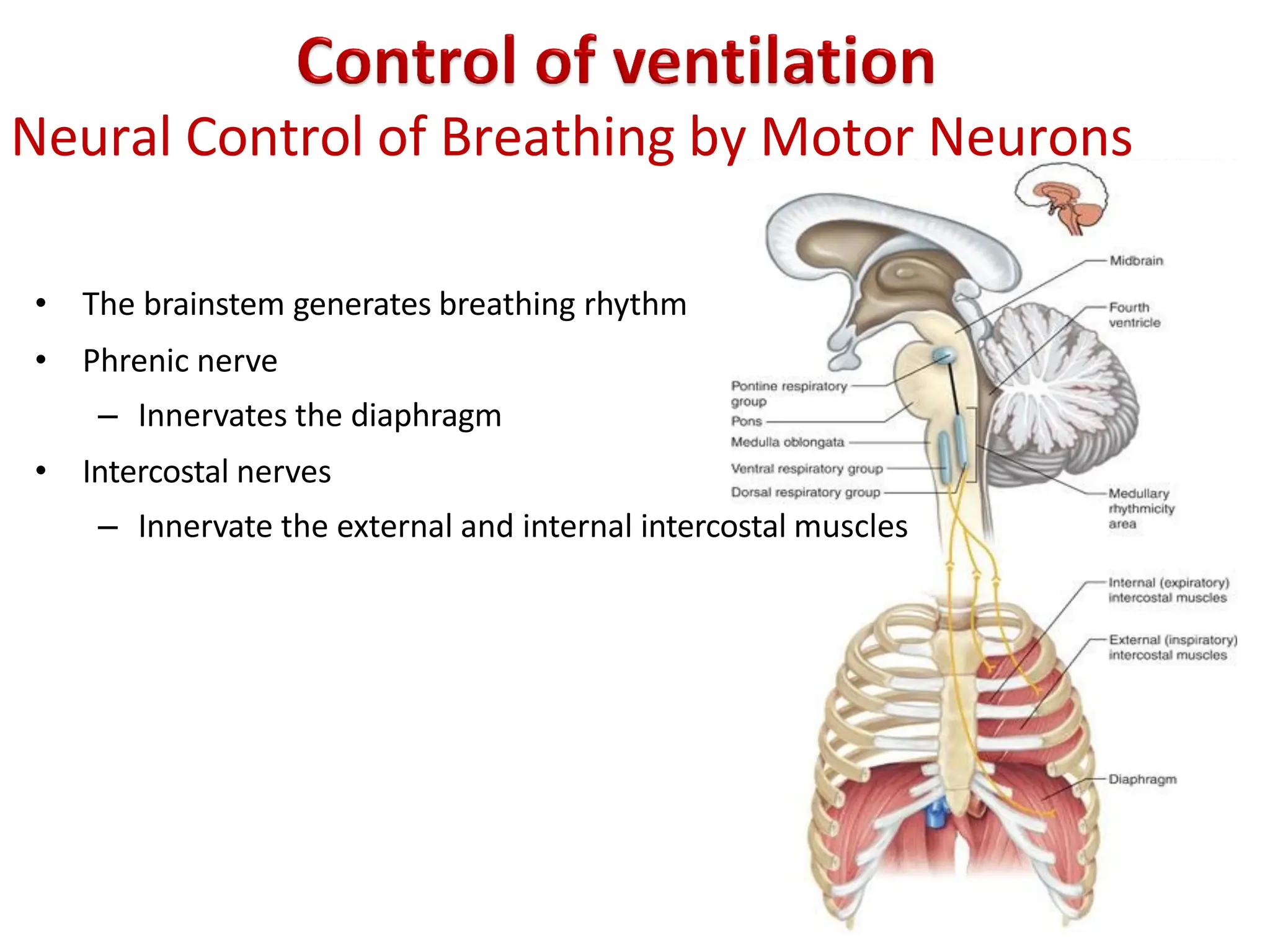
Neural Control of Breathing by Motor Neurons
• The brainstem generates breathing rhythm
• Phrenic nerve
– Innervates the diaphragm
• Intercostal nerves
– Innervate the external and internal intercostal muscles
Generation of the Breathing Rhythm by the
Brainstem
• Central control of respiration is not completely
understood
• Research indicates that respiratory control centers
are located in the brainstem
• Respiratory control centers include…
– Medullary Rhythmicity Area of the medulla oblongata
– Pneumotaxic Area of the pons
– Apneustic Center of the pons
Medullary Rhythmicity Area
• Includes two groups of
neurons:
– Dorsal Respiratory Group
– Ventral Respiratory Group
Medullary Rhythmicity Area
The Dorsal Respiratory Group
• The medullary inspiratory center
• Functions in quiet breathing
– The respiratory cycle is repeated 12 - 15 times/minute
• Quiet breathing - Inhalation
– The dorsal inspiratory neurons transmit nerve impulses via the phrenic
and intercostal nerves to the diaphragm and external intercostal
muscles
– When these muscles contract, the lungs fill with air
Medullary Rhythmicity Area
The Ventral Respiratory Group
• Inspiration and expiration center
• Functions only in forced breathing
• The ventral expiratory neurons transmit nerve impulses
to the muscles of breathing
– Accessory inspiratory muscles
– The internal intercostals
– The abdominal muscles
`
To internal
intercostal
muscles
Pneumotaxic Area
The Pontine Respiratory Group
• Facilitates the transition between
inspiration and expiration
•Regulates the frequency of
respiration
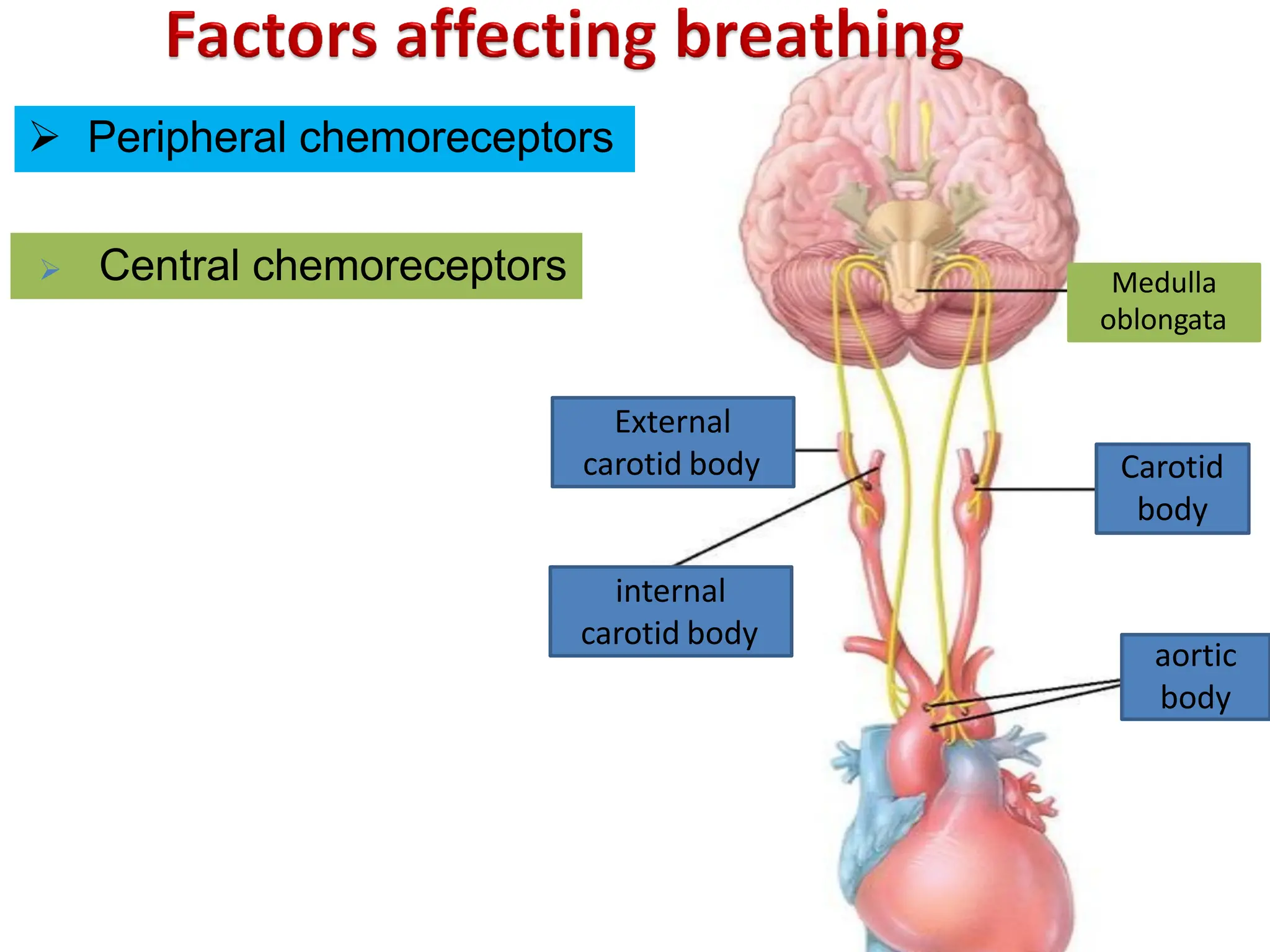
External
carotid body
internal
carotid body
aortic
body
Carotid
body
Medulla
oblongata
Ø Peripheral chemoreceptors
Ø Central chemoreceptors
Peripheral Chemoreceptors
• Location:
– Carotid and aortic bodies
– Connected to medulla by afferent neurons in the glossopharyngeal (N IX)
nerve and vagus ( N X) nerve
• Chemical concentration of the blood is most important
– Changing levels of O2,CO2 and pH of the blood
– Sensitive to low arterial O2 concentrations (below 60 mmHg)
Central Chemoreceptors
• Located in the ventro-lateral surface of the medulla
• sensitive to a increase of [CO2] and H+ ion concentration
in arterial blood and CSF
• Increased CO2 = increased concentration of H+ ions (↓
pH)
• ↓ arterial pH causes the respiratory system to attempt to
restore normal blood pH by…
– ↑ ventilation to decrease CO2 levels
– This results in an increase in pH to normal levels
Disturbances in Respiration
Hypercapnea
• An ↑ in the arterial CO2 concentration with a resultant ↓ in
pH
• This condition stimulates the…
– Central chemoreceptors and peripheral chemoreceptors
– Medullary respiratory centers
• Stimulates an increase in ventilation
CO2 Drive
Transport of oxygen and carbon
dioxide
• Blood transports gases between the lungs and body tissue
1) Oxygen transport
2) Carbon dioxide transport
Oxygen transport
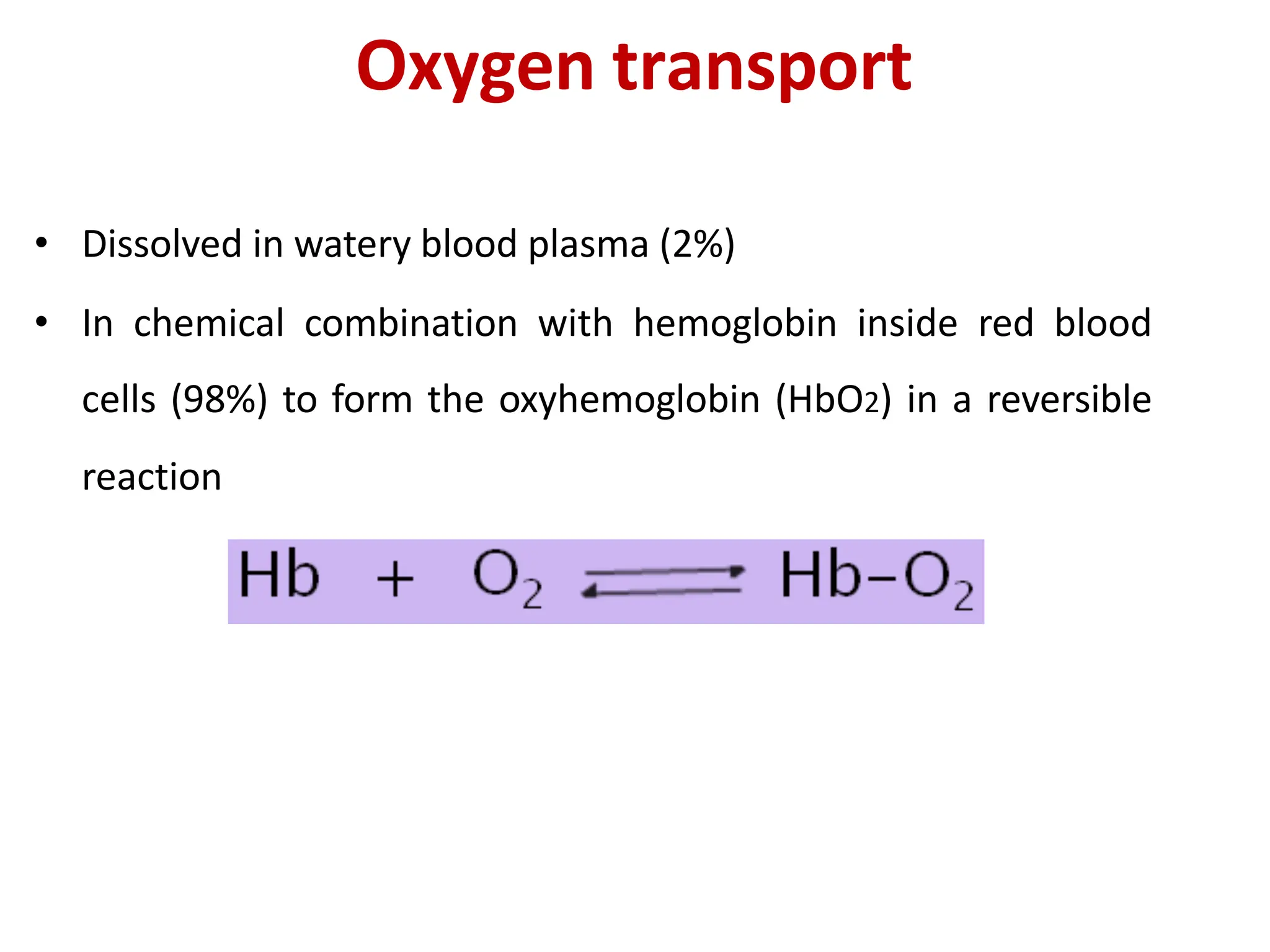
• Dissolved in watery blood plasma (2%)
• In chemical combination with hemoglobin inside red blood
cells (98%) to form the oxyhemoglobin (HbO2) in a reversible
reaction
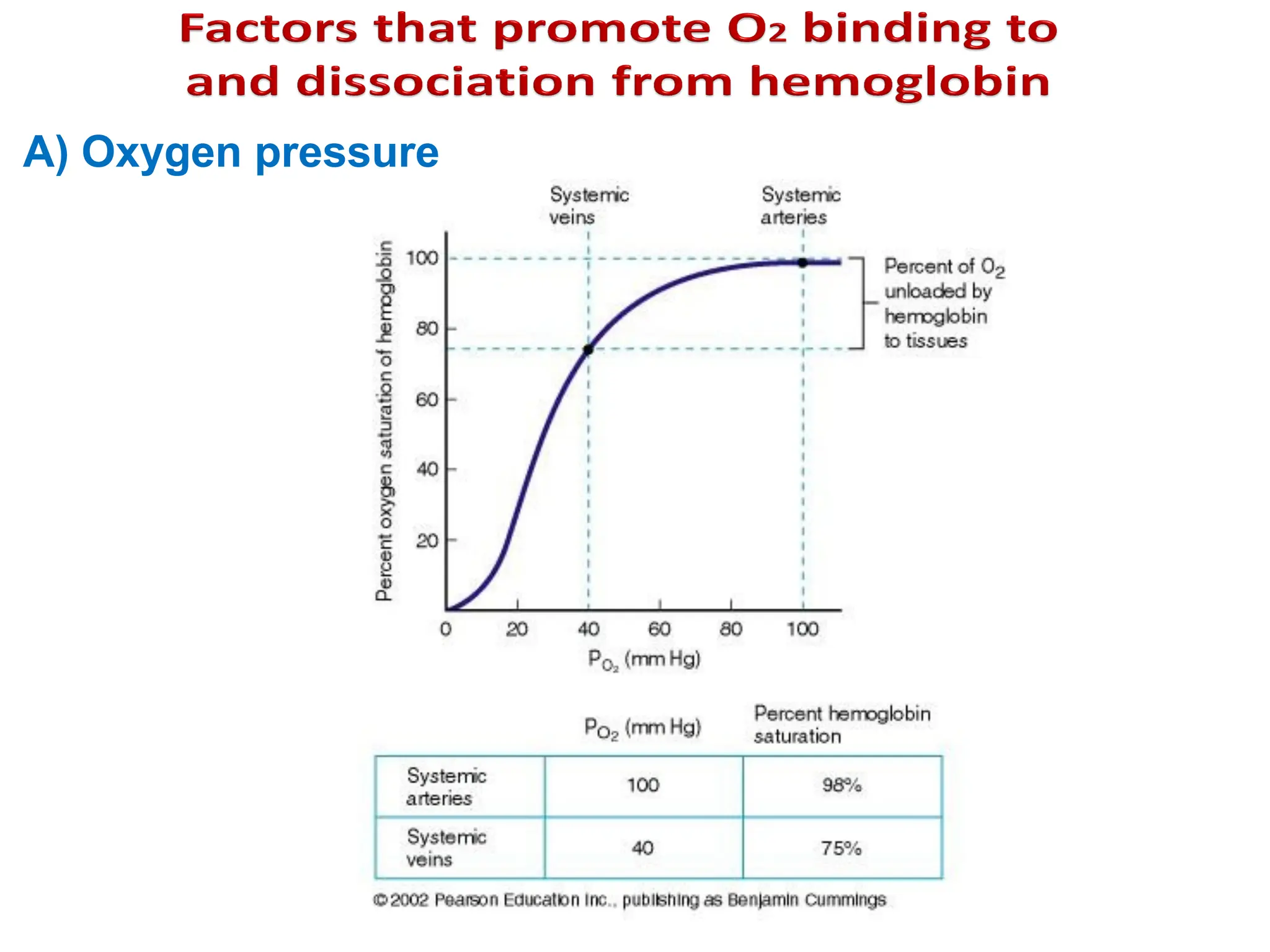
A) Oxygen pressure
B) Acidity (pH)
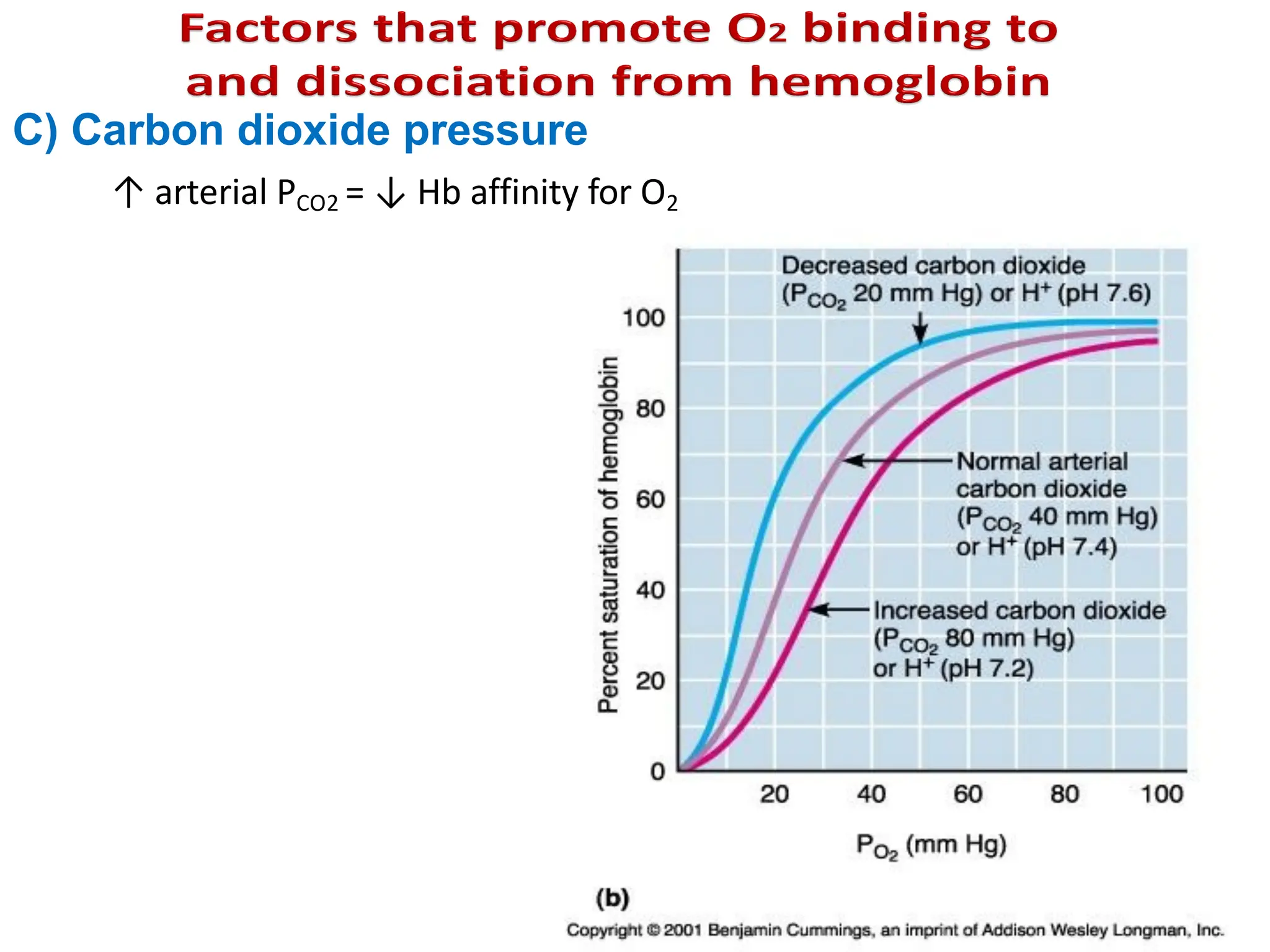
↑ H+ ions (↓ pH) = ↓ Hb affinity for O2
C) Carbon dioxide pressure
↑ arterial PCO2 = ↓ Hb affinity for O2
D) Temperature
↑ body temperature = ↓ Hb affinity for O2
Carbon dioxide transport
Ø Dissolved in the blood plasma (7%)
Ø In chemical combination with
carbaminohemoglobin (23%)
hemoglobin as
Ø Transported in plasma as bicarbonate ions (HCO3-) (70%)
Summary
Oxygen in tissue cell
Oxygen in lungs
Carbon Dioxide in tissue cell
82
83
Chloride Shift
• bicarbonate ions diffuse out RBCs
• chloride ions from plasma diffuse into RBCs
• electrical balance is maintained
Carbon Dioxide in Lungs
84

The Respiratory system _250410_111254.pdf

  • 1.
  • 2.
  • 3.
    Nose External nose –portion visible on face The interior structures of the external nose have three functions: • warming, moistening, and filtering incoming air; • detecting olfactory stimuli; • modifying speech vibrations as they pass through the large, hollow resonating chambers. Internal nose – large cavity beyond nasal vestibule • Internal nares or choanae • Ducts from paranasal sinuses and nasolacrimal ducts open into internal nose • Nasal cavity divided by nasal septum and subdivide cavity into meatuses: Increase surface are and prevents dehydration • Olfactory receptors in olfactory epithelium
  • 4.
    Cilia and mucus Theepithelial surfaces of the airways, from nose to the lungs: Ø contain cilia that transport the mucus to the pharynx Ø Mucus are secreted by the goblet cells Functions: • Mucus is important to keep the lungs clear of particle matter and many bacteria that enter the body on dust particles. • warmed the air moving into body by the heat providing by the presence of the capillaries
  • 5.
    Each lung isenclosed and protected by a double-layered membrane known as the pleural membrane: The visceral pleura: covers the external surface of lung The parietal pleura: covers the wall of the thoracic cavity The pleural cavity: a space between the two layers, contains a lubricating fluid (intrapleural fluid). This pleural fluid reduces friction between the membranes, allowing them to slide easily over one another during breathing. Lungs
  • 6.
    Functionally, the respiratorysystem consists of two parts: 1. Conducting zone – Filter, warm and conducts air to lungs Nose, pharynx, larynx, trachea, bronchi, bronchioles and terminal bronchioles Functions of the Respiratory System
  • 7.
    2. Respiratory zone– main site of gas exchange between air and blood Respiratory bronchioles, alveolar ducts, alveolar sacs, and alveoli Functions of the Respiratory System Alveoli highly important for Gas Exchange
  • 8.
    Dr. Lina SABRA-MAKKE Componentsof Alveolus Lungs receive blood from Pulmonary artery- deoxygenated blood Bronchial arteries – oxygenated blood to perfuse the muscular walls of bronchi and bronchioles
  • 9.
    a) Type Ialveolar cells: • thin epithelial cells •Make up most of the alveolar walls b) Type II alveolar cells: • thick epithelial cells that produce a detergent; Surfactant c) Alveolar macrophages: • phagocytosis and defense The main types of alveolar cells
  • 10.
    Surfactant • Complex mixtureof phospholipids and lipoproteins substance secreted by the type II alveolar cells • Formed at the last week of pregnancy • covers and coats alveolar surface • reduces the tendency of alveoli to collapse
  • 11.
    • In thelungs we have two major cholinergic and adrenergic receptors subtypes: M3 cholinergic and β2 adrenergic receptors • Stimulation of M3 receptors causes bronchoconstriction while the stimulation of β2 receptors causes a bronchodilation. ü Its is useful to note that an asthma is a chronic inflammation of smooth airways and is characterized by an intense broncho- constriction. ü We used an adrenaline to calm this problem. ü Thus, β2- adrenergic drugs (Ventolin: Salbutamol) are used in the treatment of asthma
  • 12.
    Pneumothorax • Pneumo meansair and thorax is the chest cavity. Its is an abnormal collection of air in the pleural cavity. • It occurs when air leaks into the space between your lungs and the chest wall. • This air pushes on the outside of your lungs and makes it collapse. A pneumothorax can be a complete lung collapse or a collapse of only a portion of the lung. • Symptoms usually include sudden chest pain and shortness of breath.
  • 13.
    Pulmonary ventilation The processof gas exchange in the body, called respiration, has three basic steps: 1. Pulmonary ventilation ( pulmon- lung), or breathing, is the inhalation (inflow) and exhalation (outflow) of air and involves the exchange of air between the atmosphere and the alveoli of the lungs. 2. External (pulmonary) respiration is the exchange of gases between the alveoli of the lungs and the blood in pulmonary capillaries across the respiratory membrane. In this process, pulmonary capillary blood gains O2 and loses CO2. 3. Internal (tissue) respiration is the exchange of gases between blood in systemic capillaries and tissue cells. In this step the blood loses O2 and gains CO2. Within cells, the metabolic reactions that consume O2 and give off CO2 during the production of ATP are termed cellular respiration
  • 14.
    Factors Affecting PulmonaryVentilation Lung compliance • Ability of the lungs to be expanded, stretched, or inflated. • Depends on Elasticity of the lung tissue refers to the ability of the lung to inflate easily. Surface Tension • The force of attraction between liquid molecules. • Surfactant reduces the surface tension in the alveoli allowing them to easily expand to twice their size with each breath and it interferes with the attraction between fluid molecules.
  • 15.
    1. Pulmonary ventilation •2 mechanisms: inspiration (breathing in) and expiration (breathing out) • Boyle’s Law: Volume and pressure are inversely related ↑ volume = ↓ pressure • Air always flows from an area of higher pressure to an area of lower pressure
  • 16.
    Pulmonary Pressures Pressure gradient:The difference between intrapulmonary and atmospheric pressures • Atmospheric pressure: The pressure exerted by the weight of the air in atmosphere (~ 760 mmHg at sea level) • Intra-alveolar (Intrapulmonary) pressure: The pressure inside the lungs • Intrapleural pressure: The pressure inside the pleural space. • Transpulmonary pressure The difference betweenthe intra- alveolar and intrapleural pressures.
  • 17.
    Exhalation Exhalation results fromelastic recoil of the chest wall and lungs, both of which have a natural tendency to spring back after they have been stretched. Exhalation starts when the inspiratory muscles relax. As the diaphragm relaxes, its dome moves superiorly owing to its elasticity. As the external intercostals relax, the ribs are depressed. These movements decrease the vertical, lateral, and anteroposterior diameters of the thoracic cavity, which decreases lung volume. In turn, the alveolar pressure increases to about 762 mmHg. Air then flows from the area of higher pressure in the alveoli to the area of lower pressure in the atmosphere
  • 20.
    Airway resistance • Theflow of air through the airways depends on both the pressure difference and the resistance • Airway resistance is most affected by changes in the diameter of the bronchioles – ↓ diameter of the bronchioles = ↑ airway resistance • During inspiration, the resistance to airflow decreases • During expiration, the resistance to airflow increases
  • 21.
    At rest When lungsare at rest, the pressure on the inside of the lungs is equal to the pressure on the outside of the thorax
  • 22.
    During inspiration The diagramand external intercostals contract Thoracic cavity increases in size and volume of lungs expand Alveolar pressure decreases to 758 mmHG Intrapleural pressure decreases to 754 mmHg Subclavius muscle Forced inhalation
  • 23.
    During exhalation The diaphragmand external intercostals relax Thoracic cavity decreases in size and lungs recoil Alveor pressure increases to 762 mmHg Intrapleural pressure increases to 756 mmHg Forced exhalation
  • 24.
    Spirometry The apparatus usedto measure the volume of air exchanged during breathing is a spirometer or respirometer; the record is called spirogram
  • 25.
    Spirogram of LungVolumes and Capacities
  • 26.
    Lung volumes andcapacities
  • 27.
    Lung Volumes • TidalVolume (VT) – amount of air entering/leaving lungs in a single, “normal” breath – 500 ml at rest • Inspiratory Reserve Volume (IRV) – additional volume of air that can be maximally inspired beyond VT by forced inspiration – 3100 ml. at rest • Expiratory Reserve Volume (ERV) – additional volume of air that can be maximally expired beyond VT by forced expiration – 1200 ml. at rest
  • 28.
    • Residual Volume(RV) – volume of air that remain in the lungs after a forced maximum expiration, keeping the lungs partially inflated – 1200 ml. at rest Lung Volumes
  • 29.
    Lung Capacities Minute ventilation(MV) = total volume of air inhaled and exhaled each minute Normal healthy adult averages 12 breaths per minute moving about 500 ml of air in and out of lungs (tidal volume) MV = 12 breaths/min x 500 ml/ breath = 6 liters/ min Lung capacities are combinations of specific lung volumes. Total Lung Capacity = Inspiratory Reserve Volume (IRV) + Tidal Volume (TV) + Expiratory Reserve Volume (ERV) + Residual Volume (RV)= 4800 mL +1200 mL = 6000 mL in males and 3100 mL+ 1100 mL = 4200 mL in females . Vital Capacity = Inspiratory Reserve Volume (IRV) + Tidal Volume (TV) + Expiratory Reserve Volume (ERV)= 4800 mL in males and 3100 mL in females. Inspiratory Capacity = Inspiratory Reserve Volume (IRV) + Tidal Volume (TV)= 500 mL + 3100 mL = 3600 mL in males and 500 mL +1900 mL =2400 mL in females Functional Residual Capacity = Expiratory Reserve Volume (ERV) + Residual Volume (RV)= 1200 mL + 1200 mL = 2400 mL in males and 1100 mL + 700 mL = 1800 mL in females
  • 30.
    Normal Lung Volumesand capacities
  • 31.
    Minute ventilation The totalvolume of air inspired and expired each minute minute ventilation (ml/min) = tidal volume (L/breath) 0.5 L/ breath x x respiratory rate (breaths/min) 15 cycles/min 7.5 L/min
  • 32.
    Anatomic dead space •In any average adult, about 70 % of the tidal volume actually reaches the respiratory portion of the respiratory system, while 30% remains in air spaces of the conducting portion of the respiratory system. These areas are known as the anatomic dead space (VD) that does not undergo respiratory exchange • Role: Warms and filtered the air
  • 33.
    Alveolar ventilation rate Todetermine how much fresh air enters the alveoli per minute; Alveolar ventilation rate (ml/min) = (tidal volume – anatomic dead space) x respiratory rate 5250 ml/min Tidal volume and anatomic dead space: (ml/breath) Respiratory rate: (breaths/min)
  • 34.
    Neural Control ofBreathing by Motor Neurons • The brainstem generates breathing rhythm • Phrenic nerve – Innervates the diaphragm • Intercostal nerves – Innervate the external and internal intercostal muscles
  • 35.
    Generation of theBreathing Rhythm by the Brainstem • Central control of respiration is not completely understood • Research indicates that respiratory control centers are located in the brainstem • Respiratory control centers include… – Medullary Rhythmicity Area of the medulla oblongata – Pneumotaxic Area of the pons – Apneustic Center of the pons
  • 36.
    Medullary Rhythmicity Area •Includes two groups of neurons: – Dorsal Respiratory Group – Ventral Respiratory Group
  • 37.
    Medullary Rhythmicity Area TheDorsal Respiratory Group • The medullary inspiratory center • Functions in quiet breathing – The respiratory cycle is repeated 12 - 15 times/minute • Quiet breathing - Inhalation – The dorsal inspiratory neurons transmit nerve impulses via the phrenic and intercostal nerves to the diaphragm and external intercostal muscles – When these muscles contract, the lungs fill with air
  • 38.
    Medullary Rhythmicity Area TheVentral Respiratory Group • Inspiration and expiration center • Functions only in forced breathing • The ventral expiratory neurons transmit nerve impulses to the muscles of breathing – Accessory inspiratory muscles – The internal intercostals – The abdominal muscles
  • 39.
  • 40.
    Pneumotaxic Area The PontineRespiratory Group • Facilitates the transition between inspiration and expiration •Regulates the frequency of respiration
  • 41.
  • 42.
    Peripheral Chemoreceptors • Location: –Carotid and aortic bodies – Connected to medulla by afferent neurons in the glossopharyngeal (N IX) nerve and vagus ( N X) nerve • Chemical concentration of the blood is most important – Changing levels of O2,CO2 and pH of the blood – Sensitive to low arterial O2 concentrations (below 60 mmHg)
  • 43.
    Central Chemoreceptors • Locatedin the ventro-lateral surface of the medulla • sensitive to a increase of [CO2] and H+ ion concentration in arterial blood and CSF • Increased CO2 = increased concentration of H+ ions (↓ pH) • ↓ arterial pH causes the respiratory system to attempt to restore normal blood pH by… – ↑ ventilation to decrease CO2 levels – This results in an increase in pH to normal levels
  • 44.
    Disturbances in Respiration Hypercapnea •An ↑ in the arterial CO2 concentration with a resultant ↓ in pH • This condition stimulates the… – Central chemoreceptors and peripheral chemoreceptors – Medullary respiratory centers • Stimulates an increase in ventilation
  • 45.
  • 46.
    Transport of oxygenand carbon dioxide • Blood transports gases between the lungs and body tissue 1) Oxygen transport 2) Carbon dioxide transport
  • 47.
    Oxygen transport • Dissolvedin watery blood plasma (2%) • In chemical combination with hemoglobin inside red blood cells (98%) to form the oxyhemoglobin (HbO2) in a reversible reaction
  • 48.
  • 49.
    B) Acidity (pH) ↑H+ ions (↓ pH) = ↓ Hb affinity for O2
  • 50.
    C) Carbon dioxidepressure ↑ arterial PCO2 = ↓ Hb affinity for O2
  • 51.
    D) Temperature ↑ bodytemperature = ↓ Hb affinity for O2
  • 52.
    Carbon dioxide transport ØDissolved in the blood plasma (7%) Ø In chemical combination with carbaminohemoglobin (23%) hemoglobin as Ø Transported in plasma as bicarbonate ions (HCO3-) (70%)
  • 53.
  • 54.
    Oxygen in tissuecell Oxygen in lungs
  • 55.
    Carbon Dioxide intissue cell 82
  • 56.
    83 Chloride Shift • bicarbonateions diffuse out RBCs • chloride ions from plasma diffuse into RBCs • electrical balance is maintained
  • 57.