Consultation Liaison
Psychiatry
Guided by – Dr. Rahul Mathur
Assistant Professor
MGM Medical College Indore
Presenter – Dr. Priyash Jain
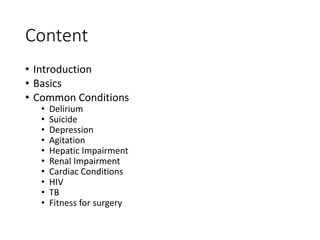
Content
• Introduction
• Basics
• Common Conditions
• Delirium
• Suicide
• Depression
• Agitation
• Hepatic Impairment
• Renal Impairment
• Cardiac Conditions
• HIV
• TB
• Fitness for surgery
Introduction
Introduction
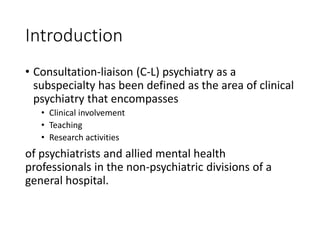
• Consultation-liaison (C-L) psychiatry as a
subspecialty has been defined as the area of clinical
psychiatry that encompasses
• Clinical involvement
• Teaching
• Research activities
of psychiatrists and allied mental health
professionals in the non-psychiatric divisions of a
general hospital.
Introduction
• “Consultation-Liaison" reflects two interrelated
roles of the consultants.
• "Consultation" refers to the provision of expert
opinion about the diagnosis and advice on
management regarding a patient's mental state and
behavior at the request of another health
professional.
• The term "Liaison" refers to linking up of groups for
the purpose of effective collaboration.
Introduction
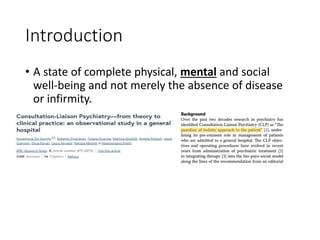
• A state of complete physical, mental and social
well-being and not merely the absence of disease
or infirmity.
Basics
Basics
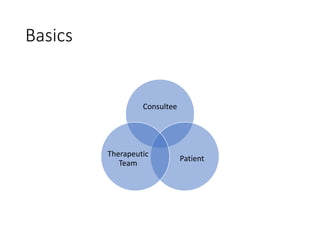
Consultee
Patient
Therapeutic
Team
Basics
• The basic aim of C-L Psychiatry is to integrate the
information so as to provide optimal health care to
patient and effective liaison with patient, consultee
and team.
• Hence for consultation to be most effective the
consultant psychiatrist need to have personal
contact with both the patient and those taking
care of him.
Basics – Functional Models
1. Consultation Model: traditional model, has patient as
the focus.
2. Liaison Model: consulting physician as the focus,
involves teaching of psychiatric and psychological
aspects of a problem to the physician.
3. Bridge Model: basically involves the teaching role of a
C-L psychiatrist for the primary care physician.
4. Hybrid Model: has psychiatrist as a part of
multidisciplinary team.
5. Autonomous psychiatric model: C-L psychiatrist is not
affiliated to any department but is hired by primary
care services.
Basics – Characteristics of
effective CLP
• Talks with the referring physician, nursing and other
staff before and after consultation.
• Clarifying the reason for the consultation is the initial
goal (not an easy job sometimes).
• Establishes the level of urgency.
• Reviews the chart and the data thoroughly.
• Performs a complete mental status exam and relevant
portions of a history and physical exam.
• Obtains medical history from family members or
friends as indicated.
• Makes notes as brief as appropriate
Basics – Characteristics of
effective CLP
• Arrives at a provisional/tentative diagnosis.
• Formulates a differential diagnosis.
• Recommends diagnostic tests.
• Has the knowledge to prescribe psychotropic drugs
and be aware of their interactions (with somatic
therapies).
• Makes specific recommendations that are brief,
goal oriented and free of psychiatric jargon and
discusses findings and recommendation with
consultee – In person whenever possible.
Basics – Characteristics of
effective CLP
• Follows-up patient until they are discharged from
the hospital or clinic or until the goals of the
consultation are achieved. Arranges out-patient
care-if necessary.
• Does not take over the aspects of the patient’s
medical care unless asked to do so.(can advise
physician but never interfere)
• Follows advances in the other medical fields and is
not isolated from the rest of the medical
community.
Basics – Approach to the care
• Emphasis on proper Documentation
• Thanking you for referral
• Demographic Details
• Date
• Reason for referral
• Referred by whom
• Location of the patient
• Primary Diagnosis of the patient
• Informant (with comment on reliabilty)
• Chief complaints
Basics – Approach to the care
• Emphasis on proper Documentation
• Brief Hopi/ Past History/Treatment History
• Medical History -Renal, Cardiac And Liver Dysfunction
• Menstrual/ Marital: Check Last Menses And Pregnancy
• Check for current Investigations
• Check For Drugs For Medical Conditions
• Physical Examination
• MSE
• Provisional Clinical Impression/Diagnosis
• Differential Diagnosis
Basics – Approach to the care
• Emphasis on proper Documentation
• Management plan:
• Additional blood investigations
• Additional psychological investigations
• Additional rating scales
• Additional consultations advise
• Additional imaging or neurophysiological test
• Check tests already done carefully, don’t repeat it
unnecessarily
Basics – Approach to the care
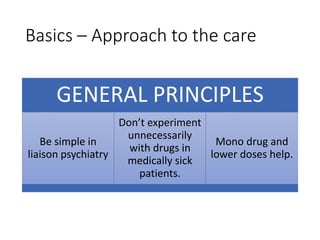
GENERAL PRINCIPLES
Be simple in
liaison psychiatry
Don’t experiment
unnecessarily
with drugs in
medically sick
patients.
Mono drug and
lower doses help.
Common Conditions
Common Conditions
• Delirium
• Suicide
• Depression
• Agitation
• Hepatic Impairment
• Renal Impairment
• Cardiac Conditions
• HIV
• TB
• Fitness for surgery
Common Conditions
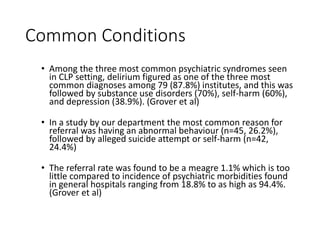
• Among the three most common psychiatric syndromes seen
in CLP setting, delirium figured as one of the three most
common diagnoses among 79 (87.8%) institutes, and this was
followed by substance use disorders (70%), self-harm (60%),
and depression (38.9%). (Grover et al)
• In a study by our department the most common reason for
referral was having an abnormal behaviour (n=45, 26.2%),
followed by alleged suicide attempt or self-harm (n=42,
24.4%)
• The referral rate was found to be a meagre 1.1% which is too
little compared to incidence of psychiatric morbidities found
in general hospitals ranging from 18.8% to as high as 94.4%.
(Grover et al)
Delirium
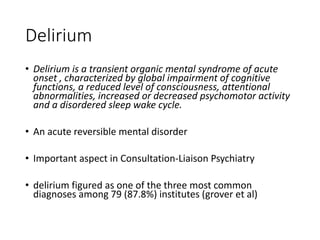
• Delirium is a transient organic mental syndrome of acute
onset , characterized by global impairment of cognitive
functions, a reduced level of consciousness, attentional
abnormalities, increased or decreased psychomotor activity
and a disordered sleep wake cycle.
• An acute reversible mental disorder
• Important aspect in Consultation-Liaison Psychiatry
• delirium figured as one of the three most common
diagnoses among 79 (87.8%) institutes (grover et al)
Delirium - Nosology
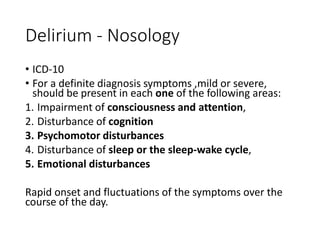
• ICD-10
• For a definite diagnosis symptoms ,mild or severe,
should be present in each one of the following areas:
1. Impairment of consciousness and attention,
2. Disturbance of cognition
3. Psychomotor disturbances
4. Disturbance of sleep or the sleep-wake cycle,
5. Emotional disturbances
Rapid onset and fluctuations of the symptoms over the
course of the day.
Delirium - Nosology
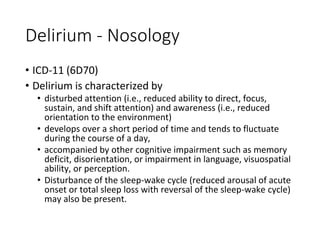
• ICD-11 (6D70)
• Delirium is characterized by
• disturbed attention (i.e., reduced ability to direct, focus,
sustain, and shift attention) and awareness (i.e., reduced
orientation to the environment)
• develops over a short period of time and tends to fluctuate
during the course of a day,
• accompanied by other cognitive impairment such as memory
deficit, disorientation, or impairment in language, visuospatial
ability, or perception.
• Disturbance of the sleep-wake cycle (reduced arousal of acute
onset or total sleep loss with reversal of the sleep-wake cycle)
may also be present.
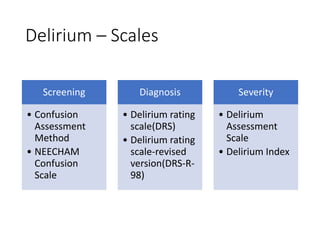
Delirium – Scales
Screening
• Confusion
Assessment
Method
• NEECHAM
Confusion
Scale
Diagnosis
• Delirium rating
scale(DRS)
• Delirium rating
scale-revised
version(DRS-R-
98)
Severity
• Delirium
Assessment
Scale
• Delirium Index
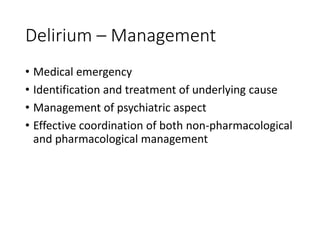
Delirium – Management
• Medical emergency
• Identification and treatment of underlying cause
• Management of psychiatric aspect
• Effective coordination of both non-pharmacological
and pharmacological management
Delirium – Management
• Provide reorientation (view of clock, calendars, familiar
objects)
• Encourage use of personal belongings
• Adequate lighting and temperature
• Encourage presence of family members
• Minimize transfers (perform procedure in room whenever
possible)
• Orient the patient to staff, surroundings, and situations
repeatedly, particularly before procedures
• Use of restrain only when….
• Increase risk of falls, injury, & delirium
• Use only in emergency, for as short a duration as possible with
frequent re-evaluations
• Repeatedly reassure the patient.
Suicide
• “N” number of factors associated with increased risk of
suicide in medical/surgical settings - Chronic illness,
Debilitating illness, Painful illness, Low pain tolerance,
Renal dialysis, Cardio-respiratory disease, AIDS.
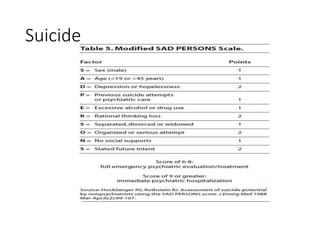
• Must be assessed diligently and appropriate scales must be
used like SAD persons or SBQ.
Suicide
Suicide - Management
• Treatment of Psychiatric Disorders
• Ward Management
• Hospital must issue suicide precaution guidelines
• Staff must be guided
i. Remove any potential object
ii. Search luggage and possessions
iii. Monitor all objects coming in the room potentially hazardous
iv. Dispensing of the medications
v. Constant observation
• Physical restraint often required in unpredictable or impulsive patients
Suicide - Management
• The consultation note must carefully document the
Diagnosis and treatment plan.
• Note must include the level of suicide risk, clearly
stating the plan and reporting of interval when the
patient will be reassessed
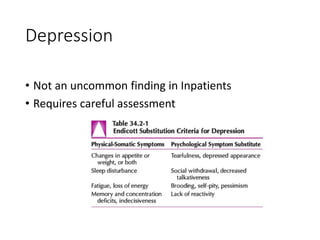
Depression
• Not an uncommon finding in Inpatients
• Requires careful assessment
Depression
• Treatment with anti-depressants can be started if
required
• Careful assessment of drug-drug interactions in
collaboration with primary physician
Agitation
• Often related to neurocognitive disorder or
withdrawal from drugs(opioids, alcohol, sedative –
hypnotics
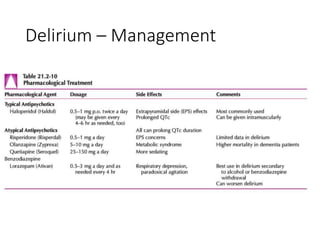
• Antipsychotic medication (Haloperidol) are very
useful for excessive agitation.
• Physical restraint- great caution and last resort
• But first rule out agitation due to medical/surgical
causes like excessive pain.
Hepatic Impairment
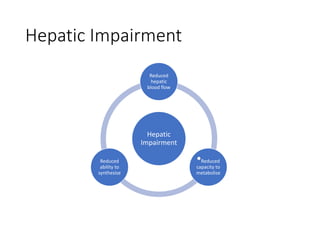
Hepatic
Impairment
Reduced
hepatic
blood flow
•Reduced
capacity to
metabolise
Reduced
ability to
synthesise
Hepatic Impairment – General
Principles
• Prescribe as few drugs as possible.
• Lower starting doses
• Leave longer intervals between dosage increases
• cautious with drugs that are extensively hepatically
metabolized
• Avoid medicines with a long half-life
• Avoid drugs that are very sedative
• Avoid drugs that are very constipating
• Avoid drugs that are known to be hepatotoxic
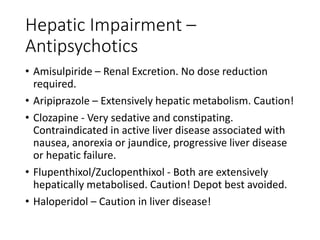
Hepatic Impairment –
Antipsychotics
• Amisulpiride – Renal Excretion. No dose reduction
required.
• Aripiprazole – Extensively hepatic metabolism. Caution!
• Clozapine - Very sedative and constipating.
Contraindicated in active liver disease associated with
nausea, anorexia or jaundice, progressive liver disease
or hepatic failure.
• Flupenthixol/Zuclopenthixol - Both are extensively
hepatically metabolised. Caution! Depot best avoided.
• Haloperidol – Caution in liver disease!
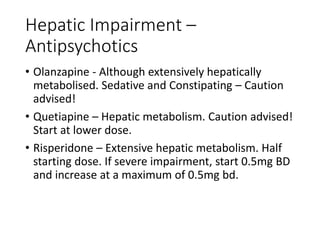
Hepatic Impairment –
Antipsychotics
• Olanzapine - Although extensively hepatically
metabolised. Sedative and Constipating – Caution
advised!
• Quetiapine – Hepatic metabolism. Caution advised!
Start at lower dose.
• Risperidone – Extensive hepatic metabolism. Half
starting dose. If severe impairment, start 0.5mg BD
and increase at a maximum of 0.5mg bd.
Hepatic Impairment
• – Antidepressants
• All SSRIs are hepatically metabolised. May accumulate
on chronic dosing. Dose reduction is required (upto
50%). Sertraline is preferred.
• All TCAs are hepatically metabolised and have high
protein binding.
• – Mood Stabilizers
• Dose reduction of all mood stabilisers by upto 50% with
slow titration and close monitoring of LFT.
• No dose reduction required with lithium.
Hepatic Impairment
• Benzodiazepines : Lorazepam, oxazepam,
temazepam considered to be safe.
Renal Impairment – General
Principles
• Be cautious when using drugs that are extensively
renally cleared (e.g. sulpiride, amisulpride, lithium).
• Start at a low dose and increase slowly because, in
renal impairment, the half‐life of a drug and the time
for it to reach steady state are often prolonged. Plasma
level monitoring may be useful for some drugs.
• Try to avoid long‐acting drugs (e.g. depot preparations).
Their dose and frequency cannot be easily adjusted
should renal function change.
• Prescribe as few drugs as possible. Patients with renal
failure take many medications requiring regular review.
Interactions and adverse effects can be avoided if fewer
drugs are used.
Renal Impairment
• No antipsychotic clearly preferred over other.
• Sulpiride and Amisulpiride avoided
• Anticholinergic drugs to be avoided.
• FGA - haloperidol 2–6 mg/day
• SGA – Olanzapine – 5mg/day
• Among antidepressants sertraline suggested as
reasonable choice though no agent clearly
preferred over other.
Renal Impairment
• Among Mood Stabilisers lithium to be avoided.
Other mood stabilisers to be started at a lower
dose.
• Sedatives and hypnotics to be given with utmost
caution. Watch for excess sedation. Lorazepam and
zopiclone are suggested as reasonable choices.
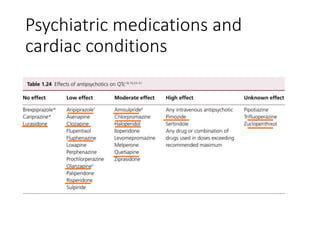
Psychiatric medications and
cardiac conditions
Psychiatric medications and
cardiac conditions
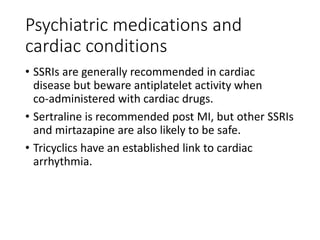
• SSRIs are generally recommended in cardiac
disease but beware antiplatelet activity when
co‐administered with cardiac drugs.
• Sertraline is recommended post MI, but other SSRIs
and mirtazapine are also likely to be safe.
• Tricyclics have an established link to cardiac
arrhythmia.
Prescribing in HIV Patients
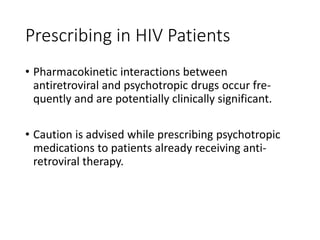
• Pharmacokinetic interactions between
antiretroviral and psychotropic drugs occur fre-
quently and are potentially clinically significant.
• Caution is advised while prescribing psychotropic
medications to patients already receiving anti-
retroviral therapy.
Prescribing in HIV Patients
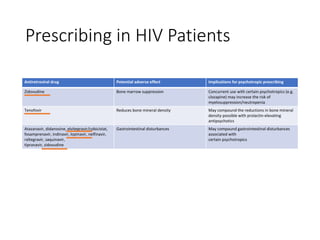
Antiretroviral drug Potential adverse effect Implications for psychotropic prescribing
Zidovudine Bone marrow suppression Concurrent use with certain psychotropics (e.g.
clozapine) may increase the risk of
myelosuppression/neutropenia
Tenofovir Reduces bone mineral density May compound the reductions in bone mineral
density possible with prolactin‐elevating
antipsychotics
Atazanavir, didanosine, elvitegravir/cobicistat,
fosamprenavir, indinavir, lopinavir, nelfinavir,
raltegravir, saquinavir,
tipranavir, zidovudine
Gastrointestinal disturbances May compound gastrointestinal disturbances
associated with
certain psychotropics
Prescribing in HIV Patients
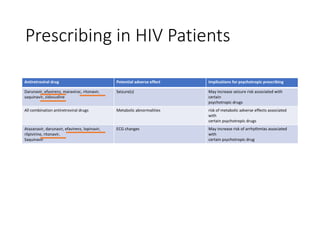
Antiretroviral drug Potential adverse effect Implications for psychotropic prescribing
Darunavir, efavirenz, maraviroc, ritonavir,
saquinavir, zidovudine
Seizure(s) May increase seizure risk associated with
certain
psychotropic drugs
All combination antiretroviral drugs Metabolic abnormalities risk of metabolic adverse effects associated
with
certain psychotropic drugs
Atazanavir, darunavir, efavirenz, lopinavir,
rilpivirine, ritonavir,
Saquinavir
ECG changes May increase risk of arrhythmias associated
with
certain psychotropic drug
Prescribing in TB patients
• Isoniazid, Ethambutol, Rifampicin, Cycloserine, 2nd
generation FQs, are known to cause psychiatric
disorders.
• Also various anti-tubercular drugs are known to
have multiple interactions with psychotropics.
• Hence Caution is advised while prescribing to
tubercular patients.
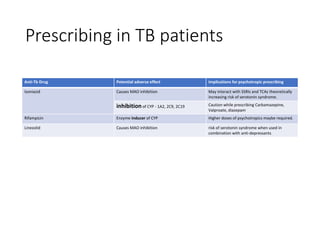
Prescribing in TB patients
Anti-Tb Drug Potential adverse effect Implications for psychotropic prescribing
Isoniazid Causes MAO inhibition May interact with SSRIs and TCAs theoretically
increasing risk of serotonin syndrome.
inhibition of CYP - 1A2, 2C9, 2C19 Caution while prescribing Carbamazepine,
Valproate, diazepam
Rifampicin Enzyme inducer of CYP Higher doses of psychotropics maybe required.
Linezolid Causes MAO inhibition risk of serotonin syndrome when used in
combination with anti-depressants
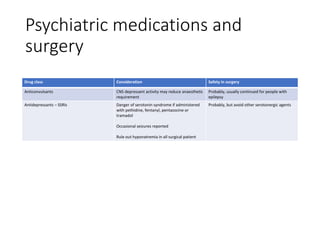
Psychiatric medications and
surgery
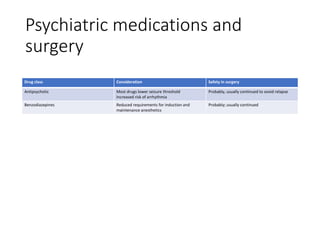
Drug class Consideration Safety in surgery
Anticonvulsants CNS depressant activity may reduce anaesthetic
requirement
Probably, usually continued for people with
epilepsy
Antidepressants – SSRIs Danger of serotonin syndrome if administered
with pethidine, fentanyl, pentazocine or
tramadol
Occasional seizures reported
Rule out hyponatremia in all surgical patient
Probably, but avoid other serotonergic agents
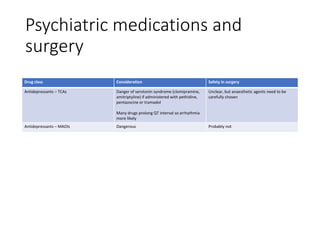
Psychiatric medications and
surgery
Drug class Consideration Safety in surgery
Antidepressants – TCAs Danger of serotonin syndrome (clomipramine,
amitriptyline) if administered with pethidine,
pentazocine or tramadol
Many drugs prolong QT interval so arrhythmia
more likely
Unclear, but anaesthetic agents need to be
carefully chosen
Antidepressants – MAOIs Dangerous Probably not
Psychiatric medications and
surgery
Drug class Consideration Safety in surgery
Antipsychotic Most drugs lower seizure threshold
Increased risk of arrhythmia
Probably, usually continued to avoid relapse
Benzodiazepines Reduced requirements for induction and
maintenance anesthetics
Probably; usually continued
Take Home Message
• Over the years Consultation-Liaison (C-L) psychiatry has
contributed significantly to the growth of the psychiatry
and has brought psychiatry very close to the advances
in the medicine.
• C-L psychiatrist should have adequate knowledge of
mental and physical illnesses as well as how they affect
each other.
• And should know how various drugs and diseases
interact with psychotropics with special regards to their
safety.
• C-L psychiatrist must look at the complete picture while
providing services to the general hospitals.
References
• Lipowski, Z., 1983. Current Trends in Consultation-Liaison Psychiatry*. The Canadian Journal of Psychiatry, 28(5),
pp.329-338.
• Grover S. State of consultation-liaison psychiatry in India: Current status and vision for future.
Indian J Psychiatry 2011;53:202-13
• Grover S, Avasthi A. Consultation-liaison psychiatry services: A survey of medical institutes in
India. Indian J Psychiatry 2018;60:300-6
• Mudgal V, Rastogi P, Niranjan V, et al. Pattern, clinical and demographic profile of inpatient
psychiatry referrals in a tertiary care teaching hospital: a descriptive study. General Psychiatry
2020;33:e100177. doi:10.1136/ gpsych-2019-100177
• Taylor, D., Paton, C. and Kerwin, R., 2018. The Maudsley Prescribing Guidelines. 13th ed. Wiley Blackwell.
• Sadock, B., Sadock, V. and Ruiz, P., 2009. Kaplan & Saddock's comprehensive textbook of psychiatry, volume 1
and 2. Philadelphia: Lippincott Williams and Wilkins.
• Shah SU, Iqbal Z, White A, et al Heart and mind: (2) psychotropic and cardiovascular therapeutics Postgraduate
Medical Journal 2005;81:33-40.
• Doherty, A., Kelly, J., McDonald, C., O’Dywer, A., Keane, J. and Cooney, J., 2013. A review of the interplay between
tuberculosis and mental health. General Hospital Psychiatry, 35(4), pp.398-406.
• Alexander, T. and Bloch, S., 2002. The Written Report in Consultation–Liaison Psychiatry: A Proposed
Schema. Australian & New Zealand Journal of Psychiatry, 36(2), pp.251-258.
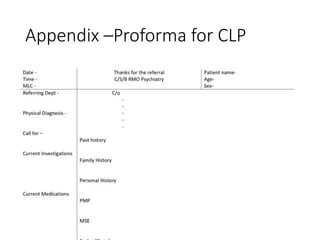
Appendix –Proforma for CLP
Thank You

Consultation liaison psychiatry

  • 1.
    Consultation Liaison Psychiatry Guided by– Dr. Rahul Mathur Assistant Professor MGM Medical College Indore Presenter – Dr. Priyash Jain
  • 2.
    Content • Introduction • Basics •Common Conditions • Delirium • Suicide • Depression • Agitation • Hepatic Impairment • Renal Impairment • Cardiac Conditions • HIV • TB • Fitness for surgery
  • 3.
  • 4.
    Introduction • Consultation-liaison (C-L)psychiatry as a subspecialty has been defined as the area of clinical psychiatry that encompasses • Clinical involvement • Teaching • Research activities of psychiatrists and allied mental health professionals in the non-psychiatric divisions of a general hospital.
  • 5.
    Introduction • “Consultation-Liaison" reflectstwo interrelated roles of the consultants. • "Consultation" refers to the provision of expert opinion about the diagnosis and advice on management regarding a patient's mental state and behavior at the request of another health professional. • The term "Liaison" refers to linking up of groups for the purpose of effective collaboration.
  • 6.
    Introduction • A stateof complete physical, mental and social well-being and not merely the absence of disease or infirmity.
  • 7.
  • 8.
  • 9.
    Basics • The basicaim of C-L Psychiatry is to integrate the information so as to provide optimal health care to patient and effective liaison with patient, consultee and team. • Hence for consultation to be most effective the consultant psychiatrist need to have personal contact with both the patient and those taking care of him.
  • 10.
    Basics – FunctionalModels 1. Consultation Model: traditional model, has patient as the focus. 2. Liaison Model: consulting physician as the focus, involves teaching of psychiatric and psychological aspects of a problem to the physician. 3. Bridge Model: basically involves the teaching role of a C-L psychiatrist for the primary care physician. 4. Hybrid Model: has psychiatrist as a part of multidisciplinary team. 5. Autonomous psychiatric model: C-L psychiatrist is not affiliated to any department but is hired by primary care services.
  • 11.
    Basics – Characteristicsof effective CLP • Talks with the referring physician, nursing and other staff before and after consultation. • Clarifying the reason for the consultation is the initial goal (not an easy job sometimes). • Establishes the level of urgency. • Reviews the chart and the data thoroughly. • Performs a complete mental status exam and relevant portions of a history and physical exam. • Obtains medical history from family members or friends as indicated. • Makes notes as brief as appropriate
  • 12.
    Basics – Characteristicsof effective CLP • Arrives at a provisional/tentative diagnosis. • Formulates a differential diagnosis. • Recommends diagnostic tests. • Has the knowledge to prescribe psychotropic drugs and be aware of their interactions (with somatic therapies). • Makes specific recommendations that are brief, goal oriented and free of psychiatric jargon and discusses findings and recommendation with consultee – In person whenever possible.
  • 13.
    Basics – Characteristicsof effective CLP • Follows-up patient until they are discharged from the hospital or clinic or until the goals of the consultation are achieved. Arranges out-patient care-if necessary. • Does not take over the aspects of the patient’s medical care unless asked to do so.(can advise physician but never interfere) • Follows advances in the other medical fields and is not isolated from the rest of the medical community.
  • 14.
    Basics – Approachto the care • Emphasis on proper Documentation • Thanking you for referral • Demographic Details • Date • Reason for referral • Referred by whom • Location of the patient • Primary Diagnosis of the patient • Informant (with comment on reliabilty) • Chief complaints
  • 15.
    Basics – Approachto the care • Emphasis on proper Documentation • Brief Hopi/ Past History/Treatment History • Medical History -Renal, Cardiac And Liver Dysfunction • Menstrual/ Marital: Check Last Menses And Pregnancy • Check for current Investigations • Check For Drugs For Medical Conditions • Physical Examination • MSE • Provisional Clinical Impression/Diagnosis • Differential Diagnosis
  • 16.
    Basics – Approachto the care • Emphasis on proper Documentation • Management plan: • Additional blood investigations • Additional psychological investigations • Additional rating scales • Additional consultations advise • Additional imaging or neurophysiological test • Check tests already done carefully, don’t repeat it unnecessarily
  • 17.
    Basics – Approachto the care GENERAL PRINCIPLES Be simple in liaison psychiatry Don’t experiment unnecessarily with drugs in medically sick patients. Mono drug and lower doses help.
  • 18.
  • 19.
    Common Conditions • Delirium •Suicide • Depression • Agitation • Hepatic Impairment • Renal Impairment • Cardiac Conditions • HIV • TB • Fitness for surgery
  • 20.
    Common Conditions • Amongthe three most common psychiatric syndromes seen in CLP setting, delirium figured as one of the three most common diagnoses among 79 (87.8%) institutes, and this was followed by substance use disorders (70%), self-harm (60%), and depression (38.9%). (Grover et al) • In a study by our department the most common reason for referral was having an abnormal behaviour (n=45, 26.2%), followed by alleged suicide attempt or self-harm (n=42, 24.4%) • The referral rate was found to be a meagre 1.1% which is too little compared to incidence of psychiatric morbidities found in general hospitals ranging from 18.8% to as high as 94.4%. (Grover et al)
  • 21.
    Delirium • Delirium isa transient organic mental syndrome of acute onset , characterized by global impairment of cognitive functions, a reduced level of consciousness, attentional abnormalities, increased or decreased psychomotor activity and a disordered sleep wake cycle. • An acute reversible mental disorder • Important aspect in Consultation-Liaison Psychiatry • delirium figured as one of the three most common diagnoses among 79 (87.8%) institutes (grover et al)
  • 22.
    Delirium - Nosology •ICD-10 • For a definite diagnosis symptoms ,mild or severe, should be present in each one of the following areas: 1. Impairment of consciousness and attention, 2. Disturbance of cognition 3. Psychomotor disturbances 4. Disturbance of sleep or the sleep-wake cycle, 5. Emotional disturbances Rapid onset and fluctuations of the symptoms over the course of the day.
  • 23.
    Delirium - Nosology •ICD-11 (6D70) • Delirium is characterized by • disturbed attention (i.e., reduced ability to direct, focus, sustain, and shift attention) and awareness (i.e., reduced orientation to the environment) • develops over a short period of time and tends to fluctuate during the course of a day, • accompanied by other cognitive impairment such as memory deficit, disorientation, or impairment in language, visuospatial ability, or perception. • Disturbance of the sleep-wake cycle (reduced arousal of acute onset or total sleep loss with reversal of the sleep-wake cycle) may also be present.
  • 24.
    Delirium – Scales Screening •Confusion Assessment Method • NEECHAM Confusion Scale Diagnosis • Delirium rating scale(DRS) • Delirium rating scale-revised version(DRS-R- 98) Severity • Delirium Assessment Scale • Delirium Index
  • 25.
    Delirium – Management •Medical emergency • Identification and treatment of underlying cause • Management of psychiatric aspect • Effective coordination of both non-pharmacological and pharmacological management
  • 26.
  • 27.
    Delirium – Management •Provide reorientation (view of clock, calendars, familiar objects) • Encourage use of personal belongings • Adequate lighting and temperature • Encourage presence of family members • Minimize transfers (perform procedure in room whenever possible) • Orient the patient to staff, surroundings, and situations repeatedly, particularly before procedures • Use of restrain only when…. • Increase risk of falls, injury, & delirium • Use only in emergency, for as short a duration as possible with frequent re-evaluations • Repeatedly reassure the patient.
  • 28.
    Suicide • “N” numberof factors associated with increased risk of suicide in medical/surgical settings - Chronic illness, Debilitating illness, Painful illness, Low pain tolerance, Renal dialysis, Cardio-respiratory disease, AIDS. • Must be assessed diligently and appropriate scales must be used like SAD persons or SBQ.
  • 29.
  • 30.
    Suicide - Management •Treatment of Psychiatric Disorders • Ward Management • Hospital must issue suicide precaution guidelines • Staff must be guided i. Remove any potential object ii. Search luggage and possessions iii. Monitor all objects coming in the room potentially hazardous iv. Dispensing of the medications v. Constant observation • Physical restraint often required in unpredictable or impulsive patients
  • 31.
    Suicide - Management •The consultation note must carefully document the Diagnosis and treatment plan. • Note must include the level of suicide risk, clearly stating the plan and reporting of interval when the patient will be reassessed
  • 32.
    Depression • Not anuncommon finding in Inpatients • Requires careful assessment
  • 33.
    Depression • Treatment withanti-depressants can be started if required • Careful assessment of drug-drug interactions in collaboration with primary physician
  • 34.
    Agitation • Often relatedto neurocognitive disorder or withdrawal from drugs(opioids, alcohol, sedative – hypnotics • Antipsychotic medication (Haloperidol) are very useful for excessive agitation. • Physical restraint- great caution and last resort • But first rule out agitation due to medical/surgical causes like excessive pain.
  • 35.
  • 36.
    Hepatic Impairment –General Principles • Prescribe as few drugs as possible. • Lower starting doses • Leave longer intervals between dosage increases • cautious with drugs that are extensively hepatically metabolized • Avoid medicines with a long half-life • Avoid drugs that are very sedative • Avoid drugs that are very constipating • Avoid drugs that are known to be hepatotoxic
  • 37.
    Hepatic Impairment – Antipsychotics •Amisulpiride – Renal Excretion. No dose reduction required. • Aripiprazole – Extensively hepatic metabolism. Caution! • Clozapine - Very sedative and constipating. Contraindicated in active liver disease associated with nausea, anorexia or jaundice, progressive liver disease or hepatic failure. • Flupenthixol/Zuclopenthixol - Both are extensively hepatically metabolised. Caution! Depot best avoided. • Haloperidol – Caution in liver disease!
  • 38.
    Hepatic Impairment – Antipsychotics •Olanzapine - Although extensively hepatically metabolised. Sedative and Constipating – Caution advised! • Quetiapine – Hepatic metabolism. Caution advised! Start at lower dose. • Risperidone – Extensive hepatic metabolism. Half starting dose. If severe impairment, start 0.5mg BD and increase at a maximum of 0.5mg bd.
  • 39.
    Hepatic Impairment • –Antidepressants • All SSRIs are hepatically metabolised. May accumulate on chronic dosing. Dose reduction is required (upto 50%). Sertraline is preferred. • All TCAs are hepatically metabolised and have high protein binding. • – Mood Stabilizers • Dose reduction of all mood stabilisers by upto 50% with slow titration and close monitoring of LFT. • No dose reduction required with lithium.
  • 40.
    Hepatic Impairment • Benzodiazepines: Lorazepam, oxazepam, temazepam considered to be safe.
  • 41.
    Renal Impairment –General Principles • Be cautious when using drugs that are extensively renally cleared (e.g. sulpiride, amisulpride, lithium). • Start at a low dose and increase slowly because, in renal impairment, the half‐life of a drug and the time for it to reach steady state are often prolonged. Plasma level monitoring may be useful for some drugs. • Try to avoid long‐acting drugs (e.g. depot preparations). Their dose and frequency cannot be easily adjusted should renal function change. • Prescribe as few drugs as possible. Patients with renal failure take many medications requiring regular review. Interactions and adverse effects can be avoided if fewer drugs are used.
  • 42.
    Renal Impairment • Noantipsychotic clearly preferred over other. • Sulpiride and Amisulpiride avoided • Anticholinergic drugs to be avoided. • FGA - haloperidol 2–6 mg/day • SGA – Olanzapine – 5mg/day • Among antidepressants sertraline suggested as reasonable choice though no agent clearly preferred over other.
  • 43.
    Renal Impairment • AmongMood Stabilisers lithium to be avoided. Other mood stabilisers to be started at a lower dose. • Sedatives and hypnotics to be given with utmost caution. Watch for excess sedation. Lorazepam and zopiclone are suggested as reasonable choices.
  • 44.
  • 45.
    Psychiatric medications and cardiacconditions • SSRIs are generally recommended in cardiac disease but beware antiplatelet activity when co‐administered with cardiac drugs. • Sertraline is recommended post MI, but other SSRIs and mirtazapine are also likely to be safe. • Tricyclics have an established link to cardiac arrhythmia.
  • 46.
    Prescribing in HIVPatients • Pharmacokinetic interactions between antiretroviral and psychotropic drugs occur fre- quently and are potentially clinically significant. • Caution is advised while prescribing psychotropic medications to patients already receiving anti- retroviral therapy.
  • 47.
    Prescribing in HIVPatients Antiretroviral drug Potential adverse effect Implications for psychotropic prescribing Zidovudine Bone marrow suppression Concurrent use with certain psychotropics (e.g. clozapine) may increase the risk of myelosuppression/neutropenia Tenofovir Reduces bone mineral density May compound the reductions in bone mineral density possible with prolactin‐elevating antipsychotics Atazanavir, didanosine, elvitegravir/cobicistat, fosamprenavir, indinavir, lopinavir, nelfinavir, raltegravir, saquinavir, tipranavir, zidovudine Gastrointestinal disturbances May compound gastrointestinal disturbances associated with certain psychotropics
  • 48.
    Prescribing in HIVPatients Antiretroviral drug Potential adverse effect Implications for psychotropic prescribing Darunavir, efavirenz, maraviroc, ritonavir, saquinavir, zidovudine Seizure(s) May increase seizure risk associated with certain psychotropic drugs All combination antiretroviral drugs Metabolic abnormalities risk of metabolic adverse effects associated with certain psychotropic drugs Atazanavir, darunavir, efavirenz, lopinavir, rilpivirine, ritonavir, Saquinavir ECG changes May increase risk of arrhythmias associated with certain psychotropic drug
  • 49.
    Prescribing in TBpatients • Isoniazid, Ethambutol, Rifampicin, Cycloserine, 2nd generation FQs, are known to cause psychiatric disorders. • Also various anti-tubercular drugs are known to have multiple interactions with psychotropics. • Hence Caution is advised while prescribing to tubercular patients.
  • 50.
    Prescribing in TBpatients Anti-Tb Drug Potential adverse effect Implications for psychotropic prescribing Isoniazid Causes MAO inhibition May interact with SSRIs and TCAs theoretically increasing risk of serotonin syndrome. inhibition of CYP - 1A2, 2C9, 2C19 Caution while prescribing Carbamazepine, Valproate, diazepam Rifampicin Enzyme inducer of CYP Higher doses of psychotropics maybe required. Linezolid Causes MAO inhibition risk of serotonin syndrome when used in combination with anti-depressants
  • 51.
    Psychiatric medications and surgery Drugclass Consideration Safety in surgery Anticonvulsants CNS depressant activity may reduce anaesthetic requirement Probably, usually continued for people with epilepsy Antidepressants – SSRIs Danger of serotonin syndrome if administered with pethidine, fentanyl, pentazocine or tramadol Occasional seizures reported Rule out hyponatremia in all surgical patient Probably, but avoid other serotonergic agents
  • 52.
    Psychiatric medications and surgery Drugclass Consideration Safety in surgery Antidepressants – TCAs Danger of serotonin syndrome (clomipramine, amitriptyline) if administered with pethidine, pentazocine or tramadol Many drugs prolong QT interval so arrhythmia more likely Unclear, but anaesthetic agents need to be carefully chosen Antidepressants – MAOIs Dangerous Probably not
  • 53.
    Psychiatric medications and surgery Drugclass Consideration Safety in surgery Antipsychotic Most drugs lower seizure threshold Increased risk of arrhythmia Probably, usually continued to avoid relapse Benzodiazepines Reduced requirements for induction and maintenance anesthetics Probably; usually continued
  • 54.
    Take Home Message •Over the years Consultation-Liaison (C-L) psychiatry has contributed significantly to the growth of the psychiatry and has brought psychiatry very close to the advances in the medicine. • C-L psychiatrist should have adequate knowledge of mental and physical illnesses as well as how they affect each other. • And should know how various drugs and diseases interact with psychotropics with special regards to their safety. • C-L psychiatrist must look at the complete picture while providing services to the general hospitals.
  • 55.
    References • Lipowski, Z.,1983. Current Trends in Consultation-Liaison Psychiatry*. The Canadian Journal of Psychiatry, 28(5), pp.329-338. • Grover S. State of consultation-liaison psychiatry in India: Current status and vision for future. Indian J Psychiatry 2011;53:202-13 • Grover S, Avasthi A. Consultation-liaison psychiatry services: A survey of medical institutes in India. Indian J Psychiatry 2018;60:300-6 • Mudgal V, Rastogi P, Niranjan V, et al. Pattern, clinical and demographic profile of inpatient psychiatry referrals in a tertiary care teaching hospital: a descriptive study. General Psychiatry 2020;33:e100177. doi:10.1136/ gpsych-2019-100177 • Taylor, D., Paton, C. and Kerwin, R., 2018. The Maudsley Prescribing Guidelines. 13th ed. Wiley Blackwell. • Sadock, B., Sadock, V. and Ruiz, P., 2009. Kaplan & Saddock's comprehensive textbook of psychiatry, volume 1 and 2. Philadelphia: Lippincott Williams and Wilkins. • Shah SU, Iqbal Z, White A, et al Heart and mind: (2) psychotropic and cardiovascular therapeutics Postgraduate Medical Journal 2005;81:33-40. • Doherty, A., Kelly, J., McDonald, C., O’Dywer, A., Keane, J. and Cooney, J., 2013. A review of the interplay between tuberculosis and mental health. General Hospital Psychiatry, 35(4), pp.398-406. • Alexander, T. and Bloch, S., 2002. The Written Report in Consultation–Liaison Psychiatry: A Proposed Schema. Australian & New Zealand Journal of Psychiatry, 36(2), pp.251-258.
  • 56.
  • 57.

Editor's Notes

  • #7 No health without mental health.
  • #20 Among the three most common psychiatric syndromes seen in CLP setting, delirium figured as one of the three most common diagnoses among 79 (87.8%) institutes, and this was followed by substance use disorders (70%), self‑harm (60%), and depression (38.9%). The most common reason for referral was having an abnormal behaviour (n=45, 26.2%), followed by alleged suicide attempt or self-harm (n=42, 24.4%)
  • #57 Alexander, T. and Bloch, S., 2002. The Written Report in Consultation–Liaison Psychiatry: A Proposed Schema. Australian & New Zealand Journal of Psychiatry, 36(2), pp.251-258.