CLINICAL INTERVIEW
BY
MUHAMMAD MUSAWAR ALI
MPHIL, ICAP
1
Clinical Interview
Characteristics of
Interview
Communication
Strategies
Types and Structure of
Interview
Roles and Tactics
Considerations and Issues
2
INTRODUCTION
 The clinical assessment examines a client’s life in far more
detail so that accurate diagnosis, appropriate treatment plan,
problem lists and treatment goals can be made.
 Identifies client’s strengths, weaknesses, along with
appropriate level of treatment and care.
3
Characteristics of Clinical Interview
 One to one conversation between a
professional (psychologist) and
client
 Professional setting (hospital,
clinic)
 Conversation either initiated by
client or by psychologist initiated
 Purposeful and goal oriented
conversation
4
Types and Structure of Clinical Interview
1- Intake Interview
 Why the client is looking for
help?
 Are the competencies and
resources available to help
client ?
 Build rapport
 Make the client at ease
 Encourage for information
 Think rules
 Behavior (actions)
 Solution (handling)
 Positive (resources)
 Small steps (increments)
 Flexible (possibilities)
 Future (control)
5
Types and Structure of Clinical Interview
2- Case History
 Psychosocial history
 Detailed description of client's
background
 Birth and development
 Family origins
 Education
 Employment
 Recreational/leisure
 Marital and Sexual history
 Alcohol and drugs
 Physical health
6
Types and Structure of Clinical Interview
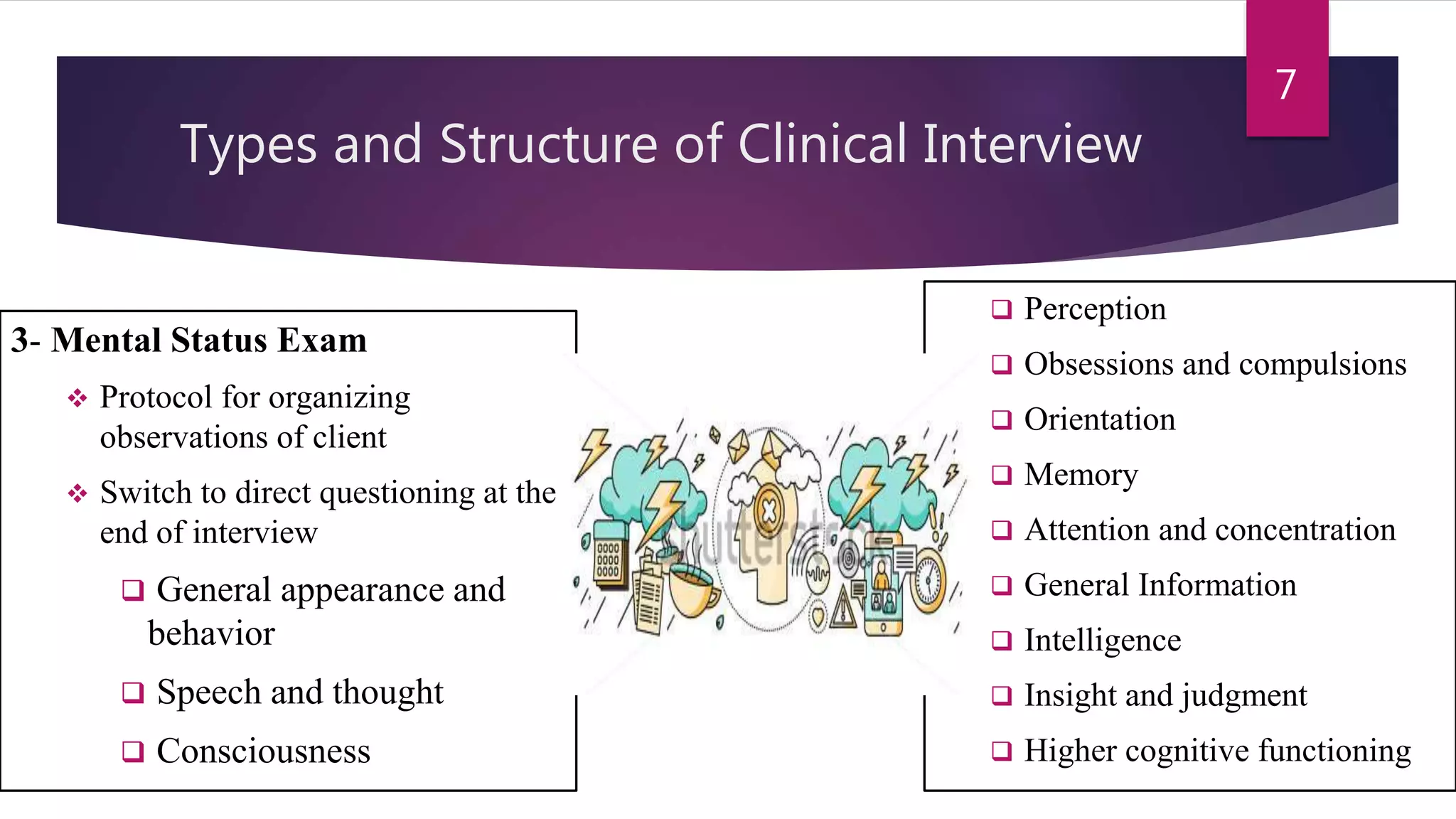
3- Mental Status Exam
 Protocol for organizing
observations of client
 Switch to direct questioning at the
end of interview
 General appearance and
behavior
 Speech and thought
 Consciousness
 Perception
 Obsessions and compulsions
 Orientation
 Memory
 Attention and concentration
 General Information
 Intelligence
 Insight and judgment
 Higher cognitive functioning
7
Types and Structure of Clinical Interview
4- Crisis Interview
 Emergency consultation
 Unexpected life stressors
 can’t be assessed through
lengthy psychological
batteries
 can’t be waited to access
previous history
 Client needed to be dealt at
moment
 Provide reassurance, assess
the problem and explore
potential resources
 Resolve problem
immediately to avoid
catastrophic event to occur
8
Types and Structure of Clinical Interview
5- Diagnostic Interview
 Goal is to classify the complaints
and dysfunctions of client
 Clinician observers:
 client’s behavior
 Inquires about symptoms in
detail
 Gathers relevant personal
and family history
 The methods for conducting
diagnostic interview vary in
goals and degree of structure
 Five steps in diagnostic
interview ( Othmer & Othmer,
1994)
9
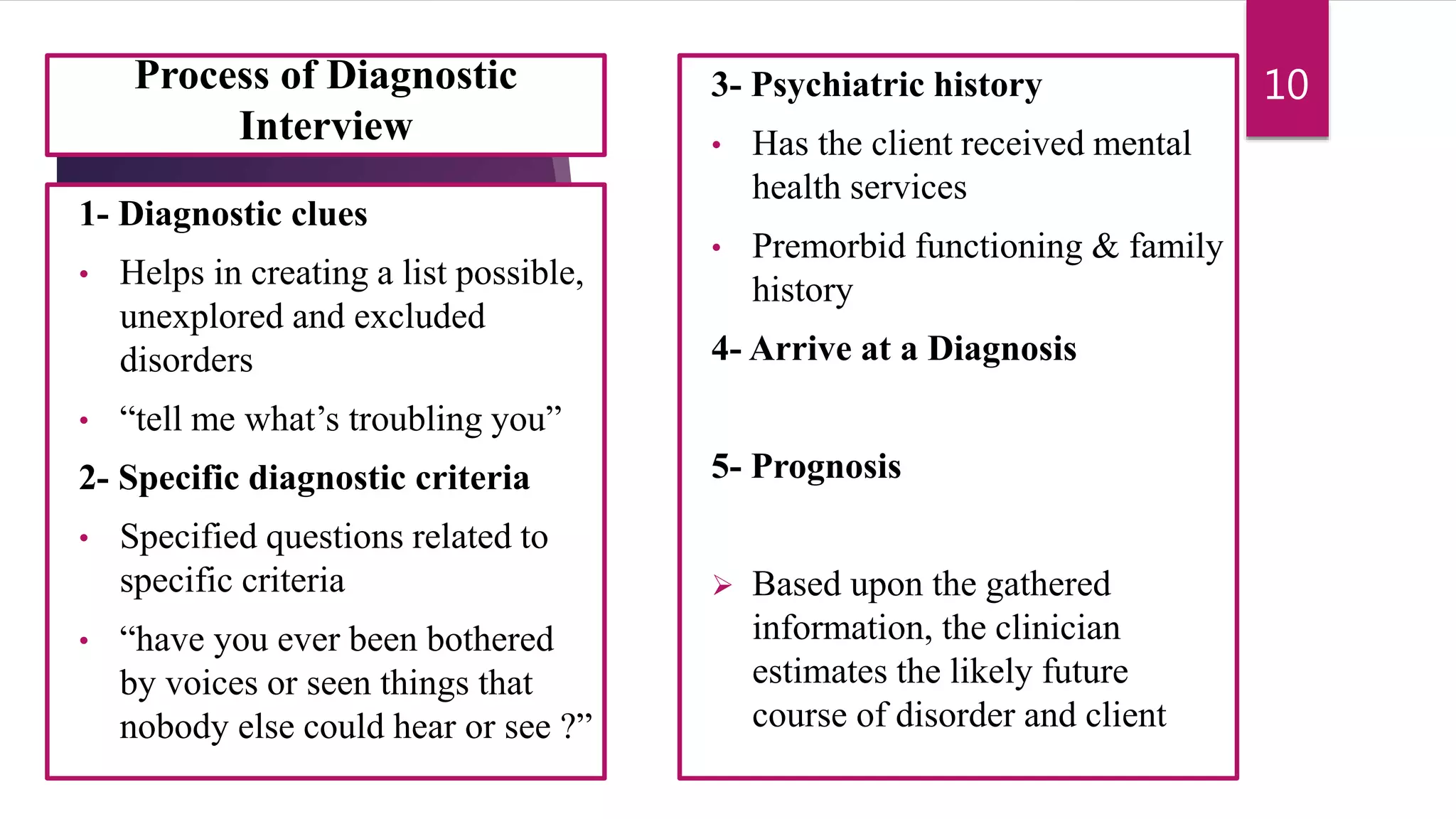
Process of Diagnostic
Interview
1- Diagnostic clues
• Helps in creating a list possible,
unexplored and excluded
disorders
• “tell me what’s troubling you”
2- Specific diagnostic criteria
• Specified questions related to
specific criteria
• “have you ever been bothered
by voices or seen things that
nobody else could hear or see ?”
3- Psychiatric history
• Has the client received mental
health services
• Premorbid functioning & family
history
4- Arrive at a Diagnosis
5- Prognosis
 Based upon the gathered
information, the clinician
estimates the likely future
course of disorder and client
10
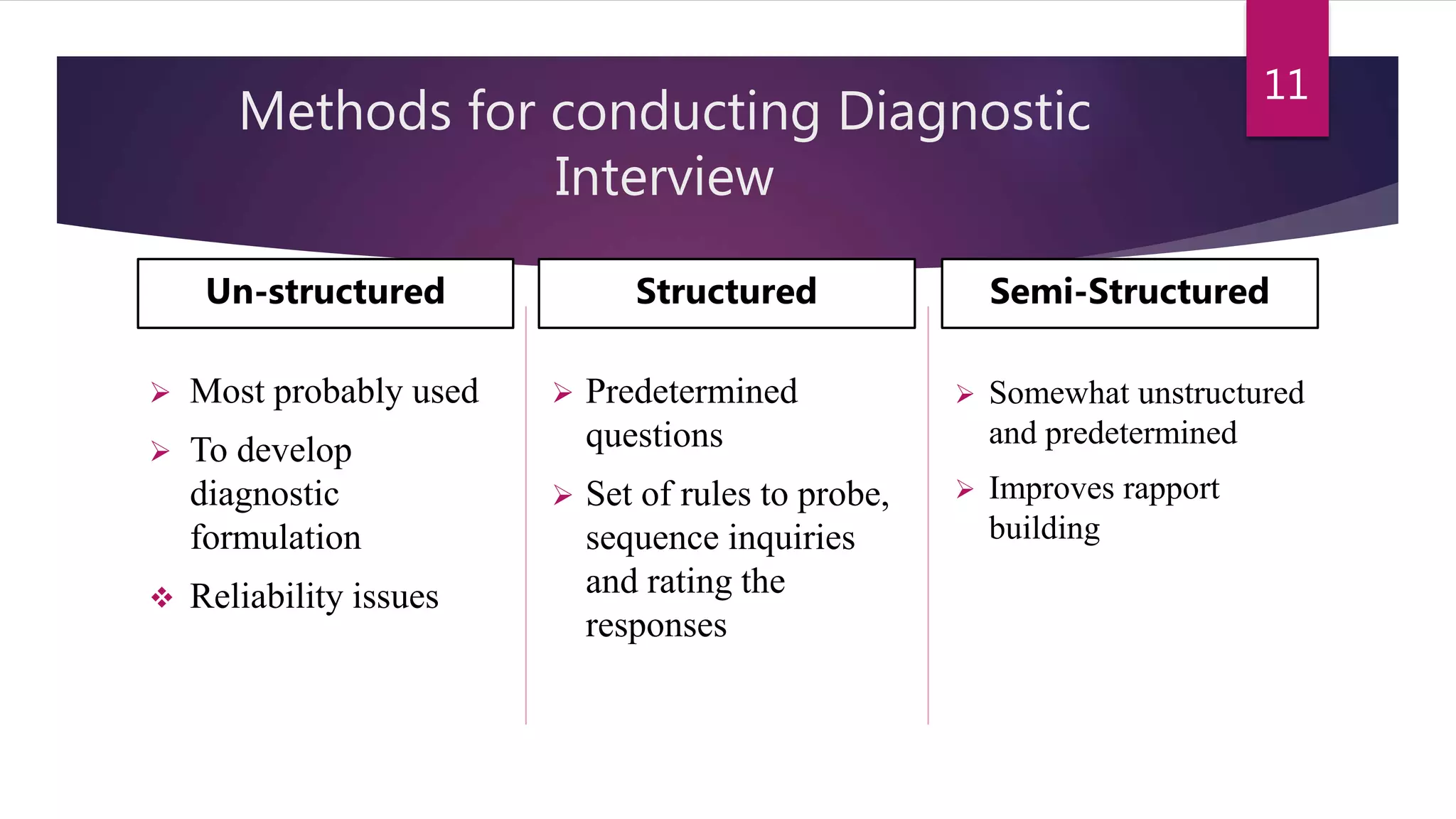
Methods for conducting Diagnostic
Interview
Un-structured
 Most probably used
 To develop
diagnostic
formulation
 Reliability issues
Structured
 Predetermined
questions
 Set of rules to probe,
sequence inquiries
and rating the
responses
Semi-Structured
 Somewhat unstructured
and predetermined
 Improves rapport
building
11
Importance of Rapport
 The sense of mutual trust and
harmony that characterizes a
good relationship (Giordano,
1997)
 Warmth and empathy
 Genuineness
 Immediacy
 Positive regard and respect
 Self-disclosure
 Consent taking
 Confidentiality assurance
12
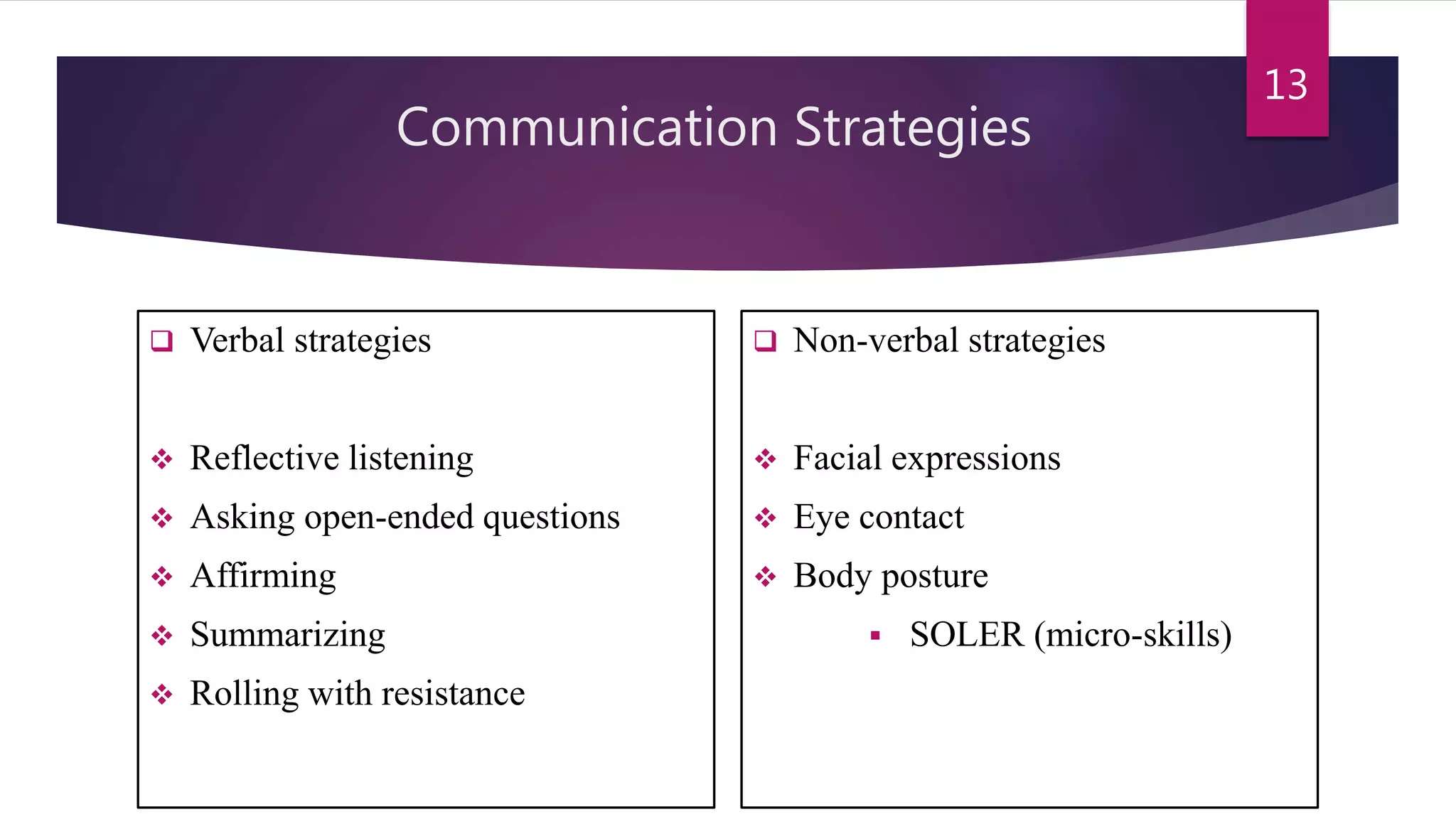
Communication Strategies
 Verbal strategies
 Reflective listening
 Asking open-ended questions
 Affirming
 Summarizing
 Rolling with resistance
 Non-verbal strategies
 Facial expressions
 Eye contact
 Body posture
 SOLER (micro-skills)
13
Roles and Tactics
 Strategies for Rolling with
resistance
 Reflective listening
 Shifting focus
 Ignore client’s negative
statement
 Agreement with a twist
 Agree with client but with a
change of direction
 Reframing
 Offering a new and positive
interpretation of negative
information
 Emphasizing personal choice and
control
 Acknowledge the positive
choices a client makes and
improve his self-efficacy
14
Other considerations and
issues
1- Interviewing with children
• Praise
• Ask simple questions
• Be tactful
• Understand silence
2- Cultural diversity issues
• Need to avoid the biases and
influence of experiences
• Educate about communication
styles of culture where you
work
• Understand local
communication norms
3- Common pitfalls
• Jargon pitfall
• Reassurance pitfall
15
Motivational Interviewing
Express empathy
&
Support self-efficacy
Roll with
resistance
Avoid argumentationDevelop
discrepancy
16
Motivational Interviewing
 Express empathy and support self-efficacy
Stay non-judgmental and help the client towards changing themselves
 Develop discrepancy
Focus their attention towards the discrepancy in their goals and actions
 Avoid argumentation
Rather confronting with client, show a gentle persuasive style
 Roll with resistance
Move with the resistance by challenging their thoughts
17

Clinical interviewing

  • 1.
  • 2.
    Clinical Interview Characteristics of Interview Communication Strategies Typesand Structure of Interview Roles and Tactics Considerations and Issues 2
  • 3.
    INTRODUCTION  The clinicalassessment examines a client’s life in far more detail so that accurate diagnosis, appropriate treatment plan, problem lists and treatment goals can be made.  Identifies client’s strengths, weaknesses, along with appropriate level of treatment and care. 3
  • 4.
    Characteristics of ClinicalInterview  One to one conversation between a professional (psychologist) and client  Professional setting (hospital, clinic)  Conversation either initiated by client or by psychologist initiated  Purposeful and goal oriented conversation 4
  • 5.
    Types and Structureof Clinical Interview 1- Intake Interview  Why the client is looking for help?  Are the competencies and resources available to help client ?  Build rapport  Make the client at ease  Encourage for information  Think rules  Behavior (actions)  Solution (handling)  Positive (resources)  Small steps (increments)  Flexible (possibilities)  Future (control) 5
  • 6.
    Types and Structureof Clinical Interview 2- Case History  Psychosocial history  Detailed description of client's background  Birth and development  Family origins  Education  Employment  Recreational/leisure  Marital and Sexual history  Alcohol and drugs  Physical health 6
  • 7.
    Types and Structureof Clinical Interview 3- Mental Status Exam  Protocol for organizing observations of client  Switch to direct questioning at the end of interview  General appearance and behavior  Speech and thought  Consciousness  Perception  Obsessions and compulsions  Orientation  Memory  Attention and concentration  General Information  Intelligence  Insight and judgment  Higher cognitive functioning 7
  • 8.
    Types and Structureof Clinical Interview 4- Crisis Interview  Emergency consultation  Unexpected life stressors  can’t be assessed through lengthy psychological batteries  can’t be waited to access previous history  Client needed to be dealt at moment  Provide reassurance, assess the problem and explore potential resources  Resolve problem immediately to avoid catastrophic event to occur 8
  • 9.
    Types and Structureof Clinical Interview 5- Diagnostic Interview  Goal is to classify the complaints and dysfunctions of client  Clinician observers:  client’s behavior  Inquires about symptoms in detail  Gathers relevant personal and family history  The methods for conducting diagnostic interview vary in goals and degree of structure  Five steps in diagnostic interview ( Othmer & Othmer, 1994) 9
  • 10.
    Process of Diagnostic Interview 1-Diagnostic clues • Helps in creating a list possible, unexplored and excluded disorders • “tell me what’s troubling you” 2- Specific diagnostic criteria • Specified questions related to specific criteria • “have you ever been bothered by voices or seen things that nobody else could hear or see ?” 3- Psychiatric history • Has the client received mental health services • Premorbid functioning & family history 4- Arrive at a Diagnosis 5- Prognosis  Based upon the gathered information, the clinician estimates the likely future course of disorder and client 10
  • 11.
    Methods for conductingDiagnostic Interview Un-structured  Most probably used  To develop diagnostic formulation  Reliability issues Structured  Predetermined questions  Set of rules to probe, sequence inquiries and rating the responses Semi-Structured  Somewhat unstructured and predetermined  Improves rapport building 11
  • 12.
    Importance of Rapport The sense of mutual trust and harmony that characterizes a good relationship (Giordano, 1997)  Warmth and empathy  Genuineness  Immediacy  Positive regard and respect  Self-disclosure  Consent taking  Confidentiality assurance 12
  • 13.
    Communication Strategies  Verbalstrategies  Reflective listening  Asking open-ended questions  Affirming  Summarizing  Rolling with resistance  Non-verbal strategies  Facial expressions  Eye contact  Body posture  SOLER (micro-skills) 13
  • 14.
    Roles and Tactics Strategies for Rolling with resistance  Reflective listening  Shifting focus  Ignore client’s negative statement  Agreement with a twist  Agree with client but with a change of direction  Reframing  Offering a new and positive interpretation of negative information  Emphasizing personal choice and control  Acknowledge the positive choices a client makes and improve his self-efficacy 14
  • 15.
    Other considerations and issues 1-Interviewing with children • Praise • Ask simple questions • Be tactful • Understand silence 2- Cultural diversity issues • Need to avoid the biases and influence of experiences • Educate about communication styles of culture where you work • Understand local communication norms 3- Common pitfalls • Jargon pitfall • Reassurance pitfall 15
  • 16.
    Motivational Interviewing Express empathy & Supportself-efficacy Roll with resistance Avoid argumentationDevelop discrepancy 16
  • 17.
    Motivational Interviewing  Expressempathy and support self-efficacy Stay non-judgmental and help the client towards changing themselves  Develop discrepancy Focus their attention towards the discrepancy in their goals and actions  Avoid argumentation Rather confronting with client, show a gentle persuasive style  Roll with resistance Move with the resistance by challenging their thoughts 17

Editor's Notes

  • #5 Heesacker (2001) eight common architectural characteristics of space and their potential impact Color Lighting Distance 90 angle
  • #6 Actions that define the problematic behavior
  • #7 To formulate a complete diagnosis
  • #8 Reliability and lack of normative data 30-item MMSE (structured) Take 10 minutes
  • #14 S squarely facing the client O open posture L lean towards client E eye contact R relax
  • #15 Shifting focus I can’t quit binge eating R: we are still exploring your concerns about going to college. We are not yet ready to decide where binge eating fits into your goals Agreement Why stuck with binge eating? My family bla bla R: you have an important point here. It involves the whole family and we will sort it out to discuss with family members Reframing family Always calling me obese, gummpy R: it seems they are concerned although they say in a way that makes you angry may be we help him to demonstrate their emotions in an acceptable way Emphasizing Parents, saved money, education in MBBS, always were talking about it- irritating R: I appreciate you choosed something of your concern and interest and decided physics.