
DSM –IV and DSM -5
Differences
Dr BK Waraich
MD Psychiatry
• The APA published the Diagnostic and statitistical manual of Mental
Disorders in 1952. DSM 1 had 60 disoders
• DSM II – 1968. By 1974, Homosexuality was removed as a mental
disorder
• DSM III- 1980, 5 part multiaxial system started
• DSM IV- 365 diagnosis
• DSM 5- Multi axial system removed.
• AXIS 1- Major psychiatric Disorders and Substance abuse Disorders
• AXIS 2- Personality Disorders
• AXIS 3 – Medical Conditions
• Axis 4- Psychosocial and Environment Factors
• AXIS 5- GAF- Global Assessment of Functioning
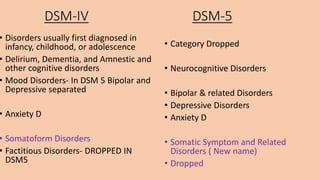
DSM-IV DSM-5
• Disorders usually first diagnosed in
infancy, childhood, or adolescence
• Delirium, Dementia, and Amnestic and
other cognitive disorders
• Mood Disorders- In DSM 5 Bipolar and
Depressive separated
• Anxiety D
• Somatoform Disorders
• Factitious Disorders- DROPPED IN
DSM5
• Category Dropped
• Neurocognitive Disorders
• Bipolar & related Disorders
• Depressive Disorders
• Anxiety D
• Somatic Symptom and Related
Disorders ( New name)
• Dropped
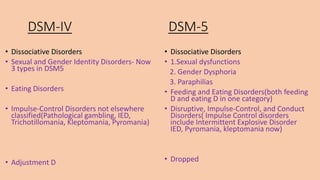
DSM-IV DSM-5
• Dissociative Disorders
• Sexual and Gender Identity Disorders- Now
3 types in DSM5
• Eating Disorders
• Impulse-Control Disorders not elsewhere
classified(Pathological gambling, IED,
Trichotillomania, Kleptomania, Pyromania)
• Adjustment D
• Dissociative Disorders
• 1.Sexual dysfunctions
2. Gender Dysphoria
3. Paraphilias
• Feeding and Eating Disorders(both feeding
D and eating D in one category)
• Disruptive, Impulse-Control, and Conduct
Disorders( Impulse Control disorders
include Intermittent Explosive Disorder
IED, Pyromania, kleptomania now)
• Dropped
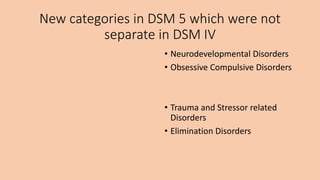
New categories in DSM 5 which were not
separate in DSM IV
• Neurodevelopmental Disorders
• Obsessive Compulsive Disorders
• Trauma and Stressor related
Disorders
• Elimination Disorders
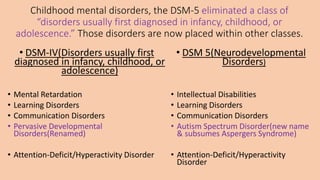
Childhood mental disorders, the DSM-5 eliminated a class of
“disorders usually first diagnosed in infancy, childhood, or
adolescence.” Those disorders are now placed within other classes.
• DSM-IV(Disorders usually first
diagnosed in infancy, childhood, or
adolescence)
• Mental Retardation
• Learning Disorders
• Communication Disorders
• Pervasive Developmental
Disorders(Renamed)
• Attention-Deficit/Hyperactivity Disorder
• DSM 5(Neurodevelopmental
Disorders)
• Intellectual Disabilities
• Learning Disorders
• Communication Disorders
• Autism Spectrum Disorder(new name
& subsumes Aspergers Syndrome)
• Attention-Deficit/Hyperactivity
Disorder
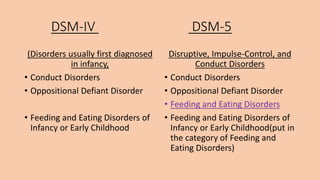
DSM-IV DSM-5
(Disorders usually first diagnosed
in infancy,
• Conduct Disorders
• Oppositional Defiant Disorder
• Feeding and Eating Disorders of
Infancy or Early Childhood
Disruptive, Impulse-Control, and
Conduct Disorders
• Conduct Disorders
• Oppositional Defiant Disorder
• Feeding and Eating Disorders
• Feeding and Eating Disorders of
Infancy or Early Childhood(put in
the category of Feeding and
Eating Disorders)
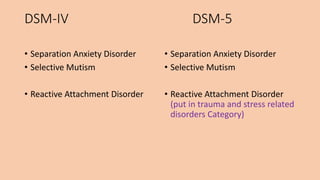
DSM-IV DSM-5
• Separation Anxiety Disorder
• Selective Mutism
• Reactive Attachment Disorder
• Separation Anxiety Disorder
• Selective Mutism
• Reactive Attachment Disorder
(put in trauma and stress related
disorders Category)
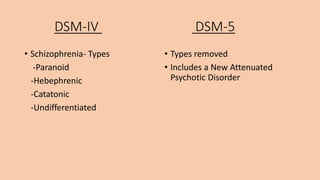
DSM-IV DSM-5
• Schizophrenia- Types
-Paranoid
-Hebephrenic
-Catatonic
-Undifferentiated
• Types removed
• Includes a New Attenuated
Psychotic Disorder
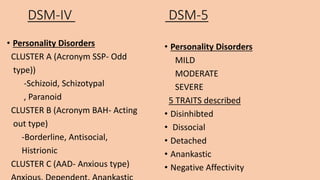
DSM-IV DSM-5
• Personality Disorders
CLUSTER A (Acronym SSP- Odd
type))
-Schizoid, Schizotypal
, Paranoid
CLUSTER B (Acronym BAH- Acting
out type)
-Borderline, Antisocial,
Histrionic
CLUSTER C (AAD- Anxious type)
• Personality Disorders
MILD
MODERATE
SEVERE
5 TRAITS described
• Disinhibted
• Dissocial
• Detached
• Anankastic
• Negative Affectivity
DSM-IV DSM-5
• Dissociative Disorders
- Dissociative Amnesia
(Psychogenic Fugue)
- Depersonalisation Derealisation
Disorder
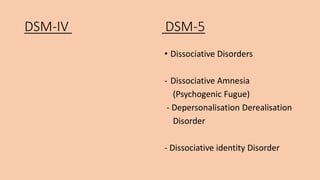
- Dissociative identity Disorder
DSM-IV DSM-5
• Anorexia nervosa- Body image
distortion ( wt 85% or less than
expected for that age OR BMI
<17.5)
• Bulimia-
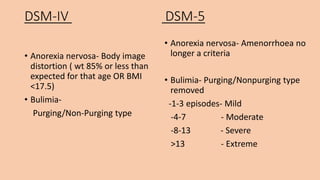
Purging/Non-Purging type
• Anorexia nervosa- Amenorrhoea no
longer a criteria
• Bulimia- Purging/Nonpurging type
removed
-1-3 episodes- Mild
-4-7 - Moderate
-8-13 - Severe
>13 - Extreme
New Addition in Childhood Mental Disorders
in DSM5
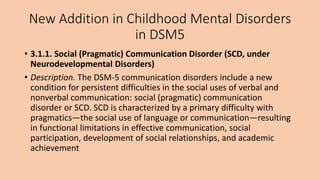
• 3.1.1. Social (Pragmatic) Communication Disorder (SCD, under
Neurodevelopmental Disorders)
• Description. The DSM-5 communication disorders include a new
condition for persistent difficulties in the social uses of verbal and
nonverbal communication: social (pragmatic) communication
disorder or SCD. SCD is characterized by a primary difficulty with
pragmatics—the social use of language or communication—resulting
in functional limitations in effective communication, social
participation, development of social relationships, and academic
achievement
DSM-IV DSM-5
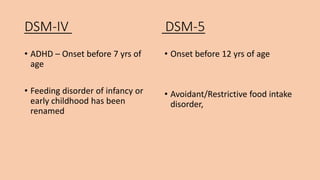
• ADHD – Onset before 7 yrs of
age
• Feeding disorder of infancy or
early childhood has been
renamed
• Onset before 12 yrs of age
• Avoidant/Restrictive food intake
disorder,
New Addition in DSM5
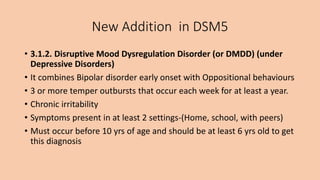
• 3.1.2. Disruptive Mood Dysregulation Disorder (or DMDD) (under
Depressive Disorders)
• It combines Bipolar disorder early onset with Oppositional behaviours
• 3 or more temper outbursts that occur each week for at least a year.
• Chronic irritability
• Symptoms present in at least 2 settings-(Home, school, with peers)
• Must occur before 10 yrs of age and should be at least 6 yrs old to get
this diagnosis
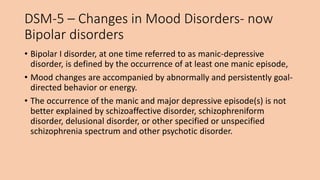
DSM-5 – Changes in Mood Disorders- now
Bipolar disorders
• Bipolar I disorder, at one time referred to as manic-depressive
disorder, is defined by the occurrence of at least one manic episode,
• Mood changes are accompanied by abnormally and persistently goal-
directed behavior or energy.
• The occurrence of the manic and major depressive episode(s) is not
better explained by schizoaffective disorder, schizophreniform
disorder, delusional disorder, or other specified or unspecified
schizophrenia spectrum and other psychotic disorder.
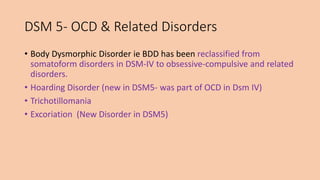
DSM 5- OCD & Related Disorders
• Body Dysmorphic Disorder ie BDD has been reclassified from
somatoform disorders in DSM-IV to obsessive-compulsive and related
disorders.
• Hoarding Disorder (new in DSM5- was part of OCD in Dsm IV)
• Trichotillomania
• Excoriation (New Disorder in DSM5)
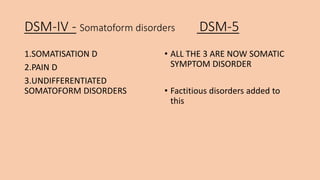
DSM-IV - Somatoform disorders DSM-5
1.SOMATISATION D
2.PAIN D
3.UNDIFFERENTIATED
SOMATOFORM DISORDERS
• ALL THE 3 ARE NOW SOMATIC
SYMPTOM DISORDER
• Factitious disorders added to
this
DSM IV DSM-5- Illness Anxiety Disorder
• Hypochondriasis was part of
Somatoform Disorders-
• Now in DSM 5 it is Illness
Anxiety Disorder
• Patients with illness anxiety disorder
may or may not have a medical
condition but -
• have heightened bodily sensations,
• are intensely anxious about the
possibility of an undiagnosed illness,
• or devote excessive time and energy to
health concerns, often obsessively
researching them.
• Illness anxiety disorder can cause
considerable distress and life
disruption, even at moderate levels.
DSM 5- Separate Persistent Complex Bereavement
Disorder
• > 6 months in children &> 12 mnths in Adults.
• The person has been bereaved (i.e. experienced the death of a loved one) for at least six
months
• At least 1 of the following-
-Intense and persistent yearning for the deceased
-Frequent preoccupation with the deceased
-Intense feelings of emptiness or loneliness
-Recurrent thoughts that life is meaningless or unfair without the deceased
-A frequent urge to join the deceased in death
DSM 5- Separate Persistent Complex Bereavement
Disorder
• At least two of the following symptoms have been recorded for at least one month:
-Feeling shocked, stunned or numb since a loved one’s death
-Feelings of disbelief or inability to accept the loss
-Rumination about the circumstances or consequences of the death
-Anger or bitterness about the death
-Experiencing pain that the deceased suffered, or hearing/seeing the deceased
-Trouble trusting or caring about others
-Intense reactions to memories or reminders of the deceased
-Avoidance of reminders of the deceased, or the opposite - seeking out reminders to feel
close to the deceased
• Symptoms cause substantial distress for the sufferer or impact significantly on areas of
functioning and cannot be attributed to other causes.
Other changes
• Intellectual Disability -To reflect common language, the issues
previously referred to as “mental retardation” are now classified as
“intellectual disability.” The diagnostic criteria for this disorder have
also been updated to more strongly focus on adaptive functioning,
rather than IQ score.
PTSD
• Increasing Detail on PTSD Symptoms
• adds nuance for children with PTSD,
• and describes four main types of symptoms:
•Arousal
•Avoidance
•Flashbacks
•Negative impacts on thought patterns and mood
DSM-IV DSM-5
• 1. Substance use disorder
included substance
abuse and substance dependence.
• 2
1.Single diagnostic category
of Substance Use Disorder.
10 separate classes of drugs: alcohol;
caffeine; cannabis; hallucinogens
(phencyclidine or similarly acting
arylcyclohexylamines, and other
hallucinogens, such as LSD);
inhalants; opioids; sedatives,
hypnotics, or anxiolytics; stimulants
(including amphetamine-type
substances, cocaine, and other
stimulants); tobacco; and other or
unknown substances.
THANK YOU

DSM IV & DSM-5 differences

  • 1.
    DSM –IV andDSM -5 Differences Dr BK Waraich MD Psychiatry
  • 2.
    • The APApublished the Diagnostic and statitistical manual of Mental Disorders in 1952. DSM 1 had 60 disoders • DSM II – 1968. By 1974, Homosexuality was removed as a mental disorder • DSM III- 1980, 5 part multiaxial system started • DSM IV- 365 diagnosis • DSM 5- Multi axial system removed.
  • 3.
    • AXIS 1-Major psychiatric Disorders and Substance abuse Disorders • AXIS 2- Personality Disorders • AXIS 3 – Medical Conditions • Axis 4- Psychosocial and Environment Factors • AXIS 5- GAF- Global Assessment of Functioning
  • 4.
    DSM-IV DSM-5 • Disordersusually first diagnosed in infancy, childhood, or adolescence • Delirium, Dementia, and Amnestic and other cognitive disorders • Mood Disorders- In DSM 5 Bipolar and Depressive separated • Anxiety D • Somatoform Disorders • Factitious Disorders- DROPPED IN DSM5 • Category Dropped • Neurocognitive Disorders • Bipolar & related Disorders • Depressive Disorders • Anxiety D • Somatic Symptom and Related Disorders ( New name) • Dropped
  • 5.
    DSM-IV DSM-5 • DissociativeDisorders • Sexual and Gender Identity Disorders- Now 3 types in DSM5 • Eating Disorders • Impulse-Control Disorders not elsewhere classified(Pathological gambling, IED, Trichotillomania, Kleptomania, Pyromania) • Adjustment D • Dissociative Disorders • 1.Sexual dysfunctions 2. Gender Dysphoria 3. Paraphilias • Feeding and Eating Disorders(both feeding D and eating D in one category) • Disruptive, Impulse-Control, and Conduct Disorders( Impulse Control disorders include Intermittent Explosive Disorder IED, Pyromania, kleptomania now) • Dropped
  • 6.
    New categories inDSM 5 which were not separate in DSM IV • Neurodevelopmental Disorders • Obsessive Compulsive Disorders • Trauma and Stressor related Disorders • Elimination Disorders
  • 7.
    Childhood mental disorders,the DSM-5 eliminated a class of “disorders usually first diagnosed in infancy, childhood, or adolescence.” Those disorders are now placed within other classes. • DSM-IV(Disorders usually first diagnosed in infancy, childhood, or adolescence) • Mental Retardation • Learning Disorders • Communication Disorders • Pervasive Developmental Disorders(Renamed) • Attention-Deficit/Hyperactivity Disorder • DSM 5(Neurodevelopmental Disorders) • Intellectual Disabilities • Learning Disorders • Communication Disorders • Autism Spectrum Disorder(new name & subsumes Aspergers Syndrome) • Attention-Deficit/Hyperactivity Disorder
  • 8.
    DSM-IV DSM-5 (Disorders usuallyfirst diagnosed in infancy, • Conduct Disorders • Oppositional Defiant Disorder • Feeding and Eating Disorders of Infancy or Early Childhood Disruptive, Impulse-Control, and Conduct Disorders • Conduct Disorders • Oppositional Defiant Disorder • Feeding and Eating Disorders • Feeding and Eating Disorders of Infancy or Early Childhood(put in the category of Feeding and Eating Disorders)
  • 9.
    DSM-IV DSM-5 • SeparationAnxiety Disorder • Selective Mutism • Reactive Attachment Disorder • Separation Anxiety Disorder • Selective Mutism • Reactive Attachment Disorder (put in trauma and stress related disorders Category)
  • 10.
    DSM-IV DSM-5 • Schizophrenia-Types -Paranoid -Hebephrenic -Catatonic -Undifferentiated • Types removed • Includes a New Attenuated Psychotic Disorder
  • 11.
    DSM-IV DSM-5 • PersonalityDisorders CLUSTER A (Acronym SSP- Odd type)) -Schizoid, Schizotypal , Paranoid CLUSTER B (Acronym BAH- Acting out type) -Borderline, Antisocial, Histrionic CLUSTER C (AAD- Anxious type) • Personality Disorders MILD MODERATE SEVERE 5 TRAITS described • Disinhibted • Dissocial • Detached • Anankastic • Negative Affectivity
  • 12.
    DSM-IV DSM-5 • DissociativeDisorders - Dissociative Amnesia (Psychogenic Fugue) - Depersonalisation Derealisation Disorder - Dissociative identity Disorder
  • 13.
    DSM-IV DSM-5 • Anorexianervosa- Body image distortion ( wt 85% or less than expected for that age OR BMI <17.5) • Bulimia- Purging/Non-Purging type • Anorexia nervosa- Amenorrhoea no longer a criteria • Bulimia- Purging/Nonpurging type removed -1-3 episodes- Mild -4-7 - Moderate -8-13 - Severe >13 - Extreme
  • 14.
    New Addition inChildhood Mental Disorders in DSM5 • 3.1.1. Social (Pragmatic) Communication Disorder (SCD, under Neurodevelopmental Disorders) • Description. The DSM-5 communication disorders include a new condition for persistent difficulties in the social uses of verbal and nonverbal communication: social (pragmatic) communication disorder or SCD. SCD is characterized by a primary difficulty with pragmatics—the social use of language or communication—resulting in functional limitations in effective communication, social participation, development of social relationships, and academic achievement
  • 15.
    DSM-IV DSM-5 • ADHD– Onset before 7 yrs of age • Feeding disorder of infancy or early childhood has been renamed • Onset before 12 yrs of age • Avoidant/Restrictive food intake disorder,
  • 16.
    New Addition inDSM5 • 3.1.2. Disruptive Mood Dysregulation Disorder (or DMDD) (under Depressive Disorders) • It combines Bipolar disorder early onset with Oppositional behaviours • 3 or more temper outbursts that occur each week for at least a year. • Chronic irritability • Symptoms present in at least 2 settings-(Home, school, with peers) • Must occur before 10 yrs of age and should be at least 6 yrs old to get this diagnosis
  • 17.
    DSM-5 – Changesin Mood Disorders- now Bipolar disorders • Bipolar I disorder, at one time referred to as manic-depressive disorder, is defined by the occurrence of at least one manic episode, • Mood changes are accompanied by abnormally and persistently goal- directed behavior or energy. • The occurrence of the manic and major depressive episode(s) is not better explained by schizoaffective disorder, schizophreniform disorder, delusional disorder, or other specified or unspecified schizophrenia spectrum and other psychotic disorder.
  • 18.
    DSM 5- OCD& Related Disorders • Body Dysmorphic Disorder ie BDD has been reclassified from somatoform disorders in DSM-IV to obsessive-compulsive and related disorders. • Hoarding Disorder (new in DSM5- was part of OCD in Dsm IV) • Trichotillomania • Excoriation (New Disorder in DSM5)
  • 19.
    DSM-IV - Somatoformdisorders DSM-5 1.SOMATISATION D 2.PAIN D 3.UNDIFFERENTIATED SOMATOFORM DISORDERS • ALL THE 3 ARE NOW SOMATIC SYMPTOM DISORDER • Factitious disorders added to this
  • 20.
    DSM IV DSM-5-Illness Anxiety Disorder • Hypochondriasis was part of Somatoform Disorders- • Now in DSM 5 it is Illness Anxiety Disorder • Patients with illness anxiety disorder may or may not have a medical condition but - • have heightened bodily sensations, • are intensely anxious about the possibility of an undiagnosed illness, • or devote excessive time and energy to health concerns, often obsessively researching them. • Illness anxiety disorder can cause considerable distress and life disruption, even at moderate levels.
  • 21.
    DSM 5- SeparatePersistent Complex Bereavement Disorder • > 6 months in children &> 12 mnths in Adults. • The person has been bereaved (i.e. experienced the death of a loved one) for at least six months • At least 1 of the following- -Intense and persistent yearning for the deceased -Frequent preoccupation with the deceased -Intense feelings of emptiness or loneliness -Recurrent thoughts that life is meaningless or unfair without the deceased -A frequent urge to join the deceased in death
  • 22.
    DSM 5- SeparatePersistent Complex Bereavement Disorder • At least two of the following symptoms have been recorded for at least one month: -Feeling shocked, stunned or numb since a loved one’s death -Feelings of disbelief or inability to accept the loss -Rumination about the circumstances or consequences of the death -Anger or bitterness about the death -Experiencing pain that the deceased suffered, or hearing/seeing the deceased -Trouble trusting or caring about others -Intense reactions to memories or reminders of the deceased -Avoidance of reminders of the deceased, or the opposite - seeking out reminders to feel close to the deceased • Symptoms cause substantial distress for the sufferer or impact significantly on areas of functioning and cannot be attributed to other causes.
  • 23.
    Other changes • IntellectualDisability -To reflect common language, the issues previously referred to as “mental retardation” are now classified as “intellectual disability.” The diagnostic criteria for this disorder have also been updated to more strongly focus on adaptive functioning, rather than IQ score.
  • 24.
    PTSD • Increasing Detailon PTSD Symptoms • adds nuance for children with PTSD, • and describes four main types of symptoms: •Arousal •Avoidance •Flashbacks •Negative impacts on thought patterns and mood
  • 25.
    DSM-IV DSM-5 • 1.Substance use disorder included substance abuse and substance dependence. • 2 1.Single diagnostic category of Substance Use Disorder. 10 separate classes of drugs: alcohol; caffeine; cannabis; hallucinogens (phencyclidine or similarly acting arylcyclohexylamines, and other hallucinogens, such as LSD); inhalants; opioids; sedatives, hypnotics, or anxiolytics; stimulants (including amphetamine-type substances, cocaine, and other stimulants); tobacco; and other or unknown substances.
  • 26.