Abnormal Psychology


                                  ti on
                           d uc
                    t ro
               In
          An
What are we studying?


Abnormal
  Behaviour
Psychopathology
Mental Disorder
Mental Illness
Deviant Behaviour
The study of mental disorder involves:
Definition: What do we mean by mental
  disorder?
Classification: How do we distinguish between
  dif ferent mental disorders?
Explanation: How do we understand mental
  disorder?
Treatment: How do we treat mental disorder?
Why study abnormal psychology?
Abnormal behaviour is par t of our common
  experience
Lots of unanswered questions and complexities
Preparation for future careers
 www.apa.org/students/
Mental Health Professionals

Clinical Psychologist (Ph.D., C. Psych.)
Psychiatrist (M.D.)
Psychiatric Social Worker (M.S.W.)
Psychoanalyst
Therapist
What do we mean by mental disorder?
Who has a mental disorder?
 Mass murders?
 People who want to cut off their arms and legs?
 People who can’t pay attention and concentrate?
Is the concept of ‘Mental Disorder’ problematic?
“I should like to make clear, therefore, that
   although I consider the concept of mental
   illness to be unser viceable, I believe that
   psychiatr y could be a science. I also
   believe that psychotherapy is an ef fective
   method of helping people – not to recover
   from an ‘illness’ but rather to learn about
   themselves, others and life. ” Szasz
Why clarify the definition of mental disorder?
Influences what is seen as pathological
Influences explanation, classification and
  treatment
Clarifies the role of professionals
Two broad ways to define mental disorder
In general, the concept of “mental disorder”
   can be defined as:
 A biomedical, culturally independent, value-free
  concept
 Or as a social, culturally relative, value-based concept.
Overview of definitions that will be discussed
Mental disorder as a statistical deviation
Mental disorder as dysfunction
Mental disorder as personal discomfor t
Mental disorder as maladaptive behaviour
Mental disorder as norm or value violation
Mental disorder as statistical deviance

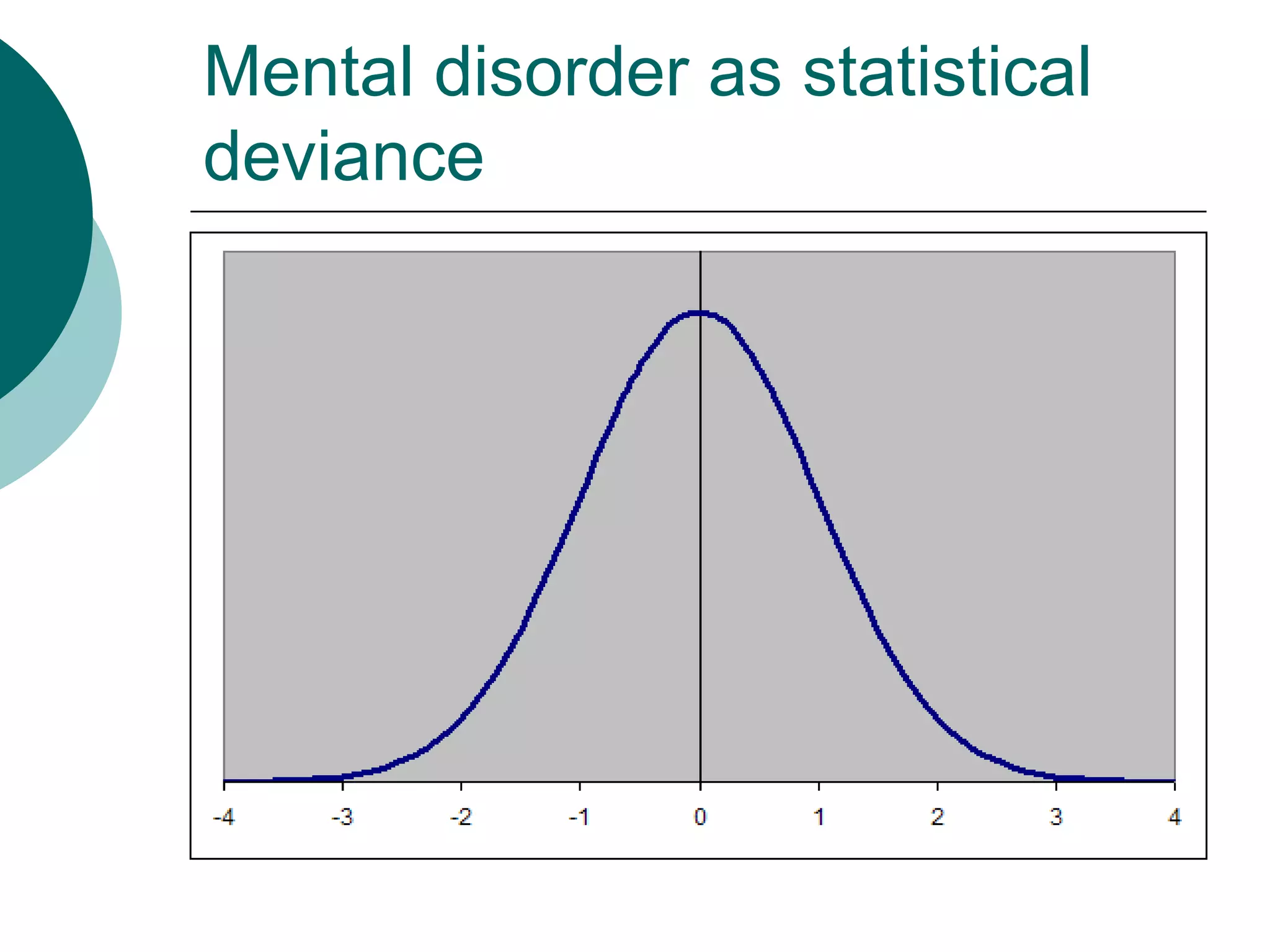
A person has a mental disorder when
  their behaviour, ability, or experience
  is significantly dif ferent from average.
Mental disorder as statistical
deviance
Mental disorder as statistical deviance
Problems:
We want to use the term disorder to describe
  some conditions that are statistically
  frequent
“positive” deviations are not distinguished from
  “negative” deviations
we do not want to call all “negative deviations
  a disorder
   Uggo Betti:
     “Allof us are mad. If it weren’t for the
      fact that every one of us is slightly
      abnormal, there wouldn’t be any point
      of giving each person a separate
      name.”
Mental disorder as a dysfunction
A person has a mental disorder when a mental
  mechanism is not per forming the natural
  function it was designed to per form.
Problems:
 Natural selection does not “design” mechanisms
   Sedgwick (1982):
     “Allsickness is essentially deviancy
      from some alternative state of affairs
      which is considered more desirable…
      The attribution of illness always
      proceeds from the computation of a
      gap between presented behaviour (or
      feeling) and some social norm.”
Mental disorder as a dysfunction
Problems cont:
 For many mechanisms there is a wide range of
  adaptive functioning across people and situations (fear
  response).
Mental disorder as a dysfunction
Problems cont:
 Many things that we want to call a disorder might
  actually be adaptive reactions.
Mental disorder as personal discomfort
A person has a mental disorder if they
  experience personal distress.
Problems:
 What about the person who abuses drugs or believes
  they are receiving messages from outer-space –
  without experiencing distress?
Mental disorder as maladaptive behaviour
A person has a mental disorder if they engage
  in behaviour that prevents them from
  meeting the demands of life.
Problems:
 There may be situations that people should not adapt
  to
 This approach emphasizes “fitting in” as being
  ultimately important
Mental disorder as norm or value violation
A person has a mental disorder if they have
    experiences and exhibit behaviours that are
    inconsistent with the norms and values of
    society.
Examples:
 Behaviour that is harmful to oneself or others
 Poor reality contact
 Inappropriate emotional reactions
 Erratic behaviour
Mental disorder as norm or value violation
Problems:
 What if violation is result of external circumstances
 Such a criteria can seem too arbitrary and open to
  abuse
DSM-IV definition of mental disorder
A mental disorder is “conceptualized as a
  clinically significant behavioural or
  psychological syndrome or pattern that
  occurs in an individual and that is associated
  with present distress or disability or with a
  significantly increased risk of suf fering
  death, pain, disability, or an impor tant loss
  of freedom.”
DSM-IV definition of mental disorder
“The syndrome or pattern must not be merely
   an expectable and culturally sanctioned
   response to a par ticular event, for example,
   the death of a loved one. ”
“It must currently be considered a
   manifestation of a behavioural,
   psychological, or biological dysfunction in
   the individual.”
Cross cultural issues
How one thinks about the role of culture
  depends on your definition of mental
  disorder
Cross cultural issues
If biomedical, then culture influences how a
    disorder impacts members of dif ferent
    cultures
 Different risk
 Idiom of distress
Cross cultural issues
If culturally based, then influences what will be
   considered a disorder
 Behaviour or experience may not be a “disorder” in all
  cultures
Non-Western approaches to mental disorder
Of t endo not separate psychology and
   spirituality
 Disruption in relation to spirit world
Of ten based on more collective and less
   individualistic conceptualizations
 Disruption in interpersonal relations
The study of mental disorder involves:
Definition: What do we mean by mental
  disorder?
Categorization: How do we classify mental
  disorder?
Explanation: How do we understand mental
  disorder?
Treatment: How do we treat mental disorder?
REFERENCES:

Linienfeld, S. O., & Marino, L. (1995). Mental Disorder as
  a Roschian Concept: A critique of Wakefield ’s “Harmful
  Dysfunction” analysis. Journal of Abnormal Psychology,
  104(3), 411-420.
Szasz, T. (2000). Second commentar y on “Aristotle’s
  function argument. Philosophical Psychiatr y and
  Psychology 7(1), 3-16.
Wakefield, J. (1992). The concept of mental disorder: On
 the boundar y between biological facts and social
 values. American Psychologist, 47(3), 373-388.

Abnormal psychology an introduction

  • 1.
    Abnormal Psychology ti on d uc t ro In An
  • 2.
    What are westudying? Abnormal Behaviour Psychopathology Mental Disorder Mental Illness Deviant Behaviour
  • 3.
    The study ofmental disorder involves: Definition: What do we mean by mental disorder? Classification: How do we distinguish between dif ferent mental disorders? Explanation: How do we understand mental disorder? Treatment: How do we treat mental disorder?
  • 4.
    Why study abnormalpsychology? Abnormal behaviour is par t of our common experience Lots of unanswered questions and complexities Preparation for future careers  www.apa.org/students/
  • 5.
    Mental Health Professionals ClinicalPsychologist (Ph.D., C. Psych.) Psychiatrist (M.D.) Psychiatric Social Worker (M.S.W.) Psychoanalyst Therapist
  • 6.
    What do wemean by mental disorder? Who has a mental disorder?  Mass murders?  People who want to cut off their arms and legs?  People who can’t pay attention and concentrate?
  • 7.
    Is the conceptof ‘Mental Disorder’ problematic? “I should like to make clear, therefore, that although I consider the concept of mental illness to be unser viceable, I believe that psychiatr y could be a science. I also believe that psychotherapy is an ef fective method of helping people – not to recover from an ‘illness’ but rather to learn about themselves, others and life. ” Szasz
  • 8.
    Why clarify thedefinition of mental disorder? Influences what is seen as pathological Influences explanation, classification and treatment Clarifies the role of professionals
  • 9.
    Two broad waysto define mental disorder In general, the concept of “mental disorder” can be defined as:  A biomedical, culturally independent, value-free concept  Or as a social, culturally relative, value-based concept.
  • 10.
    Overview of definitionsthat will be discussed Mental disorder as a statistical deviation Mental disorder as dysfunction Mental disorder as personal discomfor t Mental disorder as maladaptive behaviour Mental disorder as norm or value violation
  • 11.
    Mental disorder asstatistical deviance A person has a mental disorder when their behaviour, ability, or experience is significantly dif ferent from average.
  • 12.
    Mental disorder asstatistical deviance
  • 13.
    Mental disorder asstatistical deviance Problems: We want to use the term disorder to describe some conditions that are statistically frequent “positive” deviations are not distinguished from “negative” deviations we do not want to call all “negative deviations a disorder
  • 14.
    Uggo Betti:  “Allof us are mad. If it weren’t for the fact that every one of us is slightly abnormal, there wouldn’t be any point of giving each person a separate name.”
  • 15.
    Mental disorder asa dysfunction A person has a mental disorder when a mental mechanism is not per forming the natural function it was designed to per form. Problems:  Natural selection does not “design” mechanisms
  • 16.
    Sedgwick (1982):  “Allsickness is essentially deviancy from some alternative state of affairs which is considered more desirable… The attribution of illness always proceeds from the computation of a gap between presented behaviour (or feeling) and some social norm.”
  • 17.
    Mental disorder asa dysfunction Problems cont:  For many mechanisms there is a wide range of adaptive functioning across people and situations (fear response).
  • 18.
    Mental disorder asa dysfunction Problems cont:  Many things that we want to call a disorder might actually be adaptive reactions.
  • 19.
    Mental disorder aspersonal discomfort A person has a mental disorder if they experience personal distress. Problems:  What about the person who abuses drugs or believes they are receiving messages from outer-space – without experiencing distress?
  • 20.
    Mental disorder asmaladaptive behaviour A person has a mental disorder if they engage in behaviour that prevents them from meeting the demands of life. Problems:  There may be situations that people should not adapt to  This approach emphasizes “fitting in” as being ultimately important
  • 21.
    Mental disorder asnorm or value violation A person has a mental disorder if they have experiences and exhibit behaviours that are inconsistent with the norms and values of society. Examples:  Behaviour that is harmful to oneself or others  Poor reality contact  Inappropriate emotional reactions  Erratic behaviour
  • 22.
    Mental disorder asnorm or value violation Problems:  What if violation is result of external circumstances  Such a criteria can seem too arbitrary and open to abuse
  • 24.
    DSM-IV definition ofmental disorder A mental disorder is “conceptualized as a clinically significant behavioural or psychological syndrome or pattern that occurs in an individual and that is associated with present distress or disability or with a significantly increased risk of suf fering death, pain, disability, or an impor tant loss of freedom.”
  • 25.
    DSM-IV definition ofmental disorder “The syndrome or pattern must not be merely an expectable and culturally sanctioned response to a par ticular event, for example, the death of a loved one. ” “It must currently be considered a manifestation of a behavioural, psychological, or biological dysfunction in the individual.”
  • 26.
    Cross cultural issues Howone thinks about the role of culture depends on your definition of mental disorder
  • 27.
    Cross cultural issues Ifbiomedical, then culture influences how a disorder impacts members of dif ferent cultures  Different risk  Idiom of distress
  • 28.
    Cross cultural issues Ifculturally based, then influences what will be considered a disorder  Behaviour or experience may not be a “disorder” in all cultures
  • 29.
    Non-Western approaches tomental disorder Of t endo not separate psychology and spirituality  Disruption in relation to spirit world Of ten based on more collective and less individualistic conceptualizations  Disruption in interpersonal relations
  • 30.
    The study ofmental disorder involves: Definition: What do we mean by mental disorder? Categorization: How do we classify mental disorder? Explanation: How do we understand mental disorder? Treatment: How do we treat mental disorder?
  • 31.
    REFERENCES: Linienfeld, S. O.,& Marino, L. (1995). Mental Disorder as a Roschian Concept: A critique of Wakefield ’s “Harmful Dysfunction” analysis. Journal of Abnormal Psychology, 104(3), 411-420. Szasz, T. (2000). Second commentar y on “Aristotle’s function argument. Philosophical Psychiatr y and Psychology 7(1), 3-16. Wakefield, J. (1992). The concept of mental disorder: On the boundar y between biological facts and social values. American Psychologist, 47(3), 373-388.