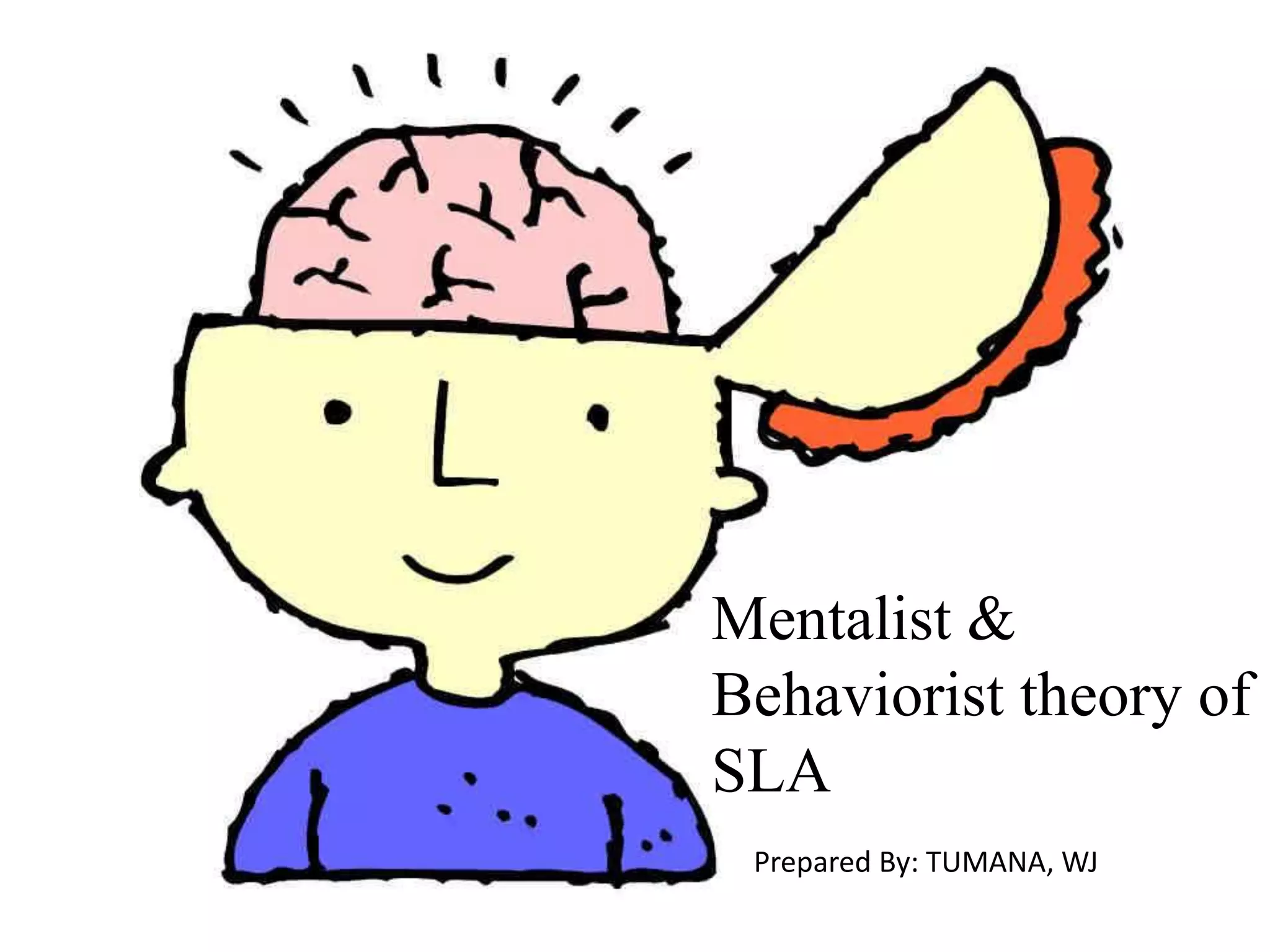
Mentalist &
Behaviorist theory of
SLA
Prepared By: TUMANA, WJ
Language acquisition theories
• In a Broader sense, various theories and approaches
have been emerged over the years to study and analyze
the process of language of acquisition. Four main
schools of thought, which provide theoretical
paradigms in guiding the course of language
acquisition are:
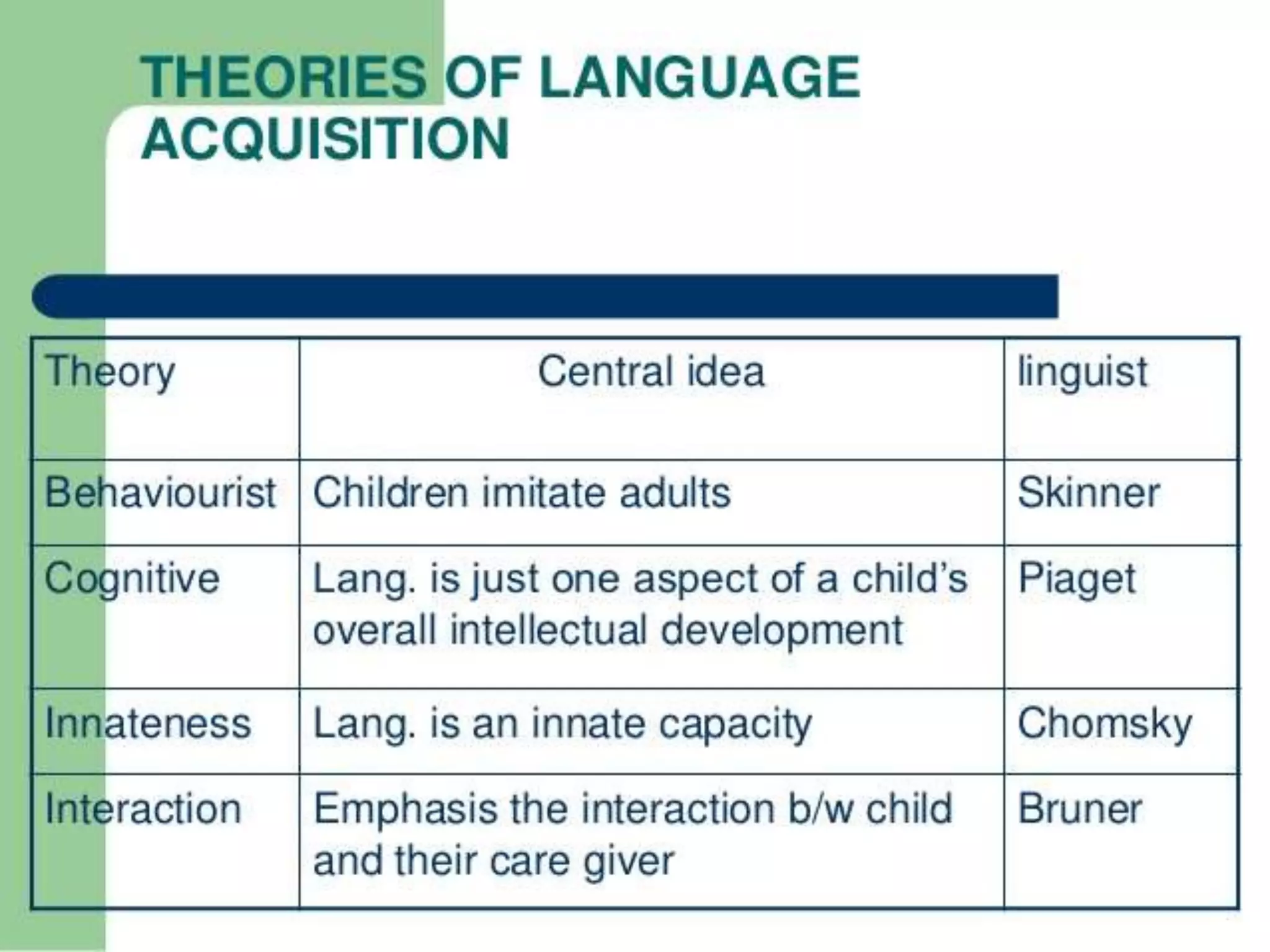
• Imitation, Nativism or Behaviorism: based on
empiricist or behavioral approach.
• Innateness or Mentalism: based on the rationalistic or
mentalist approach
• Cognition: based on the cognitive-psychological
approach
• Motherese or Input: based on the maternal approach to
language acquisition.
Sources
• www.slideshare.net/.../behaviourism-and-
mentalism-nasir-presentation
• onlinelibrary.wiley.com/doi/10.1111/j.1944-
9720.1972.tb00709.../pdf
• Google Images
Behaviorist
Skinner and his followers are known as
behaviorist. According to them language
learning is a process known as operant
conditioning.
Conditioned Behavior - behavior in which the
training is repeated.
Operant – voluntary behavior; it is the result of
the learner’s own free will, and it is not forced
by any person or thing from the outside. The
learner demonstrates the new behavior first
as a response to a system of reward or
punishment, and finally as an automatic
response.
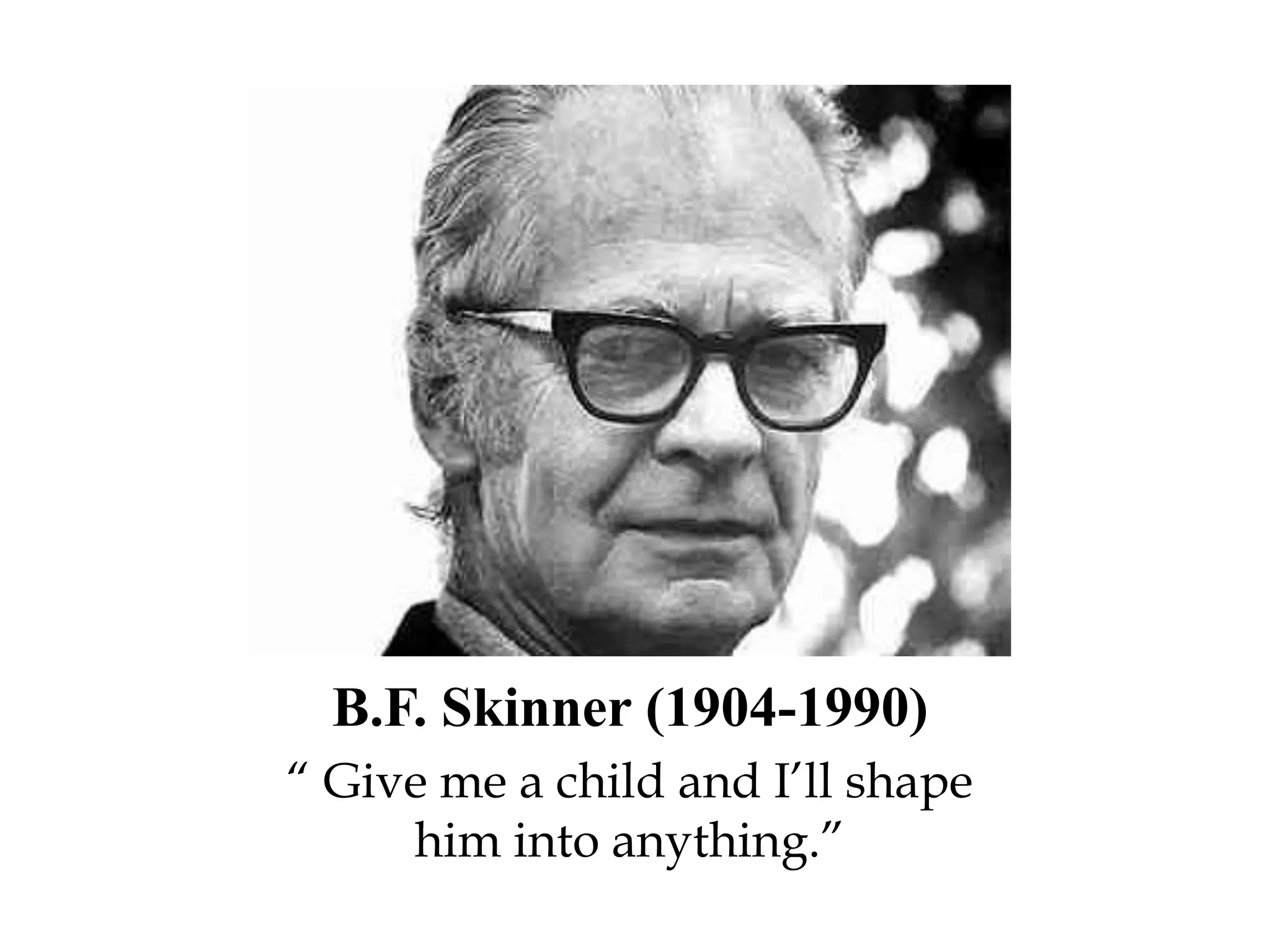
B.F. Skinner (1904-1990)
“ Give me a child and I’ll shape
him into anything.”
Experiment
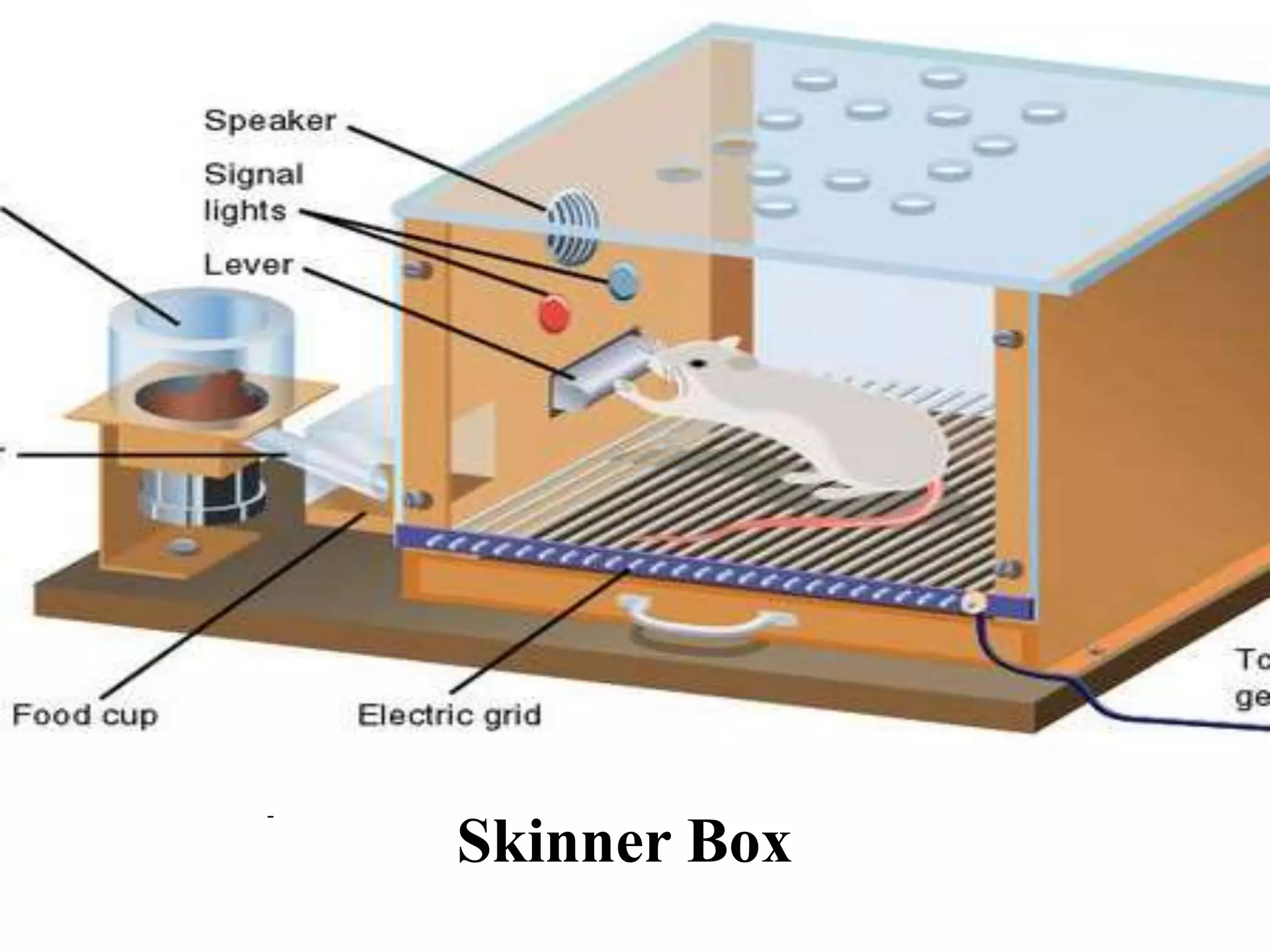
• They put a rat in a box containing a bar. If it presses the
bar, it is rewarded with a pallet of food. Nothing forces it
to push the bar.
• It probably does accidentally at the first time. When the
rat finds out that food will arrive, it will press the bar
again.
• Task was made difficult; the rat only gets rewarded with
food if it presses the bar while a light is flashed.
• At first the rat was puzzled but eventually learns the trick.
• To make it more difficult, the rat can only receive food if it
presses the bar more than once.
• After initial confusion it learned to do so. And so on, and
so on.
Skinner Box
-
-
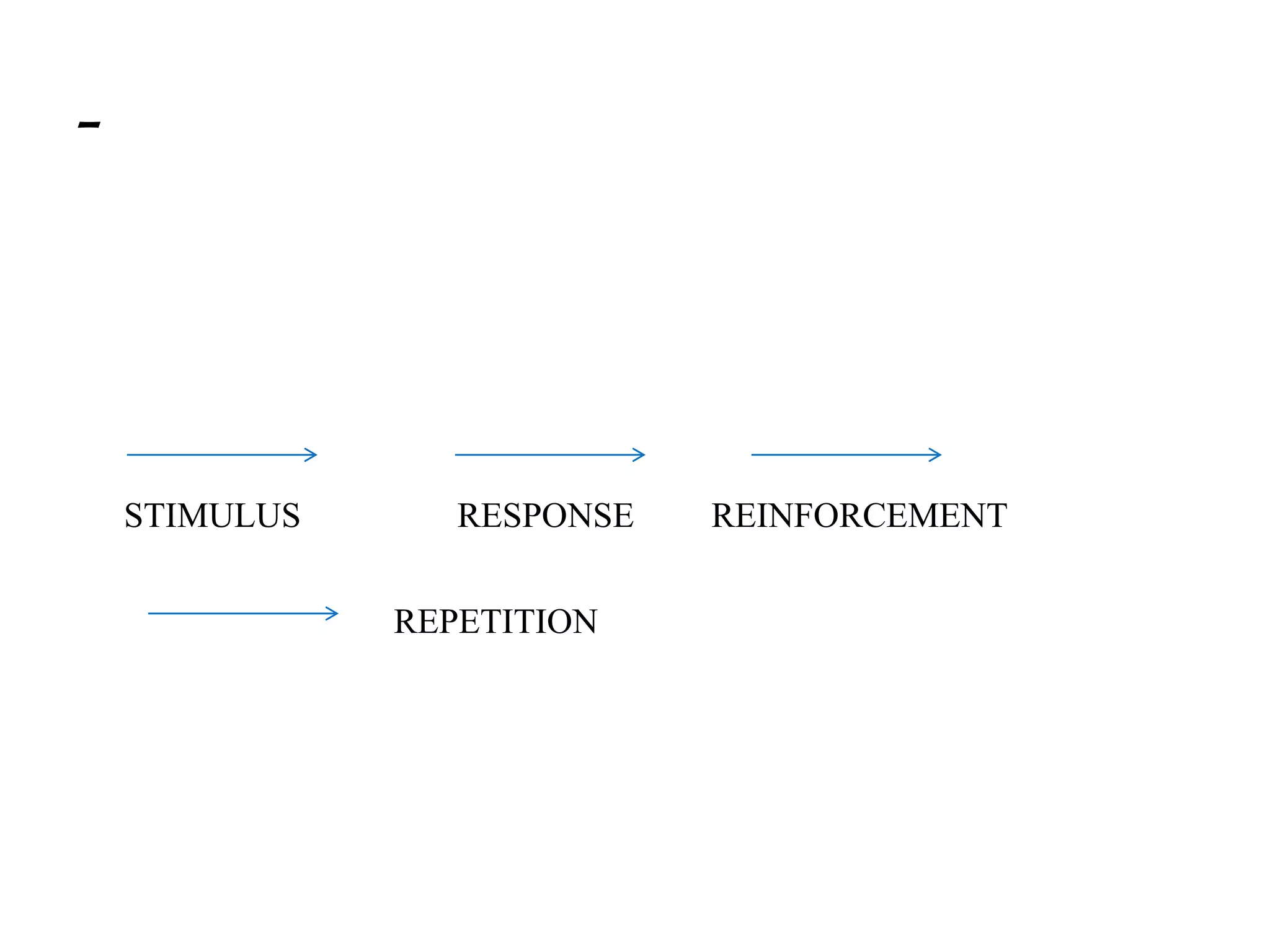
STIMULUS RESPONSE REINFORCEMENT
REPETITION
-
• In Operant conditioning, reinforcement plays a
vital role.
• TWO kinds of Reinforcement:
1. Positive Reinforcement (Praise and rewards)
2. Negative Reinforcement (Rebuke and
punishments)
Behaviorism
• Language Learning is Operant Conditioning
• Positive and Negative Reinforcement
• Imitation and Association
.
• Noam Chomsky explicitly rejects the
behaviorists’ position that language should be
thought of as verbal behavior, arguing that it
should be thought of as knowledge held by
those who use language.
• Chomsky suggests that the learner of any
language has an inbuilt learning capacity of
language that enables each learner to construct
a kind of personal theory or set of rules about
the language based on very limited exposure to
language.
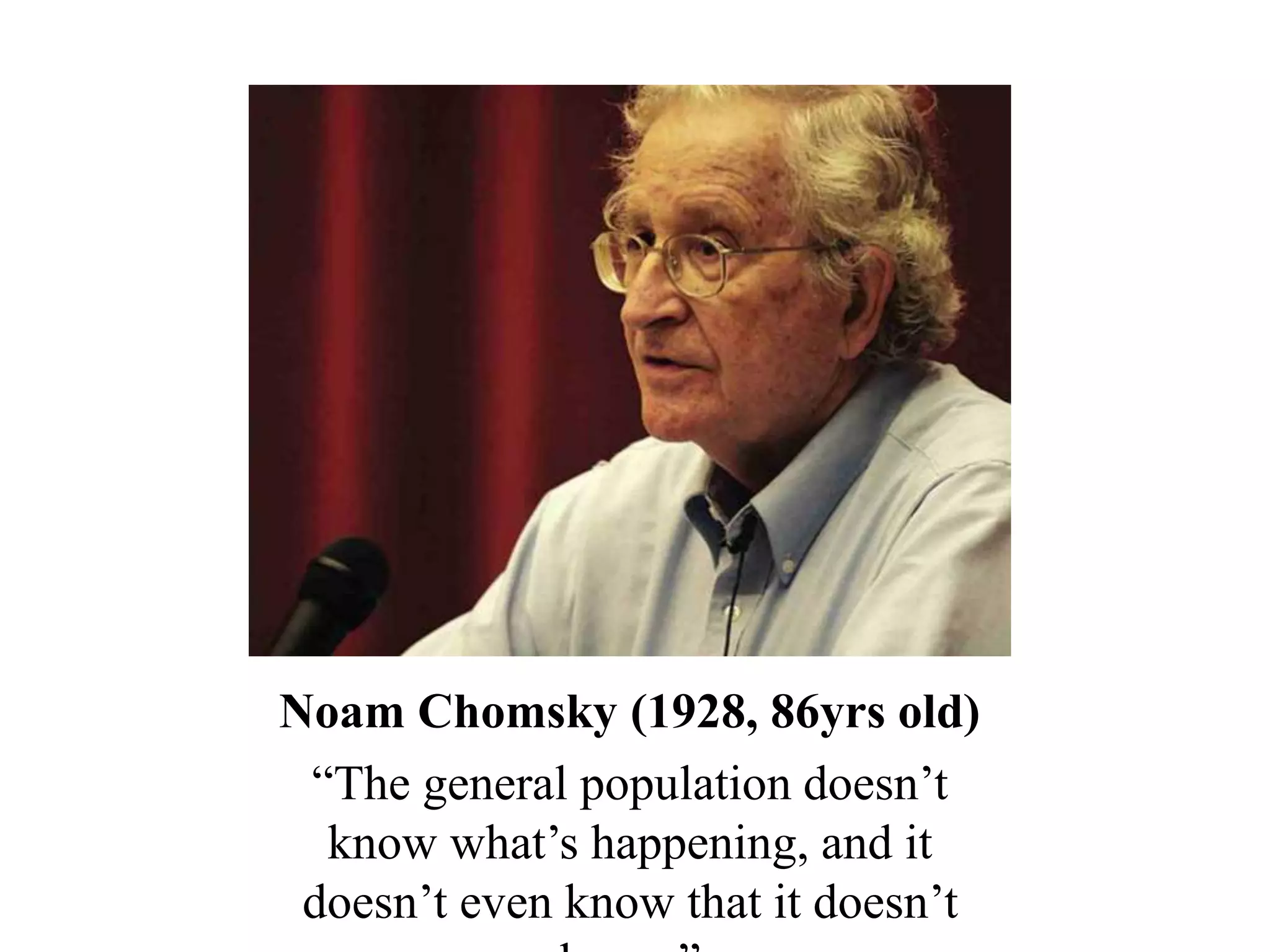
Noam Chomsky (1928, 86yrs old)
“The general population doesn’t
know what’s happening, and it
doesn’t even know that it doesn’t
Mentalist
• Chomsky and his mentalist followers claim that a
child learns his first language through cognitive
learning. They claim that language is governed by
rules, and is not a haphazard thing, as Skinner and
his followers would claim.
• According to Chomsky, the child is born with a
mental capacity for working out the underlying
system to the jumble of sounds which he hears.
• He constructs his own grammar and imposes it on
all the sound reaching his brain.
…
• The mental grammar is part of his cognitive
framework, and nothing he hears is store in his
brain until he has matched it against what he
already knows and found a ‘correct’ place for it
within this framework.
• Chomsky argues that language is so complex that
it is almost incredible that it can be acquired by a
child in a so short of time.
• He says that a child is born with some innate
mental capacity which helps the child to process
all the language which he hears.
• This is called the
Language Acquisition Device
He saw it as comprising a special area of the
brain whose only function is the processing of
language.
When Chomsky talks about ‘rules’, he means the
unconscious rules in a child’s mind. These
rules enables him to make grammatical
sentences in his own language.
Chomsky does not mean that a child can do as
described in these rules explicitly.
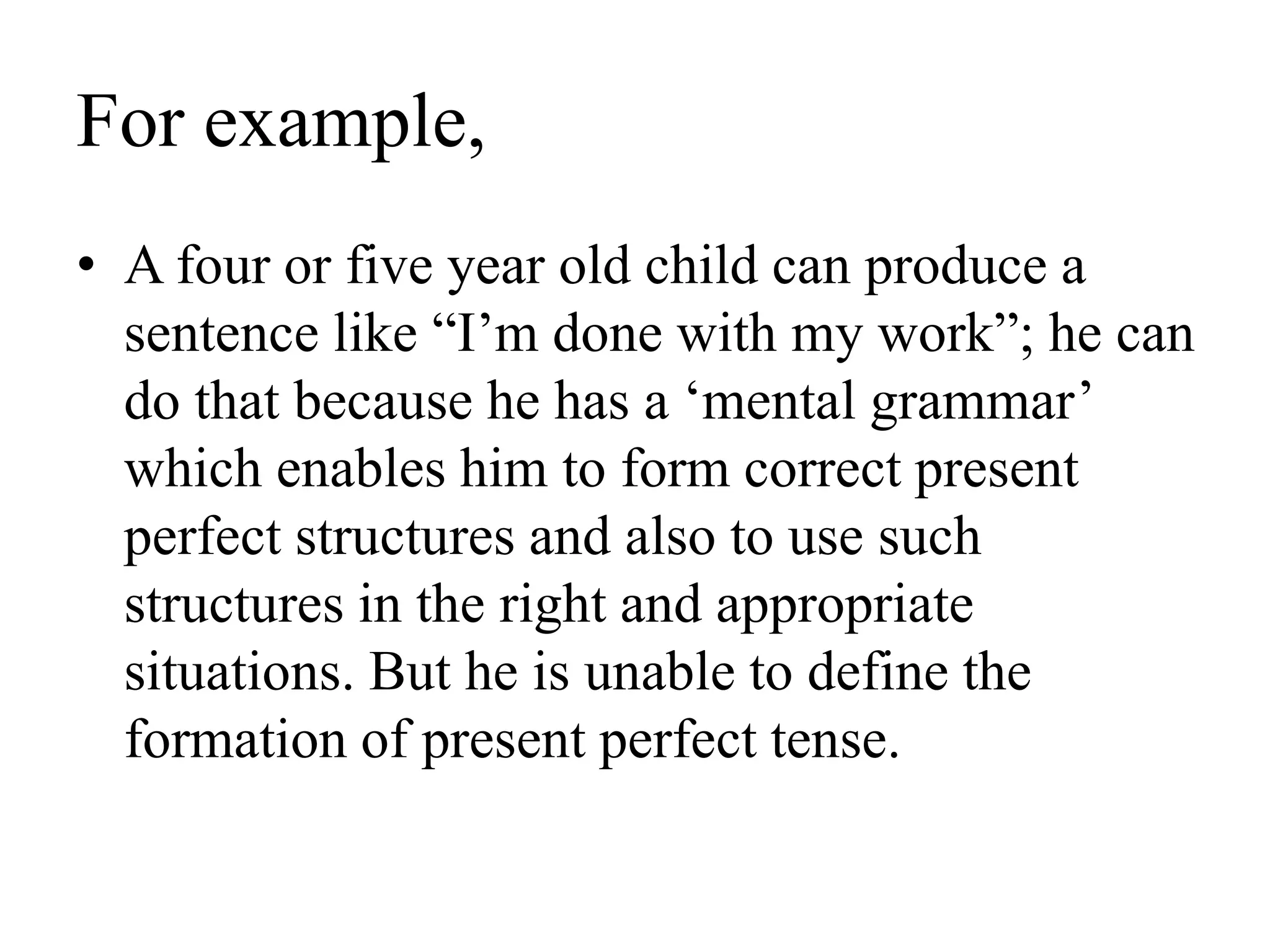
For example,
• A four or five year old child can produce a
sentence like “I’m done with my work”; he can
do that because he has a ‘mental grammar’
which enables him to form correct present
perfect structures and also to use such
structures in the right and appropriate
situations. But he is unable to define the
formation of present perfect tense.
Mentalism
• Language learning is innate ability
• Mental (own rules) and Grammatical sentences
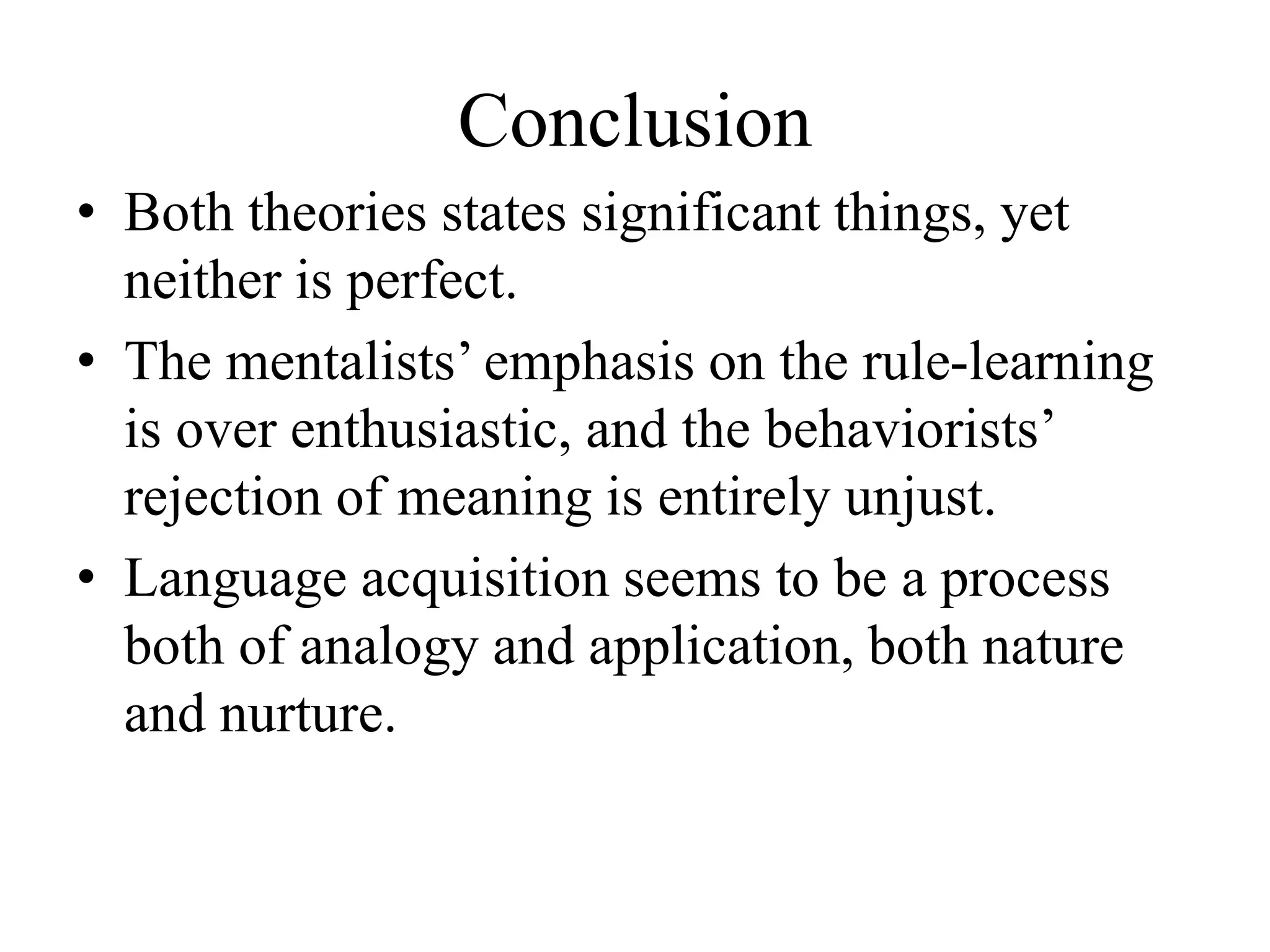
Conclusion
• Both theories states significant things, yet
neither is perfect.
• The mentalists’ emphasis on the rule-learning
is over enthusiastic, and the behaviorists’
rejection of meaning is entirely unjust.
• Language acquisition seems to be a process
both of analogy and application, both nature
and nurture.
.
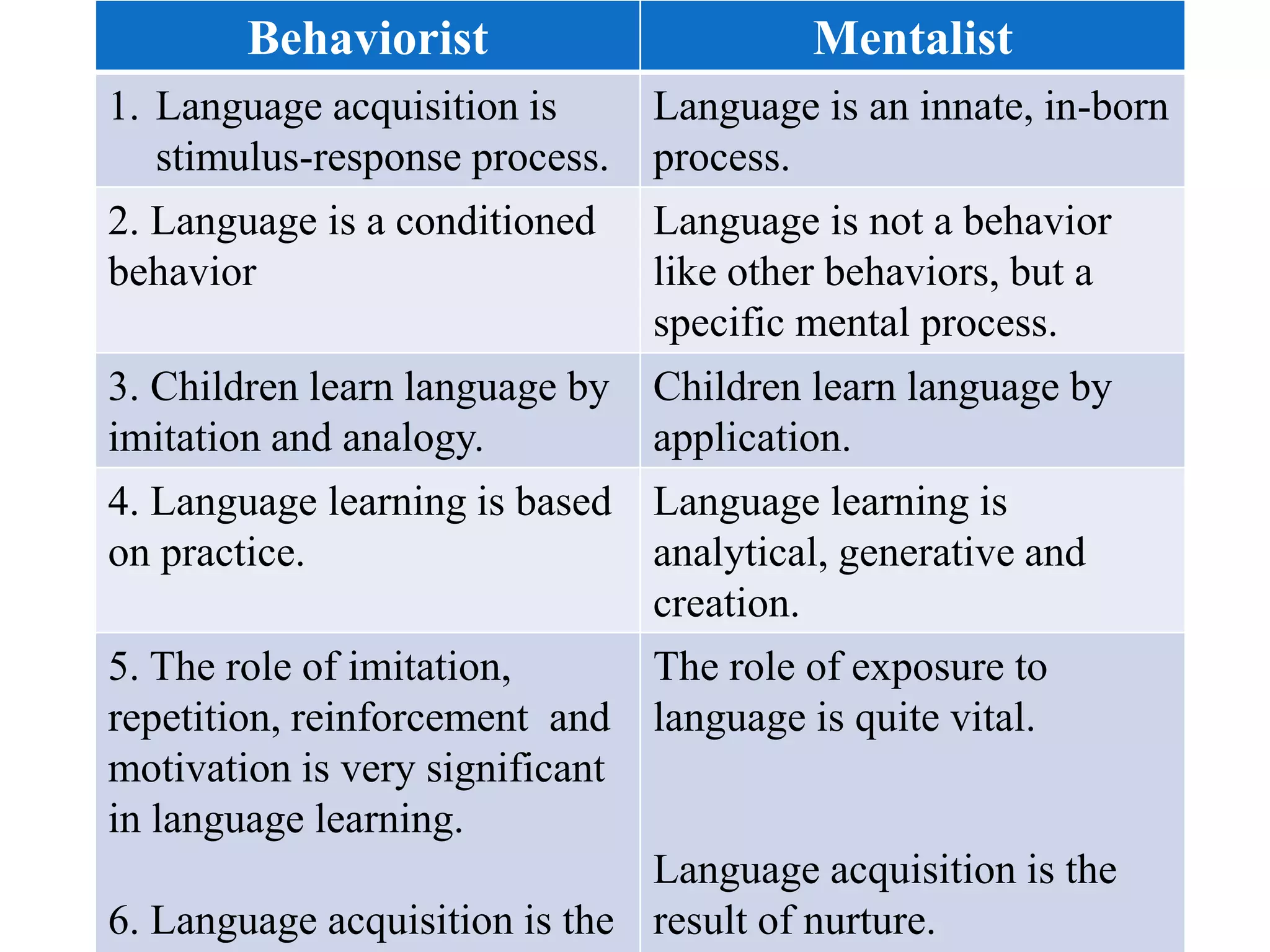
Behaviorist Mentalist
1. Language acquisition is
stimulus-response process.
Language is an innate, in-born
process.
2. Language is a conditioned
behavior
Language is not a behavior
like other behaviors, but a
specific mental process.
3. Children learn language by
imitation and analogy.
Children learn language by
application.
4. Language learning is based
on practice.
Language learning is
analytical, generative and
creation.
5. The role of imitation,
repetition, reinforcement and
motivation is very significant
in language learning.
6. Language acquisition is the
The role of exposure to
language is quite vital.
Language acquisition is the
result of nurture.
Conclusion
• This comparative study makes one thing clear:
nature and nurture, analogy and application,
practice and exposure, are important.
• Innate potentialities lay down the framework.
Within this framework, there is a wide variation
depending on the environment. The kind of
language that children ultimately grown into
shaped by the culture-based responses of the
family, if not in a way that can be called imitation,
then at least in terms of things the child chooses
to do with its language.
…
• But we should be wary of the idea that all children
experience the same practices and follow the same
development path as they grow into their language.
• Having been exposed to a small number of utterances,
the child begins to extract the principles underlying the
utterances and compose new words of his own.
• This is the way every child grammar communicate in
an intelligent manner.
• He make mistakes and produces ungrammatical
sentences. His elders correct him; he feeds the
information into his mini-grammar, modifies some of
the rules, and again produces new utterances.
…
• In a period of about four years, he is able to
master and internalize all the essential rules of
language.
• This proves that a child’s own rules of
grammar are more important to him than mere
imitation.
Mentalist and Behaviorist Theory of SLA

Mentalist and Behaviorist Theory of SLA

  • 1.
    Mentalist & Behaviorist theoryof SLA Prepared By: TUMANA, WJ
  • 2.
    Language acquisition theories •In a Broader sense, various theories and approaches have been emerged over the years to study and analyze the process of language of acquisition. Four main schools of thought, which provide theoretical paradigms in guiding the course of language acquisition are: • Imitation, Nativism or Behaviorism: based on empiricist or behavioral approach. • Innateness or Mentalism: based on the rationalistic or mentalist approach • Cognition: based on the cognitive-psychological approach • Motherese or Input: based on the maternal approach to language acquisition.
  • 3.
  • 5.
    Behaviorist Skinner and hisfollowers are known as behaviorist. According to them language learning is a process known as operant conditioning. Conditioned Behavior - behavior in which the training is repeated. Operant – voluntary behavior; it is the result of the learner’s own free will, and it is not forced by any person or thing from the outside. The learner demonstrates the new behavior first as a response to a system of reward or punishment, and finally as an automatic response.
  • 6.
    B.F. Skinner (1904-1990) “Give me a child and I’ll shape him into anything.”
  • 7.
    Experiment • They puta rat in a box containing a bar. If it presses the bar, it is rewarded with a pallet of food. Nothing forces it to push the bar. • It probably does accidentally at the first time. When the rat finds out that food will arrive, it will press the bar again. • Task was made difficult; the rat only gets rewarded with food if it presses the bar while a light is flashed. • At first the rat was puzzled but eventually learns the trick. • To make it more difficult, the rat can only receive food if it presses the bar more than once. • After initial confusion it learned to do so. And so on, and so on.
  • 8.
  • 9.
  • 10.
    - • In Operantconditioning, reinforcement plays a vital role. • TWO kinds of Reinforcement: 1. Positive Reinforcement (Praise and rewards) 2. Negative Reinforcement (Rebuke and punishments)
  • 11.
    Behaviorism • Language Learningis Operant Conditioning • Positive and Negative Reinforcement • Imitation and Association
  • 12.
    . • Noam Chomskyexplicitly rejects the behaviorists’ position that language should be thought of as verbal behavior, arguing that it should be thought of as knowledge held by those who use language. • Chomsky suggests that the learner of any language has an inbuilt learning capacity of language that enables each learner to construct a kind of personal theory or set of rules about the language based on very limited exposure to language.
  • 13.
    Noam Chomsky (1928,86yrs old) “The general population doesn’t know what’s happening, and it doesn’t even know that it doesn’t
  • 14.
    Mentalist • Chomsky andhis mentalist followers claim that a child learns his first language through cognitive learning. They claim that language is governed by rules, and is not a haphazard thing, as Skinner and his followers would claim. • According to Chomsky, the child is born with a mental capacity for working out the underlying system to the jumble of sounds which he hears. • He constructs his own grammar and imposes it on all the sound reaching his brain.
  • 15.
    … • The mentalgrammar is part of his cognitive framework, and nothing he hears is store in his brain until he has matched it against what he already knows and found a ‘correct’ place for it within this framework. • Chomsky argues that language is so complex that it is almost incredible that it can be acquired by a child in a so short of time. • He says that a child is born with some innate mental capacity which helps the child to process all the language which he hears. • This is called the
  • 16.
    Language Acquisition Device Hesaw it as comprising a special area of the brain whose only function is the processing of language. When Chomsky talks about ‘rules’, he means the unconscious rules in a child’s mind. These rules enables him to make grammatical sentences in his own language. Chomsky does not mean that a child can do as described in these rules explicitly.
  • 17.
    For example, • Afour or five year old child can produce a sentence like “I’m done with my work”; he can do that because he has a ‘mental grammar’ which enables him to form correct present perfect structures and also to use such structures in the right and appropriate situations. But he is unable to define the formation of present perfect tense.
  • 18.
    Mentalism • Language learningis innate ability • Mental (own rules) and Grammatical sentences
  • 20.
    Conclusion • Both theoriesstates significant things, yet neither is perfect. • The mentalists’ emphasis on the rule-learning is over enthusiastic, and the behaviorists’ rejection of meaning is entirely unjust. • Language acquisition seems to be a process both of analogy and application, both nature and nurture.
  • 21.
    . Behaviorist Mentalist 1. Languageacquisition is stimulus-response process. Language is an innate, in-born process. 2. Language is a conditioned behavior Language is not a behavior like other behaviors, but a specific mental process. 3. Children learn language by imitation and analogy. Children learn language by application. 4. Language learning is based on practice. Language learning is analytical, generative and creation. 5. The role of imitation, repetition, reinforcement and motivation is very significant in language learning. 6. Language acquisition is the The role of exposure to language is quite vital. Language acquisition is the result of nurture.
  • 23.
    Conclusion • This comparativestudy makes one thing clear: nature and nurture, analogy and application, practice and exposure, are important. • Innate potentialities lay down the framework. Within this framework, there is a wide variation depending on the environment. The kind of language that children ultimately grown into shaped by the culture-based responses of the family, if not in a way that can be called imitation, then at least in terms of things the child chooses to do with its language.
  • 24.
    … • But weshould be wary of the idea that all children experience the same practices and follow the same development path as they grow into their language. • Having been exposed to a small number of utterances, the child begins to extract the principles underlying the utterances and compose new words of his own. • This is the way every child grammar communicate in an intelligent manner. • He make mistakes and produces ungrammatical sentences. His elders correct him; he feeds the information into his mini-grammar, modifies some of the rules, and again produces new utterances.
  • 25.
    … • In aperiod of about four years, he is able to master and internalize all the essential rules of language. • This proves that a child’s own rules of grammar are more important to him than mere imitation.

Editor's Notes

  • #3 Empiricism – the practice of basing ideas and theories on testing and experience
  • #6 How did they prove their theory?