SUBECT: LANGUAGE ADQUISITION
TEACHER: MGS.MÓNICA DEL CARMEN PINTO
STUDENT’S NAME: ESPERANZA ALEJANDRINA MORA
ACTIVITY 1.4
The psychology of Second language
Acquisition.
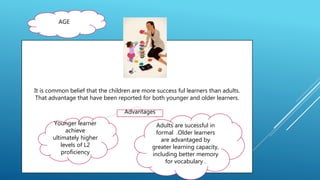
AGE
It is common belief that the children are more success ful learners than adults.
That advantage that have been reported for both younger and older learners.
Younger learner
achieve
ultimately higher
levels of L2
proficiency
Adults are sucessful in
formal .Older learners
are advantaged by
greater learning capacity,
including better memory
for vocabulary .
Advantages
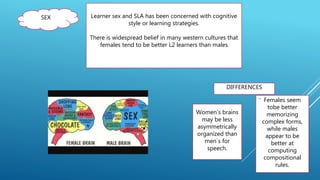
SEX Learner sex and SLA has been concerned with cognitive
style or learning strategies.
There is widespread belief in many western cultures that
females tend to be better L2 learners than males
Women’s brains
may be less
asymmetrically
organized than
men´s for
speech.
DIFFERENCES
Females seem
tobe better
memorizing
complex forms,
while males
appear to be
better at
computing
compositional
rules.
LEARNING
APTITUDE
 There is a talent which is specific to language
learning has been widely held for many years.
 The aptitude is an important predictor of
differential success in L2 learning holds both for
naturalistic contexts and formal classroom
instruction
 Phonemic coding ability is tha capacity to
process auditory input into segments.
 inductive language learning ability the brain to
infer structurre , identify patterns make
generalizations.
 Grammatical sensitivity function of elements,
and formulate rules.
 Associative memory capacity determines
appropriate selection from among the L2
elements
It is conceived as a condtruvt construct
which includes at least the following
components
 Significant goal or need
 Desire to attain the goal
 Percepton that learning L2 is
revelevants fulfiling the goala or
meetingh the need
 Belief in the likely succ ess or failure
COGNITIVE
STYLE It refers to individuals’ preferred way of processing,
perceiving, conceptualizing, organizinging, recalling
information.
The field dependent dimensión is the most frequently
referred to in SLA related research.
Global and holistic in processing new information.
Then applies it to interpret particular instances of input
PERSONALI
TY It factors are sometimes added to cognitive style in
characterizing mor general learning style.
* Personality factors are defined as individual traits,
systematic cultural differences are found between
groups of learners.
• Personality dimensión, introverts generally do better
in school and extroverts talk more.
 They are behaviors and techniques they adopt in their efforts to
learn a second language.
 it is strongly influenced by the nature of their motivation, cognitive
style, and personality, as well as by specific contexts of use and
opportunities for learning
 LS are culturally based on : individuals learn how to learn as part of
their socialzation experiences, and strategies they acquiere in relation.
LEARNING
STRATEGIES
Language adquisition 11

Language adquisition 11

  • 1.
    SUBECT: LANGUAGE ADQUISITION TEACHER:MGS.MÓNICA DEL CARMEN PINTO STUDENT’S NAME: ESPERANZA ALEJANDRINA MORA
  • 2.
    ACTIVITY 1.4 The psychologyof Second language Acquisition.
  • 3.
    AGE It is commonbelief that the children are more success ful learners than adults. That advantage that have been reported for both younger and older learners. Younger learner achieve ultimately higher levels of L2 proficiency Adults are sucessful in formal .Older learners are advantaged by greater learning capacity, including better memory for vocabulary . Advantages
  • 4.
    SEX Learner sexand SLA has been concerned with cognitive style or learning strategies. There is widespread belief in many western cultures that females tend to be better L2 learners than males Women’s brains may be less asymmetrically organized than men´s for speech. DIFFERENCES Females seem tobe better memorizing complex forms, while males appear to be better at computing compositional rules.
  • 5.
    LEARNING APTITUDE  There isa talent which is specific to language learning has been widely held for many years.  The aptitude is an important predictor of differential success in L2 learning holds both for naturalistic contexts and formal classroom instruction  Phonemic coding ability is tha capacity to process auditory input into segments.  inductive language learning ability the brain to infer structurre , identify patterns make generalizations.  Grammatical sensitivity function of elements, and formulate rules.  Associative memory capacity determines appropriate selection from among the L2 elements
  • 6.
    It is conceivedas a condtruvt construct which includes at least the following components  Significant goal or need  Desire to attain the goal  Percepton that learning L2 is revelevants fulfiling the goala or meetingh the need  Belief in the likely succ ess or failure
  • 7.
    COGNITIVE STYLE It refersto individuals’ preferred way of processing, perceiving, conceptualizing, organizinging, recalling information. The field dependent dimensión is the most frequently referred to in SLA related research. Global and holistic in processing new information. Then applies it to interpret particular instances of input
  • 8.
    PERSONALI TY It factorsare sometimes added to cognitive style in characterizing mor general learning style. * Personality factors are defined as individual traits, systematic cultural differences are found between groups of learners. • Personality dimensión, introverts generally do better in school and extroverts talk more.
  • 9.
     They arebehaviors and techniques they adopt in their efforts to learn a second language.  it is strongly influenced by the nature of their motivation, cognitive style, and personality, as well as by specific contexts of use and opportunities for learning  LS are culturally based on : individuals learn how to learn as part of their socialzation experiences, and strategies they acquiere in relation. LEARNING STRATEGIES