


















INDIVIDUAL LEARNER
DIFFERENCES IN SLA
RESEARCH
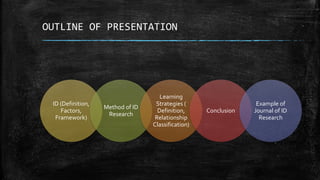
OUTLINE OF PRESENTATION
ID (Definition,
Factors,
Framework)
Method of ID
Research
Learning
Strategies (
Definition,
Relationship
Classification)
Conclusion
Example of
Journal of ID
Research
SITUATION
▪ Two or more English learners are attending the
same English class, having the same instructors
and ,materials, doing the same activities and
excercises, proceeding for the same duration of
course program, and living in the same
environment
▪ In the end of the program, these learners have a
kind of English competency assessment. But
they achieve different level of competence.
QUESTIONS
▪ How could one learner be more succesfull than another?
▪ What factor, other than instructors, materials, activities,
environment, may affect the result of learning?
INTRODUCTION
▪ Second languages are different from the primary languages.
▪ Second language learning involves some form of acquisition.This is a
process by which an individual can effectively learn a second
language also known as an additional language
▪ There are diverse learner differences in learning a second language
DEFINITIONS OF INDIVIDUAL DIFFERENCES
▪ According to the dictionary of education
▪ Individual differences stand for the variation or deviations among
individuals in regard to a single characteristic or number of
characteristics.
▪ It is stand for those differences which in their totality distinguish one
individual from another.
▪ According to Drnyei (2005), Individual differences are enduring
personal characteristics that are assumed to apply to everybody and
on which people differ by degree.
▪ “The variation or deviations among individual is regard to a single
characteristics or a number of characteristics, those differences
which in their totality distinguish one individual from another.”
(Good,C.V)
▪ “Today we think of individual differences as including any
measurable aspect of the total personality.” (Skinner)
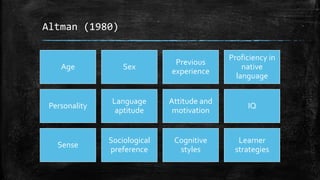
Altman (1980)
Age Sex
Previous
experience
Proficiency in
native
language
Personality
Language
aptitude
Attitude and
motivation
IQ
Sense
Sociological
preference
Cognitive
styles
Learner
strategies
Language aptitude
Motivation
Learning strategies
Cognitive and effective factors
Skehan (1989)
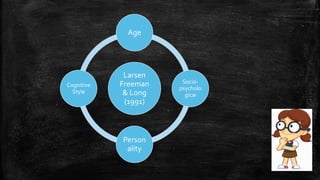
Larsen
Freeman
& Long
(1991)
Age
Socio-
psycholo
gical
Person
ality
Cognitive
Style
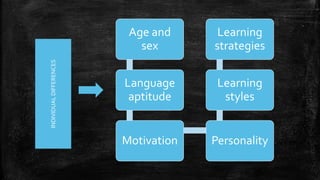
Age and
sex
Language
aptitude
Motivation Personality
Learning
styles
Learning
strategies
INDIVIDUAL
DIFFERENCES
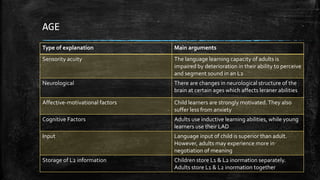
AGE
Type of explanation Main arguments
Sensority acuity The language learning capacity of adults is
impaired by deterioration in their ability to perceive
and segment sound in an L2
Neurological There are changes in neurological structure of the
brain at certain ages which affects leraner abilities
Affective-motivational factors Child learners are strongly motivated.They also
suffer less from anxiety
Cognitive Factors Adults use inductive learning abilities, while young
learners use their LAD
Input Language input of child is superior than adult.
However, adults may experience more in
negotiation of meaning
Storage of L2 information Children store L1 & L2 inormation separately.
Adults store L1 & L2 inormation together
SEX
▪ Many studies (e.g., Oxford, 1993; oung and
Oxford 1997) have found that gender can have
significant impact on how students learn
languages.
▪ Females tend to show greater integrative
motivation and positive attitudes.
▪ Larsen-Freeman & Long (2000), in early stage
of the first language acquisition, female excel
male.
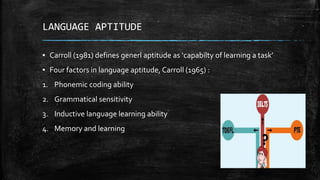
LANGUAGE APTITUDE
▪ Carroll (1981) defines generl aptitude as ‘capabilty of learning a task’
▪ Four factors in language aptitude, Carroll (1965) :
1. Phonemic coding ability
2. Grammatical sensitivity
3. Inductive language learning ability
4. Memory and learning
MOTIVATION
▪ Gardner (1985), motivation = effort + desire to achieve goals
+attitudes
▪ Types of motivation exist, Gardner & Lambert (1972) :
1. Integrative : a sincere and personal interest in the people and
culture
2. Instrumental : the practical value and advantages of learning a new
language
PERSONALITY
▪ Personality characteristics that may
affect L2 learning : extroversion vs
introversion, self esteem, anxiety, risk
taking, etc.
▪ The relationship between personality
variables and L2 learning is not yet clear,
Ellis (1994)
▪ Extroverts are advantaged in
communication skills.They may also
participate more in oral communication
LEARNING STYLES
▪ Learning styles is about an individuals’ preferred way of prossesing,
that is of perceiving, conceptualizing, organizing, and recalling
information related to language learning, Zafar & Meenakshi (2012)
▪ Reid (1987) distinguished four learning styles
1. Visual learning
2. Auditory learning
3. Kinaesthetic learning
4. Tactile learning
LEARNING STRATEGIES
▪ O’Malley and Chamot (1990) define strategies as the tools for active,
self directed involvement needed for developing L2 communicative
ability.
▪ O’Malley and Chamot (1990) state three different strategies :
1. Cognitive strategies
2. Metacognitive strategies
3. Social and affective strategies
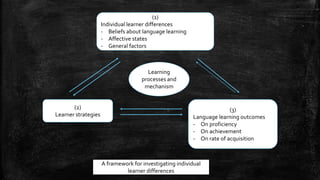
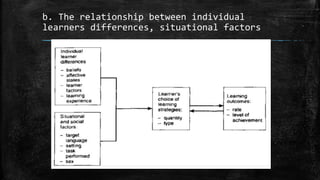
(1)
Individual learner differences
- Beliefs about language learning
- Affective states
- General factors
(2)
Learner strategies
(3)
Language learning outcomes
- On proficiency
- On achievement
- On rate of acquisition
Learning
processes and
mechanism
A framework for investigating individual
learner differences
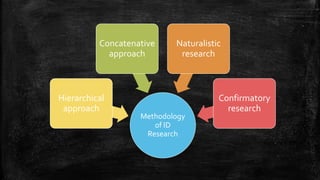
Methodology
of ID
Research
Hierarchical
approach
Concatenative
approach
Naturalistic
research
Confirmatory
research
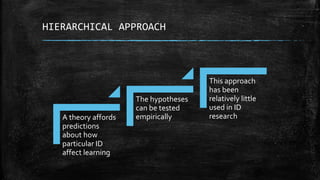
A theory affords
predictions
about how
particular ID
affect learning
The hypotheses
can be tested
empirically
This approach
has been
relatively little
used in ID
research
HIERARCHICAL APPROACH
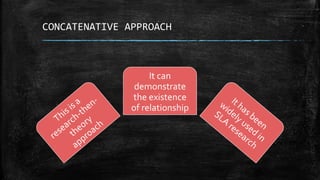
CONCATENATIVE APPROACH
It can
demonstrate
the existence
of relationship
c. Naturalistic research
In naturalistic research people are studied in real life settings. There is
no attempt to manupulate the learning context , nor are subjects
randomly assigned to pre-determined groups. Naturalistics research
also typically involves the collection of qualitative data.
d. Confirmatory research
In contrast to naturalistics enquiry, confirmatory research is
interventionist in nature, that is, it seeks to control the learning
enviroment and to manipulate key variables.This kind of research
does not typically make us of intact grroups of subject, out rather
assigns them to specific groups. Confirmatory research is often
conducted by experiment design.
Learning strategy
a. Definition
b. The relationship between individual learners differences,
situational factors
c. Classifying learning strategy
d. Relating learning strategies for a seond language development
e. conclussion
a. Definition
The concept of strategy is a somewhat fuzzy one, and as we noted in
the introduction to part four, not easy to tie down.There we settled
for a general defintion, a startegy consisted of mental or behaviuoral
activity related to some specific stage in overral process of language
acquisition or language use.
b. The relationship between individual
learners differences, situational factors
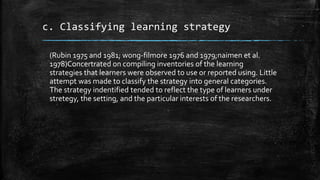
c. Classifying learning strategy
(Rubin 1975 and 1981; wong-filmore 1976 and 1979;naimen et al.
1978)Concertrated on compiling inventories of the learning
strategies that learners were observed to use or reported using. Little
attempt was made to classify the strategy into general categories.
The strategy indentified tended to reflect the type of learners under
stretegy, the setting, and the particular interests of the researchers.
Relating Learning
Strategies to Second
Language Development
1. Grammatical approach
▪ Is teacher-centered approach mainly focused on learning L2
grammar structures (Kelly, 1976)
▪ A. grammar translation (reading, writing, grammar, and translation)
▪ b. Direct Method (grammar and pronunciation, total immersion in
L2)
▪ C. Audiolingual (error-correction, minimal use of L1)
2. Communicative Approach
▪ Is a learner-centered approach, students should develop assorted
competences (e.g., communicative, grammatical, sociolinguistic,
discourse, and strategic) which are nurture through authentic
materials, activities, and strategies in order to enable students to
have a meaningful acquisition of L2 language (Patel & jain; Herrera &
Murry, 2011)
Communicative Approach
a. Silent way
b. Natural way
c. Suggestopedia
d. Integrated Content-Based (ICB)
e. Sheltered Instruction
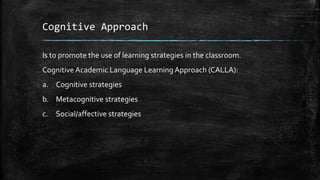
Cognitive Approach
Is to promote the use of learning strategies in the classroom.
Cognitive Academic Language Learning Approach (CALLA):
a. Cognitive strategies
b. Metacognitive strategies
c. Social/affective strategies
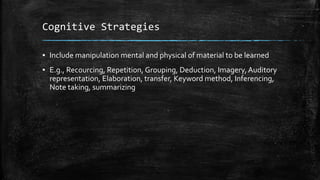
Cognitive Strategies
▪ Include manipulation mental and physical of material to be learned
▪ E.g., Recourcing, Repetition, Grouping, Deduction, Imagery, Auditory
representation, Elaboration, transfer, Keyword method, Inferencing,
Note taking, summarizing
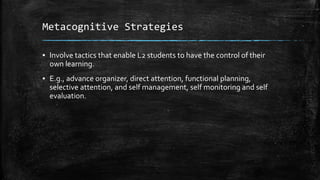
Metacognitive Strategies
▪ Involve tactics that enable L2 students to have the control of their
own learning.
▪ E.g., advance organizer, direct attention, functional planning,
selective attention, and self management, self monitoring and self
evaluation.
Social /affective strategies
▪ Refer to the learning of a second language through interaction with
peers
▪ E.g, cooperation and self-talk
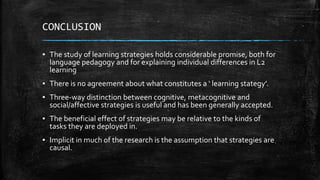
CONCLUSION
▪ The study of learning strategies holds considerable promise, both for
language pedagogy and for explaining individual differences in L2
learning
▪ There is no agreement about what constitutes a ‘ learning stategy’.
▪ Three-way distinction between cognitive, metacognitive and
social/affective strategies is useful and has been generally accepted.
▪ The beneficial effect of strategies may be relative to the kinds of
tasks they are deployed in.
▪ Implicit in much of the research is the assumption that strategies are
causal.
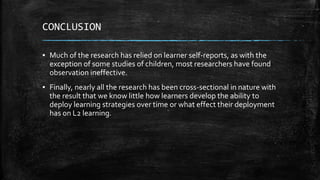
CONCLUSION
▪ Much of the research has relied on learner self-reports, as with the
exception of some studies of children, most researchers have found
observation ineffective.
▪ Finally, nearly all the research has been cross-sectional in nature with
the result that we know little how learners develop the ability to
deploy learning strategies over time or what effect their deployment
has on L2 learning.
The role of learning style
in second language among
distance education students
Mahdi Moenikia
Adel Zahed-Babelan
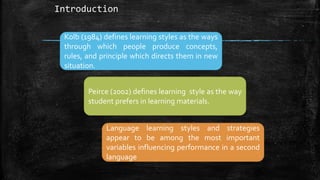
Introduction
Kolb (1984) defines learning styles as the ways
through which people produce concepts,
rules, and principle which directs them in new
situation.
Peirce (2002) defines learning style as the way
student prefers in learning materials.
Language learning styles and strategies
appear to be among the most important
variables influencing performance in a second
language
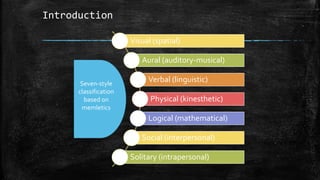
Introduction
Visual (spatial)
Aural (auditory-musical)
Verbal (linguistic)
Physical (kinesthetic)
Logical (mathematical)
Social (interpersonal)
Solitary (intrapersonal)
Seven-style
classification
based on
memletics
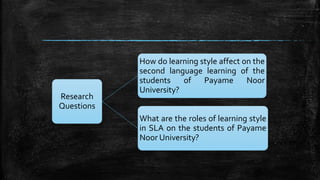
Research
Questions
How do learning style affect on the
second language learning of the
students of Payame Noor
University?
What are the roles of learning style
in SLA on the students of Payame
Noor University?
Method
Participants
-All of the Ardabil Payame Noor University
English language students (N=457) in 2008-
2009 academic year.
-112 students (40 male and 27 female) are
selected as sample)
Method
Materials
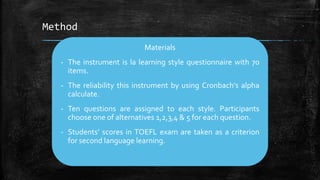
- The instrument is la learning style questionnaire with 70
items.
- The reliability this instrument by using Cronbach’s alpha
calculate.
- Ten questions are assigned to each style. Participants
choose one of alternatives 1,2,3,4 & 5 for each question.
- Students’ scores in TOEFL exam are taken as a criterion
for second language learning.
Method
Procedure
- Research method was pos facto.
- The questionnaire was distributed among participants and
gathered data was analyzed by using ANOVA test.
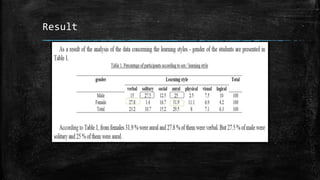
Result
listening
Discussion
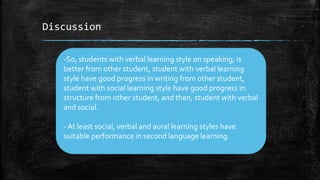
-So, students with verbal learning style on speaking, is
better from other student, student with verbal learning
style have good progress in writing from other student,
student with social learning style have good progress in
structure from other student, and then, student with verbal
and social.
- At least social, verbal and aural learning styles have
suitable performance in second language learning.
As there are students having different learning
styles in the classroom setting, second language
learning programs should be designed in such a
way as to cater to the different styles. Designing
learning experiences according to learning styles
contributes to fulfilling the objectives.

6 individual learner differences in sla reseach

  • 1.
  • 2.
    OUTLINE OF PRESENTATION ID(Definition, Factors, Framework) Method of ID Research Learning Strategies ( Definition, Relationship Classification) Conclusion Example of Journal of ID Research
  • 3.
    SITUATION ▪ Two ormore English learners are attending the same English class, having the same instructors and ,materials, doing the same activities and excercises, proceeding for the same duration of course program, and living in the same environment ▪ In the end of the program, these learners have a kind of English competency assessment. But they achieve different level of competence.
  • 4.
    QUESTIONS ▪ How couldone learner be more succesfull than another? ▪ What factor, other than instructors, materials, activities, environment, may affect the result of learning?
  • 5.
    INTRODUCTION ▪ Second languagesare different from the primary languages. ▪ Second language learning involves some form of acquisition.This is a process by which an individual can effectively learn a second language also known as an additional language ▪ There are diverse learner differences in learning a second language
  • 6.
    DEFINITIONS OF INDIVIDUALDIFFERENCES ▪ According to the dictionary of education ▪ Individual differences stand for the variation or deviations among individuals in regard to a single characteristic or number of characteristics. ▪ It is stand for those differences which in their totality distinguish one individual from another.
  • 7.
    ▪ According toDrnyei (2005), Individual differences are enduring personal characteristics that are assumed to apply to everybody and on which people differ by degree. ▪ “The variation or deviations among individual is regard to a single characteristics or a number of characteristics, those differences which in their totality distinguish one individual from another.” (Good,C.V) ▪ “Today we think of individual differences as including any measurable aspect of the total personality.” (Skinner)
  • 8.
    Altman (1980) Age Sex Previous experience Proficiencyin native language Personality Language aptitude Attitude and motivation IQ Sense Sociological preference Cognitive styles Learner strategies
  • 9.
  • 10.
  • 11.
  • 12.
    AGE Type of explanationMain arguments Sensority acuity The language learning capacity of adults is impaired by deterioration in their ability to perceive and segment sound in an L2 Neurological There are changes in neurological structure of the brain at certain ages which affects leraner abilities Affective-motivational factors Child learners are strongly motivated.They also suffer less from anxiety Cognitive Factors Adults use inductive learning abilities, while young learners use their LAD Input Language input of child is superior than adult. However, adults may experience more in negotiation of meaning Storage of L2 information Children store L1 & L2 inormation separately. Adults store L1 & L2 inormation together
  • 13.
    SEX ▪ Many studies(e.g., Oxford, 1993; oung and Oxford 1997) have found that gender can have significant impact on how students learn languages. ▪ Females tend to show greater integrative motivation and positive attitudes. ▪ Larsen-Freeman & Long (2000), in early stage of the first language acquisition, female excel male.
  • 14.
    LANGUAGE APTITUDE ▪ Carroll(1981) defines generl aptitude as ‘capabilty of learning a task’ ▪ Four factors in language aptitude, Carroll (1965) : 1. Phonemic coding ability 2. Grammatical sensitivity 3. Inductive language learning ability 4. Memory and learning
  • 15.
    MOTIVATION ▪ Gardner (1985),motivation = effort + desire to achieve goals +attitudes ▪ Types of motivation exist, Gardner & Lambert (1972) : 1. Integrative : a sincere and personal interest in the people and culture 2. Instrumental : the practical value and advantages of learning a new language
  • 16.
    PERSONALITY ▪ Personality characteristicsthat may affect L2 learning : extroversion vs introversion, self esteem, anxiety, risk taking, etc. ▪ The relationship between personality variables and L2 learning is not yet clear, Ellis (1994) ▪ Extroverts are advantaged in communication skills.They may also participate more in oral communication
  • 17.
    LEARNING STYLES ▪ Learningstyles is about an individuals’ preferred way of prossesing, that is of perceiving, conceptualizing, organizing, and recalling information related to language learning, Zafar & Meenakshi (2012) ▪ Reid (1987) distinguished four learning styles 1. Visual learning 2. Auditory learning 3. Kinaesthetic learning 4. Tactile learning
  • 18.
    LEARNING STRATEGIES ▪ O’Malleyand Chamot (1990) define strategies as the tools for active, self directed involvement needed for developing L2 communicative ability. ▪ O’Malley and Chamot (1990) state three different strategies : 1. Cognitive strategies 2. Metacognitive strategies 3. Social and affective strategies
  • 19.
    (1) Individual learner differences -Beliefs about language learning - Affective states - General factors (2) Learner strategies (3) Language learning outcomes - On proficiency - On achievement - On rate of acquisition Learning processes and mechanism A framework for investigating individual learner differences
  • 20.
  • 21.
    A theory affords predictions abouthow particular ID affect learning The hypotheses can be tested empirically This approach has been relatively little used in ID research HIERARCHICAL APPROACH
  • 22.
  • 23.
    c. Naturalistic research Innaturalistic research people are studied in real life settings. There is no attempt to manupulate the learning context , nor are subjects randomly assigned to pre-determined groups. Naturalistics research also typically involves the collection of qualitative data.
  • 24.
    d. Confirmatory research Incontrast to naturalistics enquiry, confirmatory research is interventionist in nature, that is, it seeks to control the learning enviroment and to manipulate key variables.This kind of research does not typically make us of intact grroups of subject, out rather assigns them to specific groups. Confirmatory research is often conducted by experiment design.
  • 25.
    Learning strategy a. Definition b.The relationship between individual learners differences, situational factors c. Classifying learning strategy d. Relating learning strategies for a seond language development e. conclussion
  • 26.
    a. Definition The conceptof strategy is a somewhat fuzzy one, and as we noted in the introduction to part four, not easy to tie down.There we settled for a general defintion, a startegy consisted of mental or behaviuoral activity related to some specific stage in overral process of language acquisition or language use.
  • 27.
    b. The relationshipbetween individual learners differences, situational factors
  • 28.
    c. Classifying learningstrategy (Rubin 1975 and 1981; wong-filmore 1976 and 1979;naimen et al. 1978)Concertrated on compiling inventories of the learning strategies that learners were observed to use or reported using. Little attempt was made to classify the strategy into general categories. The strategy indentified tended to reflect the type of learners under stretegy, the setting, and the particular interests of the researchers.
  • 29.
    Relating Learning Strategies toSecond Language Development
  • 30.
    1. Grammatical approach ▪Is teacher-centered approach mainly focused on learning L2 grammar structures (Kelly, 1976) ▪ A. grammar translation (reading, writing, grammar, and translation) ▪ b. Direct Method (grammar and pronunciation, total immersion in L2) ▪ C. Audiolingual (error-correction, minimal use of L1)
  • 31.
    2. Communicative Approach ▪Is a learner-centered approach, students should develop assorted competences (e.g., communicative, grammatical, sociolinguistic, discourse, and strategic) which are nurture through authentic materials, activities, and strategies in order to enable students to have a meaningful acquisition of L2 language (Patel & jain; Herrera & Murry, 2011)
  • 32.
    Communicative Approach a. Silentway b. Natural way c. Suggestopedia d. Integrated Content-Based (ICB) e. Sheltered Instruction
  • 33.
    Cognitive Approach Is topromote the use of learning strategies in the classroom. Cognitive Academic Language Learning Approach (CALLA): a. Cognitive strategies b. Metacognitive strategies c. Social/affective strategies
  • 34.
    Cognitive Strategies ▪ Includemanipulation mental and physical of material to be learned ▪ E.g., Recourcing, Repetition, Grouping, Deduction, Imagery, Auditory representation, Elaboration, transfer, Keyword method, Inferencing, Note taking, summarizing
  • 35.
    Metacognitive Strategies ▪ Involvetactics that enable L2 students to have the control of their own learning. ▪ E.g., advance organizer, direct attention, functional planning, selective attention, and self management, self monitoring and self evaluation.
  • 36.
    Social /affective strategies ▪Refer to the learning of a second language through interaction with peers ▪ E.g, cooperation and self-talk
  • 37.
    CONCLUSION ▪ The studyof learning strategies holds considerable promise, both for language pedagogy and for explaining individual differences in L2 learning ▪ There is no agreement about what constitutes a ‘ learning stategy’. ▪ Three-way distinction between cognitive, metacognitive and social/affective strategies is useful and has been generally accepted. ▪ The beneficial effect of strategies may be relative to the kinds of tasks they are deployed in. ▪ Implicit in much of the research is the assumption that strategies are causal.
  • 38.
    CONCLUSION ▪ Much ofthe research has relied on learner self-reports, as with the exception of some studies of children, most researchers have found observation ineffective. ▪ Finally, nearly all the research has been cross-sectional in nature with the result that we know little how learners develop the ability to deploy learning strategies over time or what effect their deployment has on L2 learning.
  • 39.
    The role oflearning style in second language among distance education students Mahdi Moenikia Adel Zahed-Babelan
  • 40.
    Introduction Kolb (1984) defineslearning styles as the ways through which people produce concepts, rules, and principle which directs them in new situation. Peirce (2002) defines learning style as the way student prefers in learning materials. Language learning styles and strategies appear to be among the most important variables influencing performance in a second language
  • 41.
    Introduction Visual (spatial) Aural (auditory-musical) Verbal(linguistic) Physical (kinesthetic) Logical (mathematical) Social (interpersonal) Solitary (intrapersonal) Seven-style classification based on memletics
  • 42.
    Research Questions How do learningstyle affect on the second language learning of the students of Payame Noor University? What are the roles of learning style in SLA on the students of Payame Noor University?
  • 43.
    Method Participants -All of theArdabil Payame Noor University English language students (N=457) in 2008- 2009 academic year. -112 students (40 male and 27 female) are selected as sample)
  • 44.
    Method Materials - The instrumentis la learning style questionnaire with 70 items. - The reliability this instrument by using Cronbach’s alpha calculate. - Ten questions are assigned to each style. Participants choose one of alternatives 1,2,3,4 & 5 for each question. - Students’ scores in TOEFL exam are taken as a criterion for second language learning.
  • 45.
    Method Procedure - Research methodwas pos facto. - The questionnaire was distributed among participants and gathered data was analyzed by using ANOVA test.
  • 46.
  • 47.
  • 49.
    Discussion -So, students withverbal learning style on speaking, is better from other student, student with verbal learning style have good progress in writing from other student, student with social learning style have good progress in structure from other student, and then, student with verbal and social. - At least social, verbal and aural learning styles have suitable performance in second language learning.
  • 50.
    As there arestudents having different learning styles in the classroom setting, second language learning programs should be designed in such a way as to cater to the different styles. Designing learning experiences according to learning styles contributes to fulfilling the objectives.