Social Psychology

Copyright 2004 - Prentice Hall

1
Social Psychology
• Scientific study of how a person's
• Thoughts
• Feelings
• Behaviors
• Are influenced by
• Behavior
• Characteristics
• Of other people
• Real
• Imagined
• Inferred
Copyright 2004 - Prentice Hall

2
Social Psychology
• Examines
• Causes
• Types
• Consequences
• Of human interaction

• Interactions occur in a specific cultural
context.
Copyright 2004 - Prentice Hall

3
Copyright 2004 - Prentice Hall

4
Social Psychology
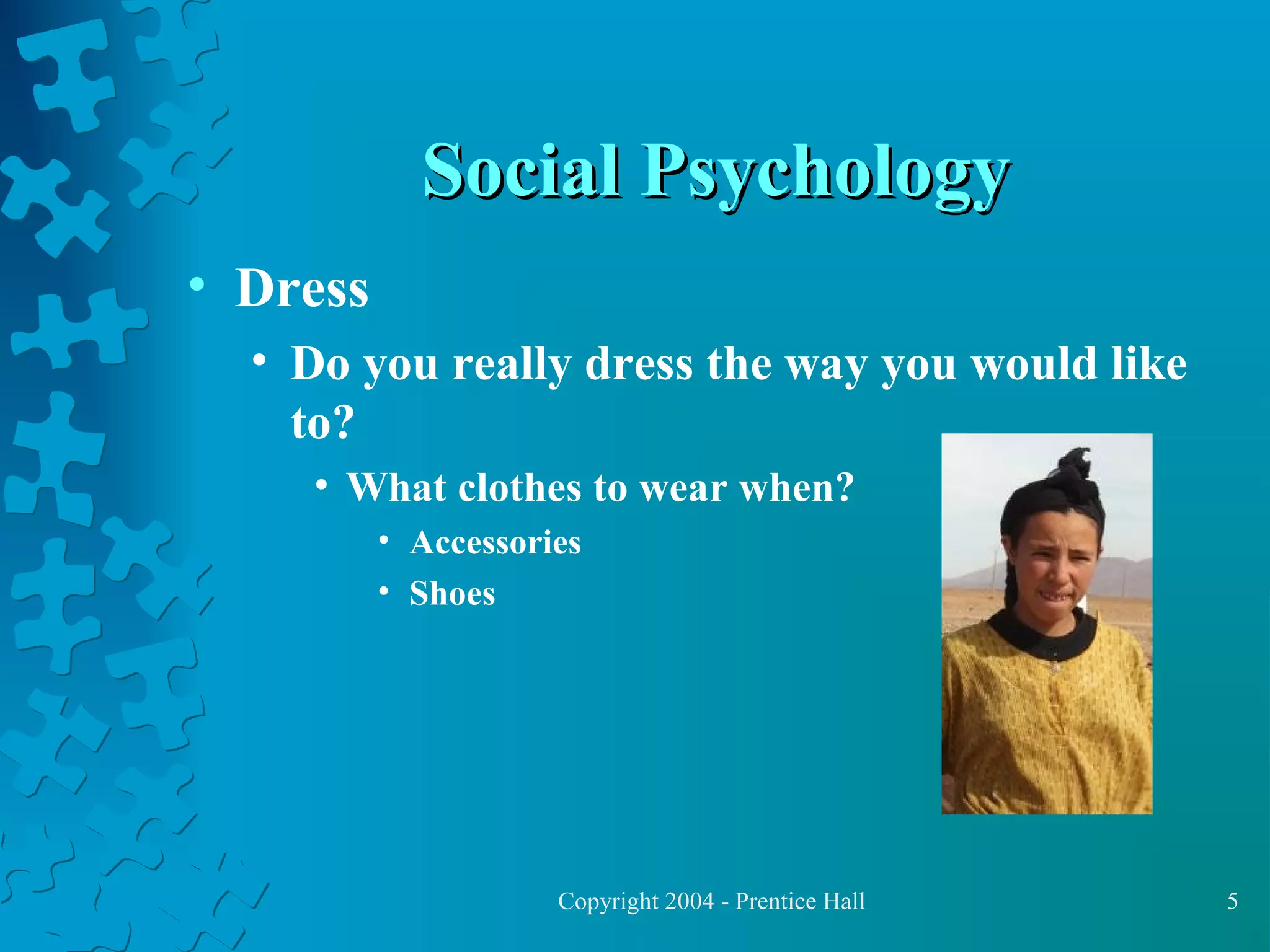
• Dress
• Do you really dress the way you would like
to?
• What clothes to wear when?
• Accessories
• Shoes

Copyright 2004 - Prentice Hall

5
Social Psychology
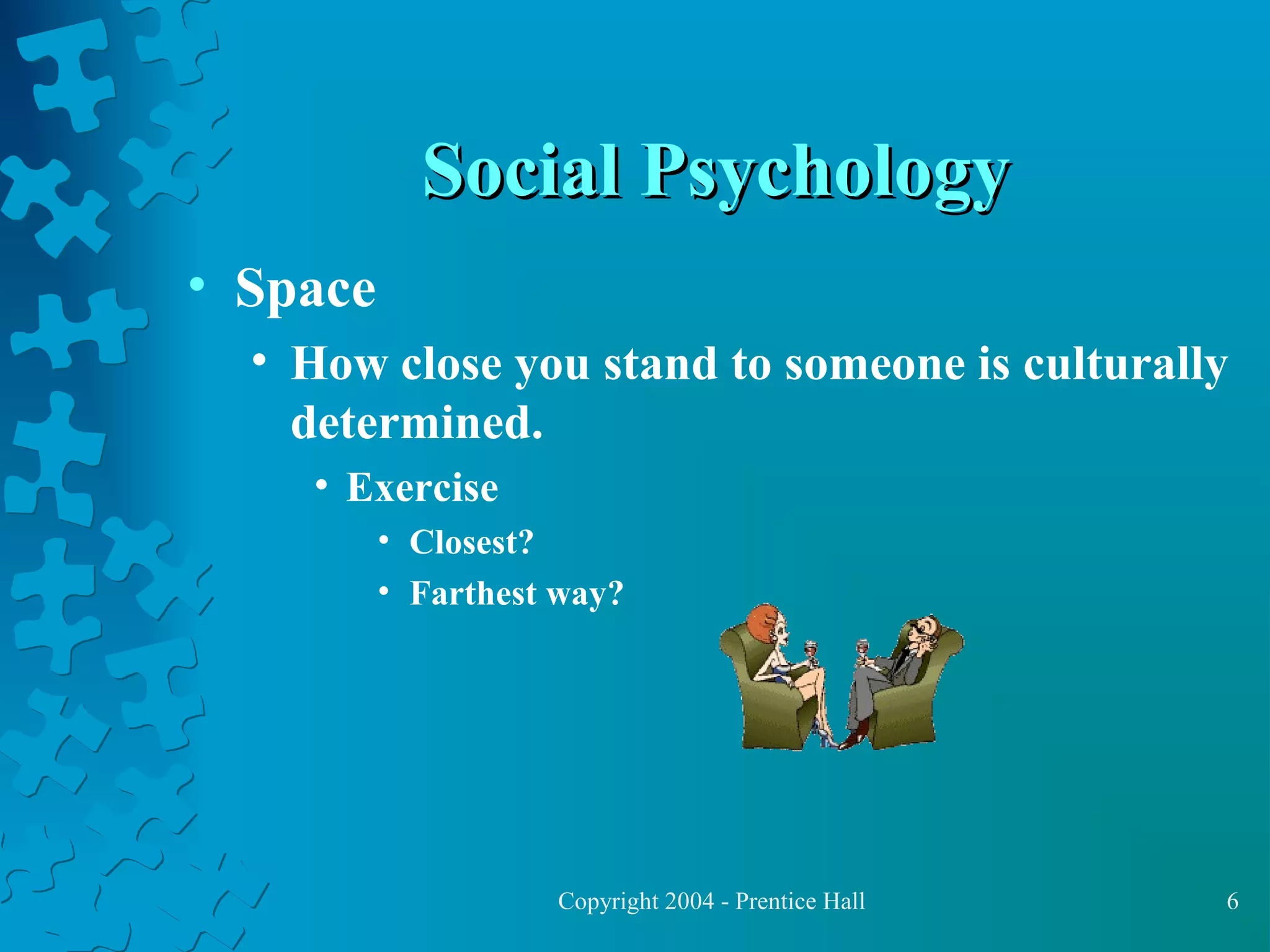
• Space
• How close you stand to someone is culturally
determined.
• Exercise
• Closest?
• Farthest way?

Copyright 2004 - Prentice Hall

6
Social Psychology
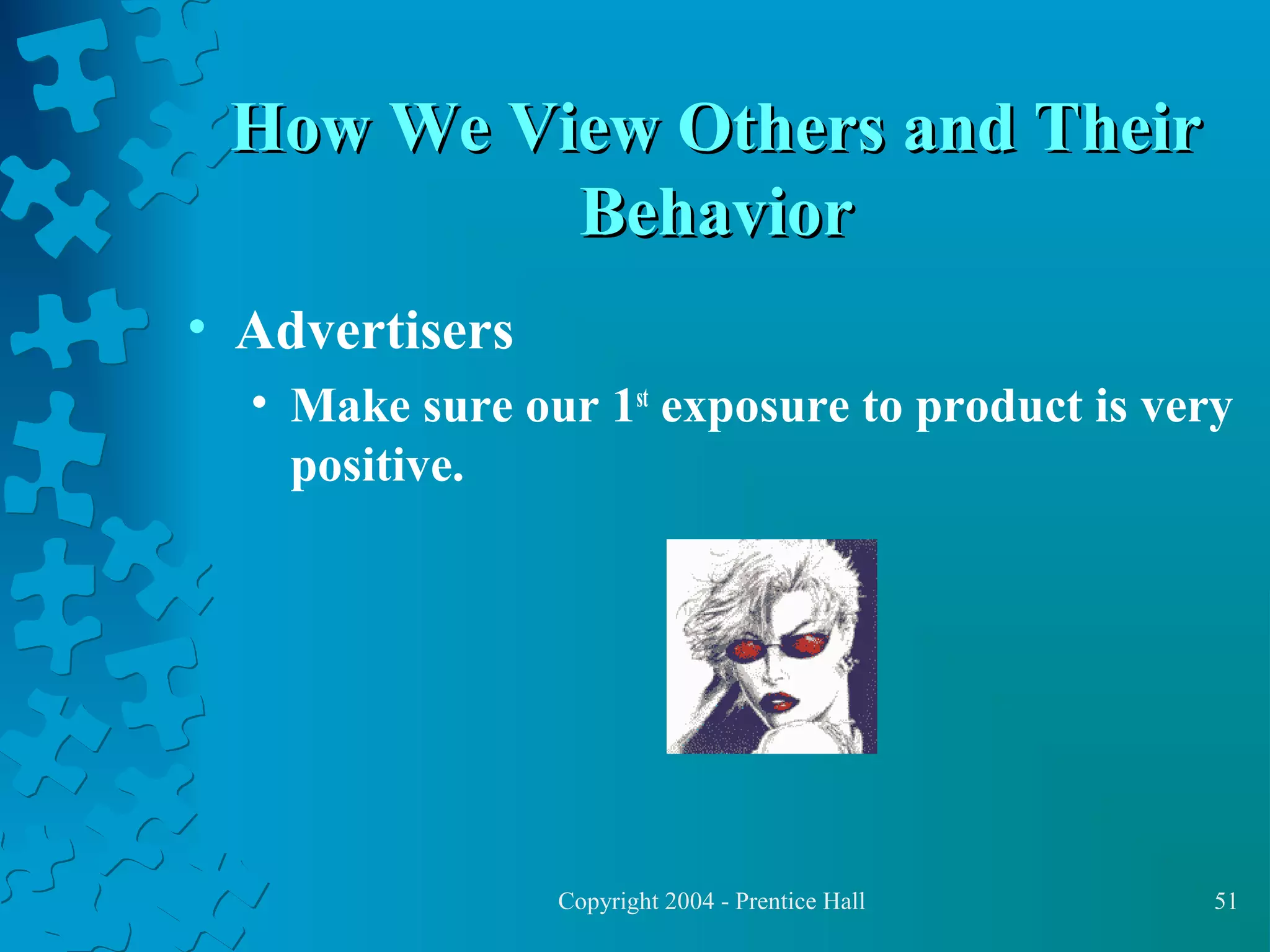
• Speech
• Do's and don'ts
• What can you say to someone?
• Should you look someone in the eyes when
speaking?
• Should we speak the truth?

• Slang

Copyright 2004 - Prentice Hall

7
Social Psychology
• Eat?
•
•
•
•

What foods do you eat with your fingers?
Which foods accompany other foods?
What do we eat and how much?
What is cool to eat?

• Food PowerPoint

Copyright 2004 - Prentice Hall

8
Social Psychology
• Culture clash
• Parents
• Travel
• Moving from one part of the country to
another
• Country to the city
• Blue collar job to a white collar job

Copyright 2004 - Prentice Hall

9
Social Psychology
• Ethnocentrism
• A belief in or assumption of the superiority of the
social or cultural group that a person belongs to.
• Researchers sometimes guilty of
• Disregard cultural differences
• See other cultures as an extension of their own “superior”
culture

• Therefore will view another culture from our own
eyes
• Female Genital Mutilation

Copyright 2004 - Prentice Hall

10
Social Psychology and Culture
• Culture can influence
• Type of research problem we choose to
investigate
• Hypothesis
• Selection of the variables we choose to
manipulate & record

Copyright 2004 - Prentice Hall

11
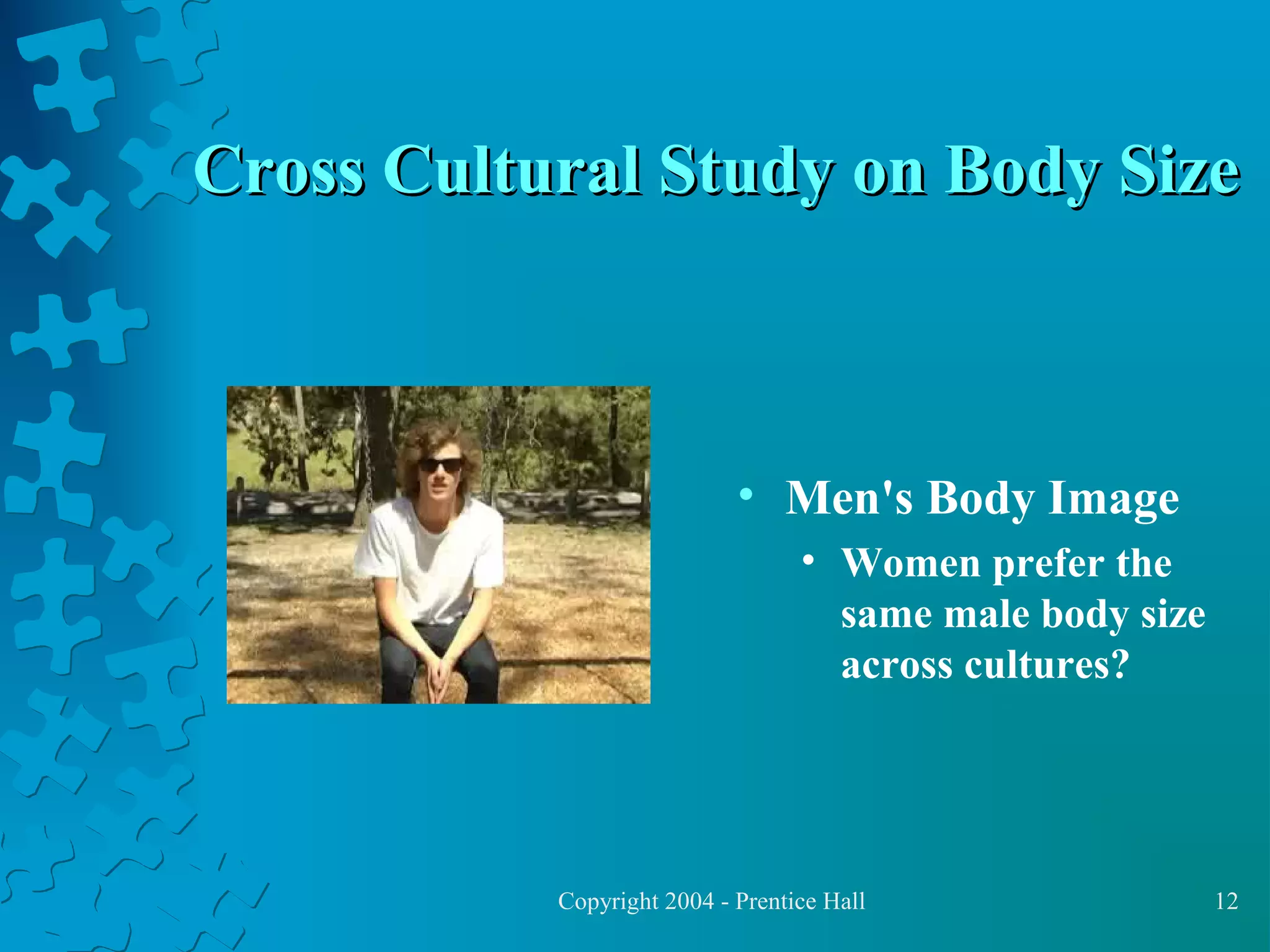
Cross Cultural Study on Body Size

• Men's Body Image
• Women prefer the
same male body size
across cultures?

Copyright 2004 - Prentice Hall

12
Social Psychology and Culture
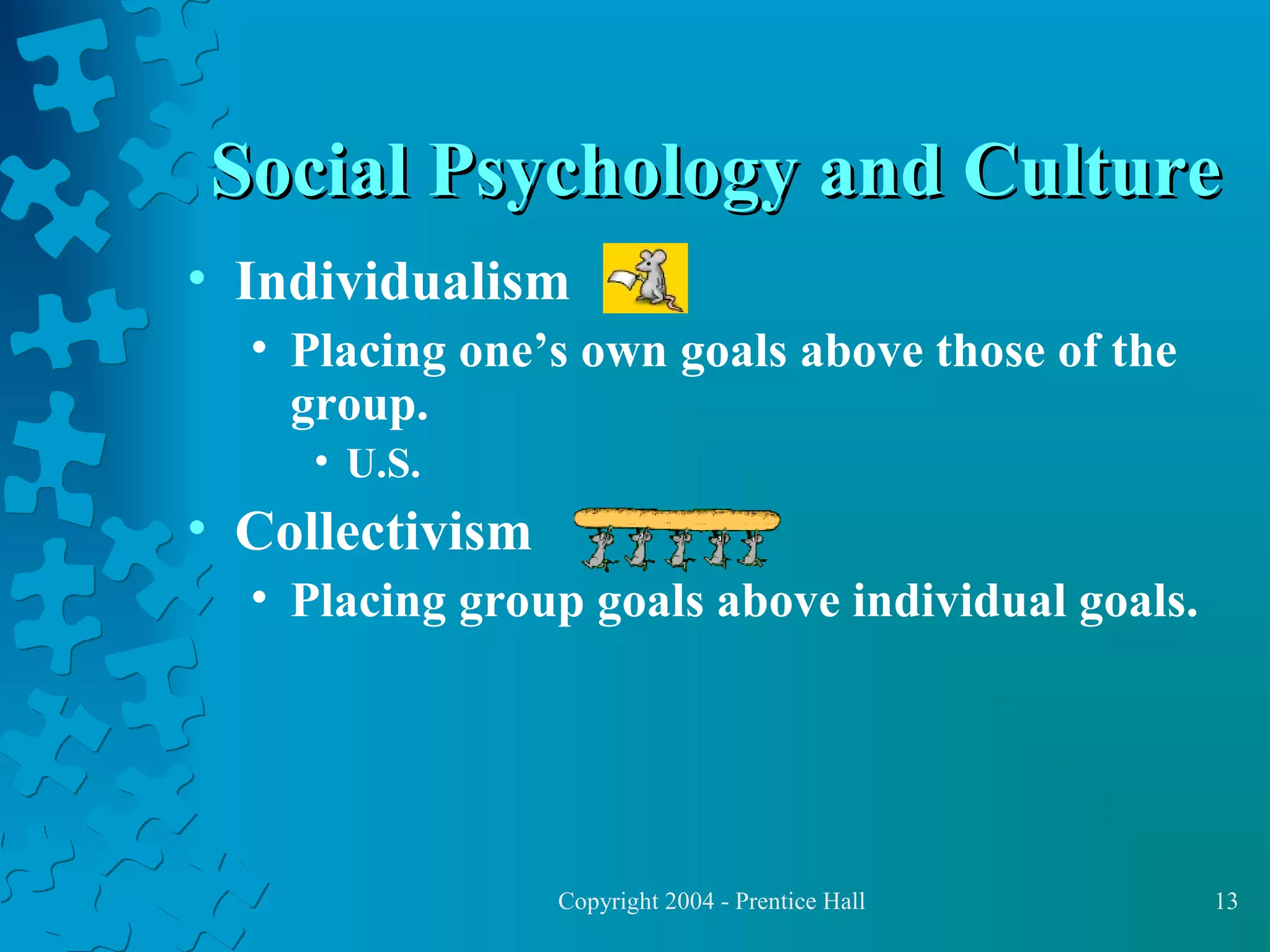
• Individualism
• Placing one’s own goals above those of the
group.
• U.S.

• Collectivism
• Placing group goals above individual goals.

Copyright 2004 - Prentice Hall

13
Social Psychology and Culture
• Degree of individualism or collectivism in
a culture can influence many aspects of
behavior
•
•
•
•
•

Interpersonal relations
Self-concept
Parenting practices
Self-esteem
Emotional expression
Copyright 2004 - Prentice Hall

14
Social Psychology and Culture
• Cultures vary widely
• Social psychologists need to conduct
cross-cultural studies
• Can results of research conducted in one
culture be generalized to others?

Copyright 2004 - Prentice Hall

15
How We View Others and Their
Behavior
• Impression formation
• Process of developing an opinion about
another person.
• Actor
• Perceiver

• Judgments you made of me and classmates
• Based on
• Stereotypes
• Set of beliefs about members of a particular
group.
Copyright 2004 - Prentice Hall

16
How We View Others and Their
Behavior
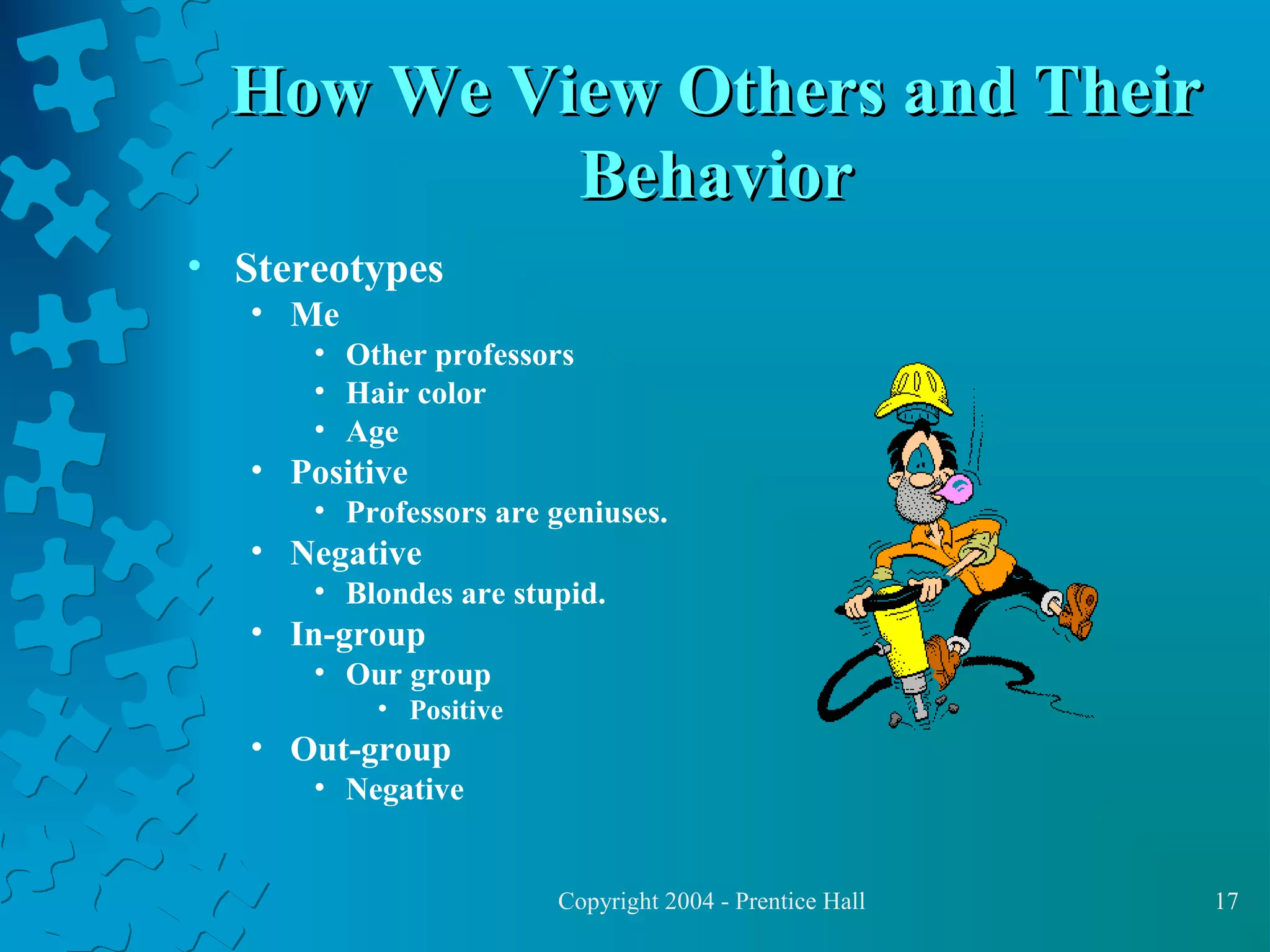
• Stereotypes
• Me
• Other professors
• Hair color
• Age

• Positive
• Professors are geniuses.

• Negative
• Blondes are stupid.

• In-group
• Our group
• Positive

• Out-group
• Negative

Copyright 2004 - Prentice Hall

17
How We View Others and Their
Behavior
•

4 features of the actor have been shown
to influence impression formation.
1) Physical appearance
2) Style and content of speech
3) Nonverbal mannerisms and nonverbal
communication
4) Perceiver’s prior information about the actor

Copyright 2004 - Prentice Hall

18
Copyright 2004 - Prentice Hall

19
How We View Others and Their
Behavior
• Why do we all create stereotypes?
• Safe, not safe
• Easier on our on our brain
• Don’t have to continually process bits of
information

Copyright 2004 - Prentice Hall

20
How We View Others and Their
Behavior
• 2 reasons stereotypes persist
• 1. Believe that a group of people possesses
certain characteristics
• Note behaviors consistent with those
characteristics
• Fail to notice behaviors that are inconsistent
• Example?

• 2. Effects of our own reactions & behaviors
on the individuals in question.
• Treat people consistent with stereotype
Copyright 2004 - Prentice Hall

21
How We View Others and Their
Behavior

• Self-fulfilling prophecy

• When your behaviors influence others to
respond the way you expect
• Information that is available to you before you
meet someone can affect your impression of that
person.
• The activation of a stereotype can either enhance
or decrease (stereotype threat) an individual’s
performance.
• Stars demanding
Copyright 2004 - Prentice Hall

22
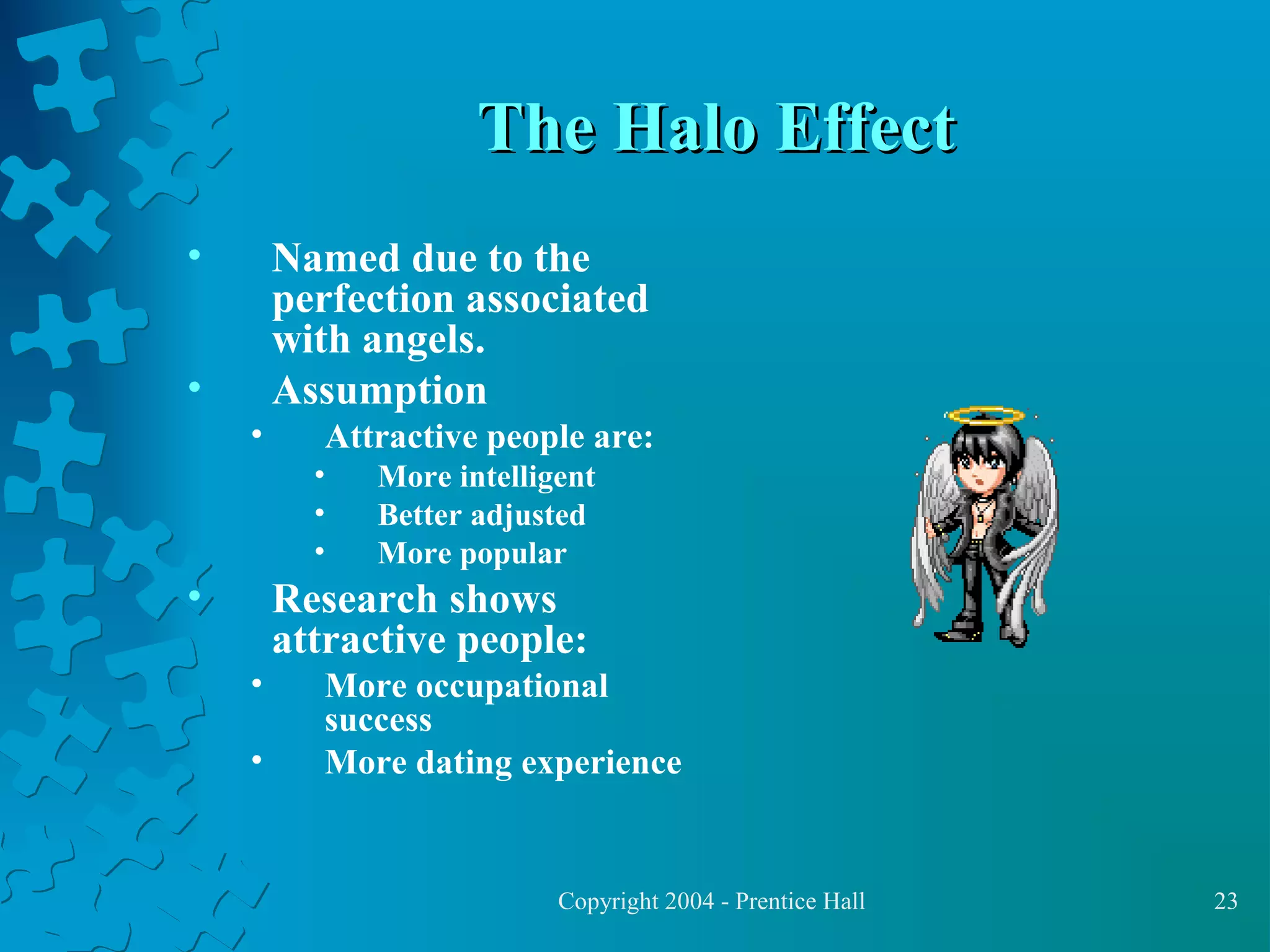
The Halo Effect
•

Named due to the
perfection associated
with angels.
Assumption

•
•

Attractive people are:
•
•
•

•

More intelligent
Better adjusted
More popular

Research shows
attractive people:
•
•

More occupational
success
More dating experience

Copyright 2004 - Prentice Hall

23
The Halo Effect
• Alternative explanation for attractive
people achieving more in life
• We automatically categorize others before
having an opportunity to evaluate their
personalities
• Cultural stereotypes
• Attractive people must be intrinsically good
• Ugly people must be inherently bad

Copyright 2004 - Prentice Hall

24
The Halo Effect
• Cultural
stereotypes
• Attractive people
must be
intrinsically good
• Ugly people must
be inherently bad

Copyright 2004 - Prentice Hall

25
The Halo Effect
• “Beautiful is good” stereotype
• Assumes that attractive people have positive
characteristics
• Witty
• Intelligent
• Pleasing personalities

• Therefore attractive people can be expected
to make better impressions.

Copyright 2004 - Prentice Hall

26
The Halo Effect
• Elliot Aronson, social psychologist at
Stanford
• Self-fulfilling prophecies
• Person’s self-perception perpetuated by
feedback from others
• May play a role in success as well.
• People who feel they are attractive - not
necessarily rated as such–
• Just as successful as those judged to be
good-looking.
Copyright 2004 - Prentice Hall

27
How We View Others and Their
Behavior
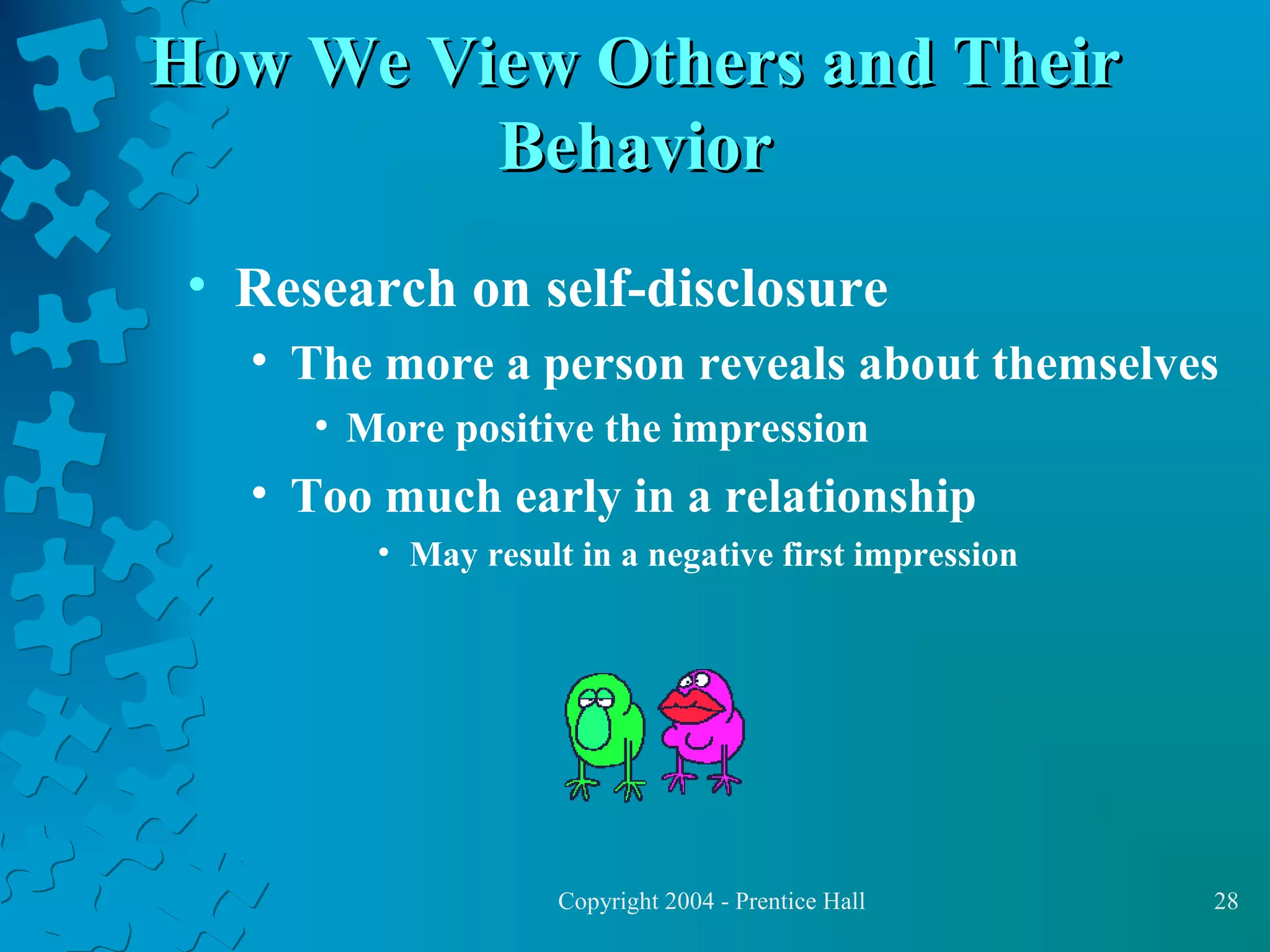
• Research on self-disclosure
• The more a person reveals about themselves
• More positive the impression

• Too much early in a relationship
• May result in a negative first impression

Copyright 2004 - Prentice Hall

28
How We View Others and Their
Behavior
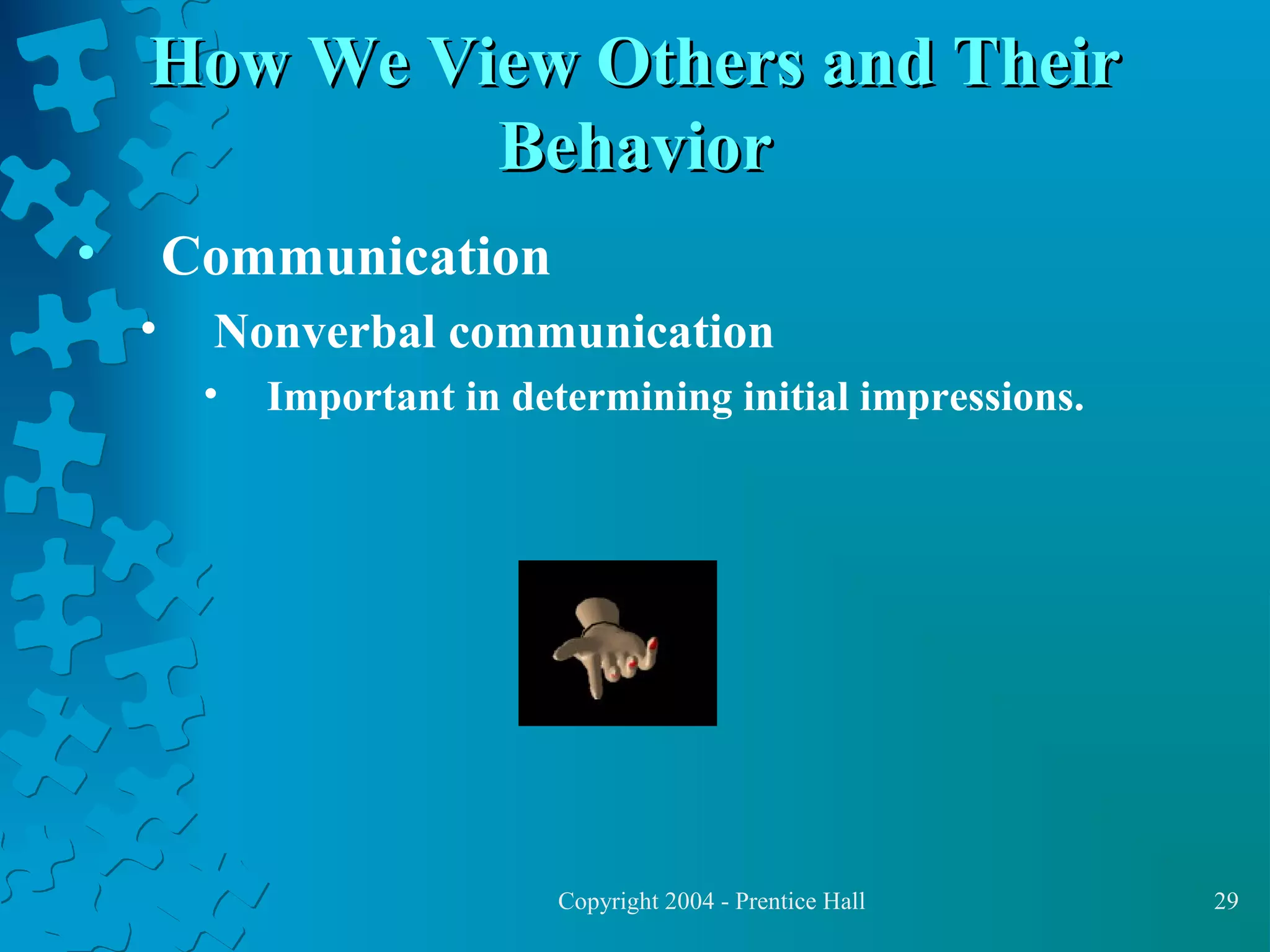
•

Communication
•

Nonverbal communication
•

Important in determining initial impressions.

Copyright 2004 - Prentice Hall

29
How We View Others and Their
Behavior

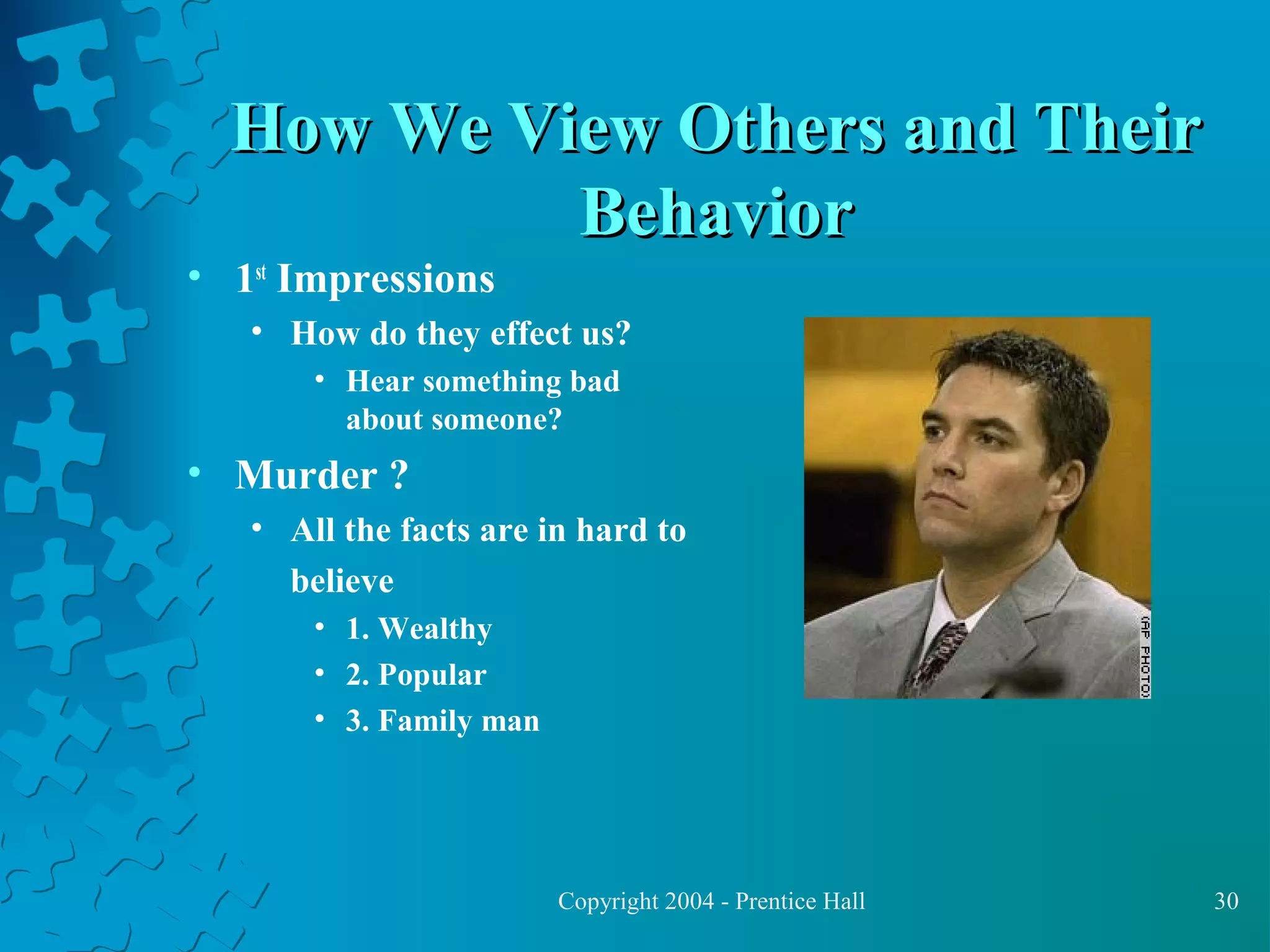
• 1st Impressions

• How do they effect us?
• Hear something bad
about someone?

• Murder ?
• All the facts are in hard to
believe
• 1. Wealthy
• 2. Popular
• 3. Family man

Copyright 2004 - Prentice Hall

30
How We View Others and Their
Behavior

• Attributions

• Addresses how people make judgments
about the causes of behavior.

Copyright 2004 - Prentice Hall

31
How We View Others and Their
Behavior
• Internal Versus External Causes
• Internal attributions
• Behavior is seen as being caused by
factors that reside within a person.

• Stupid, smart, unfocused, critical, etc.
Copyright 2004 - Prentice Hall

32
Copyright 2004 - Prentice Hall

33
How We View Others and Their
Behavior
• External
attributions

• Causes of behavior
are viewed as
residing outside an
individual.
• Environmental
• Wave
• Bright light

Copyright 2004 - Prentice Hall

34
How We View Others and Their
Behavior
• Fundamental attribution error
• Tendency to attribute the behavior of others
to causes within themselves.
• Example
• Driving
• He drives reckless because he is an asshole.

• Test
• She did poorly on the test because she is rather stupid.

Copyright 2004 - Prentice Hall

35
How We View Others and Their
Behavior
• Self-Serving Bias
• Defensive Attribution
• Tendency to attribute our successes to our own
efforts or qualities
• Failures to external factors
• Driving
• I drive fast because I am in a hurry.
• He drives fast because he is an asshole.

• Test
• I did poorly on the test because the room was noisy.
• I did well on the test because I am intelligent.
Copyright 2004 - Prentice Hall

36
How We View Others and Their
Behavior

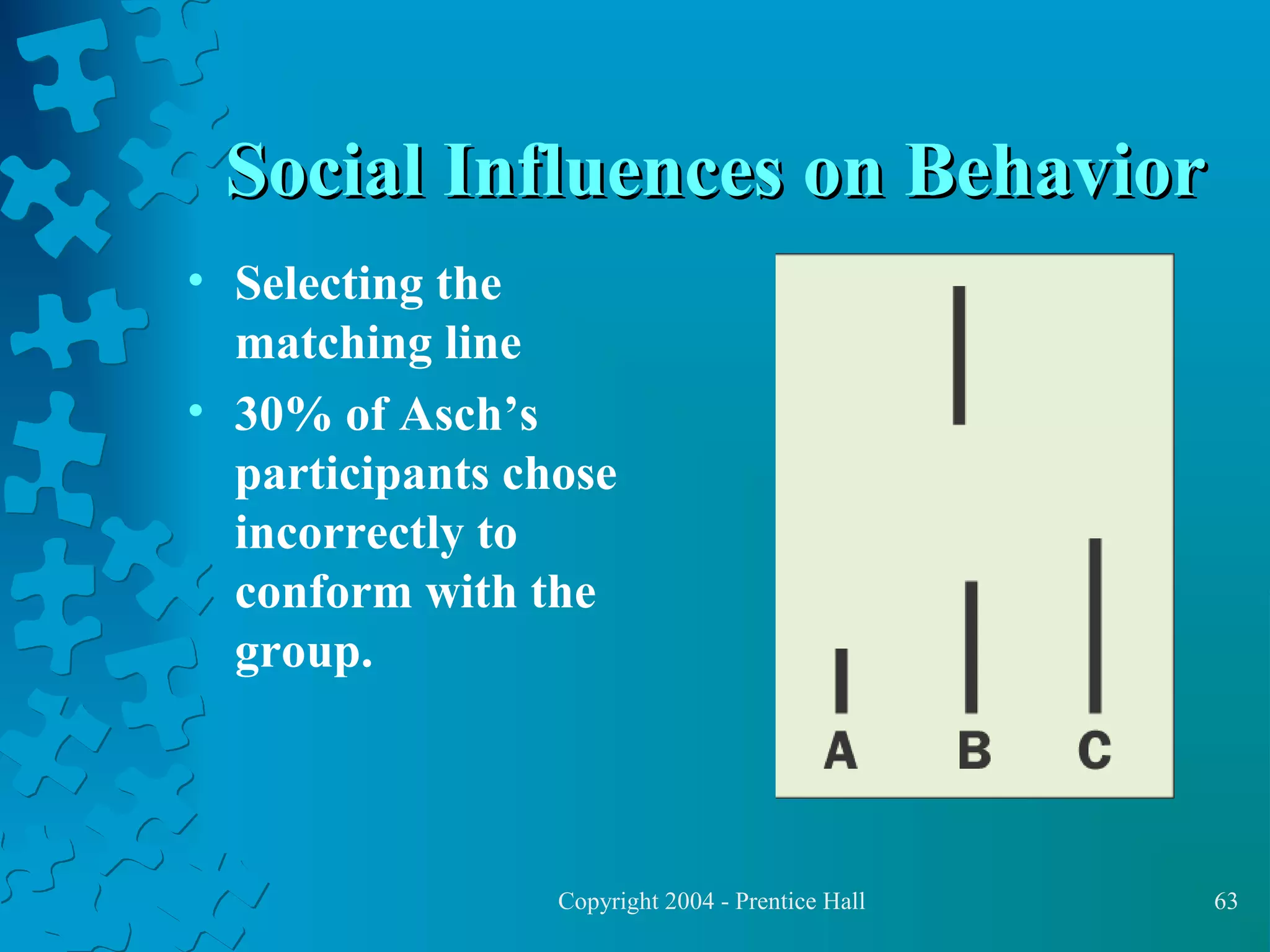
• Actor-perceiver bias

• Perceivers more likely to make internal
attributions
• Actors more likely to make external
attributions.

Copyright 2004 - Prentice Hall

37
How We View Others and Their
Behavior
• Another aspect of the self-serving bias
involves the just world belief.
• Just world belief
• Bad things happen to bad people
• Good things happen to good people

Copyright 2004 - Prentice Hall

41
How We View Others and Their
Behavior
• Attitudes
• Relatively stable organization of
• Beliefs
• Feelings
• Behavior
• Directed toward something or someone.

• Position on something or someone.
• Can be positive, negative, or neutral
Copyright 2004 - Prentice Hall

42
How We View Others and Their
Behavior
• 3 components of attitude formation
• Think
• Feel
• Do

Copyright 2004 - Prentice Hall

43
How We View Others and Their
Behavior
• 1st component of attitude formation
• Evaluative beliefs
• Think
• Facts
• Opinions
• General knowledge

Copyright 2004 - Prentice Hall

44
How We View Others and Their
Behavior
• 2nd component of attitude formation
• Feeling
•
•
•
•
•
•

Mad
Sad
Glad
Scared
Surprise
Disgust
Copyright 2004 - Prentice Hall

45
How We View Others and Their
Behavior
• 3rd component of attitude formation
• Behavioral tendency
• Approach
• Avoid

Copyright 2004 - Prentice Hall

46
How We View Others and
Their Behavior
• Example:
• Cell phone
• Think
• Feel
• Do

• Do we always act according to our
attitudes?
• Why or why not?
Copyright 2004 - Prentice Hall

47
How We View Others and Their
Behavior
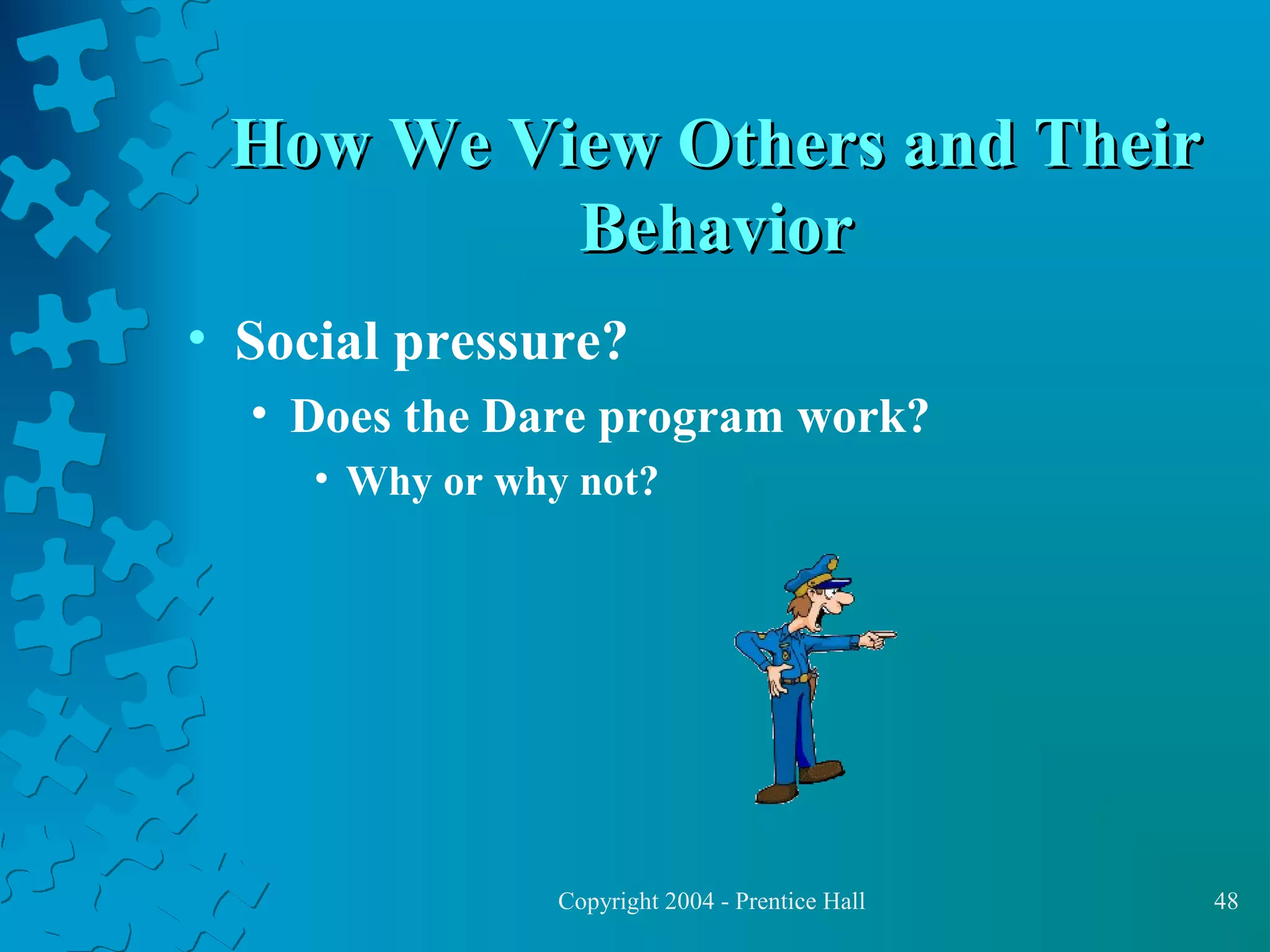
• Social pressure?
• Does the Dare program work?
• Why or why not?

Copyright 2004 - Prentice Hall

48
How We View Others and Their
Behavior
• What variables help form our
basic attitudes?

Copyright 2004 - Prentice Hall

49
How We View Others and
Their Behavior
•
•
•
•
•

Parents
Teachers
Media
Peers
Billboards
• Kids sponges
Copyright 2004 - Prentice Hall

50
How We View Others and Their
Behavior
• Advertisers
• Make sure our 1st exposure to product is very
positive.

Copyright 2004 - Prentice Hall

51
How We View Others and Their
Behavior
• Self-reports often used to measure
attitudes
• Influence responses
• Types of questions asked
• Way they are worded

• Attitudes can be measured by Likert scales
& evaluation of observed behaviors.
Copyright 2004 - Prentice Hall

52
How We View Others and Their
Behavior
• Likert scales
• Questionnaires
participants
indicate degree
of agreement or
disagreement
with statements.
Copyright 2004 - Prentice Hall

53
Experiment
• Shoes

Copyright 2004 - Prentice Hall

54
Social Influences on Behavior
• Obedience
• The initiating or changing of behavior in
response to a direct command of an
authority.
• In cases in which obedience will result in
harm to another person, obedience
increases with proximity to the source of
the commands but decreases with
proximity to the victim.
Copyright 2004 - Prentice Hall

55
Social Influences on Behavior
• Milgram
• More than 800 townspeople in New Haven,
Connecticut participated
• Scientist (the experimenter) wearing a white
laboratory coat
• Middle-aged man
• Confederate
• Learner

• Participant
• Teacher
• Real participant
Copyright 2004 - Prentice Hall

56
Social Influences on Behavior
• Teacher read a list of word
• Learner gave 1st word of a pair and asked the
learner to identify the second word from
among 4 words.
• Each time the learner gave an incorrect
answer
• Teacher instructed to administer an electric shock
starting at 15 volts

• Before the session began, each teacher
experienced a mild (45-volt) shock to
appreciate what the learner would feel.
Copyright 2004 - Prentice Hall

57
Social Influences on Behavior
• Ultimately 65% of all of the "teachers"
punished the "learners" to the maximum
450 volts.
• No subject stopped before reaching 300
volts!

Copyright 2004 - Prentice Hall

58
Social Influences on Behavior

Copyright 2004 - Prentice Hall

59
Social Influences on Behavior
• Milgram
• Authority figure
takes responsibility
for any harm
resulting from
obedience to
commands, the
likelihood of
obedience is high.

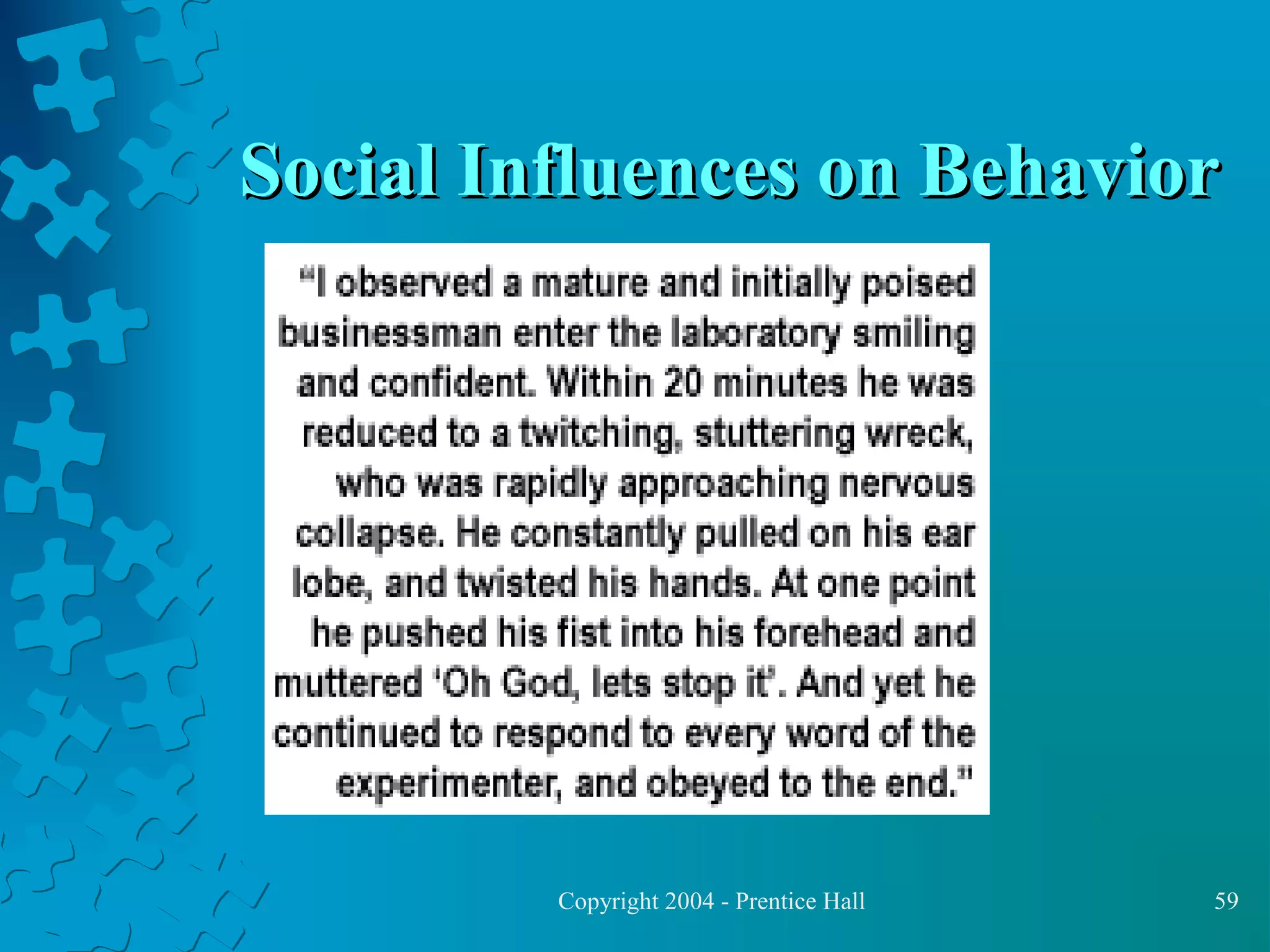
Copyright 2004 - Prentice Hall

60
Social Influences on Behavior
• Milgram's experiment
• Results:
•
•
•
•
•
•

2/3 obeyed fully
Why do we obey authority?
Waco
Jonestown
Heaven's gate
Hitler

Copyright 2004 - Prentice Hall

61
Social Influences on Behavior
• Conformity
• Results from indirect social pressure on an
individual to change his or her behaviors
and thoughts.

• The nature of the authority behind
pressures for conformity is not as
obvious as it is in commands for
obedience.
Copyright 2004 - Prentice Hall

62
Social Influences on Behavior
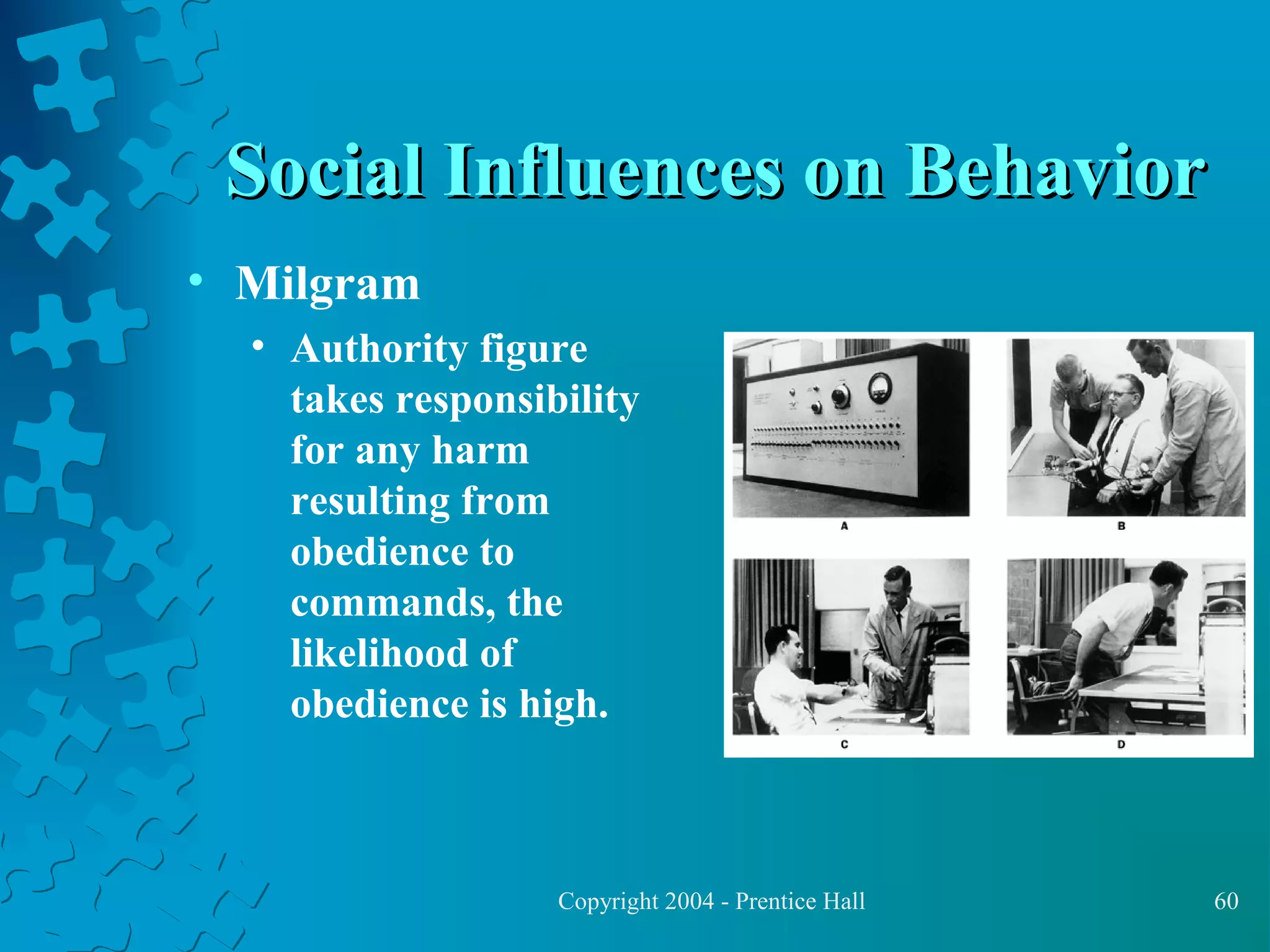
• Selecting the
matching line
• 30% of Asch’s
participants chose
incorrectly to
conform with the
group.

Copyright 2004 - Prentice Hall

63

Psycholgy Chapter 15 Social Psychology

  • 1.
  • 2.
    Social Psychology • Scientificstudy of how a person's • Thoughts • Feelings • Behaviors • Are influenced by • Behavior • Characteristics • Of other people • Real • Imagined • Inferred Copyright 2004 - Prentice Hall 2
  • 3.
    Social Psychology • Examines •Causes • Types • Consequences • Of human interaction • Interactions occur in a specific cultural context. Copyright 2004 - Prentice Hall 3
  • 4.
    Copyright 2004 -Prentice Hall 4
  • 5.
    Social Psychology • Dress •Do you really dress the way you would like to? • What clothes to wear when? • Accessories • Shoes Copyright 2004 - Prentice Hall 5
  • 6.
    Social Psychology • Space •How close you stand to someone is culturally determined. • Exercise • Closest? • Farthest way? Copyright 2004 - Prentice Hall 6
  • 7.
    Social Psychology • Speech •Do's and don'ts • What can you say to someone? • Should you look someone in the eyes when speaking? • Should we speak the truth? • Slang Copyright 2004 - Prentice Hall 7
  • 8.
    Social Psychology • Eat? • • • • Whatfoods do you eat with your fingers? Which foods accompany other foods? What do we eat and how much? What is cool to eat? • Food PowerPoint Copyright 2004 - Prentice Hall 8
  • 9.
    Social Psychology • Cultureclash • Parents • Travel • Moving from one part of the country to another • Country to the city • Blue collar job to a white collar job Copyright 2004 - Prentice Hall 9
  • 10.
    Social Psychology • Ethnocentrism •A belief in or assumption of the superiority of the social or cultural group that a person belongs to. • Researchers sometimes guilty of • Disregard cultural differences • See other cultures as an extension of their own “superior” culture • Therefore will view another culture from our own eyes • Female Genital Mutilation Copyright 2004 - Prentice Hall 10
  • 11.
    Social Psychology andCulture • Culture can influence • Type of research problem we choose to investigate • Hypothesis • Selection of the variables we choose to manipulate & record Copyright 2004 - Prentice Hall 11
  • 12.
    Cross Cultural Studyon Body Size • Men's Body Image • Women prefer the same male body size across cultures? Copyright 2004 - Prentice Hall 12
  • 13.
    Social Psychology andCulture • Individualism • Placing one’s own goals above those of the group. • U.S. • Collectivism • Placing group goals above individual goals. Copyright 2004 - Prentice Hall 13
  • 14.
    Social Psychology andCulture • Degree of individualism or collectivism in a culture can influence many aspects of behavior • • • • • Interpersonal relations Self-concept Parenting practices Self-esteem Emotional expression Copyright 2004 - Prentice Hall 14
  • 15.
    Social Psychology andCulture • Cultures vary widely • Social psychologists need to conduct cross-cultural studies • Can results of research conducted in one culture be generalized to others? Copyright 2004 - Prentice Hall 15
  • 16.
    How We ViewOthers and Their Behavior • Impression formation • Process of developing an opinion about another person. • Actor • Perceiver • Judgments you made of me and classmates • Based on • Stereotypes • Set of beliefs about members of a particular group. Copyright 2004 - Prentice Hall 16
  • 17.
    How We ViewOthers and Their Behavior • Stereotypes • Me • Other professors • Hair color • Age • Positive • Professors are geniuses. • Negative • Blondes are stupid. • In-group • Our group • Positive • Out-group • Negative Copyright 2004 - Prentice Hall 17
  • 18.
    How We ViewOthers and Their Behavior • 4 features of the actor have been shown to influence impression formation. 1) Physical appearance 2) Style and content of speech 3) Nonverbal mannerisms and nonverbal communication 4) Perceiver’s prior information about the actor Copyright 2004 - Prentice Hall 18
  • 19.
    Copyright 2004 -Prentice Hall 19
  • 20.
    How We ViewOthers and Their Behavior • Why do we all create stereotypes? • Safe, not safe • Easier on our on our brain • Don’t have to continually process bits of information Copyright 2004 - Prentice Hall 20
  • 21.
    How We ViewOthers and Their Behavior • 2 reasons stereotypes persist • 1. Believe that a group of people possesses certain characteristics • Note behaviors consistent with those characteristics • Fail to notice behaviors that are inconsistent • Example? • 2. Effects of our own reactions & behaviors on the individuals in question. • Treat people consistent with stereotype Copyright 2004 - Prentice Hall 21
  • 22.
    How We ViewOthers and Their Behavior • Self-fulfilling prophecy • When your behaviors influence others to respond the way you expect • Information that is available to you before you meet someone can affect your impression of that person. • The activation of a stereotype can either enhance or decrease (stereotype threat) an individual’s performance. • Stars demanding Copyright 2004 - Prentice Hall 22
  • 23.
    The Halo Effect • Nameddue to the perfection associated with angels. Assumption • • Attractive people are: • • • • More intelligent Better adjusted More popular Research shows attractive people: • • More occupational success More dating experience Copyright 2004 - Prentice Hall 23
  • 24.
    The Halo Effect •Alternative explanation for attractive people achieving more in life • We automatically categorize others before having an opportunity to evaluate their personalities • Cultural stereotypes • Attractive people must be intrinsically good • Ugly people must be inherently bad Copyright 2004 - Prentice Hall 24
  • 25.
    The Halo Effect •Cultural stereotypes • Attractive people must be intrinsically good • Ugly people must be inherently bad Copyright 2004 - Prentice Hall 25
  • 26.
    The Halo Effect •“Beautiful is good” stereotype • Assumes that attractive people have positive characteristics • Witty • Intelligent • Pleasing personalities • Therefore attractive people can be expected to make better impressions. Copyright 2004 - Prentice Hall 26
  • 27.
    The Halo Effect •Elliot Aronson, social psychologist at Stanford • Self-fulfilling prophecies • Person’s self-perception perpetuated by feedback from others • May play a role in success as well. • People who feel they are attractive - not necessarily rated as such– • Just as successful as those judged to be good-looking. Copyright 2004 - Prentice Hall 27
  • 28.
    How We ViewOthers and Their Behavior • Research on self-disclosure • The more a person reveals about themselves • More positive the impression • Too much early in a relationship • May result in a negative first impression Copyright 2004 - Prentice Hall 28
  • 29.
    How We ViewOthers and Their Behavior • Communication • Nonverbal communication • Important in determining initial impressions. Copyright 2004 - Prentice Hall 29
  • 30.
    How We ViewOthers and Their Behavior • 1st Impressions • How do they effect us? • Hear something bad about someone? • Murder ? • All the facts are in hard to believe • 1. Wealthy • 2. Popular • 3. Family man Copyright 2004 - Prentice Hall 30
  • 31.
    How We ViewOthers and Their Behavior • Attributions • Addresses how people make judgments about the causes of behavior. Copyright 2004 - Prentice Hall 31
  • 32.
    How We ViewOthers and Their Behavior • Internal Versus External Causes • Internal attributions • Behavior is seen as being caused by factors that reside within a person. • Stupid, smart, unfocused, critical, etc. Copyright 2004 - Prentice Hall 32
  • 33.
    Copyright 2004 -Prentice Hall 33
  • 34.
    How We ViewOthers and Their Behavior • External attributions • Causes of behavior are viewed as residing outside an individual. • Environmental • Wave • Bright light Copyright 2004 - Prentice Hall 34
  • 35.
    How We ViewOthers and Their Behavior • Fundamental attribution error • Tendency to attribute the behavior of others to causes within themselves. • Example • Driving • He drives reckless because he is an asshole. • Test • She did poorly on the test because she is rather stupid. Copyright 2004 - Prentice Hall 35
  • 36.
    How We ViewOthers and Their Behavior • Self-Serving Bias • Defensive Attribution • Tendency to attribute our successes to our own efforts or qualities • Failures to external factors • Driving • I drive fast because I am in a hurry. • He drives fast because he is an asshole. • Test • I did poorly on the test because the room was noisy. • I did well on the test because I am intelligent. Copyright 2004 - Prentice Hall 36
  • 37.
    How We ViewOthers and Their Behavior • Actor-perceiver bias • Perceivers more likely to make internal attributions • Actors more likely to make external attributions. Copyright 2004 - Prentice Hall 37
  • 38.
    How We ViewOthers and Their Behavior • Another aspect of the self-serving bias involves the just world belief. • Just world belief • Bad things happen to bad people • Good things happen to good people Copyright 2004 - Prentice Hall 41
  • 39.
    How We ViewOthers and Their Behavior • Attitudes • Relatively stable organization of • Beliefs • Feelings • Behavior • Directed toward something or someone. • Position on something or someone. • Can be positive, negative, or neutral Copyright 2004 - Prentice Hall 42
  • 40.
    How We ViewOthers and Their Behavior • 3 components of attitude formation • Think • Feel • Do Copyright 2004 - Prentice Hall 43
  • 41.
    How We ViewOthers and Their Behavior • 1st component of attitude formation • Evaluative beliefs • Think • Facts • Opinions • General knowledge Copyright 2004 - Prentice Hall 44
  • 42.
    How We ViewOthers and Their Behavior • 2nd component of attitude formation • Feeling • • • • • • Mad Sad Glad Scared Surprise Disgust Copyright 2004 - Prentice Hall 45
  • 43.
    How We ViewOthers and Their Behavior • 3rd component of attitude formation • Behavioral tendency • Approach • Avoid Copyright 2004 - Prentice Hall 46
  • 44.
    How We ViewOthers and Their Behavior • Example: • Cell phone • Think • Feel • Do • Do we always act according to our attitudes? • Why or why not? Copyright 2004 - Prentice Hall 47
  • 45.
    How We ViewOthers and Their Behavior • Social pressure? • Does the Dare program work? • Why or why not? Copyright 2004 - Prentice Hall 48
  • 46.
    How We ViewOthers and Their Behavior • What variables help form our basic attitudes? Copyright 2004 - Prentice Hall 49
  • 47.
    How We ViewOthers and Their Behavior • • • • • Parents Teachers Media Peers Billboards • Kids sponges Copyright 2004 - Prentice Hall 50
  • 48.
    How We ViewOthers and Their Behavior • Advertisers • Make sure our 1st exposure to product is very positive. Copyright 2004 - Prentice Hall 51
  • 49.
    How We ViewOthers and Their Behavior • Self-reports often used to measure attitudes • Influence responses • Types of questions asked • Way they are worded • Attitudes can be measured by Likert scales & evaluation of observed behaviors. Copyright 2004 - Prentice Hall 52
  • 50.
    How We ViewOthers and Their Behavior • Likert scales • Questionnaires participants indicate degree of agreement or disagreement with statements. Copyright 2004 - Prentice Hall 53
  • 51.
  • 52.
    Social Influences onBehavior • Obedience • The initiating or changing of behavior in response to a direct command of an authority. • In cases in which obedience will result in harm to another person, obedience increases with proximity to the source of the commands but decreases with proximity to the victim. Copyright 2004 - Prentice Hall 55
  • 53.
    Social Influences onBehavior • Milgram • More than 800 townspeople in New Haven, Connecticut participated • Scientist (the experimenter) wearing a white laboratory coat • Middle-aged man • Confederate • Learner • Participant • Teacher • Real participant Copyright 2004 - Prentice Hall 56
  • 54.
    Social Influences onBehavior • Teacher read a list of word • Learner gave 1st word of a pair and asked the learner to identify the second word from among 4 words. • Each time the learner gave an incorrect answer • Teacher instructed to administer an electric shock starting at 15 volts • Before the session began, each teacher experienced a mild (45-volt) shock to appreciate what the learner would feel. Copyright 2004 - Prentice Hall 57
  • 55.
    Social Influences onBehavior • Ultimately 65% of all of the "teachers" punished the "learners" to the maximum 450 volts. • No subject stopped before reaching 300 volts! Copyright 2004 - Prentice Hall 58
  • 56.
    Social Influences onBehavior Copyright 2004 - Prentice Hall 59
  • 57.
    Social Influences onBehavior • Milgram • Authority figure takes responsibility for any harm resulting from obedience to commands, the likelihood of obedience is high. Copyright 2004 - Prentice Hall 60
  • 58.
    Social Influences onBehavior • Milgram's experiment • Results: • • • • • • 2/3 obeyed fully Why do we obey authority? Waco Jonestown Heaven's gate Hitler Copyright 2004 - Prentice Hall 61
  • 59.
    Social Influences onBehavior • Conformity • Results from indirect social pressure on an individual to change his or her behaviors and thoughts. • The nature of the authority behind pressures for conformity is not as obvious as it is in commands for obedience. Copyright 2004 - Prentice Hall 62
  • 60.
    Social Influences onBehavior • Selecting the matching line • 30% of Asch’s participants chose incorrectly to conform with the group. Copyright 2004 - Prentice Hall 63

Editor's Notes

  • #2 Prepared by Michael J. Renner, Ph.D. These slides ©1999 Prentice Hall Psychology Publishing.