Age Ranges &
Human
Development
Dr David Armstrong
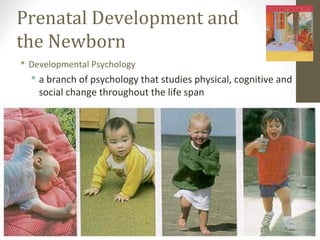
Prenatal Development and
the Newborn
ď‚§ Developmental Psychology
  ď‚§ a branch of psychology that studies physical, cognitive and
    social change throughout the life span
Age Ranges
•   Prenatal period (conception - birth)
•   Infancy and toddlerhood (from birth - 2 years)
•   Early Childhood (from 2 - 6 years)
•   Middle Childhood (from 6 - 11 years)
•   Adolescence (from 11 - 18 years)
•   Emerging adulthood (from 18-25 years)
•   Adulthood (from 25 onwards)

• Any other age range?
• What age range do you fall in? What age range of children will you be
  working with/teaching? What age range interests you the most?
• See: Berk, L. 2013. p. 5.
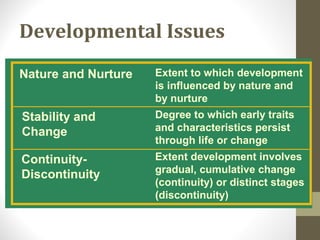
Developmental Issues
Nature and Nurture   Extent to which development
                     is influenced by nature and
                     by nurture
Stability and        Degree to which early traits
Change               and characteristics persist
                     through life or change
Continuity-          Extent development involves
                     gradual, cumulative change
Discontinuity
                     (continuity) or distinct stages
                     (discontinuity)
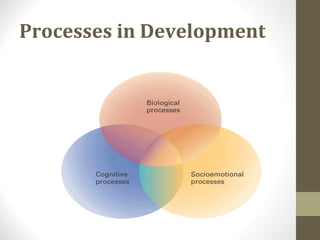
Processes in Development
Thank You
• Final Question: so if human development
  involves: biological processes, cognitive
  processes and socio-emotional processes what
  dimension of this development do educational
  examinations and assessment usually assess?

• Thank you for listening.
•
Thank You
• Final Question: so if human development
  involves: biological processes, cognitive
  processes and socio-emotional processes what
  dimension of this development do educational
  examinations and assessment usually assess?

• Thank you for listening.
•

Age ranges and human development

  • 1.
  • 2.
    Prenatal Development and theNewborn ď‚§ Developmental Psychology ď‚§ a branch of psychology that studies physical, cognitive and social change throughout the life span
  • 3.
    Age Ranges • Prenatal period (conception - birth) • Infancy and toddlerhood (from birth - 2 years) • Early Childhood (from 2 - 6 years) • Middle Childhood (from 6 - 11 years) • Adolescence (from 11 - 18 years) • Emerging adulthood (from 18-25 years) • Adulthood (from 25 onwards) • Any other age range? • What age range do you fall in? What age range of children will you be working with/teaching? What age range interests you the most? • See: Berk, L. 2013. p. 5.
  • 4.
    Developmental Issues Nature andNurture Extent to which development is influenced by nature and by nurture Stability and Degree to which early traits Change and characteristics persist through life or change Continuity- Extent development involves gradual, cumulative change Discontinuity (continuity) or distinct stages (discontinuity)
  • 5.
  • 6.
    Thank You • FinalQuestion: so if human development involves: biological processes, cognitive processes and socio-emotional processes what dimension of this development do educational examinations and assessment usually assess? • Thank you for listening. •
  • 7.
    Thank You • FinalQuestion: so if human development involves: biological processes, cognitive processes and socio-emotional processes what dimension of this development do educational examinations and assessment usually assess? • Thank you for listening. •