LEARNING
What is Learning?
• Learning:
–The process by which experience or
practice results in a relatively permanent
change in behavior or potential behavior.
(clearer than book)
• Motivation:
–Energizes & directs behavior
• How does this affect learning?
07/08/15
copyright 2006 www.brainybetty.com ALL RIGHTS
RESERVED. 2
Behaviorists
• Look at how people respond to the things in
their environment that affect them.
• Don’t think it is important to study one’s
– Inner needs
– Thoughts
– Feelings
– Motives
07/08/15
copyright 2006 www.brainybetty.com ALL RIGHTS
RESERVED. 3
Associative Learning (Stimulus Response)
• People learn to associate events
– Lighting
– Thunder
• 2 types of Associative Learning
– Classical Conditioning
• Stimulus from environment > reflexive response from
subject
– Operant Conditioning
• Behavior from subject > response from environment
07/08/15
copyright 2006 www.brainybetty.com ALL RIGHTS
RESERVED. 4
Classical Conditioning
• Classical conditioning
–Form of learning that occurs when 2
stimuli—a neutral stimulus and an
unconditioned stimulus—that are paired
(presented together) become associated
with each other.
07/08/15
copyright 2006 www.brainybetty.com ALL RIGHTS
RESERVED. 5
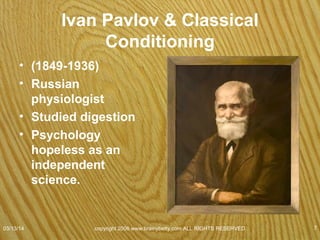
Ivan Pavlov & Classical Conditioning
• (1849-1936)
• Russian physiologist
• Studied digestion
• Psychology hopeless as
an independent
science.
• Noble prize 1904
07/08/15
copyright 2006 www.brainybetty.com ALL RIGHTS
RESERVED. 6
Pavlov Cont.
• Serendipity
• Noticed dogs salivated before food presented
• Sounded bell before feeding dogs
• Dogs salivated at sound of bell whether food or not.
• Ringing a bell alone would not ordinarily produce
salivation.
• Classical conditioning has been demonstrated in all
species.
07/08/15
copyright 2006 www.brainybetty.com ALL RIGHTS
RESERVED. 7
Classical Conditioning
• Unconditioned stimulus (UCS)
– Stimulus that automatically produces response
without any previous training.
• Meat
– Naturally salivate when anticipate eating
» Naturally & automatically elicit response
• Lighter to your finger
– Automatically pull away
» Fire unconditioned stimulus
» Stimulus > Response
07/08/15
copyright 2006 www.brainybetty.com ALL RIGHTS
RESERVED. 8
Classical Conditioning
• Unconditioned response (UCR)
– Reaction that is automatically produced when an
unconditioned stimulus is presented.
• Unlearned naturally occurring response
– Dog
• Unconditioned response was salivation
– Lighting your finger
• Unconditioned response pull away
07/08/15
copyright 2006 www.brainybetty.com ALL RIGHTS
RESERVED. 9
Classical Conditioning
• A neutral stimulus (NS)
–Stimulus that, before conditioning, does not
elicit a particular response.
–Dog
• Bell
– Does not naturally & automatically produce a
response
07/08/15
copyright 2006 www.brainybetty.com ALL RIGHTS
RESERVED. 10
Classical Conditioning
• Conditioned stimulus (CS)
– Neutral stimulus that acquires ability to elicit a
conditioned response after being paired with an
unconditioned stimulus.
– Dog
• Paired sound of bell with meat
– Tone no longer neutral stimulus
» Conditioned stimulus
07/08/15
copyright 2006 www.brainybetty.com ALL RIGHTS
RESERVED. 11
Classical Conditioning
• Conditioned response (CR)
– Response elicited by a conditioned stimulus that
has been paired with an unconditioned stimulus;
it is similar to the unconditioned response.
– Several pairings of the NS and UCS during an
acquisition phase lead to a situation in which the
CS presented by itself elicits a CR.
• Bell > Salivation
• Wouldn’t naturally salivate at sound of bell
07/08/15
copyright 2006 www.brainybetty.com ALL RIGHTS
RESERVED. 12
Classical Conditioning Cont.
• Neurological change occurs before eating.
• Dopamine in addicts
– Released before get the drug in anticipation of
receiving it.
• Classical conditioning
related to a spanking?
07/08/15
copyright 2006 www.brainybetty.com ALL RIGHTS
RESERVED. 13
Classical Conditioning Cont.
• Sound of a can opener
• Fish swim fast when knock on the aquarium.
• Taught the fish to have a physiological response to
the tapping.
• Learned tap = food
• Consistent
• Short time interval
• * Conduct experiment on Crunch.
07/08/15
copyright 2006 www.brainybetty.com ALL RIGHTS
RESERVED. 14
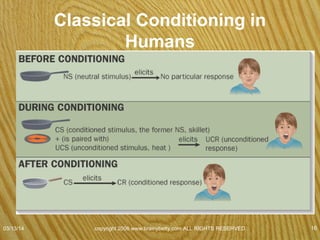
Classical Conditioning in Humans
07/08/15
copyright 2006 www.brainybetty.com ALL RIGHTS
RESERVED. 15
Classical Conditioning in Humans
• Advertising using Classical Conditioning?
– Taught to pair what with what?
07/08/15
copyright 2006 www.brainybetty.com ALL RIGHTS
RESERVED. 16
Classical Conditioning
• John Watson & Rosalie Rayner
–Demonstrated
• Emotions can be learned by classically
conditioning
– 9-month-old Little Albert to fear a white rat.
• Every time Albert reached for rat
– Struck steel bar
07/08/15
copyright 2006 www.brainybetty.com ALL RIGHTS
RESERVED. 17
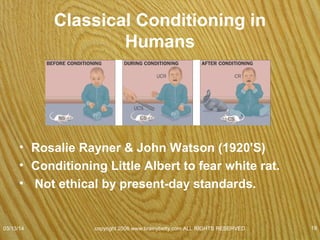
Classical Conditioning in Humans
• Rosalie Rayner & John Watson (1920'S)
• Conditioning Little Albert to fear white rat.
• Not ethical by present-day standards.
07/08/15
copyright 2006 www.brainybetty.com ALL RIGHTS
RESERVED. 18
Classical Conditioning in Humans
• Unconditioned
Stimulus (UCS)
• Loud noise
– No learning
• Conditioned Stimulus
(CS)
– Rat
• Unconditioned
Response (UCR)
• Fear (of loud noise)
– No learning
• Conditioned Response
(CR)
– Fear of rat
07/08/15
copyright 2006 www.brainybetty.com ALL RIGHTS
RESERVED. 19
Little Albert Cont.
• Generalized
• Became frightened of
–White animals
–Stuffed animals
–Fur coats
–Santa Claus beards
07/08/15
copyright 2006 www.brainybetty.com ALL RIGHTS
RESERVED. 20
Classical Conditioning in Humans
• Discrimination
– Ability to tell difference between similar stimuli.
• Rat not the same as fur coat
07/08/15
copyright 2006 www.brainybetty.com ALL RIGHTS
RESERVED. 21
Mary Cover Jones (1924)
• 3 yr. Old Peter
• Afraid of white rats
• Placed cage at a distance
• Gave child candy
• Each day moved cage closer
• Candy + white rat = pleasure
• Rat conditioned stimulus for pleasure
07/08/15
copyright 2006 www.brainybetty.com ALL RIGHTS
RESERVED. 22
Classical Conditioning
• Optimum sequence for CS to precede the UCS
(by about .50 second).
• Stronger the UCS, stronger the conditioning.
• More times the CS & UCS are presented
together
– Stronger the CR becomes
• Steel bar hit every time you touch the rat
• *Complete crunch experiment
07/08/15
copyright 2006 www.brainybetty.com ALL RIGHTS
RESERVED. 23
Classical Conditioning Cont. Aversion
Therapy
• A type of Classical Conditioning technique for
reducing or eliminating behavior by pairing
the behavior with an unpleasant stimulus.
– Antibuse
– Squirrels hot pepper
07/08/15
copyright 2006 www.brainybetty.com ALL RIGHTS
RESERVED. 24
Classical Conditioning Cont.
• Extinction: Weakening of associations.
• Dog door story
–Open all the time
–Open sometimes
–Closed all the time
–Behavior becomes extinct
07/08/15
copyright 2006 www.brainybetty.com ALL RIGHTS
RESERVED. 25
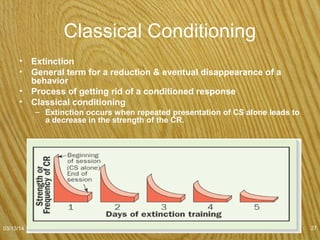
Classical Conditioning
• Extinction
• General term for a reduction & eventual disappearance of a behavior
• Process of getting rid of a conditioned response
• Classical conditioning
– Extinction occurs when repeated presentation of CS alone leads to a
decrease in the strength of the CR.
07/08/15
copyright 2006 www.brainybetty.com ALL RIGHTS
RESERVED. 26
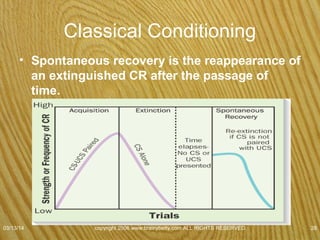
Classical Conditioning
• Spontaneous recovery is the reappearance of an
extinguished CR after the passage of time.
07/08/15
copyright 2006 www.brainybetty.com ALL RIGHTS
RESERVED. 27
Spontaneous Recovery
• Dog door
– Dog stops checking
– One day checks again
– Extinction
• Car
– Battery dead
– Stop checking
– Check again
– Extinction
07/08/15
copyright 2006 www.brainybetty.com ALL RIGHTS
RESERVED.
28
Classical Conditioning
• Fears, anxieties classically conditioned.
• Phobia irrational fear of an activity, object, or
situation that is out proportion to actual
danger it poses.
– Meaning?
07/08/15
copyright 2006 www.brainybetty.com ALL RIGHTS
RESERVED. 29
Desensitization Therapy
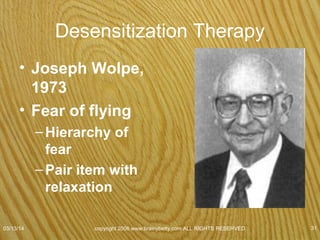
• Joseph Wolpe,
1973
• Fear of flying
–Hierarchy of fear
–Pair item with
relaxation
07/08/15
copyright 2006 www.brainybetty.com ALL RIGHTS
RESERVED. 30
Classical Conditioning
• Taste-aversion learning refers to the
development of a dislike or aversion to a
flavor or food that has been paired with
illness.
• Garcia Effect
07/08/15
copyright 2006 www.brainybetty.com ALL RIGHTS
RESERVED. 31
Operant Conditioning
• Also known as instrumental conditioning, an
organism operates on its environment to produce a
change.
• Teaches subjects to associate behaviors with their
consequences
– Subject acts first
– Environment responds to the action
• Classical Conditioning
– Environment acts first by triggering or eliciting a response
from subject
07/08/15
copyright 2006 www.brainybetty.com ALL RIGHTS
RESERVED. 32
Operant Conditioning
• Behaviors more likely to be repeated if they
are followed by a reward or an incentive to
do it again.
• Less likely to be repeated if followed by a
punishment.
– Principles apply to both Operant & Classical
Conditioning
• Extinction
• Generalization
• Discrimination
07/08/15
copyright 2006 www.brainybetty.com ALL RIGHTS
RESERVED. 33
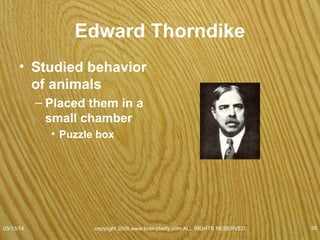
Edward Thorndike
• Studied behavior of
animals
– Placed them in a
small chamber
• Puzzle box
07/08/15
copyright 2006 www.brainybetty.com ALL RIGHTS
RESERVED. 34
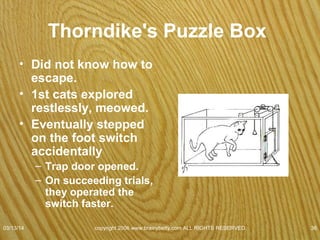
Thorndike's Puzzle Box
• Did not know how to
escape.
• 1st cats explored
restlessly, meowed.
• Eventually stepped on
the foot switch
accidentally
– Trap door opened.
– On succeeding trials,
they operated the
switch faster.
07/08/15
copyright 2006 www.brainybetty.com ALL RIGHTS
RESERVED. 35
Edward Thorndike
• Believed that when cat stumbled upon a behavior
that produced a desirable effect
– Created a link or associative bond between
• Stimulus (in this case, being in the cage)
• Response (stepping on the switch).
– Later, in the same stimulus situation response occurred
faster.
• Thorndike’s Law of Effect
– People are more likely to do things when the
consequences feel good.
07/08/15
copyright 2006 www.brainybetty.com ALL RIGHTS
RESERVED. 36
Operant Conditioning
• Example:
–Training a dog to roll over.
–How did you do it?
–What steps did you take?
07/08/15
copyright 2006 www.brainybetty.com ALL RIGHTS
RESERVED. 37
Shaping
• Reinforcing successive
approximations to the desired
behavior.
07/08/15
copyright 2006 www.brainybetty.com ALL RIGHTS
RESERVED. 38
Operant Conditioning
• B.F. Skinner influenced by Thorndike, & John B.
Watson’s behavioral view of psychology.
• Watson
– If we could understand how to
• Predict
• Control behavior
– Would know all there was to know about psychology.
• Skinner looked for the stimuli that control
behavior.
07/08/15
copyright 2006 www.brainybetty.com ALL RIGHTS
RESERVED. 39
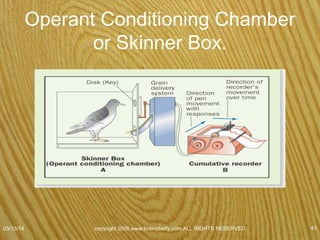
Skinner
• Skinner box recorded
– How fast
– How often
• Pressed the bar
– Taught animals weird behaviors to get food
• Reward
• Used shaping
– Operant Conditioning
• Subject acts first
• Reward from environment
• If subject likes reward will probably repeat behavior
07/08/15
copyright 2006 www.brainybetty.com ALL RIGHTS
RESERVED. 40
Operant Conditioning
• Reinforcer
– Event or stimulus that increases the frequency of the
response that it follows.
07/08/15
copyright 2006 www.brainybetty.com ALL RIGHTS
RESERVED. 41
Reinforcers
• Primary Reinforcers
– Food
– Hour extra sleep
– Something that feels good & satisfying all by itself.
• Secondary Reinforcers
– Not satisfying all by themselves
– Learn they are worth repeating a behavior
• Money / Concert tickets
– By themselves not fun
» Buy fun stuff
» See a show with the tickets
07/08/15
copyright 2006 www.brainybetty.com ALL RIGHTS
RESERVED. 42
Reinforcers
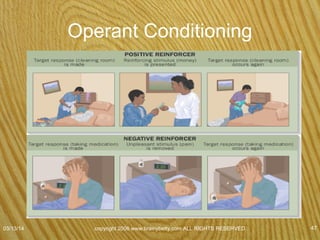
• Positive reinforcers
– Gives subject something
• More likely that a behavior will be repeated
– Food
– Money
– Concert tickets
– Praise
• Presented after the target response occurs.
07/08/15
copyright 2006 www.brainybetty.com ALL RIGHTS
RESERVED. 43
Reinforcers
• Negative reinforcers
– Events or stimuli that are removed because a
response has occurred.
• Takes away something unpleasant
– Example Skinner Box
• Rat gets shock
• Press bar to stop shock
– Behavior reinforced when the pain of the current stops
07/08/15
copyright 2006 www.brainybetty.com ALL RIGHTS
RESERVED. 44
Operant Conditioning
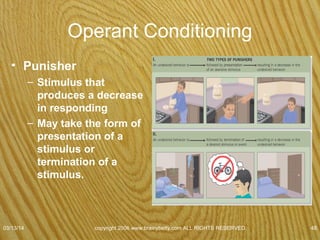
• Punisher
– Stimulus that produces a
decrease in responding
– May take the form of
presentation of a
stimulus or termination
of a stimulus.
07/08/15
copyright 2006 www.brainybetty.com ALL RIGHTS
RESERVED. 45
Operant Conditioning
• Punishment
– Process of using a punisher to decrease response
rate.
• Punishment is not an especially effective
means of altering behavior.
– May repeat the behavior but not in the presence
of the punisher
– Sometimes creates fear & aggression
– Doesn’t encourage desired behavior
– RAT EXPERIMENT!!``````````````
07/08/15
copyright 2006 www.brainybetty.com ALL RIGHTS
RESERVED.
46
Cognitive and Social Perspectives On
Learning
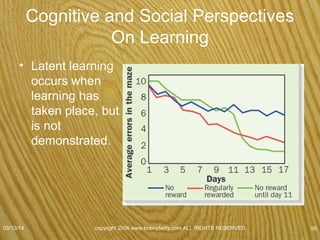
• Latent learning
occurs when
learning has
taken place, but
is not
demonstrated.
07/08/15
copyright 2006 www.brainybetty.com ALL RIGHTS
RESERVED. 47
Cognitive and Social Perspectives On
Learning
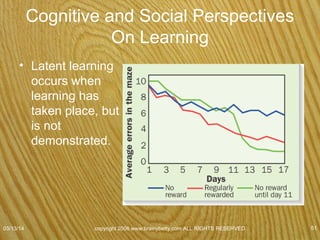
• Latent learning
occurs when
learning has
taken place, but
is not
demonstrated.
07/08/15
copyright 2006 www.brainybetty.com ALL RIGHTS
RESERVED. 48
Cognitive and Social Perspectives On
Learning
• Observational learning (modeling)
– Learning that occurs through watching & imitating
the behaviors of others.
• Parents
• See person doing the behavior reinforced for the
behavior
– Gold & silver class watch teacher do what you have been
trying to do easier.
07/08/15
copyright 2006 www.brainybetty.com ALL RIGHTS
RESERVED. 49
Cognitive and Social Perspectives On
Learning
• Keys to observational learning
– Participant identifies with the person being
observed.
• Vicarious reinforcement or vicarious
punishment.
– Put ourselves in the other person’s place for a
moment
– Better able to imagine the effects of the reinforcer
or punisher.
• Brown eye, blue eye study
07/08/15
copyright 2006 www.brainybetty.com ALL RIGHTS
RESERVED. 50
Cognitive and Social Perspectives On
Learning
• Attempts to influence behavior through
observational learning occur every day (along
with efforts based on classical conditioning).
• Observational learning
– Used to reduce or eliminate phobias.
07/08/15
copyright 2006 www.brainybetty.com ALL RIGHTS
RESERVED. 51

Psychology Chapter 6 Learning

  • 1.
  • 2.
    What is Learning? •Learning: –The process by which experience or practice results in a relatively permanent change in behavior or potential behavior. (clearer than book) • Motivation: –Energizes & directs behavior • How does this affect learning? 07/08/15 copyright 2006 www.brainybetty.com ALL RIGHTS RESERVED. 2
  • 3.
    Behaviorists • Look athow people respond to the things in their environment that affect them. • Don’t think it is important to study one’s – Inner needs – Thoughts – Feelings – Motives 07/08/15 copyright 2006 www.brainybetty.com ALL RIGHTS RESERVED. 3
  • 4.
    Associative Learning (StimulusResponse) • People learn to associate events – Lighting – Thunder • 2 types of Associative Learning – Classical Conditioning • Stimulus from environment > reflexive response from subject – Operant Conditioning • Behavior from subject > response from environment 07/08/15 copyright 2006 www.brainybetty.com ALL RIGHTS RESERVED. 4
  • 5.
    Classical Conditioning • Classicalconditioning –Form of learning that occurs when 2 stimuli—a neutral stimulus and an unconditioned stimulus—that are paired (presented together) become associated with each other. 07/08/15 copyright 2006 www.brainybetty.com ALL RIGHTS RESERVED. 5
  • 6.
    Ivan Pavlov &Classical Conditioning • (1849-1936) • Russian physiologist • Studied digestion • Psychology hopeless as an independent science. • Noble prize 1904 07/08/15 copyright 2006 www.brainybetty.com ALL RIGHTS RESERVED. 6
  • 7.
    Pavlov Cont. • Serendipity •Noticed dogs salivated before food presented • Sounded bell before feeding dogs • Dogs salivated at sound of bell whether food or not. • Ringing a bell alone would not ordinarily produce salivation. • Classical conditioning has been demonstrated in all species. 07/08/15 copyright 2006 www.brainybetty.com ALL RIGHTS RESERVED. 7
  • 8.
    Classical Conditioning • Unconditionedstimulus (UCS) – Stimulus that automatically produces response without any previous training. • Meat – Naturally salivate when anticipate eating » Naturally & automatically elicit response • Lighter to your finger – Automatically pull away » Fire unconditioned stimulus » Stimulus > Response 07/08/15 copyright 2006 www.brainybetty.com ALL RIGHTS RESERVED. 8
  • 9.
    Classical Conditioning • Unconditionedresponse (UCR) – Reaction that is automatically produced when an unconditioned stimulus is presented. • Unlearned naturally occurring response – Dog • Unconditioned response was salivation – Lighting your finger • Unconditioned response pull away 07/08/15 copyright 2006 www.brainybetty.com ALL RIGHTS RESERVED. 9
  • 10.
    Classical Conditioning • Aneutral stimulus (NS) –Stimulus that, before conditioning, does not elicit a particular response. –Dog • Bell – Does not naturally & automatically produce a response 07/08/15 copyright 2006 www.brainybetty.com ALL RIGHTS RESERVED. 10
  • 11.
    Classical Conditioning • Conditionedstimulus (CS) – Neutral stimulus that acquires ability to elicit a conditioned response after being paired with an unconditioned stimulus. – Dog • Paired sound of bell with meat – Tone no longer neutral stimulus » Conditioned stimulus 07/08/15 copyright 2006 www.brainybetty.com ALL RIGHTS RESERVED. 11
  • 12.
    Classical Conditioning • Conditionedresponse (CR) – Response elicited by a conditioned stimulus that has been paired with an unconditioned stimulus; it is similar to the unconditioned response. – Several pairings of the NS and UCS during an acquisition phase lead to a situation in which the CS presented by itself elicits a CR. • Bell > Salivation • Wouldn’t naturally salivate at sound of bell 07/08/15 copyright 2006 www.brainybetty.com ALL RIGHTS RESERVED. 12
  • 13.
    Classical Conditioning Cont. •Neurological change occurs before eating. • Dopamine in addicts – Released before get the drug in anticipation of receiving it. • Classical conditioning related to a spanking? 07/08/15 copyright 2006 www.brainybetty.com ALL RIGHTS RESERVED. 13
  • 14.
    Classical Conditioning Cont. •Sound of a can opener • Fish swim fast when knock on the aquarium. • Taught the fish to have a physiological response to the tapping. • Learned tap = food • Consistent • Short time interval • * Conduct experiment on Crunch. 07/08/15 copyright 2006 www.brainybetty.com ALL RIGHTS RESERVED. 14
  • 15.
    Classical Conditioning inHumans 07/08/15 copyright 2006 www.brainybetty.com ALL RIGHTS RESERVED. 15
  • 16.
    Classical Conditioning inHumans • Advertising using Classical Conditioning? – Taught to pair what with what? 07/08/15 copyright 2006 www.brainybetty.com ALL RIGHTS RESERVED. 16
  • 17.
    Classical Conditioning • JohnWatson & Rosalie Rayner –Demonstrated • Emotions can be learned by classically conditioning – 9-month-old Little Albert to fear a white rat. • Every time Albert reached for rat – Struck steel bar 07/08/15 copyright 2006 www.brainybetty.com ALL RIGHTS RESERVED. 17
  • 18.
    Classical Conditioning inHumans • Rosalie Rayner & John Watson (1920'S) • Conditioning Little Albert to fear white rat. • Not ethical by present-day standards. 07/08/15 copyright 2006 www.brainybetty.com ALL RIGHTS RESERVED. 18
  • 19.
    Classical Conditioning inHumans • Unconditioned Stimulus (UCS) • Loud noise – No learning • Conditioned Stimulus (CS) – Rat • Unconditioned Response (UCR) • Fear (of loud noise) – No learning • Conditioned Response (CR) – Fear of rat 07/08/15 copyright 2006 www.brainybetty.com ALL RIGHTS RESERVED. 19
  • 20.
    Little Albert Cont. •Generalized • Became frightened of –White animals –Stuffed animals –Fur coats –Santa Claus beards 07/08/15 copyright 2006 www.brainybetty.com ALL RIGHTS RESERVED. 20
  • 21.
    Classical Conditioning inHumans • Discrimination – Ability to tell difference between similar stimuli. • Rat not the same as fur coat 07/08/15 copyright 2006 www.brainybetty.com ALL RIGHTS RESERVED. 21
  • 22.
    Mary Cover Jones(1924) • 3 yr. Old Peter • Afraid of white rats • Placed cage at a distance • Gave child candy • Each day moved cage closer • Candy + white rat = pleasure • Rat conditioned stimulus for pleasure 07/08/15 copyright 2006 www.brainybetty.com ALL RIGHTS RESERVED. 22
  • 23.
    Classical Conditioning • Optimumsequence for CS to precede the UCS (by about .50 second). • Stronger the UCS, stronger the conditioning. • More times the CS & UCS are presented together – Stronger the CR becomes • Steel bar hit every time you touch the rat • *Complete crunch experiment 07/08/15 copyright 2006 www.brainybetty.com ALL RIGHTS RESERVED. 23
  • 24.
    Classical Conditioning Cont.Aversion Therapy • A type of Classical Conditioning technique for reducing or eliminating behavior by pairing the behavior with an unpleasant stimulus. – Antibuse – Squirrels hot pepper 07/08/15 copyright 2006 www.brainybetty.com ALL RIGHTS RESERVED. 24
  • 25.
    Classical Conditioning Cont. •Extinction: Weakening of associations. • Dog door story –Open all the time –Open sometimes –Closed all the time –Behavior becomes extinct 07/08/15 copyright 2006 www.brainybetty.com ALL RIGHTS RESERVED. 25
  • 26.
    Classical Conditioning • Extinction •General term for a reduction & eventual disappearance of a behavior • Process of getting rid of a conditioned response • Classical conditioning – Extinction occurs when repeated presentation of CS alone leads to a decrease in the strength of the CR. 07/08/15 copyright 2006 www.brainybetty.com ALL RIGHTS RESERVED. 26
  • 27.
    Classical Conditioning • Spontaneousrecovery is the reappearance of an extinguished CR after the passage of time. 07/08/15 copyright 2006 www.brainybetty.com ALL RIGHTS RESERVED. 27
  • 28.
    Spontaneous Recovery • Dogdoor – Dog stops checking – One day checks again – Extinction • Car – Battery dead – Stop checking – Check again – Extinction 07/08/15 copyright 2006 www.brainybetty.com ALL RIGHTS RESERVED. 28
  • 29.
    Classical Conditioning • Fears,anxieties classically conditioned. • Phobia irrational fear of an activity, object, or situation that is out proportion to actual danger it poses. – Meaning? 07/08/15 copyright 2006 www.brainybetty.com ALL RIGHTS RESERVED. 29
  • 30.
    Desensitization Therapy • JosephWolpe, 1973 • Fear of flying –Hierarchy of fear –Pair item with relaxation 07/08/15 copyright 2006 www.brainybetty.com ALL RIGHTS RESERVED. 30
  • 31.
    Classical Conditioning • Taste-aversionlearning refers to the development of a dislike or aversion to a flavor or food that has been paired with illness. • Garcia Effect 07/08/15 copyright 2006 www.brainybetty.com ALL RIGHTS RESERVED. 31
  • 32.
    Operant Conditioning • Alsoknown as instrumental conditioning, an organism operates on its environment to produce a change. • Teaches subjects to associate behaviors with their consequences – Subject acts first – Environment responds to the action • Classical Conditioning – Environment acts first by triggering or eliciting a response from subject 07/08/15 copyright 2006 www.brainybetty.com ALL RIGHTS RESERVED. 32
  • 33.
    Operant Conditioning • Behaviorsmore likely to be repeated if they are followed by a reward or an incentive to do it again. • Less likely to be repeated if followed by a punishment. – Principles apply to both Operant & Classical Conditioning • Extinction • Generalization • Discrimination 07/08/15 copyright 2006 www.brainybetty.com ALL RIGHTS RESERVED. 33
  • 34.
    Edward Thorndike • Studiedbehavior of animals – Placed them in a small chamber • Puzzle box 07/08/15 copyright 2006 www.brainybetty.com ALL RIGHTS RESERVED. 34
  • 35.
    Thorndike's Puzzle Box •Did not know how to escape. • 1st cats explored restlessly, meowed. • Eventually stepped on the foot switch accidentally – Trap door opened. – On succeeding trials, they operated the switch faster. 07/08/15 copyright 2006 www.brainybetty.com ALL RIGHTS RESERVED. 35
  • 36.
    Edward Thorndike • Believedthat when cat stumbled upon a behavior that produced a desirable effect – Created a link or associative bond between • Stimulus (in this case, being in the cage) • Response (stepping on the switch). – Later, in the same stimulus situation response occurred faster. • Thorndike’s Law of Effect – People are more likely to do things when the consequences feel good. 07/08/15 copyright 2006 www.brainybetty.com ALL RIGHTS RESERVED. 36
  • 37.
    Operant Conditioning • Example: –Traininga dog to roll over. –How did you do it? –What steps did you take? 07/08/15 copyright 2006 www.brainybetty.com ALL RIGHTS RESERVED. 37
  • 38.
    Shaping • Reinforcing successive approximationsto the desired behavior. 07/08/15 copyright 2006 www.brainybetty.com ALL RIGHTS RESERVED. 38
  • 39.
    Operant Conditioning • B.F.Skinner influenced by Thorndike, & John B. Watson’s behavioral view of psychology. • Watson – If we could understand how to • Predict • Control behavior – Would know all there was to know about psychology. • Skinner looked for the stimuli that control behavior. 07/08/15 copyright 2006 www.brainybetty.com ALL RIGHTS RESERVED. 39
  • 40.
    Skinner • Skinner boxrecorded – How fast – How often • Pressed the bar – Taught animals weird behaviors to get food • Reward • Used shaping – Operant Conditioning • Subject acts first • Reward from environment • If subject likes reward will probably repeat behavior 07/08/15 copyright 2006 www.brainybetty.com ALL RIGHTS RESERVED. 40
  • 41.
    Operant Conditioning • Reinforcer –Event or stimulus that increases the frequency of the response that it follows. 07/08/15 copyright 2006 www.brainybetty.com ALL RIGHTS RESERVED. 41
  • 42.
    Reinforcers • Primary Reinforcers –Food – Hour extra sleep – Something that feels good & satisfying all by itself. • Secondary Reinforcers – Not satisfying all by themselves – Learn they are worth repeating a behavior • Money / Concert tickets – By themselves not fun » Buy fun stuff » See a show with the tickets 07/08/15 copyright 2006 www.brainybetty.com ALL RIGHTS RESERVED. 42
  • 43.
    Reinforcers • Positive reinforcers –Gives subject something • More likely that a behavior will be repeated – Food – Money – Concert tickets – Praise • Presented after the target response occurs. 07/08/15 copyright 2006 www.brainybetty.com ALL RIGHTS RESERVED. 43
  • 44.
    Reinforcers • Negative reinforcers –Events or stimuli that are removed because a response has occurred. • Takes away something unpleasant – Example Skinner Box • Rat gets shock • Press bar to stop shock – Behavior reinforced when the pain of the current stops 07/08/15 copyright 2006 www.brainybetty.com ALL RIGHTS RESERVED. 44
  • 45.
    Operant Conditioning • Punisher –Stimulus that produces a decrease in responding – May take the form of presentation of a stimulus or termination of a stimulus. 07/08/15 copyright 2006 www.brainybetty.com ALL RIGHTS RESERVED. 45
  • 46.
    Operant Conditioning • Punishment –Process of using a punisher to decrease response rate. • Punishment is not an especially effective means of altering behavior. – May repeat the behavior but not in the presence of the punisher – Sometimes creates fear & aggression – Doesn’t encourage desired behavior – RAT EXPERIMENT!!`````````````` 07/08/15 copyright 2006 www.brainybetty.com ALL RIGHTS RESERVED. 46
  • 47.
    Cognitive and SocialPerspectives On Learning • Latent learning occurs when learning has taken place, but is not demonstrated. 07/08/15 copyright 2006 www.brainybetty.com ALL RIGHTS RESERVED. 47
  • 48.
    Cognitive and SocialPerspectives On Learning • Latent learning occurs when learning has taken place, but is not demonstrated. 07/08/15 copyright 2006 www.brainybetty.com ALL RIGHTS RESERVED. 48
  • 49.
    Cognitive and SocialPerspectives On Learning • Observational learning (modeling) – Learning that occurs through watching & imitating the behaviors of others. • Parents • See person doing the behavior reinforced for the behavior – Gold & silver class watch teacher do what you have been trying to do easier. 07/08/15 copyright 2006 www.brainybetty.com ALL RIGHTS RESERVED. 49
  • 50.
    Cognitive and SocialPerspectives On Learning • Keys to observational learning – Participant identifies with the person being observed. • Vicarious reinforcement or vicarious punishment. – Put ourselves in the other person’s place for a moment – Better able to imagine the effects of the reinforcer or punisher. • Brown eye, blue eye study 07/08/15 copyright 2006 www.brainybetty.com ALL RIGHTS RESERVED. 50
  • 51.
    Cognitive and SocialPerspectives On Learning • Attempts to influence behavior through observational learning occur every day (along with efforts based on classical conditioning). • Observational learning – Used to reduce or eliminate phobias. 07/08/15 copyright 2006 www.brainybetty.com ALL RIGHTS RESERVED. 51