CHAPTER 2:  PERCEPTION OF  SELF AND OTHERS By: Miranda Emery
PERCEPTION Process of selectively attending to information and assigning meaning to it Perception becomes reality Brain selects some information (sensory stimuli), organizes it, and interprets it
Attention and selection Needs Interests Expectations Organization of Stimuli Simplicity- Brain simplifies stimuli Pattern- set of characteristics used to differentiate some things from others Interpret- assign meaning to stimuli PERCEPTION
PERCEPTION Self-concept- Self-identity (who you are) Image of skills, abilities, knowledge, competencies, and personality Personal experience Positive experience=Positive self-concept Reactions of others Validate, reinforce, or alter perception of self Early development/ Family members Self-esteem- Overall evaluation of competence and personal worth (evaluation of self) Ideal self-concept- What we want to be Develops the more we interact with others and media
PERCEPTION Individualistic culture (U.S.) stresses self and personal achievement Care about self-concept, self-esteem, and self-image Tend to think about what is best for ourselves Collectivist culture (China) stresses achievement in relation to the group Blending occurring
PERCEPTION Feminine and Masculine Cultural expectations influence self-perception Boys- Achievement, status, and income Girls- Appearance and relationship skills Becoming less rigid but exist and promoted in popular culture
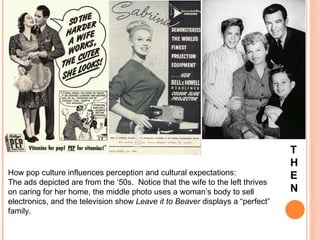
T H E N How pop culture influences perception and cultural expectations: The ads depicted are from the ‘50s.  Notice that the wife to the left thrives on caring for her home, the middle photo uses a woman’s body to sell electronics, and the television show  Leave it to Beaver  displays a “perfect”  family.
N O W Now, we have Kelly Ripa, less clothing used to sell electronics, and the cast of  According to Jim .
PERCEPTION Self-concept and Self-esteem are lasting, but they can be changed Generally slow change unless profound change to social environment
PERCEPTION Accuracy and distortion of self-perception Accuracy of our self-concept and self-esteem depends on the accuracy of our own perceptions and how we process others’ perceptions of us. Incongruence- gap between inaccurate self-perception and reality Self-fulfilling prophecy- False perception that leads to false perception becoming true Self-created prophecies- Predictions you make of self Filtering message- Generally focus on things that support our own self-image Media images- Social learning theory
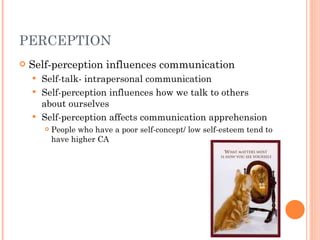
PERCEPTION Self-perception influences communication Self-talk- intrapersonal communication Self-perception influences how we talk to others about ourselves Self-perception affects communication apprehension People who have a poor self-concept/ low self-esteem tend to have higher CA
PERCEPTION Self-esteem and Self-concept are the true perceptions of ourselves We mask We create different selves, in different situations, to different people Self-monitor- Internal process of being aware of self and how you are coming across to others Role- A pattern of learned behaviors that we use to meet the perceived demands of a particular context Social media
PERCEPTION Perception of others Most feel a level of anxiety Do we have anything in common? Will they like me?  Uncertainty reduction- Monitoring social environment to learn more about self and others Observe others, build impressions of others Natural way to alleviate anxiety
PERCEPTION Observations lead to first impressions, based on appearance and actions of others Implicit personality theories- Assumptions about which physical characteristics and personality traits or behavior go together Halo effect- Assuming multiple traits that “go together” from only observing one
PERCEPTION Stereotype- “A generalization, usually exaggerated or overly simplified and often offensive, used to describe or distinguish a group.” Do not form most from our own experience Prejudice- “A rigid attitude that is based on group membership and predisposes an individual to feel, think, or act in a negative way toward another person or group.” Discrimination- Involves a negative action toward a group or person based on stereotype
 
PERCEPTION Emotional state influences the interaction Selective perceptions- “See” what supports us Attributions- Reasons we give for others’ behavior Emotions affect attributions we give
PERCEPTION Perceiving others’ messages Context- How we interpret content and intent Shared language- How each person perceives specific words, visual images, and nonverbal cues
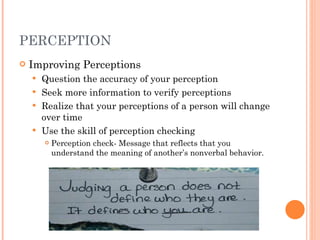
PERCEPTION Improving Perceptions Question the accuracy of your perception Seek more information to verify perceptions Realize that your perceptions of a person will change over time Use the skill of perception checking Perception check- Message that reflects that you understand the meaning of another’s nonverbal behavior.
THANK YOU (TY,   )

Chap2: Perception

  • 1.
    CHAPTER 2: PERCEPTION OF SELF AND OTHERS By: Miranda Emery
  • 2.
    PERCEPTION Process ofselectively attending to information and assigning meaning to it Perception becomes reality Brain selects some information (sensory stimuli), organizes it, and interprets it
  • 3.
    Attention and selectionNeeds Interests Expectations Organization of Stimuli Simplicity- Brain simplifies stimuli Pattern- set of characteristics used to differentiate some things from others Interpret- assign meaning to stimuli PERCEPTION
  • 4.
    PERCEPTION Self-concept- Self-identity(who you are) Image of skills, abilities, knowledge, competencies, and personality Personal experience Positive experience=Positive self-concept Reactions of others Validate, reinforce, or alter perception of self Early development/ Family members Self-esteem- Overall evaluation of competence and personal worth (evaluation of self) Ideal self-concept- What we want to be Develops the more we interact with others and media
  • 5.
    PERCEPTION Individualistic culture(U.S.) stresses self and personal achievement Care about self-concept, self-esteem, and self-image Tend to think about what is best for ourselves Collectivist culture (China) stresses achievement in relation to the group Blending occurring
  • 6.
    PERCEPTION Feminine andMasculine Cultural expectations influence self-perception Boys- Achievement, status, and income Girls- Appearance and relationship skills Becoming less rigid but exist and promoted in popular culture
  • 7.
    T H EN How pop culture influences perception and cultural expectations: The ads depicted are from the ‘50s. Notice that the wife to the left thrives on caring for her home, the middle photo uses a woman’s body to sell electronics, and the television show Leave it to Beaver displays a “perfect” family.
  • 8.
    N O WNow, we have Kelly Ripa, less clothing used to sell electronics, and the cast of According to Jim .
  • 9.
    PERCEPTION Self-concept andSelf-esteem are lasting, but they can be changed Generally slow change unless profound change to social environment
  • 10.
    PERCEPTION Accuracy anddistortion of self-perception Accuracy of our self-concept and self-esteem depends on the accuracy of our own perceptions and how we process others’ perceptions of us. Incongruence- gap between inaccurate self-perception and reality Self-fulfilling prophecy- False perception that leads to false perception becoming true Self-created prophecies- Predictions you make of self Filtering message- Generally focus on things that support our own self-image Media images- Social learning theory
  • 11.
    PERCEPTION Self-perception influencescommunication Self-talk- intrapersonal communication Self-perception influences how we talk to others about ourselves Self-perception affects communication apprehension People who have a poor self-concept/ low self-esteem tend to have higher CA
  • 12.
    PERCEPTION Self-esteem andSelf-concept are the true perceptions of ourselves We mask We create different selves, in different situations, to different people Self-monitor- Internal process of being aware of self and how you are coming across to others Role- A pattern of learned behaviors that we use to meet the perceived demands of a particular context Social media
  • 13.
    PERCEPTION Perception ofothers Most feel a level of anxiety Do we have anything in common? Will they like me? Uncertainty reduction- Monitoring social environment to learn more about self and others Observe others, build impressions of others Natural way to alleviate anxiety
  • 14.
    PERCEPTION Observations leadto first impressions, based on appearance and actions of others Implicit personality theories- Assumptions about which physical characteristics and personality traits or behavior go together Halo effect- Assuming multiple traits that “go together” from only observing one
  • 15.
    PERCEPTION Stereotype- “Ageneralization, usually exaggerated or overly simplified and often offensive, used to describe or distinguish a group.” Do not form most from our own experience Prejudice- “A rigid attitude that is based on group membership and predisposes an individual to feel, think, or act in a negative way toward another person or group.” Discrimination- Involves a negative action toward a group or person based on stereotype
  • 16.
  • 17.
    PERCEPTION Emotional stateinfluences the interaction Selective perceptions- “See” what supports us Attributions- Reasons we give for others’ behavior Emotions affect attributions we give
  • 18.
    PERCEPTION Perceiving others’messages Context- How we interpret content and intent Shared language- How each person perceives specific words, visual images, and nonverbal cues
  • 19.
    PERCEPTION Improving PerceptionsQuestion the accuracy of your perception Seek more information to verify perceptions Realize that your perceptions of a person will change over time Use the skill of perception checking Perception check- Message that reflects that you understand the meaning of another’s nonverbal behavior.
  • 20.