Chapter 6

Socioemotional Development in Early
Childhood

3-5 Years-of-Age
PowerPoints developed by Jenni Fauchier,
Butchered by Professor Carney
Class Exercise
• Take out a piece of paper and describe
yourself.
• You will not turn this in.
• Keep the paper out since we will
discuss this further in a moment.

2-5 Years-of-Age
Self-Understanding
• Self-understanding

– The child’s cognitive representation of self,
the substance & content of the child’s selfconception.
• How they think about themselves

2-5 Years-of-Age
Self-Understanding
• Self-recognition
– Describe self in concrete & observable
terms:
• Blonde hair
• Green eyes
• Body attributes

– “I’m a taller than Suzie.”

• Material possessions

– “I have a pink bike & she doesn’t.”

• Physical activities

– “I play basketball.”
2-5 Years-of-Age
Self-Understanding

2-5 Years-of-Age
Class Exercise
• How does your self description differ
from a 4-year-olds?

2-5 Years-of-Age
Understanding Others
• Ability to understand others varies
– Empathy limited
– Understands others’ statements may be
untrue
• Understands simple jokes

– Describes others in terms of
psychological traits.
• “My daddy is very silly.”

– Research: Kids 3 & up not as egocentric
as Piaget thought.
Chapter 10, ages 2-6

7
Emotional Development
• Why is shame, pride, embarrassment
& guilt self-conscious emotions?

2-5 Years-of-Age
Emotional Development
• Self Awareness
– Feel more emotions
– Increased ability to talk about one’s
• Own emotions
• Others’ emotions

– More words to describe emotions

2-5 Years-of-Age
Regulating Emotions
• Emotion-coaching parents

– Parents observing & explaining:
• “You should think about
Raphael's feelings next time
before you hit him.”

– Children become better at:
» Self-soothing
» Regulate negative emotions
» Fewer behavior problems

2-5 Years-of-Age
Regulating Emotions
• Emotion-dismissing parents
– Deny

• Boys don’t cry

– Ignore
– Change negative emotions
• Okay to be sad

3-5 Years-of-Age
Emotion & Peer Relationships
– Kids with emotional control
• More popular
– Moody & emotionally negative

children
• Rejected

2-5 Years-of-Age
Moral Development
• Moral development
– Development of thoughts, feelings, &
behaviors regarding rules & conventions
about what people should do in their
interactions with other people.
– Hit by a flag.
• Black eye

2-5 Years-of-Age
Moral Development
• Freudian theory
– Superego
• Moral element of personality
– Guilt
– Anxiety

3-5 Years-of-Age
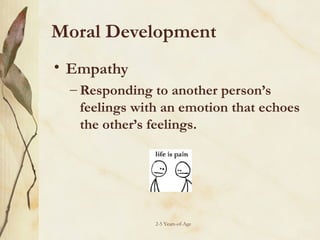
Moral Development
• Empathy
– Responding to another person’s
feelings with an emotion that echoes
the other’s feelings.

2-5 Years-of-Age
Understanding Others
• Who is most empathic in your family?
– Why?

2-5 Years-of-Age
Moral Behavior
• Behavioral & social cognitive
approach
– Reinforcement
• Likely to repeat

– Punishment
• Extinguish

2-5 Years-of-Age
Situational Behavior
• Behavioral & social cognitive approach
– Behavior is situational
– Honest in one situation but not another.
• Example?
• No
– Totally honest child
– Totally dishonest child

• Ability to resist temptation
– Tied to of self-control
• For life
2-5 Years-of-Age
Gender

• Gender

– Social & psychological dimensions of being male or
female

• Gender identity
– Sense of being male or female
– By age 3

• Gender roles
– Sets of expectations prescribe how females or males
should
• Think
• Act
• Feel
2-5 Years-of-Age
Gender
• Preschool children act to:
– Match culture's gender roles
– Exhibit sense of gender identity

2-5 Years-of-Age
Social Theories of Gender
Development  
• 3 main social theories of gender
– 1. Social role theory
– 2. Psychoanalytic theory
– 3. Social cognitive theory of gender

2-5 Years-of-Age
Social Theories of Gender
Development  
• 1. Social Role theory
– Observation
– Men & women

• Behave differently
• Take on different roles

– Why?

• Societies expectations

– 3 common patterns are:

• Women more domestic tasks
• Different occupational roles
• In occupations
– women often have lower status
2-5 Years-of-Age
Social Theories of Gender
Development 
• 2. Psychoanalytic Theory
– Freud

• Age 5 or 6

– Oedipus complex
– Resolution?
– Electra complex
» Problems with theory?

• 3. Social Cognitive Theory
– Observing
– Imitating

• Rewarded
• Punished

2-5 Years-of-Age
Parental Influence on Gender
Development
• By action & example, parents influence their
children’s gender development
– All cultures mothers & fathers different
roles
– Mothers’ Socialization Strategies
• Obedient
• Responsible

– Fathers’ Socialization Strategies

• More attention to sons
• More activities with sons
• More effort to promote sons’ intellectual
development
2-5 Years-of-Age
Peer Influences
• Peers extensively reward & punish
gender behavior
– Reject children who act like opposite
gender especially boys
• “You throw like a girl!”

– Reward cultures appropriate gender
behavior
– Gender molds important aspects of peer
relations
2-5 Years-of-Age
Peer Influences
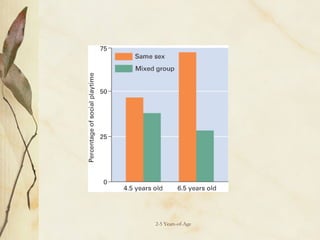
• Gender group composition:
• 3 yrs. same sex play
• Increases until 12

– Group size:
• 5 yrs. boys larger groups
– Group goal

• Girls triads

– Interaction in same sex groups
• Boys rougher, competitive, conflicts, dominance
• Girls collaborative
3-5 Years-of-Age
2-5 Years-of-Age
Consequences of Corporal
Punishment
• Corporal punishment associated with:
– higher levels of immediate compliance
– increased aggression
– lower levels of moral internalization
• Why?

– lower levels of mental health
– more adjustment problems
– spanking before age 2
• Related to behavioral problems
– in middle & late childhood
2-5 Years-of-Age
Reasons to Avoid Physical
Punishment
• Out-of-control model
– May imitate

• Punishment can instill:
– Fear
– Rage
– Avoidance

• Learn what not to do
• Doesn’t learn what to do
• Punishment can be abusive
2-5 Years-of-Age
Coparenting & Alternatives to
Corporal Punishment
• Handling misbehavior:
– Use reasoning
• Explain consequences of behavior

– Ask what they could do next time

• Time out
– Child briefly removed from setting

• Co-parenting
– Parents provide support for one another
2-5 Years-of-Age
Child Maltreatment
• 84% abused by parent or parents
– 2002 report

• Laws in many states require reporting
by:
– Physicians
– Teachers
– Therapists
• Many cases go unreported
• Especially those of battered infants
2-5 Years-of-Age
Types of Child Abuse
• Physical abuse
• Child neglect
– failure to provide basic needs

• Sexual abuse
– fondling a child’s genitals, intercourse,
incest, rape, sodomy, etc.

• Emotional abuse
– psychological/verbal abuse/mental injury
– acts/omissions that have caused, or could
cause, serious behavioral, cognitive, or
emotional problems
2-5 Years-of-Age
Developmental Consequences of
Abuse
•
•
•
•
•
•
•

Poor emotion regulation
Attachment problems
Problems with peer s
Difficulty adapting to school
Depression
Delinquency
Difficulty in establishing & maintaining healthy
intimate relationships
• As adults
–
–
–
–

Higher risk for violent behavior toward other adults
Substance abuse
Anxiety
Depression
2-5 Years-of-Age
Prevention of Maltreatment
• Recent study
– 2 treatments effective in reducing
child abuse:
• 1. Home visitation that emphasized
– Improved parenting
– Coping with stress
– Increasing support for the mother

• 2. Parent-infant psychotherapy
focused on improving maternal-infant
attachment
2-5 Years-of-Age
Birth Order
• First-born children
– More:
•
•
•
•
•
•
•
•

Intelligent
Adult-oriented
Helpful
Conforming
Self-controlled
Guilt
Anxiety
Difficulty coping with stress

– Excel in:

• Academically
• Professionally

– Why?

2-5 Years-of-Age
Birth Order
• Only children

– Often achievement-oriented
– Good personality
– Why?

3-5 Years-of-Age
2-5 Years-of-Age
Consequences of Divorce
• 40% of US children: parent’s divorce
• Children in divorced families more likely:
– Academic problems
– Show externalized problems
• Acting out
• Delinquency
• Internalized problems
– Anxiety
– Depression

–
–
–
–

Less competent intimate relationships
Drop out of school
Sexually active at early age
Use drugs
Consequences of Divorce
• Joint custody better adjusted
• Majority of children

– No significant adjustment problems
– New studies say:

• The DEATH of a parent is LESS devastating
to a child than a DIVORCE.

• Should parents stay together for
children?

2-5 Years-of-Age
Gay & Lesbian Parents

2-5 Years-of-Age
Gay Male and Lesbian Parents
• Parents

– @ 20% of lesbians
– @ 10% of gay

• Many lost custody to heterosexual
spouses after divorce
• Most born in a heterosexual relationship
• Controversial
– Thoughts?
– Just as adjusted as other kids (if 2 parents)
– Mostly heterosexual
2-5 Years-of-Age
Television
• Television most influential mass media
affecting children’s behavior
• More time in front of television than
with parents
– Average
• 2 - 4 hours day

– Negative effects?
2-5 Years-of-Age
Effects of Television
• Negative influence
–
–
–
–
–

Passive learners
Distracting from homework
Teaching stereotypes
Violent models of aggression
Unrealistic views of world

2-5 Years-of-Age
Other Media
• Increased concern: children who play
violent video games
– Especially highly realistic

• May become deeply immersed
– Altered state of consciousness
– Rational thought suspended
– Linked to aggression in M & F
2-5 Years-of-Age
Newsletter
• Newsletter about 2 – 5 yrs.

3-5 Years-of-Age

Life span chapter 6

  • 1.
    Chapter 6 Socioemotional Developmentin Early Childhood 3-5 Years-of-Age PowerPoints developed by Jenni Fauchier, Butchered by Professor Carney
  • 2.
    Class Exercise • Takeout a piece of paper and describe yourself. • You will not turn this in. • Keep the paper out since we will discuss this further in a moment. 2-5 Years-of-Age
  • 3.
    Self-Understanding • Self-understanding – Thechild’s cognitive representation of self, the substance & content of the child’s selfconception. • How they think about themselves 2-5 Years-of-Age
  • 4.
    Self-Understanding • Self-recognition – Describeself in concrete & observable terms: • Blonde hair • Green eyes • Body attributes – “I’m a taller than Suzie.” • Material possessions – “I have a pink bike & she doesn’t.” • Physical activities – “I play basketball.” 2-5 Years-of-Age
  • 5.
  • 6.
    Class Exercise • Howdoes your self description differ from a 4-year-olds? 2-5 Years-of-Age
  • 7.
    Understanding Others • Abilityto understand others varies – Empathy limited – Understands others’ statements may be untrue • Understands simple jokes – Describes others in terms of psychological traits. • “My daddy is very silly.” – Research: Kids 3 & up not as egocentric as Piaget thought. Chapter 10, ages 2-6 7
  • 8.
    Emotional Development • Whyis shame, pride, embarrassment & guilt self-conscious emotions? 2-5 Years-of-Age
  • 9.
    Emotional Development • SelfAwareness – Feel more emotions – Increased ability to talk about one’s • Own emotions • Others’ emotions – More words to describe emotions 2-5 Years-of-Age
  • 10.
    Regulating Emotions • Emotion-coachingparents – Parents observing & explaining: • “You should think about Raphael's feelings next time before you hit him.” – Children become better at: » Self-soothing » Regulate negative emotions » Fewer behavior problems 2-5 Years-of-Age
  • 11.
    Regulating Emotions • Emotion-dismissingparents – Deny • Boys don’t cry – Ignore – Change negative emotions • Okay to be sad 3-5 Years-of-Age
  • 12.
    Emotion & PeerRelationships – Kids with emotional control • More popular – Moody & emotionally negative children • Rejected 2-5 Years-of-Age
  • 13.
    Moral Development • Moraldevelopment – Development of thoughts, feelings, & behaviors regarding rules & conventions about what people should do in their interactions with other people. – Hit by a flag. • Black eye 2-5 Years-of-Age
  • 14.
    Moral Development • Freudiantheory – Superego • Moral element of personality – Guilt – Anxiety 3-5 Years-of-Age
  • 15.
    Moral Development • Empathy –Responding to another person’s feelings with an emotion that echoes the other’s feelings. 2-5 Years-of-Age
  • 16.
    Understanding Others • Whois most empathic in your family? – Why? 2-5 Years-of-Age
  • 17.
    Moral Behavior • Behavioral& social cognitive approach – Reinforcement • Likely to repeat – Punishment • Extinguish 2-5 Years-of-Age
  • 18.
    Situational Behavior • Behavioral& social cognitive approach – Behavior is situational – Honest in one situation but not another. • Example? • No – Totally honest child – Totally dishonest child • Ability to resist temptation – Tied to of self-control • For life 2-5 Years-of-Age
  • 19.
    Gender • Gender – Social& psychological dimensions of being male or female • Gender identity – Sense of being male or female – By age 3 • Gender roles – Sets of expectations prescribe how females or males should • Think • Act • Feel 2-5 Years-of-Age
  • 20.
    Gender • Preschool childrenact to: – Match culture's gender roles – Exhibit sense of gender identity 2-5 Years-of-Age
  • 21.
    Social Theories ofGender Development   • 3 main social theories of gender – 1. Social role theory – 2. Psychoanalytic theory – 3. Social cognitive theory of gender 2-5 Years-of-Age
  • 22.
    Social Theories ofGender Development   • 1. Social Role theory – Observation – Men & women • Behave differently • Take on different roles – Why? • Societies expectations – 3 common patterns are: • Women more domestic tasks • Different occupational roles • In occupations – women often have lower status 2-5 Years-of-Age
  • 23.
    Social Theories ofGender Development  • 2. Psychoanalytic Theory – Freud • Age 5 or 6 – Oedipus complex – Resolution? – Electra complex » Problems with theory? • 3. Social Cognitive Theory – Observing – Imitating • Rewarded • Punished 2-5 Years-of-Age
  • 24.
    Parental Influence onGender Development • By action & example, parents influence their children’s gender development – All cultures mothers & fathers different roles – Mothers’ Socialization Strategies • Obedient • Responsible – Fathers’ Socialization Strategies • More attention to sons • More activities with sons • More effort to promote sons’ intellectual development 2-5 Years-of-Age
  • 25.
    Peer Influences • Peersextensively reward & punish gender behavior – Reject children who act like opposite gender especially boys • “You throw like a girl!” – Reward cultures appropriate gender behavior – Gender molds important aspects of peer relations 2-5 Years-of-Age
  • 26.
    Peer Influences • Gendergroup composition: • 3 yrs. same sex play • Increases until 12 – Group size: • 5 yrs. boys larger groups – Group goal • Girls triads – Interaction in same sex groups • Boys rougher, competitive, conflicts, dominance • Girls collaborative 3-5 Years-of-Age
  • 27.
  • 28.
    Consequences of Corporal Punishment •Corporal punishment associated with: – higher levels of immediate compliance – increased aggression – lower levels of moral internalization • Why? – lower levels of mental health – more adjustment problems – spanking before age 2 • Related to behavioral problems – in middle & late childhood 2-5 Years-of-Age
  • 29.
    Reasons to AvoidPhysical Punishment • Out-of-control model – May imitate • Punishment can instill: – Fear – Rage – Avoidance • Learn what not to do • Doesn’t learn what to do • Punishment can be abusive 2-5 Years-of-Age
  • 30.
    Coparenting & Alternativesto Corporal Punishment • Handling misbehavior: – Use reasoning • Explain consequences of behavior – Ask what they could do next time • Time out – Child briefly removed from setting • Co-parenting – Parents provide support for one another 2-5 Years-of-Age
  • 31.
    Child Maltreatment • 84%abused by parent or parents – 2002 report • Laws in many states require reporting by: – Physicians – Teachers – Therapists • Many cases go unreported • Especially those of battered infants 2-5 Years-of-Age
  • 32.
    Types of ChildAbuse • Physical abuse • Child neglect – failure to provide basic needs • Sexual abuse – fondling a child’s genitals, intercourse, incest, rape, sodomy, etc. • Emotional abuse – psychological/verbal abuse/mental injury – acts/omissions that have caused, or could cause, serious behavioral, cognitive, or emotional problems 2-5 Years-of-Age
  • 33.
    Developmental Consequences of Abuse • • • • • • • Pooremotion regulation Attachment problems Problems with peer s Difficulty adapting to school Depression Delinquency Difficulty in establishing & maintaining healthy intimate relationships • As adults – – – – Higher risk for violent behavior toward other adults Substance abuse Anxiety Depression 2-5 Years-of-Age
  • 34.
    Prevention of Maltreatment •Recent study – 2 treatments effective in reducing child abuse: • 1. Home visitation that emphasized – Improved parenting – Coping with stress – Increasing support for the mother • 2. Parent-infant psychotherapy focused on improving maternal-infant attachment 2-5 Years-of-Age
  • 35.
    Birth Order • First-bornchildren – More: • • • • • • • • Intelligent Adult-oriented Helpful Conforming Self-controlled Guilt Anxiety Difficulty coping with stress – Excel in: • Academically • Professionally – Why? 2-5 Years-of-Age
  • 36.
    Birth Order • Onlychildren – Often achievement-oriented – Good personality – Why? 3-5 Years-of-Age
  • 37.
  • 38.
    Consequences of Divorce •40% of US children: parent’s divorce • Children in divorced families more likely: – Academic problems – Show externalized problems • Acting out • Delinquency • Internalized problems – Anxiety – Depression – – – – Less competent intimate relationships Drop out of school Sexually active at early age Use drugs
  • 39.
    Consequences of Divorce •Joint custody better adjusted • Majority of children – No significant adjustment problems – New studies say: • The DEATH of a parent is LESS devastating to a child than a DIVORCE. • Should parents stay together for children? 2-5 Years-of-Age
  • 40.
    Gay & LesbianParents 2-5 Years-of-Age
  • 41.
    Gay Male andLesbian Parents • Parents – @ 20% of lesbians – @ 10% of gay • Many lost custody to heterosexual spouses after divorce • Most born in a heterosexual relationship • Controversial – Thoughts? – Just as adjusted as other kids (if 2 parents) – Mostly heterosexual 2-5 Years-of-Age
  • 42.
    Television • Television mostinfluential mass media affecting children’s behavior • More time in front of television than with parents – Average • 2 - 4 hours day – Negative effects? 2-5 Years-of-Age
  • 43.
    Effects of Television •Negative influence – – – – – Passive learners Distracting from homework Teaching stereotypes Violent models of aggression Unrealistic views of world 2-5 Years-of-Age
  • 44.
    Other Media • Increasedconcern: children who play violent video games – Especially highly realistic • May become deeply immersed – Altered state of consciousness – Rational thought suspended – Linked to aggression in M & F 2-5 Years-of-Age
  • 45.
    Newsletter • Newsletter about2 – 5 yrs. 3-5 Years-of-Age