Birth & the Neonate
Module 4
Children
1. Monty Python
http://www.youtube.com/watch?v=arCITMfxvEc&NR=1&feature=fvwp
4.1
Variations in Birthing Practices
Birthing Methods & Delivery
Options
Birthing Practices
 99% of U.S. births in hospitals
 Other options
– Often no access to emergency care
 Freestanding birth center
 Home delivery
What Happens During Birth?
 Who helps varies across cultures
– 91% U.S. births physicians
– Some exclude fathers
– Some family members
– Open to community
Birthing Practices
Birthing Practices
Midwives
–Norm, most of world
–U.S. Attend 8% births
–U.S. certified nurse midwives
 Deliver babies
– More time with patient in prenatal visits
– Counseling, education
– Emotional support
What Happens During Birth?
Birthing Practices
 Doulas
– No medical care
 Do not deliver babies
– Support before, during, & after childbirth
 Physical
 Emotional
 Educational
– U.S. work independently
 Part of ‘birthing team’
What Happens During Birth?
Birthing Practices
 Natural childbirth
– Goal: reduce pain by reducing fear
 Education
 Breathing techniques
 Relaxation techniques
 Prepared childbirth (Lamaze method)
– Similar to natural childbirth
– Special breathing technique in final stages of labor
What Happens During Birth?
Birthing Methods & Delivery
Options
 Other methods to reduce pain & stress
during labor & childbirth
– Waterbirth
– Massage
– Acupuncture
– Hypnosis
– Music therapy
What Happens During Birth?
2. Water Birth
http://www.youtube.com/watch?v=Syqe3CygOEk
3. Inside pregnancy: Labor & Birth
http://www.babycenter.com/stages-of-labor
3.a. Bad Boys
https://www.youtube.com/watch?v=Gw5ayibQ-E0
STAGES OF BIRTH
4.2
Stages of Birth
 3 stages of birth
– Stage 1
 @ 12 - 24 hrs.
– Stage 2
 @ 45 min’s - 1 hour
– Stage 3
 Minutes
Effacement of the Cervix
Becomes
–Thinner
–Shorter
Starts
–Couple weeks before delivery
Stages of Birth
 1st stage: Dilation & Effacement of the
Cervix
– @ 12 - 24 hrs.
 Longest stage
– Contractions @ 15–20 min’s apart
 Closer together as birth nears
– Contractions dilate cervix to open @ 4
inches.
 Allows baby to move into birth canal
What Happens During Birth?
Stages of Birth
 2nd stage : Delivery of the
Baby
– @ 45 min’s - 1 hour
– Begins when:
 baby’s head moves through cervix & birth canal
– Ends when:
 baby completely emerges
– Mother pushes down, contractions come @
every minute
What Happens During Birth?
Stage 2
 3rd stage: Placenta (afterbirth)
– Placenta, umbilical cord, & other
membranes detached & expelled
– Fastest stage
 minutes
Stages of Birth
Stage 3 Placenta
Placenta
4. Cooking up Placenta
http://www.youtube.com/watch?v=6ceBxQSRLrg&feature=related
For the stranger members of this class!
5. Cesarean Section
http://www.youtube.com/watch
?v=xyN48VnRYUY
6. C-Section
http://www.youtube.com/watch?v=vjgxKcjnimY
Cesarean Section
 Cesarean Delivery
– Baby removed from uterus through
incision in abdomen when
 Baby is in breech or crosswise position
 Head too large for mother’s pelvis
 Vaginal bleeding has occurred in pregnancy
– U.S. births by C-sections increased since
2002
What Happens During Birth?
NEWBORN ASSESSMENT
4.3
7. Xavier's Apgar
http://www.youtube.com/watch?v=9bHCbG_JwTA
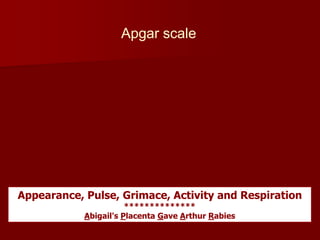
Apgar scale
Appearance, Pulse, Grimace, Activity and Respiration
**************
Abigail's Placenta Gave Arthur Rabies
PRETERM, LOW BIRTH
WEIGHT, SMALL-FOR-DATE
INFANTS
4.4
Preterm & Small-for-Date
Infants
 Low-birth-weight under 5.5 lbs
– Very low - under 3 lbs
– Extremely low - under 2 lbs
Small-for-Date
 Ex: Born full term yet 5 lbs.
–May be preterm/full term
–Birth weight below normal
Increased use of progestin to prevent
preterm births
– Lowered preterm births 1/3
Small-for-Date
8. a
Premature Baby 1st Minutes
 28 weeks 2 days, 2.95 lbs.
 Premature babies highly prone to infection
and one tiny germ can kill them .
 Plastic around the baby protect body heat
 Blue light is used for jaundice
 Quiet in the nursery sleeping which is very
important to their overall health and
development .
Preterm & Small-for-Date
Infants
 Consequences of preterm & LBW
 Most low birth weight infants
– normal & healthy
 As a group
– More developmental & health problems
– Risk increases as gestation age decreases
 Potential problems include
 brain injuries
 lung & liver diseases
 learning disabilities
 breathing problems
 Norwegian study
– Preterm-birth adolescents higher risk for:
 language delays
 learning problems
 behavior problems/delinquency involvement
Consequences of Preterm &
LBW
EARLY INFANT CARE
4.5
Bonding
 Close connection, especially physical bond,
between parents & newborn in period
shortly after birth
– Doctors suggest:
 “rooming in”
– Newborn kept in mother's hospital room
 Immediate bonding
– Not necessary for emotional health
 Adoption?
The Postpartum Period
Postpartum Depression
 Period after childbirth
– Mother adjusts physically & psychologically to
process of childbearing
– Lasts about @ 6 weeks
 Involution
– Process by which uterus returns to pre-
pregnant size
– 5 - 6 weeks
The Postpartum Period
8. How to deal with postpartum
pregnancy
Postpartum Depression
 Emotional & Psychological Adjustments
– Emotional fluctuations due to:
 Hormonal changes
 Fatigue
 Inadequate rest
 Inexperience or lack of confidence
 Extensive demands may cause
– Anxiety, depression, coping difficulties
The Postpartum Period
Emotional & Psychological
Adjustments
 Postpartum depression
– Strong feelings of
 Sadness
 Anxiety
 Despair
– Gets worse without treatment
Emotional and Psychological
Adjustments
 Postpartum depression treatments
– Antidepressants
– Psychotherapy; cognitive therapy is best
 Postpartum depression affects
– Mother-infant interaction
– Risk of additional psychological disorders
The Postpartum Period
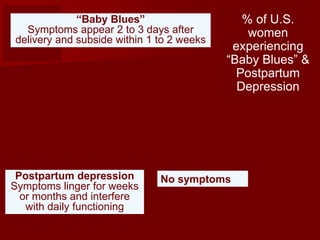
“Baby Blues”
Symptoms appear 2 to 3 days after
delivery and subside within 1 to 2 weeks
Postpartum depression
Symptoms linger for weeks
or months and interfere
with daily functioning
No symptoms
% of U.S.
women
experiencing
“Baby Blues” &
Postpartum
Depression
Emotional and Psychological
Adjustments
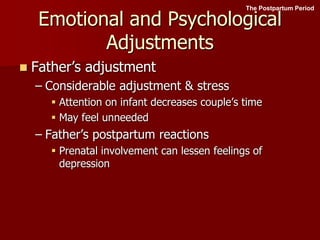
 Father’s adjustment
– Considerable adjustment & stress
 Attention on infant decreases couple’s time
 May feel unneeded
– Father’s postpartum reactions
 Prenatal involvement can lessen feelings of
depression
The Postpartum Period
9. Signs of Postparden Depression in Men
http://www.youtube.com/watch?v=dc8rPkaPz5k
10. Postpartum Depression in Men
http://www.youtube.com/watch?v=54Wd69U-EE4
INFANT NUTRITION &
HEALTH
4.6
Infant Nutrition & Health
• Infants in 1 yr.
 Triple weight
– Increase length 50%
– 50 calories per day
per lb. of weight
– High-calorie, high-
energy foods & fats
very important
 NO NONFAT FOODS
Infant Nutrition & Health
Healthy infants need:
– Loving, supportive feeding environment
– Breast milk
– Gradual increase of chew-&-swallow
– More fruits & vegetables, less junk food
– Demand feeding becoming more
popular
– Poor dietary patterns can cause
overweight
Co-sleeping
 Culture and Sleeping Arrangements
– Sharing bed common in many cultures
– American Academy of Pediatrics
– Discourages co-sleeping because of
Stress
SIDS risk
How Do Infants Grow and Develop Physically?
Sudden Infant Death Syndrome
(SIDS)
 Infant stops breathing, usually during
night, and dies without apparent cause
– Highest cause of infant death in U.S.
– Highest risk is 2 - 4 mo.'s of age
– Sleeping on back reduces risk
– Less common in:
– bedroom with fan
– infant who sleeps with pacifier
How Do Infants Grow and Develop Physically?
Sudden Infant Death Syndrome
(SIDS)
 Thoughts?
Sudden Infant Death Syndrome
(SIDS)
 Highest risks
– Lower birth weight
– Siblings with SIDS
– Sleep apnea
– Lower SES groups
– Exposure to cigarette smoke
– Placement in soft bedding
– Abnormal brain stem functioning
– African American & Inuit infants
How Do Infants Grow and Develop Physically?
11. SIDS
Breast Versus Bottle Feeding
 Breast milk
– Fewer gastrointestinal infections
– Lower respiratory tract infections
– Reduces effects of asthma in first 3 mo’s
– Reduce risk of skin inflammation
– May lessen likelihood of obesity
– Lowers risk of childhood & adult diabetes
– Less risk of experiencing SIDS
– Claims of no link to allergy prevention
How Do Infants Grow and Develop Physically?
12. Breast feeding at 12

Child Psychology Module 4 birth and the Neonate

  • 1.
    Birth & theNeonate Module 4 Children
  • 2.
  • 3.
  • 4.
    Birthing Methods &Delivery Options
  • 5.
    Birthing Practices  99%of U.S. births in hospitals  Other options – Often no access to emergency care  Freestanding birth center  Home delivery What Happens During Birth?
  • 6.
     Who helpsvaries across cultures – 91% U.S. births physicians – Some exclude fathers – Some family members – Open to community Birthing Practices
  • 7.
    Birthing Practices Midwives –Norm, mostof world –U.S. Attend 8% births –U.S. certified nurse midwives  Deliver babies – More time with patient in prenatal visits – Counseling, education – Emotional support What Happens During Birth?
  • 8.
    Birthing Practices  Doulas –No medical care  Do not deliver babies – Support before, during, & after childbirth  Physical  Emotional  Educational – U.S. work independently  Part of ‘birthing team’ What Happens During Birth?
  • 9.
    Birthing Practices  Naturalchildbirth – Goal: reduce pain by reducing fear  Education  Breathing techniques  Relaxation techniques  Prepared childbirth (Lamaze method) – Similar to natural childbirth – Special breathing technique in final stages of labor What Happens During Birth?
  • 10.
    Birthing Methods &Delivery Options  Other methods to reduce pain & stress during labor & childbirth – Waterbirth – Massage – Acupuncture – Hypnosis – Music therapy What Happens During Birth?
  • 11.
  • 12.
    3. Inside pregnancy:Labor & Birth http://www.babycenter.com/stages-of-labor
  • 13.
  • 14.
  • 15.
    Stages of Birth 3 stages of birth – Stage 1  @ 12 - 24 hrs. – Stage 2  @ 45 min’s - 1 hour – Stage 3  Minutes
  • 16.
    Effacement of theCervix Becomes –Thinner –Shorter Starts –Couple weeks before delivery
  • 17.
    Stages of Birth 1st stage: Dilation & Effacement of the Cervix – @ 12 - 24 hrs.  Longest stage – Contractions @ 15–20 min’s apart  Closer together as birth nears – Contractions dilate cervix to open @ 4 inches.  Allows baby to move into birth canal What Happens During Birth?
  • 18.
    Stages of Birth 2nd stage : Delivery of the Baby – @ 45 min’s - 1 hour – Begins when:  baby’s head moves through cervix & birth canal – Ends when:  baby completely emerges – Mother pushes down, contractions come @ every minute What Happens During Birth?
  • 19.
  • 20.
     3rd stage:Placenta (afterbirth) – Placenta, umbilical cord, & other membranes detached & expelled – Fastest stage  minutes Stages of Birth
  • 21.
  • 22.
  • 23.
    4. Cooking upPlacenta http://www.youtube.com/watch?v=6ceBxQSRLrg&feature=related For the stranger members of this class!
  • 25.
  • 26.
  • 27.
    Cesarean Section  CesareanDelivery – Baby removed from uterus through incision in abdomen when  Baby is in breech or crosswise position  Head too large for mother’s pelvis  Vaginal bleeding has occurred in pregnancy – U.S. births by C-sections increased since 2002 What Happens During Birth?
  • 30.
  • 31.
  • 32.
    Apgar scale Appearance, Pulse,Grimace, Activity and Respiration ************** Abigail's Placenta Gave Arthur Rabies
  • 33.
    PRETERM, LOW BIRTH WEIGHT,SMALL-FOR-DATE INFANTS 4.4
  • 34.
    Preterm & Small-for-Date Infants Low-birth-weight under 5.5 lbs – Very low - under 3 lbs – Extremely low - under 2 lbs
  • 35.
    Small-for-Date  Ex: Bornfull term yet 5 lbs. –May be preterm/full term –Birth weight below normal Increased use of progestin to prevent preterm births – Lowered preterm births 1/3 Small-for-Date
  • 36.
  • 37.
    Premature Baby 1stMinutes  28 weeks 2 days, 2.95 lbs.  Premature babies highly prone to infection and one tiny germ can kill them .  Plastic around the baby protect body heat  Blue light is used for jaundice  Quiet in the nursery sleeping which is very important to their overall health and development .
  • 38.
    Preterm & Small-for-Date Infants Consequences of preterm & LBW  Most low birth weight infants – normal & healthy  As a group – More developmental & health problems – Risk increases as gestation age decreases  Potential problems include  brain injuries  lung & liver diseases  learning disabilities  breathing problems
  • 39.
     Norwegian study –Preterm-birth adolescents higher risk for:  language delays  learning problems  behavior problems/delinquency involvement Consequences of Preterm & LBW
  • 40.
  • 41.
    Bonding  Close connection,especially physical bond, between parents & newborn in period shortly after birth – Doctors suggest:  “rooming in” – Newborn kept in mother's hospital room  Immediate bonding – Not necessary for emotional health  Adoption? The Postpartum Period
  • 42.
    Postpartum Depression  Periodafter childbirth – Mother adjusts physically & psychologically to process of childbearing – Lasts about @ 6 weeks  Involution – Process by which uterus returns to pre- pregnant size – 5 - 6 weeks The Postpartum Period
  • 43.
    8. How todeal with postpartum pregnancy
  • 44.
    Postpartum Depression  Emotional& Psychological Adjustments – Emotional fluctuations due to:  Hormonal changes  Fatigue  Inadequate rest  Inexperience or lack of confidence  Extensive demands may cause – Anxiety, depression, coping difficulties The Postpartum Period
  • 45.
    Emotional & Psychological Adjustments Postpartum depression – Strong feelings of  Sadness  Anxiety  Despair – Gets worse without treatment
  • 46.
    Emotional and Psychological Adjustments Postpartum depression treatments – Antidepressants – Psychotherapy; cognitive therapy is best  Postpartum depression affects – Mother-infant interaction – Risk of additional psychological disorders The Postpartum Period
  • 47.
    “Baby Blues” Symptoms appear2 to 3 days after delivery and subside within 1 to 2 weeks Postpartum depression Symptoms linger for weeks or months and interfere with daily functioning No symptoms % of U.S. women experiencing “Baby Blues” & Postpartum Depression
  • 48.
    Emotional and Psychological Adjustments Father’s adjustment – Considerable adjustment & stress  Attention on infant decreases couple’s time  May feel unneeded – Father’s postpartum reactions  Prenatal involvement can lessen feelings of depression The Postpartum Period
  • 49.
    9. Signs ofPostparden Depression in Men http://www.youtube.com/watch?v=dc8rPkaPz5k
  • 50.
    10. Postpartum Depressionin Men http://www.youtube.com/watch?v=54Wd69U-EE4
  • 51.
  • 52.
    Infant Nutrition &Health • Infants in 1 yr.  Triple weight – Increase length 50% – 50 calories per day per lb. of weight – High-calorie, high- energy foods & fats very important  NO NONFAT FOODS
  • 53.
    Infant Nutrition &Health Healthy infants need: – Loving, supportive feeding environment – Breast milk – Gradual increase of chew-&-swallow – More fruits & vegetables, less junk food – Demand feeding becoming more popular – Poor dietary patterns can cause overweight
  • 54.
    Co-sleeping  Culture andSleeping Arrangements – Sharing bed common in many cultures – American Academy of Pediatrics – Discourages co-sleeping because of Stress SIDS risk How Do Infants Grow and Develop Physically?
  • 55.
    Sudden Infant DeathSyndrome (SIDS)  Infant stops breathing, usually during night, and dies without apparent cause – Highest cause of infant death in U.S. – Highest risk is 2 - 4 mo.'s of age – Sleeping on back reduces risk – Less common in: – bedroom with fan – infant who sleeps with pacifier How Do Infants Grow and Develop Physically?
  • 56.
    Sudden Infant DeathSyndrome (SIDS)  Thoughts?
  • 57.
    Sudden Infant DeathSyndrome (SIDS)  Highest risks – Lower birth weight – Siblings with SIDS – Sleep apnea – Lower SES groups – Exposure to cigarette smoke – Placement in soft bedding – Abnormal brain stem functioning – African American & Inuit infants How Do Infants Grow and Develop Physically?
  • 58.
  • 59.
    Breast Versus BottleFeeding  Breast milk – Fewer gastrointestinal infections – Lower respiratory tract infections – Reduces effects of asthma in first 3 mo’s – Reduce risk of skin inflammation – May lessen likelihood of obesity – Lowers risk of childhood & adult diabetes – Less risk of experiencing SIDS – Claims of no link to allergy prevention How Do Infants Grow and Develop Physically?
  • 60.