In Utahin November 2021, a man was fast asleep in his home
when his garage caught fire. Sarah Maughan who lived a couple
blocks away saw the flames. She drove to the house to see if she
could be of help. When she arrived, she immediately hopped out
of her vehicle, ran to the door of the house, and started banging
on it. When the sleepy home owner came to the door, she said,
“Your house is on fire.” With the fire spreading to the main part
of the house, Maughan’s action likely saved the man’s life.
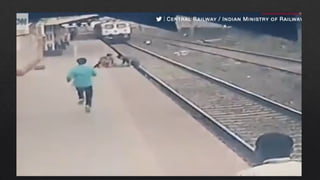
Mayur Shelkhe, and Sarah Maughan were strangers to the
people they saved. Why were they willing to risk their own lives
for others?
4.
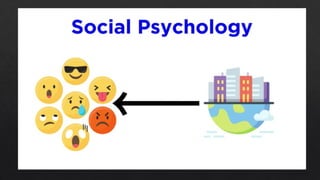
Social Psychology
The scientificstudy of how we
feel about, think about, and
behave toward the other people
around us, and how those people
influence our thoughts, feelings,
and behavior.
SOCIAL COGNITION: MAKINGSENSE OF OURSELVES
AND OTHERS
The principles of social cognition—the part of human thinking that
helps us understand and predict the behavior of ourselves and others—
and consider the ways that our judgments about other people
guide our behaviors toward them.
8.
Perceiving Others
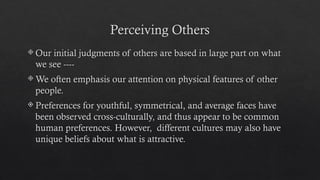
Ourinitial judgments of others are based in large part on what
we see ----
We often emphasis our attention on physical features of other
people.
Preferences for youthful, symmetrical, and average faces have
been observed cross-culturally, and thus appear to be common
human preferences. However, different cultures may also have
unique beliefs about what is attractive.
9.
Forming Judgments onthe Basis of Appearance:
Stereotyping, Prejudice, and Discrimination
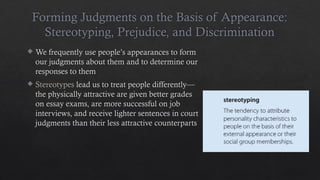
We frequently use people’s appearances to form
our judgments about them and to determine our
responses to them
Stereotypes lead us to treat people differently—
the physically attractive are given better grades
on essay exams, are more successful on job
interviews, and receive lighter sentences in court
judgments than their less attractive counterparts
10.
Forming Judgments onthe Basis of Appearance: Stereotyping,
Prejudice, and Discrimination
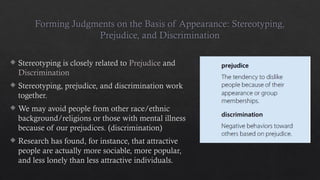
Stereotyping is closely related to Prejudice and
Discrimination
Stereotyping, prejudice, and discrimination work
together.
We may avoid people from other race/ethnic
background/religions or those with mental illness
because of our prejudices. (discrimination)
Research has found, for instance, that attractive
people are actually more sociable, more popular,
and less lonely than less attractive individuals.
11.
Forming Judgments onthe Basis of Appearance: Stereotyping,
Prejudice, and Discrimination
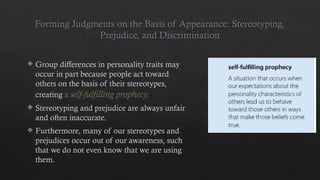
Group differences in personality traits may
occur in part because people act toward
others on the basis of their stereotypes,
creating a self-fulfilling prophecy.
Stereotyping and prejudice are always unfair
and often inaccurate.
Furthermore, many of our stereotypes and
prejudices occur out of our awareness, such
that we do not even know that we are using
them.
12.
Forming Judgments onthe Basis of Appearance: Stereotyping,
Prejudice, and Discrimination
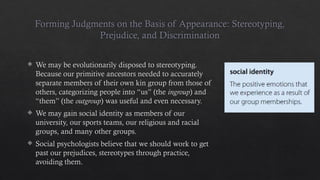
We may be evolutionarily disposed to stereotyping.
Because our primitive ancestors needed to accurately
separate members of their own kin group from those of
others, categorizing people into “us” (the ingroup) and
“them” (the outgroup) was useful and even necessary.
We may gain social identity as members of our
university, our sports teams, our religious and racial
groups, and many other groups.
Social psychologists believe that we should work to get
past our prejudices, stereotypes through practice,
avoiding them.
13.
Causal Attribution: FormingJudgments by Observing Behavior
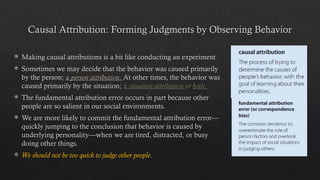
Making causal attributions is a bit like conducting an experiment
Sometimes we may decide that the behavior was caused primarily
by the person; a person attribution. At other times, the behavior was
caused primarily by the situation; a situation attribution or both.
The fundamental attribution error occurs in part because other
people are so salient in our social environments.
We are more likely to commit the fundamental attribution error—
quickly jumping to the conclusion that behavior is caused by
underlying personality—when we are tired, distracted, or busy
doing other things.
We should not be too quick to judge other people.
14.
Attitudes and Behavior
Attitude refer to our relatively enduring evaluations of people and things
(Albarracín, Johnson, & Zanna, 2005).
Attitudes are important because they frequently (but not always)
predict behavior
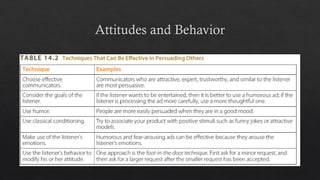
People who wish to change behavior frequently try to change attitudes
through the use of persuasive communications.
Attitudes and Behavior
Attitudes predict behavior better for some people than for others. People
who are high in self-monitoring— the tendency to regulate behavior to meet the
demands of social situations—tend to change their behaviors to match the
social situation and thus do not always act on their attitudes.
Behaviors influence attitudes in part through the process of self-perception.
Self-perception occurs when we use our own behavior as a guide to help us
determine our own thoughts and feelings.
Behavior also influences our attitudes through a more emotional process
known as cognitive dissonance. Cognitive dissonance refers to the discomfort we
experience when we choose to behave in ways that we see as inappropriate.
17.
INTERACTING WITH OTHERS:HELPING, HURTING,
AND CONFORMING
The tendency to help others in need is in part a
functional evolutionary adaptation. We help others to
benefit ourselves and to benefit the others.
18.
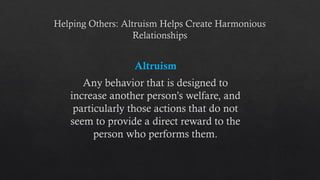
Helping Others: AltruismHelps Create Harmonious
Relationships
Altruism
Any behavior that is designed to
increase another person’s welfare, and
particularly those actions that do not
seem to provide a direct reward to the
person who performs them.
19.
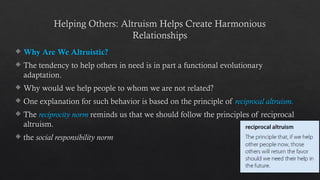
Helping Others: AltruismHelps Create Harmonious
Relationships
Why Are We Altruistic?
The tendency to help others in need is in part a functional evolutionary
adaptation.
Why would we help people to whom we are not related?
One explanation for such behavior is based on the principle of reciprocal altruism.
The reciprocity norm reminds us that we should follow the principles of reciprocal
altruism.
the social responsibility norm
21.
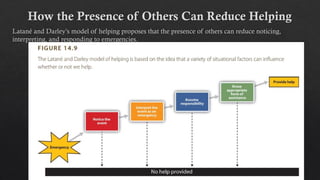
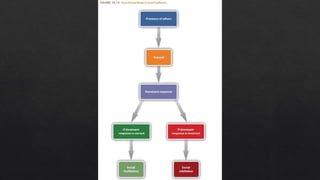
How the Presenceof Others Can Reduce Helping
Latané and Darley’s model of helping proposes that the presence of others can reduce noticing,
interpreting, and responding to emergencies.
22.
How the Presenceof Others Can Reduce Helping
Even if we have noticed the emergency and interpret it as being one we still
need to decide that it is our responsibility to do something.
The problem is that when we see others around, it is easy to assume that
they are going to do something, and that we don’t need to do anything
ourselves.
Diffusion of responsibility occurs when we assume that others will take action
and therefore we do not take action ourselves.
Markey (2000) found that people received help more quickly (in about 37 seconds) when
they asked for help by specifying a participant’s name than when no name was specified
(51 seconds).
23.
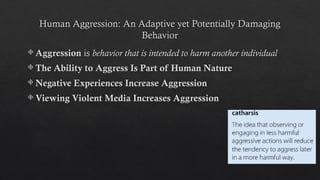
Human Aggression: AnAdaptive yet Potentially Damaging
Behavior
Aggression is behavior that is intended to harm another individual
The Ability to Aggress Is Part of Human Nature
Negative Experiences Increase Aggression
Viewing Violent Media Increases Aggression
24.
Conformity and Obedience:How Social Influence Creates Social
Norms
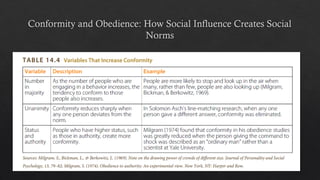
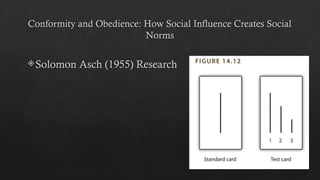
We conform not only because we believe that other people have accurate
information and we want to have knowledge (informational conformity) but also
because we want to be liked by others (normative conformity).
The typical outcome of conformity is that our beliefs and behaviors become more
similar to those of others around us.
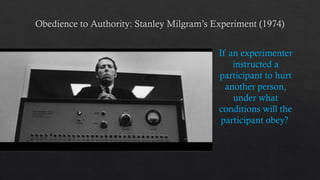
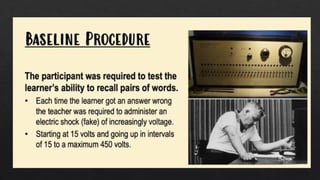
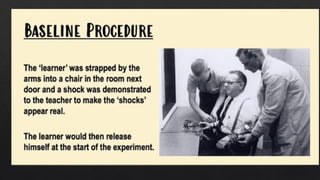
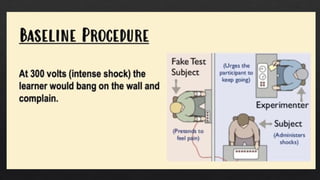
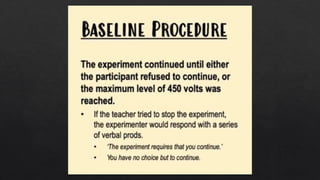
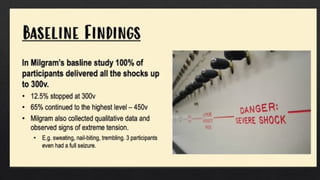
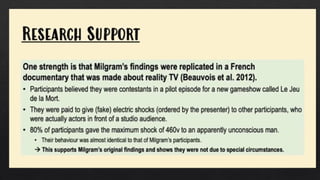
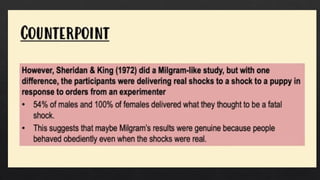
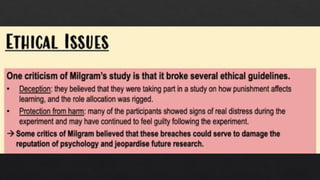
The tendency to conform to those in authority, known as obedience, was demonstrated in
a remarkable set of studies performed by
Stanley Milgram (1974).
Obedience to Authority:Stanley Milgram’s Experiment (1974)
If an experimenter
instructed a
participant to hurt
another person,
under what
conditions will the
participant obey?
28.
Obedience to Authority:Stanley Milgram’s Experiment (1974)
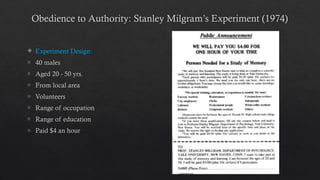
Experiment Design:
- 40 males
- Aged 20 - 50 yrs.
- From local area
- Volunteers
- Range of occupation
- Range of education
- Paid $4 an hour
39.
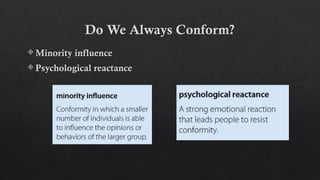
Do We AlwaysConform?
Minority influence
Psychological reactance
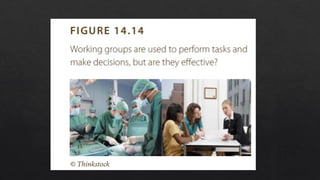
Working Together inGroups
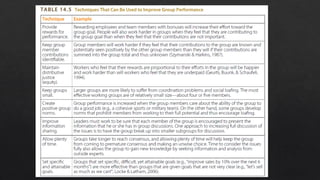
Working in groups involves both costs and benefits. When the
outcome of group performance is better than we would expect
given the individuals who form the group, we call the outcome a
group process gain, and when the group outcome is worse that we
would have expected given the individuals who form the group, we
call the outcome a group process loss.
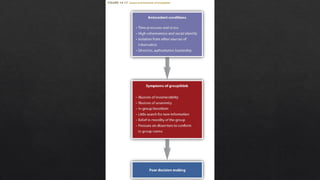
Process losses are observed in phenomena such as social loafing,
groupthink. Process losses can be reduced by better motivation and
coordination among the group members, by keeping contribution
identifiable, and by providing difficult but attainable goals.


![[DSC Europe 25] Marcos Heidemann - Beyond the Hype: Making AI Coding Assistan...](https://cdn.slidesharecdn.com/ss_thumbnails/eexkhvldrjsopspdjbur-marcos-heidemann-beyond-the-hype-getting-real-value-out-of-ai-assisted-coding-260121115910-7e9d41ec-thumbnail.jpg?width=640&height=640&fit=bounds)
![[DSC Europe 25] Andrzej Kowalczyk - AI - how to start small and grow in the f...](https://cdn.slidesharecdn.com/ss_thumbnails/oy1zmo94qv6vpcqjvno2-andrzej-kowalczyk-ai-how-to-start-small-and-grow-in-the-future-1-260119121559-cf093b23-thumbnail.jpg?width=640&height=640&fit=bounds)


![[DSC Europe 25] Paula Garcia Esteban -Building the Future: The Role of Data S...](https://cdn.slidesharecdn.com/ss_thumbnails/9ld1r1bsqpwve8qfvphy-paula-garcia-esteban-building-the-future-260122103838-4171f5cb-thumbnail.jpg?width=640&height=640&fit=bounds)

![[DSC Europe 25] Jovan Sumarac - Real-World Applications of Computer Vision in...](https://cdn.slidesharecdn.com/ss_thumbnails/fiksms22smcpopvvld03-jovan-sumarac-real-life-applications-of-computer-vision-in-automotive-systems-260120105855-de622abb-thumbnail.jpg?width=640&height=640&fit=bounds)


![[DSC Europe 25] Egor Krasheninnikov - The Control Stack: Building Guardrails ...](https://cdn.slidesharecdn.com/ss_thumbnails/3lzcz7hxqmo51mtalv4u-the-control-stack-260119101520-ea90841a-thumbnail.jpg?width=640&height=640&fit=bounds)


