Development Across the
Lifespan
Chapter in Perspective
• Lifespan Developmental Psychology
– The branch of psychology concerned with the
changes in psychological functioning that
occur, from conception across the entire life
span.
• From conception until death, we change
– Physically
– Cognitively
– Psychosocially
Basic Issues In Developmental
Psychology
• Which is more important to human
development?
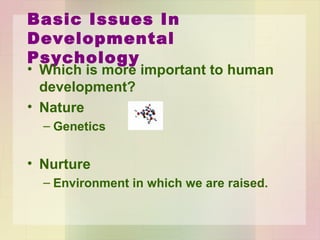
• Nature
– Genetics
• Nurture
– Environment in which we are raised.
Basic Issues In Developmental
Psychology
• Behavior Genetics
– Relatively new field
– Combines
• Psychology
• Biology
– Researchers work on the nature-or-nurture
question.
Nature vs Nurture
• Why does a child misbehave?
– Inherited tendency to be active?
• Nature
– The way the parents raised him?
• Nurture
• Most psychologists believe both nature &
nurture shape our behavior.
– Critical question
• How much does nature or nurture determine
behavior?
Psychosocial Development
In Childhood
• 3 temperament types in young
children have been identified:
1. Easy
2. Slow-to-warm-up
3. Difficult
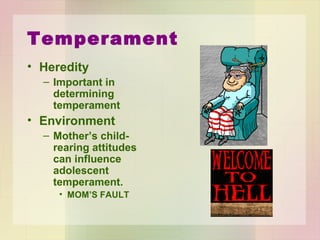
Temperament
• Heredity
– Important in
determining
temperament
• Environment
– Mother’s child-rearing
attitudes can influence
adolescent
temperament.
• MOM’S FAULT
Psychosocial Development
In Childhood
• Sigmund Freud
– Personality develops as a child deals with conflicts
between
• Biological urges
• Demands of society
• Erik Erikson
– Psychosocial crises, or conflicts between
• Psychological needs
• Societal demands
– Main determinants of personality
Psychosocial Development
In Childhood
• Erikson's psychosocial crises for childhood
include:
– Basic trust versus basic mistrust (birth to age
1.5 years),
– Autonomy versus shame and doubt (1.5 to 3
years),
– Initiative versus quilt (3 to 7 years), and
– Industry versus inferiority (7 to 10 years).
Harry & Marguerite Harlow
• Attachment
• Intense reciprocal relationship occurring
between two people, usually a child and an
adult.
• Studies of young monkeys conducted by
Harry and Marguerite Harlow
– Attachment was determined by contact
comfort, rather than by the presence of food.
Harry & Marguerite Harlow
• Determined raising baby monkeys in
isolation in laboratory
– Detrimental effect on social behavior
• A major conclusion of Harlow's research
– Attachment was important
• Did not ensure normal social development.
– Environmental contact (nurture)
• With members of one’s own species is needed
for this kind of development.
Cognitive Development
In Childhood
• Changes that occur in our thought
processes throughout life.
– Piaget
• Cognitive development progresses through a series
of qualitative stages
Cognitive Development
In Childhood
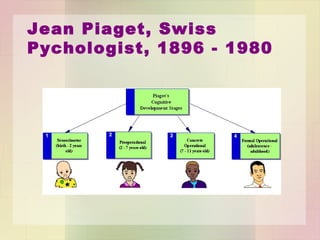
• Jean Piaget
– 50 years observing children’s intellectual
functioning.
– Cognitive development progresses through a
series of stages.
– All children progress through these stages in
same sequence.
Sensorimotor Stage
• Sensorimotor stage
– Birth to age 2
• Infants learn to coordinate their senses and their
motor behavior.
• Organize world into:
– What can I put in my mouth
– What is graspable
– What makes noise
• What they experience directly
Sensorimotor Stage
• Object permanence
– Perception that objects continue to exist
even when out of sight.
– Baby’s favorite game?
• Why?
Sensorimotor Stage
• Self-recognition
– Towards end of stage
– Rouge test Lewis & Brooks 1979
– Placed in front of mirror
– Touched nose at 18 – 24 months.
Preoperational Stage
• Ages 2 to 7
– Able to use mental representations & language
to describe, remember & reason about the
world, though only an egocentric fashion.
• Mental representations
– See object in head
• Egocentrism
– Can’t see things from another person's
point of view.
Preoperational Stage
• Animistic Thinking
– Imagining that inanimate objects have life & mental
processes.
• Child tripped over coffee table, what will they say?
• Fantasy Play
– Believe they are Batman
• Symbolic Gestures
– Stick becomes a gun
Cognitive Development
In Childhood
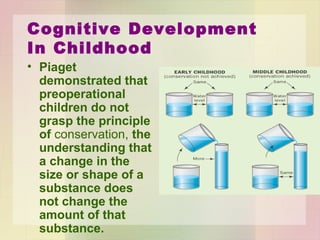
• Piaget demonstrated
that preoperational
children do not grasp
the principle of
conservation, the
understanding that a
change in the size or
shape of a substance
does not change the
amount of that
substance.
Concrete Operational
• Ages 7 - 11
• Able to:
– Represent objects mentally
– Begin to use logical reasoning about the world
• Not able to:
– Think abstractly
• What would happen if we had no thumbs?
Formal Operational
• Adolescence to adulthood
• Able to think abstractly
– Think in terms of possibilities as opposed
to concrete reality.
Adolescence
• In U.S. society, no single event marks the
passage from childhood to adulthood.
• Children experience an extended period of
adolescence, which lasts roughly from age
12 to age 20.
– Not expected to work
Adolescence
• Thought & behavior continues to be
somewhat childish &contradictory.
• Personal fable
– One is not subject to the same rules as other
people.
– Unique
– Invulnerable
Adolescence
• Imaginary audience
– Assumption that everyone else is concerned
with his or her appearance and behavior.
End

Psychology Chapter 9, Development

  • 1.
  • 2.
    Chapter in Perspective •Lifespan Developmental Psychology – The branch of psychology concerned with the changes in psychological functioning that occur, from conception across the entire life span. • From conception until death, we change – Physically – Cognitively – Psychosocially
  • 3.
    Basic Issues InDevelopmental Psychology • Which is more important to human development? • Nature – Genetics • Nurture – Environment in which we are raised.
  • 4.
    Basic Issues InDevelopmental Psychology • Behavior Genetics – Relatively new field – Combines • Psychology • Biology – Researchers work on the nature-or-nurture question.
  • 5.
    Nature vs Nurture •Why does a child misbehave? – Inherited tendency to be active? • Nature – The way the parents raised him? • Nurture • Most psychologists believe both nature & nurture shape our behavior. – Critical question • How much does nature or nurture determine behavior?
  • 6.
    Psychosocial Development In Childhood •3 temperament types in young children have been identified: 1. Easy 2. Slow-to-warm-up 3. Difficult
  • 7.
    Temperament • Heredity – Importantin determining temperament • Environment – Mother’s child-rearing attitudes can influence adolescent temperament. • MOM’S FAULT
  • 8.
    Psychosocial Development In Childhood •Sigmund Freud – Personality develops as a child deals with conflicts between • Biological urges • Demands of society • Erik Erikson – Psychosocial crises, or conflicts between • Psychological needs • Societal demands – Main determinants of personality
  • 9.
    Psychosocial Development In Childhood •Erikson's psychosocial crises for childhood include: – Basic trust versus basic mistrust (birth to age 1.5 years), – Autonomy versus shame and doubt (1.5 to 3 years), – Initiative versus quilt (3 to 7 years), and – Industry versus inferiority (7 to 10 years).
  • 10.
    Harry & MargueriteHarlow • Attachment • Intense reciprocal relationship occurring between two people, usually a child and an adult. • Studies of young monkeys conducted by Harry and Marguerite Harlow – Attachment was determined by contact comfort, rather than by the presence of food.
  • 11.
    Harry & MargueriteHarlow • Determined raising baby monkeys in isolation in laboratory – Detrimental effect on social behavior • A major conclusion of Harlow's research – Attachment was important • Did not ensure normal social development. – Environmental contact (nurture) • With members of one’s own species is needed for this kind of development.
  • 12.
    Cognitive Development In Childhood •Changes that occur in our thought processes throughout life. – Piaget • Cognitive development progresses through a series of qualitative stages
  • 13.
    Cognitive Development In Childhood •Jean Piaget – 50 years observing children’s intellectual functioning. – Cognitive development progresses through a series of stages. – All children progress through these stages in same sequence.
  • 14.
    Sensorimotor Stage • Sensorimotorstage – Birth to age 2 • Infants learn to coordinate their senses and their motor behavior. • Organize world into: – What can I put in my mouth – What is graspable – What makes noise • What they experience directly
  • 15.
    Sensorimotor Stage • Objectpermanence – Perception that objects continue to exist even when out of sight. – Baby’s favorite game? • Why?
  • 16.
    Sensorimotor Stage • Self-recognition –Towards end of stage – Rouge test Lewis & Brooks 1979 – Placed in front of mirror – Touched nose at 18 – 24 months.
  • 17.
    Preoperational Stage • Ages2 to 7 – Able to use mental representations & language to describe, remember & reason about the world, though only an egocentric fashion. • Mental representations – See object in head • Egocentrism – Can’t see things from another person's point of view.
  • 18.
    Preoperational Stage • AnimisticThinking – Imagining that inanimate objects have life & mental processes. • Child tripped over coffee table, what will they say? • Fantasy Play – Believe they are Batman • Symbolic Gestures – Stick becomes a gun
  • 19.
    Cognitive Development In Childhood •Piaget demonstrated that preoperational children do not grasp the principle of conservation, the understanding that a change in the size or shape of a substance does not change the amount of that substance.
  • 20.
    Concrete Operational • Ages7 - 11 • Able to: – Represent objects mentally – Begin to use logical reasoning about the world • Not able to: – Think abstractly • What would happen if we had no thumbs?
  • 21.
    Formal Operational • Adolescenceto adulthood • Able to think abstractly – Think in terms of possibilities as opposed to concrete reality.
  • 22.
    Adolescence • In U.S.society, no single event marks the passage from childhood to adulthood. • Children experience an extended period of adolescence, which lasts roughly from age 12 to age 20. – Not expected to work
  • 23.
    Adolescence • Thought &behavior continues to be somewhat childish &contradictory. • Personal fable – One is not subject to the same rules as other people. – Unique – Invulnerable
  • 24.
    Adolescence • Imaginary audience –Assumption that everyone else is concerned with his or her appearance and behavior.
  • 25.