Self-Awareness, Perception
and Communication
Prof Dr. Mona AbosereaProf Dr. Mona Aboserea
Professor of public healthProfessor of public health
Zagazig UniversityZagazig University
““People only see what theyPeople only see what they
are prepared to see.”are prepared to see.”
Ralph Waldo EmersonRalph Waldo Emerson
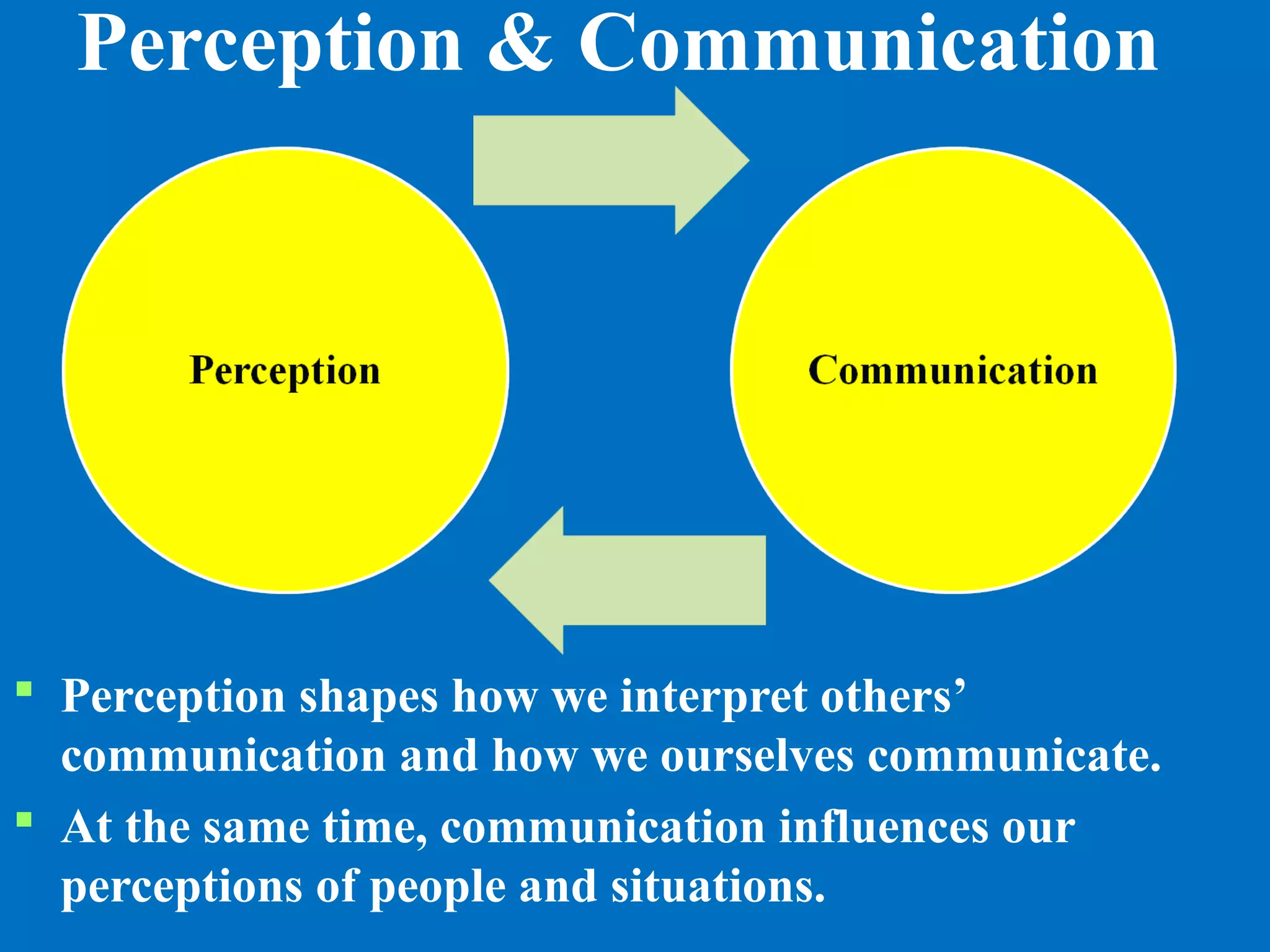
Perception & Communication
 Perception shapes how we interpret others’
communication and how we ourselves communicate.
 At the same time, communication influences our
perceptions of people and situations.
Cognition
COGNITION is the act or process ofCOGNITION is the act or process of
knowing informationknowing information
Perception
PERCEPTION is A process by
which individuals organize and
interpret their sensory impressions
in order to give meaning to their
environment
What is Perception?
The ability to see, hear, or become aware
of something through the senses.
People’s behavior is based on their
perception of what reality is, not on reality
itself
The world as it is perceived is the world
that is behaviorally important
Unfortunately, our self perceptions affect
our behaviors more than our true abilities
Steps in Perception
 Something affects the senses;Something affects the senses;
see, hear, taste, smell, touchsee, hear, taste, smell, touch
 Interpret the sensation (giveInterpret the sensation (give
meaning to it)meaning to it)
Differences inDifferences in
Perception come from:Perception come from:
 Physical Differences
 Past Experiences; background
 Present feelings; circumstances
 Differences in using information
 Differences in expectations
AwarenessAwareness
 It is the ability to directly know and
perceive, to feel, or to be cognizant
of events .
 More broadly, it is the state of being
conscious of something
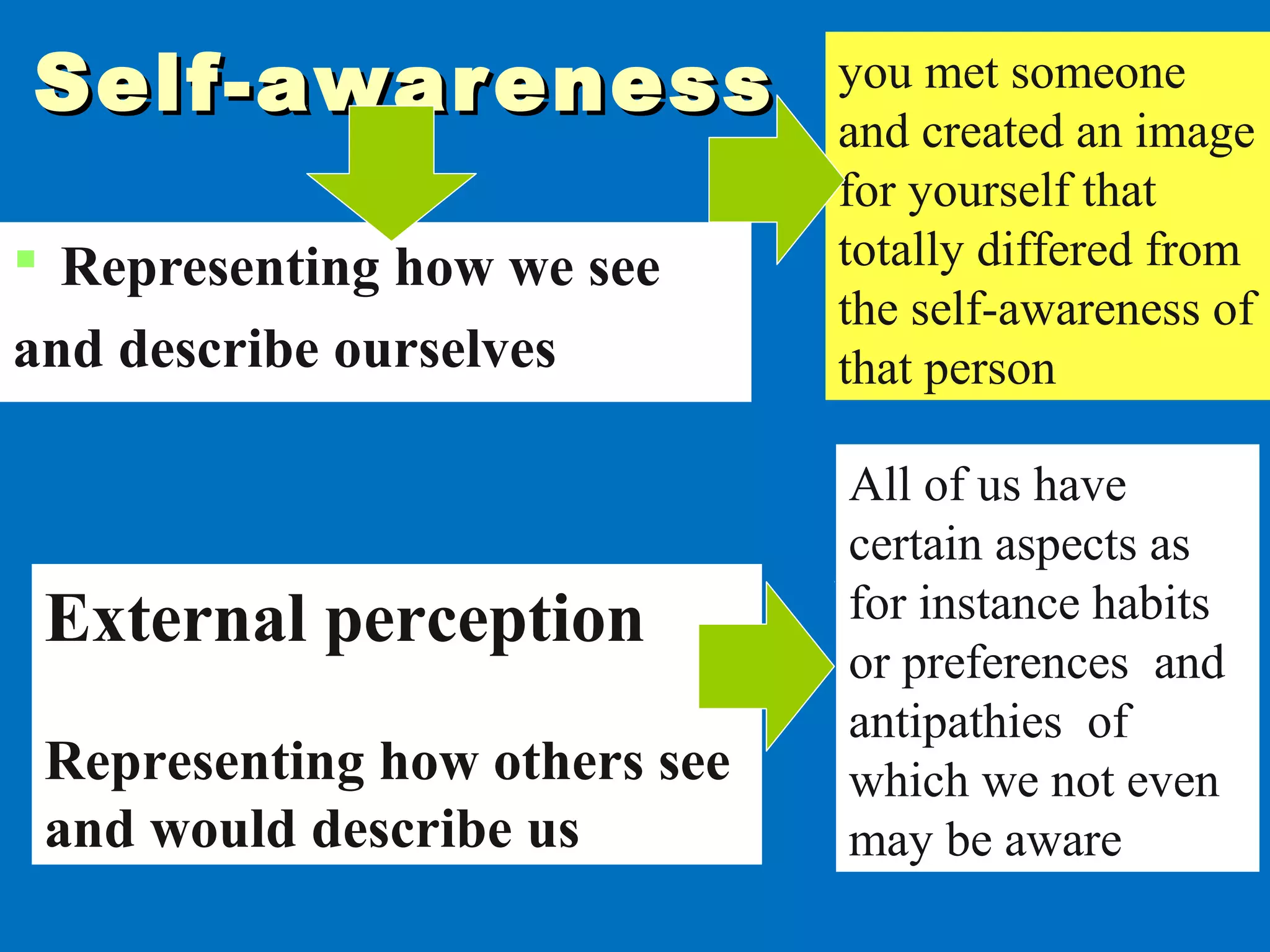
Self-awarenessSelf-awareness
 Representing how we see
and describe ourselves
External perception
Representing how others see
and would describe us
All of us have
certain aspects as
for instance habits
or preferences and
antipathies of
which we not even
may be aware
you met someone
and created an image
for yourself that
totally differed from
the self-awareness of
that person
Covert awareness is the
knowledge of something without
knowing it (e.g. pts with some brain
damage are for example unable to
tell if a pencil is horizontal or
vertical. They are however able to
grab the pencil, using the correct
orientation of the hand and wrist)
Awareness sections: (e.g. SMBG)
 Influence: (never, seldom, often, & very
often).
 Perception: (much worse, worse, better,
much better)
 Concern: (not concerned at all, somewhat
concerned, concerned & very concerned)
 Willingness to adapt certain behavior:
(very unlikely, unlikely, no opinion, likely,
&very likely)
 Perception questions differ from otherdiffer from other
types of survey questions—behavioral,types of survey questions—behavioral,
knowledge, attitudinal, or demographic—knowledge, attitudinal, or demographic—
in thatin that
 Questions that measureQuestions that measure perception askask
respondents to provide information onrespondents to provide information on
how they perceive such matters as thehow they perceive such matters as the
effectiveness of programs, their healtheffectiveness of programs, their health
status, or the makeup of their community,status, or the makeup of their community,
among ...among ...
Self-Concept: Who are
you?
 Self-concept refers to your subjective
description of who you think you are.
 Self-image is your view of yourself in
particular situations
Self-Concept orSelf-Concept or
perceived self (personal(personal
perception):perception):
 Beliefs about who you areBeliefs about who you are basedbased
on perceptions, expectations,on perceptions, expectations,
and others’ reactionsand others’ reactions
 Formed early in lifeFormed early in life
 Static---Hard to changeStatic---Hard to change
Presenting self to others(public image
prospective).
 How do we manage identityHow do we manage identity ::
A.A.Manner:Manner: consists of a communicator’s words &consists of a communicator’s words &
nonverbal actions.nonverbal actions.
B.B.Appearance:Appearance: personal items people use topersonal items people use to
shape an imageshape an image
C.C.Setting:Setting: physical items we use to influence howphysical items we use to influence how
others view us.others view us.
Perception of others:
 Uncertainty reductionUncertainty reduction: we monitor our: we monitor our
environment to learn more about ourselves &environment to learn more about ourselves &
others.others.
 Social perceptions are often made on the
basis of physical characteristics and social
behaviors, we stereotype..
 We judge one’s friendliness and intelligenceWe judge one’s friendliness and intelligence
on how physically attraction they are.on how physically attraction they are.
 We learn stereotypes from family, friends,
…..
Self Concept and Self-Self Concept and Self-
EfficacyEfficacy
 Those with poor self-concept willThose with poor self-concept will
complete tasks that are too EASY orcomplete tasks that are too EASY or
too HARDtoo HARD
 Self-efficacy is your belief on whatSelf-efficacy is your belief on what
you can doyou can do
Self-Concept Components
 Attitude: a learned predisposition toa learned predisposition to
respond to a person, object, or idea in arespond to a person, object, or idea in a
favorable or unfavorable way.favorable or unfavorable way.
 Beliefs: The way in which you structureThe way in which you structure
your understanding of realityyour understanding of reality
(true/false).(true/false).
 Values: Enduring conceptsEnduring concepts of good andof good and
bad, right and wrong.bad, right and wrong.
One of Many Selves?
 The Material Self
 The Social Self
 The Spiritual Self
The Material Self
 The materialmaterial self is a total of allis a total of all
the tangible thingsthe tangible things you own:you own:
 Your bodyYour body
 Your possessionsYour possessions
 Your homeYour home
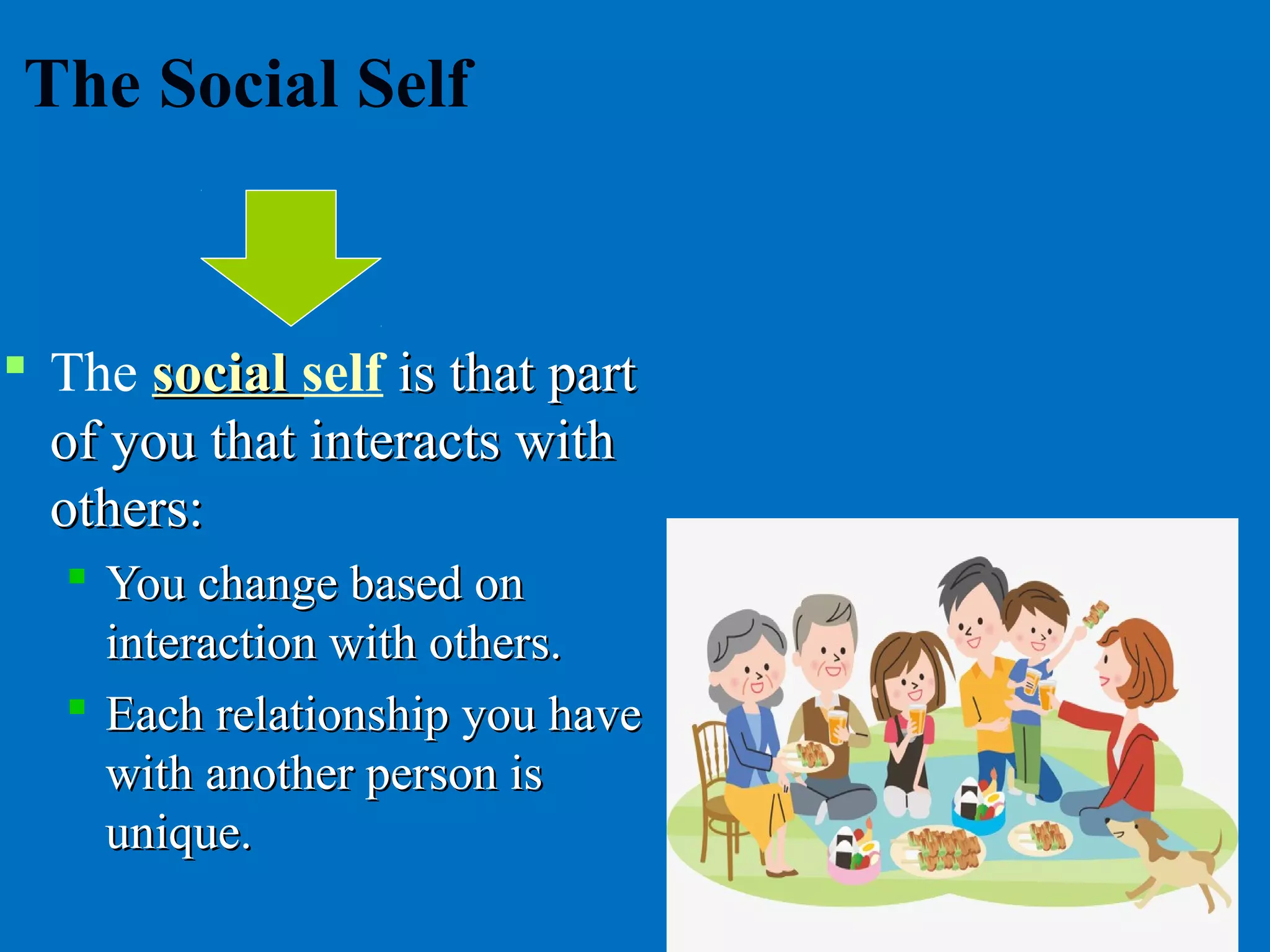
The Social Self
 The socialsocial self is that partis that part
of you that interacts withof you that interacts with
others:others:
 You change based onYou change based on
interaction with others.interaction with others.
 Each relationship you haveEach relationship you have
with another person iswith another person is
unique.unique.
The Spiritual Self
 The spiritualspiritual self consists of allconsists of all
your internal thoughts about youryour internal thoughts about your
values and moral standards:values and moral standards:
 It is the essence ofIt is the essence of who you think
you are.
 It is a mixture ofIt is a mixture of your spiritual
beliefs and your sense of who you
are in relationship to other forcesto other forces
in the universe.in the universe.
How the Self-Concept
Develops???????????
 Our communication with other
individuals
 Our association with groups
 Roles we assume
 Our self-labels
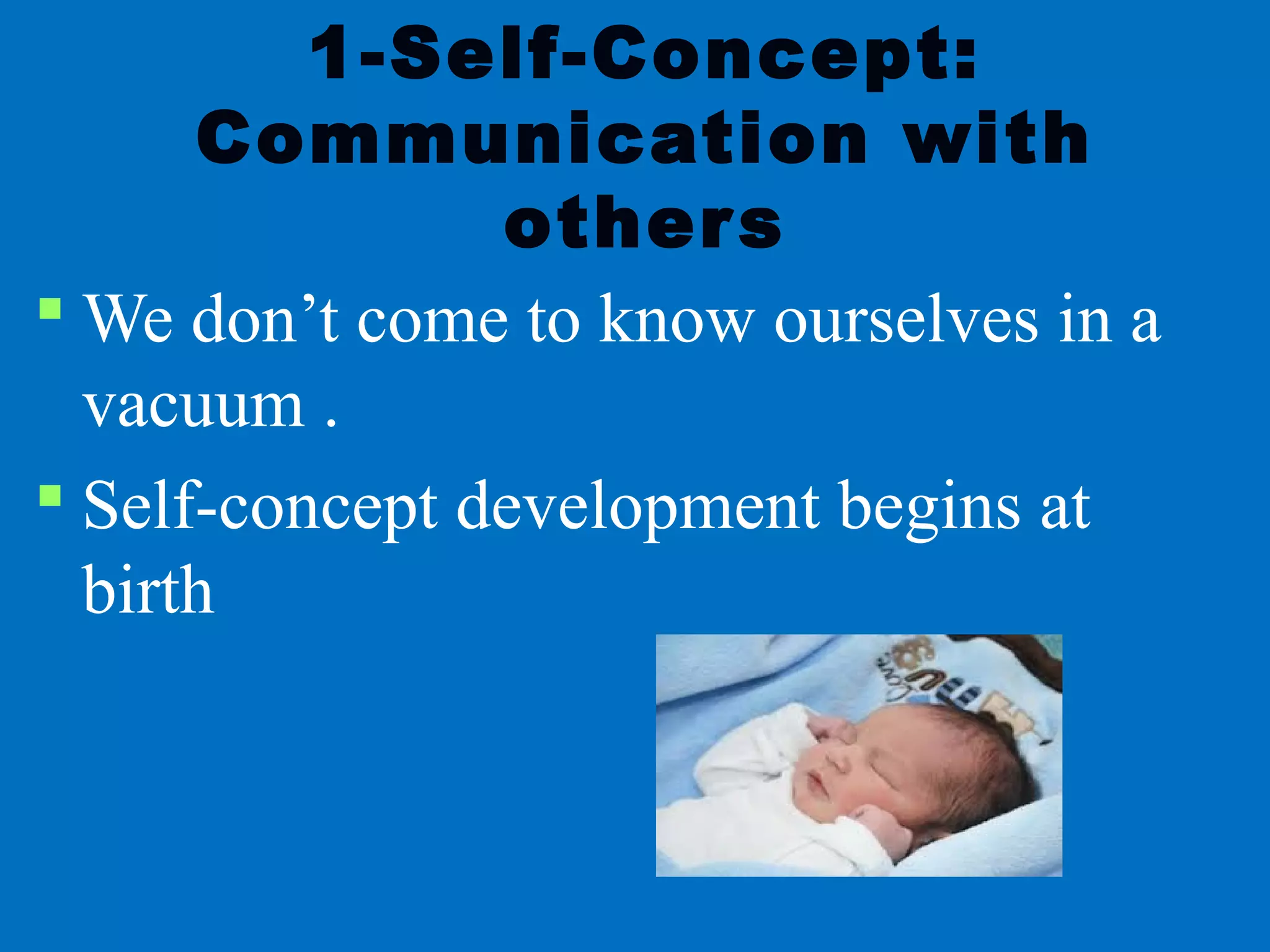
1-Self-Concept:
Communication with
others
 We don’t come to know ourselves in a
vacuum .
 Self-concept development begins at
birth
2-Self-Concept:
Association with Groups
Our awareness of who we are is often
linked to who we associate with:
 Religious groupsReligious groups
 Political groupsPolitical groups
 EthnicEthnic groupsgroups
 Social groupsSocial groups
Peer pressurePeer pressure is a powerful force in shapingis a powerful force in shaping
attitudes and behavior.attitudes and behavior.
3-Self-Concept: Assumed Roles
Your self-concept likely reflects the roles
you assume:
 MotherMother
 BrotherBrother
 TeacherTeacher
 Student………etcStudent………etc
Gender asserts a powerful influence onGender asserts a powerful influence on
the self-concept from birth on.the self-concept from birth on.
4-Self-Concept: Self-
Labels
 Self-concept is affected by others but we are
not blank slates,.
 Self-reflectionness is the human ability to
think about what we’re doing while we’re
doing it.
 Through self-observation we discover
strengths which encourage us to assume new
labels.
Self-Esteem:
What is your value?
 Self-esteem refers to your evaluation
of who you are.
 Your self-esteem can fluctuate and
rise or fall within the course of a day.
Self-Esteem: Gender
Differences
 In patriarchal cultures , women and
girls suffer loss of self-esteem to a
greater degree than men and boys.
Boys often feel better able to do thingsBoys often feel better able to do things
than girls.than girls.
Self-Esteem: Social Comparisons
 We become more aware of ourselves by
measuring ourselves against others, a
process called social comparison.
 It can be self-defeating to take social
comparisons too far, to cause your self-
esteem to suffer because you compare
yourself unrealistically to others.
Self-Esteem: Self-
Expectations
 Self-expectations are those goals we set for
ourselves.
 Self-esteem is affected when you evaluate
how well you measure up to your own
expectations.
 Be worry of placing unrealistic demands on
yourself.
Self-Esteem:
Self-Fulfilling Prophecy
 The self-fulfilling prophecy refers to the
idea that what you believe about yourself
often comes true because you expect it to
come true.
 Your level of self-esteem affects the kinds of
prophecies you make about yourself and
colors your interpretation of events.
Communication & the
Enhancement of Self-
Esteem
 Our feelings of low self-worth may
contribute to many of our societal
problems.
 Communication is essential in the
process of building and maintaining self-
esteem.
Communication & Self:
Engage in POSITIVE self-talk
 Intrapersonal communication involves
communication within yourself – self-
talk.
 Your self-concept and self-esteem
influence the way you talk to yourself.
 Your inner dialogue also has an impact
on your self-concept and self-esteem.
Communication and Self:
Visualize
 Visualization involves “seeing” yourself
exhibiting some desirable behavior.
 Apprehensive public speakers can
manage their fears by visualizing
positive results:
Reduce negative self-talkReduce negative self-talk
Enhances confidence and speaking skillEnhances confidence and speaking skill
Communication and Self:
Develop Honest
Relationships
 Have at least one other person that will
give you honest, objective feedback.
You need a “straight scoopYou need a “straight scoop””
 Stuff that’s the hardest to hear about youStuff that’s the hardest to hear about you
 Nobody else would dareNobody else would dare tell youtell you
 Trust enough to deal with the tough stuffTrust enough to deal with the tough stuff
Communication and Self:
Surround Yourself With Positive
People
 Surround yourself with people who
have higher levels of self-esteem
 Don’t engage in pity parties
 Immunize yourself from negativity
Communication and Self:
Lose your baggage
 Avoid constantly re-living negative
experiences.
 Leave past experiences that cause
your present self-esteem to suffer
.
Perceiving Others
 Perception:Perception: an active process of creating
meaning by selecting, organizing, and
interpreting people, objects, events,
situations, and activities.
 Narrative: The stories people create andNarrative: The stories people create and
use to make sense of their personaluse to make sense of their personal
worlds.worlds.
Common Perceptual
Tendencies
 Attribution: the process of attaching meaningAttribution: the process of attaching meaning
to behavior.to behavior.
We judge ourselves more charitablyWe judge ourselves more charitably
 SituationalSituational
 Self-serving biasSelf-serving bias
We judge others more criticallyWe judge others more critically
 DispositionalDispositional
Two types of attributions
 Dispositional attribution -A-Attributes attributes a
persons behavior topersons behavior to internal factors such assuch as
personality traits , motivation, ability, fatigue,personality traits , motivation, ability, fatigue,
efforteffort
 Situational attribution -A-Attributes a personsttributes a persons
behavior tobehavior to external factors such as equipment,such as equipment,
rules, social influence etcrules, social influence etc
These two combine actively to determine
behaviour
ANTICEDENTS ATTRIBUTIONS CONSEQUENCIES
Information
Beliefs
Motivation
Perceived
causes
Behaviour
General model of the attribution field.
4545
Person Perception: Making Judgments
About Others
Attribution Theory
An attempt to determine whether an individual’s behavior is internally or externally caused
The Attribution Process
Observation of
Behavior
Distinctiveness
(High or Low)
Consensus
(High or Low)
Consistency
(High or Low)
Internal or External
causes
Observation Interpretation Attribution of Cause
The Perception Process
 Stage One: Attention and selection
 Stage Two: Organization
 Stage Three: Interpretation
Sub process of perception
External
stimulus
environment as
5 senses
Confrontation
Interpretation:
Motivation,
learning ,
personality
Feedback
Kinesthetic
(fear, anger,
panic, pain,….)
Physical
environment
Office, values,
climate ,,,,
Registration of
the stimulus
Sensory &
neural (e.g.
hearing a high
voice)
Behavior
Overt (run
away) or covert
(self evaluation)
Consequences:
Reinforcement/
punishment, some
body hurt,…)
Elements in perception
 Involvement of an individual
 Process
 Receiving, selecting, & organizing sensory
stimuli and data
 Yield a picture of the environment
 The picture varies between the reality & just
opposite to the environment
Factors influencing perception
Situational FactorsSituational Factors
Influencing PerceptionInfluencing Perception
 Relational satisfaction.Relational satisfaction.
 Degree of involvement with the otherDegree of involvement with the other
person.person.
 Past experiencePast experience
 ExpectationsExpectations
 Social rolesSocial roles
 KnowledgeKnowledge
 Self-conceptSelf-concept
Perception and CulturePerception and Culture
 Different people see things differently
 Culture is a major factor on how people
perceive things.
 Categories such as gender, sub-culture,
economic class, and age all influence one’s
perception.
Are the horizontal lines parallel, or do they slope?
Is the book face-down?
Or face-up?
Looking up, or looking down?
Influences on perception:
 Physiology: different sensory abilities: different sensory abilities
 Tiredness: -ve perception: -ve perception
 Medical conditions: drugs affects thinking: drugs affects thinking
 Age: the older we are, the richer ourthe older we are, the richer our
perspective for perceiving life and people.perspective for perceiving life and people.
 Culture, beliefs, values, understandings,
& practices.
Influences on perception
cont.
 Social roles:
 Cognitive abilities, & personal
knowledge of others
 Self: how we perceive people
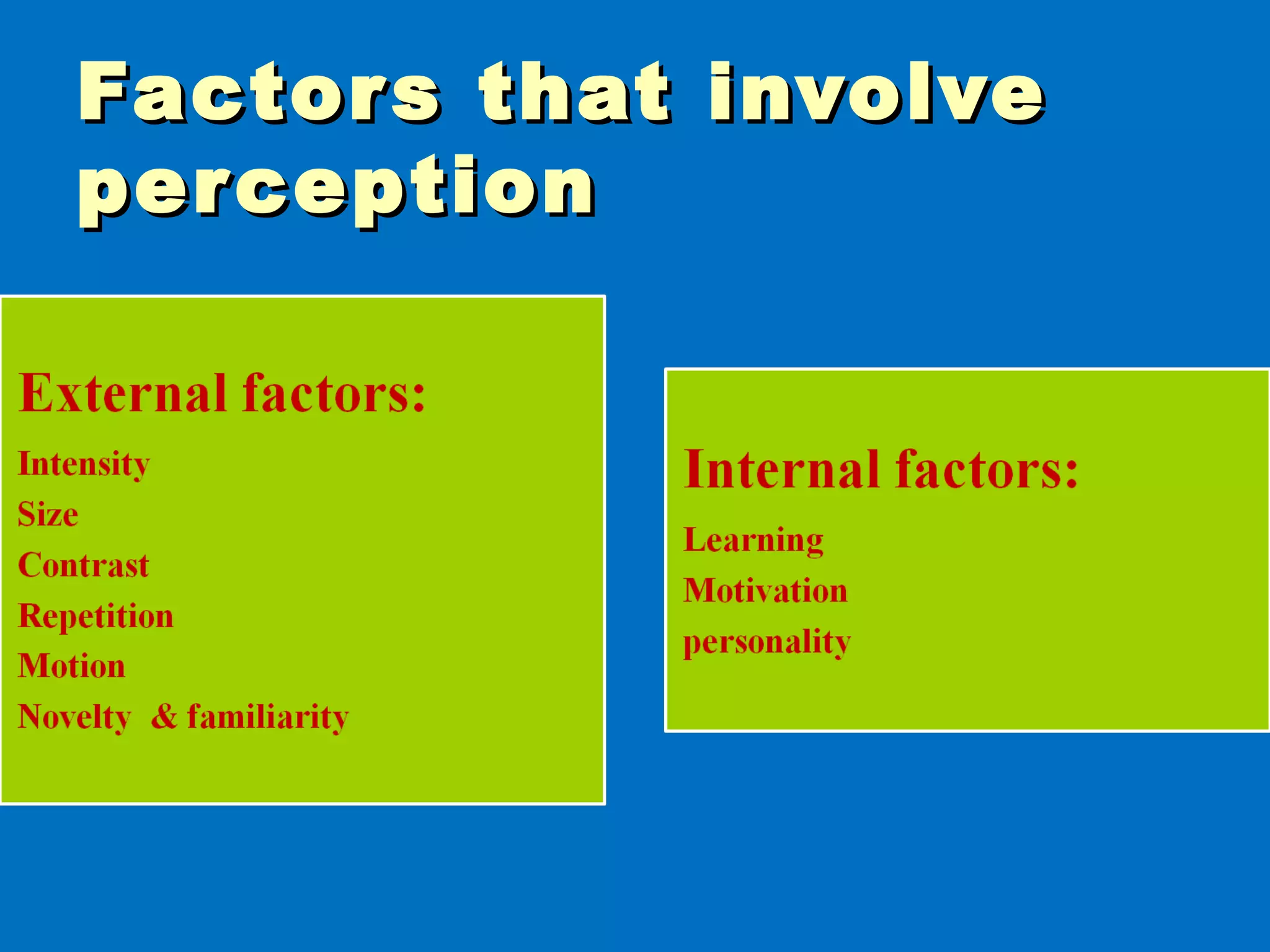
Factors that involveFactors that involve
perceptionperception
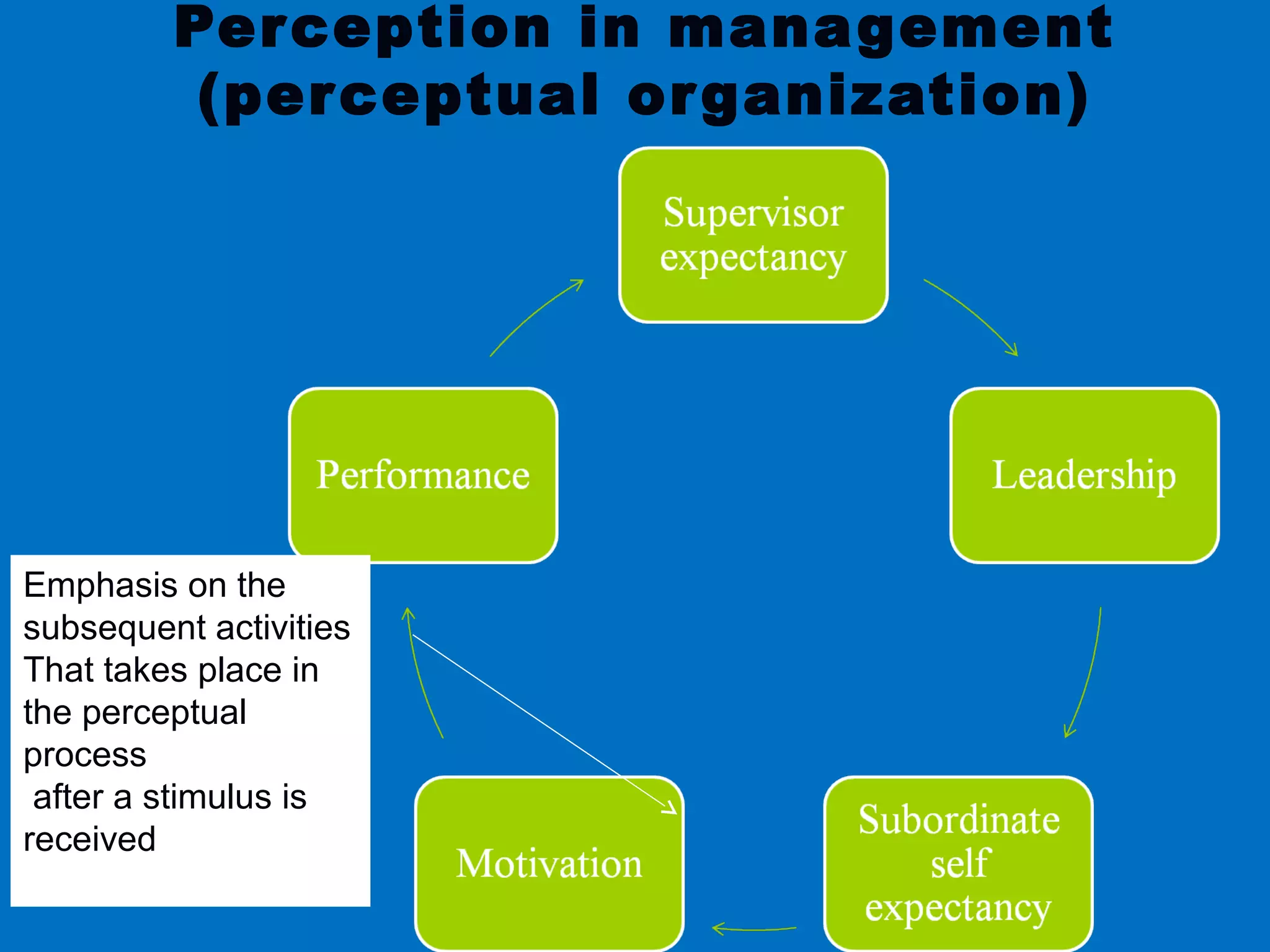
Perception in management
(perceptual organization)
Emphasis on the
subsequent activities
That takes place in
the perceptual
process
after a stimulus is
received
7575
Perceptual Organization:
Gestalt
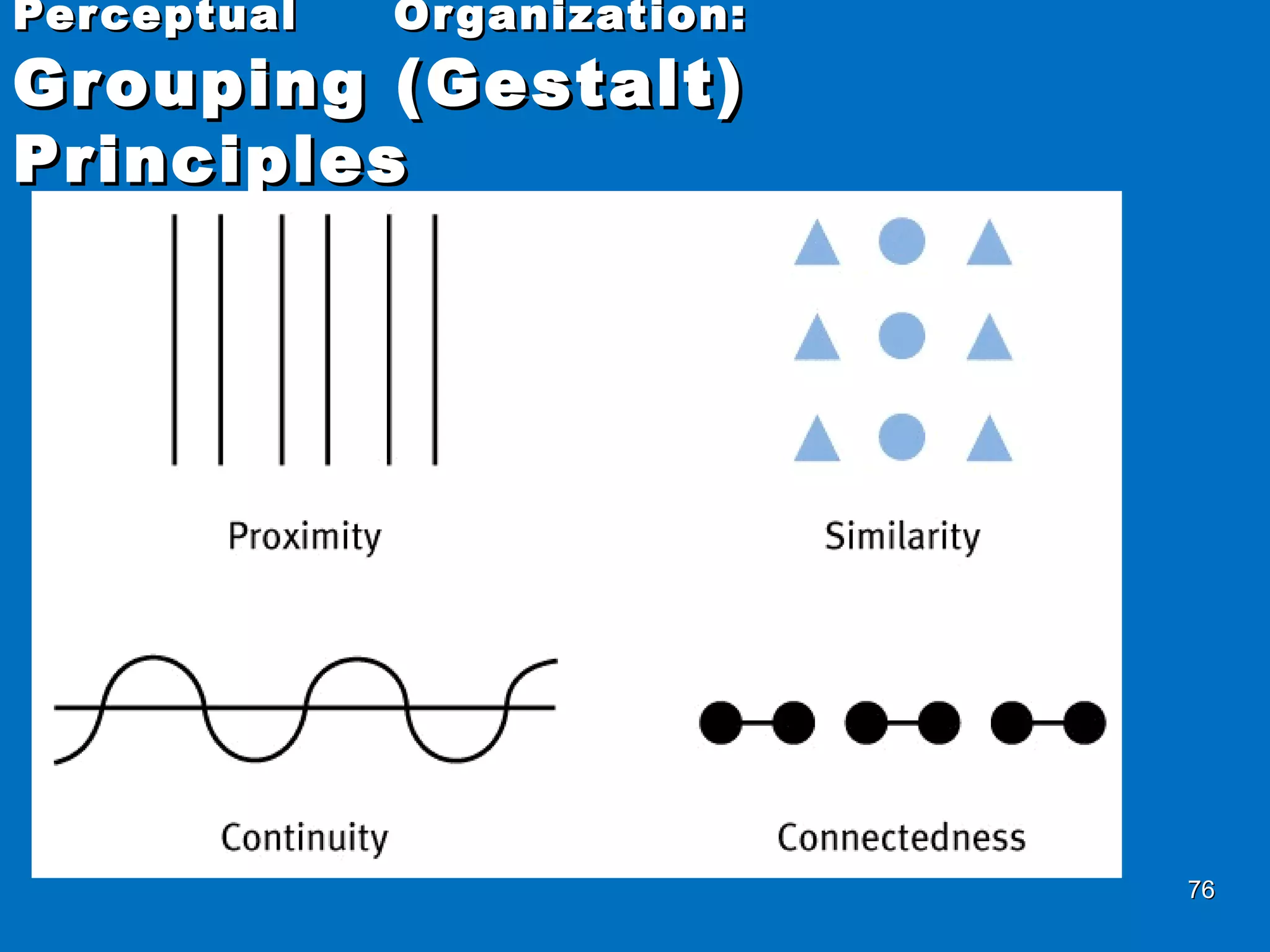
 Grouping: the perceptual tendency to
organize stimuli into coherent groups
 Grouping Principles
1. proximity--group of nearby figures
2. similarity--group of similar figures
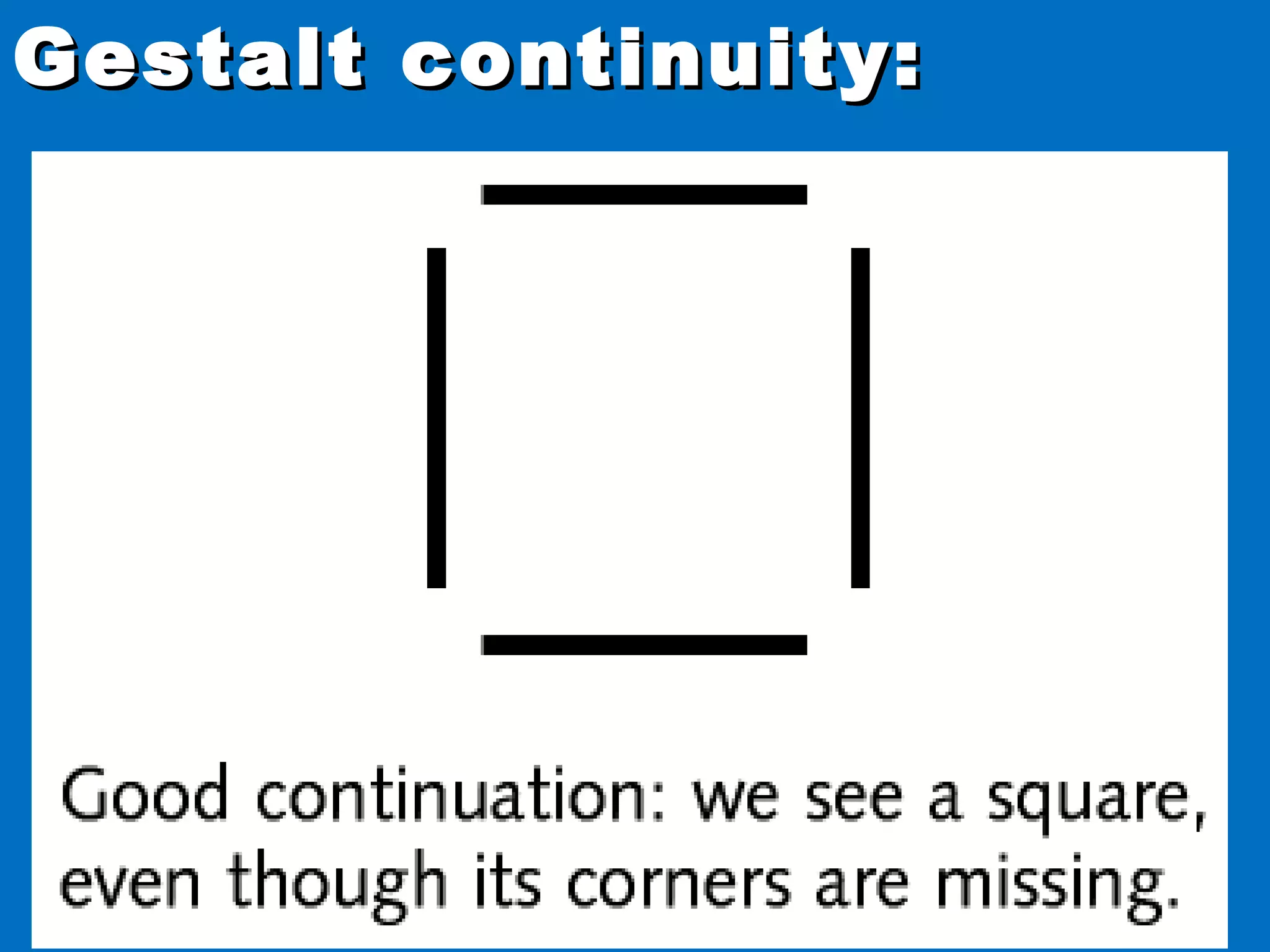
3. continuity--perceive continuous patterns
4. closure--fill in gaps
5. connectedness--spots, lines, & areas are seen as
unit when connected
7676
PerceptualPerceptual Organization:Organization:
Grouping (Gestalt)Grouping (Gestalt)
PrinciplesPrinciples
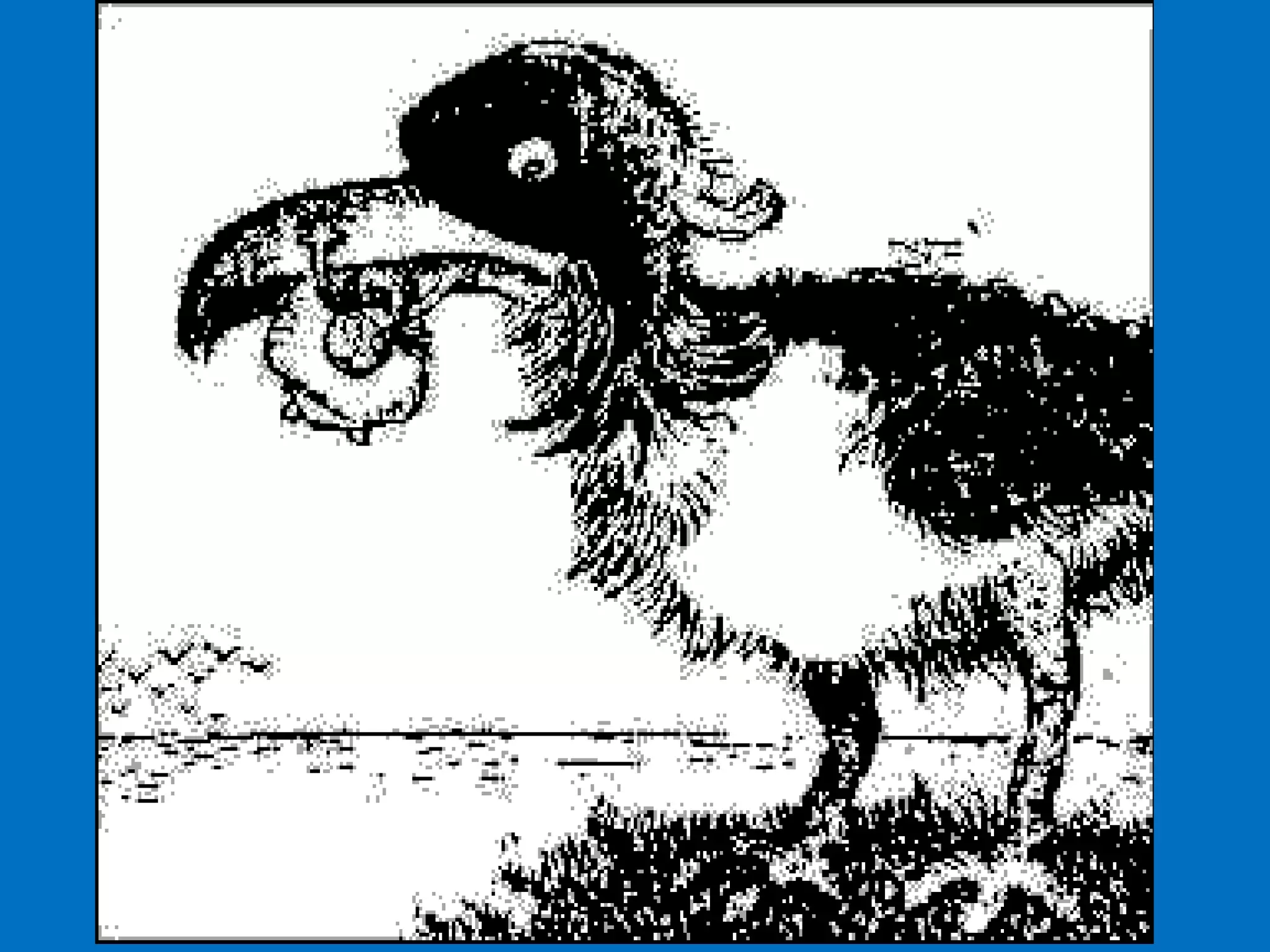
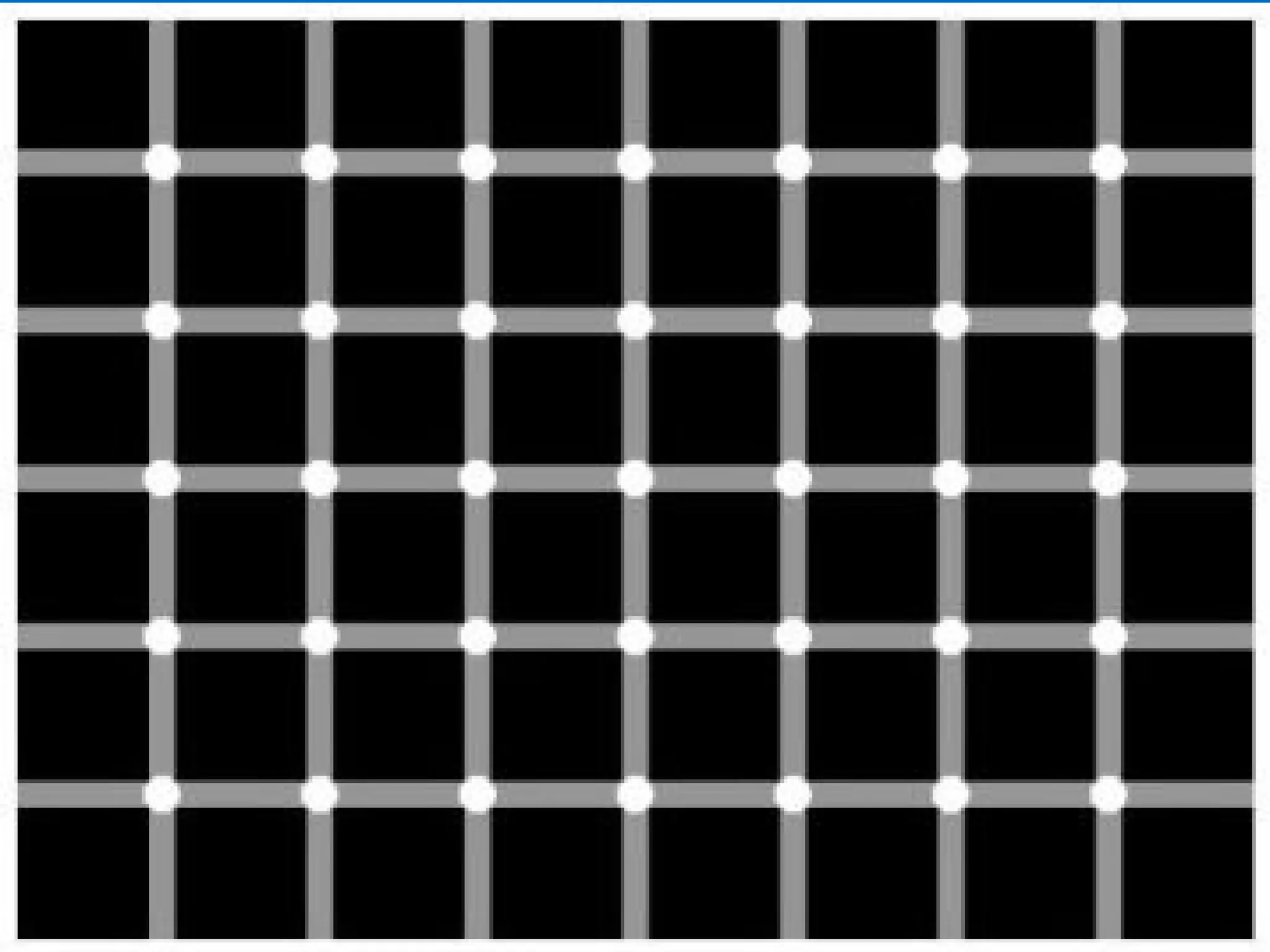
7777
Perceptual Organization:Perceptual Organization:
Illusory (Illusory (illusionsillusions) Contours) Contours
((edges or shapesedges or shapes…)…)
7878
7979
PerceptualPerceptual Organization:Organization:
Closure:Closure: We see what…?We see what…?
AA BB
 GestaltGestalt
groupinggrouping
principlesprinciples
are at workare at work
here.here.
8080
Gestalt continuity:Gestalt continuity:
8181
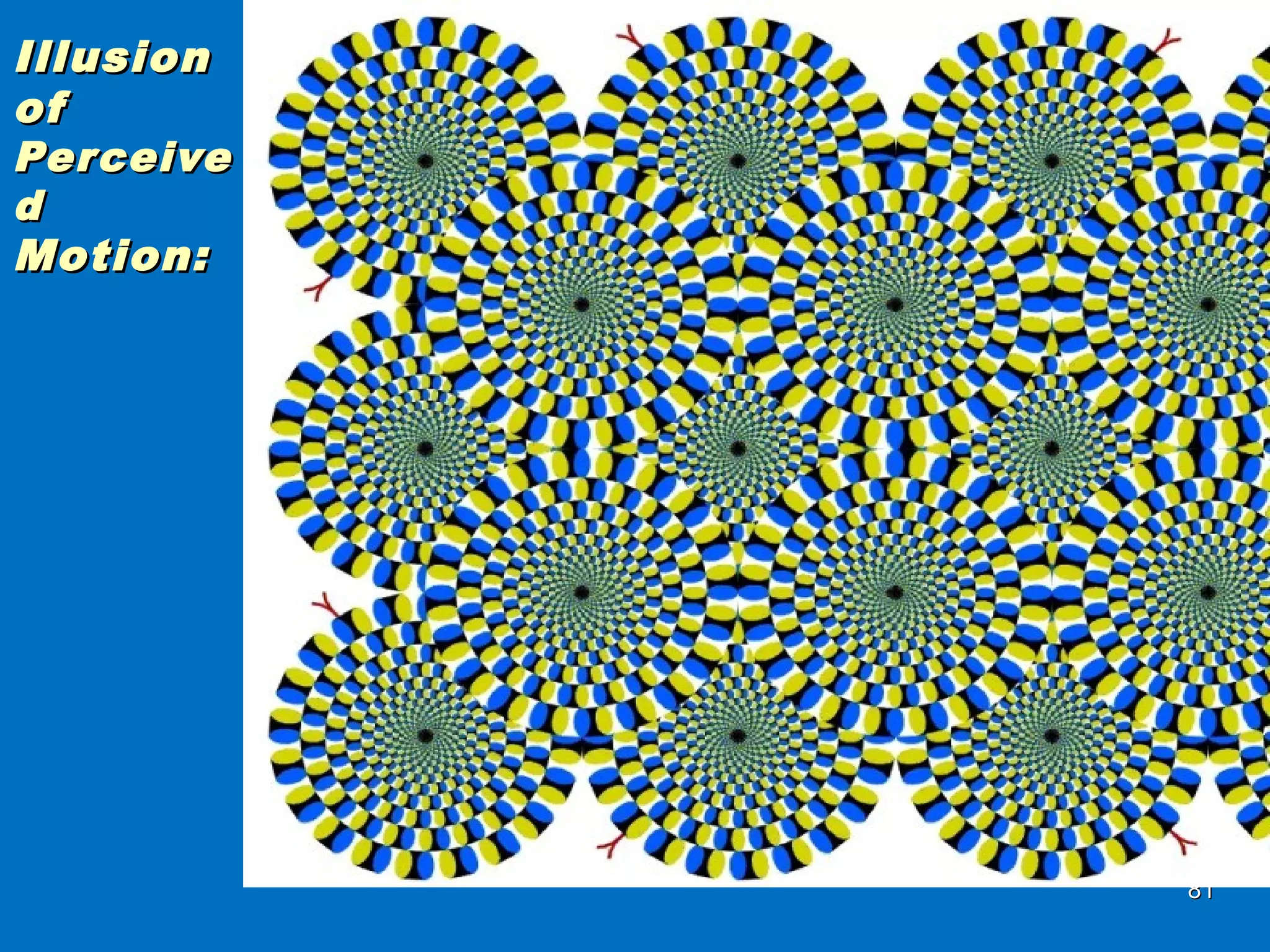
IllusionIllusion
ofof
PerceivePerceive
dd
Motion:Motion:
8282
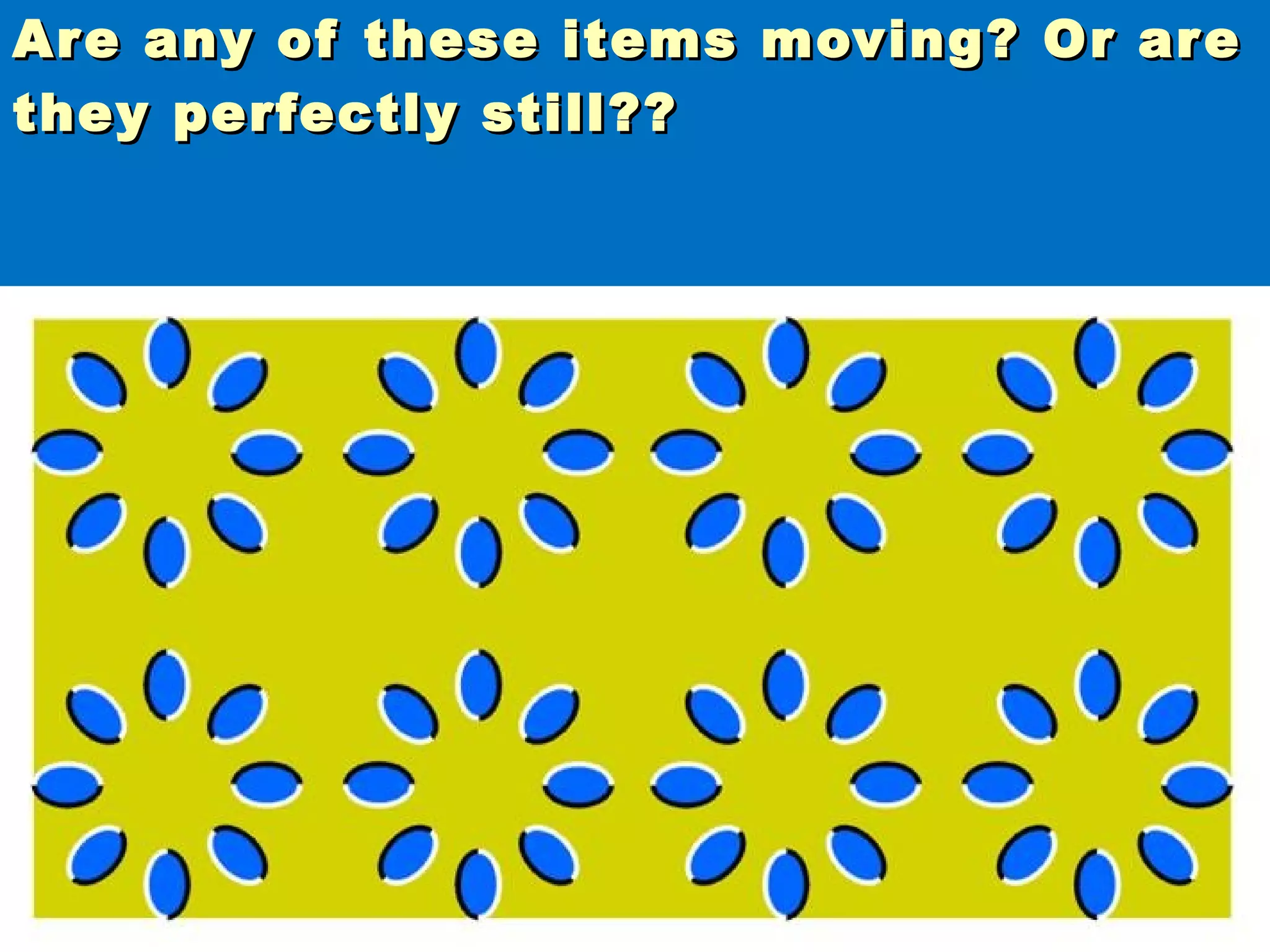
Are any of these items moving? Or areAre any of these items moving? Or are
they perfectly still??they perfectly still??
8383
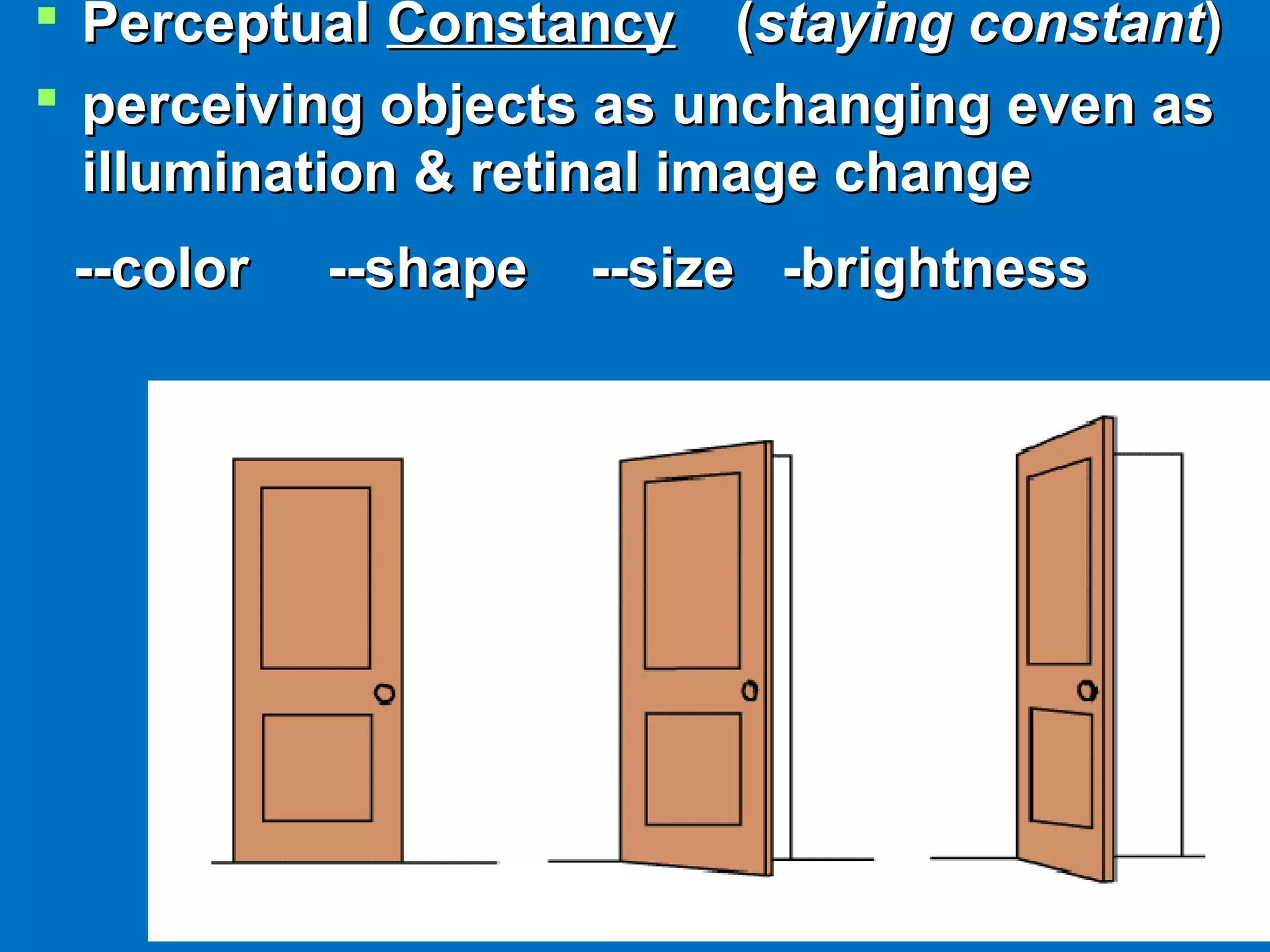
 PerceptualPerceptual ConstancyConstancy ((staying constantstaying constant))
 perceiving objects as unchanging even asperceiving objects as unchanging even as
illumination & retinal image changeillumination & retinal image change
--color --shape --size -brightness--color --shape --size -brightness
8484
Perceptual context:
QUICK!!!!! In 15 seconds…QUICK!!!!! In 15 seconds…
Count the" F’s" in the following text:Count the" F’s" in the following text:
FINISHED FILES ARE THEFINISHED FILES ARE THE
RESULT OF YEARS OF SCIENTIFICRESULT OF YEARS OF SCIENTIFIC
STUDY COMBINED WITH THESTUDY COMBINED WITH THE
EXPERIENCE OF YEARS...EXPERIENCE OF YEARS...
 Write downWrite down how many…how many…
8585
THERE ARETHERE ARE 66 -- no joke.-- no joke.
FFINISHEDINISHED FFILES ARE THE RESULT OILES ARE THE RESULT OFF YEARSYEARS
OOFF SCIENTISCIENTIFFIC STUDY COMBINED WITHIC STUDY COMBINED WITH
THE EXPERIENCE OTHE EXPERIENCE OFF YEARS...YEARS...
 This has to do with the way we perceive words…This has to do with the way we perceive words…
The brain has trouble perceivingThe brain has trouble perceiving "OF"."OF".
 3 is normal, 4 is quite rare all 63 is normal, 4 is quite rare all 6 exceptional…exceptional…
……....unless you HAVE seen this before..unless you HAVE seen this before..

Managing the perception
process:
 Have a high level of awareness.
 Seek information from various sources to
confirm or disconfirm personal impressions of a
decision.
 Be empathetic.
 Influence perceptions of other people when they
are drawing incorrect or incomplete impressions
of events in the work setting.
 Avoid inappropriate attributions.
 Diversity management programs.
Communication and theCommunication and the
Enhancement of PerceptualEnhancement of Perceptual
AccuracyAccuracy
 Increase your
awareness
 Avoid stereotypes
 Check your
perceptions
 Indirect perceptionIndirect perception
checkingchecking
 Direct perceptionDirect perception
checkingchecking
Guidelines for improving perception and
communication:
 Recognize that all perceptions are partialRecognize that all perceptions are partial
& subjective.& subjective.
 Avoid mindreading one of the behaviorsAvoid mindreading one of the behaviors
that contribute to conflictthat contribute to conflict
 Check perceptions with others.Check perceptions with others.
 Distinguish between facts and inferences.Distinguish between facts and inferences.
 Guard against the self serving biasGuard against the self serving bias..
Empathy andEmpathy and
PerceptionPerception
 EmpathyEmpathy : the ability to re-create another: the ability to re-create another
person’s perspective, to experience theperson’s perspective, to experience the
world from the other’s point of view.world from the other’s point of view.
 Dimensions of empathyDimensions of empathy
 Perspective takingPerspective taking
 Emotional dimensionEmotional dimension
 Genuine concernGenuine concern
Empathy vs. SympathyEmpathy vs. Sympathy
 Sympathy:Sympathy: when you feel compassion forwhen you feel compassion for
another person’s predicament.another person’s predicament.
 It lacks the degree of identification that empathyIt lacks the degree of identification that empathy
entails.entails.
 Empathy: when you have a personal sense ofEmpathy: when you have a personal sense of
what that predicamentwhat that predicament is like.is like.
 The other persons confusion, joy, or painThe other persons confusion, joy, or pain
becomes your own.becomes your own.
“Persons appear to us according to the
light we throw upon them from our
minds’’.
Laura Ingalls wilder.
AnyAny
questions????questions????
??????????????????
Thank uThank u

Perception selfawareness

  • 1.
    Self-Awareness, Perception and Communication ProfDr. Mona AbosereaProf Dr. Mona Aboserea Professor of public healthProfessor of public health Zagazig UniversityZagazig University
  • 2.
    ““People only seewhat theyPeople only see what they are prepared to see.”are prepared to see.” Ralph Waldo EmersonRalph Waldo Emerson
  • 3.
    Perception & Communication Perception shapes how we interpret others’ communication and how we ourselves communicate.  At the same time, communication influences our perceptions of people and situations.
  • 4.
    Cognition COGNITION is theact or process ofCOGNITION is the act or process of knowing informationknowing information
  • 5.
    Perception PERCEPTION is Aprocess by which individuals organize and interpret their sensory impressions in order to give meaning to their environment
  • 6.
    What is Perception? Theability to see, hear, or become aware of something through the senses. People’s behavior is based on their perception of what reality is, not on reality itself The world as it is perceived is the world that is behaviorally important
  • 7.
    Unfortunately, our selfperceptions affect our behaviors more than our true abilities
  • 8.
    Steps in Perception Something affects the senses;Something affects the senses; see, hear, taste, smell, touchsee, hear, taste, smell, touch  Interpret the sensation (giveInterpret the sensation (give meaning to it)meaning to it)
  • 9.
    Differences inDifferences in Perceptioncome from:Perception come from:  Physical Differences  Past Experiences; background  Present feelings; circumstances  Differences in using information  Differences in expectations
  • 10.
    AwarenessAwareness  It isthe ability to directly know and perceive, to feel, or to be cognizant of events .  More broadly, it is the state of being conscious of something
  • 11.
    Self-awarenessSelf-awareness  Representing howwe see and describe ourselves External perception Representing how others see and would describe us All of us have certain aspects as for instance habits or preferences and antipathies of which we not even may be aware you met someone and created an image for yourself that totally differed from the self-awareness of that person
  • 12.
    Covert awareness isthe knowledge of something without knowing it (e.g. pts with some brain damage are for example unable to tell if a pencil is horizontal or vertical. They are however able to grab the pencil, using the correct orientation of the hand and wrist)
  • 13.
    Awareness sections: (e.g.SMBG)  Influence: (never, seldom, often, & very often).  Perception: (much worse, worse, better, much better)  Concern: (not concerned at all, somewhat concerned, concerned & very concerned)  Willingness to adapt certain behavior: (very unlikely, unlikely, no opinion, likely, &very likely)
  • 14.
     Perception questionsdiffer from otherdiffer from other types of survey questions—behavioral,types of survey questions—behavioral, knowledge, attitudinal, or demographic—knowledge, attitudinal, or demographic— in thatin that  Questions that measureQuestions that measure perception askask respondents to provide information onrespondents to provide information on how they perceive such matters as thehow they perceive such matters as the effectiveness of programs, their healtheffectiveness of programs, their health status, or the makeup of their community,status, or the makeup of their community, among ...among ...
  • 15.
    Self-Concept: Who are you? Self-concept refers to your subjective description of who you think you are.  Self-image is your view of yourself in particular situations
  • 16.
    Self-Concept orSelf-Concept or perceivedself (personal(personal perception):perception):  Beliefs about who you areBeliefs about who you are basedbased on perceptions, expectations,on perceptions, expectations, and others’ reactionsand others’ reactions  Formed early in lifeFormed early in life  Static---Hard to changeStatic---Hard to change
  • 17.
    Presenting self toothers(public image prospective).  How do we manage identityHow do we manage identity :: A.A.Manner:Manner: consists of a communicator’s words &consists of a communicator’s words & nonverbal actions.nonverbal actions. B.B.Appearance:Appearance: personal items people use topersonal items people use to shape an imageshape an image C.C.Setting:Setting: physical items we use to influence howphysical items we use to influence how others view us.others view us.
  • 18.
    Perception of others: Uncertainty reductionUncertainty reduction: we monitor our: we monitor our environment to learn more about ourselves &environment to learn more about ourselves & others.others.  Social perceptions are often made on the basis of physical characteristics and social behaviors, we stereotype..  We judge one’s friendliness and intelligenceWe judge one’s friendliness and intelligence on how physically attraction they are.on how physically attraction they are.  We learn stereotypes from family, friends, …..
  • 19.
    Self Concept andSelf-Self Concept and Self- EfficacyEfficacy  Those with poor self-concept willThose with poor self-concept will complete tasks that are too EASY orcomplete tasks that are too EASY or too HARDtoo HARD  Self-efficacy is your belief on whatSelf-efficacy is your belief on what you can doyou can do
  • 20.
    Self-Concept Components  Attitude:a learned predisposition toa learned predisposition to respond to a person, object, or idea in arespond to a person, object, or idea in a favorable or unfavorable way.favorable or unfavorable way.  Beliefs: The way in which you structureThe way in which you structure your understanding of realityyour understanding of reality (true/false).(true/false).  Values: Enduring conceptsEnduring concepts of good andof good and bad, right and wrong.bad, right and wrong.
  • 21.
    One of ManySelves?  The Material Self  The Social Self  The Spiritual Self
  • 22.
    The Material Self The materialmaterial self is a total of allis a total of all the tangible thingsthe tangible things you own:you own:  Your bodyYour body  Your possessionsYour possessions  Your homeYour home
  • 23.
    The Social Self The socialsocial self is that partis that part of you that interacts withof you that interacts with others:others:  You change based onYou change based on interaction with others.interaction with others.  Each relationship you haveEach relationship you have with another person iswith another person is unique.unique.
  • 24.
    The Spiritual Self The spiritualspiritual self consists of allconsists of all your internal thoughts about youryour internal thoughts about your values and moral standards:values and moral standards:  It is the essence ofIt is the essence of who you think you are.  It is a mixture ofIt is a mixture of your spiritual beliefs and your sense of who you are in relationship to other forcesto other forces in the universe.in the universe.
  • 25.
    How the Self-Concept Develops??????????? Our communication with other individuals  Our association with groups  Roles we assume  Our self-labels
  • 26.
    1-Self-Concept: Communication with others  Wedon’t come to know ourselves in a vacuum .  Self-concept development begins at birth
  • 27.
    2-Self-Concept: Association with Groups Ourawareness of who we are is often linked to who we associate with:  Religious groupsReligious groups  Political groupsPolitical groups  EthnicEthnic groupsgroups  Social groupsSocial groups Peer pressurePeer pressure is a powerful force in shapingis a powerful force in shaping attitudes and behavior.attitudes and behavior.
  • 28.
    3-Self-Concept: Assumed Roles Yourself-concept likely reflects the roles you assume:  MotherMother  BrotherBrother  TeacherTeacher  Student………etcStudent………etc Gender asserts a powerful influence onGender asserts a powerful influence on the self-concept from birth on.the self-concept from birth on.
  • 29.
    4-Self-Concept: Self- Labels  Self-conceptis affected by others but we are not blank slates,.  Self-reflectionness is the human ability to think about what we’re doing while we’re doing it.  Through self-observation we discover strengths which encourage us to assume new labels.
  • 30.
    Self-Esteem: What is yourvalue?  Self-esteem refers to your evaluation of who you are.  Your self-esteem can fluctuate and rise or fall within the course of a day.
  • 31.
    Self-Esteem: Gender Differences  Inpatriarchal cultures , women and girls suffer loss of self-esteem to a greater degree than men and boys. Boys often feel better able to do thingsBoys often feel better able to do things than girls.than girls.
  • 32.
    Self-Esteem: Social Comparisons We become more aware of ourselves by measuring ourselves against others, a process called social comparison.  It can be self-defeating to take social comparisons too far, to cause your self- esteem to suffer because you compare yourself unrealistically to others.
  • 33.
    Self-Esteem: Self- Expectations  Self-expectationsare those goals we set for ourselves.  Self-esteem is affected when you evaluate how well you measure up to your own expectations.  Be worry of placing unrealistic demands on yourself.
  • 34.
    Self-Esteem: Self-Fulfilling Prophecy  Theself-fulfilling prophecy refers to the idea that what you believe about yourself often comes true because you expect it to come true.  Your level of self-esteem affects the kinds of prophecies you make about yourself and colors your interpretation of events.
  • 35.
    Communication & the Enhancementof Self- Esteem  Our feelings of low self-worth may contribute to many of our societal problems.  Communication is essential in the process of building and maintaining self- esteem.
  • 36.
    Communication & Self: Engagein POSITIVE self-talk  Intrapersonal communication involves communication within yourself – self- talk.  Your self-concept and self-esteem influence the way you talk to yourself.  Your inner dialogue also has an impact on your self-concept and self-esteem.
  • 37.
    Communication and Self: Visualize Visualization involves “seeing” yourself exhibiting some desirable behavior.  Apprehensive public speakers can manage their fears by visualizing positive results: Reduce negative self-talkReduce negative self-talk Enhances confidence and speaking skillEnhances confidence and speaking skill
  • 38.
    Communication and Self: DevelopHonest Relationships  Have at least one other person that will give you honest, objective feedback. You need a “straight scoopYou need a “straight scoop””  Stuff that’s the hardest to hear about youStuff that’s the hardest to hear about you  Nobody else would dareNobody else would dare tell youtell you  Trust enough to deal with the tough stuffTrust enough to deal with the tough stuff
  • 39.
    Communication and Self: SurroundYourself With Positive People  Surround yourself with people who have higher levels of self-esteem  Don’t engage in pity parties  Immunize yourself from negativity
  • 40.
    Communication and Self: Loseyour baggage  Avoid constantly re-living negative experiences.  Leave past experiences that cause your present self-esteem to suffer .
  • 41.
    Perceiving Others  Perception:Perception:an active process of creating meaning by selecting, organizing, and interpreting people, objects, events, situations, and activities.  Narrative: The stories people create andNarrative: The stories people create and use to make sense of their personaluse to make sense of their personal worlds.worlds.
  • 42.
    Common Perceptual Tendencies  Attribution:the process of attaching meaningAttribution: the process of attaching meaning to behavior.to behavior. We judge ourselves more charitablyWe judge ourselves more charitably  SituationalSituational  Self-serving biasSelf-serving bias We judge others more criticallyWe judge others more critically  DispositionalDispositional
  • 43.
    Two types ofattributions  Dispositional attribution -A-Attributes attributes a persons behavior topersons behavior to internal factors such assuch as personality traits , motivation, ability, fatigue,personality traits , motivation, ability, fatigue, efforteffort  Situational attribution -A-Attributes a personsttributes a persons behavior tobehavior to external factors such as equipment,such as equipment, rules, social influence etcrules, social influence etc These two combine actively to determine behaviour
  • 44.
  • 45.
    4545 Person Perception: MakingJudgments About Others Attribution Theory An attempt to determine whether an individual’s behavior is internally or externally caused The Attribution Process Observation of Behavior Distinctiveness (High or Low) Consensus (High or Low) Consistency (High or Low) Internal or External causes Observation Interpretation Attribution of Cause
  • 46.
    The Perception Process Stage One: Attention and selection  Stage Two: Organization  Stage Three: Interpretation
  • 48.
    Sub process ofperception External stimulus environment as 5 senses Confrontation Interpretation: Motivation, learning , personality Feedback Kinesthetic (fear, anger, panic, pain,….) Physical environment Office, values, climate ,,,, Registration of the stimulus Sensory & neural (e.g. hearing a high voice) Behavior Overt (run away) or covert (self evaluation) Consequences: Reinforcement/ punishment, some body hurt,…)
  • 49.
    Elements in perception Involvement of an individual  Process  Receiving, selecting, & organizing sensory stimuli and data  Yield a picture of the environment  The picture varies between the reality & just opposite to the environment
  • 50.
  • 51.
    Situational FactorsSituational Factors InfluencingPerceptionInfluencing Perception  Relational satisfaction.Relational satisfaction.  Degree of involvement with the otherDegree of involvement with the other person.person.  Past experiencePast experience  ExpectationsExpectations  Social rolesSocial roles  KnowledgeKnowledge  Self-conceptSelf-concept
  • 52.
    Perception and CulturePerceptionand Culture  Different people see things differently  Culture is a major factor on how people perceive things.  Categories such as gender, sub-culture, economic class, and age all influence one’s perception.
  • 61.
    Are the horizontallines parallel, or do they slope?
  • 66.
    Is the bookface-down? Or face-up?
  • 67.
    Looking up, orlooking down?
  • 71.
    Influences on perception: Physiology: different sensory abilities: different sensory abilities  Tiredness: -ve perception: -ve perception  Medical conditions: drugs affects thinking: drugs affects thinking  Age: the older we are, the richer ourthe older we are, the richer our perspective for perceiving life and people.perspective for perceiving life and people.  Culture, beliefs, values, understandings, & practices.
  • 72.
    Influences on perception cont. Social roles:  Cognitive abilities, & personal knowledge of others  Self: how we perceive people
  • 73.
    Factors that involveFactorsthat involve perceptionperception
  • 74.
    Perception in management (perceptualorganization) Emphasis on the subsequent activities That takes place in the perceptual process after a stimulus is received
  • 75.
    7575 Perceptual Organization: Gestalt  Grouping:the perceptual tendency to organize stimuli into coherent groups  Grouping Principles 1. proximity--group of nearby figures 2. similarity--group of similar figures 3. continuity--perceive continuous patterns 4. closure--fill in gaps 5. connectedness--spots, lines, & areas are seen as unit when connected
  • 76.
  • 77.
    7777 Perceptual Organization:Perceptual Organization: Illusory(Illusory (illusionsillusions) Contours) Contours ((edges or shapesedges or shapes…)…)
  • 78.
  • 79.
    7979 PerceptualPerceptual Organization:Organization: Closure:Closure: Wesee what…?We see what…? AA BB  GestaltGestalt groupinggrouping principlesprinciples are at workare at work here.here.
  • 80.
  • 81.
  • 82.
    8282 Are any ofthese items moving? Or areAre any of these items moving? Or are they perfectly still??they perfectly still??
  • 83.
    8383  PerceptualPerceptual ConstancyConstancy((staying constantstaying constant))  perceiving objects as unchanging even asperceiving objects as unchanging even as illumination & retinal image changeillumination & retinal image change --color --shape --size -brightness--color --shape --size -brightness
  • 84.
    8484 Perceptual context: QUICK!!!!! In15 seconds…QUICK!!!!! In 15 seconds… Count the" F’s" in the following text:Count the" F’s" in the following text: FINISHED FILES ARE THEFINISHED FILES ARE THE RESULT OF YEARS OF SCIENTIFICRESULT OF YEARS OF SCIENTIFIC STUDY COMBINED WITH THESTUDY COMBINED WITH THE EXPERIENCE OF YEARS...EXPERIENCE OF YEARS...  Write downWrite down how many…how many…
  • 85.
    8585 THERE ARETHERE ARE66 -- no joke.-- no joke. FFINISHEDINISHED FFILES ARE THE RESULT OILES ARE THE RESULT OFF YEARSYEARS OOFF SCIENTISCIENTIFFIC STUDY COMBINED WITHIC STUDY COMBINED WITH THE EXPERIENCE OTHE EXPERIENCE OFF YEARS...YEARS...  This has to do with the way we perceive words…This has to do with the way we perceive words… The brain has trouble perceivingThe brain has trouble perceiving "OF"."OF".  3 is normal, 4 is quite rare all 63 is normal, 4 is quite rare all 6 exceptional…exceptional… ……....unless you HAVE seen this before..unless you HAVE seen this before.. 
  • 86.
    Managing the perception process: Have a high level of awareness.  Seek information from various sources to confirm or disconfirm personal impressions of a decision.  Be empathetic.  Influence perceptions of other people when they are drawing incorrect or incomplete impressions of events in the work setting.  Avoid inappropriate attributions.  Diversity management programs.
  • 87.
    Communication and theCommunicationand the Enhancement of PerceptualEnhancement of Perceptual AccuracyAccuracy  Increase your awareness  Avoid stereotypes  Check your perceptions  Indirect perceptionIndirect perception checkingchecking  Direct perceptionDirect perception checkingchecking
  • 88.
    Guidelines for improvingperception and communication:  Recognize that all perceptions are partialRecognize that all perceptions are partial & subjective.& subjective.  Avoid mindreading one of the behaviorsAvoid mindreading one of the behaviors that contribute to conflictthat contribute to conflict  Check perceptions with others.Check perceptions with others.  Distinguish between facts and inferences.Distinguish between facts and inferences.  Guard against the self serving biasGuard against the self serving bias..
  • 89.
    Empathy andEmpathy and PerceptionPerception EmpathyEmpathy : the ability to re-create another: the ability to re-create another person’s perspective, to experience theperson’s perspective, to experience the world from the other’s point of view.world from the other’s point of view.  Dimensions of empathyDimensions of empathy  Perspective takingPerspective taking  Emotional dimensionEmotional dimension  Genuine concernGenuine concern
  • 90.
    Empathy vs. SympathyEmpathyvs. Sympathy  Sympathy:Sympathy: when you feel compassion forwhen you feel compassion for another person’s predicament.another person’s predicament.  It lacks the degree of identification that empathyIt lacks the degree of identification that empathy entails.entails.  Empathy: when you have a personal sense ofEmpathy: when you have a personal sense of what that predicamentwhat that predicament is like.is like.  The other persons confusion, joy, or painThe other persons confusion, joy, or pain becomes your own.becomes your own.
  • 91.
    “Persons appear tous according to the light we throw upon them from our minds’’. Laura Ingalls wilder.
  • 92.
  • 93.