Chapter 5
Physical and Cognitive Development in Early
Childhood
3-5 Years-of-Age
PowerPoints developed by Jenni Fauchier,
Butchered by Professor Carney
3-5 Years-of-Age
3-5 Years-of-Age
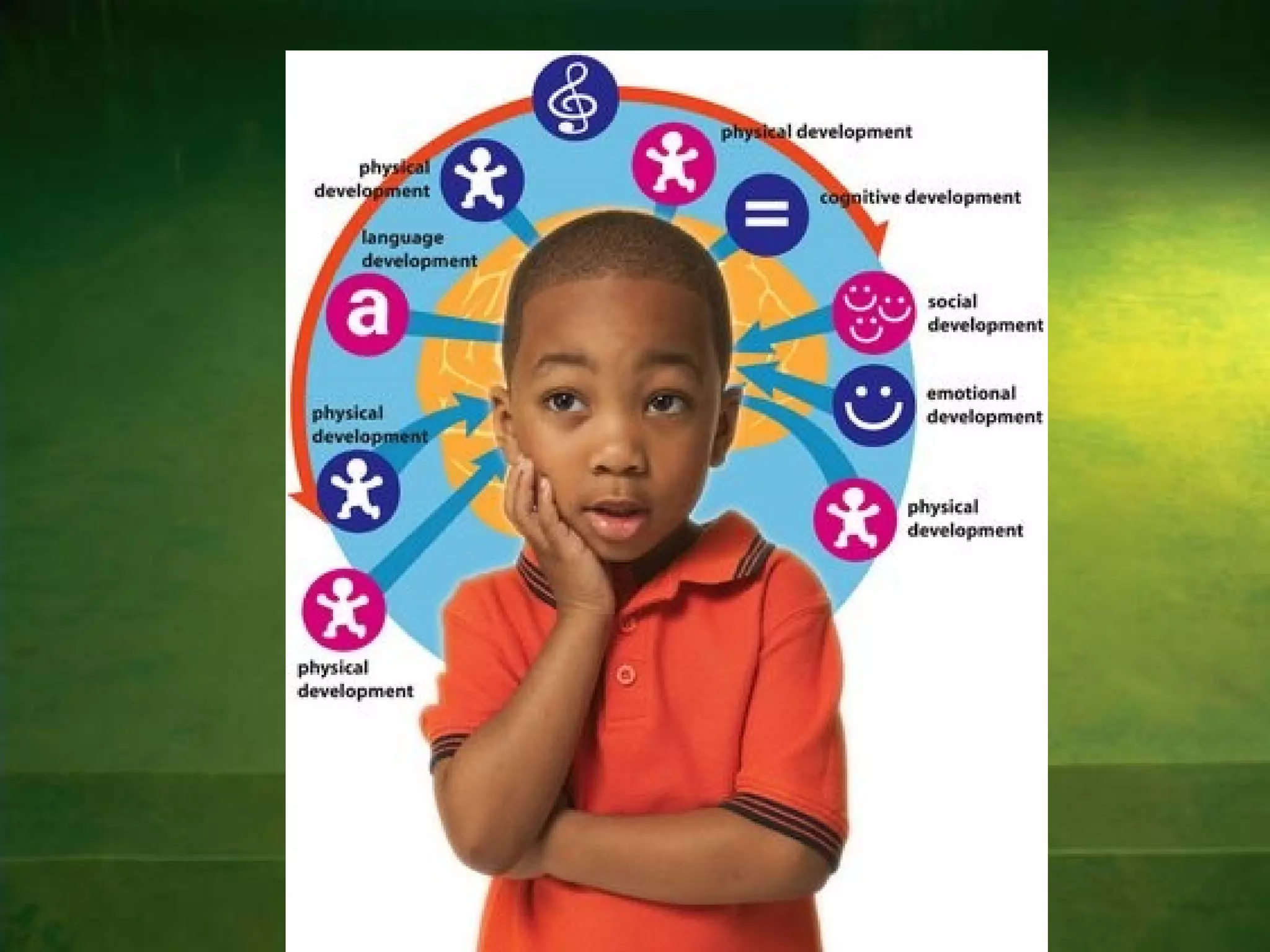
How Does a Young Child’s Body and Brain Grow and Change?

Intimate Moment
• Did the parents handle the situation well?
• What could they have done differently?

3-5 Years-of-Age
Physical Development
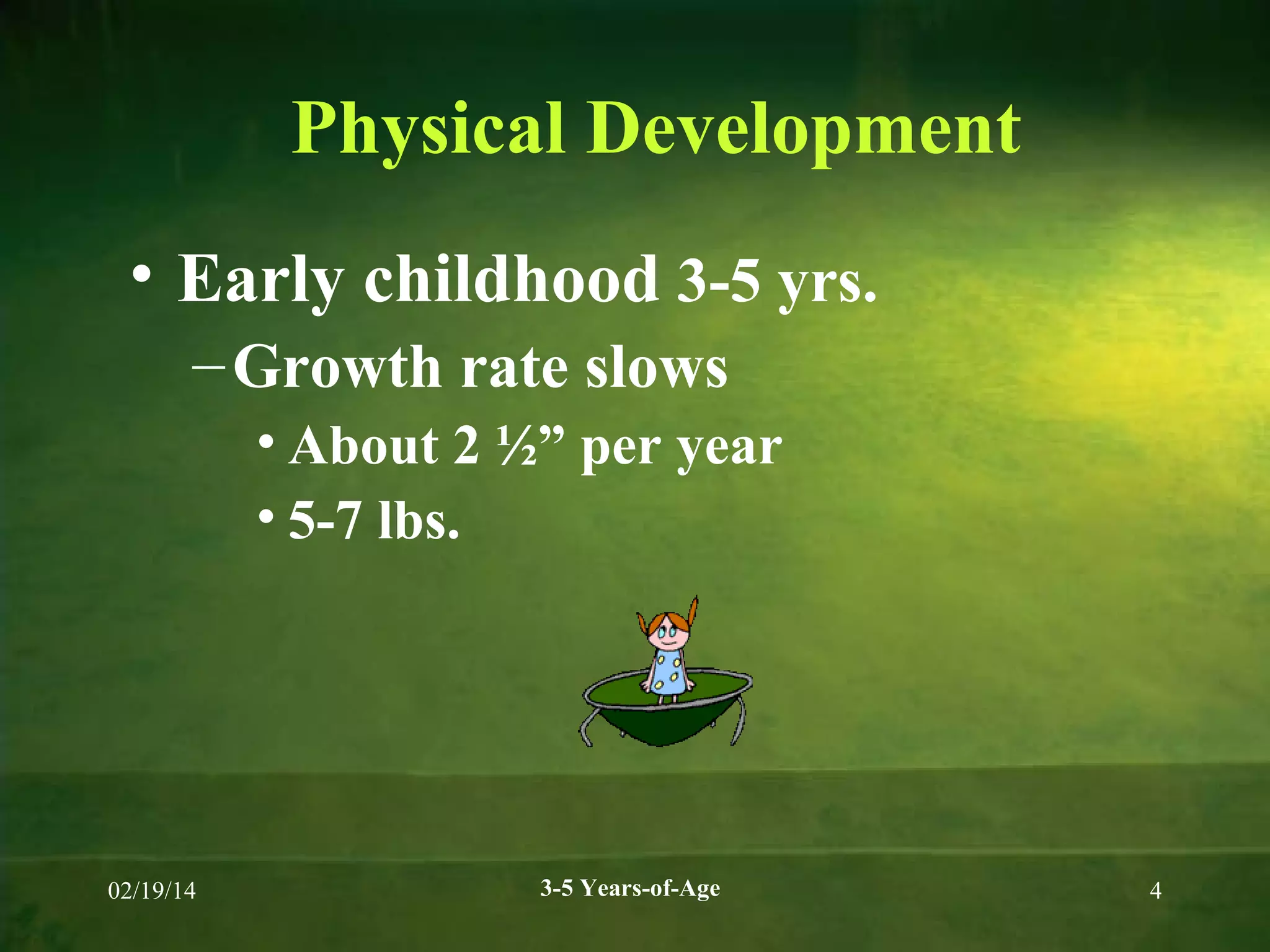
• Early childhood 3-5 yrs.
– Growth rate slows
• About 2 ½” per year
• 5-7 lbs.
02/19/14

3-5 Years-of-Age

4
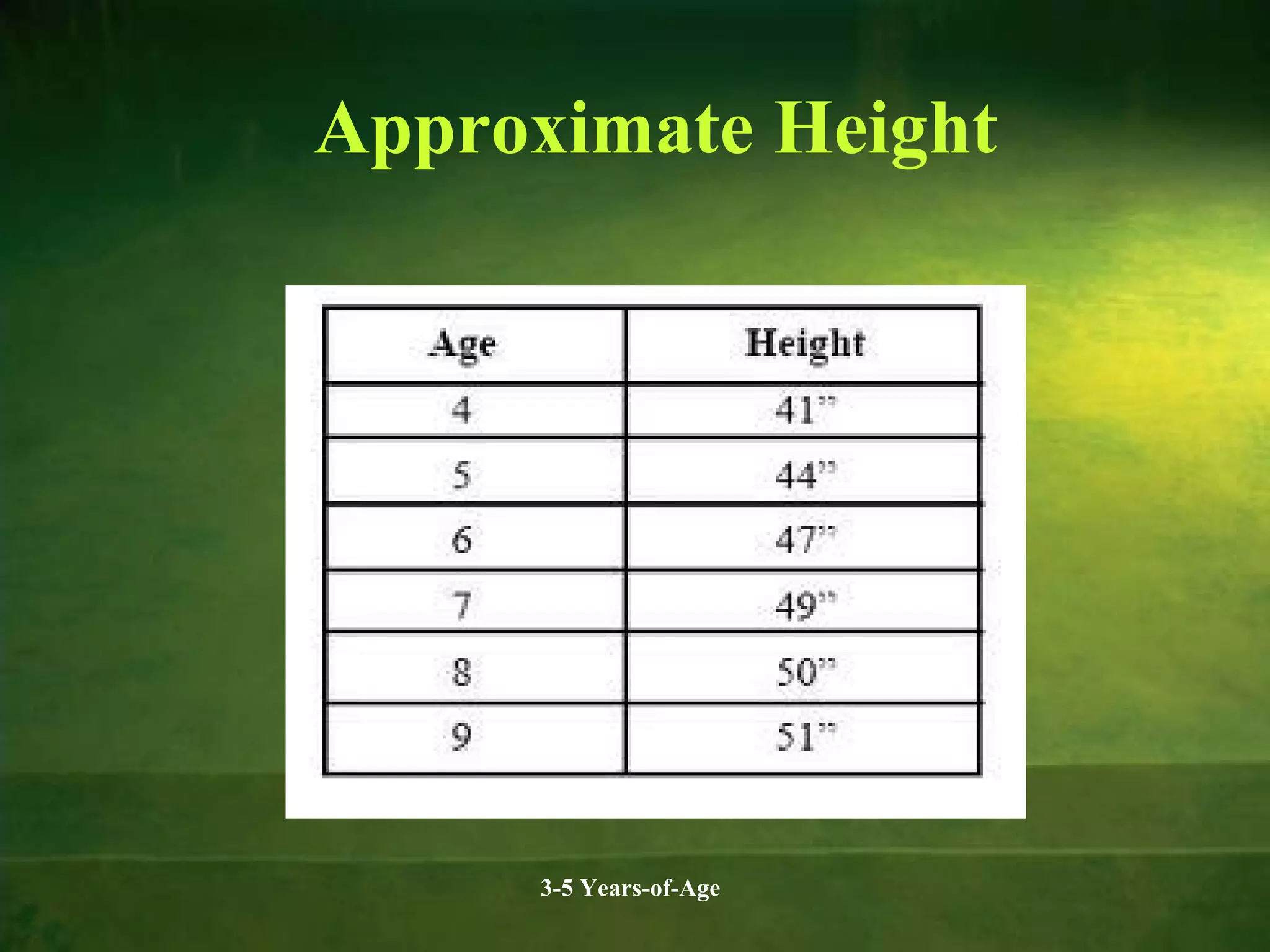
Approximate Height

3-5 Years-of-Age
Physical Development
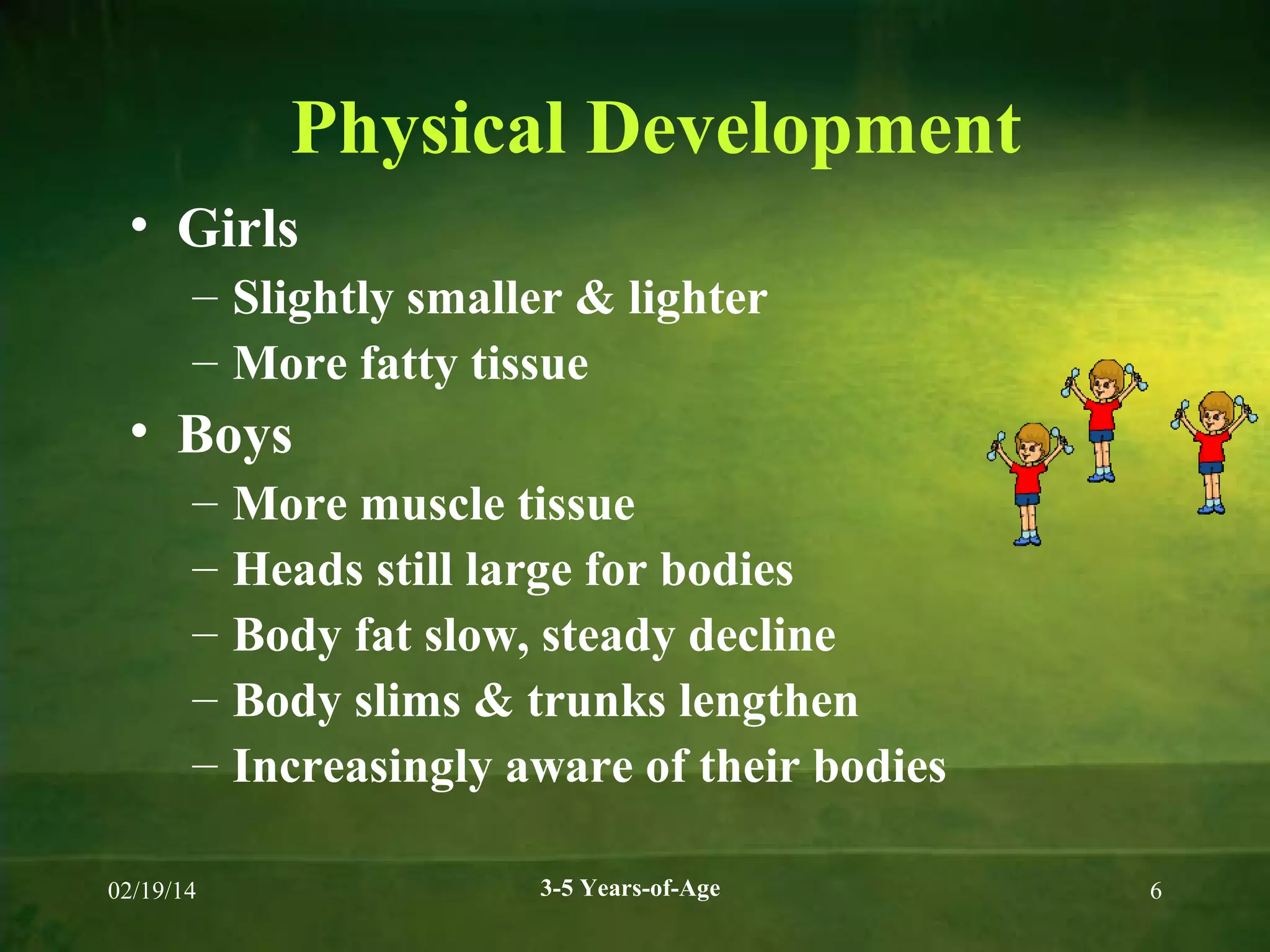
• Girls
– Slightly smaller & lighter
– More fatty tissue

• Boys
–
–
–
–
–
02/19/14

More muscle tissue
Heads still large for bodies
Body fat slow, steady decline
Body slims & trunks lengthen
Increasingly aware of their bodies
3-5 Years-of-Age

6
Variations in Growth
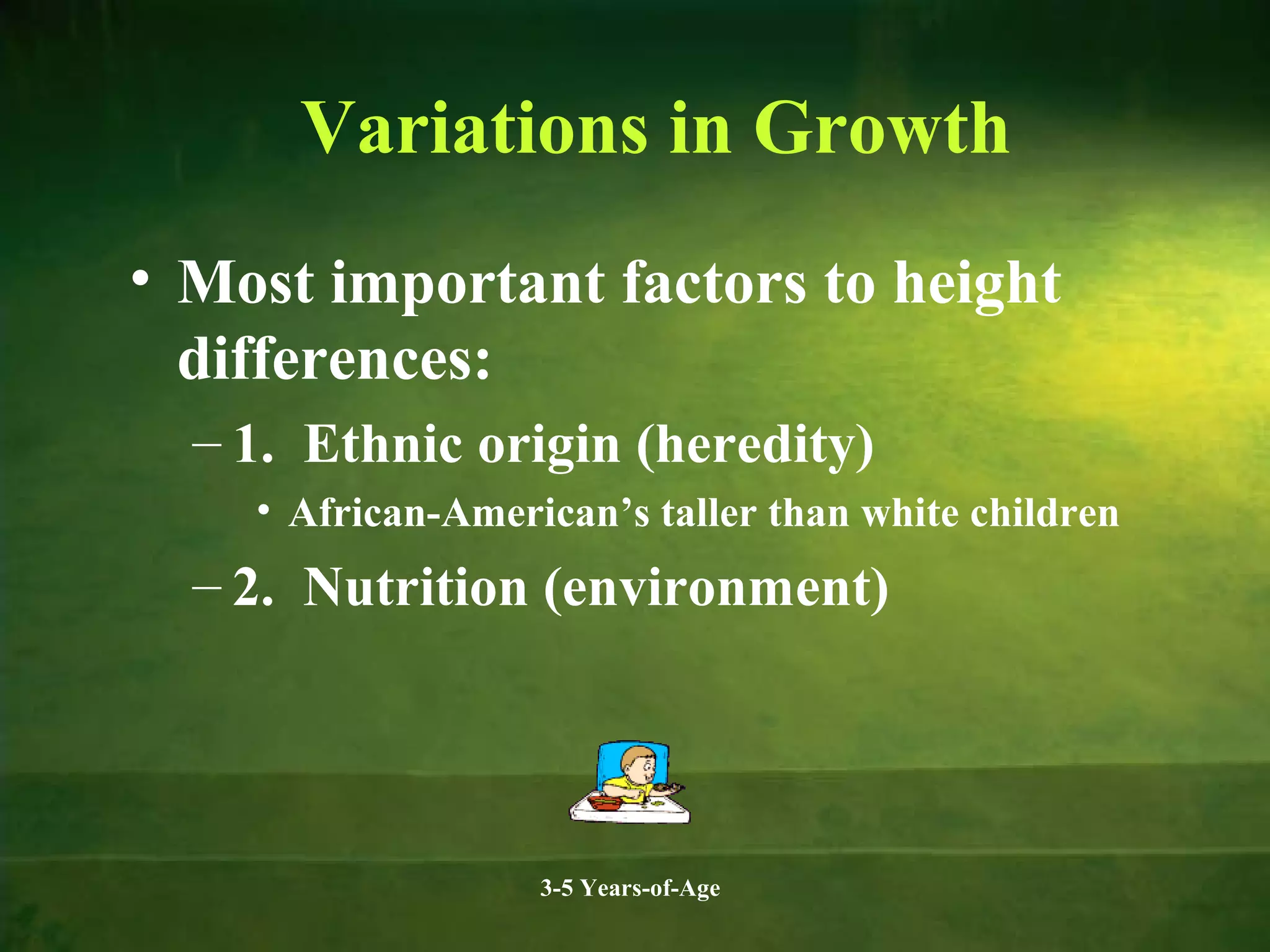
• Most important factors to height
differences:
– 1. Ethnic origin (heredity)
• African-American’s taller than white children

– 2. Nutrition (environment)

3-5 Years-of-Age
Variations in Growth
• Growth patterns vary
– Due to heredity mostly
– Environment

• Environmental
– Urban
• Middle class
• 1st born children

– Taller than
• Rural
• Lower class
• Later-born children
02/19/14

3-5 Years-of-Age

8
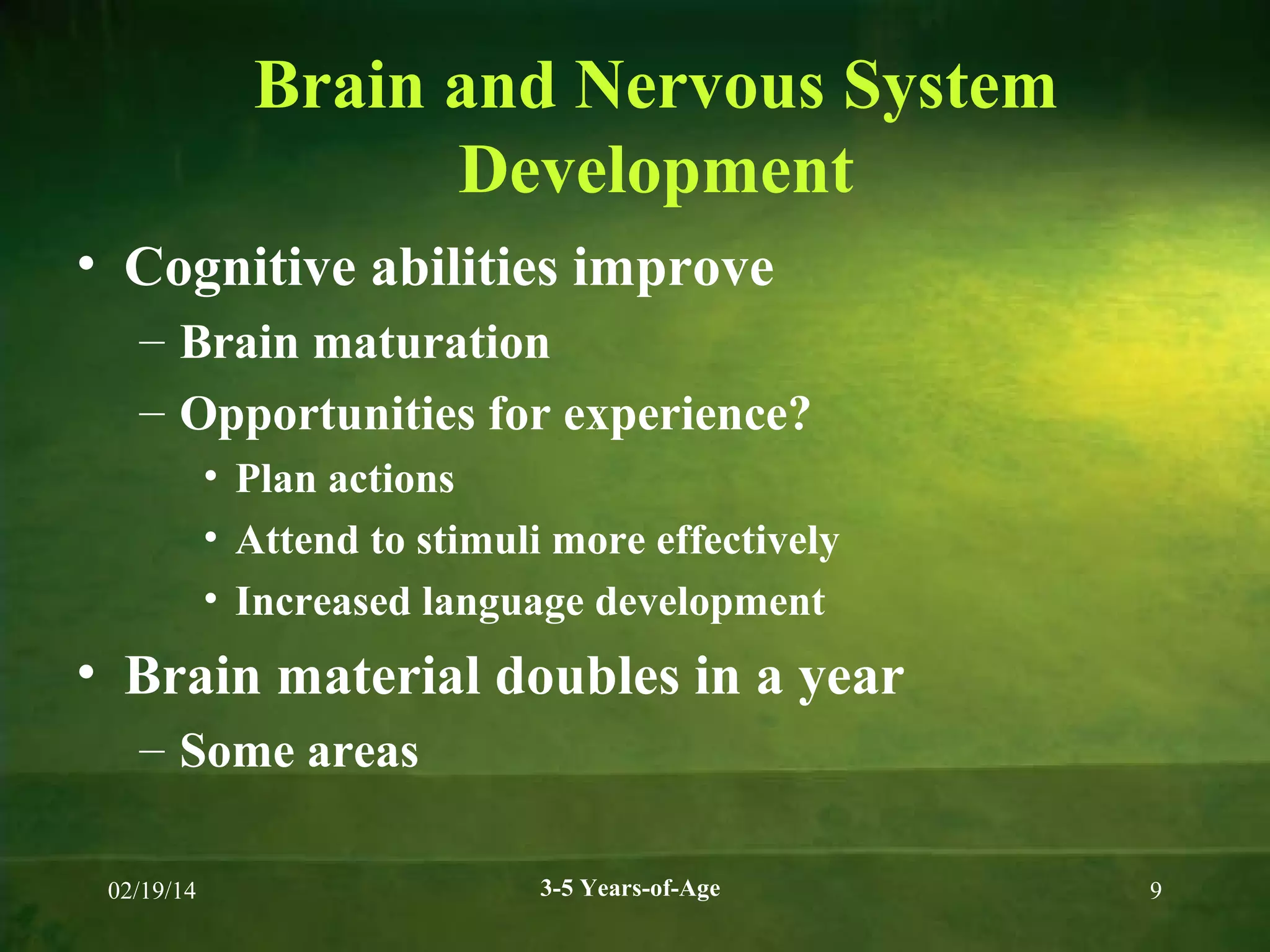
Brain and Nervous System
Development
• Cognitive abilities improve
– Brain maturation
– Opportunities for experience?
• Plan actions
• Attend to stimuli more effectively
• Increased language development

• Brain material doubles in a year
– Some areas
02/19/14

3-5 Years-of-Age

9
Brain and Nervous System
Development

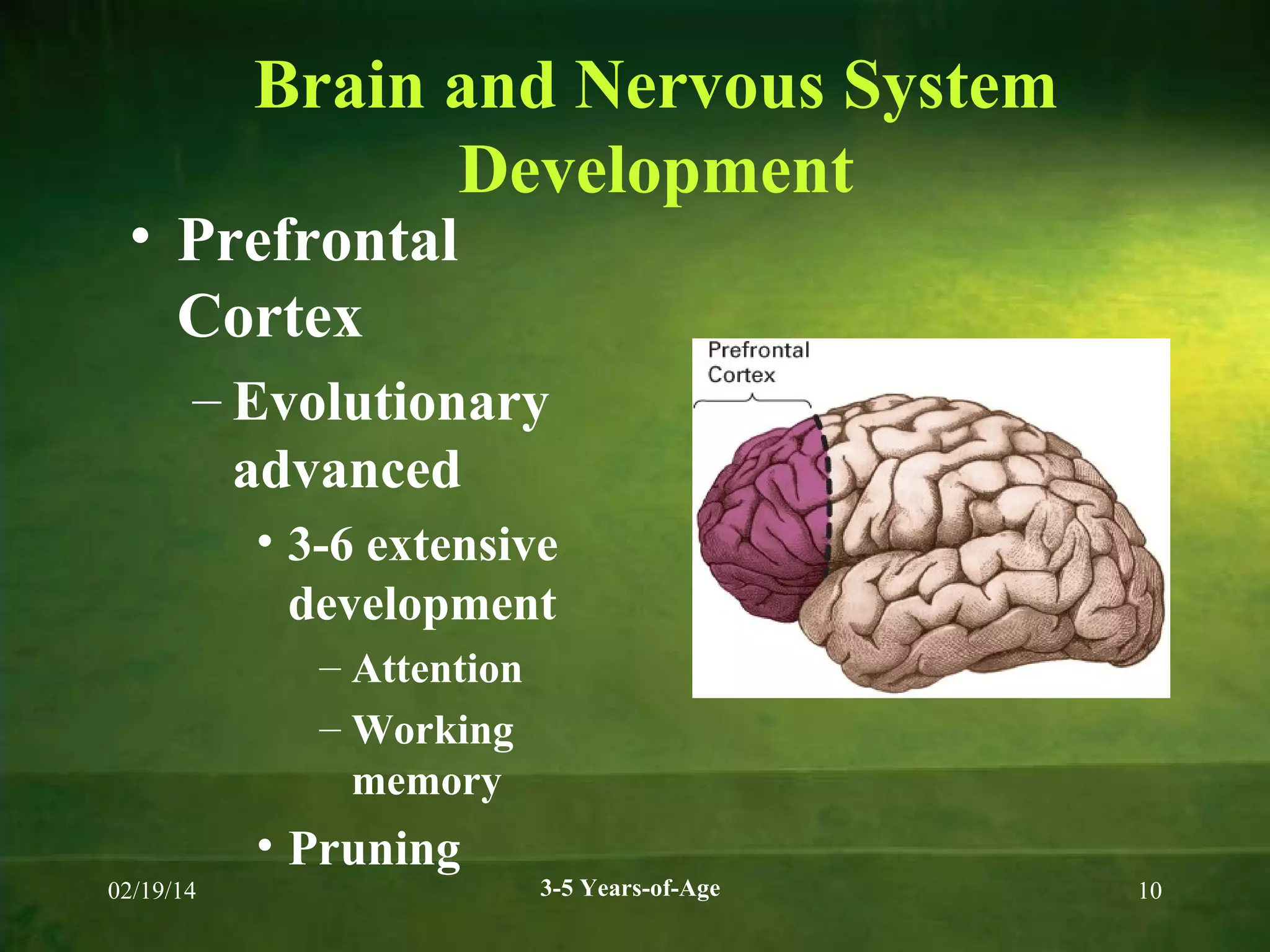
• Prefrontal
Cortex

– Evolutionary
advanced
• 3-6 extensive
development
– Attention
– Working
memory

• Pruning
02/19/14

3-5 Years-of-Age

10
Neurons
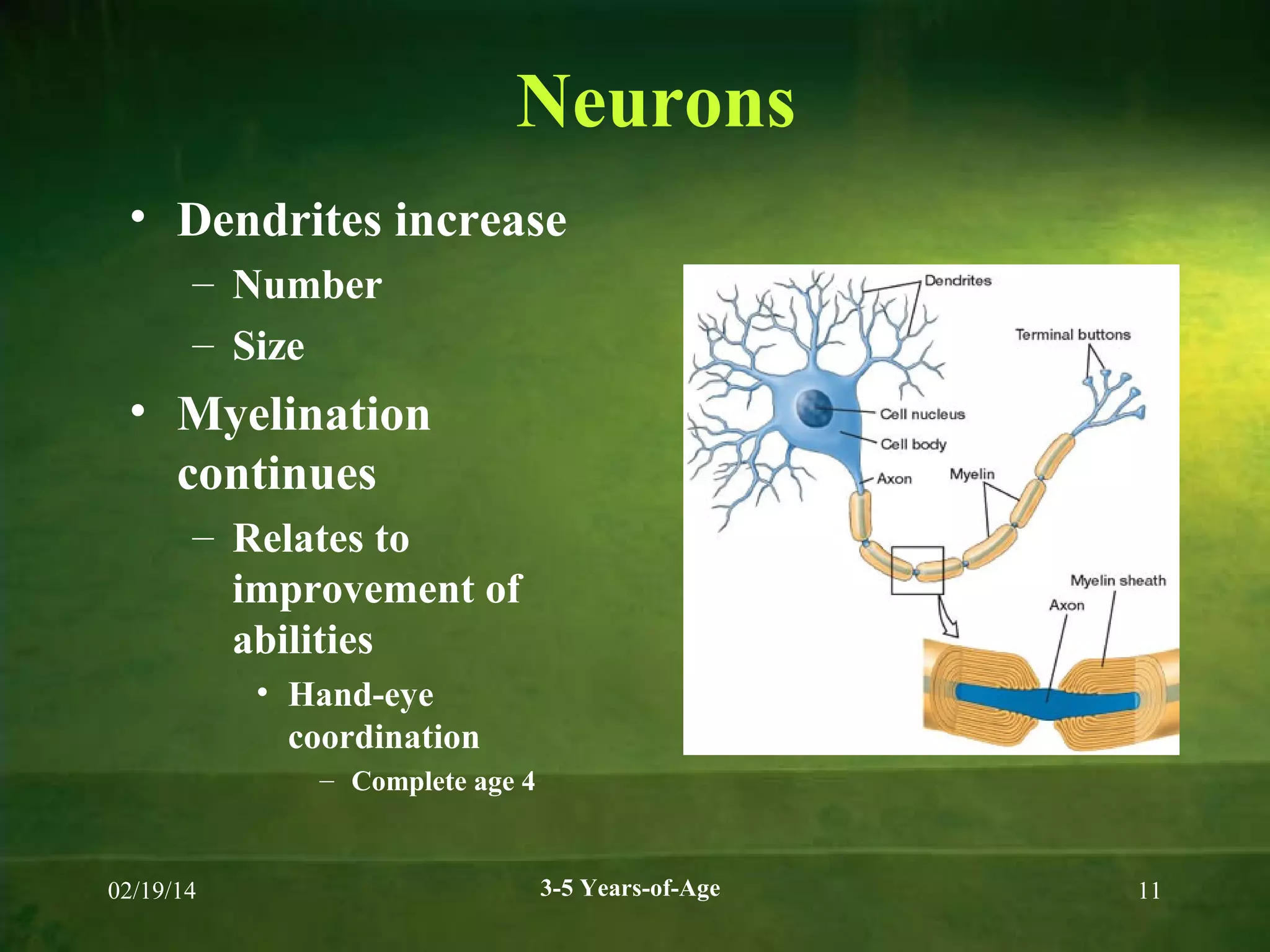
• Dendrites increase
– Number
– Size

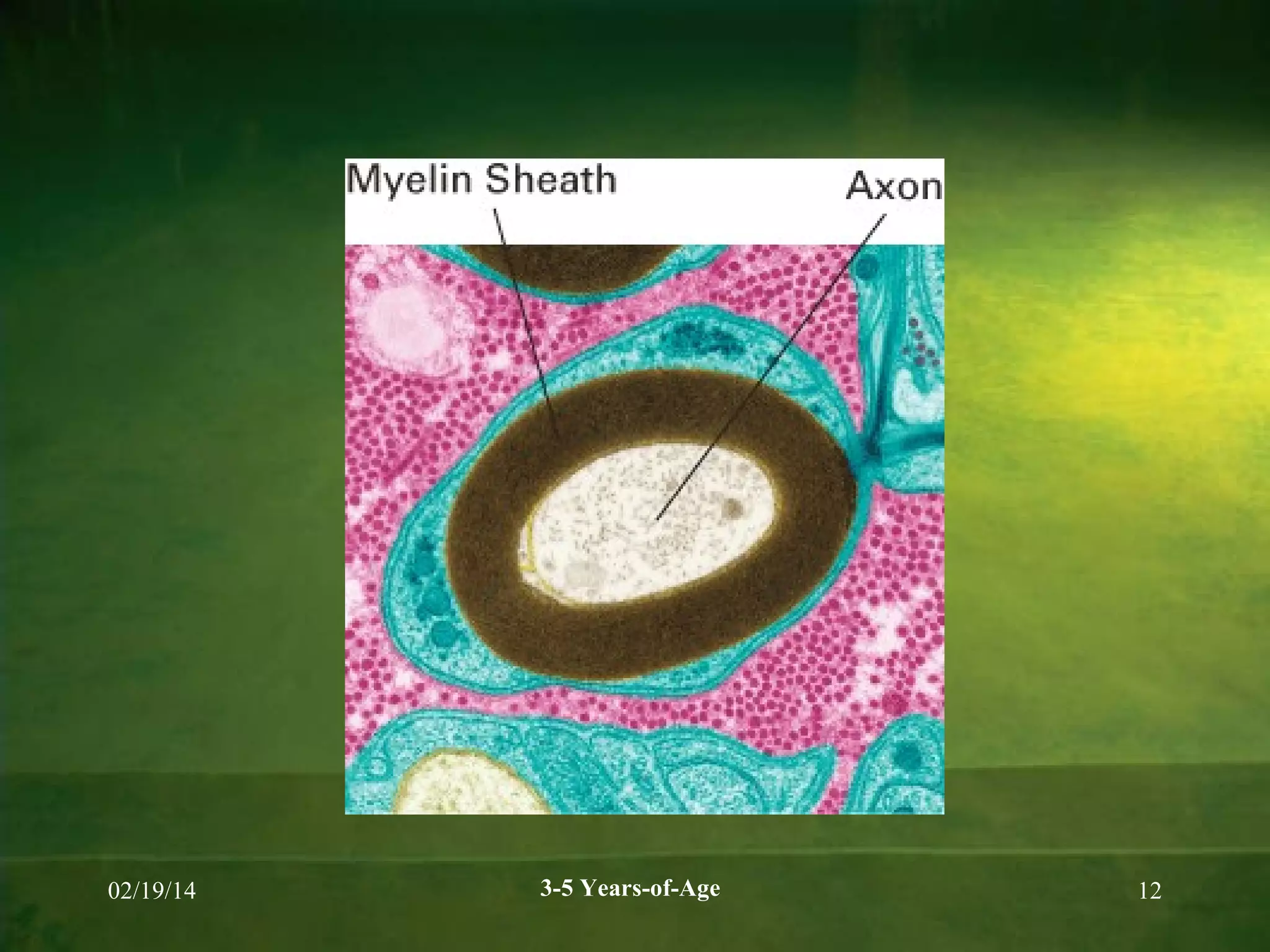
• Myelination
continues
– Relates to
improvement of
abilities
• Hand-eye
coordination
– Complete age 4

02/19/14

3-5 Years-of-Age

11
02/19/14

3-5 Years-of-Age

12
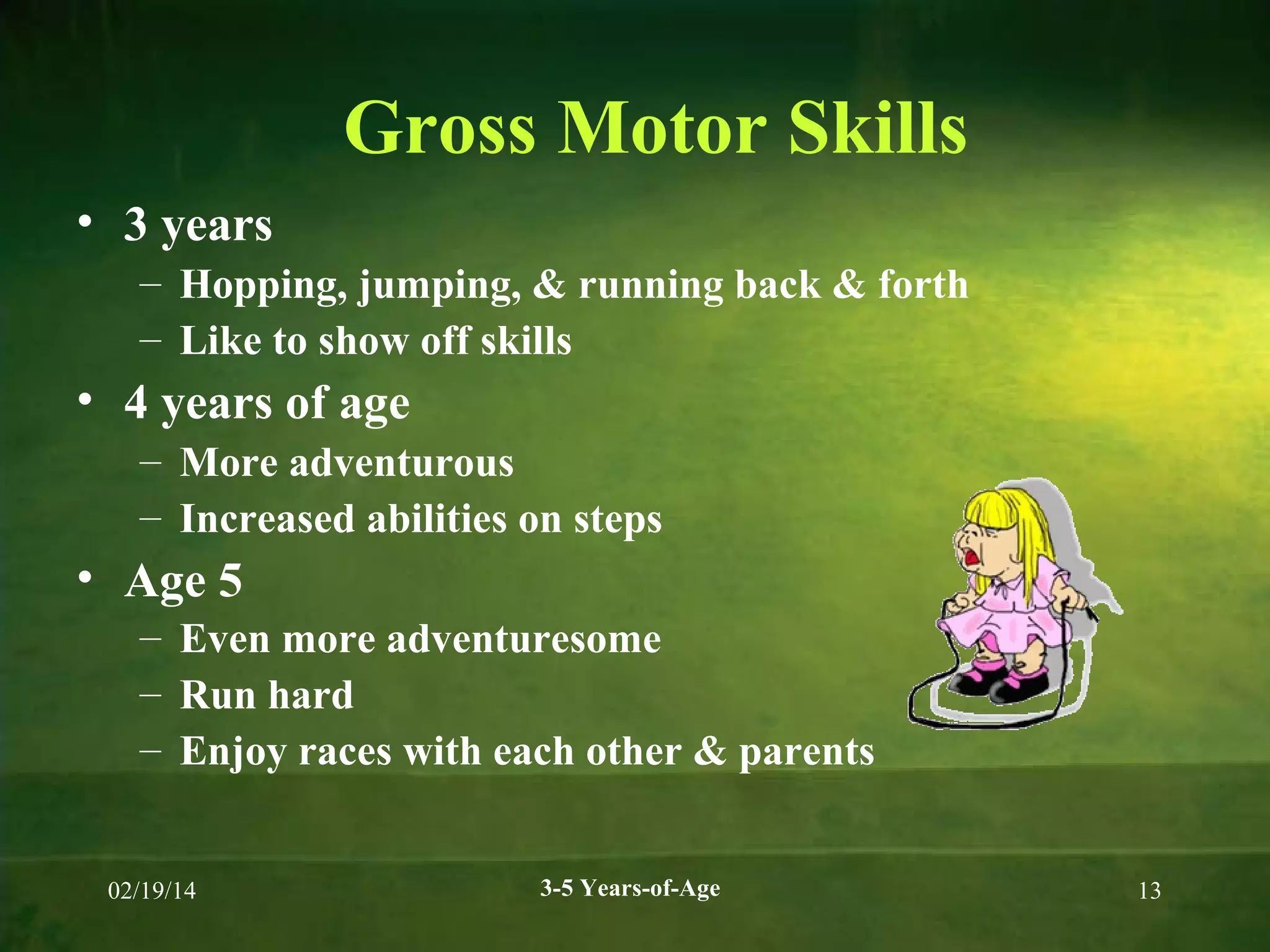
Gross Motor Skills
• 3 years
– Hopping, jumping, & running back & forth
– Like to show off skills

• 4 years of age
– More adventurous
– Increased abilities on steps

• Age 5
– Even more adventuresome
– Run hard
– Enjoy races with each other & parents
02/19/14

3-5 Years-of-Age

13
Fine Motor Skills
• Age 3:
– Can pick up tiny objects
• Clumsy

– Build high towers

• Age 4:
– Much more precise

• Age 5:
– Hand, arm, & body all move together
02/19/14

3-5 Years-of-Age

14
Motor Skills
• Recall your favorite early childhood activities.
• Did you prefer gross motor oriented activities
or fine motor oriented activities?
• How did you spend most of your time?
• Do you remember any activity that you wanted
to be able to participate in, but you were not
physically coordinated enough to do?
• Can you recall a time of triumph, when you
accomplished a particular feat for the first
time?
3-5 Years-of-Age
What Are Some Aspects of Young Children’s Health?

Nutrition
• Energy needs
– Calorie needs increase with age
– Needs vary by age, sex, & size
• Preschooler
• Up to 1,800 calories per day.

• Diets worsen as children age
– Why?

• Today’s meals exceed dietary needs
• Eating influenced by?

8

3-5 Years-of-Age
What Are Some Aspects of Young Children’s Health?

Nutrition
• Malnutrition Low-Income Families
– Most common:
• Iron deficiency anemia
– Causes chronic fatigue

– Less
• Fresh fruits
• Vegetables
• Education

– More processed foods
• Linked to cognitive deficits, physical growth
• Can improve with use of U.S. food programs
• Linked to behavioral, conduct problems
3-5 Years-of-Age
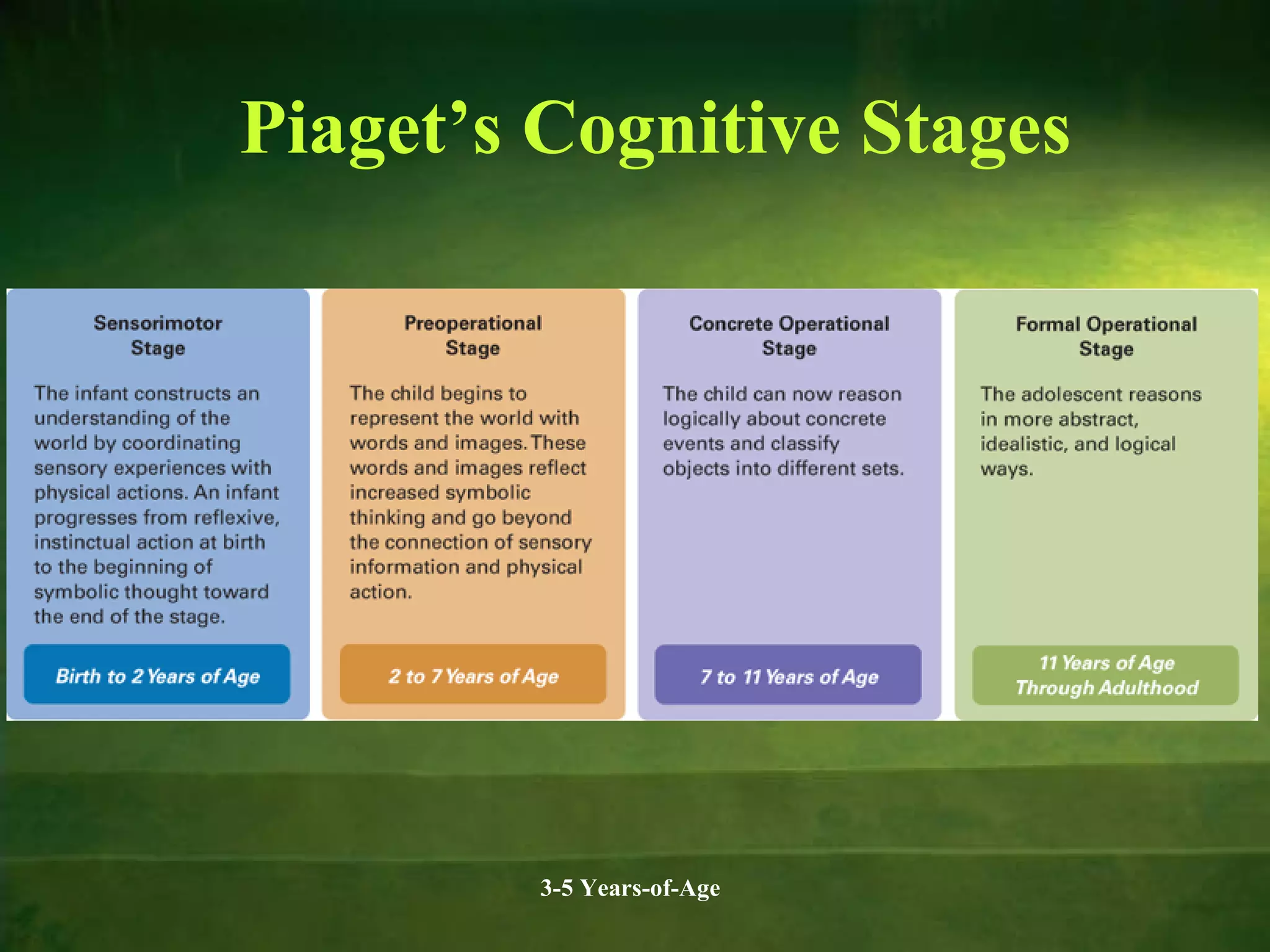
Piaget’s Cognitive Stages

3-5 Years-of-Age
3-5 Years-of-Age
Three Views of Cognitive Changes in Early Childhood

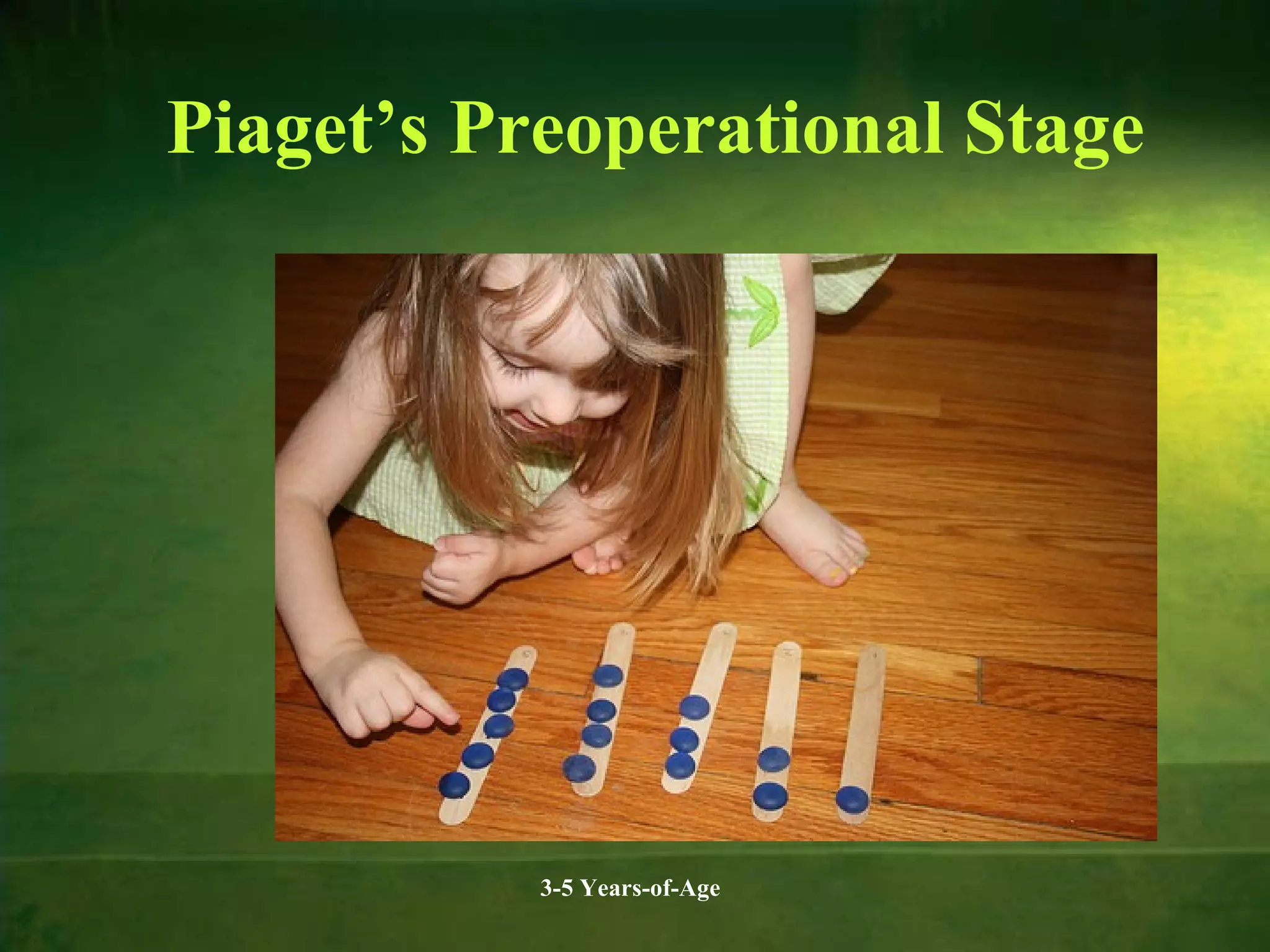
Piaget’s Preoperational Stage
• Not yet capable of operations
• What is an operation?
• Operations definition:
– Internalized set of actions highly organized
& conform to principles of logic.
• Do mentally what was done physically
before.
– Ex: Math problems in head
» Not yet capable
3-5 Years-of-Age
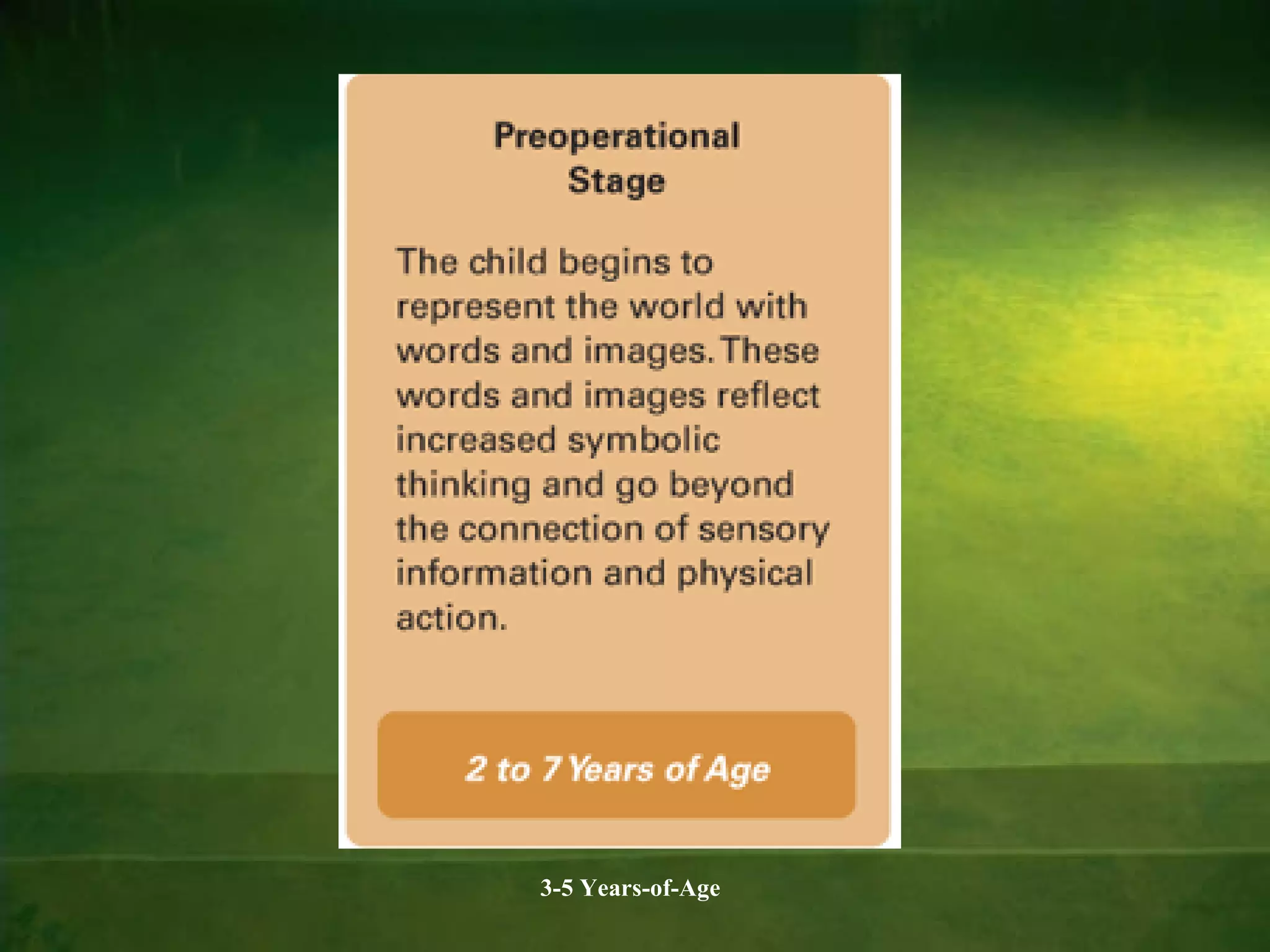
Piaget’s Preoperational Stage

3-5 Years-of-Age
Piaget’s Preoperational Stage
• Preoperational stage
– Ages 2 - 7
– Stable concepts formed
– Mental reasoning, magical beliefs
emerge
– Contains 2 substages:
– 1. Symbolic Function
– 2. Intuitive Thought
3-5 Years-of-Age
Three Views of Cognitive Changes in Early Childhood

Piaget’s Preoperational Stage
• 1. Symbolic Function Stage, Age 2 –
4
– Creates mental images of objects
• Store for later use
– Disneyland

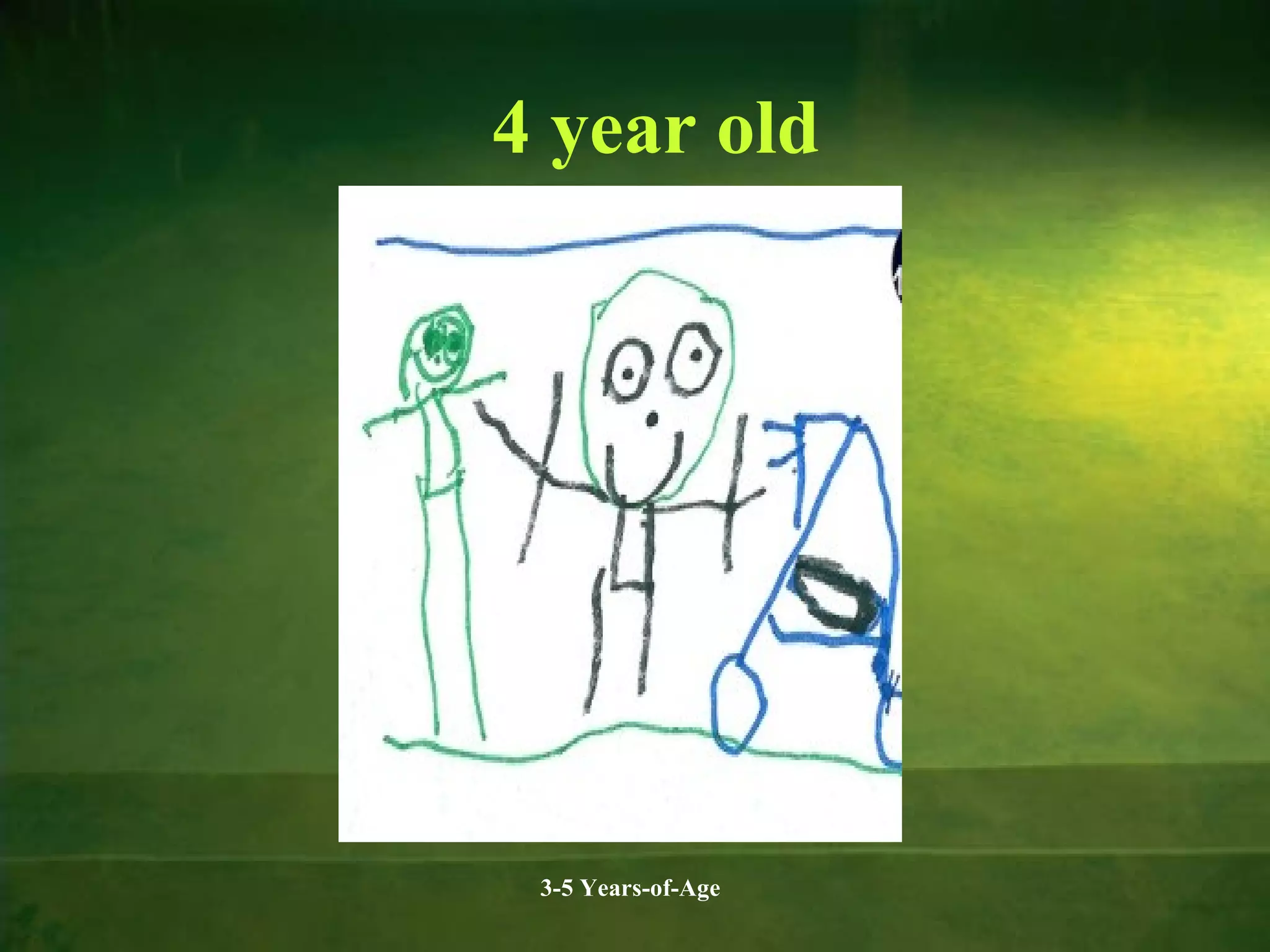
– Imaginative drawings
– Mentally represent object not present
• Ex: Scribbles represent people
– Awareness of what scribble represents even
over time. 3-5 Years-of-Age
4 year old

3-5 Years-of-Age
Piaget’s Preoperational Stage
• 1. Symbolic Function Stage
Cont.
– Thoughts limited beliefs:
• Egocentrism:
–Inability to see things from
another person's point of view.
»What happens if parents
divorce at this stage?
3-5 Years-of-Age
Piaget’s Preoperational Stage
• Symbolic Function Stage Cont.
– Animistic Thinking
• Imagining that inanimate objects
have life & mental processes.
– Child trips over coffee table, what will
they say?

3-5 Years-of-Age
Three Views of Cognitive Changes in Early Childhood

Piaget’s Preoperational Stage
• 2. Substage: Intuitive Thought
– @ 4 - 7 yrs. of age
– Primitive reasoning
• Can’t answer “what if” questions.
– Have many questions
• “What makes you grow?”

3-5 Years-of-Age
Piaget’s Preoperational Stage
Intuitive Thought Cont.
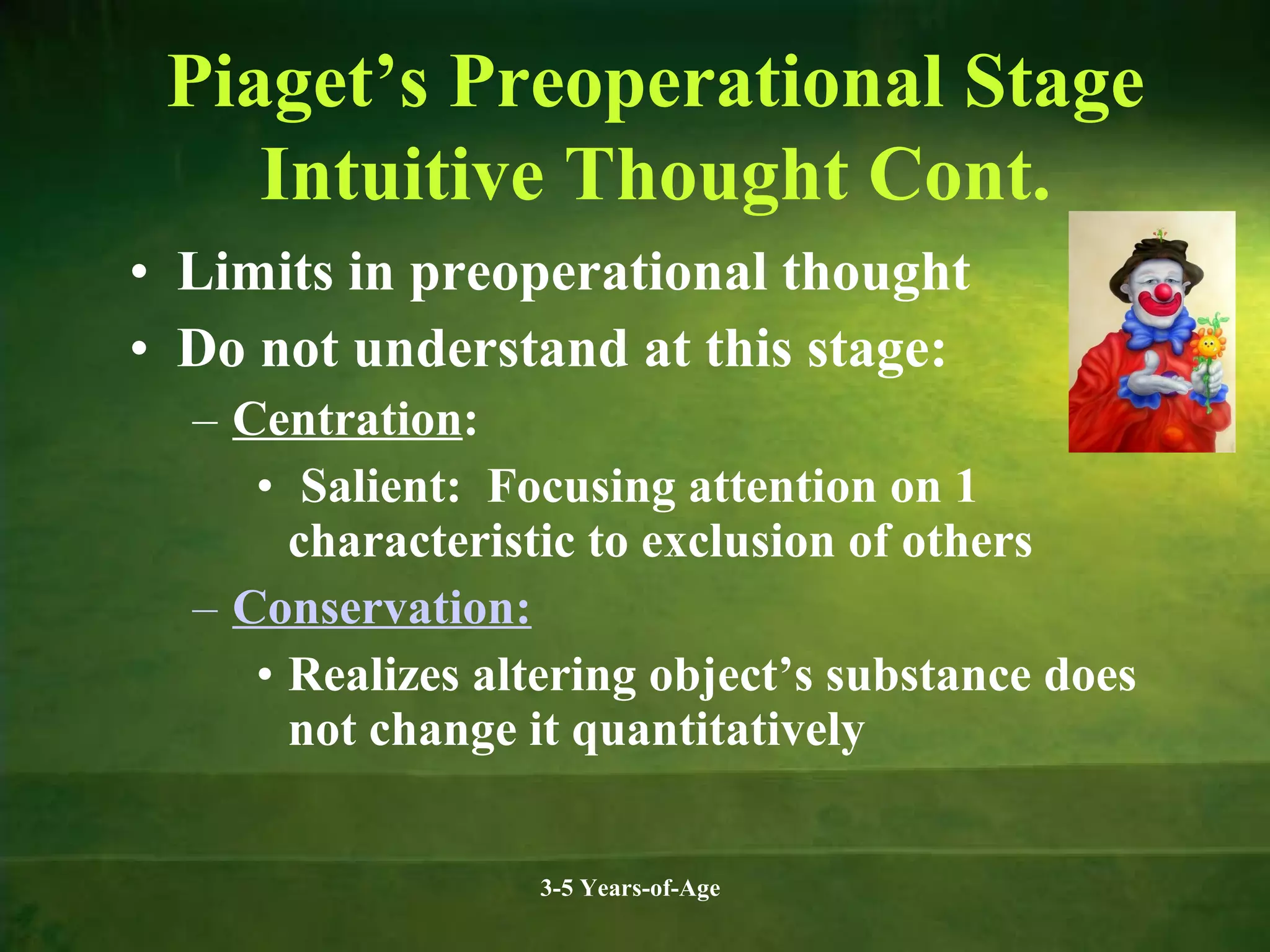
• Limits in preoperational thought
• Do not understand at this stage:
– Centration:
• Salient: Focusing attention on 1
characteristic to exclusion of others
– Conservation:
• Realizes altering object’s substance does
not change it quantitatively
3-5 Years-of-Age
Information Processing
• 2 ways preschool child’s attention
deficient:
– 1. Salient vs. relevant dimensions
• Salient means
– Attention to what stands out

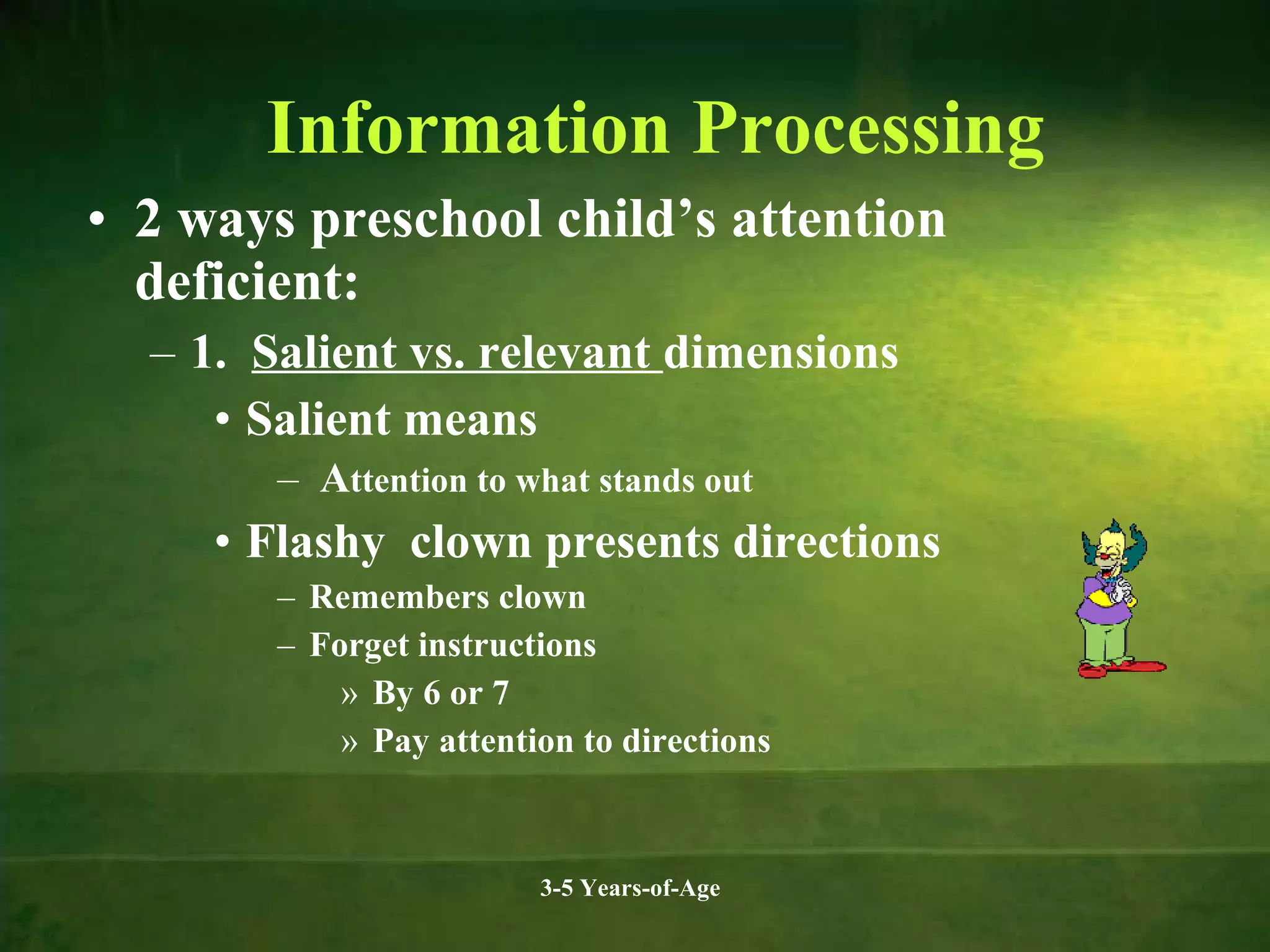
• Flashy clown presents directions
– Remembers clown
– Forget instructions
» By 6 or 7
» Pay attention to directions

3-5 Years-of-Age
Information-Processing Approach
• 2. Planfulness
– Preschool
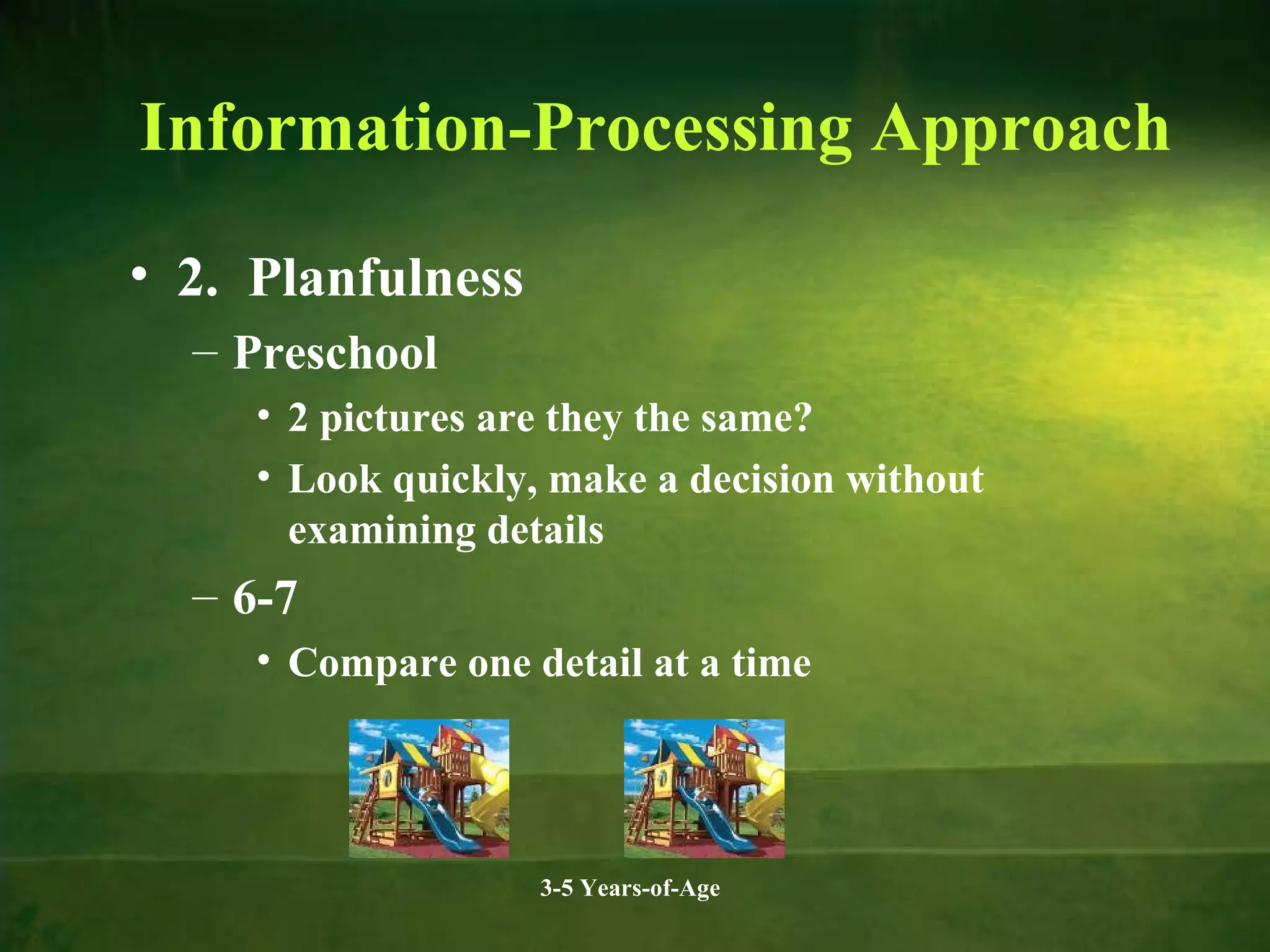
• 2 pictures are they the same?
• Look quickly, make a decision without
examining details

– 6-7
• Compare one detail at a time

3-5 Years-of-Age
School Readiness
• Longer attention spans linked to school
readiness.

3-5 Years-of-Age
Memory
• Short-term memory
– Retain information for @ 30 sec.
– Rehearsal
• (repeating information )
• Keeps information in short-term memory
longer
• Older children better able to rehearse

– Memory becomes more accurate
3-5 Years-of-Age

34
Factors Influencing Accuracy of
Memory
• Susceptible to misleading or incorrect postevent information
• Individual differences in suggestibility
• Interviewing techniques can produce
distortions
– Suggestible
• Small details
• Central aspects of event

– Interviewing kids about child abuse?
3-5 Years-of-Age

35
Theory of Mind

3-5 Years-of-Age
Theory of Mind
• Theory of Mind
– Awareness of one’s own mental processes &
the mental processes of others

• Children’s theory of mind changes as
they develop

3-5 Years-of-Age

37
Theory of Mind:
Beyond age 5
• Not until middle & late childhood
– Move from understanding that beliefs
can be false
• to

– Realizing same event can be open to
multiple interpretations

02/19/14

3-5 Years-of-Age

39
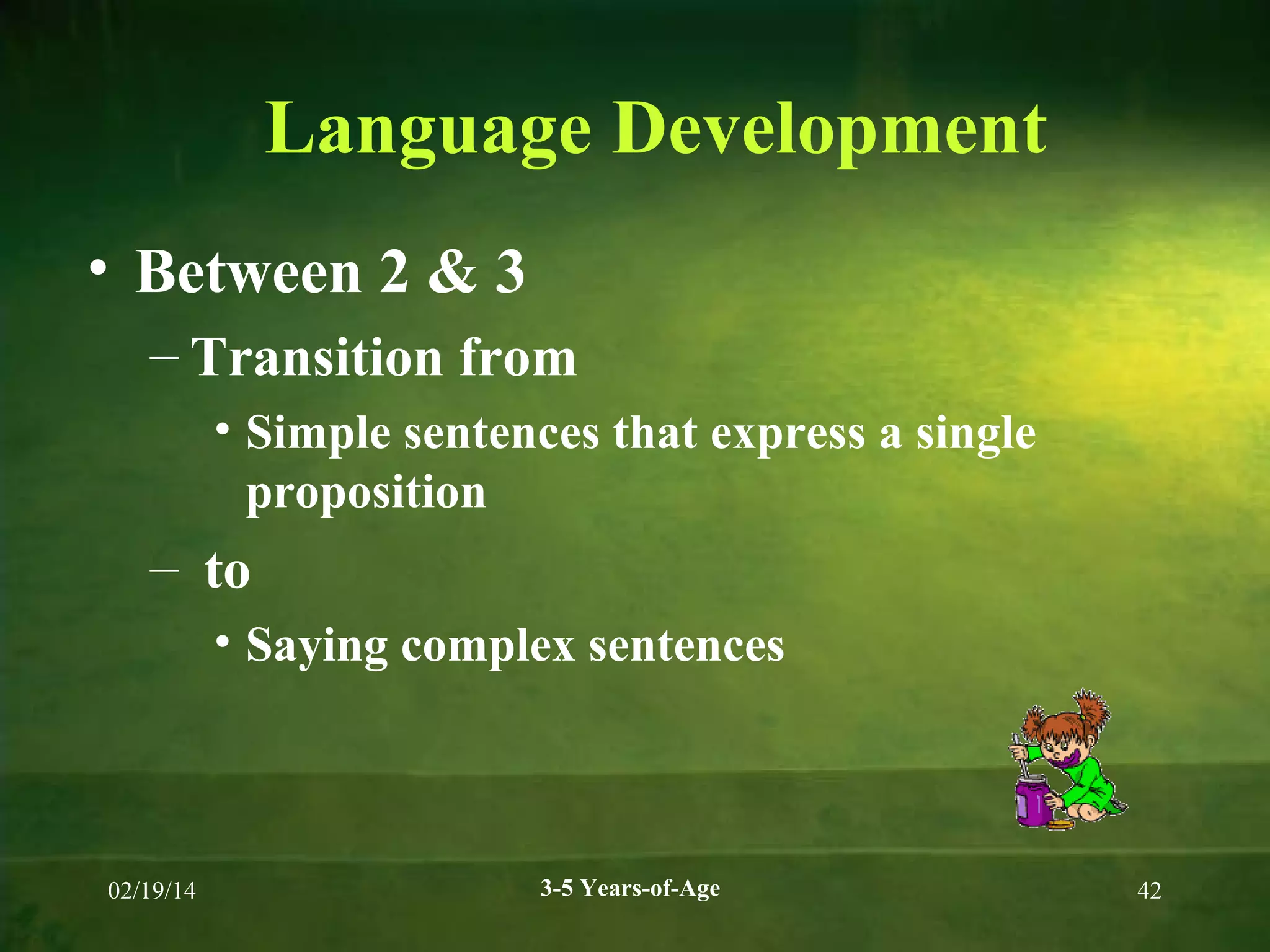
Star Wars according to a 3 year-old

3-5 Years-of-Age
3 year-old asked about monsters

3-5 Years-of-Age
Language Development
• Between 2 & 3
– Transition from
• Simple sentences that express a single
proposition

– to
• Saying complex sentences

02/19/14

3-5 Years-of-Age

42

Life span chapter 5

  • 1.
    Chapter 5 Physical andCognitive Development in Early Childhood 3-5 Years-of-Age PowerPoints developed by Jenni Fauchier, Butchered by Professor Carney 3-5 Years-of-Age
  • 2.
  • 3.
    How Does aYoung Child’s Body and Brain Grow and Change? Intimate Moment • Did the parents handle the situation well? • What could they have done differently? 3-5 Years-of-Age
  • 4.
    Physical Development • Earlychildhood 3-5 yrs. – Growth rate slows • About 2 ½” per year • 5-7 lbs. 02/19/14 3-5 Years-of-Age 4
  • 5.
  • 6.
    Physical Development • Girls –Slightly smaller & lighter – More fatty tissue • Boys – – – – – 02/19/14 More muscle tissue Heads still large for bodies Body fat slow, steady decline Body slims & trunks lengthen Increasingly aware of their bodies 3-5 Years-of-Age 6
  • 7.
    Variations in Growth •Most important factors to height differences: – 1. Ethnic origin (heredity) • African-American’s taller than white children – 2. Nutrition (environment) 3-5 Years-of-Age
  • 8.
    Variations in Growth •Growth patterns vary – Due to heredity mostly – Environment • Environmental – Urban • Middle class • 1st born children – Taller than • Rural • Lower class • Later-born children 02/19/14 3-5 Years-of-Age 8
  • 9.
    Brain and NervousSystem Development • Cognitive abilities improve – Brain maturation – Opportunities for experience? • Plan actions • Attend to stimuli more effectively • Increased language development • Brain material doubles in a year – Some areas 02/19/14 3-5 Years-of-Age 9
  • 10.
    Brain and NervousSystem Development • Prefrontal Cortex – Evolutionary advanced • 3-6 extensive development – Attention – Working memory • Pruning 02/19/14 3-5 Years-of-Age 10
  • 11.
    Neurons • Dendrites increase –Number – Size • Myelination continues – Relates to improvement of abilities • Hand-eye coordination – Complete age 4 02/19/14 3-5 Years-of-Age 11
  • 12.
  • 13.
    Gross Motor Skills •3 years – Hopping, jumping, & running back & forth – Like to show off skills • 4 years of age – More adventurous – Increased abilities on steps • Age 5 – Even more adventuresome – Run hard – Enjoy races with each other & parents 02/19/14 3-5 Years-of-Age 13
  • 14.
    Fine Motor Skills •Age 3: – Can pick up tiny objects • Clumsy – Build high towers • Age 4: – Much more precise • Age 5: – Hand, arm, & body all move together 02/19/14 3-5 Years-of-Age 14
  • 15.
    Motor Skills • Recallyour favorite early childhood activities. • Did you prefer gross motor oriented activities or fine motor oriented activities? • How did you spend most of your time? • Do you remember any activity that you wanted to be able to participate in, but you were not physically coordinated enough to do? • Can you recall a time of triumph, when you accomplished a particular feat for the first time? 3-5 Years-of-Age
  • 16.
    What Are SomeAspects of Young Children’s Health? Nutrition • Energy needs – Calorie needs increase with age – Needs vary by age, sex, & size • Preschooler • Up to 1,800 calories per day. • Diets worsen as children age – Why? • Today’s meals exceed dietary needs • Eating influenced by? 8 3-5 Years-of-Age
  • 17.
    What Are SomeAspects of Young Children’s Health? Nutrition • Malnutrition Low-Income Families – Most common: • Iron deficiency anemia – Causes chronic fatigue – Less • Fresh fruits • Vegetables • Education – More processed foods • Linked to cognitive deficits, physical growth • Can improve with use of U.S. food programs • Linked to behavioral, conduct problems 3-5 Years-of-Age
  • 18.
  • 19.
  • 20.
    Three Views ofCognitive Changes in Early Childhood Piaget’s Preoperational Stage • Not yet capable of operations • What is an operation? • Operations definition: – Internalized set of actions highly organized & conform to principles of logic. • Do mentally what was done physically before. – Ex: Math problems in head » Not yet capable 3-5 Years-of-Age
  • 21.
  • 22.
    Piaget’s Preoperational Stage •Preoperational stage – Ages 2 - 7 – Stable concepts formed – Mental reasoning, magical beliefs emerge – Contains 2 substages: – 1. Symbolic Function – 2. Intuitive Thought 3-5 Years-of-Age
  • 23.
    Three Views ofCognitive Changes in Early Childhood Piaget’s Preoperational Stage • 1. Symbolic Function Stage, Age 2 – 4 – Creates mental images of objects • Store for later use – Disneyland – Imaginative drawings – Mentally represent object not present • Ex: Scribbles represent people – Awareness of what scribble represents even over time. 3-5 Years-of-Age
  • 24.
    4 year old 3-5Years-of-Age
  • 25.
    Piaget’s Preoperational Stage •1. Symbolic Function Stage Cont. – Thoughts limited beliefs: • Egocentrism: –Inability to see things from another person's point of view. »What happens if parents divorce at this stage? 3-5 Years-of-Age
  • 26.
    Piaget’s Preoperational Stage •Symbolic Function Stage Cont. – Animistic Thinking • Imagining that inanimate objects have life & mental processes. – Child trips over coffee table, what will they say? 3-5 Years-of-Age
  • 27.
    Three Views ofCognitive Changes in Early Childhood Piaget’s Preoperational Stage • 2. Substage: Intuitive Thought – @ 4 - 7 yrs. of age – Primitive reasoning • Can’t answer “what if” questions. – Have many questions • “What makes you grow?” 3-5 Years-of-Age
  • 28.
    Piaget’s Preoperational Stage IntuitiveThought Cont. • Limits in preoperational thought • Do not understand at this stage: – Centration: • Salient: Focusing attention on 1 characteristic to exclusion of others – Conservation: • Realizes altering object’s substance does not change it quantitatively 3-5 Years-of-Age
  • 29.
    Information Processing • 2ways preschool child’s attention deficient: – 1. Salient vs. relevant dimensions • Salient means – Attention to what stands out • Flashy clown presents directions – Remembers clown – Forget instructions » By 6 or 7 » Pay attention to directions 3-5 Years-of-Age
  • 30.
    Information-Processing Approach • 2.Planfulness – Preschool • 2 pictures are they the same? • Look quickly, make a decision without examining details – 6-7 • Compare one detail at a time 3-5 Years-of-Age
  • 31.
    School Readiness • Longerattention spans linked to school readiness. 3-5 Years-of-Age
  • 32.
    Memory • Short-term memory –Retain information for @ 30 sec. – Rehearsal • (repeating information ) • Keeps information in short-term memory longer • Older children better able to rehearse – Memory becomes more accurate 3-5 Years-of-Age 34
  • 33.
    Factors Influencing Accuracyof Memory • Susceptible to misleading or incorrect postevent information • Individual differences in suggestibility • Interviewing techniques can produce distortions – Suggestible • Small details • Central aspects of event – Interviewing kids about child abuse? 3-5 Years-of-Age 35
  • 34.
    Theory of Mind 3-5Years-of-Age
  • 35.
    Theory of Mind •Theory of Mind – Awareness of one’s own mental processes & the mental processes of others • Children’s theory of mind changes as they develop 3-5 Years-of-Age 37
  • 36.
    Theory of Mind: Beyondage 5 • Not until middle & late childhood – Move from understanding that beliefs can be false • to – Realizing same event can be open to multiple interpretations 02/19/14 3-5 Years-of-Age 39
  • 37.
    Star Wars accordingto a 3 year-old 3-5 Years-of-Age
  • 38.
    3 year-old askedabout monsters 3-5 Years-of-Age
  • 39.
    Language Development • Between2 & 3 – Transition from • Simple sentences that express a single proposition – to • Saying complex sentences 02/19/14 3-5 Years-of-Age 42