Chapter 7
Physical and Cognitive Development
in Middle and Late Childhood

6-11 Years-of-Age

PowerPoints developed by Jenni Fauchier,
Butchered by Professor Carney
Body Growth & Change
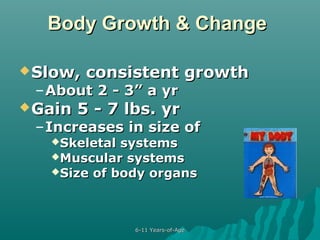
 Slow,

consistent growth

– About 2 - 3” a yr

 Gain

5 - 7 lbs. yr

– Increases in size of
Skeletal

systems
Muscular systems
Size of body organs

6-11 Years-of-Age
Body Growth & Change
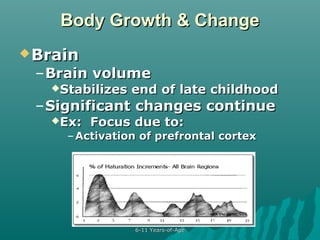
 Brain

– Brain volume
Stabilizes

end of late childhood

– Significant changes continue
Ex:

Focus due to:

– Activation of prefrontal cortex

6-11 Years-of-Age
Focal Activation Prefrontal
Cortex
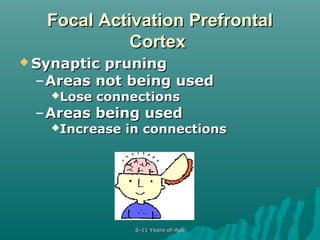
 Synaptic

pruning
– Areas not being used
Lose

connections

– Areas being used
Increase

in connections

6-11 Years-of-Age
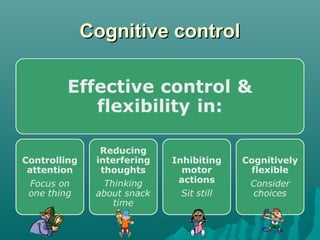
Cognitive control
Motor Development
 Middle/late

childhood:

– Smoother movement
– Better coordination
– Mastered skills source of pleasure
– Boys better gross motor skills
 Fine motor

skills

– Improvement due to increased
myelination
– Able to write script
6-11 Years-of-Age
Exercise
 Research:

– Exercise
 Important

in growth & development.

6-11 Years-of-Age
Children with Disabilities
 Gov’t

defines learning disabilities

– Top of pg. 179 complete def.
 3x’s

more common in boys
 Children excluded:
– Severe emotional disorders
– 2nd language background
– Sensory disabilities
 EX:

Blind

– Neurological deficits
6-11 Years-of-Age
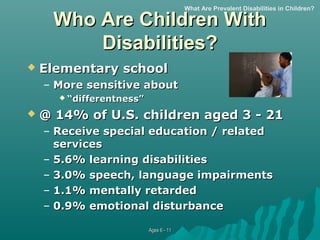
What Are Prevalent Disabilities in Children?

Who Are Children With
Disabilities?


Elementary school
– More sensitive about
 “differentness”



@ 14% of U.S. children aged 3 - 21
– Receive special education / related
services
– 5.6% learning disabilities
– 3.0% speech, language impairments
– 1.1% mentally retarded
– 0.9% emotional disturbance
Ages 6 - 11
Children with Disabilities


Learning disabilities definition
includes:
– Significant difficulty in school-related area
 Listening
 Thinking
 Reading
 Writing
 Spelling
 Math

– 80% of LD’s also have reading problems

6-11 Years-of-Age
Specific Disabilities


Dyslexia
– Severe impairment in ability to read &
spell
 Common problem
 Writing may be extremely slow &
illegible
 Spelling errors
– Problem matching sounds & letters

6-11 Years-of-Age
Causes of Learning Disability
 Nature:

Genes

– LDs run in families
 Nurture:

Environmental
influences
– How can this occur?

6-11 Years-of-Age
Causes of Learning Disability
 Unlikely

– Reside in 1, specific brain location
 More

likely

– Due to problems such as:


Integrating information from multiple
brain regions

6-11 Years-of-Age
Attention Deficit Hyperactivity
Disorder (ADHD)
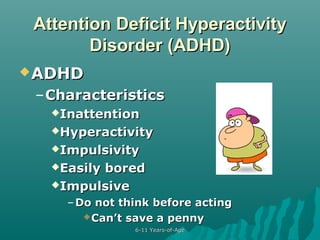
 ADHD

– Characteristics
Inattention
Hyperactivity
Impulsivity
Easily

bored
Impulsive
– Do not think before acting
 Can’t save a penny
6-11 Years-of-Age
Treatment of ADHD


Combination of
– Stimulant medication
 Ritalin

or Adderall

– Behavior management


Improves behavior better than either alone

Exercise
 Thoughts?


– Physicians too quick to prescribe
stimulants for kids with milder forms of
ADHD?
– Bipolar Disorder R/O
6-11 Years-of-Age
Caring for Children

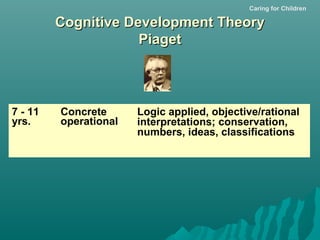
Cognitive Development Theory
Piaget

7 - 11
yrs.

Concrete
operational

Logic applied, objective/rational
interpretations; conservation,
numbers, ideas, classifications
Piaget
 Can

reason logically

– Must have a specific example
– Has conservation
– Can do in head what did on paper
– Understand dad has other functions
in life

6-11 Years-of-Age
Information Processing
 Information-processing

– How children process information
about their world
 Dramatic

improvement (6-11)

– Sustain & control attention
improves

6-11 Years-of-Age
Memory
 After

age 7

– Short-term memory
Not

as much of increase as
preschool period

– Long-term memory
Increases

with age

– Improvements reflect increased
 Knowledge
 Use of memory strategies
6-11 Years-of-Age
Thinking
 Critical

thinking

– Thinking reflectively &
productively
– Evaluating evidence
 Creative

thinking

– Think in novel & unusual ways
– Unique solutions
– May be creative in 1 area, not
another
6-11 Years-of-Age
Creative Thinking
 Guilford

(1967) distinguished
between:
– Convergent thinking
– Divergent thinking

6-11 Years-of-Age
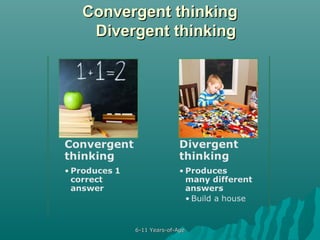
Convergent thinking
Divergent thinking

6-11 Years-of-Age
Intelligence
 Intelligence

– Ability to solve problems & to adapt
& learn from experiences

6-11 Years-of-Age
Historic Assessments of
Intelligence
 Binet

& Simon, France 1904

– Developed test
 Purpose

– Identify children unable to learn in school

– Developed concept of mental age
(MA)
 An

individual’s level of mental
development relative to others

6-11 Years-of-Age
Wechsler Scales
 Overall

IQ

– Verbal Comprehension Index
– Working Memory Index
– Processing Speed Index
Determines

weak & strong areas

6-11 Years-of-Age
Types of Intelligence:
 Sternberg’s

Triarchic Theory
of intelligence
– 3 forms of Intelligence:
1.

Analytical intelligence
2. Creative intelligence
3. Practical intelligence

6-11 Years-of-Age
Triarchic theory of intelligence

Sternberg Cont.
 1.

Analytical intelligence

– Ability to:
Analyze
Judge
Evaluate
Compare
Contrast

6-11 Years-of-Age
Triarchic theory of
intelligence Sternberg Cont.
 2.

Creative intelligence

– Ability to:
Create
Design
Invent
Originate
Imagine

6-11 Years-of-Age
Triarchic theory of
intelligence Sternberg Cont.
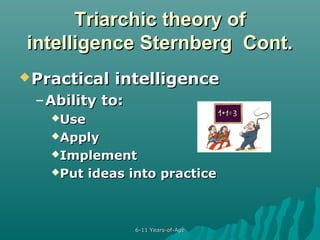
 Practical

intelligence

– Ability to:
Use
Apply
Implement
Put

ideas into practice

6-11 Years-of-Age
Triarchic theory of
intelligence Sternberg Cont.
 In

school:

– High analytic
 Favored

in conventional schooling

– High creative
 Not

at top of class, do not conform to
expectations

– High practical
 Do

not relate well to demands of school
 Often successful as adults
6-11 Years-of-Age
Types of Intelligence: Howard
Gardner
8 types of intelligence, or “frames of
mind”
– verbal
– mathematical
– spatial
– bodilykinesthetic

– musical
– interpersonal
– intrapersonal
– naturalist

Everyone has all of these intelligences to
varying degrees. Which are your strengths?
6-11 Years-of-Age
Interpreting Differences in IQ
Scores
Most researchers agree:
–Genetics
–Environment
Interact

to influence
intelligence

6-11 Years-of-Age
Group Differences
 IQ

tests U.S. children

– Score lower than white
 African-American
 Latinos

 Why?

– Biased tests?
– Cultural differences?
– What else?
6-11 Years-of-Age
Creating Culture-Fair Tests


Culture-fair tests
– Intended to be free of cultural bias



2 types devised
– 1. Items familiar to children from all
socioeconomic & ethnic
backgrounds
 Or

– Items that are familiar to the
children
– 2. No verbal questions
6-11 Years-of-Age
Using Intelligence Tests



Psychological tests are tools
Avoid using information in negative ways
– Avoid stereotyping & expectations
– IQ NOT sole indicator of competence
– Use caution in interpreting an overall IQ
score

6-11 Years-of-Age

Life span chapter 7

  • 1.
    Chapter 7 Physical andCognitive Development in Middle and Late Childhood 6-11 Years-of-Age PowerPoints developed by Jenni Fauchier, Butchered by Professor Carney
  • 2.
    Body Growth &Change  Slow, consistent growth – About 2 - 3” a yr  Gain 5 - 7 lbs. yr – Increases in size of Skeletal systems Muscular systems Size of body organs 6-11 Years-of-Age
  • 3.
    Body Growth &Change  Brain – Brain volume Stabilizes end of late childhood – Significant changes continue Ex: Focus due to: – Activation of prefrontal cortex 6-11 Years-of-Age
  • 4.
    Focal Activation Prefrontal Cortex Synaptic pruning – Areas not being used Lose connections – Areas being used Increase in connections 6-11 Years-of-Age
  • 5.
  • 6.
    Motor Development  Middle/late childhood: –Smoother movement – Better coordination – Mastered skills source of pleasure – Boys better gross motor skills  Fine motor skills – Improvement due to increased myelination – Able to write script 6-11 Years-of-Age
  • 7.
    Exercise  Research: – Exercise Important in growth & development. 6-11 Years-of-Age
  • 8.
    Children with Disabilities Gov’t defines learning disabilities – Top of pg. 179 complete def.  3x’s more common in boys  Children excluded: – Severe emotional disorders – 2nd language background – Sensory disabilities  EX: Blind – Neurological deficits 6-11 Years-of-Age
  • 9.
    What Are PrevalentDisabilities in Children? Who Are Children With Disabilities?  Elementary school – More sensitive about  “differentness”  @ 14% of U.S. children aged 3 - 21 – Receive special education / related services – 5.6% learning disabilities – 3.0% speech, language impairments – 1.1% mentally retarded – 0.9% emotional disturbance Ages 6 - 11
  • 10.
    Children with Disabilities  Learningdisabilities definition includes: – Significant difficulty in school-related area  Listening  Thinking  Reading  Writing  Spelling  Math – 80% of LD’s also have reading problems 6-11 Years-of-Age
  • 11.
    Specific Disabilities  Dyslexia – Severeimpairment in ability to read & spell  Common problem  Writing may be extremely slow & illegible  Spelling errors – Problem matching sounds & letters 6-11 Years-of-Age
  • 12.
    Causes of LearningDisability  Nature: Genes – LDs run in families  Nurture: Environmental influences – How can this occur? 6-11 Years-of-Age
  • 13.
    Causes of LearningDisability  Unlikely – Reside in 1, specific brain location  More likely – Due to problems such as:  Integrating information from multiple brain regions 6-11 Years-of-Age
  • 14.
    Attention Deficit Hyperactivity Disorder(ADHD)  ADHD – Characteristics Inattention Hyperactivity Impulsivity Easily bored Impulsive – Do not think before acting  Can’t save a penny 6-11 Years-of-Age
  • 15.
    Treatment of ADHD  Combinationof – Stimulant medication  Ritalin or Adderall – Behavior management  Improves behavior better than either alone Exercise  Thoughts?  – Physicians too quick to prescribe stimulants for kids with milder forms of ADHD? – Bipolar Disorder R/O 6-11 Years-of-Age
  • 16.
    Caring for Children CognitiveDevelopment Theory Piaget 7 - 11 yrs. Concrete operational Logic applied, objective/rational interpretations; conservation, numbers, ideas, classifications
  • 17.
    Piaget  Can reason logically –Must have a specific example – Has conservation – Can do in head what did on paper – Understand dad has other functions in life 6-11 Years-of-Age
  • 18.
    Information Processing  Information-processing –How children process information about their world  Dramatic improvement (6-11) – Sustain & control attention improves 6-11 Years-of-Age
  • 19.
    Memory  After age 7 –Short-term memory Not as much of increase as preschool period – Long-term memory Increases with age – Improvements reflect increased  Knowledge  Use of memory strategies 6-11 Years-of-Age
  • 20.
    Thinking  Critical thinking – Thinkingreflectively & productively – Evaluating evidence  Creative thinking – Think in novel & unusual ways – Unique solutions – May be creative in 1 area, not another 6-11 Years-of-Age
  • 21.
    Creative Thinking  Guilford (1967)distinguished between: – Convergent thinking – Divergent thinking 6-11 Years-of-Age
  • 22.
  • 23.
    Intelligence  Intelligence – Abilityto solve problems & to adapt & learn from experiences 6-11 Years-of-Age
  • 24.
    Historic Assessments of Intelligence Binet & Simon, France 1904 – Developed test  Purpose – Identify children unable to learn in school – Developed concept of mental age (MA)  An individual’s level of mental development relative to others 6-11 Years-of-Age
  • 25.
    Wechsler Scales  Overall IQ –Verbal Comprehension Index – Working Memory Index – Processing Speed Index Determines weak & strong areas 6-11 Years-of-Age
  • 26.
    Types of Intelligence: Sternberg’s Triarchic Theory of intelligence – 3 forms of Intelligence: 1. Analytical intelligence 2. Creative intelligence 3. Practical intelligence 6-11 Years-of-Age
  • 27.
    Triarchic theory ofintelligence Sternberg Cont.  1. Analytical intelligence – Ability to: Analyze Judge Evaluate Compare Contrast 6-11 Years-of-Age
  • 28.
    Triarchic theory of intelligenceSternberg Cont.  2. Creative intelligence – Ability to: Create Design Invent Originate Imagine 6-11 Years-of-Age
  • 29.
    Triarchic theory of intelligenceSternberg Cont.  Practical intelligence – Ability to: Use Apply Implement Put ideas into practice 6-11 Years-of-Age
  • 30.
    Triarchic theory of intelligenceSternberg Cont.  In school: – High analytic  Favored in conventional schooling – High creative  Not at top of class, do not conform to expectations – High practical  Do not relate well to demands of school  Often successful as adults 6-11 Years-of-Age
  • 31.
    Types of Intelligence:Howard Gardner 8 types of intelligence, or “frames of mind” – verbal – mathematical – spatial – bodilykinesthetic – musical – interpersonal – intrapersonal – naturalist Everyone has all of these intelligences to varying degrees. Which are your strengths? 6-11 Years-of-Age
  • 32.
    Interpreting Differences inIQ Scores Most researchers agree: –Genetics –Environment Interact to influence intelligence 6-11 Years-of-Age
  • 33.
    Group Differences  IQ testsU.S. children – Score lower than white  African-American  Latinos  Why? – Biased tests? – Cultural differences? – What else? 6-11 Years-of-Age
  • 34.
    Creating Culture-Fair Tests  Culture-fairtests – Intended to be free of cultural bias  2 types devised – 1. Items familiar to children from all socioeconomic & ethnic backgrounds  Or – Items that are familiar to the children – 2. No verbal questions 6-11 Years-of-Age
  • 35.
    Using Intelligence Tests   Psychologicaltests are tools Avoid using information in negative ways – Avoid stereotyping & expectations – IQ NOT sole indicator of competence – Use caution in interpreting an overall IQ score 6-11 Years-of-Age