By Babli Sharma
B.Optom, M.Optom
 Pseudostrabismus is the
clinical impression of
ocular deviation when no
squint is present.
Epicanthic folds may
simulate an esotropia
Abnormal interpupillary
distance, if short may
simulate an esotropia and if
wide an exotropia
Prominent epicanthic folds
Simulating esotropia
Wide interpupillary distance
simulating exotropia
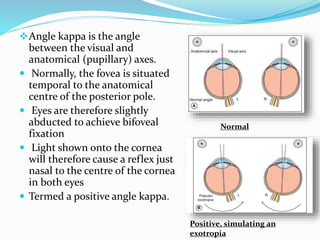
Angle kappa is the angle
between the visual and
anatomical (pupillary) axes.
 Normally, the fovea is situated
temporal to the anatomical
centre of the posterior pole.
 Eyes are therefore slightly
abducted to achieve bifoveal
fixation
 Light shown onto the cornea
will therefore cause a reflex just
nasal to the centre of the cornea
in both eyes
 Termed a positive angle kappa.
Normal
Positive, simulating an
exotropia
 A large positive angle kappa
(e.g. temporally displaced
macula) may give a
pseudoexotropia
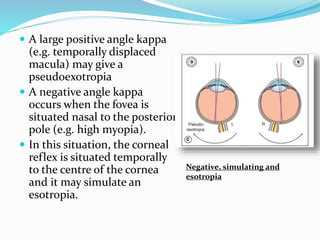
 A negative angle kappa
occurs when the fovea is
situated nasal to the posterior
pole (e.g. high myopia).
 In this situation, the corneal
reflex is situated temporally
to the centre of the cornea
and it may simulate an
esotropia.
Negative, simulating and
esotropia
THANK YOU

PSEUDOSTRABISMUS.pptx

  • 1.
  • 2.
     Pseudostrabismus isthe clinical impression of ocular deviation when no squint is present. Epicanthic folds may simulate an esotropia Abnormal interpupillary distance, if short may simulate an esotropia and if wide an exotropia Prominent epicanthic folds Simulating esotropia Wide interpupillary distance simulating exotropia
  • 3.
    Angle kappa isthe angle between the visual and anatomical (pupillary) axes.  Normally, the fovea is situated temporal to the anatomical centre of the posterior pole.  Eyes are therefore slightly abducted to achieve bifoveal fixation  Light shown onto the cornea will therefore cause a reflex just nasal to the centre of the cornea in both eyes  Termed a positive angle kappa. Normal Positive, simulating an exotropia
  • 4.
     A largepositive angle kappa (e.g. temporally displaced macula) may give a pseudoexotropia  A negative angle kappa occurs when the fovea is situated nasal to the posterior pole (e.g. high myopia).  In this situation, the corneal reflex is situated temporally to the centre of the cornea and it may simulate an esotropia. Negative, simulating and esotropia
  • 5.