Soft Contact Lens Material
By Babli Sharma
B.Optom, M.Optom
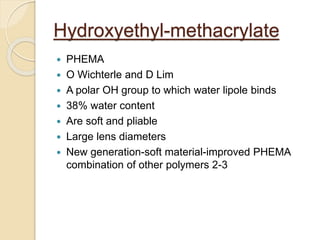
Hydroxyethyl-methacrylate
 PHEMA
 O Wichterle and D Lim
 A polar OH group to which water lipole binds
 38% water content
 Are soft and pliable
 Large lens diameters
 New generation-soft material-improved PHEMA
combination of other polymers 2-3
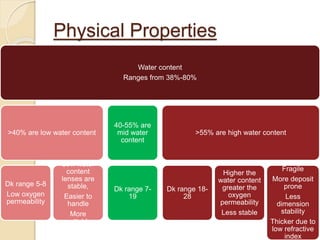
Physical Properties
Water content
Ranges from 38%-80%
>40% are low water content
Dk range 5-8
Low oxygen
permeability
Low water
content
lenses are
stable,
Easier to
handle
More
wettable
40-55% are
mid water
content
Dk range 7-
19
>55% are high water content
Dk range 18-
28
Higher the
water content
greater the
oxygen
permeability
Less stable
Fragile
More deposit
prone
Less
dimension
stability
Thicker due to
low refractive
index
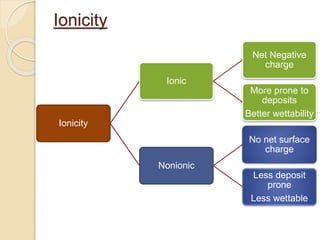
Ionicity
Ionicity
Ionic
Net Negative
charge
More prone to
deposits
Better wettability
Nonionic
No net surface
charge
Less deposit
prone
Less wettable
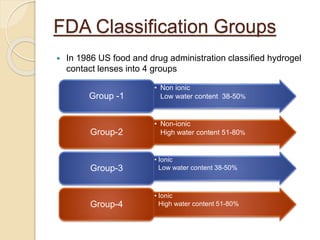
FDA Classification Groups
 In 1986 US food and drug administration classified hydrogel
contact lenses into 4 groups
• Non ionic
Low water content 38-50%
Group -1
• Non-ionic
High water content 51-80%
Group-2
• Ionic
Low water content 38-50%
Group-3
• Ionic
High water content 51-80%
Group-4
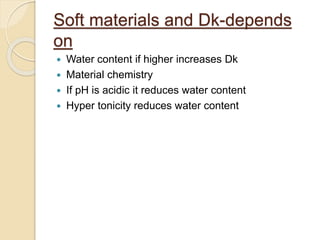
Soft materials and Dk-depends
on
 Water content if higher increases Dk
 Material chemistry
 If pH is acidic it reduces water content
 Hyper tonicity reduces water content
Thank you

Soft Contact Lens Material.pptx

  • 1.
    Soft Contact LensMaterial By Babli Sharma B.Optom, M.Optom
  • 2.
    Hydroxyethyl-methacrylate  PHEMA  OWichterle and D Lim  A polar OH group to which water lipole binds  38% water content  Are soft and pliable  Large lens diameters  New generation-soft material-improved PHEMA combination of other polymers 2-3
  • 3.
    Physical Properties Water content Rangesfrom 38%-80% >40% are low water content Dk range 5-8 Low oxygen permeability Low water content lenses are stable, Easier to handle More wettable 40-55% are mid water content Dk range 7- 19 >55% are high water content Dk range 18- 28 Higher the water content greater the oxygen permeability Less stable Fragile More deposit prone Less dimension stability Thicker due to low refractive index
  • 4.
    Ionicity Ionicity Ionic Net Negative charge More proneto deposits Better wettability Nonionic No net surface charge Less deposit prone Less wettable
  • 5.
    FDA Classification Groups In 1986 US food and drug administration classified hydrogel contact lenses into 4 groups • Non ionic Low water content 38-50% Group -1 • Non-ionic High water content 51-80% Group-2 • Ionic Low water content 38-50% Group-3 • Ionic High water content 51-80% Group-4
  • 6.
    Soft materials andDk-depends on  Water content if higher increases Dk  Material chemistry  If pH is acidic it reduces water content  Hyper tonicity reduces water content
  • 7.