Binocular vision anomalies and vision therapy for
By Endalew Mulugeta (BSc, MSc in clinical
optometry
3rd-year optometry students
December 31, 2025
Chapter 4
 Strabismus
Course Title: Fundamentals of Strabismus Diagnosis and
Management
Target Audience: Third year Optometry students
December 31, 2025
Course objective
 At the end of this course Learners will be:
 Able to independently perform a comprehensive sensory and
motor examination on a patient with suspected strabismus
Accurately diagnose the type of deviation
Formulate an appropriate initial management plan
December 31, 2025
Outline
 Highlights of EOM Function:
Define Basic Terminologies of strabismus
Understand Classification of Strabismus
Discuss motor and sensory evaluations of strabismus
Brainstorming
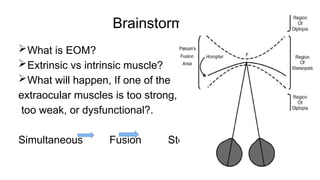
What is EOM?
Extrinsic vs intrinsic muscle?
What will happen, If one of the
extraocular muscles is too strong,
too weak, or dysfunctional?.
Simultaneous Fusion Stereopsis
December 31, 2025
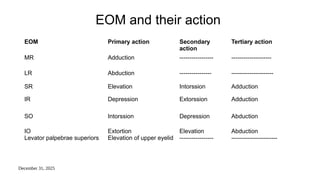
EOM and their action
EOM Primary action Secondary
action
Tertiary action
MR Adduction ----------------- --------------------
LR Abduction ---------------- ---------------------
SR Elevation Intorssion Adduction
IR Depression Extorssion Adduction
SO Intorssion Depression Abduction
IO
Levator palpebrae superiors
Extortion
Elevation of upper eyelid
Elevation
-----------------
Abduction
-----------------------
December 31, 2025
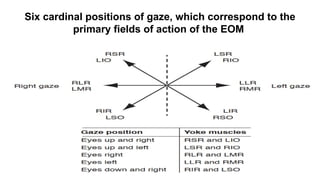
Six cardinal positions of gaze, which correspond to the
primary fields of action of the EOM
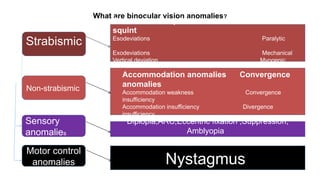
What are binocular vision anomalies?
Strabismic
Concomitant squint Incomitant
squint
Esodeviations Paralytic
Exodeviations Mechanical
Vertical deviation Myogenic
Neurogenic
Non-strabismic
Sensory
anomalies
Motor control
anomalies
Accommodation anomalies Convergence
anomalies
Accommodation weakness Convergence
insufficiency
Accommodation insufficiency Divergence
insufficiency
Accommodation excess Convergence excess
Accommodation spasm Divergence excess
Accommodation paralysis
Diplopia,ARC,Eccentric fixation ,Suppression,
Amblyopia
Nystagmus
December 31, 2025
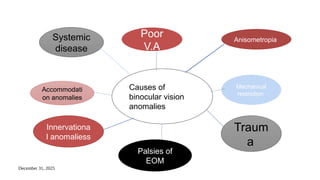
Causes of
binocular vision
anomalies
Systemic
disease
Poor
V.A
Anisometropia
Accommodati
on anomalies
Innervationa
l anomaliess
Palsies of
EOM
Mechanical
restriction
Traum
a
Strabismus
Definition
December 31, 2025
Onset of strabismus
• Strabismus may be infantile or acquired.
•The term infantile rather than congenital is preferred
because the presence of true strabismus at birth is
uncommon, and the term infantile permits inclusion of
varieties that develop within the first 6 months of life.
•The term acquired includes varieties that develop after 6
months of life
Etiology of strabismus
Neoplasm
Head trauma
 Intracranial aneurysm
 Hypertension
Diabetes mellitus
Atherosclerosis
Hydrocephalus(CSF)
 Multiple sclerosis
Meningitis/encephalitis
Myasthenia gravis
Ophthalmologic
migraine
Chemotherapy
December 31, 2025
Risk factor for strabismus
Family history
Refractive error
Medical conditions
Surgery
Mechanism of delivery
 Genetic disorders (Down syndrome and craniofacial
syndromes)
Prenatal drug exposure (including alcohol)
Prenatal medication exposure,
Prematurity or low birth weight
December 31, 2025
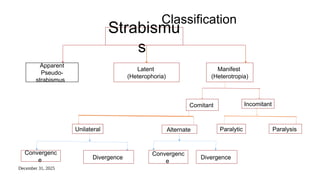
Strabismu
s
Classification
Apparent
Pseudo-
strabismus
Latent
(Heterophoria)
Manifest
(Heterotropia)
Comitant Incomitant
Paralysis
Paralytic
Alternate
Unilateral
Convergenc
e Divergence
Convergenc
e
Divergence
December 31, 2025
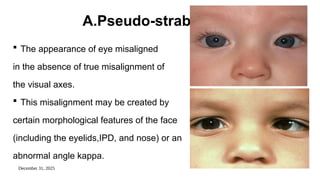
A.Pseudo-strabismus
 The appearance of eye misaligned
in the absence of true misalignment of
the visual axes.
 This misalignment may be created by
certain morphological features of the face
(including the eyelids,IPD, and nose) or an
abnormal angle kappa.
December 31, 2025
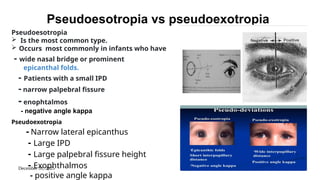
Pseudoesotropia vs pseudoexotropia
Pseudoesotropia
 Is the most common type.
 Occurs most commonly in infants who have
- wide nasal bridge or prominent
epicanthal folds.
- Patients with a small IPD
- narrow palpebral fissure
- enophtalmos
- negative angle kappa
Pseudoexotropia
- Narrow lateral epicanthus
- Large IPD
- Large palpebral fissure height
- Exophthalmos
- positive angle kappa
December 31, 2025
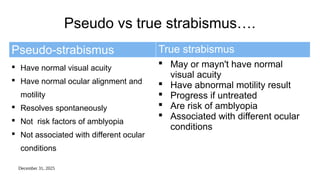
Pseudo vs true strabismus….
Pseudo-strabismus True strabismus
 Have normal visual acuity
 Have normal ocular alignment and
motility
 Resolves spontaneously
 Not risk factors of amblyopia
 Not associated with different ocular
conditions
 May or mayn't have normal
visual acuity
 Have abnormal motility result
 Progress if untreated
 Are risk of amblyopia
 Associated with different ocular
conditions
December 31, 2025
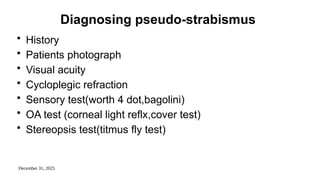
Diagnosing pseudo-strabismus
• History
• Patients photograph
• Visual acuity
• Cycloplegic refraction
• Sensory test(worth 4 dot,bagolini)
• OA test (corneal light reflx,cover test)
• Stereopsis test(titmus fly test)
December 31, 2025
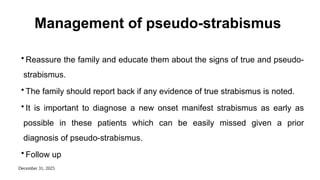
Management of pseudo-strabismus
• Reassure the family and educate them about the signs of true and pseudo-
strabismus.
• The family should report back if any evidence of true strabismus is noted.
• It is important to diagnose a new onset manifest strabismus as early as
possible in these patients which can be easily missed given a prior
diagnosis of pseudo-strabismus.
• Follow up
December 31, 2025
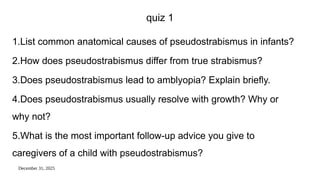
quiz 1
1.List common anatomical causes of pseudostrabismus in infants?
2.How does pseudostrabismus differ from true strabismus?
3.Does pseudostrabismus lead to amblyopia? Explain briefly.
4.Does pseudostrabismus usually resolve with growth? Why or
why not?
5.What is the most important follow-up advice you give to
caregivers of a child with pseudostrabismus?
December 31, 2025
Comitant strabismus
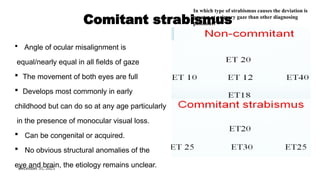
 Angle of ocular misalignment is
equal/nearly equal in all fields of gaze
 The movement of both eyes are full
 Develops most commonly in early
childhood but can do so at any age particularly
in the presence of monocular visual loss.
 Can be congenital or acquired.
 No obvious structural anomalies of the
eye and brain, the etiology remains unclear.
In which type of strabismus causes the deviation is
greater at primary gaze than other diagnosing
positions?
December 31, 2025
Incomitant/ paralytic strabismus
 The angle of deviation changes in different positions of gaze
 Neurogenic (Hypoplasia of 3rd, 4th, and 6th cranial nerve,
tumors, infections, trauma, toxicity)
 Myogenic (a weakness of the ocular muscle itself)
 Mechanical (a physical limitation of the ocular muscle)
 If it is neurogenic the movement is limited in the direction of the limitation.
 When the cause is mechanical the movement can be limited in the opposing
direction of the limitation.
December 31, 2025
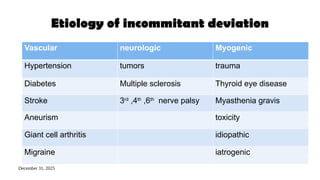
Etiology of incommitant deviation
Vascular neurologic Myogenic
Hypertension tumors trauma
Diabetes Multiple sclerosis Thyroid eye disease
Stroke 3rd
,4th
,6th
nerve palsy Myasthenia gravis
Aneurism toxicity
Giant cell arthritis idiopathic
Migraine iatrogenic
December 31, 2025
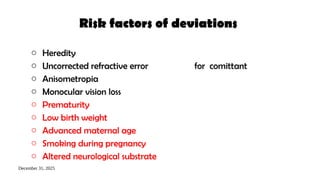
Risk factors of deviations
o Heredity
o Uncorrected refractive error for comittant
o Anisometropia
o Monocular vision loss
o Prematurity
o Low birth weight
o Advanced maternal age
o Smoking during pregnancy
o Altered neurological substrate
December 31, 2025
Comitant Esodeviations
 Latent or manifest convergent squint.
 Are the most common type of childhood strabismus.
 Result from innervational, anatomical, mechanical, refractive, or
accommodative factors.
 Accounting for more than 50% of ocular deviations in the pediatric population.
 In adults, esodeviations and exodeviations are equally prevalent.
 Equal frequency in males and females
 The prevalence of esotropia increases with age (higher prevalence at 48–72
months compared with 6–11 months)
December 31, 2025
Incomitant esotropia
• Paralytic- Neurogenic (VI nerve palsy)
• Nonparalytic- Myogenic (ocular myasthenia)
• Mechanical – restrictive esodeviation
• Congenital fibrosis syndrome
• Acquired
• thyroid eye disease
• Trauma to the orbital wall
• Myositis
December 31, 2025
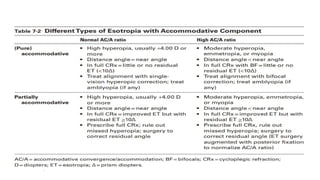
Accommodative esotropia
i. Refractive accommodative esotropia (normal AC/A
ratio)
ii. Non Refractive accommodative esotropia (high AC/A
ratio)
iii. Hypo accommodative esotropia (reduced NPA)
iv. Partially accommodative esotropia
December 31, 2025
Non-accommodative esotropia
1.Essential infantile esotropia
2.Non-accommodative convergence excess
3.Acquired esotropia
4.Acute Onset esotropia
5.Divergence insufficiency or paralysis
6.Cyclic esotropia
7.Recurrent esotropia
• III. Microtropia
• IV. Nystagmus blockade syndrome
December 31, 2025
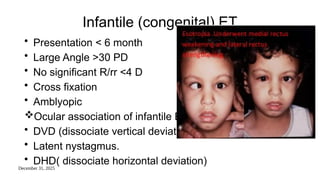
Infantile (congenital) ET
• Presentation < 6 month
• Large Angle >30 PD
• No significant R/rr <4 D
• Cross fixation
• Amblyopic
Ocular association of infantile ET :
• DVD (dissociate vertical deviation) .
• Latent nystagmus.
• DHD( dissociate horizontal deviation)
December 31, 2025
Treatment of Infantile esotropia
1.Surgery (medial rectus recession/ lateral rectus resection)
and inferior oblique myectomy if there is IOO.
2) Treat amblyopia by patching
3) Botox injections into medial rectus
December 31, 2025
Treatment of infantile ET conti…
•Surgically by weakening the medial rectus muscles (by
disinserting the muscle from the original position and moving it
backward according to the degree of deviation i.e. if it was 30
PD you see in a table how many mm you have to move back
to place the insertion in the sclera) at age of 10-11months.
•Prognosis: gross stereopsis.
December 31, 2025
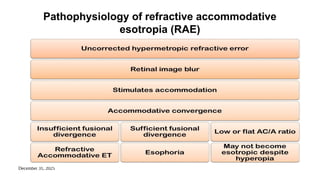
i.Referactive Accommodative ET
• Most common type of deviation
• Good Vision in each eye (at time of onset of strabismus)
• Uncorrected hypermetropia(>+2.00D) is the cause
• Normal AC/A ratio(fully accommodative or partial)
• Onset from 4 months to 7 years of age(2-3 years)
• Deviation is larger at near than the distance.
December 31, 2025
conti...
• If normal AC/A,esotropia is approximately the same at D&N fixation
and between 20Δ and 30Δ.
• Usually intermittent at onset, later becoming constant and comitant
• Family history often present and precipitated by trauma or illness
• Frequently associated with amblyopia
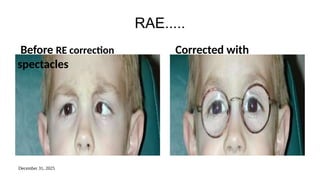
• Restoration of binocular single vision with spectacle correction
• The deviation angle decreases to <10 Δ with refractive correction
December 31, 2025
Pathophysiology of refractive accommodative
esotropia (RAE)
December 31, 2025
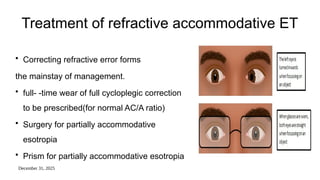
Treatment of refractive accommodative ET
• Correcting refractive error forms
the mainstay of management.
• full- -time wear of full cycloplegic correction
to be prescribed(for normal AC/A ratio)
• Surgery for partially accommodative
esotropia
• Prism for partially accommodative esotropia
December 31, 2025
RAE.....
Before RE correction Corrected with
spectacles
December 31, 2025
Case Scenario
Case Summary
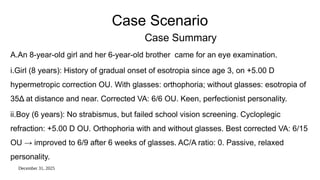
A.An 8-year-old girl and her 6-year-old brother came for an eye examination.
i.Girl (8 years): History of gradual onset of esotropia since age 3, on +5.00 D
hypermetropic correction OU. With glasses: orthophoria; without glasses: esotropia of
35Δ at distance and near. Corrected VA: 6/6 OU. Keen, perfectionist personality.
ii.Boy (6 years): No strabismus, but failed school vision screening. Cycloplegic
refraction: +5.00 D OU. Orthophoria with and without glasses. Best corrected VA: 6/15
OU → improved to 6/9 after 6 weeks of glasses. AC/A ratio: 0. Passive, relaxed
personality.
December 31, 2025
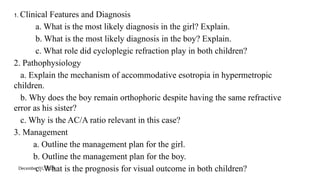
1. Clinical Features and Diagnosis
a. What is the most likely diagnosis in the girl? Explain.
b. What is the most likely diagnosis in the boy? Explain.
c. What role did cycloplegic refraction play in both children?
2. Pathophysiology
a. Explain the mechanism of accommodative esotropia in hypermetropic
children.
b. Why does the boy remain orthophoric despite having the same refractive
error as his sister?
c. Why is the AC/A ratio relevant in this case?
3. Management
a. Outline the management plan for the girl.
b. Outline the management plan for the boy.
c. What is the prognosis for visual outcome in both children?
December 31, 2025
Non-refractive accommodative ET(high AC/A)
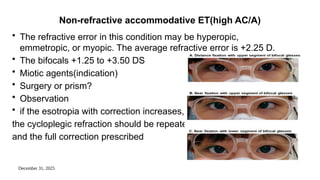
• The refractive error in this condition may be hyperopic,
emmetropic, or myopic. The average refractive error is +2.25 D.
• The bifocals +1.25 to +3.50 DS
• Miotic agents(indication)
• Surgery or prism?
• Observation
• if the esotropia with correction increases,
the cycloplegic refraction should be repeated
and the full correction prescribed
December 31, 2025
Hypoaccomodative esotropia
• Associated with weakness of accommodation
• Known as convergence excess with defective
accommodation
Etiopathogenesis
Patients excessively accommodate to overcome their
weakness of accommodation.This is accompanied by
excessive accommodation convergence.
December 31, 2025
Clinical feature
• Presents at 2-3 years
• The deviation is greater at near-than-distance
• Patients may be hyperopic, myopic, or emmetropic
• AC/A ratio may be normal or even low
• Near point of accommodation: is reduced as compared
with their expected age
December 31, 2025
December 31, 2025
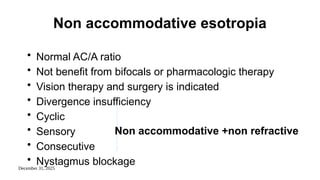
Non accommodative esotropia
• Normal AC/A ratio
• Not benefit from bifocals or pharmacologic therapy
• Vision therapy and surgery is indicated
• Divergence insufficiency
• Cyclic
• Sensory
• Consecutive
• Nystagmus blockage
Non accommodative +non refractive
December 31, 2025
Cyclic esotropia
• Follows a 48 hrs rhythm, i.e. a 24 hrs period of normal binocular
vision followed by 24 hrs of manifest tropia.
• Onset of cyclic esotropia is typically during the preschool years.
• On ‘Straight days’ no anomalies of binocular vision On
‘strabismus days’, a large angle esotropia often as large as
40pd– 50pd will appear.
• Cyclic nature may last for a month to years, after which it breaks
& esotropia becomes constant.
• Surgery for deviation measured on ‘squint days’ gives
satisfactory results.
December 31, 2025
Cyclic…
• Fusion and binocular vision are usually absent or defective
on the strabismus day
• Occlusion therapy may convert the cyclic deviation into a
constant one.
Treatment
• Surgical treatment of cyclic esotropia is usually
effective.
• The amount of surgery is based on the maximum angle of
deviation pre sent when the eyes are esotropic
December 31, 2025
Sensory esotropia
•Monocular vision loss (due to cataract, corneal clouding,
optic nerve or retinal disorders, or various causes) may
cause sensory (deprivation) esotropia.
•Conditions preventing clear and focused retinal images and
symmetric visual stimulation must be identified and remedied
promptly, if possible, to prevent irreversible amblyopia.
December 31, 2025
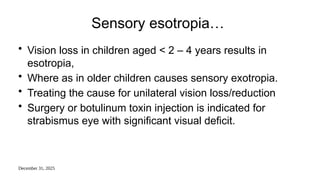
Sensory esotropia…
• Vision loss in children aged < 2 – 4 years results in
esotropia,
• Where as in older children causes sensory exotropia.
• Treating the cause for unilateral vision loss/reduction
• Surgery or botulinum toxin injection is indicated for
strabismus eye with significant visual deficit.
December 31, 2025
Consecutive esotropia
• An esotropia that follows a history of over correction of exotropia
• Consecutive esotropia is rare but always occurs in patients with
neurologic disorders or with very poor vision in one eye
Treatment depends on the amount of the consecuitive esotropia
• orthoptics
• prism
• surgery
December 31, 2025
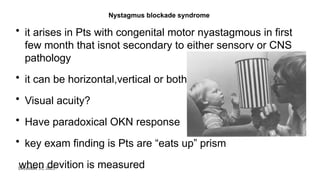
Nystagmus blockade syndrome
• it arises in Pts with congenital motor nyastagmous in first
few month that isnot secondary to either sensory or CNS
pathology
• it can be horizontal,vertical or both
• Visual acuity?
• Have paradoxical OKN response
• key exam finding is Pts are “eats up” prism
when devition is measured
December 31, 2025
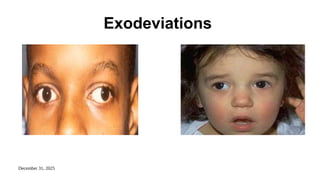
Exodeviations
December 31, 2025
Exodeviation
• it occurs 1/3 less freuently than esotropia
• more commonly found at latitudes that receive more sun
exposure
• even if it have genetic componnet,mostl multifactorial
• like esodeviation,EXT is manifeested and latent.
• less common in children than esodeiation
• XT is much more common in the Middle East, Africa and
Asia than in the US and/or Europe
December 31, 2025
Risk factors for exotropia include
Maternal substance abuse and smoking during pregnancy,
Premature birth
Perinatal morbidity,
Genetic anomalies
Family history of strabismus, and
Uncorrected refractive errors
December 31, 2025
A.comitant exodeviation
1. Divergence excess—distance deviation is at least 15Δ larger than
for near
2. Convergence insufficiency— near deviation is at least 15Δ larger
than for distance
3. Basic— distance and near deviations are equal or their difference is
< 15Δ
4. Simulated divergence excess—initially it seems distance deviation is
larger than near but after occlusion for 30min-1hr the distance and
near deviations are equal. It is simulated by the effect of tonic and
fusional convergence at near
December 31, 2025
cont…
B) Incomitant
 Paralytic(III N,MR palsy)
Restrictive(Myasthenia gravis, Graves disease, Botulism,
Oculo pharyngeal dystrophy, Myotonic dystrophy and Orbital
mass (e.g, tumor, pseudo tumor)
 Musculofacial anomalies
December 31, 2025
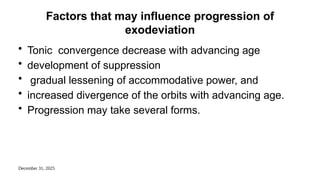
Factors that may influence progression of
exodeviation
• Tonic convergence decrease with advancing age
• development of suppression
• gradual lessening of accommodative power, and
• increased divergence of the orbits with advancing age.
• Progression may take several forms.
December 31, 2025
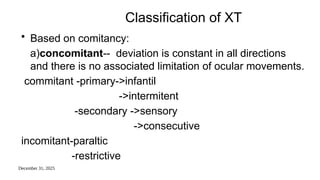
Classification of XT
• Based on comitancy:
a)concomitant-- deviation is constant in all directions
and there is no associated limitation of ocular movements.
commitant -primary->infantil
->intermitent
-secondary ->sensory
->consecutive
incomitant-paraltic
-restrictive
December 31, 2025
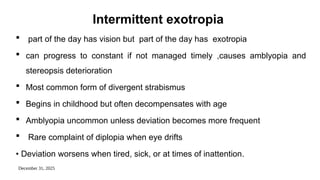
Intermittent exotropia
 part of the day has vision but part of the day has exotropia
 can progress to constant if not managed timely ,causes amblyopia and
stereopsis deterioration
 Most common form of divergent strabismus
 Begins in childhood but often decompensates with age
 Amblyopia uncommon unless deviation becomes more frequent
 Rare complaint of diplopia when eye drifts
• Deviation worsens when tired, sick, or at times of inattention.
December 31, 2025
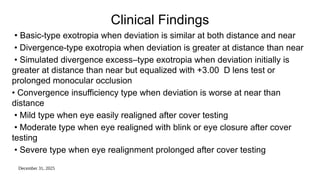
Clinical Findings
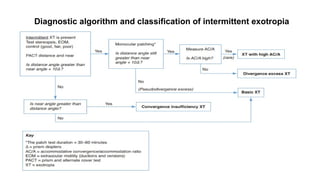
• Basic-type exotropia when deviation is similar at both distance and near
• Divergence-type exotropia when deviation is greater at distance than near
• Simulated divergence excess–type exotropia when deviation initially is
greater at distance than near but equalized with +3.00 D lens test or
prolonged monocular occlusion
• Convergence insufficiency type when deviation is worse at near than
distance
• Mild type when eye easily realigned after cover testing
• Moderate type when eye realigned with blink or eye closure after cover
testing
• Severe type when eye realignment prolonged after cover testing
December 31, 2025
Diagnostic algorithm and classification of intermittent exotropia
December 31, 2025
symptoms
• Headache
• Eye strain
• Blurred vision
• Double vision
• Discomfort to strong light(diplopia-phobia)
• Abnormal stereopsis-X(T) to XT
Treatment of Intermittent Exotropia
• Full refractive correction if myopic, hyperopic?
• 1-2hr patching of the fixating eye
• Stimulate accommodative convergence by prescribing more myopic correction,
typically 1 D (under plus or over minus)
• Orthoptic exercises for convergence insuffi ciency type
• Bilateral LR recessions or uniocular MR resection with lateral rectus recession
• Consider NCS for choice of treatment
• Ranges from 0 being the best control to 7 being the worst control
• NSC >3/7== suggestive for surgery.
• NCS Total=Home Score+Distance Score+Near Score
*
*
December 31, 2025
Example 2
Example Calculation
• Home: Exotropia noticed sometimes → 1
• Distance clinic: Breaks but recovers → 1
• Near clinic: Sustained exotropia → 2
A.Calculate NCS total?
B.interpret the result?
December 31, 2025
Infantile exotropia
• presents before the age of 6 months with a large-angle >35pd
• It have associated with neurologic impairment or craniofacial disorders.
• Usually it is constant in nature
• Patients with constant infantile exotropia undergo surgery early in life, and
surgical outcomes are similar to those for infantile esotropia
• Typically no signifi cant refractive error
• Alternate fixation
• Deviation similar both distance and near
• With large angles >50 PD, may require surgery on three or four muscles
December 31, 2025
secondary XT
Sensory Exotropia
 Any condition that severely reduces visual acuity in one eye can
cause sensory exotropia.
 It may appear secondary to anisometropia, unilateral medial opacity
secondary to corneal opacity or lenticular changes, optic atrophy or
hypoplasia,unilateral aphakia, optic atrophy, or macular pathology
December 31, 2025
cont…
• It predominates in infants younger than 1 year, older children, and
adults.
• If the disadvantaged eye can be visually rehabilitated, peripheral
fusion may sometimes be reestablished after surgical realignment
December 31, 2025
Consecutive exotropia
• An exotropia that follows previous surgery for esotropia/other
refractive corrections or a spontaneous change of esotropia to
exotropia
• Treatment of consecutive exotropia depends on many factors,
including the size of the deviation, the type, lateral incomitance,
and the level of visual acuity in each eye
December 31, 2025
cont…
• central fusional disruption lead to constant and permanent
diplopia when onset is in adult life.
• In these patients, intractable diplopia may persist, even with
well -aligned eyes.
December 31, 2025
Treatment summery for XT
Non surgical
Optical (prism, spectacle correction)
Orthoptic treatment- improve control(<20 pd)
December 31, 2025
optical spectacle correction
• improve retinal image clarity and help control the
exodeviation.
concave lenses are effective to stimulus convergence
by inducing accom. (esp. High AC/A ratio)
Correction of even mild myopia may improve control
of the exodeviation.
Mild to moderate degrees of hyperopia are not
routinely corrected in children with intermittent
exotropia for fear of worsening the deviation but
>4.00D or 1.5D of aniso????
December 31, 2025
Prism correction
• BI prisms
compensate strabismus
 enforce bifoveal stimulation preoperatively
but this treatment option is seldom chosen for long-term
management because it can cause a reduction in fusional
vergence amplitudes.
December 31, 2025
surgical
• Indications
• infantile exotropia
• large angle exotropia
• Intermittent deviation (if >50%)
• If diplopia is present
• Suppression in the early childhood
 recession of lateral rectus muscles is the most common
 Recession of lateral rectus muscle combined with resection of the ipsilateral medial rectus
December 31, 2025
Reference
1. Scottish Intercollegiate Guidelines Network. Annex B: Key to evidence statements and grades of
recommendations. In: SIGN 50: A guideline developer's handbook. 2008 edition, revised 2011. Edinburgh,
Scotland: Scottish Intercollegiate Guidelines Network. https://www.sign.ac.uk/our-guidelines/sign-50-aguideline-
developers-handbook/. Accessed August 25, 2022.
2. Guyatt GH, Oxman AD, Vist GE, et al. GRADE: An emerging consensus on rating quality of evidence
and strength of recommendations. BMJ. 2008;336:924-926.
3. GRADE Working Group. Organizations that have endorsed or that are using GRADE.
www.gradeworkinggroup.org/. Accessed August 25, 2022.
4. Mohney BG. Common forms of childhood esotropia. Ophthalmology. 2001;108:805-809.
5. Archer SM, Sondhi N, Helveston EM. Strabismus in infancy. Ophthalmology. 1989;96:133-137.
6. Horwood AM. Maternal observations of ocular alignment in infants. J Pediatr Ophthalmol Strabismus.
1993;30:100-105.
7. Nixon RB, Helveston EM, Miller K, et al. Incidence of strabismus in neonates. Am J Ophthalmol.
1985;100:798-801.
8. Sondhi N, Archer SM, Helveston EM. Development of normal ocular alignment. J Pediatr Ophthalmol
Strabismus. 1988;25:210-211.
9.BCSC pediatric ophthalmology and strabismus 2024-2025
December 31, 2025
PATTERN DEVIATIONS???????
Reading assignment

chapter four strabismus or manifest deviation.pptx

  • 1.
    Binocular vision anomaliesand vision therapy for By Endalew Mulugeta (BSc, MSc in clinical optometry 3rd-year optometry students
  • 2.
    December 31, 2025 Chapter4  Strabismus Course Title: Fundamentals of Strabismus Diagnosis and Management Target Audience: Third year Optometry students
  • 3.
    December 31, 2025 Courseobjective  At the end of this course Learners will be:  Able to independently perform a comprehensive sensory and motor examination on a patient with suspected strabismus Accurately diagnose the type of deviation Formulate an appropriate initial management plan
  • 4.
    December 31, 2025 Outline Highlights of EOM Function: Define Basic Terminologies of strabismus Understand Classification of Strabismus Discuss motor and sensory evaluations of strabismus
  • 5.
    Brainstorming What is EOM? Extrinsicvs intrinsic muscle? What will happen, If one of the extraocular muscles is too strong, too weak, or dysfunctional?. Simultaneous Fusion Stereopsis
  • 6.
    December 31, 2025 EOMand their action EOM Primary action Secondary action Tertiary action MR Adduction ----------------- -------------------- LR Abduction ---------------- --------------------- SR Elevation Intorssion Adduction IR Depression Extorssion Adduction SO Intorssion Depression Abduction IO Levator palpebrae superiors Extortion Elevation of upper eyelid Elevation ----------------- Abduction -----------------------
  • 7.
    December 31, 2025 Sixcardinal positions of gaze, which correspond to the primary fields of action of the EOM
  • 8.
    What are binocularvision anomalies? Strabismic Concomitant squint Incomitant squint Esodeviations Paralytic Exodeviations Mechanical Vertical deviation Myogenic Neurogenic Non-strabismic Sensory anomalies Motor control anomalies Accommodation anomalies Convergence anomalies Accommodation weakness Convergence insufficiency Accommodation insufficiency Divergence insufficiency Accommodation excess Convergence excess Accommodation spasm Divergence excess Accommodation paralysis Diplopia,ARC,Eccentric fixation ,Suppression, Amblyopia Nystagmus
  • 9.
    December 31, 2025 Causesof binocular vision anomalies Systemic disease Poor V.A Anisometropia Accommodati on anomalies Innervationa l anomaliess Palsies of EOM Mechanical restriction Traum a
  • 10.
  • 11.
    December 31, 2025 Onsetof strabismus • Strabismus may be infantile or acquired. •The term infantile rather than congenital is preferred because the presence of true strabismus at birth is uncommon, and the term infantile permits inclusion of varieties that develop within the first 6 months of life. •The term acquired includes varieties that develop after 6 months of life
  • 12.
    Etiology of strabismus Neoplasm Headtrauma  Intracranial aneurysm  Hypertension Diabetes mellitus Atherosclerosis Hydrocephalus(CSF)  Multiple sclerosis Meningitis/encephalitis Myasthenia gravis Ophthalmologic migraine Chemotherapy
  • 13.
    December 31, 2025 Riskfactor for strabismus Family history Refractive error Medical conditions Surgery Mechanism of delivery  Genetic disorders (Down syndrome and craniofacial syndromes) Prenatal drug exposure (including alcohol) Prenatal medication exposure, Prematurity or low birth weight
  • 14.
    December 31, 2025 Strabismu s Classification Apparent Pseudo- strabismus Latent (Heterophoria) Manifest (Heterotropia) ComitantIncomitant Paralysis Paralytic Alternate Unilateral Convergenc e Divergence Convergenc e Divergence
  • 15.
    December 31, 2025 A.Pseudo-strabismus The appearance of eye misaligned in the absence of true misalignment of the visual axes.  This misalignment may be created by certain morphological features of the face (including the eyelids,IPD, and nose) or an abnormal angle kappa.
  • 16.
    December 31, 2025 Pseudoesotropiavs pseudoexotropia Pseudoesotropia  Is the most common type.  Occurs most commonly in infants who have - wide nasal bridge or prominent epicanthal folds. - Patients with a small IPD - narrow palpebral fissure - enophtalmos - negative angle kappa Pseudoexotropia - Narrow lateral epicanthus - Large IPD - Large palpebral fissure height - Exophthalmos - positive angle kappa
  • 17.
    December 31, 2025 Pseudovs true strabismus…. Pseudo-strabismus True strabismus  Have normal visual acuity  Have normal ocular alignment and motility  Resolves spontaneously  Not risk factors of amblyopia  Not associated with different ocular conditions  May or mayn't have normal visual acuity  Have abnormal motility result  Progress if untreated  Are risk of amblyopia  Associated with different ocular conditions
  • 18.
    December 31, 2025 Diagnosingpseudo-strabismus • History • Patients photograph • Visual acuity • Cycloplegic refraction • Sensory test(worth 4 dot,bagolini) • OA test (corneal light reflx,cover test) • Stereopsis test(titmus fly test)
  • 19.
    December 31, 2025 Managementof pseudo-strabismus • Reassure the family and educate them about the signs of true and pseudo- strabismus. • The family should report back if any evidence of true strabismus is noted. • It is important to diagnose a new onset manifest strabismus as early as possible in these patients which can be easily missed given a prior diagnosis of pseudo-strabismus. • Follow up
  • 20.
    December 31, 2025 quiz1 1.List common anatomical causes of pseudostrabismus in infants? 2.How does pseudostrabismus differ from true strabismus? 3.Does pseudostrabismus lead to amblyopia? Explain briefly. 4.Does pseudostrabismus usually resolve with growth? Why or why not? 5.What is the most important follow-up advice you give to caregivers of a child with pseudostrabismus?
  • 21.
    December 31, 2025 Comitantstrabismus  Angle of ocular misalignment is equal/nearly equal in all fields of gaze  The movement of both eyes are full  Develops most commonly in early childhood but can do so at any age particularly in the presence of monocular visual loss.  Can be congenital or acquired.  No obvious structural anomalies of the eye and brain, the etiology remains unclear. In which type of strabismus causes the deviation is greater at primary gaze than other diagnosing positions?
  • 22.
    December 31, 2025 Incomitant/paralytic strabismus  The angle of deviation changes in different positions of gaze  Neurogenic (Hypoplasia of 3rd, 4th, and 6th cranial nerve, tumors, infections, trauma, toxicity)  Myogenic (a weakness of the ocular muscle itself)  Mechanical (a physical limitation of the ocular muscle)  If it is neurogenic the movement is limited in the direction of the limitation.  When the cause is mechanical the movement can be limited in the opposing direction of the limitation.
  • 23.
    December 31, 2025 Etiologyof incommitant deviation Vascular neurologic Myogenic Hypertension tumors trauma Diabetes Multiple sclerosis Thyroid eye disease Stroke 3rd ,4th ,6th nerve palsy Myasthenia gravis Aneurism toxicity Giant cell arthritis idiopathic Migraine iatrogenic
  • 24.
    December 31, 2025 Riskfactors of deviations o Heredity o Uncorrected refractive error for comittant o Anisometropia o Monocular vision loss o Prematurity o Low birth weight o Advanced maternal age o Smoking during pregnancy o Altered neurological substrate
  • 25.
    December 31, 2025 ComitantEsodeviations  Latent or manifest convergent squint.  Are the most common type of childhood strabismus.  Result from innervational, anatomical, mechanical, refractive, or accommodative factors.  Accounting for more than 50% of ocular deviations in the pediatric population.  In adults, esodeviations and exodeviations are equally prevalent.  Equal frequency in males and females  The prevalence of esotropia increases with age (higher prevalence at 48–72 months compared with 6–11 months)
  • 26.
    December 31, 2025 Incomitantesotropia • Paralytic- Neurogenic (VI nerve palsy) • Nonparalytic- Myogenic (ocular myasthenia) • Mechanical – restrictive esodeviation • Congenital fibrosis syndrome • Acquired • thyroid eye disease • Trauma to the orbital wall • Myositis
  • 27.
    December 31, 2025 Accommodativeesotropia i. Refractive accommodative esotropia (normal AC/A ratio) ii. Non Refractive accommodative esotropia (high AC/A ratio) iii. Hypo accommodative esotropia (reduced NPA) iv. Partially accommodative esotropia
  • 28.
    December 31, 2025 Non-accommodativeesotropia 1.Essential infantile esotropia 2.Non-accommodative convergence excess 3.Acquired esotropia 4.Acute Onset esotropia 5.Divergence insufficiency or paralysis 6.Cyclic esotropia 7.Recurrent esotropia • III. Microtropia • IV. Nystagmus blockade syndrome
  • 29.
    December 31, 2025 Infantile(congenital) ET • Presentation < 6 month • Large Angle >30 PD • No significant R/rr <4 D • Cross fixation • Amblyopic Ocular association of infantile ET : • DVD (dissociate vertical deviation) . • Latent nystagmus. • DHD( dissociate horizontal deviation)
  • 30.
    December 31, 2025 Treatmentof Infantile esotropia 1.Surgery (medial rectus recession/ lateral rectus resection) and inferior oblique myectomy if there is IOO. 2) Treat amblyopia by patching 3) Botox injections into medial rectus
  • 31.
    December 31, 2025 Treatmentof infantile ET conti… •Surgically by weakening the medial rectus muscles (by disinserting the muscle from the original position and moving it backward according to the degree of deviation i.e. if it was 30 PD you see in a table how many mm you have to move back to place the insertion in the sclera) at age of 10-11months. •Prognosis: gross stereopsis.
  • 32.
    December 31, 2025 i.ReferactiveAccommodative ET • Most common type of deviation • Good Vision in each eye (at time of onset of strabismus) • Uncorrected hypermetropia(>+2.00D) is the cause • Normal AC/A ratio(fully accommodative or partial) • Onset from 4 months to 7 years of age(2-3 years) • Deviation is larger at near than the distance.
  • 33.
    December 31, 2025 conti... •If normal AC/A,esotropia is approximately the same at D&N fixation and between 20Δ and 30Δ. • Usually intermittent at onset, later becoming constant and comitant • Family history often present and precipitated by trauma or illness • Frequently associated with amblyopia • Restoration of binocular single vision with spectacle correction • The deviation angle decreases to <10 Δ with refractive correction
  • 34.
    December 31, 2025 Pathophysiologyof refractive accommodative esotropia (RAE)
  • 35.
    December 31, 2025 Treatmentof refractive accommodative ET • Correcting refractive error forms the mainstay of management. • full- -time wear of full cycloplegic correction to be prescribed(for normal AC/A ratio) • Surgery for partially accommodative esotropia • Prism for partially accommodative esotropia
  • 36.
    December 31, 2025 RAE..... BeforeRE correction Corrected with spectacles
  • 37.
    December 31, 2025 CaseScenario Case Summary A.An 8-year-old girl and her 6-year-old brother came for an eye examination. i.Girl (8 years): History of gradual onset of esotropia since age 3, on +5.00 D hypermetropic correction OU. With glasses: orthophoria; without glasses: esotropia of 35Δ at distance and near. Corrected VA: 6/6 OU. Keen, perfectionist personality. ii.Boy (6 years): No strabismus, but failed school vision screening. Cycloplegic refraction: +5.00 D OU. Orthophoria with and without glasses. Best corrected VA: 6/15 OU → improved to 6/9 after 6 weeks of glasses. AC/A ratio: 0. Passive, relaxed personality.
  • 38.
    December 31, 2025 1.Clinical Features and Diagnosis a. What is the most likely diagnosis in the girl? Explain. b. What is the most likely diagnosis in the boy? Explain. c. What role did cycloplegic refraction play in both children? 2. Pathophysiology a. Explain the mechanism of accommodative esotropia in hypermetropic children. b. Why does the boy remain orthophoric despite having the same refractive error as his sister? c. Why is the AC/A ratio relevant in this case? 3. Management a. Outline the management plan for the girl. b. Outline the management plan for the boy. c. What is the prognosis for visual outcome in both children?
  • 39.
    December 31, 2025 Non-refractiveaccommodative ET(high AC/A) • The refractive error in this condition may be hyperopic, emmetropic, or myopic. The average refractive error is +2.25 D. • The bifocals +1.25 to +3.50 DS • Miotic agents(indication) • Surgery or prism? • Observation • if the esotropia with correction increases, the cycloplegic refraction should be repeated and the full correction prescribed
  • 40.
    December 31, 2025 Hypoaccomodativeesotropia • Associated with weakness of accommodation • Known as convergence excess with defective accommodation Etiopathogenesis Patients excessively accommodate to overcome their weakness of accommodation.This is accompanied by excessive accommodation convergence.
  • 41.
    December 31, 2025 Clinicalfeature • Presents at 2-3 years • The deviation is greater at near-than-distance • Patients may be hyperopic, myopic, or emmetropic • AC/A ratio may be normal or even low • Near point of accommodation: is reduced as compared with their expected age
  • 42.
  • 43.
    December 31, 2025 Nonaccommodative esotropia • Normal AC/A ratio • Not benefit from bifocals or pharmacologic therapy • Vision therapy and surgery is indicated • Divergence insufficiency • Cyclic • Sensory • Consecutive • Nystagmus blockage Non accommodative +non refractive
  • 44.
    December 31, 2025 Cyclicesotropia • Follows a 48 hrs rhythm, i.e. a 24 hrs period of normal binocular vision followed by 24 hrs of manifest tropia. • Onset of cyclic esotropia is typically during the preschool years. • On ‘Straight days’ no anomalies of binocular vision On ‘strabismus days’, a large angle esotropia often as large as 40pd– 50pd will appear. • Cyclic nature may last for a month to years, after which it breaks & esotropia becomes constant. • Surgery for deviation measured on ‘squint days’ gives satisfactory results.
  • 45.
    December 31, 2025 Cyclic… •Fusion and binocular vision are usually absent or defective on the strabismus day • Occlusion therapy may convert the cyclic deviation into a constant one. Treatment • Surgical treatment of cyclic esotropia is usually effective. • The amount of surgery is based on the maximum angle of deviation pre sent when the eyes are esotropic
  • 46.
    December 31, 2025 Sensoryesotropia •Monocular vision loss (due to cataract, corneal clouding, optic nerve or retinal disorders, or various causes) may cause sensory (deprivation) esotropia. •Conditions preventing clear and focused retinal images and symmetric visual stimulation must be identified and remedied promptly, if possible, to prevent irreversible amblyopia.
  • 47.
    December 31, 2025 Sensoryesotropia… • Vision loss in children aged < 2 – 4 years results in esotropia, • Where as in older children causes sensory exotropia. • Treating the cause for unilateral vision loss/reduction • Surgery or botulinum toxin injection is indicated for strabismus eye with significant visual deficit.
  • 48.
    December 31, 2025 Consecutiveesotropia • An esotropia that follows a history of over correction of exotropia • Consecutive esotropia is rare but always occurs in patients with neurologic disorders or with very poor vision in one eye Treatment depends on the amount of the consecuitive esotropia • orthoptics • prism • surgery
  • 49.
    December 31, 2025 Nystagmusblockade syndrome • it arises in Pts with congenital motor nyastagmous in first few month that isnot secondary to either sensory or CNS pathology • it can be horizontal,vertical or both • Visual acuity? • Have paradoxical OKN response • key exam finding is Pts are “eats up” prism when devition is measured
  • 50.
  • 51.
    December 31, 2025 Exodeviation •it occurs 1/3 less freuently than esotropia • more commonly found at latitudes that receive more sun exposure • even if it have genetic componnet,mostl multifactorial • like esodeviation,EXT is manifeested and latent. • less common in children than esodeiation • XT is much more common in the Middle East, Africa and Asia than in the US and/or Europe
  • 52.
    December 31, 2025 Riskfactors for exotropia include Maternal substance abuse and smoking during pregnancy, Premature birth Perinatal morbidity, Genetic anomalies Family history of strabismus, and Uncorrected refractive errors
  • 53.
    December 31, 2025 A.comitantexodeviation 1. Divergence excess—distance deviation is at least 15Δ larger than for near 2. Convergence insufficiency— near deviation is at least 15Δ larger than for distance 3. Basic— distance and near deviations are equal or their difference is < 15Δ 4. Simulated divergence excess—initially it seems distance deviation is larger than near but after occlusion for 30min-1hr the distance and near deviations are equal. It is simulated by the effect of tonic and fusional convergence at near
  • 54.
    December 31, 2025 cont… B)Incomitant  Paralytic(III N,MR palsy) Restrictive(Myasthenia gravis, Graves disease, Botulism, Oculo pharyngeal dystrophy, Myotonic dystrophy and Orbital mass (e.g, tumor, pseudo tumor)  Musculofacial anomalies
  • 55.
    December 31, 2025 Factorsthat may influence progression of exodeviation • Tonic convergence decrease with advancing age • development of suppression • gradual lessening of accommodative power, and • increased divergence of the orbits with advancing age. • Progression may take several forms.
  • 56.
    December 31, 2025 Classificationof XT • Based on comitancy: a)concomitant-- deviation is constant in all directions and there is no associated limitation of ocular movements. commitant -primary->infantil ->intermitent -secondary ->sensory ->consecutive incomitant-paraltic -restrictive
  • 57.
    December 31, 2025 Intermittentexotropia  part of the day has vision but part of the day has exotropia  can progress to constant if not managed timely ,causes amblyopia and stereopsis deterioration  Most common form of divergent strabismus  Begins in childhood but often decompensates with age  Amblyopia uncommon unless deviation becomes more frequent  Rare complaint of diplopia when eye drifts • Deviation worsens when tired, sick, or at times of inattention.
  • 58.
    December 31, 2025 ClinicalFindings • Basic-type exotropia when deviation is similar at both distance and near • Divergence-type exotropia when deviation is greater at distance than near • Simulated divergence excess–type exotropia when deviation initially is greater at distance than near but equalized with +3.00 D lens test or prolonged monocular occlusion • Convergence insufficiency type when deviation is worse at near than distance • Mild type when eye easily realigned after cover testing • Moderate type when eye realigned with blink or eye closure after cover testing • Severe type when eye realignment prolonged after cover testing
  • 59.
    December 31, 2025 Diagnosticalgorithm and classification of intermittent exotropia
  • 60.
    December 31, 2025 symptoms •Headache • Eye strain • Blurred vision • Double vision • Discomfort to strong light(diplopia-phobia) • Abnormal stereopsis-X(T) to XT
  • 61.
    Treatment of IntermittentExotropia • Full refractive correction if myopic, hyperopic? • 1-2hr patching of the fixating eye • Stimulate accommodative convergence by prescribing more myopic correction, typically 1 D (under plus or over minus) • Orthoptic exercises for convergence insuffi ciency type • Bilateral LR recessions or uniocular MR resection with lateral rectus recession • Consider NCS for choice of treatment • Ranges from 0 being the best control to 7 being the worst control • NSC >3/7== suggestive for surgery. • NCS Total=Home Score+Distance Score+Near Score * *
  • 62.
    December 31, 2025 Example2 Example Calculation • Home: Exotropia noticed sometimes → 1 • Distance clinic: Breaks but recovers → 1 • Near clinic: Sustained exotropia → 2 A.Calculate NCS total? B.interpret the result?
  • 63.
    December 31, 2025 Infantileexotropia • presents before the age of 6 months with a large-angle >35pd • It have associated with neurologic impairment or craniofacial disorders. • Usually it is constant in nature • Patients with constant infantile exotropia undergo surgery early in life, and surgical outcomes are similar to those for infantile esotropia • Typically no signifi cant refractive error • Alternate fixation • Deviation similar both distance and near • With large angles >50 PD, may require surgery on three or four muscles
  • 64.
    December 31, 2025 secondaryXT Sensory Exotropia  Any condition that severely reduces visual acuity in one eye can cause sensory exotropia.  It may appear secondary to anisometropia, unilateral medial opacity secondary to corneal opacity or lenticular changes, optic atrophy or hypoplasia,unilateral aphakia, optic atrophy, or macular pathology
  • 65.
    December 31, 2025 cont… •It predominates in infants younger than 1 year, older children, and adults. • If the disadvantaged eye can be visually rehabilitated, peripheral fusion may sometimes be reestablished after surgical realignment
  • 66.
    December 31, 2025 Consecutiveexotropia • An exotropia that follows previous surgery for esotropia/other refractive corrections or a spontaneous change of esotropia to exotropia • Treatment of consecutive exotropia depends on many factors, including the size of the deviation, the type, lateral incomitance, and the level of visual acuity in each eye
  • 67.
    December 31, 2025 cont… •central fusional disruption lead to constant and permanent diplopia when onset is in adult life. • In these patients, intractable diplopia may persist, even with well -aligned eyes.
  • 68.
    December 31, 2025 Treatmentsummery for XT Non surgical Optical (prism, spectacle correction) Orthoptic treatment- improve control(<20 pd)
  • 69.
    December 31, 2025 opticalspectacle correction • improve retinal image clarity and help control the exodeviation. concave lenses are effective to stimulus convergence by inducing accom. (esp. High AC/A ratio) Correction of even mild myopia may improve control of the exodeviation. Mild to moderate degrees of hyperopia are not routinely corrected in children with intermittent exotropia for fear of worsening the deviation but >4.00D or 1.5D of aniso????
  • 70.
    December 31, 2025 Prismcorrection • BI prisms compensate strabismus  enforce bifoveal stimulation preoperatively but this treatment option is seldom chosen for long-term management because it can cause a reduction in fusional vergence amplitudes.
  • 71.
    December 31, 2025 surgical •Indications • infantile exotropia • large angle exotropia • Intermittent deviation (if >50%) • If diplopia is present • Suppression in the early childhood  recession of lateral rectus muscles is the most common  Recession of lateral rectus muscle combined with resection of the ipsilateral medial rectus
  • 72.
    December 31, 2025 Reference 1.Scottish Intercollegiate Guidelines Network. Annex B: Key to evidence statements and grades of recommendations. In: SIGN 50: A guideline developer's handbook. 2008 edition, revised 2011. Edinburgh, Scotland: Scottish Intercollegiate Guidelines Network. https://www.sign.ac.uk/our-guidelines/sign-50-aguideline- developers-handbook/. Accessed August 25, 2022. 2. Guyatt GH, Oxman AD, Vist GE, et al. GRADE: An emerging consensus on rating quality of evidence and strength of recommendations. BMJ. 2008;336:924-926. 3. GRADE Working Group. Organizations that have endorsed or that are using GRADE. www.gradeworkinggroup.org/. Accessed August 25, 2022. 4. Mohney BG. Common forms of childhood esotropia. Ophthalmology. 2001;108:805-809. 5. Archer SM, Sondhi N, Helveston EM. Strabismus in infancy. Ophthalmology. 1989;96:133-137. 6. Horwood AM. Maternal observations of ocular alignment in infants. J Pediatr Ophthalmol Strabismus. 1993;30:100-105. 7. Nixon RB, Helveston EM, Miller K, et al. Incidence of strabismus in neonates. Am J Ophthalmol. 1985;100:798-801. 8. Sondhi N, Archer SM, Helveston EM. Development of normal ocular alignment. J Pediatr Ophthalmol Strabismus. 1988;25:210-211. 9.BCSC pediatric ophthalmology and strabismus 2024-2025
  • 73.
    December 31, 2025 PATTERNDEVIATIONS??????? Reading assignment

Editor's Notes

  • #5 While extrinsic (extraocular) muscles control the movement of the eyes, the function of intrinsic eye muscles is to focus the eye, and control the iris to allow a specific amount of light to enter it.Of these muscle groups, the extrinsic muscles are the muscles around the eye and the intrinsic muscles are located in the eye. Extrinsic muscles are also voluntary, while intrinsic muscles are involuntary. The intrinsic eye muscles include the ciliary muscle, iris sphincter and radial pupil dilator muscles.
  • #10 Normal conditions means there is no any factors that dissociates sensory as well as motor fusions.
  • #14 Comitant (degree of deviation constant in all directions of gaze and no limitation of eye movements) Incomitant (deviation varies in different directions of gaze with limitation of eye movements)
  • #15 A positive angle kappa is associated with an out-turning of the eye (the pupillary axis is temporal relative to the visual axis), while a negative angle kappa is an inward turning of the eye (the pupillary axis is nasal relative to the visual axis).
  • #16 The prominence of the epicanthal folds may decrease as a child’s face grows
  • #18 etailed history regarding birth weight, gestational age, the health of the child, history of prior procedures to treat retinopathy of prematurity may give diagnostic clues. History of first presentation aided by photographs of the child in the first few months of life can assist in documenting the onset, detecting the stability of the appearance and confirming the diagnosis.
  • #22 Congenital lesions, trauma, muscle incarceration in orbital fractures, post-viral myositis, and chronic progressive external ophthalmoplegia.b/c to move the eye in different direction EOM must be contracted,to contract and relax muscles to be accurately innervated unless it cannot be move the eye.
  • #23 Iatrogenic strabismus is induced unintentionally by a physician or surgeon or by medical treatment or diagnostic procedures. Strabismus in thyroid eye disease is a result of inflammation and subsequent fibrosis that causes swelling and thickening of the extraocular muscles. 
  • #27 an inward turning of one or both eyes that occurs with activation of the accommodative reflex. long-term use of near plus addition powers can stimulate the development of hypo-accommodation in children who have NRAET. This is because of a prolonged accommodative deficit and reduced NPA
  • #29 Cross fixation (turning the face to fixate the eye contralateral to the target). à pt looks at the right target with the left eye and vice versa
  • #30 The Congenital Esotropia Observational Study found that when patients pre sent with constant esotropia of at least 40Δ after 10 weeks of age, the deviations are unlikely to resolve spontaneously. Most ophthalmologists in North Amer i ca agree that surgery should be undertaken early, before age 2 years, to optimize binocular cooperation. Surgery can be performed in healthy children as early as age 4 months.
  • #31 Monofixation syndrome (MFS) (also: microtropia or microstrabismus) is an eye condition defined by less-than-perfect binocular vision. It is defined by a small angle deviation with suppression of the deviated eye and the presence of binocular peripheral fusion
  • #42 The mechanism of accommodative esotropia with normal AC/A ratio (also referred to as refractive accommodative esotropia) involves 3 factors:1. uncorrected hyperopia 2. accommodative convergence 3. insufficient fusional divergence
  • #50 In case of esotropia there is active stimulation of accommodation-convergence and results high or normal AC/A ratio but incase of exotropia, exodeviation may develop on the basis of an understimulated and thus underactive convergence mechanism that causes the accommodative convergence–accommodation (AC/A) In moderate degrees of hypermetropia, spectacles correction will decrease the accommodative demand and an underlying exodeviation, previously controlled by accommodative convergence, will increase and may require treatment.
  • #53 This is Duane's classification of exodeviation and veregence association. divergence excess type of deviation tends to remain more or less stable, whereas with simulated divergence excess the near deviation tends to increase. In patients with the convergence insufficiency type of deviation, binocular function degenerates rapidly and progressively, and in those with a basic exotropia there is a tendency for the deviation to increase or for secondary convergence insufficiency to develop
  • #54 Myasthenia gravis is a chronic neuromuscular disease that causes weakness in the voluntary muscles
  • #55 The deviation may increase at near or at distance fixation exophoria may become intermittent or change to manifest exotropia, or suppression may develop
  • #57 It has been shown that bright light decreases fusional convergence amplitudes in patients with X(T)
  • #61 Mild- to- moderate degrees of hyperopia are not routinely corrected in children with intermittent exotropia because refractive correction may worsen the deviation.