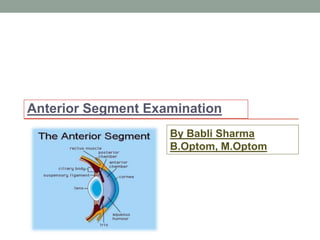

Anterior Segment Examination
By Babli Sharma
B.Optom, M.Optom
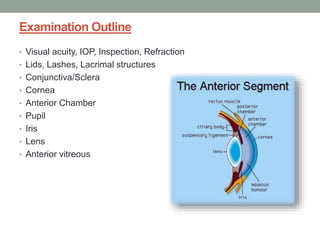
Examination Outline
• Visual acuity, IOP, Inspection, Refraction
• Lids, Lashes, Lacrimal structures
• Conjunctiva/Sclera
• Cornea
• Anterior Chamber
• Pupil
• Iris
• Lens
• Anterior vitreous
Examination Structure
• Attention should be given to the wording of the question which often
directs the candidate where to look:
“Examines the”…
External Eye – Periorbital tissue,
• Eyelid, margins,
• Conjunctiva,
• Fornices,
• Limbus and Corneal surface
• Anterior Segment –
• Eyelids,
• Conjunctiva,
• Cornea (all layers),
• Anterior chamber,
• Iris and Lens
Visual Acuity, IOP, Inspection, ± Refraction
• Always stand back and examine the patient as a whole.
• Age / gender / ethnicity are often useful in narrowing the potential
differential diagnoses.
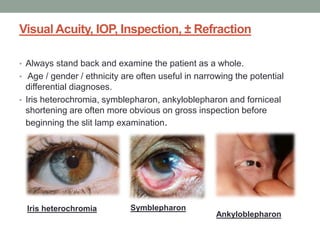
• Iris heterochromia, symblepharon, ankyloblepharon and forniceal
shortening are often more obvious on gross inspection before
beginning the slit lamp examination.
Iris heterochromia Symblepharon
Ankyloblepharon
Lid, Lashes, Lacrimal Structures
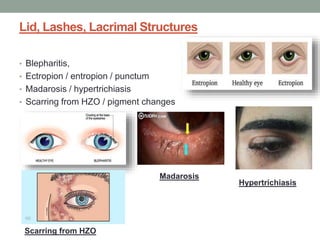
• Blepharitis,
• Ectropion / entropion / punctum
• Madarosis / hypertrichiasis
• Scarring from HZO / pigment changes
Madarosis
Hypertrichiasis
Scarring from HZO
Conjunctiva/Sclera
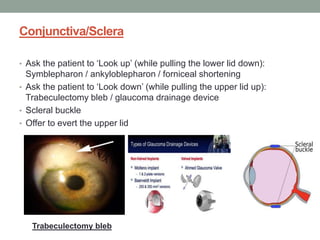
• Ask the patient to ‘Look up’ (while pulling the lower lid down):
Symblepharon / ankyloblepharon / forniceal shortening
• Ask the patient to ‘Look down’ (while pulling the upper lid up):
Trabeculectomy bleb / glaucoma drainage device
• Scleral buckle
• Offer to evert the upper lid
Trabeculectomy bleb
Cornea
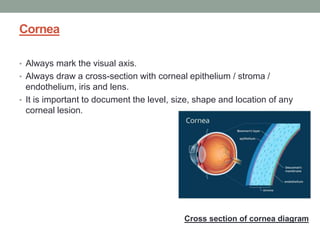
• Always mark the visual axis.
• Always draw a cross-section with corneal epithelium / stroma /
endothelium, iris and lens.
• It is important to document the level, size, shape and location of any
corneal lesion.
Cross section of cornea diagram
Note:
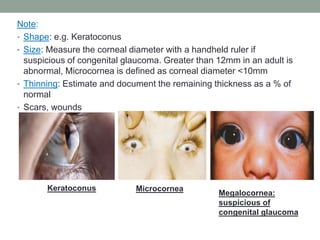
• Shape: e.g. Keratoconus
• Size: Measure the corneal diameter with a handheld ruler if
suspicious of congenital glaucoma. Greater than 12mm in an adult is
abnormal, Microcornea is defined as corneal diameter <10mm
• Thinning: Estimate and document the remaining thickness as a % of
normal
• Scars, wounds
Keratoconus Microcornea
Megalocornea:
suspicious of
congenital glaucoma
Contd..
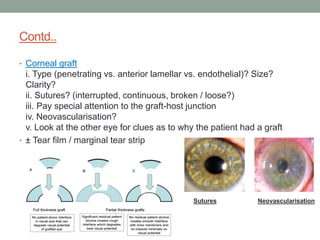
• Corneal graft
i. Type (penetrating vs. anterior lamellar vs. endothelial)? Size?
Clarity?
ii. Sutures? (interrupted, continuous, broken / loose?)
iii. Pay special attention to the graft-host junction
iv. Neovascularisation?
v. Look at the other eye for clues as to why the patient had a graft
• ± Tear film / marginal tear strip
Sutures Neovascularisation
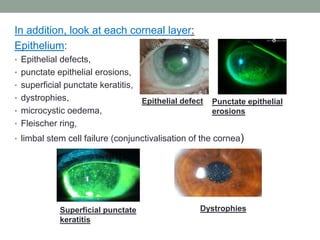
In addition, look at each corneal layer:
Epithelium:
• Epithelial defects,
• punctate epithelial erosions,
• superficial punctate keratitis,
• dystrophies,
• microcystic oedema,
• Fleischer ring,
• limbal stem cell failure (conjunctivalisation of the cornea)
Epithelial defect Punctate epithelial
erosions
Superficial punctate
keratitis
Dystrophies
Contd..
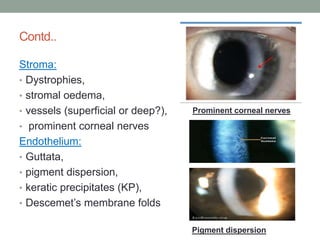
Stroma:
• Dystrophies,
• stromal oedema,
• vessels (superficial or deep?),
• prominent corneal nerves
Endothelium:
• Guttata,
• pigment dispersion,
• keratic precipitates (KP),
• Descemet’s membrane folds
Prominent corneal nerves
Pigment dispersion
Contd..
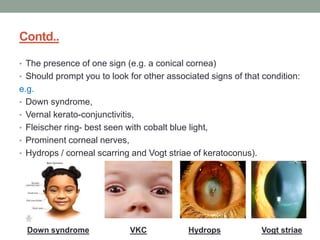
• The presence of one sign (e.g. a conical cornea)
• Should prompt you to look for other associated signs of that condition:
e.g.
• Down syndrome,
• Vernal kerato-conjunctivitis,
• Fleischer ring- best seen with cobalt blue light,
• Prominent corneal nerves,
• Hydrops / corneal scarring and Vogt striae of keratoconus).
VKC Hydrops Vogt striae
Down syndrome
Contd…
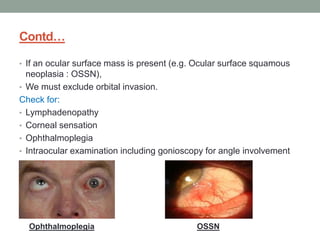
• If an ocular surface mass is present (e.g. Ocular surface squamous
neoplasia : OSSN),
• We must exclude orbital invasion.
Check for:
• Lymphadenopathy
• Corneal sensation
• Ophthalmoplegia
• Intraocular examination including gonioscopy for angle involvement
OSSN
Ophthalmoplegia
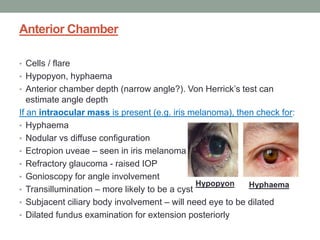
Anterior Chamber
• Cells / flare
• Hypopyon, hyphaema
• Anterior chamber depth (narrow angle?). Von Herrick’s test can
estimate angle depth
If an intraocular mass is present (e.g. iris melanoma), then check for:
• Hyphaema
• Nodular vs diffuse configuration
• Ectropion uveae – seen in iris melanoma
• Refractory glaucoma - raised IOP
• Gonioscopy for angle involvement
• Transillumination – more likely to be a cyst
• Subjacent ciliary body involvement – will need eye to be dilated
• Dilated fundus examination for extension posteriorly
Hypopyon Hyphaema
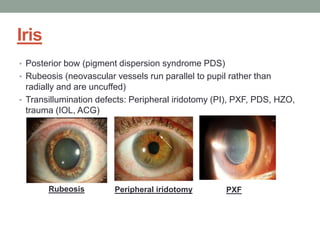
Iris
• Posterior bow (pigment dispersion syndrome PDS)
• Rubeosis (neovascular vessels run parallel to pupil rather than
radially and are uncuffed)
• Transillumination defects: Peripheral iridotomy (PI), PXF, PDS, HZO,
trauma (IOL, ACG)
Rubeosis Peripheral iridotomy PXF
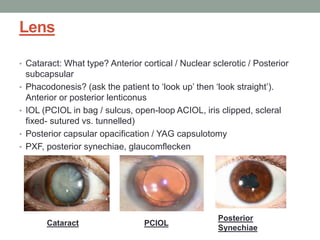
Lens
• Cataract: What type? Anterior cortical / Nuclear sclerotic / Posterior
subcapsular
• Phacodonesis? (ask the patient to ‘look up’ then ‘look straight’).
Anterior or posterior lenticonus
• IOL (PCIOL in bag / sulcus, open-loop ACIOL, iris clipped, scleral
fixed- sutured vs. tunnelled)
• Posterior capsular opacification / YAG capsulotomy
• PXF, posterior synechiae, glaucomflecken
Cataract PCIOL
Posterior
Synechiae
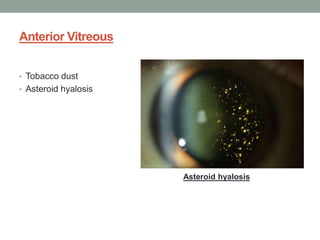
Anterior Vitreous
• Tobacco dust
• Asteroid hyalosis
Asteroid hyalosis
General Comments
Record important negatives :
• (e.g. absence of hypopyon /
• synechiae in infection).
Consider further examination / testing:
• fluorescein staining,
• corneal sensation,
• Schirmer’s test.
Things Not to Miss (or to Look for if You Can’t Find
Anything)
• Symblepharon, forniceal shortening
• Trabeculectomy bleb, glaucoma drainage tube, MIGS
• Keratoconus
• Corneal guttata (Fuchs endothelial dystrophy)
• Cells / flare
• Transillumination defects (PI)
• LASIK flaps
• PXF
Investigations
Investigations will be dictated by findings, but may include:
• Corneal scrape / biopsy / impression cytology
• Confocal microscopy
• Corneal topography / Keratometry
• Corneal pachymetry
• Anterior segment optical coherence tomography (OCT)
• Ultrasound biomicroscopy (UBM)
•Thank you

ANTERIOR SEGMENT EXAMINATION.PPTX.......

  • 1.
    Anterior Segment Examination ByBabli Sharma B.Optom, M.Optom
  • 2.
    Examination Outline • Visualacuity, IOP, Inspection, Refraction • Lids, Lashes, Lacrimal structures • Conjunctiva/Sclera • Cornea • Anterior Chamber • Pupil • Iris • Lens • Anterior vitreous
  • 3.
    Examination Structure • Attentionshould be given to the wording of the question which often directs the candidate where to look: “Examines the”… External Eye – Periorbital tissue, • Eyelid, margins, • Conjunctiva, • Fornices, • Limbus and Corneal surface • Anterior Segment – • Eyelids, • Conjunctiva, • Cornea (all layers), • Anterior chamber, • Iris and Lens
  • 4.
    Visual Acuity, IOP,Inspection, ± Refraction • Always stand back and examine the patient as a whole. • Age / gender / ethnicity are often useful in narrowing the potential differential diagnoses. • Iris heterochromia, symblepharon, ankyloblepharon and forniceal shortening are often more obvious on gross inspection before beginning the slit lamp examination. Iris heterochromia Symblepharon Ankyloblepharon
  • 5.
    Lid, Lashes, LacrimalStructures • Blepharitis, • Ectropion / entropion / punctum • Madarosis / hypertrichiasis • Scarring from HZO / pigment changes Madarosis Hypertrichiasis Scarring from HZO
  • 6.
    Conjunctiva/Sclera • Ask thepatient to ‘Look up’ (while pulling the lower lid down): Symblepharon / ankyloblepharon / forniceal shortening • Ask the patient to ‘Look down’ (while pulling the upper lid up): Trabeculectomy bleb / glaucoma drainage device • Scleral buckle • Offer to evert the upper lid Trabeculectomy bleb
  • 7.
    Cornea • Always markthe visual axis. • Always draw a cross-section with corneal epithelium / stroma / endothelium, iris and lens. • It is important to document the level, size, shape and location of any corneal lesion. Cross section of cornea diagram
  • 8.
    Note: • Shape: e.g.Keratoconus • Size: Measure the corneal diameter with a handheld ruler if suspicious of congenital glaucoma. Greater than 12mm in an adult is abnormal, Microcornea is defined as corneal diameter <10mm • Thinning: Estimate and document the remaining thickness as a % of normal • Scars, wounds Keratoconus Microcornea Megalocornea: suspicious of congenital glaucoma
  • 9.
    Contd.. • Corneal graft i.Type (penetrating vs. anterior lamellar vs. endothelial)? Size? Clarity? ii. Sutures? (interrupted, continuous, broken / loose?) iii. Pay special attention to the graft-host junction iv. Neovascularisation? v. Look at the other eye for clues as to why the patient had a graft • ± Tear film / marginal tear strip Sutures Neovascularisation
  • 10.
    In addition, lookat each corneal layer: Epithelium: • Epithelial defects, • punctate epithelial erosions, • superficial punctate keratitis, • dystrophies, • microcystic oedema, • Fleischer ring, • limbal stem cell failure (conjunctivalisation of the cornea) Epithelial defect Punctate epithelial erosions Superficial punctate keratitis Dystrophies
  • 11.
    Contd.. Stroma: • Dystrophies, • stromaloedema, • vessels (superficial or deep?), • prominent corneal nerves Endothelium: • Guttata, • pigment dispersion, • keratic precipitates (KP), • Descemet’s membrane folds Prominent corneal nerves Pigment dispersion
  • 12.
    Contd.. • The presenceof one sign (e.g. a conical cornea) • Should prompt you to look for other associated signs of that condition: e.g. • Down syndrome, • Vernal kerato-conjunctivitis, • Fleischer ring- best seen with cobalt blue light, • Prominent corneal nerves, • Hydrops / corneal scarring and Vogt striae of keratoconus). VKC Hydrops Vogt striae Down syndrome
  • 13.
    Contd… • If anocular surface mass is present (e.g. Ocular surface squamous neoplasia : OSSN), • We must exclude orbital invasion. Check for: • Lymphadenopathy • Corneal sensation • Ophthalmoplegia • Intraocular examination including gonioscopy for angle involvement OSSN Ophthalmoplegia
  • 14.
    Anterior Chamber • Cells/ flare • Hypopyon, hyphaema • Anterior chamber depth (narrow angle?). Von Herrick’s test can estimate angle depth If an intraocular mass is present (e.g. iris melanoma), then check for: • Hyphaema • Nodular vs diffuse configuration • Ectropion uveae – seen in iris melanoma • Refractory glaucoma - raised IOP • Gonioscopy for angle involvement • Transillumination – more likely to be a cyst • Subjacent ciliary body involvement – will need eye to be dilated • Dilated fundus examination for extension posteriorly Hypopyon Hyphaema
  • 15.
    Iris • Posterior bow(pigment dispersion syndrome PDS) • Rubeosis (neovascular vessels run parallel to pupil rather than radially and are uncuffed) • Transillumination defects: Peripheral iridotomy (PI), PXF, PDS, HZO, trauma (IOL, ACG) Rubeosis Peripheral iridotomy PXF
  • 16.
    Lens • Cataract: Whattype? Anterior cortical / Nuclear sclerotic / Posterior subcapsular • Phacodonesis? (ask the patient to ‘look up’ then ‘look straight’). Anterior or posterior lenticonus • IOL (PCIOL in bag / sulcus, open-loop ACIOL, iris clipped, scleral fixed- sutured vs. tunnelled) • Posterior capsular opacification / YAG capsulotomy • PXF, posterior synechiae, glaucomflecken Cataract PCIOL Posterior Synechiae
  • 17.
    Anterior Vitreous • Tobaccodust • Asteroid hyalosis Asteroid hyalosis
  • 18.
    General Comments Record importantnegatives : • (e.g. absence of hypopyon / • synechiae in infection). Consider further examination / testing: • fluorescein staining, • corneal sensation, • Schirmer’s test.
  • 19.
    Things Not toMiss (or to Look for if You Can’t Find Anything) • Symblepharon, forniceal shortening • Trabeculectomy bleb, glaucoma drainage tube, MIGS • Keratoconus • Corneal guttata (Fuchs endothelial dystrophy) • Cells / flare • Transillumination defects (PI) • LASIK flaps • PXF
  • 20.
    Investigations Investigations will bedictated by findings, but may include: • Corneal scrape / biopsy / impression cytology • Confocal microscopy • Corneal topography / Keratometry • Corneal pachymetry • Anterior segment optical coherence tomography (OCT) • Ultrasound biomicroscopy (UBM)
  • 21.