S 
Methodology: 
Designing a 
Psychology Research
Today’s Objective 
Content Objective 
S SWBAT…Identify the steps 
necessary to design a research 
study in psychology. 
S SWBAT…Explain whether an 
experiment is reliable. 
Language Objective 
S SWBAT…Understand the 
names of different 
methodological choices.
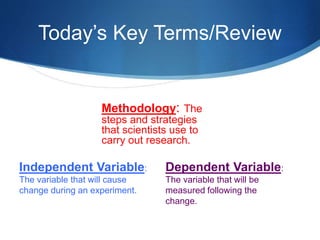
Today’s Key Terms/Review 
Methodology: The 
steps and strategies 
that scientists use to 
carry out research. 
Dependent Variable: 
The variable that will be 
measured following the 
change. 
Independent Variable: 
The variable that will cause 
change during an experiment.
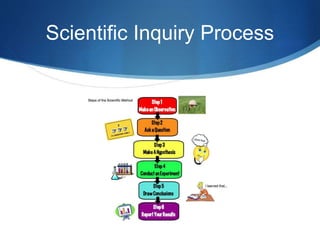
Scientific Inquiry Process
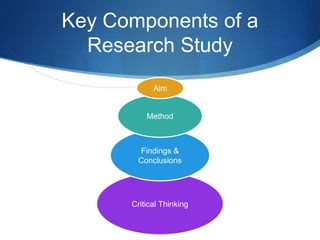
Key Components of a 
Research Study 
Aim 
Method 
Findings & 
Conclusions 
Critical Thinking
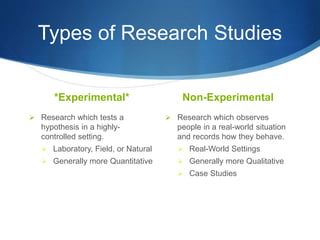
Types of Research Studies 
*Experimental* 
 Research which tests a 
hypothesis in a highly-controlled 
setting. 
 Laboratory, Field, or Natural 
 Generally more Quantitative 
Non-Experimental 
 Research which observes 
people in a real-world situation 
and records how they behave. 
 Real-World Settings 
 Generally more Qualitative 
 Case Studies
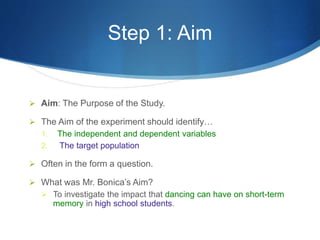
Step 1: Aim 
 Aim: The Purpose of the Study. 
 The Aim of the experiment should identify… 
1. The independent and dependent variables 
2. The target population 
 Often in the form a question. 
 What was Mr. Bonica’s Aim? 
 To investigate the impact that dancing can have on short-term 
memory in high school students.
Step #2: Method 
 This is the stage of an experiment where the researcher 
carefully plans their experiment. Things they must 
consider include… 
 Participants/Sampling 
 Control Conditions 
 Design 
 Ethics (Next Class)
Participants 
 Key Question: Who will be your participants and how will 
you get them to participate in your research? 
 There are different ways to go about this process… 
 Random Sampling: randomly selecting individuals from a 
population…Good chance that it will be representative. 
 Opportunity Sampling: Participants are used because they 
are available…May not be representative of whole 
population 
 Systematic Sampling: Selecting certain individuals with 
certain traits.
Mr. Bonica’s Sampling 
 What method did Mr. Bonica use to gain his sample? 
 What are the strengths and limitations of his choice? 
 Should he have used a different method? Why?
Controls 
 Controls are the strategies that researchers use to limit 
the impact of all variables besides the specified 
independent variable. 
 Scripted Instructions and Conditions (Time of Day, Room, 
etc.) 
 Randomization of participants 
 Placebos (medicine) 
 Blind Studies
Blinds: Single and Double 
Blinds 
 Studies that use blinds are used to limit the possibility 
that a researcher’s or participant’s expectations will 
impact the results of a study. 
 Single-Blind: The participant does not know whether 
they are in the treatment or control group. 
 Double-Blind: Neither the participant or the research 
know whether the participant is in the treatment or control 
group.
Treatment and Control Groups 
 Treatment Group: The group that is being impacted by 
the independent variable. 
 Control Group: The group that is not being impacted by 
the independent variable. 
 The control group gives something to compare to the 
treatment group. 
 Helps tell researchers if it was the independent variable that 
was really impacting the experiment.
Design 
S Design is the strategy that researchers use to divide their 
participants into either the treatment or control group. 
S There are two main ways to do this… 
S Independent Sample Design: Each participant is either 
tested in the control or the treatment group. 
S Repeated Measures Design: Each participant is tested 
under both the control and test group.
Reason for Repeated Measure 
Design 
+Limits Participation Variability: Differences in results are due to 
natural differences between participants. 
+Requires fewer participants. 
-May lead to Order Effect: When an earlier tasks such as a 
question or test impact the performance on a later task. 
- Demand Characteristics: When participants guess the aim of the 
study and do not act naturally because they want to be helpful – or 
the harmful.
Reasons for Independent Sample 
Design 
+Avoids Order Effect 
+ Participants are less likely to guess the hypothesis of the study. 
+ Less likely to bore participants. 
+ Same material may be used with both groups. 
- More likely that Participant Variability impacts results
Reliability 
S The extent to which the findings of a study can be 
replicated (duplicated, copied) by other experiments. 
S What would have to happen in Mr. Bonica’s other two 
psychology classes to make it reliable?
Validity 
 An experiment is valid if it measures what it claims it 
measures. 
 Ecological Validity: The measure of the whether an 
experiment can be generalized and applied to the real-world. 
 An experiment is not ecologically valid if it does not replicate 
the real world. 
 To what extent is Mr. Bonica’s experiment valid? Is it hold 
ecologically validity?
Playing Pepper 
S Mr. Bonica will randomly call on students to define or 
explain a key term. 
S Be prepared at any moment to build on a fellow student’s 
response or to help them if necessary.

Pscyhology methodology pp

  • 1.
    S Methodology: Designinga Psychology Research
  • 2.
    Today’s Objective ContentObjective S SWBAT…Identify the steps necessary to design a research study in psychology. S SWBAT…Explain whether an experiment is reliable. Language Objective S SWBAT…Understand the names of different methodological choices.
  • 3.
    Today’s Key Terms/Review Methodology: The steps and strategies that scientists use to carry out research. Dependent Variable: The variable that will be measured following the change. Independent Variable: The variable that will cause change during an experiment.
  • 4.
  • 5.
    Key Components ofa Research Study Aim Method Findings & Conclusions Critical Thinking
  • 6.
    Types of ResearchStudies *Experimental*  Research which tests a hypothesis in a highly-controlled setting.  Laboratory, Field, or Natural  Generally more Quantitative Non-Experimental  Research which observes people in a real-world situation and records how they behave.  Real-World Settings  Generally more Qualitative  Case Studies
  • 7.
    Step 1: Aim  Aim: The Purpose of the Study.  The Aim of the experiment should identify… 1. The independent and dependent variables 2. The target population  Often in the form a question.  What was Mr. Bonica’s Aim?  To investigate the impact that dancing can have on short-term memory in high school students.
  • 8.
    Step #2: Method  This is the stage of an experiment where the researcher carefully plans their experiment. Things they must consider include…  Participants/Sampling  Control Conditions  Design  Ethics (Next Class)
  • 9.
    Participants  KeyQuestion: Who will be your participants and how will you get them to participate in your research?  There are different ways to go about this process…  Random Sampling: randomly selecting individuals from a population…Good chance that it will be representative.  Opportunity Sampling: Participants are used because they are available…May not be representative of whole population  Systematic Sampling: Selecting certain individuals with certain traits.
  • 10.
    Mr. Bonica’s Sampling  What method did Mr. Bonica use to gain his sample?  What are the strengths and limitations of his choice?  Should he have used a different method? Why?
  • 11.
    Controls  Controlsare the strategies that researchers use to limit the impact of all variables besides the specified independent variable.  Scripted Instructions and Conditions (Time of Day, Room, etc.)  Randomization of participants  Placebos (medicine)  Blind Studies
  • 12.
    Blinds: Single andDouble Blinds  Studies that use blinds are used to limit the possibility that a researcher’s or participant’s expectations will impact the results of a study.  Single-Blind: The participant does not know whether they are in the treatment or control group.  Double-Blind: Neither the participant or the research know whether the participant is in the treatment or control group.
  • 13.
    Treatment and ControlGroups  Treatment Group: The group that is being impacted by the independent variable.  Control Group: The group that is not being impacted by the independent variable.  The control group gives something to compare to the treatment group.  Helps tell researchers if it was the independent variable that was really impacting the experiment.
  • 14.
    Design S Designis the strategy that researchers use to divide their participants into either the treatment or control group. S There are two main ways to do this… S Independent Sample Design: Each participant is either tested in the control or the treatment group. S Repeated Measures Design: Each participant is tested under both the control and test group.
  • 15.
    Reason for RepeatedMeasure Design +Limits Participation Variability: Differences in results are due to natural differences between participants. +Requires fewer participants. -May lead to Order Effect: When an earlier tasks such as a question or test impact the performance on a later task. - Demand Characteristics: When participants guess the aim of the study and do not act naturally because they want to be helpful – or the harmful.
  • 16.
    Reasons for IndependentSample Design +Avoids Order Effect + Participants are less likely to guess the hypothesis of the study. + Less likely to bore participants. + Same material may be used with both groups. - More likely that Participant Variability impacts results
  • 17.
    Reliability S Theextent to which the findings of a study can be replicated (duplicated, copied) by other experiments. S What would have to happen in Mr. Bonica’s other two psychology classes to make it reliable?
  • 18.
    Validity  Anexperiment is valid if it measures what it claims it measures.  Ecological Validity: The measure of the whether an experiment can be generalized and applied to the real-world.  An experiment is not ecologically valid if it does not replicate the real world.  To what extent is Mr. Bonica’s experiment valid? Is it hold ecologically validity?
  • 19.
    Playing Pepper SMr. Bonica will randomly call on students to define or explain a key term. S Be prepared at any moment to build on a fellow student’s response or to help them if necessary.