Research Methods and Techniques
             The Observational Method
L/O: to be able to describe observation as a research
    method and the associated key terms (AO3)

Starter:

Complete the worksheet on hypotheses.


            Identify the IV and DV in the different
            hypotheses.
L/O: to be able to describe observation as a research
       method and the associated key terms (AO3)


The Observational Method

                                                    ME
              Doesn’t all research
               begin with some
                   form of
                observation?                 Yes.
   YOU
                                         But it is also a
                                      research method in
                                         its own right.
L/O: to be able to describe observation as a research
       method and the associated key terms (AO3)

The Observational Method
- Involves systematically watching and
  recording what people say and do.
- Naturally occurring behaviours are observed
  = no attempt to manipulate variables.

     We can get natural behaviour,
     unchanged by researcher presence or the
     research environment.
L/O: to be able to describe observation as a research
         method and the associated key terms (AO3)
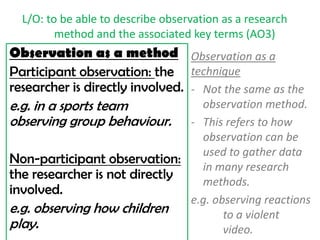
Observation as a method Observation as a
Participant observation: the technique
researcher is directly involved. - Not the same as the
e.g. in a sports team            observation method.
observing group behaviour.     - This refers to how
                                 observation can be
                                 used to gather data
Non-participant observation:
                                 in many research
the researcher is not directly   methods.
involved.
                               e.g. observing reactions
e.g. observing how children           to a violent
play.                                 video.
L/O: to be able to describe observation as a research
       method and the associated key terms (AO3)


The Observational Method

                                                        ME

                This seems easy
                    enough!

   YOU                                       Ok.

                                          You try it!
L/O: to be able to describe observation as a research
        method and the associated key terms (AO3)

Take a slip and 3 minutes,to yourself.
             For keep it try to create a
                  rhyme/method for
               remembering the three
               research designs within
Look at the details of the small-scale research
               laboratory experiment:
(pilot study) using the observational method.
                • Repeated Measures
               • Independent Groups
                   • Matched Pairs
For the next 3 minutes you are the researcher. So
get observing and recording!
L/O: to be able to describe observation as a research
       method and the associated key terms (AO3)

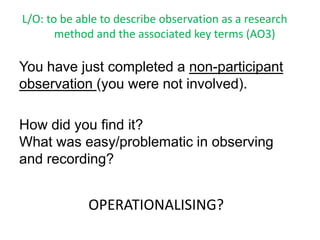
You have just completed a non-participant
observation (you were not involved).

How did you find it?
What was easy/problematic in observing
and recording?


             OPERATIONALISING?
L/O: to be able to describe observation as a research
          method and the associated key terms (AO3)

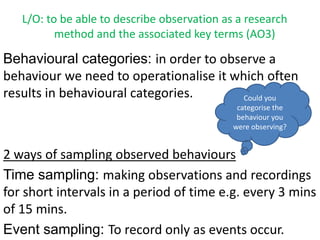
Behavioural categories: in order to observe a
behaviour we need to operationalise it which often
results in behavioural categories.       Could you
                                              categorise the
                                              behaviour you
                                             were observing?


2 ways of sampling observed behaviours
Time sampling: making observations and recordings
for short intervals in a period of time e.g. every 3 mins
of 15 mins.
Event sampling: To record only as events occur.
L/O: to be able to describe observation as a research
        method and the associated key terms (AO3)

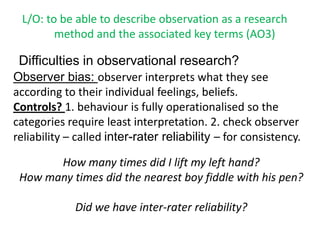
 Difficulties in observational research?
Observer bias: observer interprets what they see
according to their individual feelings, beliefs.
Controls? 1. behaviour is fully operationalised so the
categories require least interpretation. 2. check observer
reliability – called inter-rater reliability – for consistency.

       How many times did I lift my left hand?
 How many times did the nearest boy fiddle with his pen?

             Did we have inter-rater reliability?
L/O: to be able to describe observation as a research
         method and the associated key terms (AO3)

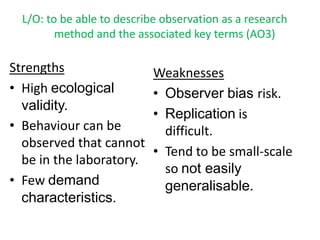
Strengths                   Weaknesses
• High ecological           • Observer bias risk.
  validity.
                            • Replication is
• Behaviour can be            difficult.
  observed that cannot
                            • Tend to be small-scale
  be in the laboratory.
                              so not easily
• Few demand                  generalisable.
  characteristics.

Observational method

  • 1.
    Research Methods andTechniques The Observational Method L/O: to be able to describe observation as a research method and the associated key terms (AO3) Starter: Complete the worksheet on hypotheses. Identify the IV and DV in the different hypotheses.
  • 2.
    L/O: to beable to describe observation as a research method and the associated key terms (AO3) The Observational Method ME Doesn’t all research begin with some form of observation? Yes. YOU But it is also a research method in its own right.
  • 3.
    L/O: to beable to describe observation as a research method and the associated key terms (AO3) The Observational Method - Involves systematically watching and recording what people say and do. - Naturally occurring behaviours are observed = no attempt to manipulate variables. We can get natural behaviour, unchanged by researcher presence or the research environment.
  • 4.
    L/O: to beable to describe observation as a research method and the associated key terms (AO3) Observation as a method Observation as a Participant observation: the technique researcher is directly involved. - Not the same as the e.g. in a sports team observation method. observing group behaviour. - This refers to how observation can be used to gather data Non-participant observation: in many research the researcher is not directly methods. involved. e.g. observing reactions e.g. observing how children to a violent play. video.
  • 5.
    L/O: to beable to describe observation as a research method and the associated key terms (AO3) The Observational Method ME This seems easy enough! YOU Ok. You try it!
  • 6.
    L/O: to beable to describe observation as a research method and the associated key terms (AO3) Take a slip and 3 minutes,to yourself. For keep it try to create a rhyme/method for remembering the three research designs within Look at the details of the small-scale research laboratory experiment: (pilot study) using the observational method. • Repeated Measures • Independent Groups • Matched Pairs For the next 3 minutes you are the researcher. So get observing and recording!
  • 7.
    L/O: to beable to describe observation as a research method and the associated key terms (AO3) You have just completed a non-participant observation (you were not involved). How did you find it? What was easy/problematic in observing and recording? OPERATIONALISING?
  • 8.
    L/O: to beable to describe observation as a research method and the associated key terms (AO3) Behavioural categories: in order to observe a behaviour we need to operationalise it which often results in behavioural categories. Could you categorise the behaviour you were observing? 2 ways of sampling observed behaviours Time sampling: making observations and recordings for short intervals in a period of time e.g. every 3 mins of 15 mins. Event sampling: To record only as events occur.
  • 9.
    L/O: to beable to describe observation as a research method and the associated key terms (AO3) Difficulties in observational research? Observer bias: observer interprets what they see according to their individual feelings, beliefs. Controls? 1. behaviour is fully operationalised so the categories require least interpretation. 2. check observer reliability – called inter-rater reliability – for consistency. How many times did I lift my left hand? How many times did the nearest boy fiddle with his pen? Did we have inter-rater reliability?
  • 10.
    L/O: to beable to describe observation as a research method and the associated key terms (AO3) Strengths Weaknesses • High ecological • Observer bias risk. validity. • Replication is • Behaviour can be difficult. observed that cannot • Tend to be small-scale be in the laboratory. so not easily • Few demand generalisable. characteristics.