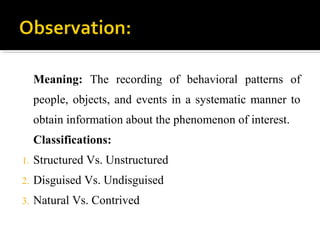
Meaning: The recording of behavioral patterns of
people, objects, and events in a systematic manner to
obtain information about the phenomenon of interest.
Classifications:
1. Structured Vs. Unstructured
2. Disguised Vs. Undisguised
3. Natural Vs. Contrived
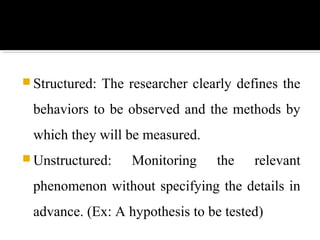
 Structured: The researcher clearly defines the
behaviors to be observed and the methods by
which they will be measured.
 Unstructured: Monitoring the relevant
phenomenon without specifying the details in
advance. (Ex: A hypothesis to be tested)
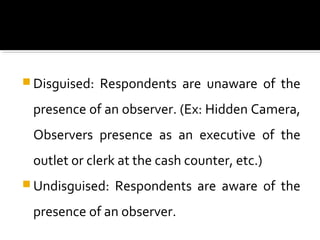
 Disguised: Respondents are unaware of the
presence of an observer. (Ex: Hidden Camera,
Observers presence as an executive of the
outlet or clerk at the cash counter, etc.)
 Undisguised: Respondents are aware of the
presence of an observer.
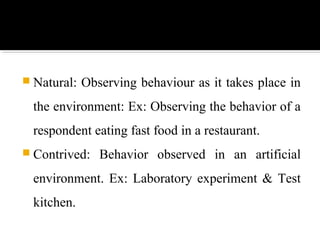
 Natural: Observing behaviour as it takes place in
the environment: Ex: Observing the behavior of a
respondent eating fast food in a restaurant.
 Contrived: Behavior observed in an artificial
environment. Ex: Laboratory experiment & Test
kitchen.
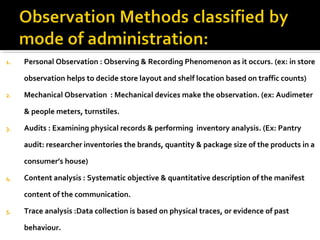
1. Personal Observation : Observing & Recording Phenomenon as it occurs. (ex: in store
observation helps to decide store layout and shelf location based on traffic counts)
2. Mechanical Observation : Mechanical devices make the observation. (ex: Audimeter
& people meters, turnstiles.
3. Audits : Examining physical records & performing inventory analysis. (Ex: Pantry
audit: researcher inventories the brands, quantity & package size of the products in a
consumer’s house)
4. Content analysis : Systematic objective & quantitative description of the manifest
content of the communication.
5. Trace analysis :Data collection is based on physical traces, or evidence of past
behaviour.
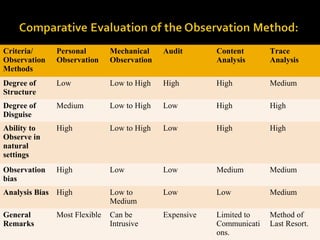
Criteria/
Observation
Methods
Personal
Observation
Mechanical
Observation
Audit Content
Analysis
Trace
Analysis
Degree of
Structure
Low Low to High High High Medium
Degree of
Disguise
Medium Low to High Low High High
Ability to
Observe in
natural
settings
High Low to High Low High High
Observation
bias
High Low Low Medium Medium
Analysis Bias High Low to
Medium
Low Low Medium
General
Remarks
Most Flexible Can be
Intrusive
Expensive Limited to
Communicati
ons.
Method of
Last Resort.
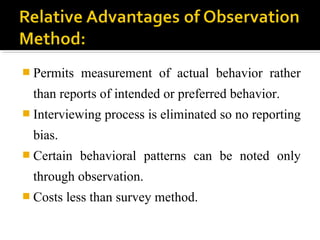
 Permits measurement of actual behavior rather
than reports of intended or preferred behavior.
 Interviewing process is eliminated so no reporting
bias.
 Certain behavioral patterns can be noted only
through observation.
 Costs less than survey method.
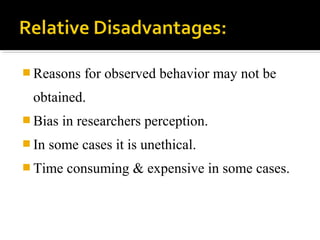
 Reasons for observed behavior may not be
obtained.
 Bias in researchers perception.
 In some cases it is unethical.
 Time consuming & expensive in some cases.
 Reasons for observed behavior may not be
obtained.
 Bias in researchers perception.
 In some cases it is unethical.
 Time consuming & expensive in some cases.

Observation method (2)

  • 2.
    Meaning: The recordingof behavioral patterns of people, objects, and events in a systematic manner to obtain information about the phenomenon of interest. Classifications: 1. Structured Vs. Unstructured 2. Disguised Vs. Undisguised 3. Natural Vs. Contrived
  • 3.
     Structured: Theresearcher clearly defines the behaviors to be observed and the methods by which they will be measured.  Unstructured: Monitoring the relevant phenomenon without specifying the details in advance. (Ex: A hypothesis to be tested)
  • 4.
     Disguised: Respondentsare unaware of the presence of an observer. (Ex: Hidden Camera, Observers presence as an executive of the outlet or clerk at the cash counter, etc.)  Undisguised: Respondents are aware of the presence of an observer.
  • 5.
     Natural: Observingbehaviour as it takes place in the environment: Ex: Observing the behavior of a respondent eating fast food in a restaurant.  Contrived: Behavior observed in an artificial environment. Ex: Laboratory experiment & Test kitchen.
  • 6.
    1. Personal Observation: Observing & Recording Phenomenon as it occurs. (ex: in store observation helps to decide store layout and shelf location based on traffic counts) 2. Mechanical Observation : Mechanical devices make the observation. (ex: Audimeter & people meters, turnstiles. 3. Audits : Examining physical records & performing inventory analysis. (Ex: Pantry audit: researcher inventories the brands, quantity & package size of the products in a consumer’s house) 4. Content analysis : Systematic objective & quantitative description of the manifest content of the communication. 5. Trace analysis :Data collection is based on physical traces, or evidence of past behaviour.
  • 7.
    Criteria/ Observation Methods Personal Observation Mechanical Observation Audit Content Analysis Trace Analysis Degree of Structure LowLow to High High High Medium Degree of Disguise Medium Low to High Low High High Ability to Observe in natural settings High Low to High Low High High Observation bias High Low Low Medium Medium Analysis Bias High Low to Medium Low Low Medium General Remarks Most Flexible Can be Intrusive Expensive Limited to Communicati ons. Method of Last Resort.
  • 8.
     Permits measurementof actual behavior rather than reports of intended or preferred behavior.  Interviewing process is eliminated so no reporting bias.  Certain behavioral patterns can be noted only through observation.  Costs less than survey method.
  • 9.
     Reasons forobserved behavior may not be obtained.  Bias in researchers perception.  In some cases it is unethical.  Time consuming & expensive in some cases.
  • 10.
     Reasons forobserved behavior may not be obtained.  Bias in researchers perception.  In some cases it is unethical.  Time consuming & expensive in some cases.