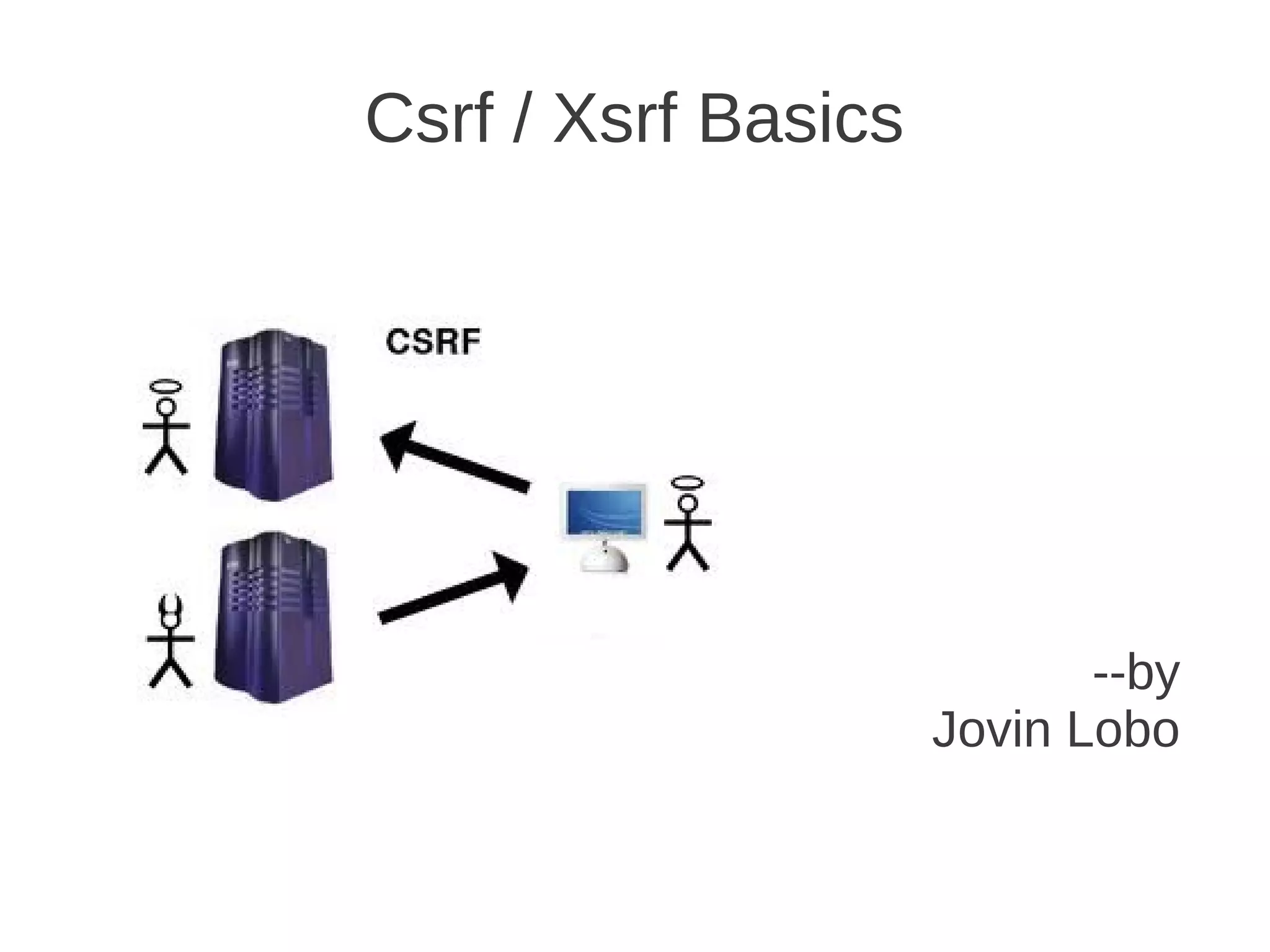
Csrf / Xsrf Basics


                            --by
                     Jovin Lobo
Definition :

“CSRF / XSRF (Cross-Site Request Forgery) is a
type of web application vulnerability that allows a
malicious website to send unauthorized requests
to a vulnerable website using active sessions of
its authorized users.”


                           --- Samvel Gevorgyan
OWASP describes CSRF as ....

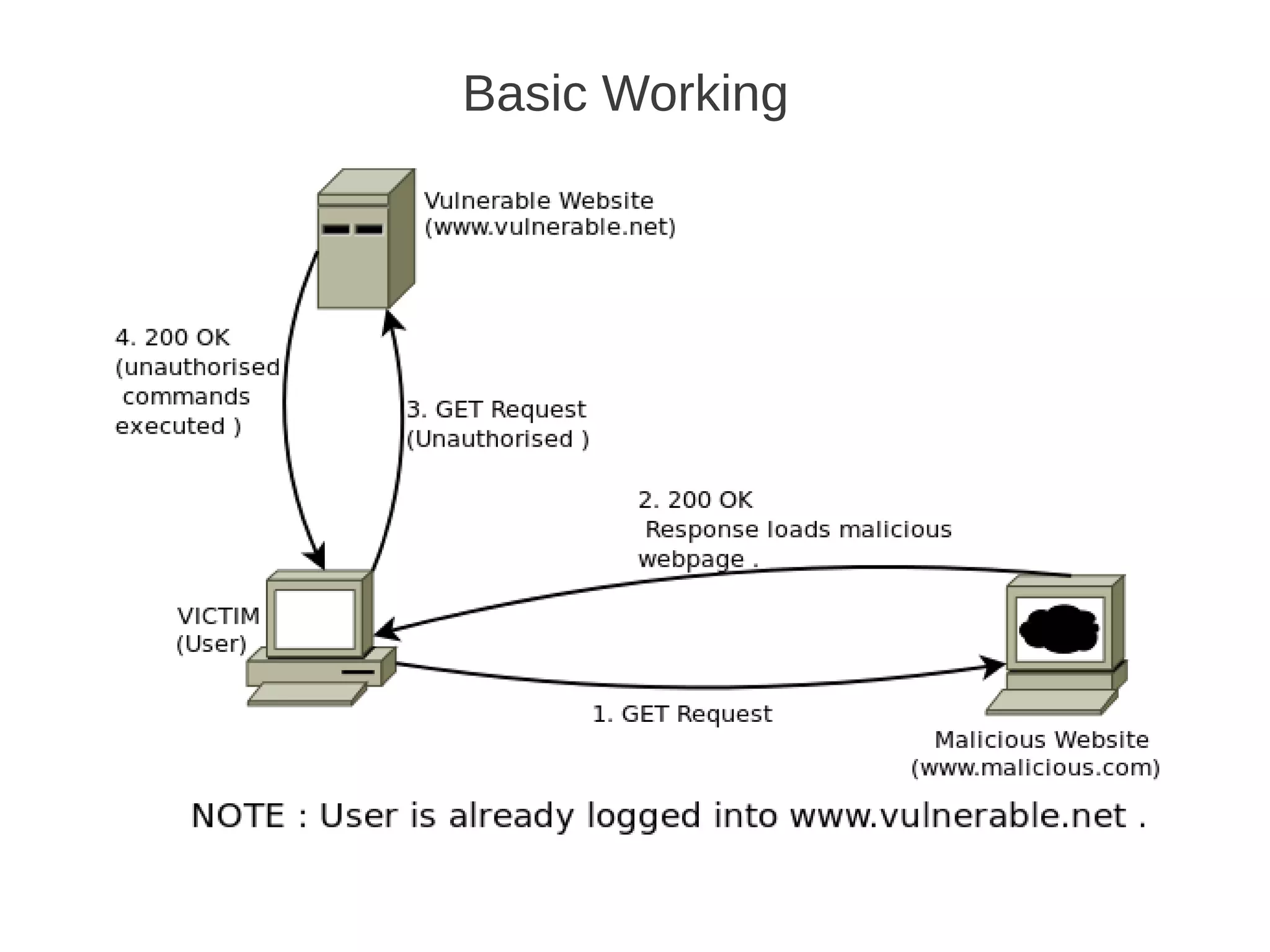
CSRF is an attack that tricks the victim into loading a page
that contains a malicious request. It is malicious in the sense
that it inherits the identity and privileges of the victim to
perform an undesired function on the victim's behalf like
change the victim's e-mail address, home address, or
password..etc

So basically CSRF attacks target functions that cause a
state change on the server but can also be used to access
sensitive data.
Basic Working
DEMO
Prevention techniques that SUCK !!!
✗   Secret cookies
✗   Accepting only POST requests
✗   Multi-Step transactions
Then how do we prevent it ??


“Adding any 'unpredictable' parameter to the
requests should solve the problem...............
What Say ??”
Some prevention techniques that
          DO NOT SUCK ...

✔   Challenge-Response :
    ➢   Re- Authentication.
    ➢   Implement CAPTCHAS.


✔   Synchronizer Token Pattern
Synchronizer Token Pattern
Its a Server-Side Solution.


Concept:
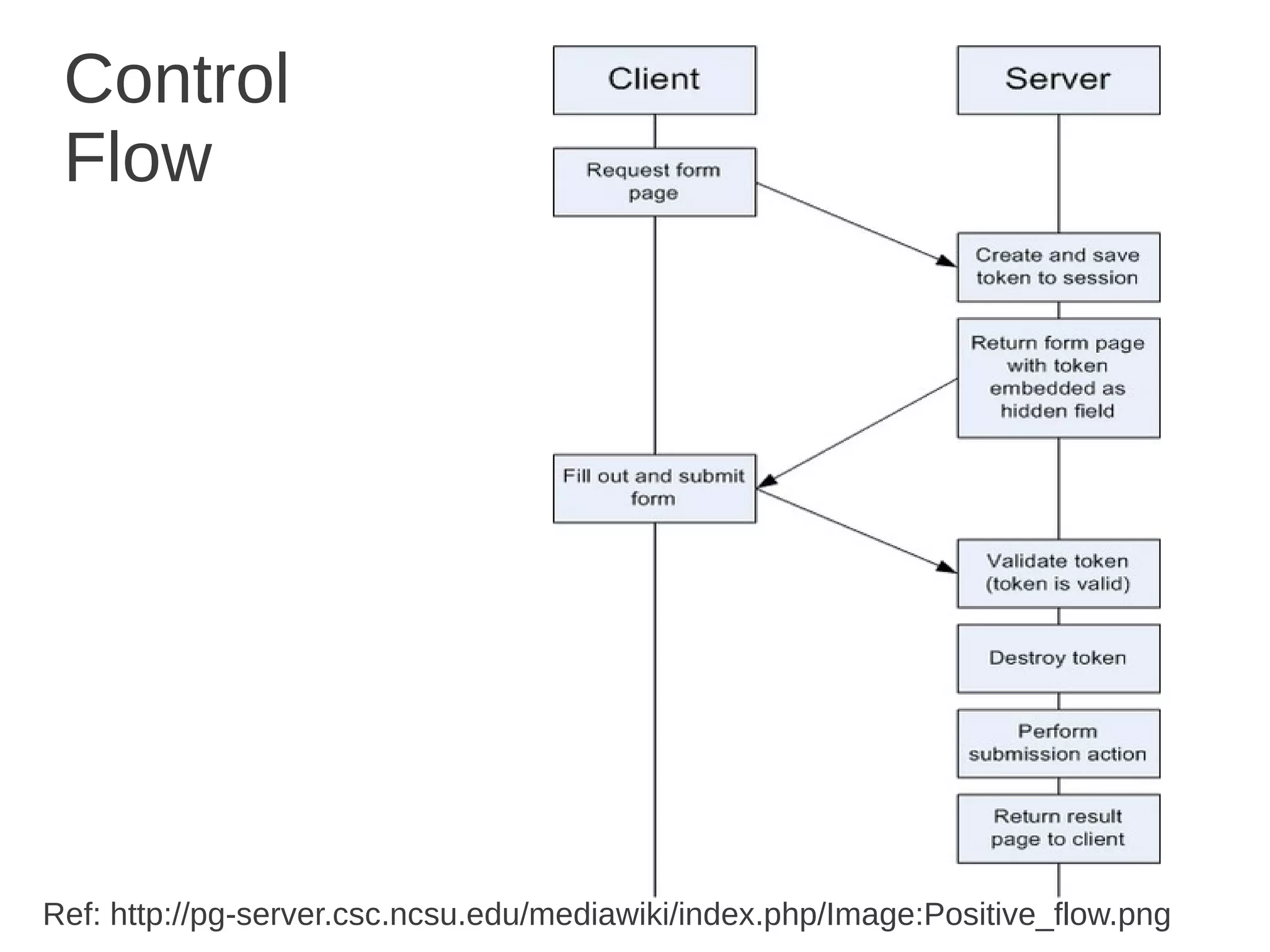
 Establish a token on the server side that indicates a valid
submission, and give a token signature to the client that
corresponds to that token (most likely in a hidden input field).
When the client submits their form, the server validates their token
and proceeds. It then marks the token as invalid so it may not be
used again. The result is that any given form may only be used
once and then will not work again.
Control
 Flow


Ref: http://pg-server.csc.ncsu.edu/mediawiki/index.php/Image:Positive_flow.png
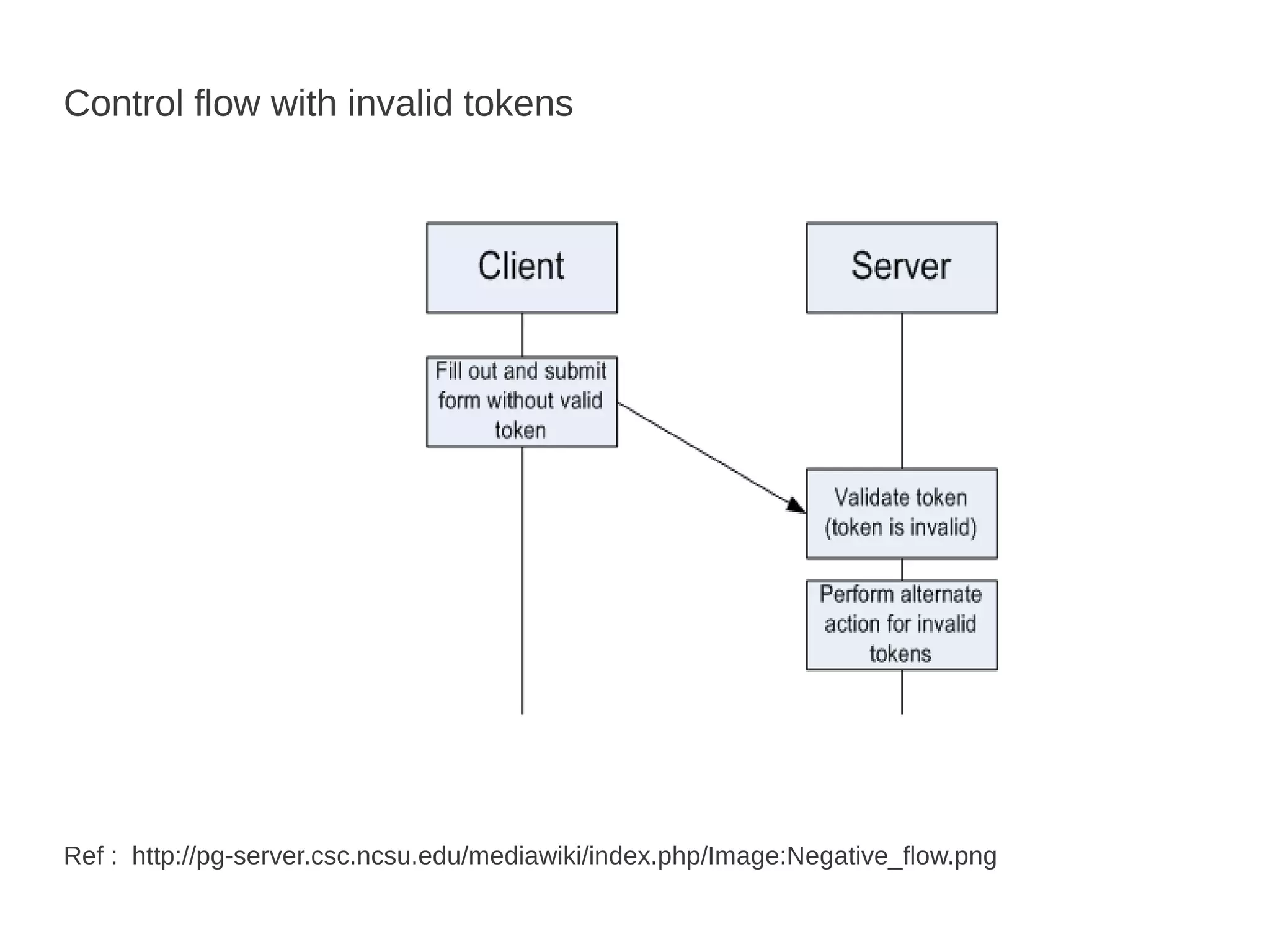
Control flow with invalid tokens


Ref : http://pg-server.csc.ncsu.edu/mediawiki/index.php/Image:Negative_flow.png
QUESTIONS ??
References:

●   https://www.owasp.org/index.php/Cross-Site_Request_Forgery_
    %28CSRF%29_Prevention_Cheat_Sheet
●   http://tournasdimitrios1.wordpress.com/2012/02/16/preventing-
    cross-site-request-forgeries-in-php/
●   http://pg-
    server.csc.ncsu.edu/mediawiki/index.php/CSC/ECE_517_Fall_2009
    /wiki2_3_b5
THANK YOU

CSRF Basics

  • 1.
    Csrf / XsrfBasics --by Jovin Lobo
  • 2.
    Definition : “CSRF /XSRF (Cross-Site Request Forgery) is a type of web application vulnerability that allows a malicious website to send unauthorized requests to a vulnerable website using active sessions of its authorized users.” --- Samvel Gevorgyan
  • 3.
    OWASP describes CSRFas .... CSRF is an attack that tricks the victim into loading a page that contains a malicious request. It is malicious in the sense that it inherits the identity and privileges of the victim to perform an undesired function on the victim's behalf like change the victim's e-mail address, home address, or password..etc So basically CSRF attacks target functions that cause a state change on the server but can also be used to access sensitive data.
  • 4.
  • 5.
  • 6.
    Prevention techniques thatSUCK !!! ✗ Secret cookies ✗ Accepting only POST requests ✗ Multi-Step transactions
  • 7.
    Then how dowe prevent it ?? “Adding any 'unpredictable' parameter to the requests should solve the problem............... What Say ??”
  • 8.
    Some prevention techniquesthat DO NOT SUCK ... ✔ Challenge-Response : ➢ Re- Authentication. ➢ Implement CAPTCHAS. ✔ Synchronizer Token Pattern
  • 9.
    Synchronizer Token Pattern Itsa Server-Side Solution. Concept: Establish a token on the server side that indicates a valid submission, and give a token signature to the client that corresponds to that token (most likely in a hidden input field). When the client submits their form, the server validates their token and proceeds. It then marks the token as invalid so it may not be used again. The result is that any given form may only be used once and then will not work again.
  • 10.
  • 11.
    Control flow withinvalid tokens Ref : http://pg-server.csc.ncsu.edu/mediawiki/index.php/Image:Negative_flow.png
  • 12.
  • 13.
    References: ● https://www.owasp.org/index.php/Cross-Site_Request_Forgery_ %28CSRF%29_Prevention_Cheat_Sheet ● http://tournasdimitrios1.wordpress.com/2012/02/16/preventing- cross-site-request-forgeries-in-php/ ● http://pg- server.csc.ncsu.edu/mediawiki/index.php/CSC/ECE_517_Fall_2009 /wiki2_3_b5
  • 14.