Spark on YARN
● Shashank L
● Big data consultant and trainer at
datamantra.io
● shashankgowda.me@gmail.com
Agenda
● YARN - Introduction
● Need for YARN
● OS Analogy
● Why run Spark on YARN
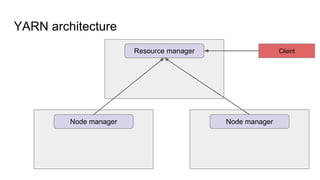
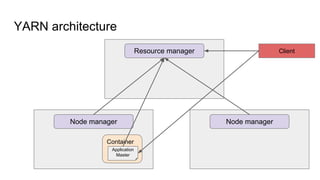
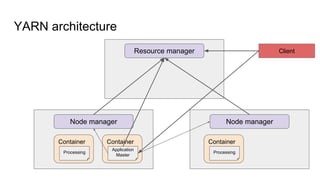
● YARN Architecture
● Modes of Spark on YARN
● Internals of Spark on YARN
● Recent developments
● Road ahead
● Hands-on
YARN
● Yet another resource negotiator.
● a general-purpose, distributed, application management
framework.
Need for YARN
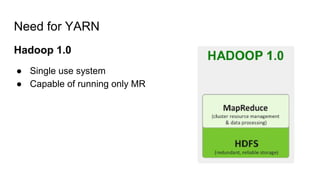
Hadoop 1.0
● Single use system
● Capable of running only MR
Need for YARN
● Scalability
○ 2009 – 8 cores, 16GB of RAM, 4x1TB disk
○ 2012 – 16+ cores, 48-96GB of RAM, 12x2TB or 12x3TB of disk.
● Cluster utilization
○ distinct map slots and reduce slots
● Supporting workloads other than MapReduce
○ MapReduce is great for many applications, but not everything.
Need for YARN
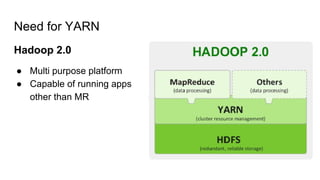
Hadoop 2.0
● Multi purpose platform
● Capable of running apps
other than MR
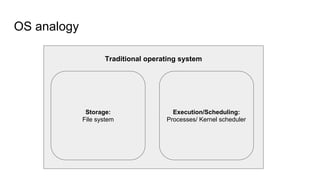
OS analogy
Traditional operating system
Storage:
File system
Execution/Scheduling:
Processes/ Kernel scheduler
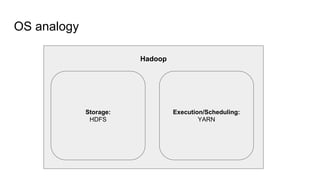
OS analogy
Hadoop
Storage:
HDFS
Execution/Scheduling:
YARN
Why run Spark on YARN
● Leverage existing clusters
● Data locality
● Dynamically sharing the cluster resources between different frameworks.
● YARN schedulers can be used for categorizing, isolating, and prioritizing
workloads.
● Only cluster manager for Spark that supports security
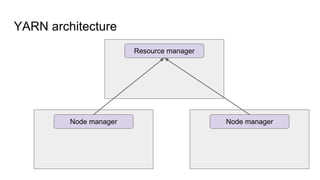
YARN architecture
Resource manager
Node manager Node manager
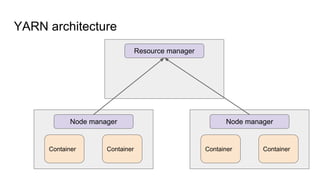
YARN architecture
Resource manager
Node manager Node manager
Container Container Container Container
YARN architecture
Resource manager
Node manager Node manager
Client
YARN architecture
Resource manager
Node manager Node manager
Container
Application
Master
Client
YARN architecture
Resource manager
Node manager Node manager
Container
Application
Master
Client
Container
Processing
Container
Processing
Running Spark on YARN
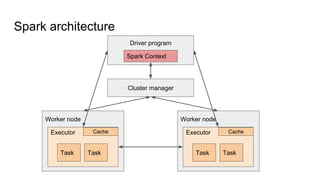
Spark architecture
Driver program
Spark Context
Cluster manager
Worker node
Executor Cache
Task Task
Worker node
Executor Cache
Task Task
Spark architecture
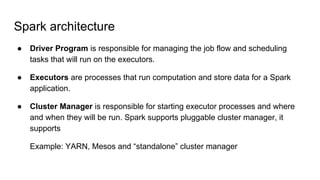
● Driver Program is responsible for managing the job flow and scheduling
tasks that will run on the executors.
● Executors are processes that run computation and store data for a Spark
application.
● Cluster Manager is responsible for starting executor processes and where
and when they will be run. Spark supports pluggable cluster manager, it
supports
Example: YARN, Mesos and “standalone” cluster manager
Modes on Spark on YARN
● YARN-Client Mode
● YARN-Cluster Mode
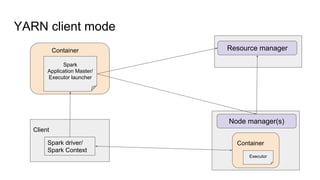
YARN client mode
Resource manager
Node manager(s)
Container
Spark
Application Master/
Executor launcher
Container
Executor
Client
Spark driver/
Spark Context
YARN client mode
● Driver runs in the client process, and the application master is only used for
requesting resources from YARN.
● Used for interactive and debugging uses where you want to see your
application’s output immediately (on the client process side).
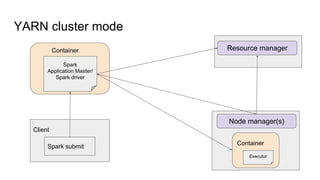
YARN cluster mode
Resource manager
Node manager(s)
Container
Spark
Application Master/
Spark driver
Container
Executor
Client
Spark submit
YARN cluster mode
● In yarn-cluster mode, the Spark driver runs inside an application master
process which is managed by YARN on the cluster, and the client can go
away after initiating the application.
● Yarn-cluster mode makes sense for production jobs.
Concurrency vs Parallelism
● Concurrency is about dealing with lots of things at once.
● Parallelism is about doing lots of things at once.
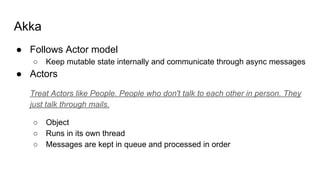
Akka
● Follows Actor model
○ Keep mutable state internally and communicate through async messages
● Actors
Treat Actors like People. People who don't talk to each other in person. They
just talk through mails.
○ Object
○ Runs in its own thread
○ Messages are kept in queue and processed in order
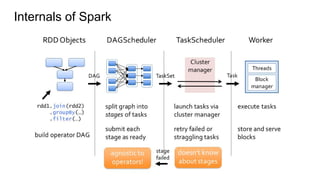
Internals of Spark
YARN Cluster
Internals of Spark on YARN
Container
Spark AM
Spark driver
(Spark Context)
ContainerContainer
Container
Executor
DAG
Scheduler
Task
Scheduler
Scheduler
backend
1
2
3
9
Client
5
8
4
6 7
1010
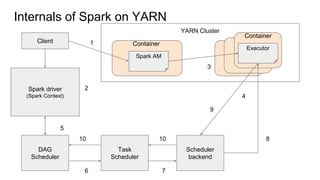
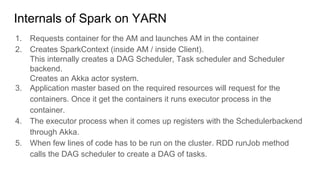
Internals of Spark on YARN
1. Requests container for the AM and launches AM in the container
2. Creates SparkContext (inside AM / inside Client).
This internally creates a DAG Scheduler, Task scheduler and Scheduler
backend.
Creates an Akka actor system.
3. Application master based on the required resources will request for the
containers. Once it get the containers it runs executor process in the
container.
4. The executor process when it comes up registers with the Schedulerbackend
through Akka.
5. When few lines of code has to be run on the cluster. RDD runJob method
calls the DAG scheduler to create a DAG of tasks.
Internals of Spark on YARN
6. Set of tasks which is capable of running in parallel is sent to the Task
Scheduler in the form of TaskSet.
7. Task scheduler in turn will contact the Schedulerbackend to run the tasks on
the executor.
8. Scheduler backend which keeps track of running executors and its statuses,
will schedule tasks on executors
9. Task output if any are sent through heartbeats to Schedulerbackend/
10. SchedulerBackend passes the task output onto the Task and DAG scheduler
which could make use of that output.
Recent developments
● Dynamic resource allocation
○ No need to specify number of executors
○ Application grows and shrinks based on outstanding task count
○ Need to specify other things
● Data locality
○ Allocate executors close to data
○ SPARK-4352
● Cached RDDs
○ Keep executors around
Road ahead
● Making dynamic allocation better
○ Reduce allocation latency
○ Handle cached RDDs
● Simplified allocation
● Encrypt shuffle files
● File distribution
○ Replace HTTP with RPC
Yarn Hands On
● Shashidhar E S
● Big data consultant and trainer at
datamantra.io
● shashidhar.e@gmail.com
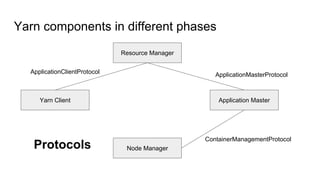
Yarn components in different phases
Resource Manager
Yarn Client Application Master
Node Manager
ApplicationClientProtocol ApplicationMasterProtocol
ContainerManagementProtocol
Protocols
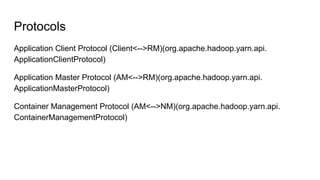
Protocols
Application Client Protocol (Client<-->RM)(org.apache.hadoop.yarn.api.
ApplicationClientProtocol)
Application Master Protocol (AM<-->RM)(org.apache.hadoop.yarn.api.
ApplicationMasterProtocol)
Container Management Protocol (AM<-->NM)(org.apache.hadoop.yarn.api.
ContainerManagementProtocol)
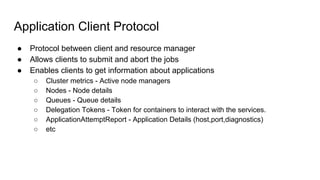
Application Client Protocol
● Protocol between client and resource manager
● Allows clients to submit and abort the jobs
● Enables clients to get information about applications
○ Cluster metrics - Active node managers
○ Nodes - Node details
○ Queues - Queue details
○ Delegation Tokens - Token for containers to interact with the services.
○ ApplicationAttemptReport - Application Details (host,port,diagnostics)
○ etc
Application Master Protocol
● Protocol between AM and RM
● Key functionalities
○ RegisterAM
○ FinishAM - Notify RM about completion
○ Allocate - RM responds with available/unused containers
Container Management Protocol
● Protocol between AM and NM
● Key functionalities
○ Start Containers
○ Stop Containers
○ Status of running containers - (NEW,RUNNING,COMPLETE)
Building Blocks of Communication
Records
Each component in YARN architecture communicates between each other by
forming records.Each request sent is a record
Ex: localResource requests,applicationContext, containerLaunchContext etc
Each response obtained is a record
Ex: applicationResponse, applicationMasterResponse, allocateResponse etc
Custom Yarn Application
Components
● Yarn Client
● Yarn Application Master
● Application
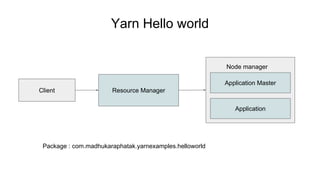
Yarn Hello world
Resource ManagerClient
Application
Application Master
Node manager
Package : com.madhukaraphatak.yarnexamples.helloworld
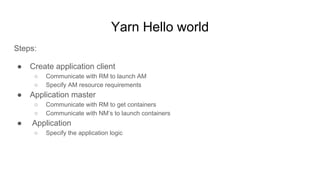
Yarn Hello world
Steps:
● Create application client
○ Communicate with RM to launch AM
○ Specify AM resource requirements
● Application master
○ Communicate with RM to get containers
○ Communicate with NM’s to launch containers
● Application
○ Specify the application logic
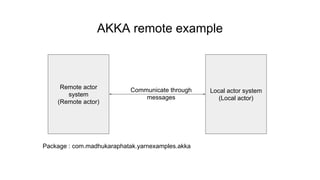
AKKA remote example
Remote actor
system
(Remote actor)
Local actor system
(Local actor)
Communicate through
messages
Package : com.madhukaraphatak.yarnexamples.akka
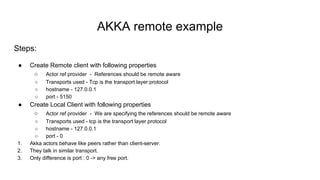
AKKA remote example
Steps:
● Create Remote client with following properties
○ Actor ref provider - References should be remote aware
○ Transports used - Tcp is the transport layer protocol
○ hostname - 127.0.0.1
○ port - 5150
● Create Local Client with following properties
○ Actor ref provider - We are specifying the references should be remote aware
○ Transports used - tcp is the transport layer protocol
○ hostname - 127.0.0.1
○ port - 0
1. Akka actors behave like peers rather than client-server.
2. They talk in similar transport.
3. Only difference is port : 0 -> any free port.
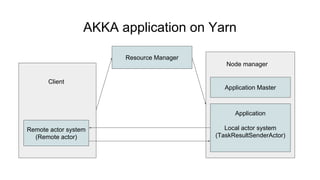
AKKA application on Yarn
Resource Manager
Application
Local actor system
(TaskResultSenderActor)
Application Master
Remote actor system
(Remote actor)
Client
Node manager
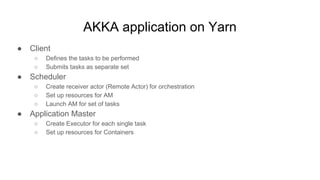
AKKA application on Yarn
● Client
○ Defines the tasks to be performed
○ Submits tasks as separate set
● Scheduler
○ Create receiver actor (Remote Actor) for orchestration
○ Set up resources for AM
○ Launch AM for set of tasks
● Application Master
○ Create Executor for each single task
○ Set up resources for Containers
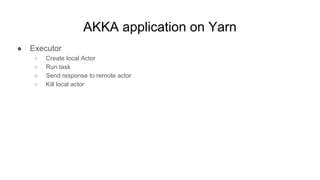
AKKA application on Yarn
● Executor
○ Create local Actor
○ Run task
○ Send response to remote actor
○ Kill local actor

Spark on yarn

  • 1.
  • 2.
    ● Shashank L ●Big data consultant and trainer at datamantra.io ● shashankgowda.me@gmail.com
  • 3.
    Agenda ● YARN -Introduction ● Need for YARN ● OS Analogy ● Why run Spark on YARN ● YARN Architecture ● Modes of Spark on YARN ● Internals of Spark on YARN ● Recent developments ● Road ahead ● Hands-on
  • 4.
    YARN ● Yet anotherresource negotiator. ● a general-purpose, distributed, application management framework.
  • 5.
    Need for YARN Hadoop1.0 ● Single use system ● Capable of running only MR
  • 6.
    Need for YARN ●Scalability ○ 2009 – 8 cores, 16GB of RAM, 4x1TB disk ○ 2012 – 16+ cores, 48-96GB of RAM, 12x2TB or 12x3TB of disk. ● Cluster utilization ○ distinct map slots and reduce slots ● Supporting workloads other than MapReduce ○ MapReduce is great for many applications, but not everything.
  • 7.
    Need for YARN Hadoop2.0 ● Multi purpose platform ● Capable of running apps other than MR
  • 8.
    OS analogy Traditional operatingsystem Storage: File system Execution/Scheduling: Processes/ Kernel scheduler
  • 9.
  • 10.
    Why run Sparkon YARN ● Leverage existing clusters ● Data locality ● Dynamically sharing the cluster resources between different frameworks. ● YARN schedulers can be used for categorizing, isolating, and prioritizing workloads. ● Only cluster manager for Spark that supports security
  • 11.
  • 12.
    YARN architecture Resource manager Nodemanager Node manager Container Container Container Container
  • 13.
    YARN architecture Resource manager Nodemanager Node manager Client
  • 14.
    YARN architecture Resource manager Nodemanager Node manager Container Application Master Client
  • 15.
    YARN architecture Resource manager Nodemanager Node manager Container Application Master Client Container Processing Container Processing
  • 16.
  • 17.
    Spark architecture Driver program SparkContext Cluster manager Worker node Executor Cache Task Task Worker node Executor Cache Task Task
  • 18.
    Spark architecture ● DriverProgram is responsible for managing the job flow and scheduling tasks that will run on the executors. ● Executors are processes that run computation and store data for a Spark application. ● Cluster Manager is responsible for starting executor processes and where and when they will be run. Spark supports pluggable cluster manager, it supports Example: YARN, Mesos and “standalone” cluster manager
  • 19.
    Modes on Sparkon YARN ● YARN-Client Mode ● YARN-Cluster Mode
  • 20.
    YARN client mode Resourcemanager Node manager(s) Container Spark Application Master/ Executor launcher Container Executor Client Spark driver/ Spark Context
  • 21.
    YARN client mode ●Driver runs in the client process, and the application master is only used for requesting resources from YARN. ● Used for interactive and debugging uses where you want to see your application’s output immediately (on the client process side).
  • 22.
    YARN cluster mode Resourcemanager Node manager(s) Container Spark Application Master/ Spark driver Container Executor Client Spark submit
  • 23.
    YARN cluster mode ●In yarn-cluster mode, the Spark driver runs inside an application master process which is managed by YARN on the cluster, and the client can go away after initiating the application. ● Yarn-cluster mode makes sense for production jobs.
  • 24.
    Concurrency vs Parallelism ●Concurrency is about dealing with lots of things at once. ● Parallelism is about doing lots of things at once.
  • 25.
    Akka ● Follows Actormodel ○ Keep mutable state internally and communicate through async messages ● Actors Treat Actors like People. People who don't talk to each other in person. They just talk through mails. ○ Object ○ Runs in its own thread ○ Messages are kept in queue and processed in order
  • 26.
  • 27.
    YARN Cluster Internals ofSpark on YARN Container Spark AM Spark driver (Spark Context) ContainerContainer Container Executor DAG Scheduler Task Scheduler Scheduler backend 1 2 3 9 Client 5 8 4 6 7 1010
  • 28.
    Internals of Sparkon YARN 1. Requests container for the AM and launches AM in the container 2. Creates SparkContext (inside AM / inside Client). This internally creates a DAG Scheduler, Task scheduler and Scheduler backend. Creates an Akka actor system. 3. Application master based on the required resources will request for the containers. Once it get the containers it runs executor process in the container. 4. The executor process when it comes up registers with the Schedulerbackend through Akka. 5. When few lines of code has to be run on the cluster. RDD runJob method calls the DAG scheduler to create a DAG of tasks.
  • 29.
    Internals of Sparkon YARN 6. Set of tasks which is capable of running in parallel is sent to the Task Scheduler in the form of TaskSet. 7. Task scheduler in turn will contact the Schedulerbackend to run the tasks on the executor. 8. Scheduler backend which keeps track of running executors and its statuses, will schedule tasks on executors 9. Task output if any are sent through heartbeats to Schedulerbackend/ 10. SchedulerBackend passes the task output onto the Task and DAG scheduler which could make use of that output.
  • 30.
    Recent developments ● Dynamicresource allocation ○ No need to specify number of executors ○ Application grows and shrinks based on outstanding task count ○ Need to specify other things ● Data locality ○ Allocate executors close to data ○ SPARK-4352 ● Cached RDDs ○ Keep executors around
  • 31.
    Road ahead ● Makingdynamic allocation better ○ Reduce allocation latency ○ Handle cached RDDs ● Simplified allocation ● Encrypt shuffle files ● File distribution ○ Replace HTTP with RPC
  • 32.
  • 33.
    ● Shashidhar ES ● Big data consultant and trainer at datamantra.io ● shashidhar.e@gmail.com
  • 34.
    Yarn components indifferent phases Resource Manager Yarn Client Application Master Node Manager ApplicationClientProtocol ApplicationMasterProtocol ContainerManagementProtocol Protocols
  • 35.
    Protocols Application Client Protocol(Client<-->RM)(org.apache.hadoop.yarn.api. ApplicationClientProtocol) Application Master Protocol (AM<-->RM)(org.apache.hadoop.yarn.api. ApplicationMasterProtocol) Container Management Protocol (AM<-->NM)(org.apache.hadoop.yarn.api. ContainerManagementProtocol)
  • 36.
    Application Client Protocol ●Protocol between client and resource manager ● Allows clients to submit and abort the jobs ● Enables clients to get information about applications ○ Cluster metrics - Active node managers ○ Nodes - Node details ○ Queues - Queue details ○ Delegation Tokens - Token for containers to interact with the services. ○ ApplicationAttemptReport - Application Details (host,port,diagnostics) ○ etc
  • 37.
    Application Master Protocol ●Protocol between AM and RM ● Key functionalities ○ RegisterAM ○ FinishAM - Notify RM about completion ○ Allocate - RM responds with available/unused containers
  • 38.
    Container Management Protocol ●Protocol between AM and NM ● Key functionalities ○ Start Containers ○ Stop Containers ○ Status of running containers - (NEW,RUNNING,COMPLETE)
  • 39.
    Building Blocks ofCommunication Records Each component in YARN architecture communicates between each other by forming records.Each request sent is a record Ex: localResource requests,applicationContext, containerLaunchContext etc Each response obtained is a record Ex: applicationResponse, applicationMasterResponse, allocateResponse etc
  • 40.
    Custom Yarn Application Components ●Yarn Client ● Yarn Application Master ● Application
  • 41.
    Yarn Hello world ResourceManagerClient Application Application Master Node manager Package : com.madhukaraphatak.yarnexamples.helloworld
  • 42.
    Yarn Hello world Steps: ●Create application client ○ Communicate with RM to launch AM ○ Specify AM resource requirements ● Application master ○ Communicate with RM to get containers ○ Communicate with NM’s to launch containers ● Application ○ Specify the application logic
  • 43.
    AKKA remote example Remoteactor system (Remote actor) Local actor system (Local actor) Communicate through messages Package : com.madhukaraphatak.yarnexamples.akka
  • 44.
    AKKA remote example Steps: ●Create Remote client with following properties ○ Actor ref provider - References should be remote aware ○ Transports used - Tcp is the transport layer protocol ○ hostname - 127.0.0.1 ○ port - 5150 ● Create Local Client with following properties ○ Actor ref provider - We are specifying the references should be remote aware ○ Transports used - tcp is the transport layer protocol ○ hostname - 127.0.0.1 ○ port - 0 1. Akka actors behave like peers rather than client-server. 2. They talk in similar transport. 3. Only difference is port : 0 -> any free port.
  • 45.
    AKKA application onYarn Resource Manager Application Local actor system (TaskResultSenderActor) Application Master Remote actor system (Remote actor) Client Node manager
  • 46.
    AKKA application onYarn ● Client ○ Defines the tasks to be performed ○ Submits tasks as separate set ● Scheduler ○ Create receiver actor (Remote Actor) for orchestration ○ Set up resources for AM ○ Launch AM for set of tasks ● Application Master ○ Create Executor for each single task ○ Set up resources for Containers
  • 47.
    AKKA application onYarn ● Executor ○ Create local Actor ○ Run task ○ Send response to remote actor ○ Kill local actor