GOOD MORNING
PROTOTYPE MODEL

P RESENETED B Y
D ANISH M USTHAFA
WHAT IS PROTOYPE?
• Prototype is the process of quickly putting together a
working model (a prototype) in order to test various
aspects of a design,

• A Prototype is an early sample or model built to test a
concept or process or to act as a thing to be replicated or
learned from.
• . A prototype is a model or a program which is not based
on strict planning, but is an early approximation of the
final product or software system
•Hardware acquisition
•Software acquisition
•User preparation
•Personal: hiring and training
•Site preparation
•Data preparation
•Installation
•Testing
•Start up
•User acceptance
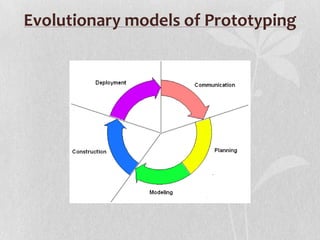
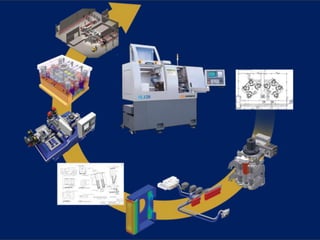
Evolutionary models of Prototyping
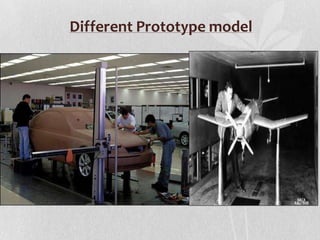
Different Prototype model
Need of prototype model
• A prototype is made. Completely built sample model is shown to user
and based on his feedback
.
• Prototypes are an essential part of the design process: realizing a design
in a physical form. This is beneficial in proving whether a new product is
viable, in terms of its mechanical, electronic and ergonomic design.
Having a working prototype demonstrates the benefits of your idea to
industry, in a convincing way, to help inspire confidence in the idea.
Benefits Of Prototyping
• Misunderstandings between software users and
developers are exposed
• Missing services may be detected and confusing services
may be identified
• A working system is available early in the process

• The prototype may serve as a basis for deriving a system
specification
• The system can support user training and system testing
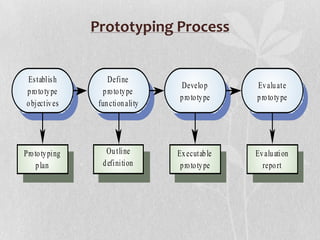
Prototyping Process
Es tablis h
p ro to ty pe
o bjectiv es

Define
p ro to ty pe
fun ction ality

Develo p
p ro to ty pe

Ev alu ate
p ro to ty pe

Pro to ty ping
p lan

Ou tline
d efinition

Ex ecutab le
p ro to ty pe

Ev alu ation
repo rt
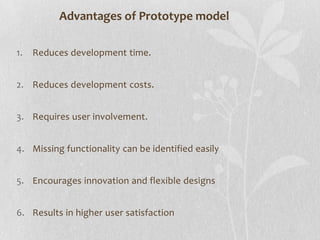
Advantages of Prototype model
1.

Reduces development time.

2. Reduces development costs.
3. Requires user involvement.
4. Missing functionality can be identified easily
5. Encourages innovation and flexible designs
6. Results in higher user satisfaction
Disadvantage
• Insufficient analysis: The focus on a limited prototype can distract
developers from properly analyzing the complete project. This can
lead to overlooking better solutions, preparation of incomplete
specifications or the conversion of limited prototypes into poorly
engineered final projects that are hard to maintain.
• User confusion of prototype and finished system: Users can begin
to think that a prototype, intended to be thrown away, is actually a
final system that merely needs to be finished or polished. Users can
also become attached to features that were included in a prototype
for consideration and then removed from the specification for a
final system.
• Developer misunderstanding of user objectives:
• Expense of implementing prototyping:
• Excessive development time of the prototype
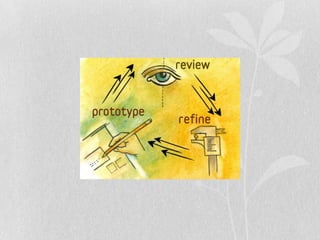
Prototype model  and process

Prototype model and process

  • 1.
  • 2.
    PROTOTYPE MODEL P RESENETEDB Y D ANISH M USTHAFA
  • 3.
    WHAT IS PROTOYPE? •Prototype is the process of quickly putting together a working model (a prototype) in order to test various aspects of a design, • A Prototype is an early sample or model built to test a concept or process or to act as a thing to be replicated or learned from. • . A prototype is a model or a program which is not based on strict planning, but is an early approximation of the final product or software system
  • 4.
    •Hardware acquisition •Software acquisition •Userpreparation •Personal: hiring and training •Site preparation •Data preparation •Installation •Testing •Start up •User acceptance
  • 5.
  • 6.
  • 8.
    Need of prototypemodel • A prototype is made. Completely built sample model is shown to user and based on his feedback . • Prototypes are an essential part of the design process: realizing a design in a physical form. This is beneficial in proving whether a new product is viable, in terms of its mechanical, electronic and ergonomic design. Having a working prototype demonstrates the benefits of your idea to industry, in a convincing way, to help inspire confidence in the idea.
  • 9.
    Benefits Of Prototyping •Misunderstandings between software users and developers are exposed • Missing services may be detected and confusing services may be identified • A working system is available early in the process • The prototype may serve as a basis for deriving a system specification • The system can support user training and system testing
  • 10.
    Prototyping Process Es tablish p ro to ty pe o bjectiv es Define p ro to ty pe fun ction ality Develo p p ro to ty pe Ev alu ate p ro to ty pe Pro to ty ping p lan Ou tline d efinition Ex ecutab le p ro to ty pe Ev alu ation repo rt
  • 11.
    Advantages of Prototypemodel 1. Reduces development time. 2. Reduces development costs. 3. Requires user involvement. 4. Missing functionality can be identified easily 5. Encourages innovation and flexible designs 6. Results in higher user satisfaction
  • 12.
    Disadvantage • Insufficient analysis:The focus on a limited prototype can distract developers from properly analyzing the complete project. This can lead to overlooking better solutions, preparation of incomplete specifications or the conversion of limited prototypes into poorly engineered final projects that are hard to maintain. • User confusion of prototype and finished system: Users can begin to think that a prototype, intended to be thrown away, is actually a final system that merely needs to be finished or polished. Users can also become attached to features that were included in a prototype for consideration and then removed from the specification for a final system.
  • 13.
    • Developer misunderstandingof user objectives: • Expense of implementing prototyping: • Excessive development time of the prototype